The Use of Computer  Simulations & Gaming  to Enhance Authentic Learning By Alan Zollner Teaching with Technology ED 5700-01 Mount Saint Mary College Fall 2008
Elluminate Poll Question: Have you used a computer simulation, or played a computer game, at any time in the past 5 years? (yes / no)
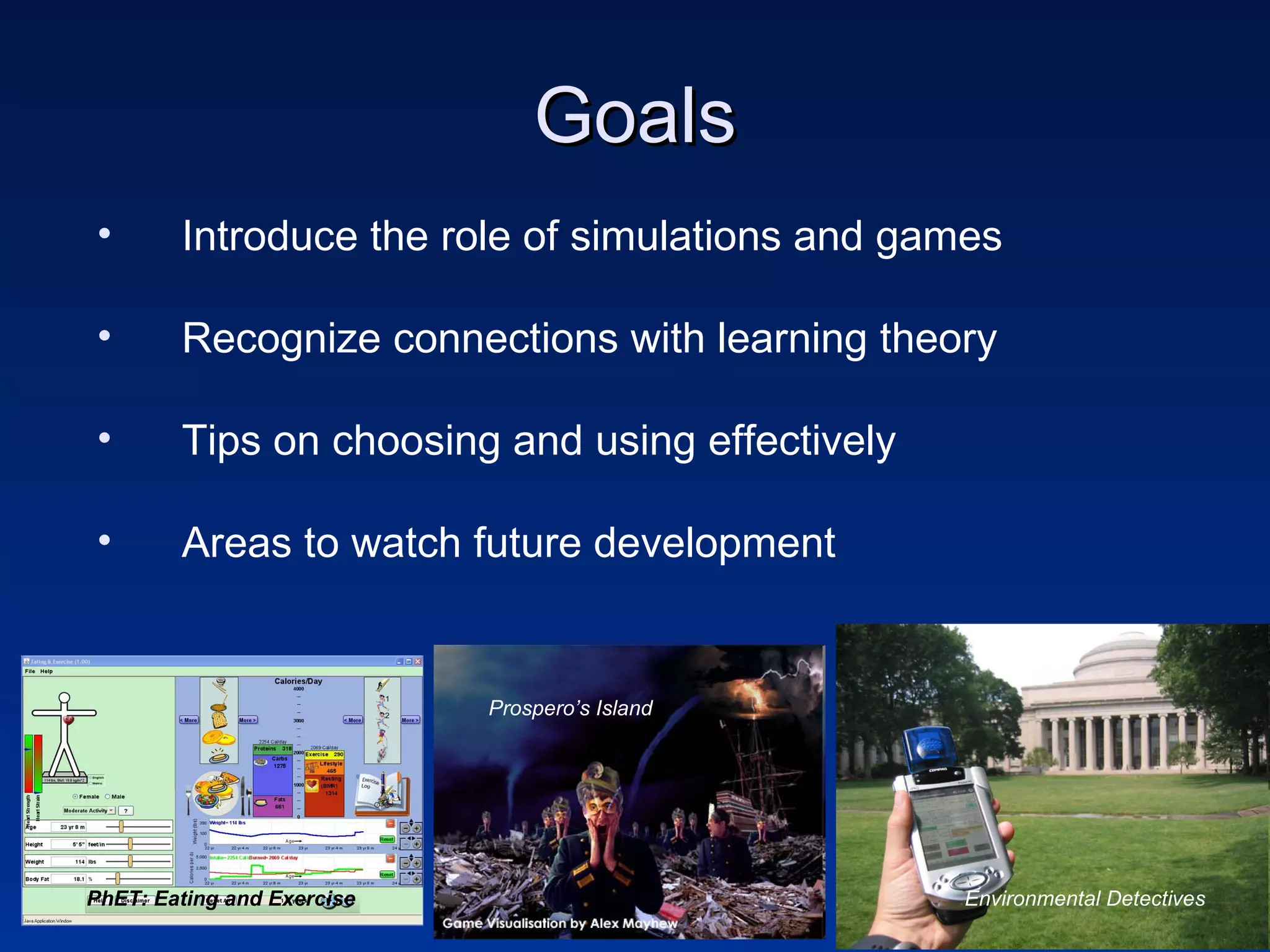
Goals Introduce the role of simulations and games Recognize connections with learning theory Tips on choosing and using effectively Areas to watch future development Environmental Detectives Prospero’s Island PhET: Eating and Exercise
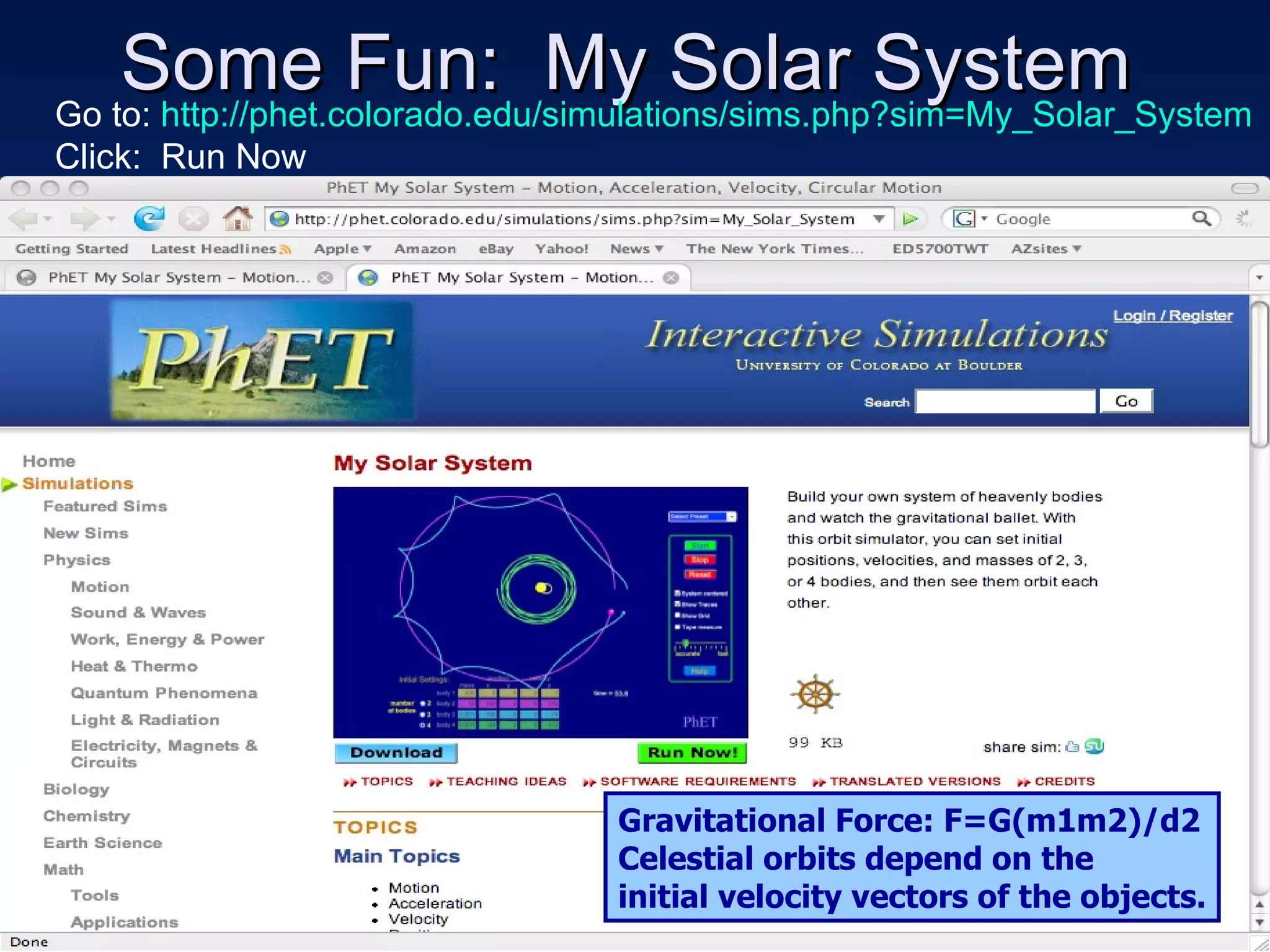
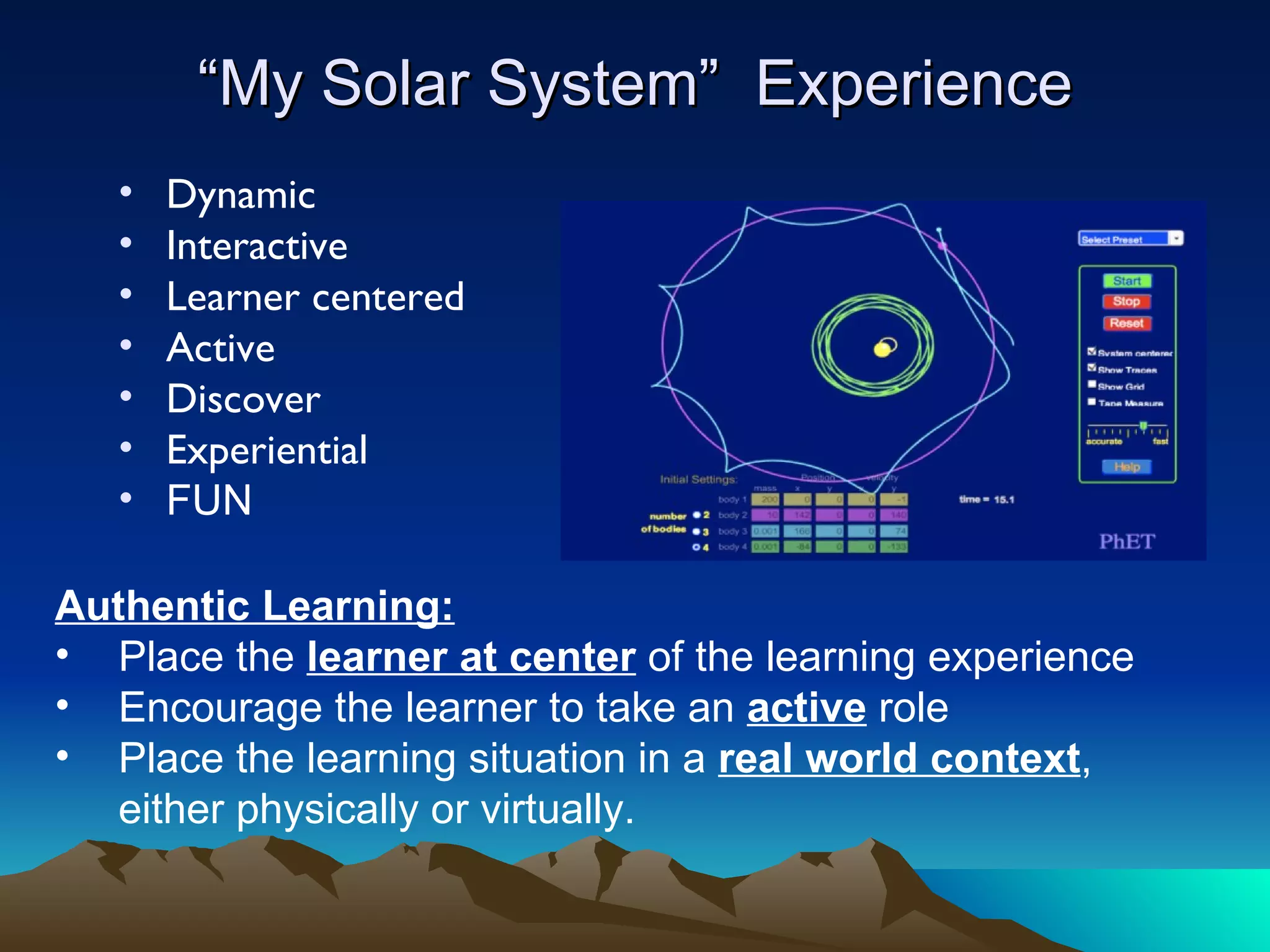
Some Fun:  My Solar System Go to:  http://phet.colorado.edu/simulations/sims.php?sim=My_Solar_System Click:  Run Now Gravitational Force: F=G(m1m2)/d2 Celestial orbits depend on the initial velocity vectors of the objects.
“ My Solar System”  Experience Dynamic Interactive Learner centered Active Discover Experiential FUN Authentic Learning: Place the  learner at center  of the learning experience Encourage the learner to take an  active  role Place the learning situation in a  real world context , either physically or virtually.
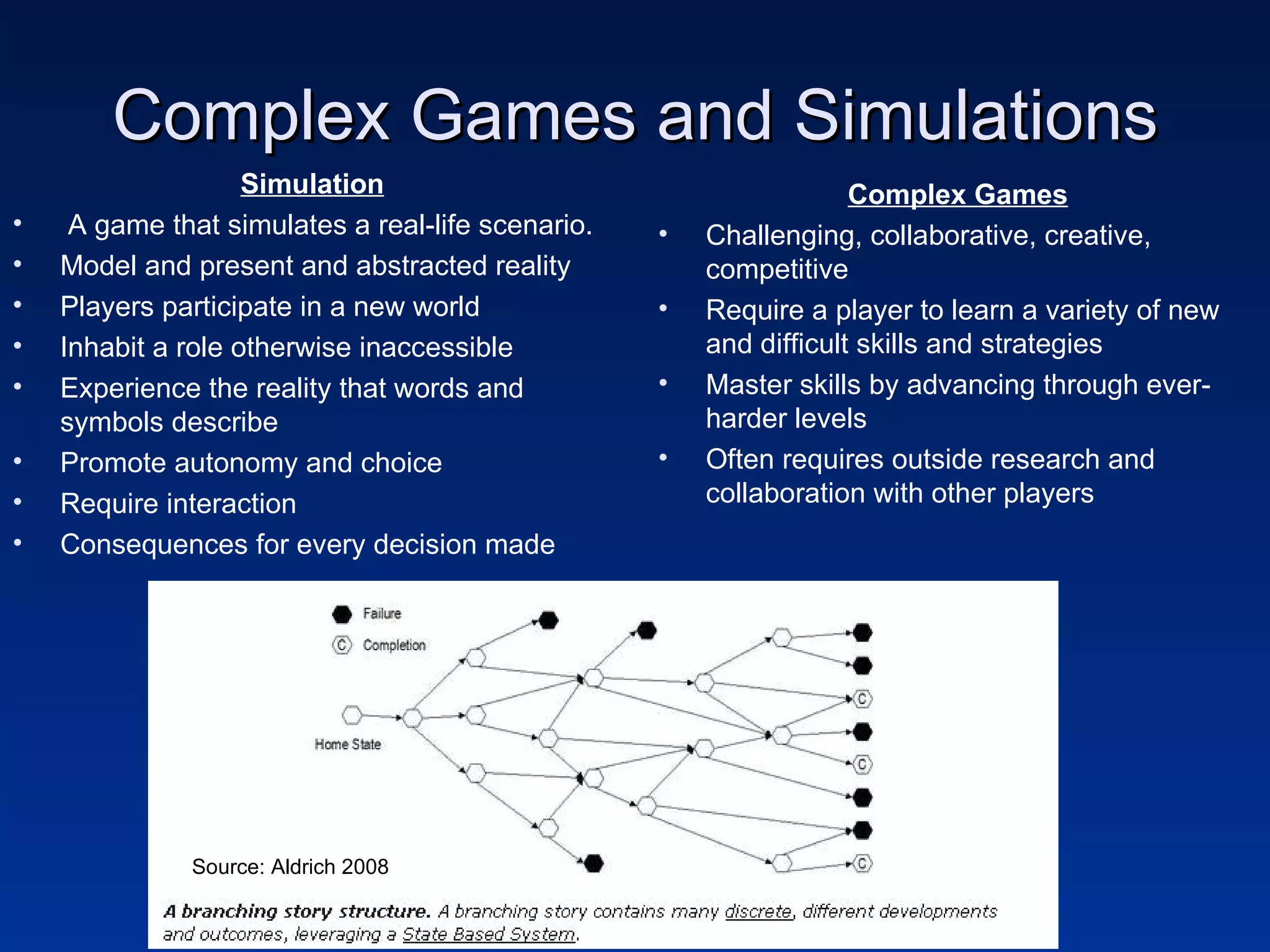
Complex Games and Simulations Simulation A game that simulates a real-life scenario.  Model and present and abstracted reality Players participate in a new world Inhabit a role otherwise inaccessible Experience the reality that words and symbols describe Promote autonomy and choice Require interaction Consequences for every decision made Complex Games Challenging, collaborative, creative, competitive Require a player to learn a variety of new and difficult skills and strategies Master skills by advancing through ever-harder levels Often requires outside research and collaboration with other players Source: Aldrich 2008
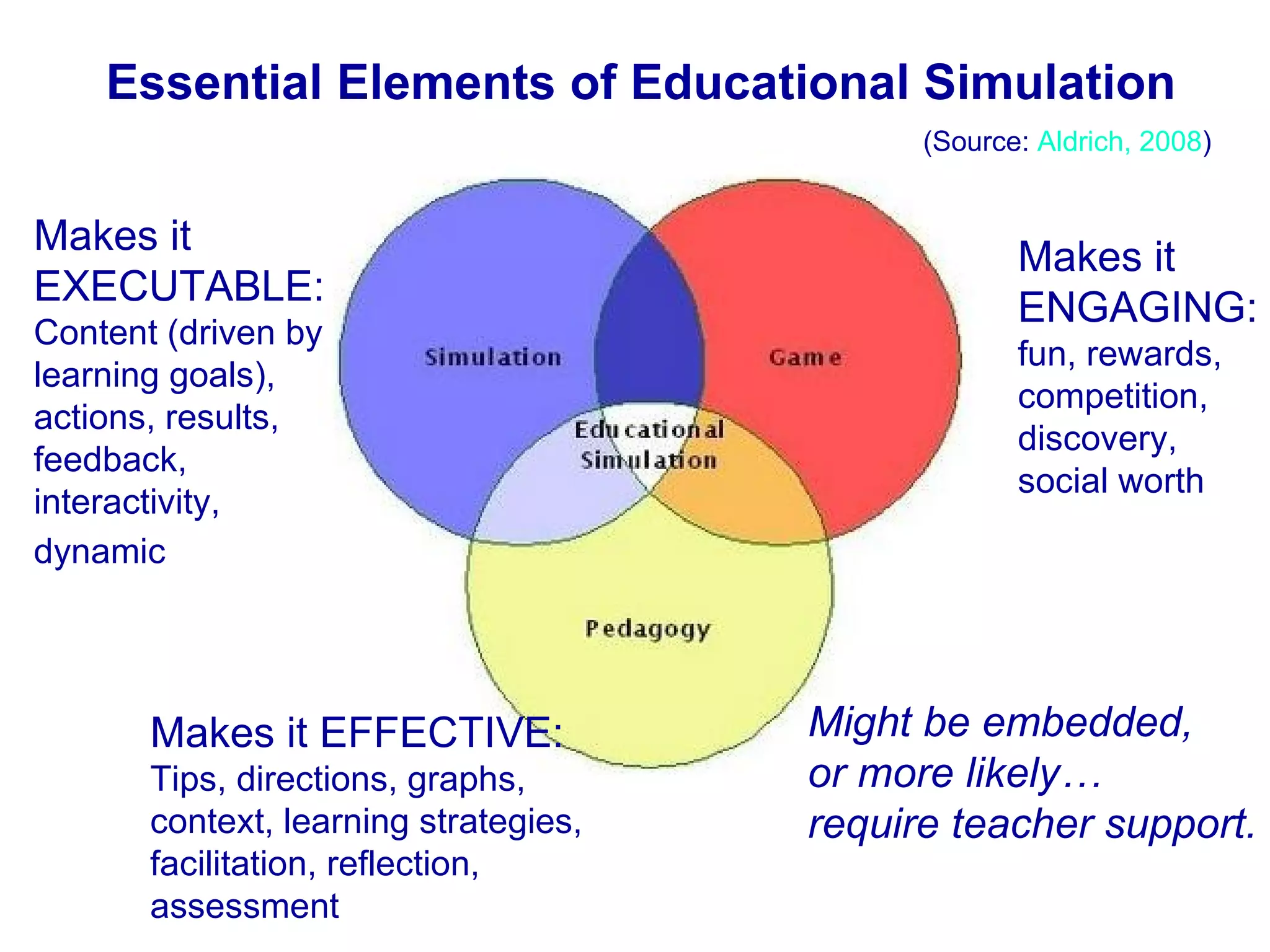
Essential Elements of Educational Simulation Makes it EFFECTIVE: Tips, directions, graphs, context, learning strategies, facilitation, reflection, assessment Makes it EXECUTABLE: Content (driven by learning goals), actions, results, feedback, interactivity, dynamic   Makes it ENGAGING: fun, rewards, competition, discovery, social worth Might be embedded,  or more likely…  require teacher support. (Source:  Aldrich, 2008 )
Alignment with Constructivism CONSTRUCTIVIST BELIEFS Not simplified problems Not basic skill drills Encounter complex learning environments Experiential Social interaction Negotiation Collaboration Multiple perspectives and representations Freedom to research, explore, and discover One’s own quest for knowledge is at the forefront of the learning experience. Cognitive conflict - puzzlement is the stimulus for learning. GAMES Complexity Learning by trial and error Scoring points Active Participation Exploring Experiential learning Problem based Contextual Constructive Learner centered Urgency Immediate feedback  Social status is based on investing and hard work Student owns his/her learning so it’s worth something MULTIPLAYER GAMES Collaborative Conversational
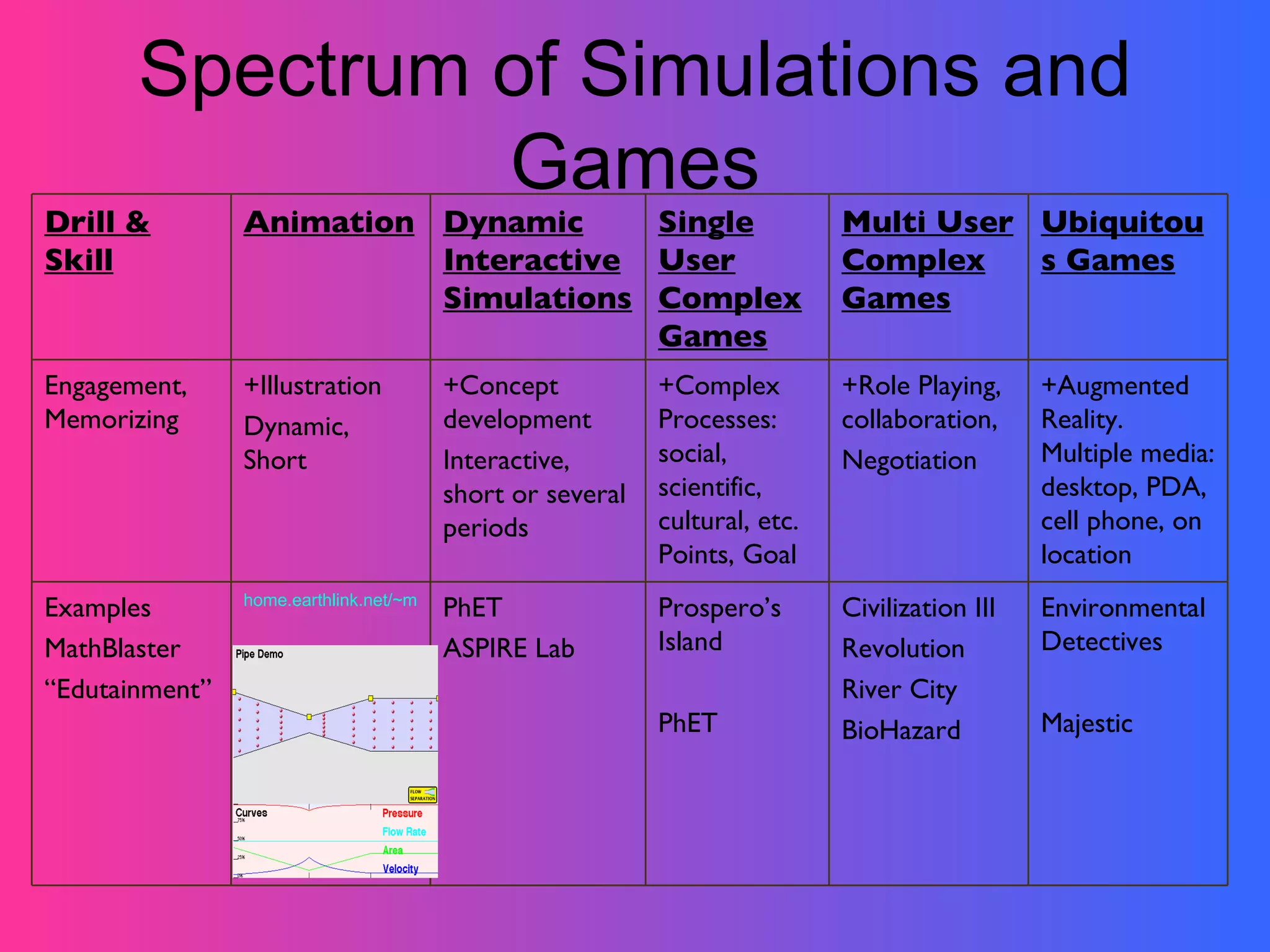
Spectrum of Simulations and Games Environmental Detectives Majestic Civilization III Revolution River City BioHazard Prospero’s Island PhET PhET ASPIRE Lab home.earthlink.net/~mmc1919/venturi.html Examples MathBlaster “ Edutainment” +Augmented Reality. Multiple media: desktop, PDA, cell phone, on location +Role Playing, collaboration,  Negotiation +Complex Processes: social, scientific, cultural, etc. Points, Goal +Concept development Interactive, short or several periods +Illustration Dynamic, Short Engagement, Memorizing Ubiquitous Games Multi User Complex Games Single User Complex Games Dynamic Interactive Simulations Animation Drill & Skill
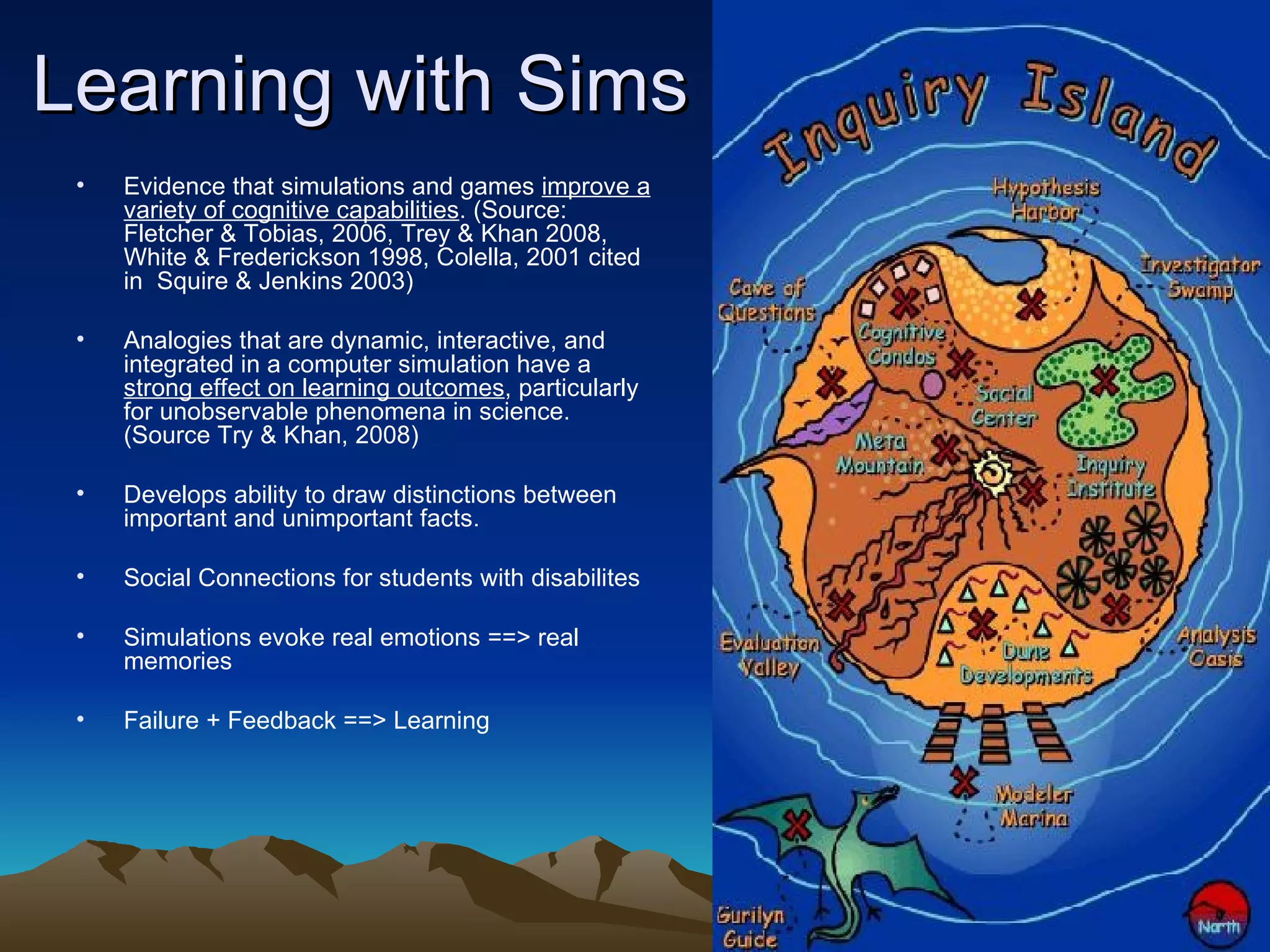
Learning with Sims Evidence that simulations and games  improve a variety of cognitive capabilities . (Source: Fletcher & Tobias, 2006, Trey & Khan 2008, White & Frederickson 1998, Colella, 2001 cited in  Squire & Jenkins 2003) Analogies that are dynamic, interactive, and integrated in a computer simulation have a  strong effect on learning outcomes , particularly for unobservable phenomena in science. (Source Try & Khan, 2008) Develops ability to draw distinctions between important and unimportant facts. Social Connections for students with disabilites Simulations evoke real emotions ==> real memories Failure + Feedback ==> Learning
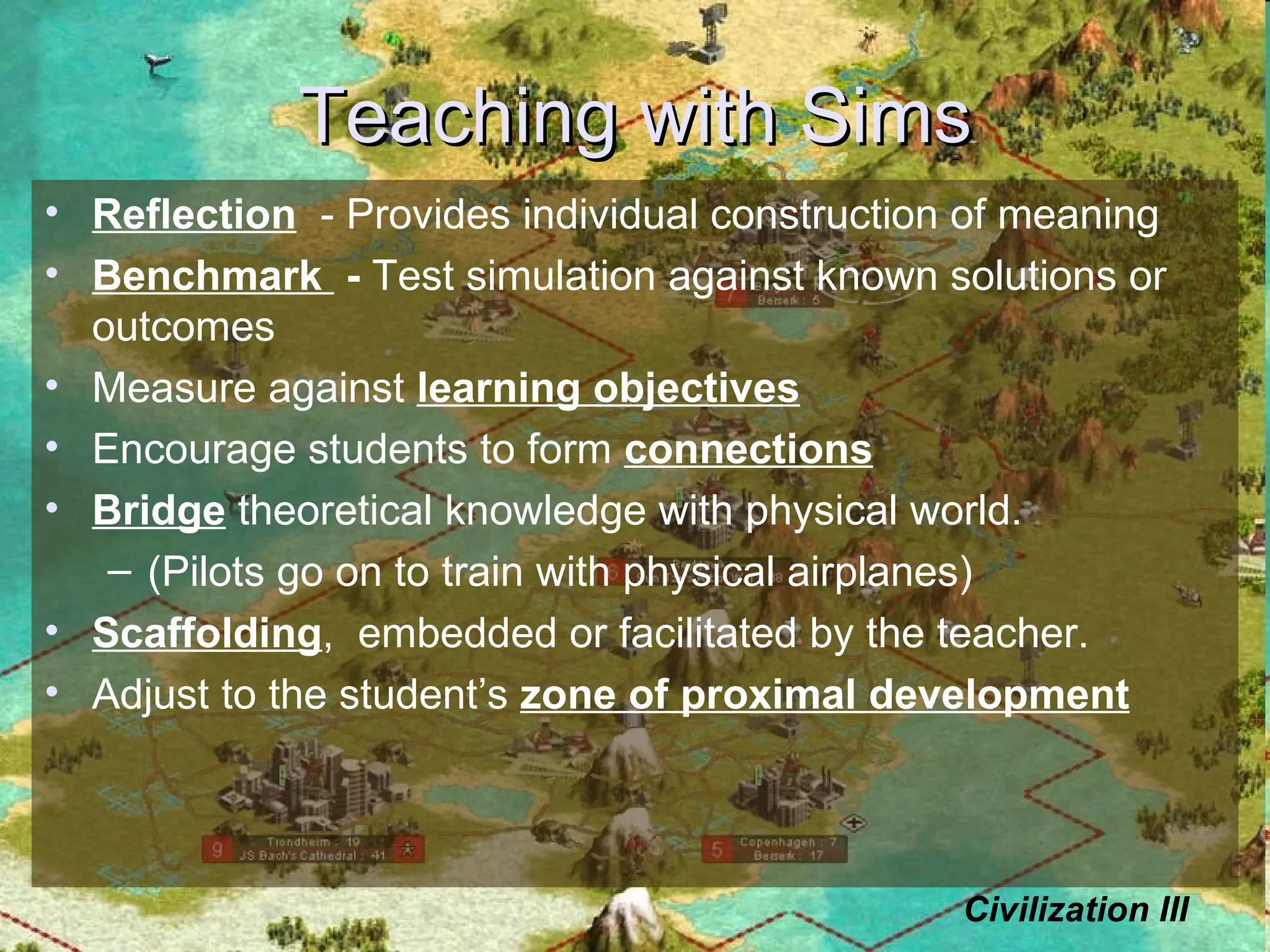
Teaching with Sims Reflection   - Provides individual construction of meaning Benchmark  -  Test simulation against known solutions or outcomes Measure against  learning objectives Encourage students to form  connections Bridge  theoretical knowledge with physical world.  (Pilots go on to train with physical airplanes) Scaffolding ,  embedded or facilitated by the teacher. Adjust to the student’s  zone of proximal development Civilization III
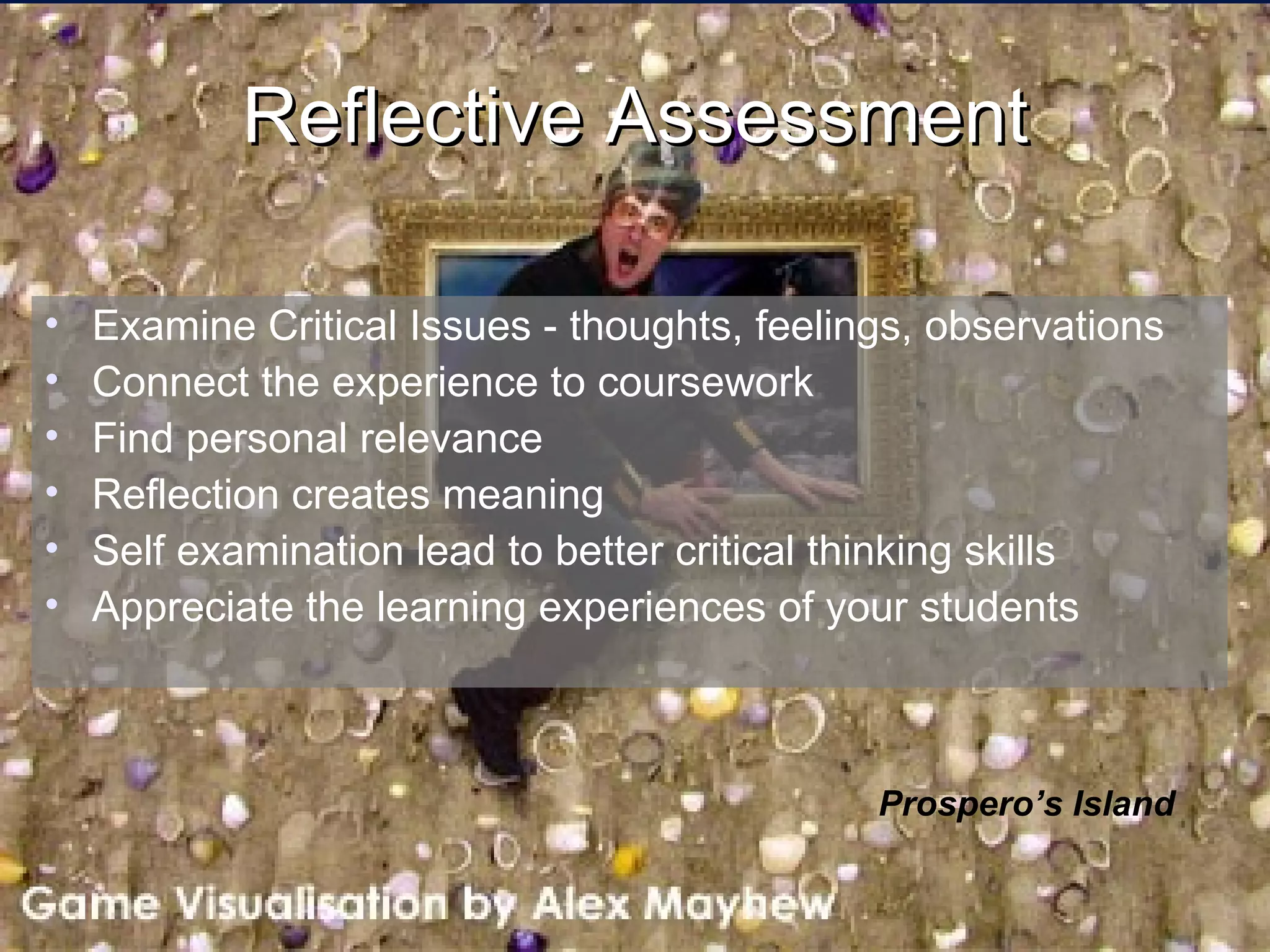
Reflective Assessment Examine Critical Issues - thoughts, feelings, observations Connect the experience to coursework Find personal relevance Reflection creates meaning Self examination lead to better critical thinking skills Appreciate the learning experiences of your students Prospero’s Island
Key Players Univ of Wisc – Madison Kurt Squire  James Paul Gee GAPPS (Games and Professional Practice Simulations) MIT Seymour Papert Henry Jenkins (Comparative Media Studies) The Education Arcade Harvard Christopher Dede George Mason University MUVEES (Multi-User Virtual Environment Experiential Simulator) UC-Berkley American Association of History and Computing Marc Prensky (Games2train, The Digital Multiplier) Clark Aldrich – Author, Simulation designer Serious Games Initiative Muzzy Lane (software developer) Digiplay Initiative "Breaking down the artificial barriers between what we learn and what we do, between business and academics, and between understanding history and controlling our future, simulation development will be a defining 21st century industry."   - Clark Aldrich
Quiz Time http://www.proprofs.com/quiz-school/story.php?title =simulations-gaming-in-authentic-learning
Homework Distributed Supercomputing: Donate the time your computer is turned on, but is idle, to computational simulation projects that benefit humanity! Research to Conquer Cancer,  Fight AIDS, Climate Prediction, and more. Please Visit: World Community Grid: http://www.worldcommunitygrid.org/ Boinc    http://boinc.berkeley.edu/ PS3Grid.net  http://www.ps3grid.net/
Sources Aldrich, C. (2008). Clark Aldrich's style guide for serious games and simulations [Electronic Version].  Notes from an Analyst and Sumulation Designer . Retrieved 11/24/2008 from  http://clarkaldrich.blogspot.com/search/label/Topic%20Heading .  Barbara Y. White, & Frederikson, J. R. (1998). Inquiry, modeling, and metacognition: making science accessible to all students.  Cognition and Instruction, 16 (1), 3-118. Dominguez, L. (2006). Reflective assessment [Electronic Version].  Teaching Central , 1. Retrieved 11/24/2008 from  http://www.facit.cmich.edu/teaching-central/issues/may06/reflective-assessment.htm . Fletcher, J. D., & Tobias, S. (2006).  Using computer games and simulations for instruction: A research review . Paper presented at the Society for Applied Learning Technology Meeting, New Learning Technologies. Retrieved 11/24/2008  http://digiplay.info/node/3151 Galarneau, L. (2005).  Authentic learning experiences through play: Games, simulations and the construction of knowledge.  Paper presented at the DiGRA 2005 Conference: Changing Views - Worlds in Play. Ibbitson, K. E. (2005). The use of complex digital games and simulations in the classroom to enhance engagement and learning. Irvine CA: An independent research paper. Prensky, M. (2001). Do they really think differently? [Electronic Version].  On the Horizon , 9. Retrieved 11/26/2008 from  http://www.marcprensky.com/writing/Prensky%20-%20Digital%20Natives,%20Digital%20Immigrants%20-%20Part2.pdf . Prensky, M. (2008). Are you lecturing about nouns or facilitating learning with verbs? [Electronic Version].  The Greentree Gazette . Retrieved 11/26/2008 from  http://www.greentreegazette.com/articles/load.aspx?art=985 . Squire, K., & Jenkins, H. (2003). Harnessing the power of games in education [Electronic Version].  IN>>SIGHT , 3, 5-33. Retrieved 11/24/2008. Trey, L., & Khan, S. (2008). How science students can learn about unobservable phenomena using computer-based analogies.  Computers & Education, 51 (2), 519-529.

The Use of Computer Simulations and Gaming to Enhance Authentic Learning

  • 1.
    The Use ofComputer Simulations & Gaming to Enhance Authentic Learning By Alan Zollner Teaching with Technology ED 5700-01 Mount Saint Mary College Fall 2008
  • 2.
    Elluminate Poll Question:Have you used a computer simulation, or played a computer game, at any time in the past 5 years? (yes / no)
  • 3.
    Goals Introduce therole of simulations and games Recognize connections with learning theory Tips on choosing and using effectively Areas to watch future development Environmental Detectives Prospero’s Island PhET: Eating and Exercise
  • 4.
    Some Fun: My Solar System Go to: http://phet.colorado.edu/simulations/sims.php?sim=My_Solar_System Click: Run Now Gravitational Force: F=G(m1m2)/d2 Celestial orbits depend on the initial velocity vectors of the objects.
  • 5.
    “ My SolarSystem” Experience Dynamic Interactive Learner centered Active Discover Experiential FUN Authentic Learning: Place the learner at center of the learning experience Encourage the learner to take an active role Place the learning situation in a real world context , either physically or virtually.
  • 6.
    Complex Games andSimulations Simulation A game that simulates a real-life scenario. Model and present and abstracted reality Players participate in a new world Inhabit a role otherwise inaccessible Experience the reality that words and symbols describe Promote autonomy and choice Require interaction Consequences for every decision made Complex Games Challenging, collaborative, creative, competitive Require a player to learn a variety of new and difficult skills and strategies Master skills by advancing through ever-harder levels Often requires outside research and collaboration with other players Source: Aldrich 2008
  • 7.
    Essential Elements ofEducational Simulation Makes it EFFECTIVE: Tips, directions, graphs, context, learning strategies, facilitation, reflection, assessment Makes it EXECUTABLE: Content (driven by learning goals), actions, results, feedback, interactivity, dynamic Makes it ENGAGING: fun, rewards, competition, discovery, social worth Might be embedded, or more likely… require teacher support. (Source: Aldrich, 2008 )
  • 8.
    Alignment with ConstructivismCONSTRUCTIVIST BELIEFS Not simplified problems Not basic skill drills Encounter complex learning environments Experiential Social interaction Negotiation Collaboration Multiple perspectives and representations Freedom to research, explore, and discover One’s own quest for knowledge is at the forefront of the learning experience. Cognitive conflict - puzzlement is the stimulus for learning. GAMES Complexity Learning by trial and error Scoring points Active Participation Exploring Experiential learning Problem based Contextual Constructive Learner centered Urgency Immediate feedback Social status is based on investing and hard work Student owns his/her learning so it’s worth something MULTIPLAYER GAMES Collaborative Conversational
  • 9.
    Spectrum of Simulationsand Games Environmental Detectives Majestic Civilization III Revolution River City BioHazard Prospero’s Island PhET PhET ASPIRE Lab home.earthlink.net/~mmc1919/venturi.html Examples MathBlaster “ Edutainment” +Augmented Reality. Multiple media: desktop, PDA, cell phone, on location +Role Playing, collaboration, Negotiation +Complex Processes: social, scientific, cultural, etc. Points, Goal +Concept development Interactive, short or several periods +Illustration Dynamic, Short Engagement, Memorizing Ubiquitous Games Multi User Complex Games Single User Complex Games Dynamic Interactive Simulations Animation Drill & Skill
  • 10.
    Learning with SimsEvidence that simulations and games improve a variety of cognitive capabilities . (Source: Fletcher & Tobias, 2006, Trey & Khan 2008, White & Frederickson 1998, Colella, 2001 cited in Squire & Jenkins 2003) Analogies that are dynamic, interactive, and integrated in a computer simulation have a strong effect on learning outcomes , particularly for unobservable phenomena in science. (Source Try & Khan, 2008) Develops ability to draw distinctions between important and unimportant facts. Social Connections for students with disabilites Simulations evoke real emotions ==> real memories Failure + Feedback ==> Learning
  • 11.
    Teaching with SimsReflection - Provides individual construction of meaning Benchmark - Test simulation against known solutions or outcomes Measure against learning objectives Encourage students to form connections Bridge theoretical knowledge with physical world. (Pilots go on to train with physical airplanes) Scaffolding , embedded or facilitated by the teacher. Adjust to the student’s zone of proximal development Civilization III
  • 12.
    Reflective Assessment ExamineCritical Issues - thoughts, feelings, observations Connect the experience to coursework Find personal relevance Reflection creates meaning Self examination lead to better critical thinking skills Appreciate the learning experiences of your students Prospero’s Island
  • 13.
    Key Players Univof Wisc – Madison Kurt Squire James Paul Gee GAPPS (Games and Professional Practice Simulations) MIT Seymour Papert Henry Jenkins (Comparative Media Studies) The Education Arcade Harvard Christopher Dede George Mason University MUVEES (Multi-User Virtual Environment Experiential Simulator) UC-Berkley American Association of History and Computing Marc Prensky (Games2train, The Digital Multiplier) Clark Aldrich – Author, Simulation designer Serious Games Initiative Muzzy Lane (software developer) Digiplay Initiative "Breaking down the artificial barriers between what we learn and what we do, between business and academics, and between understanding history and controlling our future, simulation development will be a defining 21st century industry." - Clark Aldrich
  • 14.
    Quiz Time http://www.proprofs.com/quiz-school/story.php?title=simulations-gaming-in-authentic-learning
  • 15.
    Homework Distributed Supercomputing:Donate the time your computer is turned on, but is idle, to computational simulation projects that benefit humanity! Research to Conquer Cancer, Fight AIDS, Climate Prediction, and more. Please Visit: World Community Grid: http://www.worldcommunitygrid.org/ Boinc http://boinc.berkeley.edu/ PS3Grid.net http://www.ps3grid.net/
  • 16.
    Sources Aldrich, C.(2008). Clark Aldrich's style guide for serious games and simulations [Electronic Version]. Notes from an Analyst and Sumulation Designer . Retrieved 11/24/2008 from http://clarkaldrich.blogspot.com/search/label/Topic%20Heading . Barbara Y. White, & Frederikson, J. R. (1998). Inquiry, modeling, and metacognition: making science accessible to all students. Cognition and Instruction, 16 (1), 3-118. Dominguez, L. (2006). Reflective assessment [Electronic Version]. Teaching Central , 1. Retrieved 11/24/2008 from http://www.facit.cmich.edu/teaching-central/issues/may06/reflective-assessment.htm . Fletcher, J. D., & Tobias, S. (2006). Using computer games and simulations for instruction: A research review . Paper presented at the Society for Applied Learning Technology Meeting, New Learning Technologies. Retrieved 11/24/2008 http://digiplay.info/node/3151 Galarneau, L. (2005). Authentic learning experiences through play: Games, simulations and the construction of knowledge. Paper presented at the DiGRA 2005 Conference: Changing Views - Worlds in Play. Ibbitson, K. E. (2005). The use of complex digital games and simulations in the classroom to enhance engagement and learning. Irvine CA: An independent research paper. Prensky, M. (2001). Do they really think differently? [Electronic Version]. On the Horizon , 9. Retrieved 11/26/2008 from http://www.marcprensky.com/writing/Prensky%20-%20Digital%20Natives,%20Digital%20Immigrants%20-%20Part2.pdf . Prensky, M. (2008). Are you lecturing about nouns or facilitating learning with verbs? [Electronic Version]. The Greentree Gazette . Retrieved 11/26/2008 from http://www.greentreegazette.com/articles/load.aspx?art=985 . Squire, K., & Jenkins, H. (2003). Harnessing the power of games in education [Electronic Version]. IN>>SIGHT , 3, 5-33. Retrieved 11/24/2008. Trey, L., & Khan, S. (2008). How science students can learn about unobservable phenomena using computer-based analogies. Computers & Education, 51 (2), 519-529.