Play


―Man is fully human when he is at play.‖
                               Schiller
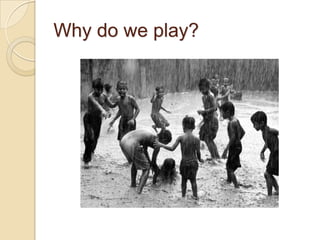
Why do we play?
Some of the reasons we play:


   to learn
   to create
   to feel challenged
   to pass time
   to calm and focus ourselves
   to compete
   to cooperate
   to connect
   to enjoy yourselves and others
   to have fun
   to refresh our minds and body
Play is:
netain
eylbaonjae
criiintns
taoluyvnr
eontsanpous
lelfiexb
nfu
Play is:
Innate - we are born with it!
Enjoyable – there is pleasure
Intrinsic – no goals
Voluntary – we can´t be forced
Spontaneous – just happens
Flexible – no rules
Fun – ooooooooooooooohhh yes!

Cognition and affectivity fuel each other!
When children play:

   They test their developing ideas with objects, people, and situations—the
    key ability for academic learning.
   They develop many kinds of skills together—physical, social, emotional,
    thinking, and language
   They are doing things they are interested in, so they have a natural
    motivation to learn
   They develop concepts and skills together. Children are more likely to
    remember skills and concepts they have learned by doing things that are
    meaningful to them
   They learn from other children and develop social skills by playing together
Play
Play is learning about themselves, others and the environment. Children actively
make models of the real world. Children repeat activities over and over as they
investigates and verify information from the environment.


Play relates to and relies upon past experiences and upon previous explorations of
an object. During play, children assume a non literal orientation to the object. Not
on what the object can do, but on what they can do with the object. The rules
of play, made by children, are unique to each imaginative situation.


Play only occurs when children do not feel anxious or threatened, and after they
have become familiar with objects through exploration. Children can not be forced
to play, neither do they need to be taught to do so. When at play children actively
use their hands, head and heart.

Play provides opportunity for adults to share the child´s inner world on the child´s
terms at the child´s pace.

Play is not a break from learning—it’s the way young children learn.
While playing, children
Change                  Combine
                                                 Describe
Design                  Compare
                                                 Communicate
Question                Criticize
                                                 Identify
Organize                Evaluate
                                                 Listen
Integrate               Explain
                                                 Order
Simplify                Define
                                                 Match
Understand              Collect
                                                 Classify
Penalize                Choose


When playing, children enter an altered state.
Play and thinking

Play makes the brain grow.
The simpler the toy, the more complex the play.
Play permits children to do something with their thoughts.

 How children play is linked to how children think.


Play and language

Play is also important for the development of children's language skills.
Children experiment with language during play and use words to express their
thoughts and ideas. As children become more sophisticated in their play skills,
their language development becomes equally sophisticated. Children use
language during play to solve problems and to communicate their desires.
Feelings We Experience in Play (Flow State)
Mihaly Csikszentmihalyi describes play as a flow state that requires just the right balance of
challenge and opportunity.


 Involvement
 Complete focus and concentration, either due to innate curiosity or as the result of training.
 Delight
 A sense of bliss and positive detachment from everyday reality.
 Clarity
 Great inner clarity and a built-in understanding about the state of affairs.
 Confidence
 An innate sense that the activity is doable and that your skills are adequate to the task.
    Additionally, you don‘t feel anxious or bored.
 Serenity
 A sense of peace and an absence of worries about self.
 Timeliness
 Thorough focus on the present and a lack of attention to the passing of time.
 Motivation
 Intrinsic understanding about what needs to be done and a desire to keep the moment of
      play moving.
Types of play


   Functional play: manipulate objects, repeat actions, imitate actions as
    they explore.


   Constructive play: begin to create things with those objects.


   Dramatic play: aware of the relationship of play and the real world.
    Substitute objects, actions and language for realistic props. Interact
    socially and verbally with other players, starting to negotiate participation
    rules.


   Games with rules: learn to accept and adjust with prearranged rules.
Functions of dramatic play
 ①   Imitate adults
 ②   Play out real life roles in an intense way
 ③   Reflect upon relationships and experiences
 ④   Express pressing needs
 ⑤   Release socially unacceptable impulses
 ⑥   Reverse usually taken roles
 ⑦   Change attitudes and adjust to reality
 ⑧   Work out problems and try many solutions
Categories of social participation


    Non-social interactions

1)   Unoccupied behavior (2 to 3 years old): children watch, look, study the
     situation, and play with their body.
2)   Onlooker( 2.5 to 3 years old): children observe, comment, but do not
     enter.
3)   Solitary play ( 2.5 years old): children play alone, regardless of other
     children. It contributes to cognitive development and the child may have
     chosen to be alone, which is fine.
Categories of social participation


Social interactions

4)   Parallel play (2 years old): children play independently with the
     same toy in the same space and assess the situation to which
     they are close. Most common.
5)   Associative play (4 years old): children play similar activities and
     try to control others.
6)   Cooperative play (4.5 years old): one or two members direct the
     activities of others
Moments during play


Definition of a situation: Let´s play house.
Assignment of roles: I´ll be the daddy and you will be the son.
Defining location: This is the kitchen.
Specifying the action plan: I´ll fix supper and you wait.
Assigning props: This is my pan.
Correcting operating procedures and fixing the script: Daddy doesn´t
  cook like this.
Directing other´s performance: This is the way to do it.
Invoking rules related to real X pretend context: You don´t really have
   to do it.
Termination/ transition: Okay, supper finished.
Commenting interpersonal climate: We are playing, so we are friends,
  right?
Videos about play

The importance of play


http://www.youtube.com/watch?v=h_-1O_rBLPU&feature=related


Stages of play


http://www.youtube.com/watch?v=nhF6E7zHqWI&feature=related
Language play is:

    􀂙   universal
    􀂙   natural
    􀂙   a source of enjoyment
    􀂙   infectious
    􀂙   spontaneous
    􀂙   often unpredictable
    􀂙   exploratory (and therefore risky)
    􀂙   occasional and idiosyncratic
    􀂙 going beyond the norm – clearly distinct from the ―normal‖
    use of language
Children playing with language


Gibberish
Jabberwocky
Tongue twisters
Riddles
Rhymes
Poems
Jokes
Songs
Catch phrases
Imitation
I see, I see
Crosswords
Wordfind
Hangman

Children invent languages!
Some types of language play for adults

Alliteration – words beginning with the same sound/letter
Acrostic – a series or words or lines arranged so that the initial letters make up a
    message
Lipogram – avoiding the use of a particular letter
Pangram – constructing a meaningful sentence containing every letter of the
    alphabet, using each letter only once
Palindrome – word/sentence which reads the same way in both directions
Anagram – reordering letters in a word/phrase to find another word or phrase;
Homoliteral text: each word must have at least one letter in common with the
    previous word
Heteroliteral text: no two consecutive words can have any letter in common
 􀂙Word-chain: the final letter of a word must be the same as the first letter of
    the following word
Rhopalic: each word of the sentence contains one letter or one syllable
more than the previous word
Transpositional poetry: take someone‘s poem and reshuffle all the words
to make a new poem
Play signalling
How do children know we are playing?

Exaggerated actions
Cyclical repetition
Play face
More smiling
Smiling after own action
Look more to the child than to the task
Higher repetition of words
Higher you and me language
More comment noises
Sing-songy quality in one´s voice
Timing is odd when compared to real tasks


 Laughter !
Laughter brings people closer!


   Laughter has a powerful effect on your health and
    well-being.
   A good laugh relieves tension and stress, elevates
    mood, enhances creativity and problem-solving
    ability, and provides a quick energy boost.
   But even more importantly, laughter brings people
    together. Mutual laughter and play are an essential
    component of strong, healthy relationships.
PCIT
( Parent child interactive therapy)

   Do:


   Praise –    Parent : I love how you are using such nice manners.
   Reflection – Child: My favorite is Play Dough.
               Parent: Your favorite is Play Dough, I like it too.
   Imitation – Do the same thing actions the child is doing.
   Description – Parent: you are feeding the baby chickens.
   Enthusiasm – What a great play doh you made!


   Avoid:


   Questions – what do you think we should play now?
   Commands – Let´s color now.
   Criticism – you know that grass isn´t black, grass should be green.
Teachers can:
Let children master toys by making materials available for frequent and longer
  periods of time
Provide playthings that kids can use in a variety of ways: blocks, paper and
   crayons, dolls and toy animals, balls, playdough, etc.
Encourage kids to play with ordinary household objects like pots and pans and
  outdoor materials like sticks and grass.
Provide simple playthings that encourage children to be active and use their
   imaginations, not to watch while the toy does tricks.
Create an environment where children feel safe to try new things and where they
   feel they have the support of adults.
Respond to play: A teacher sees a child playing and builds vocabulary by
  providing new words.
Extend play:a teacher observes a child pretending a chair is a car and ―driving.‖
   She encourages imagination by asking ―Where are you going? What do you see
   along the way?‖
Guide play: One week a teacher turns the dress-up area into a shoe store.
  Children practice language and social skills by acting out ―customers‖ and ―sales
  people.
Observe the child’s activities: Seeing a child line up toy dinosaurs by size shows
  her understanding of size comparisons and putting things in order..
Take photos: A series of photos of a child‘s block structures over time shows that
   she is learning more about spatial relations.
―We don‘t stop playing because we grow old; we
  grow old because we stop playing.‖

                          George Bernard Shaw
The Play Types        Devised by Bob Hughes, in ‗A playworker‘s Taxonomy of Play Types‘
   • Symbolic Play – play which allows control, gradual exploration and increased understanding without the
    risk of being out of one‘s depth.
   • Rough and Tumble Play – close encounter play which is less to do with fighting and more to do with
    touching, tickling, gauging relative strength. Discovering physical flexibility and the exhilaration of display.
   • Socio-dramatic Play – the enactment of real and potential experiences of an intense personal, social,
    domestic or interpersonal nature.
   • Social Play – play during which the rules and criteria for social engagement and interaction can be
    revealed, explored and amended.
   • Creative Play – play which allows a new response, the transformation of information, awareness of new
    connections, with an element of surprise.
   • Communication Play – play using words, nuances or gestures for example, mime, jokes, play acting,
    mickey taking, singing, debate, poetry.
   • Dramatic Play – play which dramatizes events in which the child is not a direct participator.
   • Deep Play – play which allows the child to encounter risky or even potentially life threatening experiences,
    to develop survival skills and conquer fear.
   • Exploratory Play – play to access factual information consisting of manipulative behaviours such as
    handling, throwing, banging or mouthing objects.
   • Fantasy Play – play which rearranges the world in the child‘s way, a way which is unlikely to occur.
   • Imaginative Play – play where the conventional rules, which govern the physical world, do not apply.
   • Locomotor Play – movement in any or every direction for its own sake.
   • Mastery Play – control of the physical and affective ingredients of the environments.
   • Object Play – play which uses infinite and interesting sequences of hand-eyen manipulations and
    movements.
   • Role Play – play exploring ways of being, although not normally of an intense personal, social, domestic or
    interpersonal nature.
   • Recapitulative Play – play that allows the child to explore ancestry, history, rituals, stories, rhymes, fire
    and darkness. Enables children to access play of earlier human evolutionary stages.

Play

  • 1.
    Play ―Man is fullyhuman when he is at play.‖ Schiller
  • 2.
    Why do weplay?
  • 3.
    Some of thereasons we play:  to learn  to create  to feel challenged  to pass time  to calm and focus ourselves  to compete  to cooperate  to connect  to enjoy yourselves and others  to have fun  to refresh our minds and body
  • 4.
  • 5.
    Play is: Innate -we are born with it! Enjoyable – there is pleasure Intrinsic – no goals Voluntary – we can´t be forced Spontaneous – just happens Flexible – no rules Fun – ooooooooooooooohhh yes! Cognition and affectivity fuel each other!
  • 6.
    When children play:  They test their developing ideas with objects, people, and situations—the key ability for academic learning.  They develop many kinds of skills together—physical, social, emotional, thinking, and language  They are doing things they are interested in, so they have a natural motivation to learn  They develop concepts and skills together. Children are more likely to remember skills and concepts they have learned by doing things that are meaningful to them  They learn from other children and develop social skills by playing together
  • 7.
    Play Play is learningabout themselves, others and the environment. Children actively make models of the real world. Children repeat activities over and over as they investigates and verify information from the environment. Play relates to and relies upon past experiences and upon previous explorations of an object. During play, children assume a non literal orientation to the object. Not on what the object can do, but on what they can do with the object. The rules of play, made by children, are unique to each imaginative situation. Play only occurs when children do not feel anxious or threatened, and after they have become familiar with objects through exploration. Children can not be forced to play, neither do they need to be taught to do so. When at play children actively use their hands, head and heart. Play provides opportunity for adults to share the child´s inner world on the child´s terms at the child´s pace. Play is not a break from learning—it’s the way young children learn.
  • 8.
    While playing, children Change Combine Describe Design Compare Communicate Question Criticize Identify Organize Evaluate Listen Integrate Explain Order Simplify Define Match Understand Collect Classify Penalize Choose When playing, children enter an altered state.
  • 9.
    Play and thinking Playmakes the brain grow. The simpler the toy, the more complex the play. Play permits children to do something with their thoughts. How children play is linked to how children think. Play and language Play is also important for the development of children's language skills. Children experiment with language during play and use words to express their thoughts and ideas. As children become more sophisticated in their play skills, their language development becomes equally sophisticated. Children use language during play to solve problems and to communicate their desires.
  • 10.
    Feelings We Experiencein Play (Flow State) Mihaly Csikszentmihalyi describes play as a flow state that requires just the right balance of challenge and opportunity. Involvement Complete focus and concentration, either due to innate curiosity or as the result of training. Delight A sense of bliss and positive detachment from everyday reality. Clarity Great inner clarity and a built-in understanding about the state of affairs. Confidence An innate sense that the activity is doable and that your skills are adequate to the task. Additionally, you don‘t feel anxious or bored. Serenity A sense of peace and an absence of worries about self. Timeliness Thorough focus on the present and a lack of attention to the passing of time. Motivation Intrinsic understanding about what needs to be done and a desire to keep the moment of play moving.
  • 11.
    Types of play  Functional play: manipulate objects, repeat actions, imitate actions as they explore.  Constructive play: begin to create things with those objects.  Dramatic play: aware of the relationship of play and the real world. Substitute objects, actions and language for realistic props. Interact socially and verbally with other players, starting to negotiate participation rules.  Games with rules: learn to accept and adjust with prearranged rules.
  • 12.
    Functions of dramaticplay ① Imitate adults ② Play out real life roles in an intense way ③ Reflect upon relationships and experiences ④ Express pressing needs ⑤ Release socially unacceptable impulses ⑥ Reverse usually taken roles ⑦ Change attitudes and adjust to reality ⑧ Work out problems and try many solutions
  • 13.
    Categories of socialparticipation  Non-social interactions 1) Unoccupied behavior (2 to 3 years old): children watch, look, study the situation, and play with their body. 2) Onlooker( 2.5 to 3 years old): children observe, comment, but do not enter. 3) Solitary play ( 2.5 years old): children play alone, regardless of other children. It contributes to cognitive development and the child may have chosen to be alone, which is fine.
  • 14.
    Categories of socialparticipation Social interactions 4) Parallel play (2 years old): children play independently with the same toy in the same space and assess the situation to which they are close. Most common. 5) Associative play (4 years old): children play similar activities and try to control others. 6) Cooperative play (4.5 years old): one or two members direct the activities of others
  • 15.
    Moments during play Definitionof a situation: Let´s play house. Assignment of roles: I´ll be the daddy and you will be the son. Defining location: This is the kitchen. Specifying the action plan: I´ll fix supper and you wait. Assigning props: This is my pan. Correcting operating procedures and fixing the script: Daddy doesn´t cook like this. Directing other´s performance: This is the way to do it. Invoking rules related to real X pretend context: You don´t really have to do it. Termination/ transition: Okay, supper finished. Commenting interpersonal climate: We are playing, so we are friends, right?
  • 16.
    Videos about play Theimportance of play http://www.youtube.com/watch?v=h_-1O_rBLPU&feature=related Stages of play http://www.youtube.com/watch?v=nhF6E7zHqWI&feature=related
  • 17.
    Language play is:  􀂙 universal  􀂙 natural  􀂙 a source of enjoyment  􀂙 infectious  􀂙 spontaneous  􀂙 often unpredictable  􀂙 exploratory (and therefore risky)  􀂙 occasional and idiosyncratic  􀂙 going beyond the norm – clearly distinct from the ―normal‖ use of language
  • 18.
    Children playing withlanguage Gibberish Jabberwocky Tongue twisters Riddles Rhymes Poems Jokes Songs Catch phrases Imitation I see, I see Crosswords Wordfind Hangman Children invent languages!
  • 19.
    Some types oflanguage play for adults Alliteration – words beginning with the same sound/letter Acrostic – a series or words or lines arranged so that the initial letters make up a message Lipogram – avoiding the use of a particular letter Pangram – constructing a meaningful sentence containing every letter of the alphabet, using each letter only once Palindrome – word/sentence which reads the same way in both directions Anagram – reordering letters in a word/phrase to find another word or phrase; Homoliteral text: each word must have at least one letter in common with the previous word Heteroliteral text: no two consecutive words can have any letter in common 􀂙Word-chain: the final letter of a word must be the same as the first letter of the following word Rhopalic: each word of the sentence contains one letter or one syllable more than the previous word Transpositional poetry: take someone‘s poem and reshuffle all the words to make a new poem
  • 20.
    Play signalling How dochildren know we are playing? Exaggerated actions Cyclical repetition Play face More smiling Smiling after own action Look more to the child than to the task Higher repetition of words Higher you and me language More comment noises Sing-songy quality in one´s voice Timing is odd when compared to real tasks Laughter !
  • 21.
    Laughter brings peoplecloser!  Laughter has a powerful effect on your health and well-being.  A good laugh relieves tension and stress, elevates mood, enhances creativity and problem-solving ability, and provides a quick energy boost.  But even more importantly, laughter brings people together. Mutual laughter and play are an essential component of strong, healthy relationships.
  • 22.
    PCIT ( Parent childinteractive therapy) Do: Praise – Parent : I love how you are using such nice manners. Reflection – Child: My favorite is Play Dough. Parent: Your favorite is Play Dough, I like it too. Imitation – Do the same thing actions the child is doing. Description – Parent: you are feeding the baby chickens. Enthusiasm – What a great play doh you made! Avoid: Questions – what do you think we should play now? Commands – Let´s color now. Criticism – you know that grass isn´t black, grass should be green.
  • 23.
    Teachers can: Let childrenmaster toys by making materials available for frequent and longer periods of time Provide playthings that kids can use in a variety of ways: blocks, paper and crayons, dolls and toy animals, balls, playdough, etc. Encourage kids to play with ordinary household objects like pots and pans and outdoor materials like sticks and grass. Provide simple playthings that encourage children to be active and use their imaginations, not to watch while the toy does tricks. Create an environment where children feel safe to try new things and where they feel they have the support of adults. Respond to play: A teacher sees a child playing and builds vocabulary by providing new words. Extend play:a teacher observes a child pretending a chair is a car and ―driving.‖ She encourages imagination by asking ―Where are you going? What do you see along the way?‖ Guide play: One week a teacher turns the dress-up area into a shoe store. Children practice language and social skills by acting out ―customers‖ and ―sales people. Observe the child’s activities: Seeing a child line up toy dinosaurs by size shows her understanding of size comparisons and putting things in order.. Take photos: A series of photos of a child‘s block structures over time shows that she is learning more about spatial relations.
  • 24.
    ―We don‘t stopplaying because we grow old; we grow old because we stop playing.‖ George Bernard Shaw
  • 25.
    The Play Types Devised by Bob Hughes, in ‗A playworker‘s Taxonomy of Play Types‘  • Symbolic Play – play which allows control, gradual exploration and increased understanding without the risk of being out of one‘s depth.  • Rough and Tumble Play – close encounter play which is less to do with fighting and more to do with touching, tickling, gauging relative strength. Discovering physical flexibility and the exhilaration of display.  • Socio-dramatic Play – the enactment of real and potential experiences of an intense personal, social, domestic or interpersonal nature.  • Social Play – play during which the rules and criteria for social engagement and interaction can be revealed, explored and amended.  • Creative Play – play which allows a new response, the transformation of information, awareness of new connections, with an element of surprise.  • Communication Play – play using words, nuances or gestures for example, mime, jokes, play acting, mickey taking, singing, debate, poetry.  • Dramatic Play – play which dramatizes events in which the child is not a direct participator.  • Deep Play – play which allows the child to encounter risky or even potentially life threatening experiences, to develop survival skills and conquer fear.  • Exploratory Play – play to access factual information consisting of manipulative behaviours such as handling, throwing, banging or mouthing objects.  • Fantasy Play – play which rearranges the world in the child‘s way, a way which is unlikely to occur.  • Imaginative Play – play where the conventional rules, which govern the physical world, do not apply.  • Locomotor Play – movement in any or every direction for its own sake.  • Mastery Play – control of the physical and affective ingredients of the environments.  • Object Play – play which uses infinite and interesting sequences of hand-eyen manipulations and movements.  • Role Play – play exploring ways of being, although not normally of an intense personal, social, domestic or interpersonal nature.  • Recapitulative Play – play that allows the child to explore ancestry, history, rituals, stories, rhymes, fire and darkness. Enables children to access play of earlier human evolutionary stages.