Objectives
The student will be able to:
1. simplify square roots, and
2. simplify radical expressions.
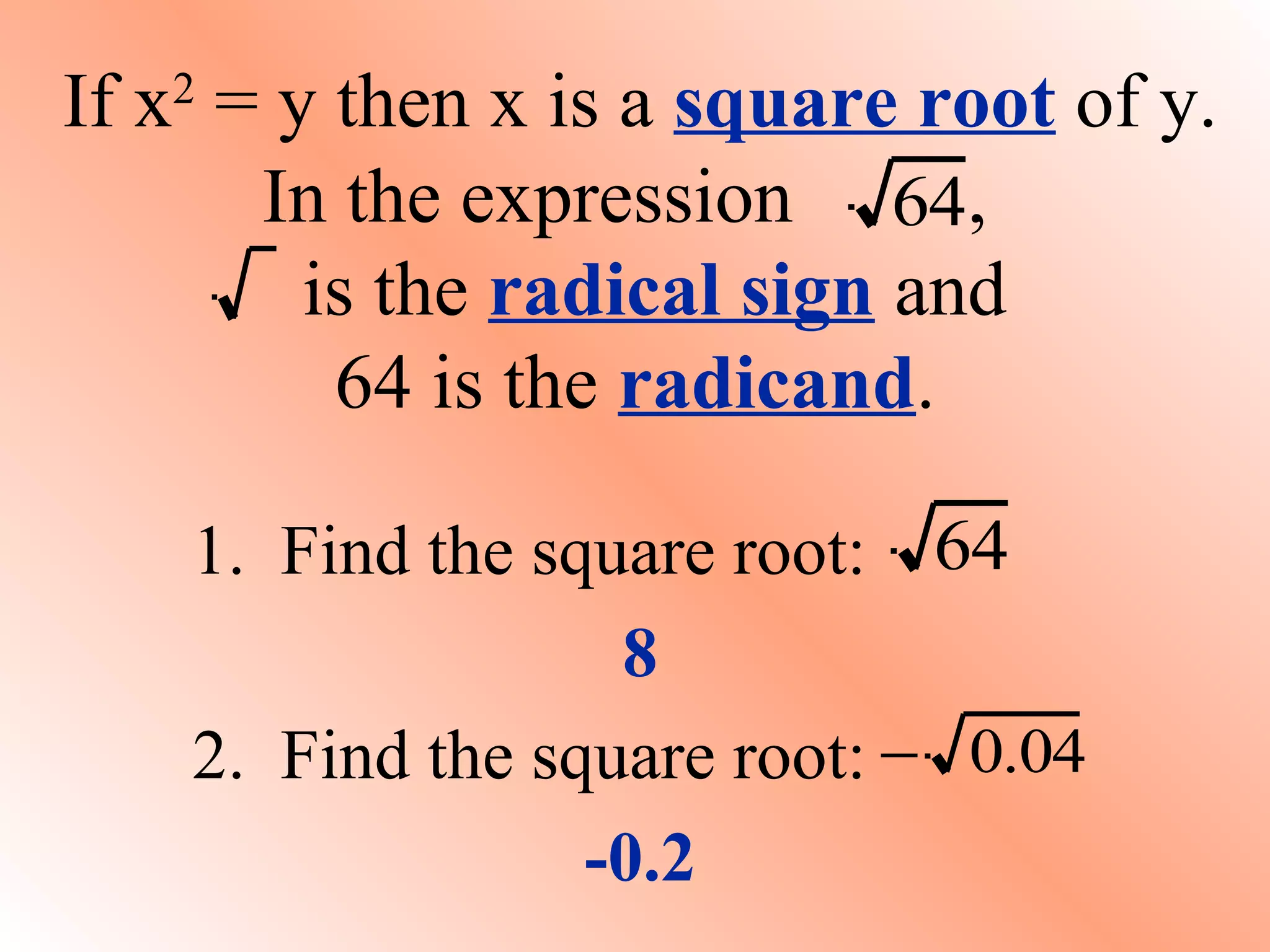
In the expression ,
is the radical sign and
64 is the radicand.
If x2
= y then x is a square root of y.
1. Find the square root:
8
2. Find the square root:
-0.2
64
64
− 0.04
11, -11
4. Find the square root:
21
5. Find the square root:
3. Find the square root: ± 121
441
−
25
81
5
9
−
6.82, -6.82
6. Use a calculator to find each
square root. Round the decimal
answer to the nearest hundredth.
± 46.5
1 • 1 = 1
2 • 2 = 4
3 • 3 = 9
4 • 4 = 16
5 • 5 = 25
6 • 6 = 36
49, 64, 81, 100, 121, 144, ...
What numbers are perfect squares?
1. Simplify
Find a perfect square that goes into 147.
147
147 349= g
147 349= g
147 7 3=
2. Simplify
Find a perfect square that goes into 605.
605
121 5g
121 5g
11 5
Simplify
1. .
2. .
3. .
4. .
2 18
72
3 8
6 2
36 2
Look at these examples and try to find the pattern…
How do you simplify variables in the radical?
x7
1
x x=
2
x x=
3
x x x=
4 2
x x=
5 2
x x x=
6 3
x x=
What is the answer to ?x7
7 3
x x x=
As a general rule, divide the
exponent by two. The
remainder stays in the
radical.
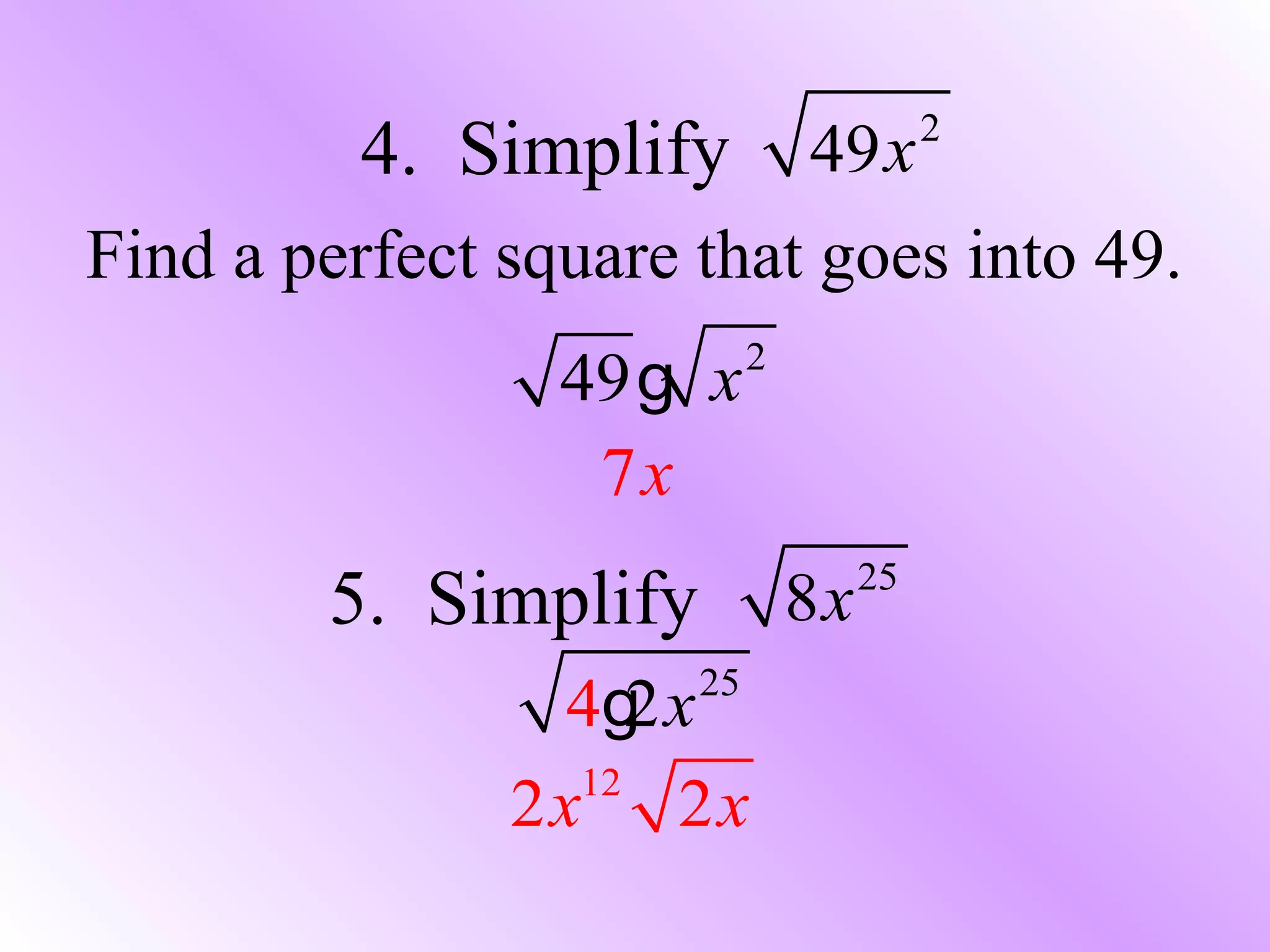
Find a perfect square that goes into 49.
4. Simplify 49x2
2
49 xg
7x
5. Simplify 25
8x
25
4 2xg
12
2 2x x
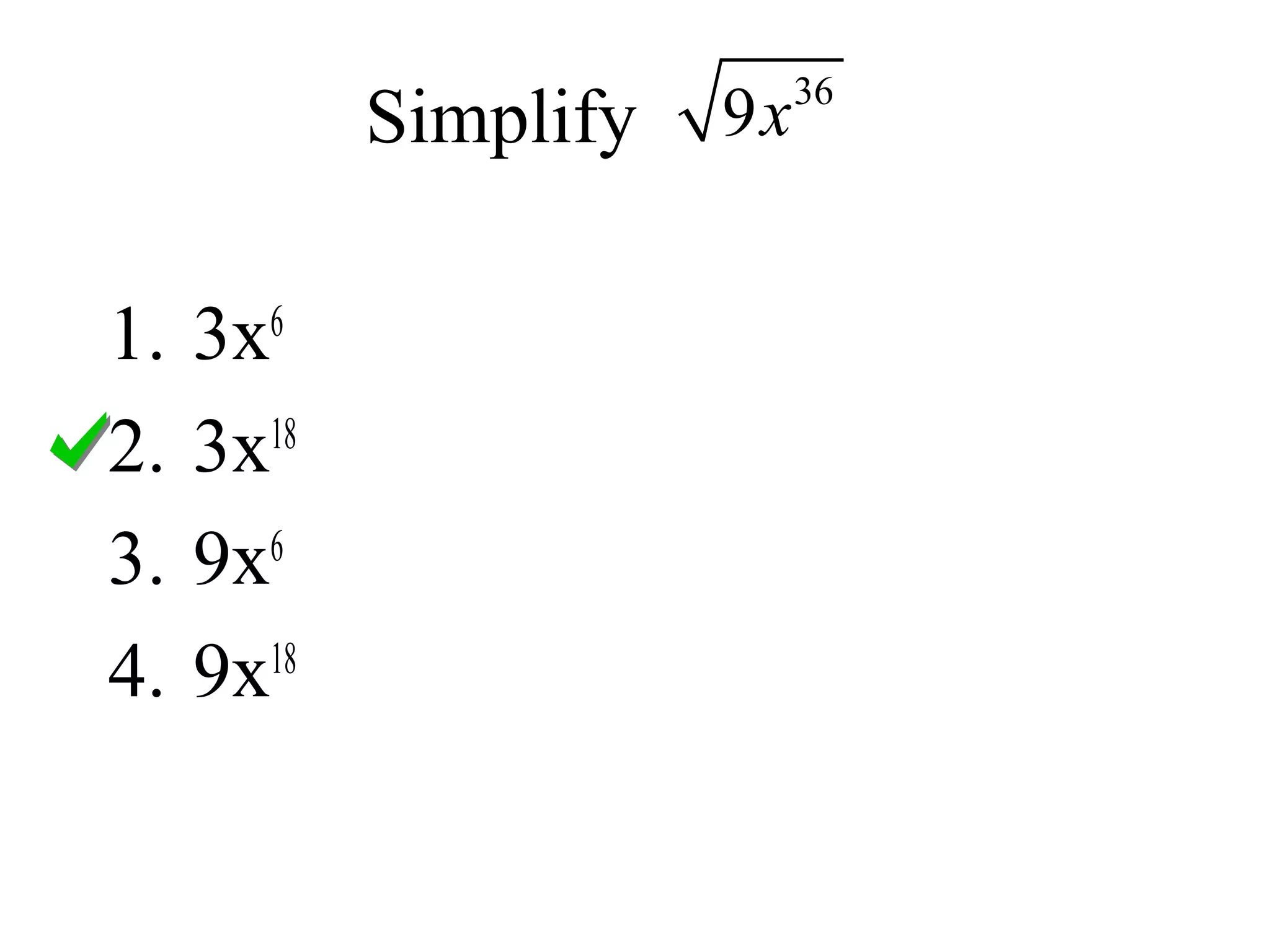
Simplify 36
9x
1. 3x6
2. 3x18
3. 9x6
4. 9x18
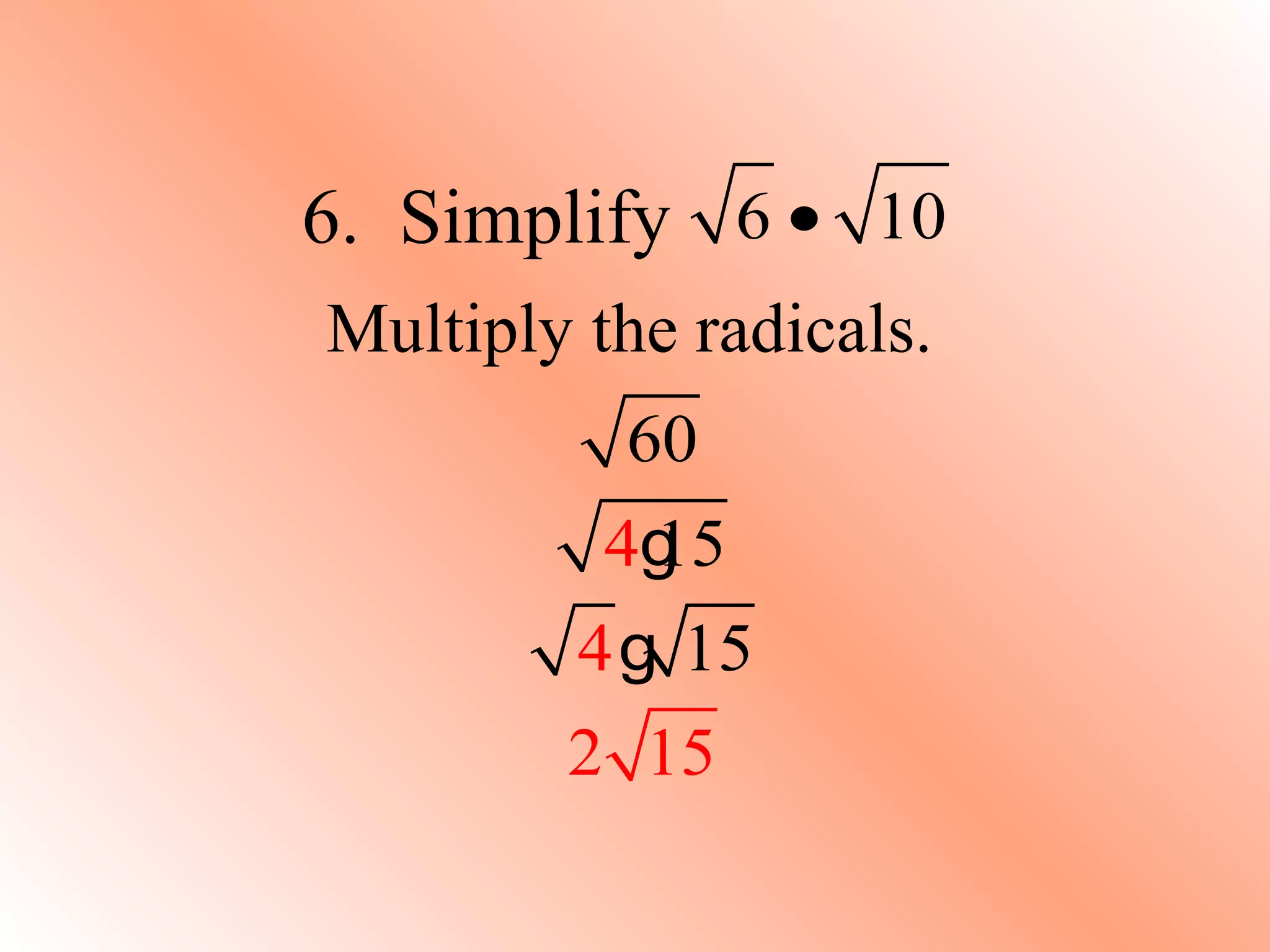
Multiply the radicals.
6. Simplify 6 • 10
60
4 15g
4 15g
2 15
7. Simplify 2 14 •3 21
Multiply the coefficients and radicals.
6 294
6 49 6g
6 649g g
42 6
6 67g g
Simplify
1. .
2. .
3. .
4. .
2
4 3x
4
4 3x
2
48x
4
48x
3
6 8x xg
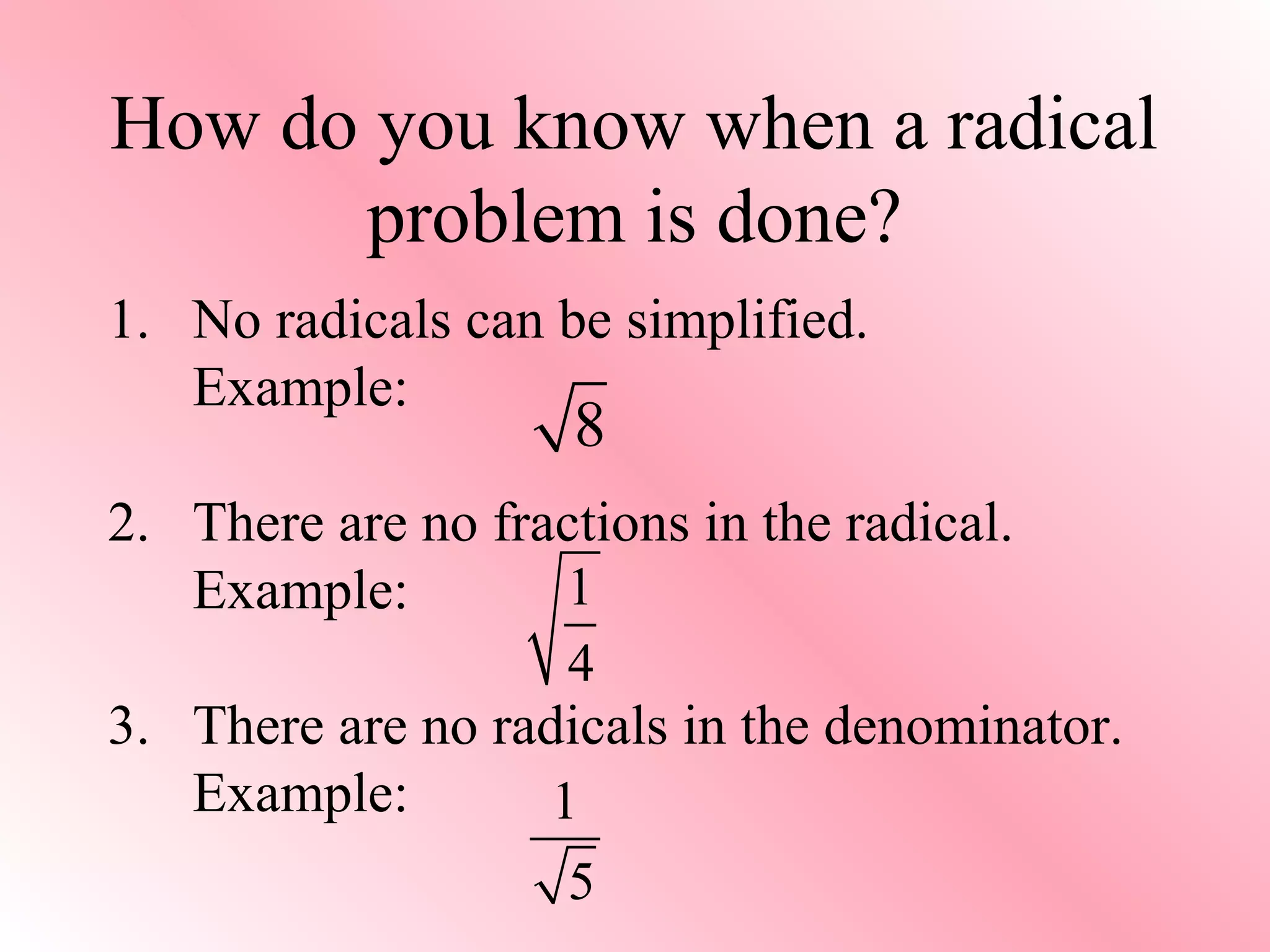
How do you know when a radical
problem is done?
1. No radicals can be simplified.
Example:
2. There are no fractions in the radical.
Example:
3. There are no radicals in the denominator.
Example:
8
1
4
1
5
8. Simplify.
Divide the radicals.
108
3
108
3
36
6
Uh oh…
There is a
radical in the
denominator!
Whew! It
simplified!
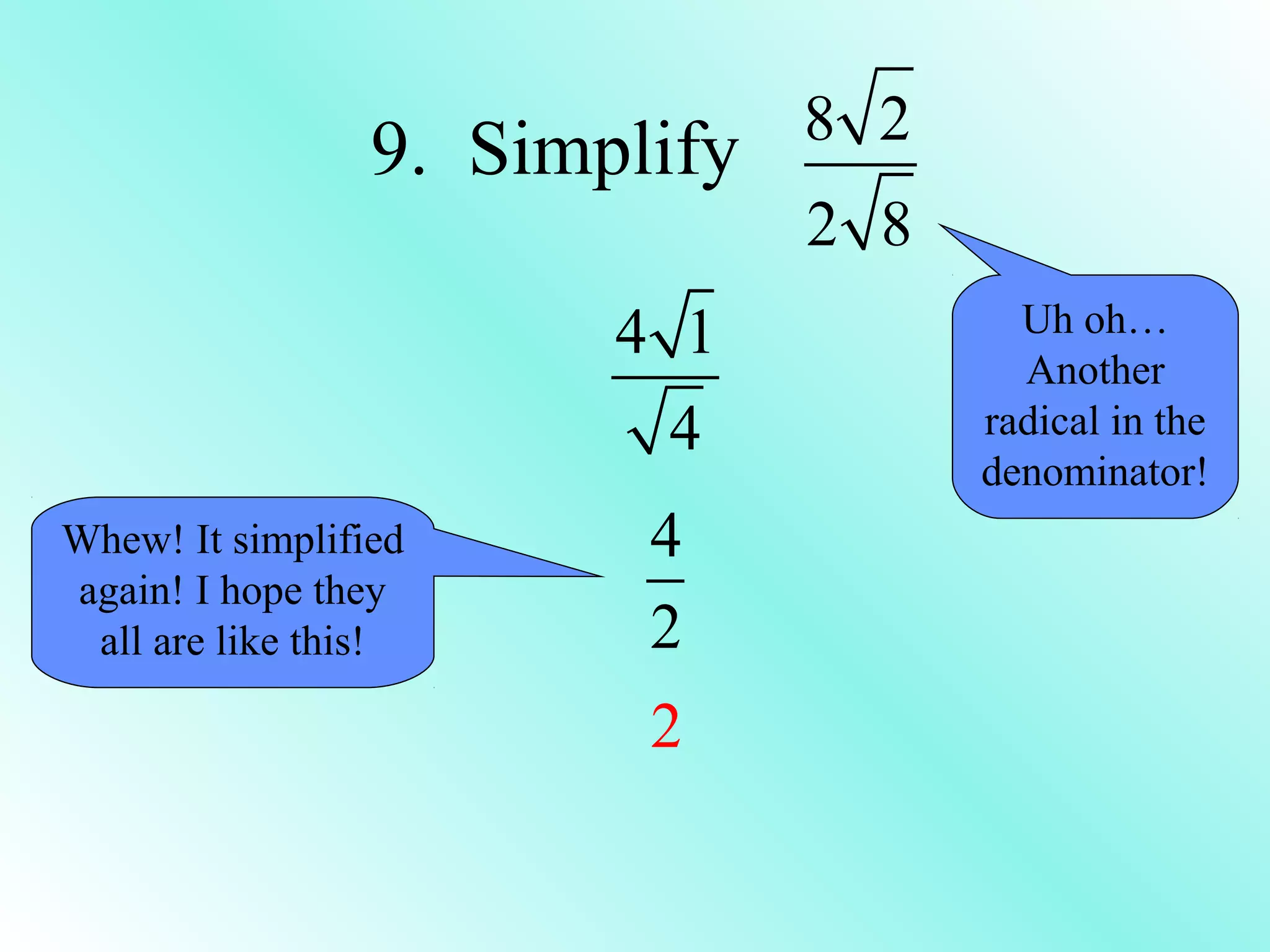
9. Simplify 8 2
2 8
4 1
4
4
2
2
Uh oh…
Another
radical in the
denominator!
Whew! It simplified
again! I hope they
all are like this!
10. Simplify
5
7
5
7
75
7 7
= g
35
49
=
35
7
=
Since the fraction doesn’t reduce, split the radical up.
Uh oh…
There is a
fraction in
the radical!
How do I get rid
of the radical in
the denominator?
Multiply by the “fancy one”
to make the denominator a
perfect square!

Simplify radicals

  • 1.
    Objectives The student willbe able to: 1. simplify square roots, and 2. simplify radical expressions.
  • 2.
    In the expression, is the radical sign and 64 is the radicand. If x2 = y then x is a square root of y. 1. Find the square root: 8 2. Find the square root: -0.2 64 64 − 0.04
  • 3.
    11, -11 4. Findthe square root: 21 5. Find the square root: 3. Find the square root: ± 121 441 − 25 81 5 9 −
  • 4.
    6.82, -6.82 6. Usea calculator to find each square root. Round the decimal answer to the nearest hundredth. ± 46.5
  • 5.
    1 • 1= 1 2 • 2 = 4 3 • 3 = 9 4 • 4 = 16 5 • 5 = 25 6 • 6 = 36 49, 64, 81, 100, 121, 144, ... What numbers are perfect squares?
  • 6.
    1. Simplify Find aperfect square that goes into 147. 147 147 349= g 147 349= g 147 7 3=
  • 7.
    2. Simplify Find aperfect square that goes into 605. 605 121 5g 121 5g 11 5
  • 8.
    Simplify 1. . 2. . 3.. 4. . 2 18 72 3 8 6 2 36 2
  • 9.
    Look at theseexamples and try to find the pattern… How do you simplify variables in the radical? x7 1 x x= 2 x x= 3 x x x= 4 2 x x= 5 2 x x x= 6 3 x x= What is the answer to ?x7 7 3 x x x= As a general rule, divide the exponent by two. The remainder stays in the radical.
  • 10.
    Find a perfectsquare that goes into 49. 4. Simplify 49x2 2 49 xg 7x 5. Simplify 25 8x 25 4 2xg 12 2 2x x
  • 11.
    Simplify 36 9x 1. 3x6 2.3x18 3. 9x6 4. 9x18
  • 12.
    Multiply the radicals. 6.Simplify 6 • 10 60 4 15g 4 15g 2 15
  • 13.
    7. Simplify 214 •3 21 Multiply the coefficients and radicals. 6 294 6 49 6g 6 649g g 42 6 6 67g g
  • 14.
    Simplify 1. . 2. . 3.. 4. . 2 4 3x 4 4 3x 2 48x 4 48x 3 6 8x xg
  • 15.
    How do youknow when a radical problem is done? 1. No radicals can be simplified. Example: 2. There are no fractions in the radical. Example: 3. There are no radicals in the denominator. Example: 8 1 4 1 5
  • 16.
    8. Simplify. Divide theradicals. 108 3 108 3 36 6 Uh oh… There is a radical in the denominator! Whew! It simplified!
  • 17.
    9. Simplify 82 2 8 4 1 4 4 2 2 Uh oh… Another radical in the denominator! Whew! It simplified again! I hope they all are like this!
  • 18.
    10. Simplify 5 7 5 7 75 7 7 =g 35 49 = 35 7 = Since the fraction doesn’t reduce, split the radical up. Uh oh… There is a fraction in the radical! How do I get rid of the radical in the denominator? Multiply by the “fancy one” to make the denominator a perfect square!