ROOTS
AND
RADICALS
CHAPTER 12
BY GROUP 12 :
MEUTIAH NAHRISYAH
• 1711441014
NIATI INDAN
• 1711441013
SECTION 1. Understanding Roots and Radicals
2. Understanding Rational and Irrational Number
3. Finding The Square Root of a Number by Using a Graph
4. Finding The Square Root of a Number by Using a Table
5. Simplifying The Square Root of a Product
6. Simplifying The Square Root of a Fraction
7. Adding and Subtraction Square Roots of a Numbers
8. Multiplying and Dividing Square Roots of a Numbers
9. Rationalizing The Dominator of Fraction
10. Solving Radical Equation
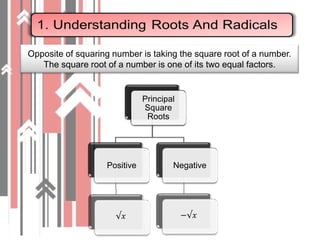
Opposite of squaring number is taking the square root of a number.
The square root of a number is one of its two equal factors.
Principal
Square
Roots
Positive
√𝑥
Negative
−√𝑥
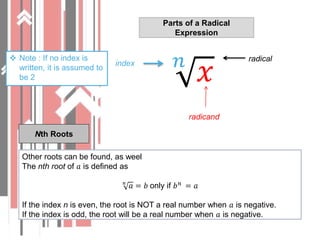
𝑛
𝑥
radical
radicand
index
Parts of a Radical
Expression
 Note : If no index is
written, it is assumed to
be 2
Nth Roots
Other roots can be found, as weel
The nth root of 𝑎 is defined as
𝑛
𝑎 = 𝑏 only if 𝑏 𝑛
= 𝑎
If the index n is even, the root is NOT a real number when 𝑎 is negative.
If the index is odd, the root will be a real number when 𝑎 is negative.
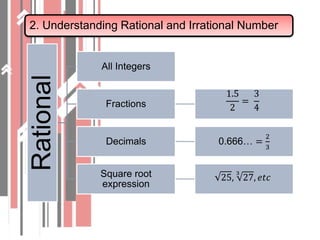
2. Understanding Rational and Irrational Number
Rational
All Integers
Fractions
1.5
2
=
3
4
Decimals 0.666… =
2
3
Square root
expression
25,
3
27, 𝑒𝑡𝑐
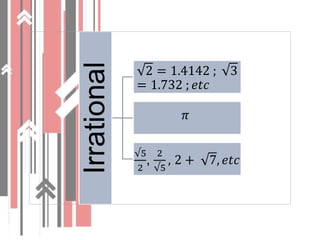
Irrational
2 = 1.4142 ; 3
= 1.732 ; 𝑒𝑡𝑐
𝜋
√5
2
,
2
√5
, 2 + 7, 𝑒𝑡𝑐
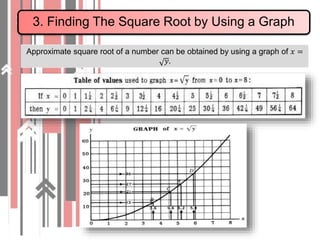
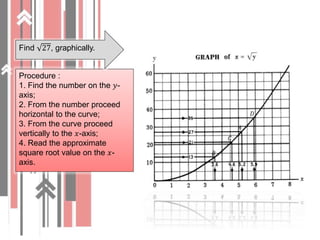
3. Finding The Square Root by Using a Graph
Approximate square root of a number can be obtained by using a graph of 𝑥 =
𝑦.
Procedure :
1. Find the number on the 𝑦-
axis;
2. From the number proceed
horizontal to the curve;
3. From the curve proceed
vertically to the 𝑥-axis;
4. Read the approximate
square root value on the 𝑥-
axis.
Find 27, graphically.
4. Finding The Square Root by Using a Table
[Using the table on page 290] To find the principal square root of a number, look
for the number the number under 𝑁. Read the square root of the number under
𝑁, immediately to the right of the number.
Example:
5 = 2.236
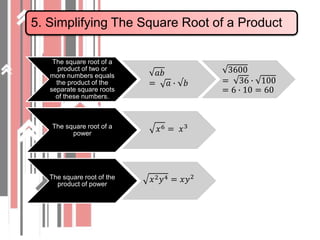
5. Simplifying The Square Root of a Product
The square root of a
product of two or
more numbers equals
the product of the
separate square roots
of these numbers.
𝑎𝑏
= 𝑎 ∙ √𝑏
3600
= 36 ∙ 100
= 6 ∙ 10 = 60
The square root of a
power
𝑥6 = 𝑥3
The square root of the
product of power
𝑥2 𝑦4 = 𝑥𝑦2
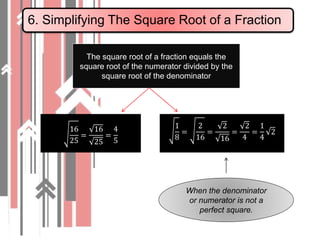
6. Simplifying The Square Root of a Fraction
The square root of a fraction equals the
square root of the numerator divided by the
square root of the denominator
16
25
=
16
25
=
4
5
1
8
=
2
16
=
2
16
=
2
4
=
1
4
2
When the denominator
or numerator is not a
perfect square.
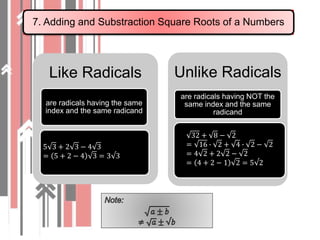
7. Adding and Substraction Square Roots of a Numbers
Like Radicals
are radicals having the same
index and the same radicand
5 3 + 2 3 − 4 3
= 5 + 2 − 4 3 = 3√3
Unlike Radicals
are radicals having NOT the
same index and the same
radicand
32 + 8 − 2
= 16 ∙ 2 + 4 ∙ 2 − 2
= 4 2 + 2 2 − 2
= 4 + 2 − 1 2 = 5√2
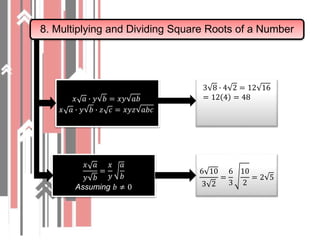
8. Multiplying and Dividing Square Roots of a Number
𝑥 𝑎 ∙ 𝑦 𝑏 = 𝑥𝑦 𝑎𝑏
𝑥 𝑎 ∙ 𝑦 𝑏 ∙ 𝑧 𝑐 = 𝑥𝑦𝑧 𝑎𝑏𝑐
3 8 ∙ 4 2 = 12 16
= 12 4 = 48
𝑥 𝑎
𝑦 𝑏
=
𝑥
𝑦
𝑎
𝑏
Assuming 𝑏 ≠ 0
6 10
3 2
=
6
3
10
2
= 2 5
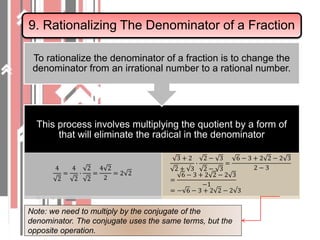
9. Rationalizing The Denominator of a Fraction
This process involves multiplying the quotient by a form of
that will eliminate the radical in the denominator
4
2
=
4
2
∙
2
2
=
4 2
2
= 2 2
3 + 2
2 + √3
∙
2 − 3
2 − 3
=
6 − 3 + 2 2 − 2 3
2 − 3
=
6 − 3 + 2 2 − 2 3
−1
= − 6 − 3 + 2 2 − 2√3
To rationalize the denominator of a fraction is to change the
denominator from an irrational number to a rational number.
Note: we need to multiply by the conjugate of the
denominator. The conjugate uses the same terms, but the
opposite operation.
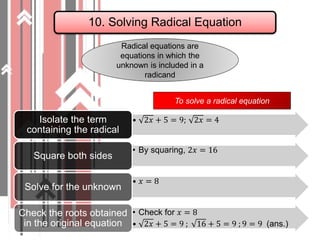
10. Solving Radical Equation
Radical equations are
equations in which the
unknown is included in a
radicand
• 2𝑥 + 5 = 9; 2𝑥 = 4Isolate the term
containing the radical
• By squaring, 2𝑥 = 16
Square both sides
• 𝑥 = 8
Solve for the unknown
• Check for 𝑥 = 8
• 2𝑥 + 5 = 9 ; 16 + 5 = 9 ; 9 = 9 (ans.)
Check the roots obtained
in the original equation
To solve a radical equation
ANY QUESTION

ROOTS AND RADICALS - ELEMENTARY ALGEBRA

  • 1.
  • 2.
    BY GROUP 12: MEUTIAH NAHRISYAH • 1711441014 NIATI INDAN • 1711441013
  • 3.
    SECTION 1. UnderstandingRoots and Radicals 2. Understanding Rational and Irrational Number 3. Finding The Square Root of a Number by Using a Graph 4. Finding The Square Root of a Number by Using a Table 5. Simplifying The Square Root of a Product 6. Simplifying The Square Root of a Fraction 7. Adding and Subtraction Square Roots of a Numbers 8. Multiplying and Dividing Square Roots of a Numbers 9. Rationalizing The Dominator of Fraction 10. Solving Radical Equation
  • 4.
    Opposite of squaringnumber is taking the square root of a number. The square root of a number is one of its two equal factors. Principal Square Roots Positive √𝑥 Negative −√𝑥
  • 5.
    𝑛 𝑥 radical radicand index Parts of aRadical Expression  Note : If no index is written, it is assumed to be 2 Nth Roots Other roots can be found, as weel The nth root of 𝑎 is defined as 𝑛 𝑎 = 𝑏 only if 𝑏 𝑛 = 𝑎 If the index n is even, the root is NOT a real number when 𝑎 is negative. If the index is odd, the root will be a real number when 𝑎 is negative.
  • 6.
    2. Understanding Rationaland Irrational Number Rational All Integers Fractions 1.5 2 = 3 4 Decimals 0.666… = 2 3 Square root expression 25, 3 27, 𝑒𝑡𝑐
  • 7.
    Irrational 2 = 1.4142; 3 = 1.732 ; 𝑒𝑡𝑐 𝜋 √5 2 , 2 √5 , 2 + 7, 𝑒𝑡𝑐
  • 8.
    3. Finding TheSquare Root by Using a Graph Approximate square root of a number can be obtained by using a graph of 𝑥 = 𝑦.
  • 9.
    Procedure : 1. Findthe number on the 𝑦- axis; 2. From the number proceed horizontal to the curve; 3. From the curve proceed vertically to the 𝑥-axis; 4. Read the approximate square root value on the 𝑥- axis. Find 27, graphically.
  • 10.
    4. Finding TheSquare Root by Using a Table [Using the table on page 290] To find the principal square root of a number, look for the number the number under 𝑁. Read the square root of the number under 𝑁, immediately to the right of the number. Example: 5 = 2.236
  • 11.
    5. Simplifying TheSquare Root of a Product The square root of a product of two or more numbers equals the product of the separate square roots of these numbers. 𝑎𝑏 = 𝑎 ∙ √𝑏 3600 = 36 ∙ 100 = 6 ∙ 10 = 60 The square root of a power 𝑥6 = 𝑥3 The square root of the product of power 𝑥2 𝑦4 = 𝑥𝑦2
  • 12.
    6. Simplifying TheSquare Root of a Fraction The square root of a fraction equals the square root of the numerator divided by the square root of the denominator 16 25 = 16 25 = 4 5 1 8 = 2 16 = 2 16 = 2 4 = 1 4 2 When the denominator or numerator is not a perfect square.
  • 13.
    7. Adding andSubstraction Square Roots of a Numbers Like Radicals are radicals having the same index and the same radicand 5 3 + 2 3 − 4 3 = 5 + 2 − 4 3 = 3√3 Unlike Radicals are radicals having NOT the same index and the same radicand 32 + 8 − 2 = 16 ∙ 2 + 4 ∙ 2 − 2 = 4 2 + 2 2 − 2 = 4 + 2 − 1 2 = 5√2
  • 14.
    8. Multiplying andDividing Square Roots of a Number 𝑥 𝑎 ∙ 𝑦 𝑏 = 𝑥𝑦 𝑎𝑏 𝑥 𝑎 ∙ 𝑦 𝑏 ∙ 𝑧 𝑐 = 𝑥𝑦𝑧 𝑎𝑏𝑐 3 8 ∙ 4 2 = 12 16 = 12 4 = 48 𝑥 𝑎 𝑦 𝑏 = 𝑥 𝑦 𝑎 𝑏 Assuming 𝑏 ≠ 0 6 10 3 2 = 6 3 10 2 = 2 5
  • 15.
    9. Rationalizing TheDenominator of a Fraction This process involves multiplying the quotient by a form of that will eliminate the radical in the denominator 4 2 = 4 2 ∙ 2 2 = 4 2 2 = 2 2 3 + 2 2 + √3 ∙ 2 − 3 2 − 3 = 6 − 3 + 2 2 − 2 3 2 − 3 = 6 − 3 + 2 2 − 2 3 −1 = − 6 − 3 + 2 2 − 2√3 To rationalize the denominator of a fraction is to change the denominator from an irrational number to a rational number. Note: we need to multiply by the conjugate of the denominator. The conjugate uses the same terms, but the opposite operation.
  • 16.
    10. Solving RadicalEquation Radical equations are equations in which the unknown is included in a radicand • 2𝑥 + 5 = 9; 2𝑥 = 4Isolate the term containing the radical • By squaring, 2𝑥 = 16 Square both sides • 𝑥 = 8 Solve for the unknown • Check for 𝑥 = 8 • 2𝑥 + 5 = 9 ; 16 + 5 = 9 ; 9 = 9 (ans.) Check the roots obtained in the original equation To solve a radical equation
  • 17.