Operations Research
MBA-024
PROJECT MANAGEMENT
UNIT IV
Basic Concepts
• Activity (arc): All projects are composed of
operations or tasks called activities.
• Predecessor activity: Activity that must be
completed immediately prior to the start of
another activity.
• Successor activity: Activity that cannot be
started until one or more of the other
activities are completed.
Basic Concepts
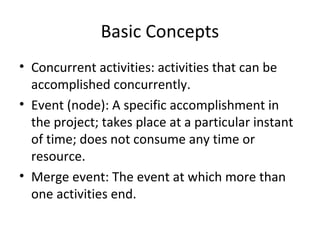
• Concurrent activities: activities that can be
accomplished concurrently.
• Event (node): A specific accomplishment in
the project; takes place at a particular instant
of time; does not consume any time or
resource.
• Merge event: The event at which more than
one activities end.
Basic Concepts
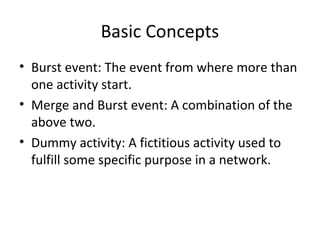
• Burst event: The event from where more than
one activity start.
• Merge and Burst event: A combination of the
above two.
• Dummy activity: A fictitious activity used to
fulfill some specific purpose in a network.
Rules for Drawing Network
Diagram
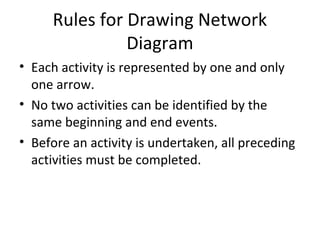
• Each activity is represented by one and only
one arrow.
• No two activities can be identified by the
same beginning and end events.
• Before an activity is undertaken, all preceding
activities must be completed.
Rules for Drawing Network
Diagram
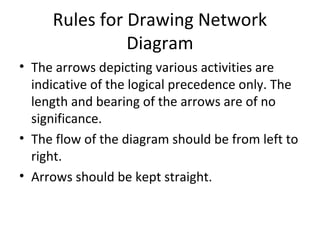
• The arrows depicting various activities are
indicative of the logical precedence only. The
length and bearing of the arrows are of no
significance.
• The flow of the diagram should be from left to
right.
• Arrows should be kept straight.
Rules for Drawing Network
Diagram
• Angles between the arrows should be as large
as possible.
• Each activity must have a tail and a head
event.
• Dangling must be avoided.
• Fulkerson’s rule should be followed for
numbering the nodes.
• The interdependence of activities must not be
violated.
Common Errors
• Dangling.
• Looping.
• Redundancy.
Critical Path Method (CPM)
• Developed by M. R. Walker.
• Uses single time estimate, unlike PERT.
• The amount of time required for completing
various activities is assumed to be known with
certainty.
• Emphasizes the relationship between applying
more men and/or other resources to shorten
the duration of project; in the process, the
cost increases.
Programme Evaluation and Review
Technique (PERT)
• Developed by a (American) Navy sponsored
research team in 1950s.
• Helpful in planning and controlling projects.
• Designed for scheduling complex projects that
involve many inter-related tasks.
• Uses three time estimates – normal,
optimistic, pessimistic.
• Identifies likely trouble spots in advance.
Applications of PERT and CPM
To plan, schedule, monitor and control projects
such as:
•Construction of buildings, bridges, factories,
highways, stadiums, irrigation projects, etc.
•Budget and auditing procedures.
•Missile development programmes.
•Installation of a complex new equipment such
as computers or large machinery.
Applications of PERT and CPM
To plan, schedule, monitor and control projects
such as:
•Advertising programmes and for development
and launching of new products.
•Planning of political campaigns.
•Strategic and tactical military planning.
•Research and development of new products.
Applications of PERT and CPM
To plan, schedule, monitor and control projects
such as:
•Finding the best traffic flow pattern in a large
city.
•Maintenance and overhauling complicated
equipment in the chemical, power plants, steel
and petroleum industries.
Applications of PERT and CPM
To plan, schedule, monitor and control projects
such as:
•Long-range planning and developing staffing
plans.
•Organisation of big conferences, public works,
etc.
•Shifting of manufacturing plant from one site to
another.
Applications of PERT and CPM
To plan, schedule, monitor and control projects
such as:
•Preparation of bids and proposals for projects
of large size.
•Launching space programmes.
Crashing
• The project completion time can be reduced
by reducing (crashing) the normal completion
time of critical activities.
• The reduction in normal time of completion
will increase the total budget of the project.
• The decision-maker will have to look at the
time-cost trade-off for the various activities of
the project.

Unit iv-3-pm

  • 1.
  • 2.
  • 3.
    Basic Concepts • Activity(arc): All projects are composed of operations or tasks called activities. • Predecessor activity: Activity that must be completed immediately prior to the start of another activity. • Successor activity: Activity that cannot be started until one or more of the other activities are completed.
  • 4.
    Basic Concepts • Concurrentactivities: activities that can be accomplished concurrently. • Event (node): A specific accomplishment in the project; takes place at a particular instant of time; does not consume any time or resource. • Merge event: The event at which more than one activities end.
  • 5.
    Basic Concepts • Burstevent: The event from where more than one activity start. • Merge and Burst event: A combination of the above two. • Dummy activity: A fictitious activity used to fulfill some specific purpose in a network.
  • 6.
    Rules for DrawingNetwork Diagram • Each activity is represented by one and only one arrow. • No two activities can be identified by the same beginning and end events. • Before an activity is undertaken, all preceding activities must be completed.
  • 7.
    Rules for DrawingNetwork Diagram • The arrows depicting various activities are indicative of the logical precedence only. The length and bearing of the arrows are of no significance. • The flow of the diagram should be from left to right. • Arrows should be kept straight.
  • 8.
    Rules for DrawingNetwork Diagram • Angles between the arrows should be as large as possible. • Each activity must have a tail and a head event. • Dangling must be avoided. • Fulkerson’s rule should be followed for numbering the nodes. • The interdependence of activities must not be violated.
  • 9.
    Common Errors • Dangling. •Looping. • Redundancy.
  • 10.
    Critical Path Method(CPM) • Developed by M. R. Walker. • Uses single time estimate, unlike PERT. • The amount of time required for completing various activities is assumed to be known with certainty. • Emphasizes the relationship between applying more men and/or other resources to shorten the duration of project; in the process, the cost increases.
  • 11.
    Programme Evaluation andReview Technique (PERT) • Developed by a (American) Navy sponsored research team in 1950s. • Helpful in planning and controlling projects. • Designed for scheduling complex projects that involve many inter-related tasks. • Uses three time estimates – normal, optimistic, pessimistic. • Identifies likely trouble spots in advance.
  • 12.
    Applications of PERTand CPM To plan, schedule, monitor and control projects such as: •Construction of buildings, bridges, factories, highways, stadiums, irrigation projects, etc. •Budget and auditing procedures. •Missile development programmes. •Installation of a complex new equipment such as computers or large machinery.
  • 13.
    Applications of PERTand CPM To plan, schedule, monitor and control projects such as: •Advertising programmes and for development and launching of new products. •Planning of political campaigns. •Strategic and tactical military planning. •Research and development of new products.
  • 14.
    Applications of PERTand CPM To plan, schedule, monitor and control projects such as: •Finding the best traffic flow pattern in a large city. •Maintenance and overhauling complicated equipment in the chemical, power plants, steel and petroleum industries.
  • 15.
    Applications of PERTand CPM To plan, schedule, monitor and control projects such as: •Long-range planning and developing staffing plans. •Organisation of big conferences, public works, etc. •Shifting of manufacturing plant from one site to another.
  • 16.
    Applications of PERTand CPM To plan, schedule, monitor and control projects such as: •Preparation of bids and proposals for projects of large size. •Launching space programmes.
  • 17.
    Crashing • The projectcompletion time can be reduced by reducing (crashing) the normal completion time of critical activities. • The reduction in normal time of completion will increase the total budget of the project. • The decision-maker will have to look at the time-cost trade-off for the various activities of the project.