LEAST COST METHOD
BY VISHAL HOTCHANDANI
ROLL NO 60
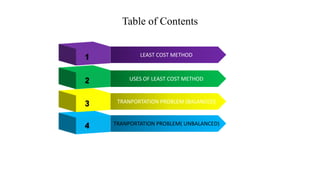
TRANPORTATION PROBLEM (BALANCED)
USES OF LEAST COST METHOD
LEAST COST METHOD
TRANPORTATION PROBLEM( UNBALANCED)
Table of Contents
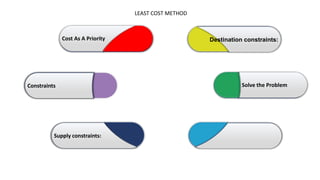
Destination constraints:Cost As A Priority
Solve the Problem
Supply constraints:
Constraints
LEAST COST METHOD
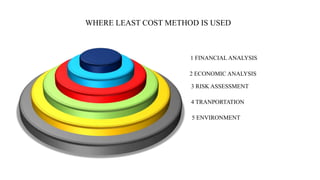
1 FINANCIAL ANALYSIS
2 ECONOMIC ANALYSIS
3 RISK ASSESSMENT
4 TRANPORTATION
5 ENVIRONMENT
WHERE LEAST COST METHOD IS USED
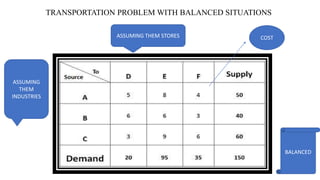
TRANSPORTATION PROBLEM WITH BALANCED SITUATIONS
ASSUMING
THEM
INDUSTRIES
ASSUMING THEM STORES
BALANCED
COST
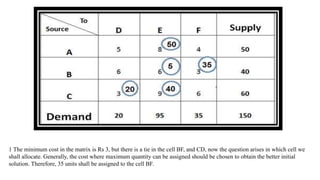
1 The minimum cost in the matrix is Rs 3, but there is a tie in the cell BF, and CD, now the question arises in which cell we
shall allocate. Generally, the cost where maximum quantity can be assigned should be chosen to obtain the better initial
solution. Therefore, 35 units shall be assigned to the cell BF.
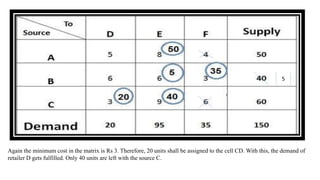
5
Again the minimum cost in the matrix is Rs 3. Therefore, 20 units shall be assigned to the cell CD. With this, the demand of
retailer D gets fulfilled. Only 40 units are left with the source C.
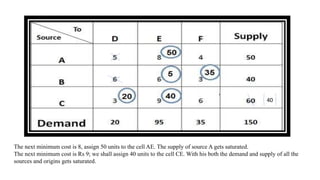
40
The next minimum cost is 8, assign 50 units to the cell AE. The supply of source A gets saturated.
The next minimum cost is Rs 9; we shall assign 40 units to the cell CE. With his both the demand and supply of all the
sources and origins gets saturated.
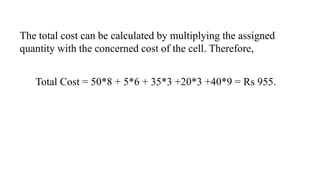
Total Cost = 50*8 + 5*6 + 35*3 +20*3 +40*9 = Rs 955.
The total cost can be calculated by multiplying the assigned
quantity with the concerned cost of the cell. Therefore,
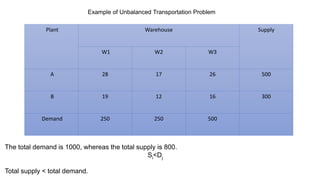
Example of Unbalanced Transportation Problem
Plant Warehouse Supply
W1 W2 W3
A 28 17 26 500
B 19 12 16 300
Demand 250 250 500
The total demand is 1000, whereas the total supply is 800.
Si<Dj
Total supply < total demand.
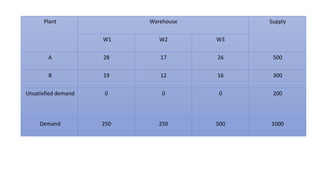
Plant Warehouse Supply
W1 W2 W3
A 28 17 26 500
B 19 12 16 300
Unsatisfied demand 0 0 0 200
Demand 250 250 500 1000
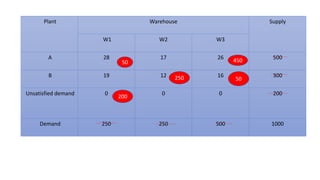
Plant Warehouse Supply
W1 W2 W3
A 28 17 26 500
B 19 12 16 300
Unsatisfied demand 0 0 0 200
Demand 250 250 500 1000
200
250 50
50 450

LEAST COST METHOD

  • 1.
    LEAST COST METHOD BYVISHAL HOTCHANDANI ROLL NO 60
  • 2.
    TRANPORTATION PROBLEM (BALANCED) USESOF LEAST COST METHOD LEAST COST METHOD TRANPORTATION PROBLEM( UNBALANCED) Table of Contents
  • 3.
    Destination constraints:Cost AsA Priority Solve the Problem Supply constraints: Constraints LEAST COST METHOD
  • 4.
    1 FINANCIAL ANALYSIS 2ECONOMIC ANALYSIS 3 RISK ASSESSMENT 4 TRANPORTATION 5 ENVIRONMENT WHERE LEAST COST METHOD IS USED
  • 5.
    TRANSPORTATION PROBLEM WITHBALANCED SITUATIONS ASSUMING THEM INDUSTRIES ASSUMING THEM STORES BALANCED COST
  • 6.
    1 The minimumcost in the matrix is Rs 3, but there is a tie in the cell BF, and CD, now the question arises in which cell we shall allocate. Generally, the cost where maximum quantity can be assigned should be chosen to obtain the better initial solution. Therefore, 35 units shall be assigned to the cell BF.
  • 7.
    5 Again the minimumcost in the matrix is Rs 3. Therefore, 20 units shall be assigned to the cell CD. With this, the demand of retailer D gets fulfilled. Only 40 units are left with the source C.
  • 8.
    40 The next minimumcost is 8, assign 50 units to the cell AE. The supply of source A gets saturated. The next minimum cost is Rs 9; we shall assign 40 units to the cell CE. With his both the demand and supply of all the sources and origins gets saturated.
  • 9.
    Total Cost =50*8 + 5*6 + 35*3 +20*3 +40*9 = Rs 955. The total cost can be calculated by multiplying the assigned quantity with the concerned cost of the cell. Therefore,
  • 10.
    Example of UnbalancedTransportation Problem Plant Warehouse Supply W1 W2 W3 A 28 17 26 500 B 19 12 16 300 Demand 250 250 500 The total demand is 1000, whereas the total supply is 800. Si<Dj Total supply < total demand.
  • 11.
    Plant Warehouse Supply W1W2 W3 A 28 17 26 500 B 19 12 16 300 Unsatisfied demand 0 0 0 200 Demand 250 250 500 1000
  • 12.
    Plant Warehouse Supply W1W2 W3 A 28 17 26 500 B 19 12 16 300 Unsatisfied demand 0 0 0 200 Demand 250 250 500 1000 200 250 50 50 450