REPORT OF PRACTICUM
"SIMPLE HARMONIC MOVEMENT IN BANDUL “
COLLECTION DATE : 23rd
of April 2018 M
DATEPRACTICUM : 18th
of April 2018
"SIMPLE HARMONIC MOTION ON SIMPLE PENDULUM"
FINAL PRACTICUM
A. OBJECTIVES PRACTICUM
1. to determine factors which can affect the acceleration of gravity.
2. Can determine the period of a pendulum.
3. Knowing the constant acceleration of gravity with a simple pendulum.
4. Compare the results of the gravitational acceleration to a simple
pendulum with theoretical gravitational acceleration.
5. Can understand the terms of simple harmonic motion in the pendulum.
B. BASIC THEORY
This movement will have an equilibrium point, where the position
of the object oscillated does not direct the force. When an object gets a net
force, the object will move away from its equilibrium point and return to its
equilibrium point due to the restoring force. A simple pendulum has an
equilibrium point that is perpendicular to the rope with a support pole. This
pendulum has a mass of weights and straps, pendants will oscillate at the x
coordinate (Giancoli, 2014: 369).
Simple pendulum or (simple pendulum). A simple pendulum is an
ideal object consisting of a point of mass hanging on a light rope that cannot
stretch. If the pendulum is pulled sideways from its balanced position and
released, the pendulum will swing in the pertinent field due to the influence
of gravity, its motion is oscillating and periodic motion (Halliday, 1991:
459).
SIMPLE HARMONIC MANTION UTUT MUHAMMAD
The restoring force is used so that vibrations occur in objects that
vibrate must be a restoring force, i.e. the force with a direction such that it
always pushes or pulls the object to its equilibrium position. If the object
that is bound to the tip of the spring is noticed, then in a spring condition
stretched the restoring force pulls the object back to its equilibrium position
while in a state of compressed spring, the restoring force pushes the load to
return to its equilibrium point (Bueche, 1989: 98).
A simple harmonic motion has a period. The period is the time
needed by an object to do one vibration. Or mathematically the period (T)
is the time (n) that is needed in full back and forth. Written with the
equation:
𝑇 =
𝑡
𝑛
(Ishaq, 2007: 155)
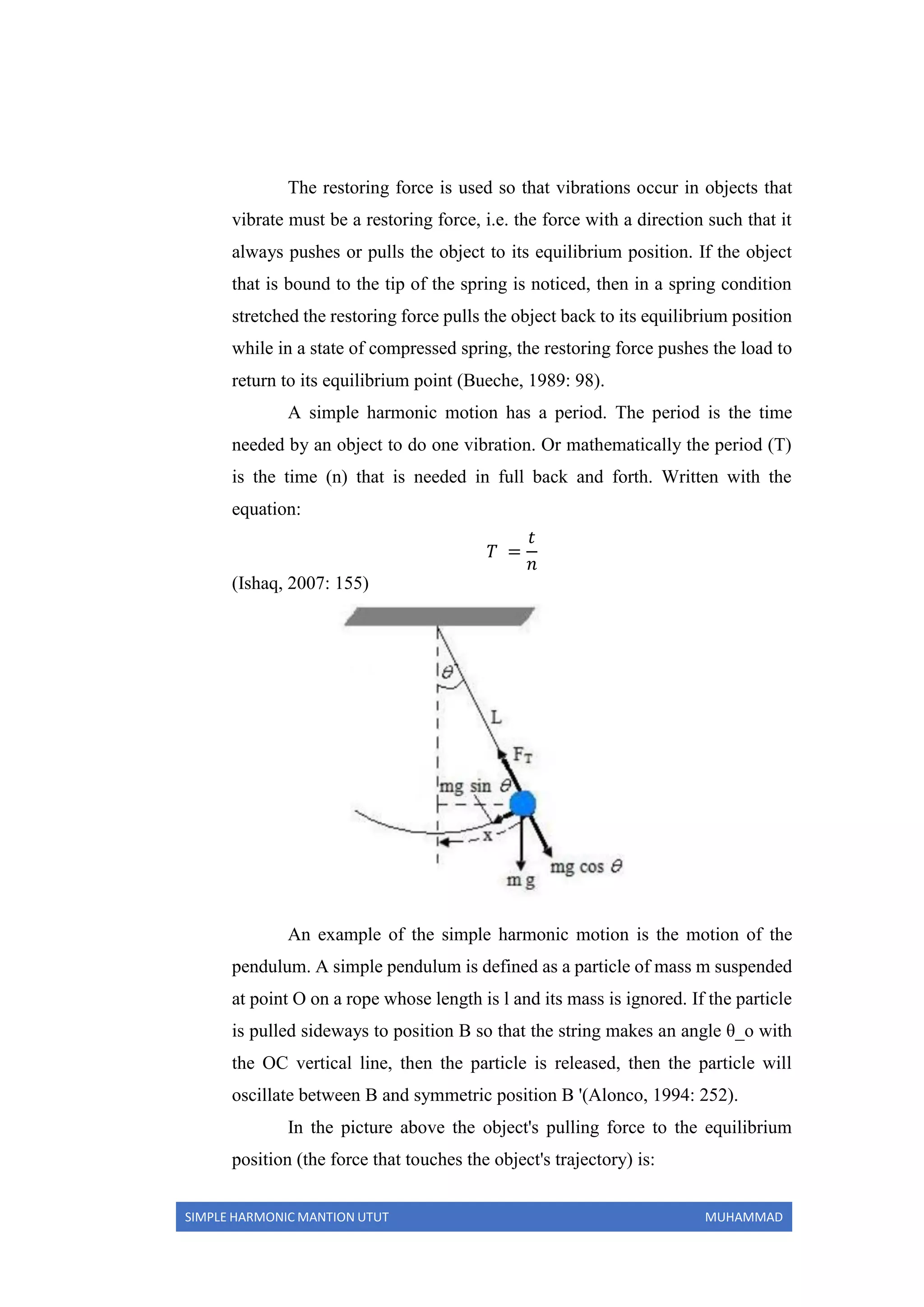
An example of the simple harmonic motion is the motion of the
pendulum. A simple pendulum is defined as a particle of mass m suspended
at point O on a rope whose length is l and its mass is ignored. If the particle
is pulled sideways to position B so that the string makes an angle θ_o with
the OC vertical line, then the particle is released, then the particle will
oscillate between B and symmetric position B '(Alonco, 1994: 252).
In the picture above the object's pulling force to the equilibrium
position (the force that touches the object's trajectory) is:
SIMPLE HARMONIC MANTION UTUT MUHAMMAD
𝐹 = −𝑊 𝑠𝑖𝑛 𝑠𝑖𝑛 𝜃
By lowering the previous equation we got frequency and period of
oscillation of the pendulum simple mathematical is:
𝑓 =
1
2𝜋
√
𝑔
𝑙
𝑎𝑛𝑑 𝑇2
=
4𝜋2
𝑔
𝑙
(Mikrajuddin, 2016: 502)
Normally the two systems are always used as an example of motion
harmonic simple as a spring system and pendulum or pendulum. Indeed the
RC electronic circuit is also another example of simple harmonic motion, if
a pendulum is given a deviation around its equilibrium point with a swing
angle θ (in the sense of a small angle), a harmonious motion arises due to
the recovery force arising at F = mg sin an y the direction is always opposite
to the pendulum swing ∑ F = ma in the direction of x:
∑ 𝐹 = 𝑚𝑎 −
𝑊.𝑠𝑖𝑛 𝑠𝑖𝑛 𝜃 = 𝑚.
𝑑2
𝑥
𝑑𝑡2−
𝑚𝑔 𝑠𝑖𝑛 𝑠𝑖𝑛 𝜃 = 𝑚.
𝑑2
𝑥
𝑑𝑡2
𝑏𝑦 𝑟𝑒𝑚𝑜𝑣𝑖𝑛𝑔 𝑚 −
𝑔 𝑠𝑖𝑛 𝑠𝑖𝑛 𝜃 =
𝑑2
𝑥
𝑑𝑡2
𝑓𝑜𝑟 𝑎𝑛𝑔𝑙𝑒𝑠 𝜃 𝑠𝑚𝑎𝑙𝑙𝑒𝑟 𝑠𝑖𝑛 𝑠𝑖𝑛 𝜃 =𝑡𝑎𝑛 𝑡𝑎𝑛 𝜃
−𝑔 𝑡𝑎𝑛 𝑡𝑎𝑛 𝜃 =
𝑑2
𝑥
𝑑𝑡2
,𝑡𝑎𝑛 𝑡𝑎𝑛 𝜃 =
𝑥
𝐿
𝑠𝑜:
−𝑔
𝑥
𝐿
=
𝑑2
𝑥
𝑑𝑡2
𝑑2
𝑥
𝑑𝑡2
+ (
𝑔
𝐿
) 𝑥 = 0
Because the angular frequency 𝜔 = √
𝑔
𝐿
where 𝜔 =
2𝜋
𝑇
so
2𝜋
𝑇
= √
𝑔
𝐿
Or
𝑇2
=
4𝜋2
𝑔
. 𝐿
(Ishaq, 2007: 157-158).
SIMPLE HARMONIC MANTION UTUT MUHAMMAD
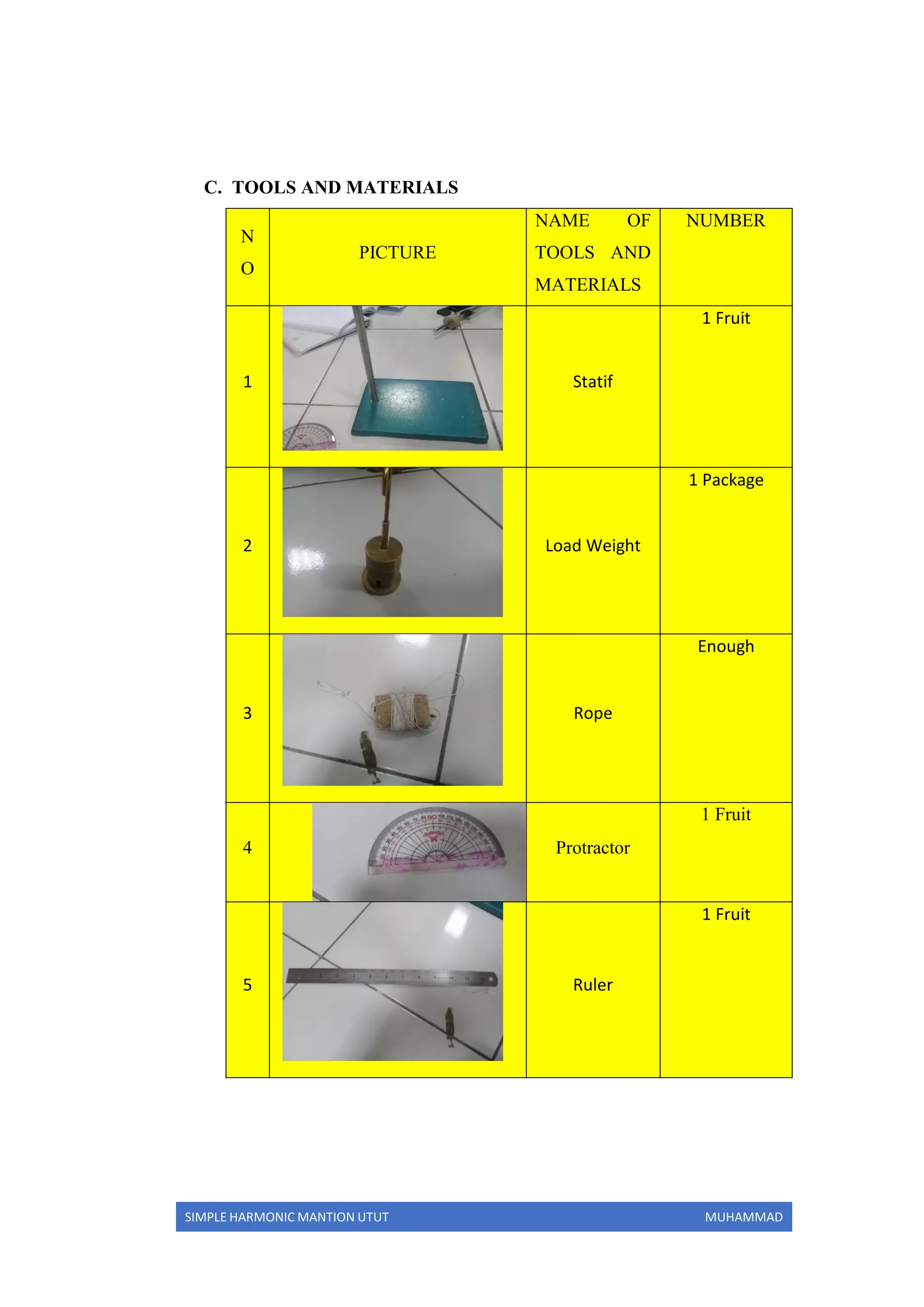
C. TOOLS AND MATERIALS
N
O
PICTURE
NAME OF
TOOLS AND
MATERIALS
NUMBER
1 Statif
1 Fruit
2 Load Weight
1 Package
3 Rope
Enough
4 Protractor
1 Fruit
5 Ruler
1 Fruit
SIMPLE HARMONIC MANTION UTUT MUHAMMAD
6 Stopwatch
1 Fruit
7 Bosshead
1 Fruit
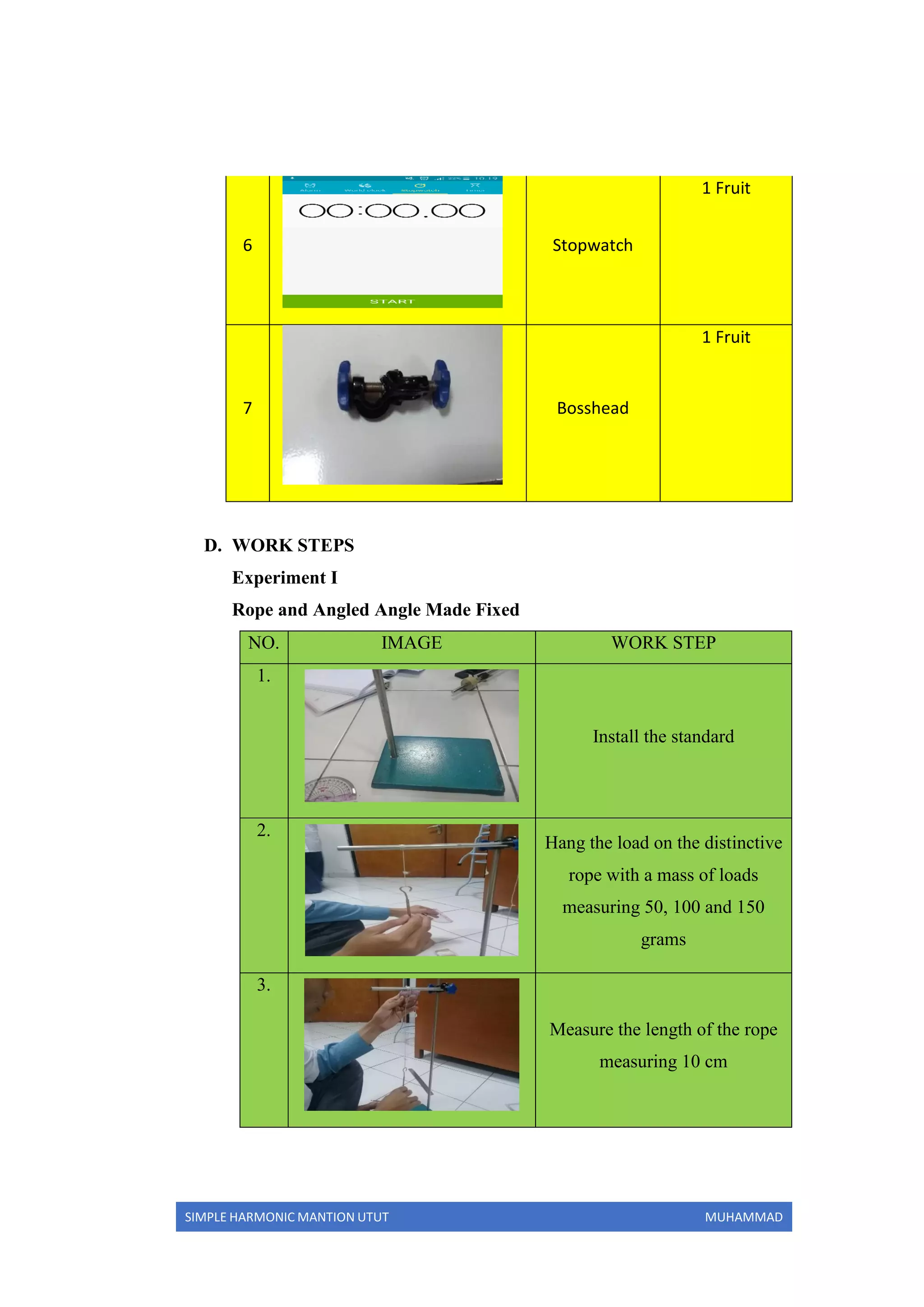
D. WORK STEPS
Experiment I
Rope and Angled Angle Made Fixed
NO. IMAGE WORK STEP
1.
Install the standard
2.
Hang the load on the distinctive
rope with a mass of loads
measuring 50, 100 and 150
grams
3.
Measure the length of the rope
measuring 10 cm
SIMPLE HARMONIC MANTION UTUT MUHAMMAD
4.
Measure the angle given by the
deviation of 10o
.
5.
Remove the pendulum along
with the stopwatch. Measure
the time needed for the
pendulum to reach 5 vibrations.
6.
Record the experimental results
of the
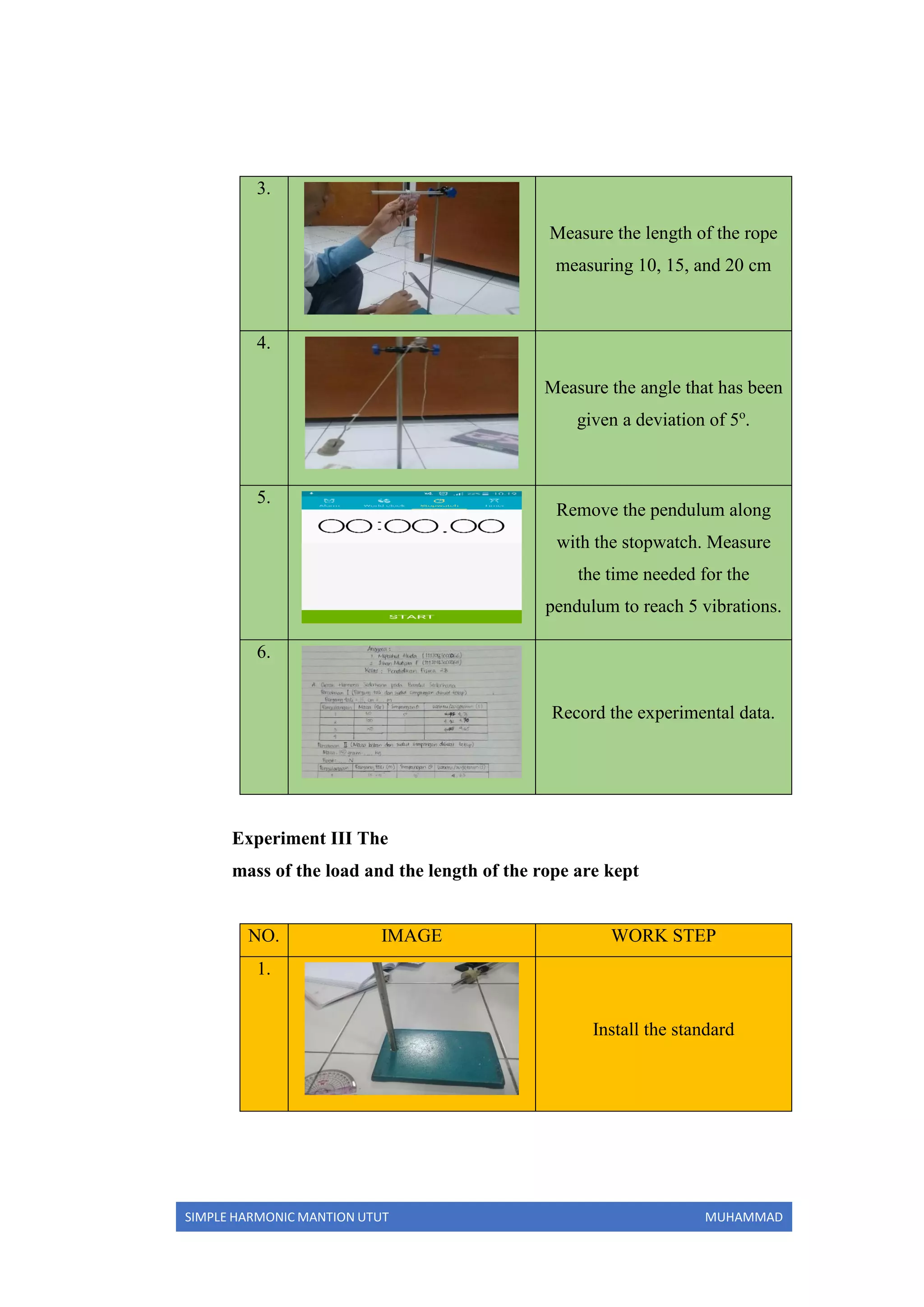
Experiment II. The
mass of the load and the angle of deviation are made to remain
NO. IMAGE WORK STEP
1.
Install the standard
2.
Hang the load on the distinctive
rope with a mass of load
measuring 50 grams
SIMPLE HARMONIC MANTION UTUT MUHAMMAD
3.
Measure the length of the rope
measuring 10, 15, and 20 cm
4.
Measure the angle that has been
given a deviation of 5o
.
5.
Remove the pendulum along
with the stopwatch. Measure
the time needed for the
pendulum to reach 5 vibrations.
6.
Record the experimental data.
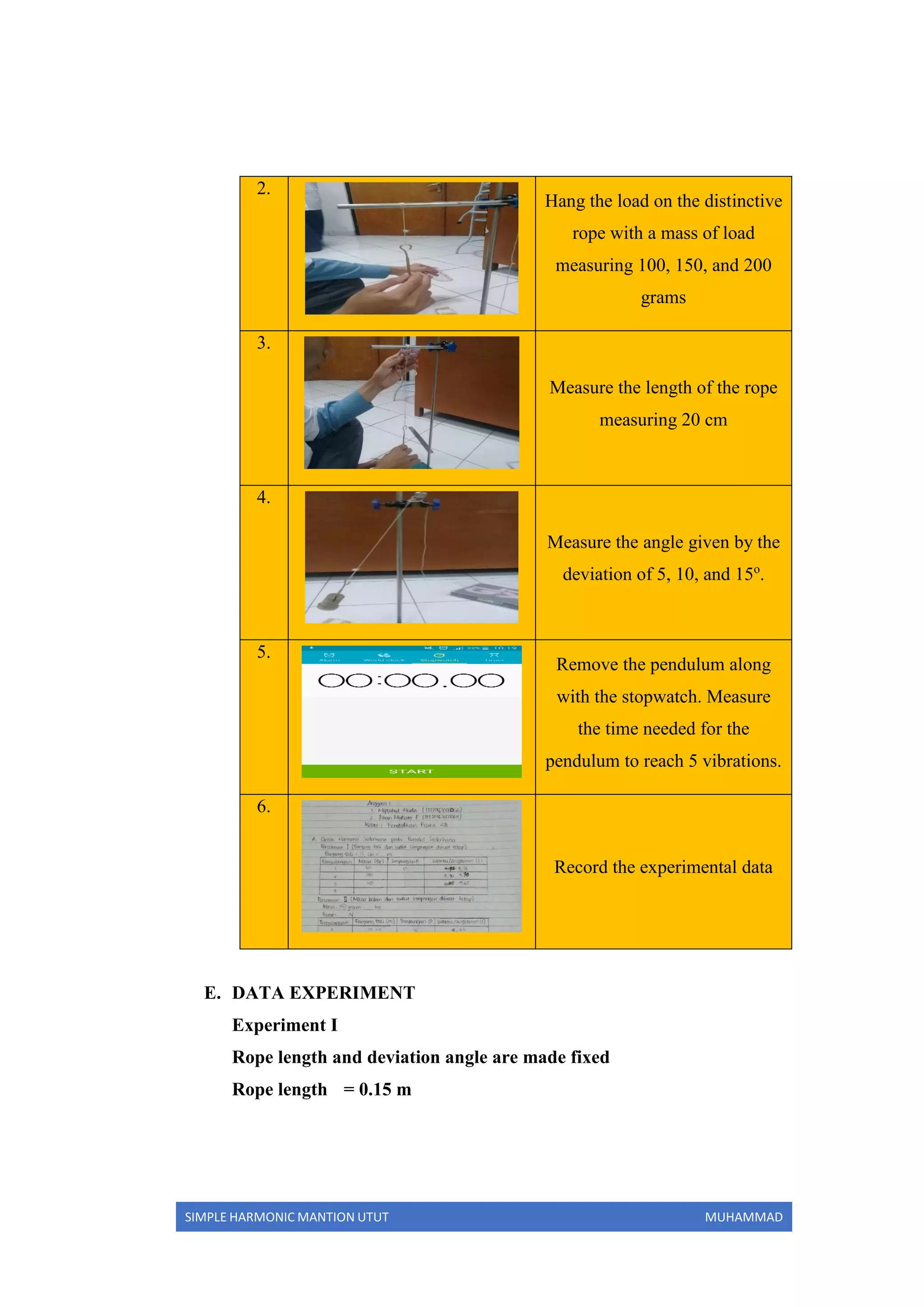
Experiment III The
mass of the load and the length of the rope are kept
NO. IMAGE WORK STEP
1.
Install the standard
SIMPLE HARMONIC MANTION UTUT MUHAMMAD
2.
Hang the load on the distinctive
rope with a mass of load
measuring 100, 150, and 200
grams
3.
Measure the length of the rope
measuring 20 cm
4.
Measure the angle given by the
deviation of 5, 10, and 15o
.
5.
Remove the pendulum along
with the stopwatch. Measure
the time needed for the
pendulum to reach 5 vibrations.
6.
Record the experimental data
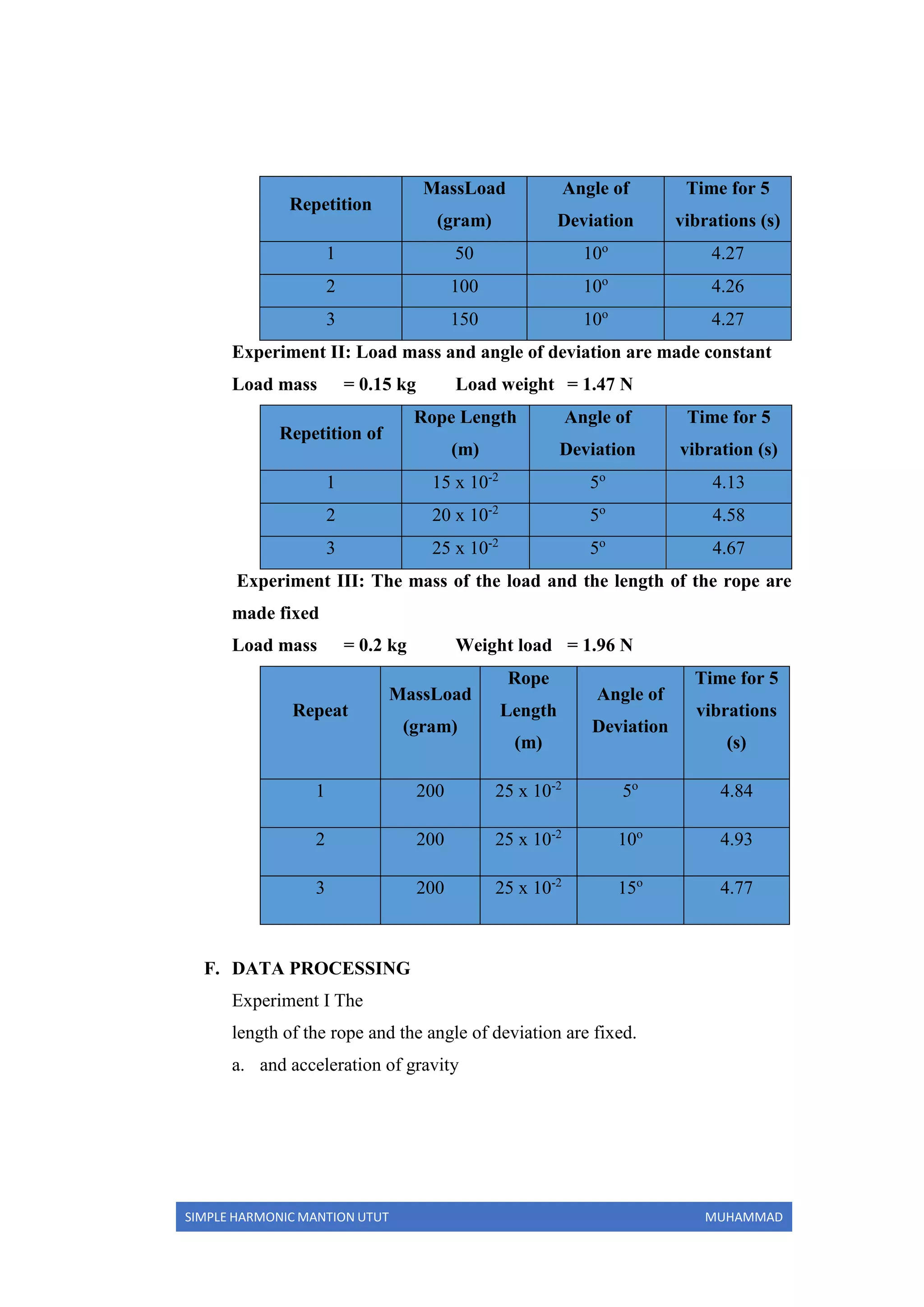
E. DATA EXPERIMENT
Experiment I
Rope length and deviation angle are made fixed
Rope length = 0.15 m
SIMPLE HARMONIC MANTION UTUT MUHAMMAD
Repetition
MassLoad
(gram)
Angle of
Deviation
Time for 5
vibrations (s)
1 50 10o
4.27
2 100 10o
4.26
3 150 10o
4.27
Experiment II: Load mass and angle of deviation are made constant
Load mass = 0.15 kg Load weight = 1.47 N
Repetition of
Rope Length
(m)
Angle of
Deviation
Time for 5
vibration (s)
1 15 x 10-2
5o
4.13
2 20 x 10-2
5o
4.58
3 25 x 10-2
5o
4.67
Experiment III: The mass of the load and the length of the rope are
made fixed
Load mass = 0.2 kg Weight load = 1.96 N
Repeat
MassLoad
(gram)
Rope
Length
(m)
Angle of
Deviation
Time for 5
vibrations
(s)
1 200 25 x 10-2
5o
4.84
2 200 25 x 10-2
10o
4.93
3 200 25 x 10-2
15o
4.77
F. DATA PROCESSING
Experiment I The
length of the rope and the angle of deviation are fixed.
a. and acceleration of gravity
SIMPLE HARMONIC MANTION UTUT MUHAMMAD
Repeat
Pendulum
periodPendulum
Period
Gravity Acceleration
1
𝑇 =
𝑡
𝑛
𝑇 =
4.27
5
𝑇 = 0.854 𝑠
𝑔 =
4𝜋 2
𝑙
𝑇2
𝑔 =
4. (3.14) 2
. 0.1 𝑚
0.8542
𝑔 = 5.40 𝑚 /𝑠2
2
𝑇 =
𝑡
𝑛
𝑇 =
4.25
5
𝑇 = 0.852 𝑠
𝑔 =
4𝜋 2
𝑙
𝑇2
𝑔 =
4. (3.14) 2
. 0.1 𝑚
0.8522
𝑔 = 5.42 𝑚 /𝑠2
3
𝑇 =
𝑡
𝑛
𝑇 =
4.27
5
𝑇 = 0.854 𝑠
𝑔 =
4𝜋 2
𝑙
𝑇2
𝑔 =
4. (3.14) 2
. 0.1 𝑚
0.8542
𝑔 = 5.40 𝑚 /𝑠2
b. Relative error
Repetition Relative error
1
𝐾𝑅 = [
𝑔𝑡ℎ𝑒𝑜𝑟𝑦 − 𝑔 𝑝𝑟𝑎𝑐𝑡𝑖𝑐𝑒𝑠
𝑔𝑡ℎ𝑒𝑜𝑟𝑦
] 𝑥 100%
𝐾𝑅 = [
9.80665 𝑡𝑜 5.40
9.80665
] 𝑥 100%
𝐾𝑅 = [0.449]𝑥 100%
= 44.9% 𝐾𝑅
2
𝐾𝑅 = [
𝑔𝑡ℎ𝑒𝑜𝑟𝑦 − 𝑔 𝑝𝑟𝑎𝑐𝑡𝑖𝑐𝑒𝑠
𝑔𝑡ℎ𝑒𝑜𝑟𝑦
] 𝑥 100%
𝐾𝑅 = [
9.80665 𝑡𝑜 5.40
9.80665
] 𝑥 100%
𝐾𝑅 = [0,447]𝑥 100%
= 44.7% 𝐾𝑅
3
𝐾𝑅 = [
𝑔𝑡ℎ𝑒𝑜𝑟𝑦 − 𝑔 𝑝𝑟𝑎𝑐𝑡𝑖𝑐𝑒𝑠
𝑔𝑡ℎ𝑒𝑜𝑟𝑦
] 𝑥 100%
𝐾𝑅 = [
9.80665 𝑡𝑜 5.40
9.80665
] 𝑥 100%
𝐾𝑅 = [0.449]𝑥 100%
= 44.9% 𝐾𝑅
Experiment II
SIMPLE HARMONIC MANTION UTUT MUHAMMAD
Massa load and angle deviation is made Equipment.
a. Pendulum period and gravitational acceleration.
Repetition of PendulumPeriod Gravity Acceleration
1
𝑇 =
𝑡
𝑛
𝑇 =
4.13
5
𝑇 = 0.826 𝑠
𝑔 =
4𝜋 2
𝑙
𝑇2
𝑔 =
4. (3.14) 2
. 0.1 𝑚
0.8262
𝑔 = 5.78 𝑚 /𝑠2
2
𝑇 =
𝑡
𝑛
𝑇 =
4.58
5
𝑇 = 0.916 𝑠
𝑔 =
4𝜋 2
𝑙
𝑇2
𝑔 =
4. (3.14) 2
. 0.15 𝑚
0.9162
𝑔 = 7.05 𝑚 /𝑠2
3
𝑇 =
𝑡
𝑛
𝑇 =
4.67
5
𝑇 = 0.934 𝑠
𝑔 =
4𝜋 2
𝑙
𝑇2
𝑔 =
4. (3.14) 2
. 0.2 𝑚
0.9342
𝑔 = 9.04 𝑚 /𝑠2
b. relative error
Repeatability Relative error
1
𝐾𝑅 = [
𝑔𝑡ℎ𝑒𝑜𝑟𝑦 − 𝑔 𝑝𝑟𝑎𝑐𝑡𝑖𝑐𝑒𝑠
𝑔𝑡ℎ𝑒𝑜𝑟𝑦
] 𝑥 100%
𝐾𝑅 = [
9.80665 𝑡𝑜 5.78
9.80665
] 𝑥 100%
𝐾𝑅 = [0.410]𝑥 100%
= 41% 𝐾𝑅
2
𝐾𝑅 = [
𝑔𝑡ℎ𝑒𝑜𝑟𝑦 − 𝑔 𝑝𝑟𝑎𝑐𝑡𝑖𝑐𝑒
𝑔𝑡ℎ𝑒𝑜𝑟𝑦
] 𝑥 100%
𝐾𝑅 = [
9,80665 − 7,05
9,80665
] 𝑥 100%
𝐾𝑅 = [0,281]𝑥 100%
𝐾𝑅 = 28,1%
3
𝐾𝑅 = [
𝑔𝑡ℎ𝑒𝑜𝑟𝑦 − 𝑔 𝑝𝑟𝑎𝑐𝑡𝑖𝑐𝑒
𝑔𝑡ℎ𝑒𝑜𝑟𝑦
] 𝑥 100%
𝐾𝑅 = [
9, 80665 − 9.04
9,80665
] 𝑥 100%
𝐾𝑅 = [0.078]𝑥 100%
𝐾𝑅 = 7.8%
Experiment III
Rope length and load mass made Fixed
SIMPLE HARMONIC MANTION UTUT MUHAMMAD
a. pendulum period and gravitational acceleration
Repeat Pendulum Period Gravity Acceleration
1
𝑇 =
𝑡
𝑛
𝑇 =
4 , 84
5
𝑇 = 0.968 𝑠
𝑔 =
4𝜋 2
𝑙
𝑇2
𝑔 =
4. (3.14) 2
. 0.2 𝑚
0.9682
𝑔 = 8.417 𝑚 /𝑠2
2
𝑇 =
𝑡
𝑛
𝑇 =
4.93
5
𝑇 = 0.986 𝑠
𝑔 =
4𝜋 2
𝑙
𝑇2
𝑔 =
4. (3.14) 2
. 0.2 𝑚
0.9862
𝑔 = 8.11 𝑚 /𝑠2
3
𝑇 =
𝑡
𝑛
𝑇 =
4.77
5
𝑇 = 0.954 𝑠
𝑔 =
4𝜋 2
𝑙
𝑇2
𝑔 =
4. (3.14) 2
. 0.2 𝑚
0.9542
𝑔 = 8.667 𝑚 /𝑠2
b. Relative error
Repetition Relative error
1
𝐾𝑅 = [
𝑔𝑡ℎ𝑒𝑜𝑟𝑦 − 𝑔 𝑝𝑟𝑎𝑐𝑡𝑖𝑐𝑒𝑠
𝑔𝑡ℎ𝑒𝑜𝑟𝑦
] 𝑥 100%
𝐾𝑅 = [
9.80665 𝑡𝑜 8.417
9.80665
] 𝑥 100%
𝐾𝑅 = [0.1417]𝑥 100%
𝐾𝑅 = 14, 17%
2
𝐾𝑅 = [
𝑔𝑡ℎ𝑒𝑜𝑟𝑦 − 𝑔 𝑝𝑟𝑎𝑐𝑡𝑖𝑐𝑒
𝑔𝑡ℎ𝑒𝑜𝑟𝑦
] 𝑥 100%
𝐾𝑅 = [
9,80665 − 8,11
9,80665
] 𝑥 100%
𝐾𝑅 = [0.173]𝑥 100%
𝐾𝑅 = 17.3%
3
𝐾𝑅 = [
𝑔𝑡ℎ𝑒𝑜𝑟𝑦 − 𝑔 𝑝𝑟𝑎𝑐𝑡𝑖𝑐𝑒
𝑔𝑡ℎ𝑒𝑜𝑟𝑦
] 𝑥 100%
𝐾𝑅 = [
9,80665 − 8,667
9,80665
] 𝑥 100%
𝐾𝑅 = [0.116]𝑥 100%
𝐾𝑅 = 11.6%
G. DISCUSSION
SIMPLE HARMONIC MANTION UTUT MUHAMMAD
In this practice, practicum conducted several experiments to prove
GHS (Simple Harmonic Motion). Simple harmonic motion to find the value
of gravitational acceleration can be done by several methods, the first
method is to use the length of the rope, and the angle of deviation that is
fixed, second, that is using the mass of the load and the deviation angle that
is fixed and the third is the mass of load and length of rope made regularly.
Simple harmonic motion is a vibration that occurs when if caused
by a force that directs itself to a point and the magnitude is balanced with
the deviation. The purpose of the practitioner when doing this lab is to
determine whether the gravitational perceptions obtained in this lab are the
same or not with theoretical gravitational acceleration. It is known where
the simple pendulum is only and only if there is a fulcrum where the load is
hung by a rope that depends on a fulcrum. Each vibration in the pendulum
is calculated by the time it takes to use the stopwatch. In this practice, try to
specify or change variables such as pendulum mass, deviation, and rope
length.
Praktikan takes data for the initial experiment that is using the length
of the rope and the angle of deviation that is made permanently but the mass
used is different like 50 grams, 100 grams, and 150 grams. When doing the
experiment the time obtained in the pendulum reached 5 vibrations, namely,
5.40 s, 5.42 s, and 5.40 s. Based on the three-time data we can conclude that
the greater the mass of time needed can also be faster or smaller, but the
foundation is not correct, because the mass of the load does not affect the
duration of time required for the 5 vibrations in motion. this simple
harmonic, but the time obtained is as big as each repetition, but the data
obtained by the practitioner is almost like all for this first experiment. After
doing the calculation to get the value of the period, the practitioner looks for
the gravitational value of an object, and the data obtained from the three
data is 5.40 𝑚 /𝑠2
, 5.42 𝑚 /𝑠2
, and 5.40 𝑚 /𝑠2
.
It can be noted that the results almost match all of the three data
because this is also not affected by the pendulum mass. It is also very far
SIMPLE HARMONIC MANTION UTUT MUHAMMAD
from the original gravitational theoretical value of 9,80665 𝑚 /𝑠2
, this is
very unexpected because the relative error is also very large with an average
relative error of 44, 83%. So in this case proving the mass of objects is not
a factor that can affect the value of gravitational acceleration, in this case
t,here is also a mistake in the practitioner that is when deviating from the
incorrect angle, measuring the length of the rope, and when releasing a
pendulum that does not match wrong in the lab.
In this second experiment, that is by using the mass of the load and
the angle of deviation that is made fixed. But the length of the rope used is
different for each repetition, which is 10 cm, 15 cm, and 20 cm. After
practicing, the data obtained for the period are 4.13 s, 4.58 s, and 4.67 s. Of
the three data obtained is seen that the length of the rope then the time
needed is also getting longer or vice versa. This is in accordance with the
theory that the length of the rope affects the length or not the time needed
for 5 vibrations in a simple pendulum. So, if the length of the rope is greater,
the length or length of time needed to reach one vibration and vice versa, if
the smaller the length of the rope, the faster or smaller the time needed to
achieve a vibration. After that, the practitioner performs a recalculation of
the experimental data obtained to obtain the results of the period and then
to get the data from the acceleration of gravity, which is 5.78 𝑚 /𝑠2
, 7.05
𝑚 /𝑠2
, and 9.04 𝑚 /𝑠2
. It can be noted that the longer the acceleration of
gravity, the greater is proportional to the length of the rope. Because this is
if the rope gets longer and closer to the earth (earth base), then the
acceleration in gravity is also getting bigger in terms of things like this
according to the results of the calculations obtained, but also the long
differences in this case are different with 5 cm, the data obtained should not
be far from calculating the repetition. These results are very far with the
actual gravity value of 9,80665 𝑚 /𝑠2
, as evidenced by the relative error
obtained is 25, 63% is the same as the percentage error data in this third
experiment. Based on the data from the results of the gravitational
acceleration values varying, the longer the rope is used, the greater the value
SIMPLE HARMONIC MANTION UTUT MUHAMMAD
of gravitational acceleration and the longer the rope, the greater the
pendulum period.
In the third experiment that has been done by the practitioner is
where the length of the rope and the mass of the load is made permanently
and given a deviation of different than each repetition that is equal to 5o
, 10o
and 15o
. When the practitioner has done the practicum, the time needed is
4.84 s, and 4.93 s, and 4.77 s. Based on the three times that are passed three
times that the greater the deviation, the time needed is also small or fast, but
in fact, this is wrong because the amount of deviation does not affect the
length or not required in the five simple pendulum vibrations. So the data
obtained is as large or almost close to the data that matches it. When
calculating the period and getting results for the acceleration of gravity, after
calculating the experimental data to get the results, the data is obtained with
three repetitions, namely 8.417 𝑚 /𝑠2
, 8.11 𝑚 /𝑠2
, and 8.667 𝑚 /𝑠2
. The
results show that the gravitational acceleration should be greater, but with
the data listed above we know that there is an error in human error , it can
be pressed or not simultaneously when releasing the pendulum and pressing
the stopwatch button and also due to lack of accuracy when retrieving data.
the amount of deviation should not be very far from the percentage of the
value of the relative error in the theoretical gravity value of 9.08665 𝑚 /𝑠2
with the average scale of the relative error of 11.02%.
Of the three data that have been carried out to determine the gravity
of the results of the observations or experiments obtained are not in
accordance with the value of gravitational acceleration based on the
theoretical ie 9.08665 𝑚 /𝑠2
but there are also those that think at 10 𝑚 /𝑠2
.
This happens because of the error factors when there are both internal and
external factors such as lack of accuracy in measuring the length of the rope
or angle of deviation, in this practice the,re is a difference between the
gravitational acceleration that the practitioner seeks with theoretical
gravitational acceleration. This happens maybe because of several factors
that cause the experimental data obtained to be imperfect or appropriate, for
SIMPLE HARMONIC MANTION UTUT MUHAMMAD
example the, first is, it occurs because in this lab using a stopwatch, it is
possible to turn on or turn off the stopwatch when measuring the pendulum
vibrating not exactly. Second is, when the pendulum oscillates, the
oscillations of the pendulum are not perfect according to the path causing
the time to reach one vibration is also different. The third is, when
measuring the size of the deviation from the pendulum each repetition may
differ slightly. Fourth is, when the measurement of the length of the rope
may be wrong in the measurement or when practicing the rope used
loosened from the bond and change the length of the rope. In this simple
harmonic motion practice the, practitioner can take data and practicum
smoothly with the guidance of Ka Nur.
H. POST PRACTICUM TASKS
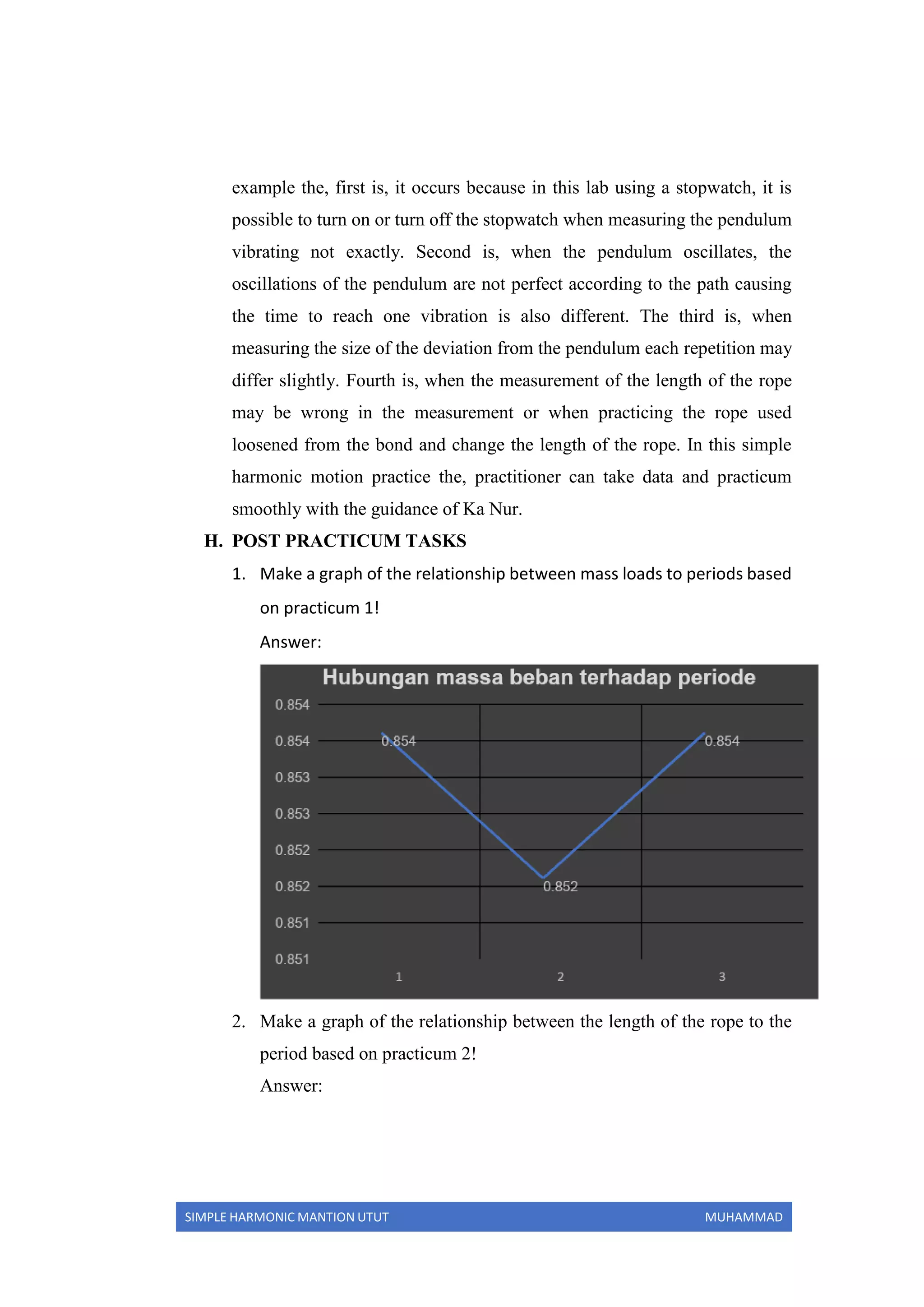
1. Make a graph of the relationship between mass loads to periods based
on practicum 1!
Answer:
2. Make a graph of the relationship between the length of the rope to the
period based on practicum 2!
Answer:
SIMPLE HARMONIC MANTION UTUT MUHAMMAD
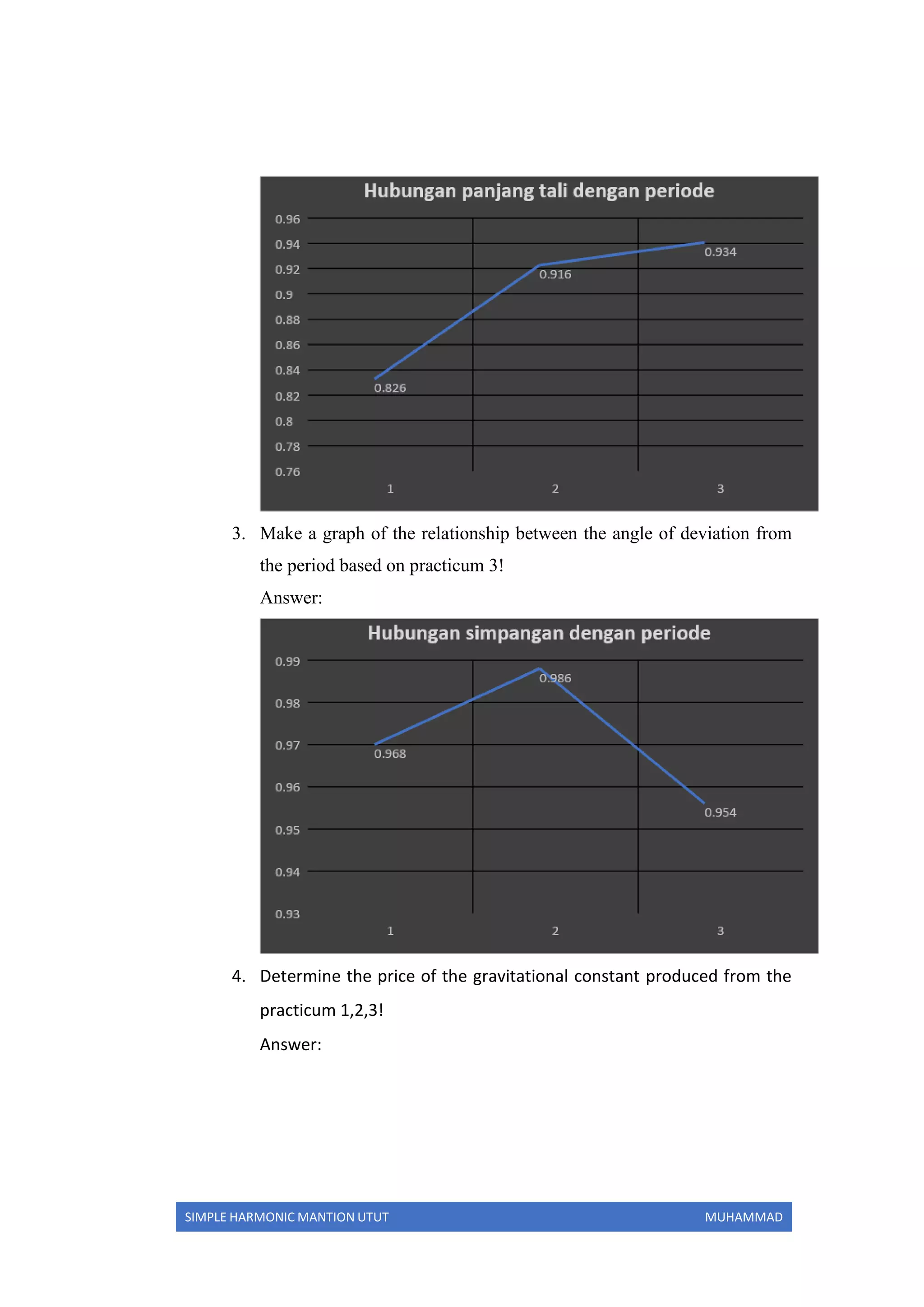
3. Make a graph of the relationship between the angle of deviation from
the period based on practicum 3!
Answer:
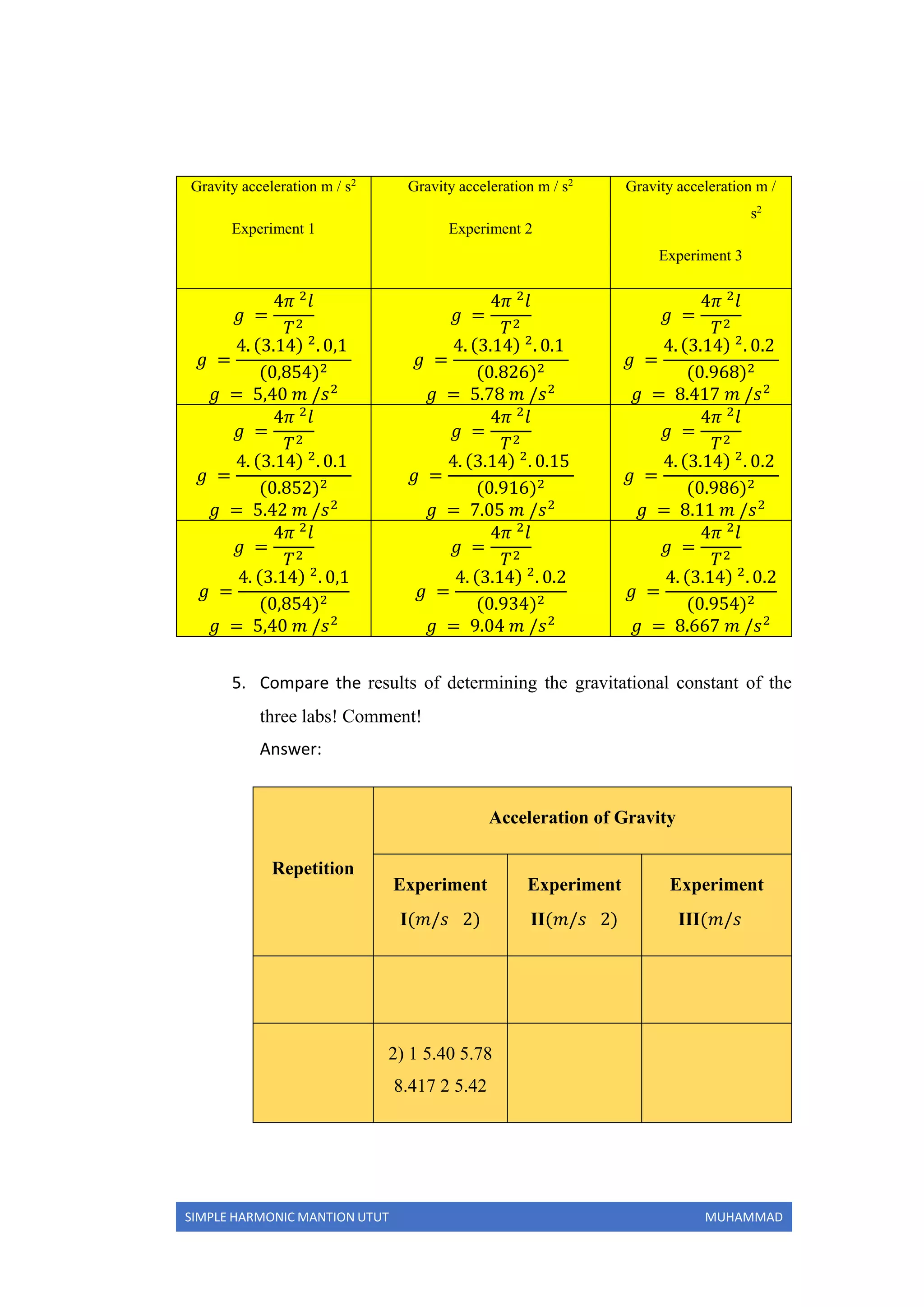
4. Determine the price of the gravitational constant produced from the
practicum 1,2,3!
Answer:
SIMPLE HARMONIC MANTION UTUT MUHAMMAD
Gravity acceleration m / s2
Experiment 1
Gravity acceleration m / s2
Experiment 2
Gravity acceleration m /
s2
Experiment 3
𝑔 =
4𝜋 2
𝑙
𝑇2
𝑔 =
4. (3.14) 2
. 0,1
(0,854)2
𝑔 = 5,40 𝑚 /𝑠2
𝑔 =
4𝜋 2
𝑙
𝑇2
𝑔 =
4. (3.14) 2
. 0.1
(0.826)2
𝑔 = 5.78 𝑚 /𝑠2
𝑔 =
4𝜋 2
𝑙
𝑇2
𝑔 =
4. (3.14) 2
. 0.2
(0.968)2
𝑔 = 8.417 𝑚 /𝑠2
𝑔 =
4𝜋 2
𝑙
𝑇2
𝑔 =
4. (3.14) 2
. 0.1
(0.852)2
𝑔 = 5.42 𝑚 /𝑠2
𝑔 =
4𝜋 2
𝑙
𝑇2
𝑔 =
4. (3.14) 2
. 0.15
(0.916)2
𝑔 = 7.05 𝑚 /𝑠2
𝑔 =
4𝜋 2
𝑙
𝑇2
𝑔 =
4. (3.14) 2
. 0.2
(0.986)2
𝑔 = 8.11 𝑚 /𝑠2
𝑔 =
4𝜋 2
𝑙
𝑇2
𝑔 =
4. (3.14) 2
. 0,1
(0,854)2
𝑔 = 5,40 𝑚 /𝑠2
𝑔 =
4𝜋 2
𝑙
𝑇2
𝑔 =
4. (3.14) 2
. 0.2
(0.934)2
𝑔 = 9.04 𝑚 /𝑠2
𝑔 =
4𝜋 2
𝑙
𝑇2
𝑔 =
4. (3.14) 2
. 0.2
(0.954)2
𝑔 = 8.667 𝑚 /𝑠2
5. Compare the results of determining the gravitational constant of the
three labs! Comment!
Answer:
Repetition
Acceleration of Gravity
Experiment
I(𝑚/𝑠 2)
Experiment
II(𝑚/𝑠 2)
Experiment
III(𝑚/𝑠
2) 1 5.40 5.78
8.417 2 5.42
SIMPLE HARMONIC MANTION UTUT MUHAMMAD
, 40 9.04 8,667
My opinion is a comparison with the experimental data above is
the second data on the third repetition that is equal to 9.04 𝑚 /𝑠2
and the
third data with the last data repetition that is equal to 8.667 𝑚 /𝑠2
.
Different from the first experiment, the data obtained is getting smaller
and the distance is getting farther away with the actual gravity value of
9.8 𝑚 /𝑠2
.
6. Determine the percentage of errors from the results of the calculation of
the three labs! If the gravitational acceleration is 9.80665 𝑚 /𝑠2
.
Answer:
ErrorRelative
Experiment 1
Error Relative
Experiment 2
Mistakes Relative
Experiment 3
𝐾𝑅
= [
𝑔𝑡ℎ𝑒𝑜𝑟𝑦 − 𝑔 𝑝𝑟𝑎𝑐𝑡𝑖𝑐𝑒𝑠
𝑔𝑡ℎ𝑒𝑜𝑟𝑦
] 𝑥 100%
𝐾𝑅
= [
9.80665 𝑡𝑜 5.4
9.80665
] 𝑥 100%
𝐾𝑅 = [0.449]𝑥 100%
𝐾𝑅 = 44 , 9%
𝐾𝑅
= [
𝑔𝑡ℎ𝑒𝑜𝑟𝑦 − 𝑔 𝑝𝑟𝑎𝑐𝑡𝑖𝑐𝑒𝑠
𝑔𝑡ℎ𝑒𝑜𝑟𝑦
] 𝑥 100%
𝐾𝑅
= [
9.80665 𝑡𝑜 5.78
9.80665
] 𝑥 100%
𝐾𝑅 = [0.41]𝑥 100%
= 41% 𝐾𝑅
𝐾𝑅
= [
𝑔𝑡ℎ𝑒𝑜𝑟𝑦 − 𝑔 𝑝𝑟𝑎𝑐𝑡𝑖𝑐𝑒𝑠
𝑔𝑡ℎ𝑒𝑜𝑟𝑦
] 𝑥 100%
𝐾𝑅
= [
9,80665 − 8,417
9,80665
] 𝑥 100%
𝐾𝑅 = [0.1417]𝑥 100%
𝐾𝑅 = 14.17%
𝐾𝑅
= [
𝑔𝑡ℎ𝑒𝑜𝑟𝑦 − 𝑔 𝑝𝑟𝑎𝑐𝑡𝑖𝑐𝑒
𝑔𝑡ℎ𝑒𝑜𝑟𝑦
] 𝑥 100%
𝐾𝑅
= [
9,80665 − 5 , 42
9.80665
] 𝑥 100%
𝐾𝑅 = [0,447]𝑥 100%
= 44.7% 𝐾𝑅
𝐾𝑅
= [
𝑔𝑡ℎ𝑒𝑜𝑟𝑦 − 𝑔 𝑝𝑟𝑎𝑐𝑡𝑖𝑐𝑒𝑠
𝑔𝑡ℎ𝑒𝑜𝑟𝑦
] 𝑥 100%
𝐾𝑅
= [
9.80665 𝑡𝑜 7.05
9.80665
] 𝑥 100%
𝐾𝑅 = [0.281]𝑥 100%
= 28.1% 𝐾𝑅
𝐾𝑅
= [
𝑔𝑡ℎ𝑒𝑜𝑟𝑦 − 𝑔 𝑝𝑟𝑎𝑐𝑡𝑖𝑐𝑒𝑠
𝑔𝑡ℎ𝑒𝑜𝑟𝑦
] 𝑥 100%
𝐾𝑅
= [
9.80665 𝑡𝑜 8.11
9.80665
] 𝑥 100%
𝐾𝑅 = [0.175]𝑥 100%
= 17.5% 𝐾𝑅
𝐾𝑅
= [
𝑔𝑡ℎ𝑒𝑜𝑟𝑦 − 𝑔 𝑝𝑟𝑎𝑐𝑡𝑖𝑐𝑒𝑠
𝑔𝑡ℎ𝑒𝑜𝑟𝑦
] 𝑥 100%
𝐾𝑅
= [
9.80665 𝑡𝑜 5.40
9.80665
] 𝑥 100%
𝐾𝑅
= [
𝑔𝑡ℎ𝑒𝑜𝑟𝑦 − 𝑔 𝑝𝑟𝑎𝑐𝑡𝑖𝑐𝑒𝑠
𝑔𝑡ℎ𝑒𝑜𝑟𝑦
] 𝑥 100%
𝐾𝑅
= [
9.80665 𝑡𝑜 9.04
9.80665
] 𝑥 100%
𝐾𝑅
= [
𝑔𝑡ℎ𝑒𝑜𝑟𝑦 − 𝑔 𝑝𝑟𝑎𝑐𝑡𝑖𝑐𝑒𝑠
𝑔𝑡ℎ𝑒𝑜𝑟𝑦
] 𝑥 100%
𝐾𝑅
= [
9.80665 𝑡𝑜 8.667
9.80665
] 𝑥 100 %
SIMPLE HARMONIC MANTION UTUT MUHAMMAD
𝐾𝑅 = [0.449]𝑥 100%
= 44.9% 𝐾𝑅
𝐾𝑅 = [0.078]𝑥 100%
= 7.8% 𝐾𝑅
𝐾𝑅 = [0.116]𝑥 100%
𝐾𝑅 = 11 , 6%
7. Which method do you think is closer to the real result? Explain your
argument!
Answer:
In my opinion, if you look at the comparison between the first to third
experiments, the closest to the theoretical gravitational acceleration is
9,80665 𝑚 /𝑠2,
which is the third experiment because the greatest
acceleration value of the experiment is 9.04 𝑚 /𝑠2
. In contrast to the
first experiment and the third data that is still far from the difference
with the gravitational acceleration theoretically, but in the third data it
is only less small to equate the theoretical gravitational perceptions, but
the second data with the third data approximation can be close to the
gravitational acceleration. So, actually because the mass of the load and
the amount of deviation does not affect the acceleration of gravity, it is
better to change the length of the rope, because the length of the rope
affects the acceleration of gravity, so we can compare the magnitude of
the acceleration according to the second experiment. .
8. Analyze the location of errors when practicing!
Answer:
When making a pendulum that is used to measure the time through a
stopwatch is the observer's inaccuracy when making a deviation and
stopping and starting the stopwatch, then on the string installation
statif by changing the string variable allows the error in the length of
the rope to be fixed at the pendulum installation. And also First, when
the measurement of the length of the rope may be wrong in the
measurement or when the practicum of the rope is used loosely from
the bond and change the length of the rope. Second, when measuring
the magnitude of the deviation from the pendulum each repetition
may differ slightly. Third, when the pendulum oscillates, the
SIMPLE HARMONIC MANTION UTUT MUHAMMAD
oscillations of the pendulum are not perfect according to the time that
causes the time to reach one vibration also different. Fourth, because
in this lab using a stopwatch, it is possible that when turning the
stopwatch on or off when measuring the pendulum vibrating time, the
device is inappropriate or not accurate causing the time to be incorrect.
I. CONCLUSION
Based on the practicum that has been done, it can be concluded that: The
1. condition of the object to do simple harmonious motion is the
restoring force proportional to its deviation.
2. The period can be determined by the equation:
𝑇 =
𝑡
𝑛
3. be determined by the equation:
𝑇 = 2𝜋√
𝑙
𝑔
4. Factors that affect gravity namely the height of an object The
5. Gravity acceleration value of gravitational acceleration constants
can be determined by the equation of the period as follows:
𝑔 =
4𝜋 2
𝑙
𝑇2
J. COMMENTS
1. Before doing the lab you should first understand the contents of the
module and the material to be studied
2. Make sure when distorting the pendulum, the pendulum does not
touch other objects
3. Make sure it is right in distorting the pendulum according to the
variable sought
K. REFERENCES
SIMPLE HARMONIC MANTION UTUT MUHAMMAD
Abdullah, Mikrajuddin. 2016. Basic Physics II. Bandung Bandung: Institute
of Technology.
Alonco, M and Finn, EJ 1994. Fundamentals of University Physics Volume
2. Jakarta: Erlangga
Bueche, Frederick and Eugene Hecht. 2006. Ten Physics University Edition.
Jakarta: Erlangga
Giancoli, Douglas C. 2014. Physics: Principles and Applications of the
Seventh Edition
Volume 1. Jakarta: Erlangga.
Halliday, Resnick. 2014. Fundamentals of Physics. Jakarta: Erlangga
Ishaq, Muhammad. 2007. Secondary Physics Second Edition. Yogyakarta:
Graha Ilmu
L. ATTACHMENT

Simple harmonic movement in bandul

  • 1.
    REPORT OF PRACTICUM "SIMPLEHARMONIC MOVEMENT IN BANDUL “ COLLECTION DATE : 23rd of April 2018 M DATEPRACTICUM : 18th of April 2018 "SIMPLE HARMONIC MOTION ON SIMPLE PENDULUM" FINAL PRACTICUM A. OBJECTIVES PRACTICUM 1. to determine factors which can affect the acceleration of gravity. 2. Can determine the period of a pendulum. 3. Knowing the constant acceleration of gravity with a simple pendulum. 4. Compare the results of the gravitational acceleration to a simple pendulum with theoretical gravitational acceleration. 5. Can understand the terms of simple harmonic motion in the pendulum. B. BASIC THEORY This movement will have an equilibrium point, where the position of the object oscillated does not direct the force. When an object gets a net force, the object will move away from its equilibrium point and return to its equilibrium point due to the restoring force. A simple pendulum has an equilibrium point that is perpendicular to the rope with a support pole. This pendulum has a mass of weights and straps, pendants will oscillate at the x coordinate (Giancoli, 2014: 369). Simple pendulum or (simple pendulum). A simple pendulum is an ideal object consisting of a point of mass hanging on a light rope that cannot stretch. If the pendulum is pulled sideways from its balanced position and released, the pendulum will swing in the pertinent field due to the influence of gravity, its motion is oscillating and periodic motion (Halliday, 1991: 459).
  • 2.
    SIMPLE HARMONIC MANTIONUTUT MUHAMMAD The restoring force is used so that vibrations occur in objects that vibrate must be a restoring force, i.e. the force with a direction such that it always pushes or pulls the object to its equilibrium position. If the object that is bound to the tip of the spring is noticed, then in a spring condition stretched the restoring force pulls the object back to its equilibrium position while in a state of compressed spring, the restoring force pushes the load to return to its equilibrium point (Bueche, 1989: 98). A simple harmonic motion has a period. The period is the time needed by an object to do one vibration. Or mathematically the period (T) is the time (n) that is needed in full back and forth. Written with the equation: 𝑇 = 𝑡 𝑛 (Ishaq, 2007: 155) An example of the simple harmonic motion is the motion of the pendulum. A simple pendulum is defined as a particle of mass m suspended at point O on a rope whose length is l and its mass is ignored. If the particle is pulled sideways to position B so that the string makes an angle θ_o with the OC vertical line, then the particle is released, then the particle will oscillate between B and symmetric position B '(Alonco, 1994: 252). In the picture above the object's pulling force to the equilibrium position (the force that touches the object's trajectory) is:
  • 3.
    SIMPLE HARMONIC MANTIONUTUT MUHAMMAD 𝐹 = −𝑊 𝑠𝑖𝑛 𝑠𝑖𝑛 𝜃 By lowering the previous equation we got frequency and period of oscillation of the pendulum simple mathematical is: 𝑓 = 1 2𝜋 √ 𝑔 𝑙 𝑎𝑛𝑑 𝑇2 = 4𝜋2 𝑔 𝑙 (Mikrajuddin, 2016: 502) Normally the two systems are always used as an example of motion harmonic simple as a spring system and pendulum or pendulum. Indeed the RC electronic circuit is also another example of simple harmonic motion, if a pendulum is given a deviation around its equilibrium point with a swing angle θ (in the sense of a small angle), a harmonious motion arises due to the recovery force arising at F = mg sin an y the direction is always opposite to the pendulum swing ∑ F = ma in the direction of x: ∑ 𝐹 = 𝑚𝑎 − 𝑊.𝑠𝑖𝑛 𝑠𝑖𝑛 𝜃 = 𝑚. 𝑑2 𝑥 𝑑𝑡2− 𝑚𝑔 𝑠𝑖𝑛 𝑠𝑖𝑛 𝜃 = 𝑚. 𝑑2 𝑥 𝑑𝑡2 𝑏𝑦 𝑟𝑒𝑚𝑜𝑣𝑖𝑛𝑔 𝑚 − 𝑔 𝑠𝑖𝑛 𝑠𝑖𝑛 𝜃 = 𝑑2 𝑥 𝑑𝑡2 𝑓𝑜𝑟 𝑎𝑛𝑔𝑙𝑒𝑠 𝜃 𝑠𝑚𝑎𝑙𝑙𝑒𝑟 𝑠𝑖𝑛 𝑠𝑖𝑛 𝜃 =𝑡𝑎𝑛 𝑡𝑎𝑛 𝜃 −𝑔 𝑡𝑎𝑛 𝑡𝑎𝑛 𝜃 = 𝑑2 𝑥 𝑑𝑡2 ,𝑡𝑎𝑛 𝑡𝑎𝑛 𝜃 = 𝑥 𝐿 𝑠𝑜: −𝑔 𝑥 𝐿 = 𝑑2 𝑥 𝑑𝑡2 𝑑2 𝑥 𝑑𝑡2 + ( 𝑔 𝐿 ) 𝑥 = 0 Because the angular frequency 𝜔 = √ 𝑔 𝐿 where 𝜔 = 2𝜋 𝑇 so 2𝜋 𝑇 = √ 𝑔 𝐿 Or 𝑇2 = 4𝜋2 𝑔 . 𝐿 (Ishaq, 2007: 157-158).
  • 4.
    SIMPLE HARMONIC MANTIONUTUT MUHAMMAD C. TOOLS AND MATERIALS N O PICTURE NAME OF TOOLS AND MATERIALS NUMBER 1 Statif 1 Fruit 2 Load Weight 1 Package 3 Rope Enough 4 Protractor 1 Fruit 5 Ruler 1 Fruit
  • 5.
    SIMPLE HARMONIC MANTIONUTUT MUHAMMAD 6 Stopwatch 1 Fruit 7 Bosshead 1 Fruit D. WORK STEPS Experiment I Rope and Angled Angle Made Fixed NO. IMAGE WORK STEP 1. Install the standard 2. Hang the load on the distinctive rope with a mass of loads measuring 50, 100 and 150 grams 3. Measure the length of the rope measuring 10 cm
  • 6.
    SIMPLE HARMONIC MANTIONUTUT MUHAMMAD 4. Measure the angle given by the deviation of 10o . 5. Remove the pendulum along with the stopwatch. Measure the time needed for the pendulum to reach 5 vibrations. 6. Record the experimental results of the Experiment II. The mass of the load and the angle of deviation are made to remain NO. IMAGE WORK STEP 1. Install the standard 2. Hang the load on the distinctive rope with a mass of load measuring 50 grams
  • 7.
    SIMPLE HARMONIC MANTIONUTUT MUHAMMAD 3. Measure the length of the rope measuring 10, 15, and 20 cm 4. Measure the angle that has been given a deviation of 5o . 5. Remove the pendulum along with the stopwatch. Measure the time needed for the pendulum to reach 5 vibrations. 6. Record the experimental data. Experiment III The mass of the load and the length of the rope are kept NO. IMAGE WORK STEP 1. Install the standard
  • 8.
    SIMPLE HARMONIC MANTIONUTUT MUHAMMAD 2. Hang the load on the distinctive rope with a mass of load measuring 100, 150, and 200 grams 3. Measure the length of the rope measuring 20 cm 4. Measure the angle given by the deviation of 5, 10, and 15o . 5. Remove the pendulum along with the stopwatch. Measure the time needed for the pendulum to reach 5 vibrations. 6. Record the experimental data E. DATA EXPERIMENT Experiment I Rope length and deviation angle are made fixed Rope length = 0.15 m
  • 9.
    SIMPLE HARMONIC MANTIONUTUT MUHAMMAD Repetition MassLoad (gram) Angle of Deviation Time for 5 vibrations (s) 1 50 10o 4.27 2 100 10o 4.26 3 150 10o 4.27 Experiment II: Load mass and angle of deviation are made constant Load mass = 0.15 kg Load weight = 1.47 N Repetition of Rope Length (m) Angle of Deviation Time for 5 vibration (s) 1 15 x 10-2 5o 4.13 2 20 x 10-2 5o 4.58 3 25 x 10-2 5o 4.67 Experiment III: The mass of the load and the length of the rope are made fixed Load mass = 0.2 kg Weight load = 1.96 N Repeat MassLoad (gram) Rope Length (m) Angle of Deviation Time for 5 vibrations (s) 1 200 25 x 10-2 5o 4.84 2 200 25 x 10-2 10o 4.93 3 200 25 x 10-2 15o 4.77 F. DATA PROCESSING Experiment I The length of the rope and the angle of deviation are fixed. a. and acceleration of gravity
  • 10.
    SIMPLE HARMONIC MANTIONUTUT MUHAMMAD Repeat Pendulum periodPendulum Period Gravity Acceleration 1 𝑇 = 𝑡 𝑛 𝑇 = 4.27 5 𝑇 = 0.854 𝑠 𝑔 = 4𝜋 2 𝑙 𝑇2 𝑔 = 4. (3.14) 2 . 0.1 𝑚 0.8542 𝑔 = 5.40 𝑚 /𝑠2 2 𝑇 = 𝑡 𝑛 𝑇 = 4.25 5 𝑇 = 0.852 𝑠 𝑔 = 4𝜋 2 𝑙 𝑇2 𝑔 = 4. (3.14) 2 . 0.1 𝑚 0.8522 𝑔 = 5.42 𝑚 /𝑠2 3 𝑇 = 𝑡 𝑛 𝑇 = 4.27 5 𝑇 = 0.854 𝑠 𝑔 = 4𝜋 2 𝑙 𝑇2 𝑔 = 4. (3.14) 2 . 0.1 𝑚 0.8542 𝑔 = 5.40 𝑚 /𝑠2 b. Relative error Repetition Relative error 1 𝐾𝑅 = [ 𝑔𝑡ℎ𝑒𝑜𝑟𝑦 − 𝑔 𝑝𝑟𝑎𝑐𝑡𝑖𝑐𝑒𝑠 𝑔𝑡ℎ𝑒𝑜𝑟𝑦 ] 𝑥 100% 𝐾𝑅 = [ 9.80665 𝑡𝑜 5.40 9.80665 ] 𝑥 100% 𝐾𝑅 = [0.449]𝑥 100% = 44.9% 𝐾𝑅 2 𝐾𝑅 = [ 𝑔𝑡ℎ𝑒𝑜𝑟𝑦 − 𝑔 𝑝𝑟𝑎𝑐𝑡𝑖𝑐𝑒𝑠 𝑔𝑡ℎ𝑒𝑜𝑟𝑦 ] 𝑥 100% 𝐾𝑅 = [ 9.80665 𝑡𝑜 5.40 9.80665 ] 𝑥 100% 𝐾𝑅 = [0,447]𝑥 100% = 44.7% 𝐾𝑅 3 𝐾𝑅 = [ 𝑔𝑡ℎ𝑒𝑜𝑟𝑦 − 𝑔 𝑝𝑟𝑎𝑐𝑡𝑖𝑐𝑒𝑠 𝑔𝑡ℎ𝑒𝑜𝑟𝑦 ] 𝑥 100% 𝐾𝑅 = [ 9.80665 𝑡𝑜 5.40 9.80665 ] 𝑥 100% 𝐾𝑅 = [0.449]𝑥 100% = 44.9% 𝐾𝑅 Experiment II
  • 11.
    SIMPLE HARMONIC MANTIONUTUT MUHAMMAD Massa load and angle deviation is made Equipment. a. Pendulum period and gravitational acceleration. Repetition of PendulumPeriod Gravity Acceleration 1 𝑇 = 𝑡 𝑛 𝑇 = 4.13 5 𝑇 = 0.826 𝑠 𝑔 = 4𝜋 2 𝑙 𝑇2 𝑔 = 4. (3.14) 2 . 0.1 𝑚 0.8262 𝑔 = 5.78 𝑚 /𝑠2 2 𝑇 = 𝑡 𝑛 𝑇 = 4.58 5 𝑇 = 0.916 𝑠 𝑔 = 4𝜋 2 𝑙 𝑇2 𝑔 = 4. (3.14) 2 . 0.15 𝑚 0.9162 𝑔 = 7.05 𝑚 /𝑠2 3 𝑇 = 𝑡 𝑛 𝑇 = 4.67 5 𝑇 = 0.934 𝑠 𝑔 = 4𝜋 2 𝑙 𝑇2 𝑔 = 4. (3.14) 2 . 0.2 𝑚 0.9342 𝑔 = 9.04 𝑚 /𝑠2 b. relative error Repeatability Relative error 1 𝐾𝑅 = [ 𝑔𝑡ℎ𝑒𝑜𝑟𝑦 − 𝑔 𝑝𝑟𝑎𝑐𝑡𝑖𝑐𝑒𝑠 𝑔𝑡ℎ𝑒𝑜𝑟𝑦 ] 𝑥 100% 𝐾𝑅 = [ 9.80665 𝑡𝑜 5.78 9.80665 ] 𝑥 100% 𝐾𝑅 = [0.410]𝑥 100% = 41% 𝐾𝑅 2 𝐾𝑅 = [ 𝑔𝑡ℎ𝑒𝑜𝑟𝑦 − 𝑔 𝑝𝑟𝑎𝑐𝑡𝑖𝑐𝑒 𝑔𝑡ℎ𝑒𝑜𝑟𝑦 ] 𝑥 100% 𝐾𝑅 = [ 9,80665 − 7,05 9,80665 ] 𝑥 100% 𝐾𝑅 = [0,281]𝑥 100% 𝐾𝑅 = 28,1% 3 𝐾𝑅 = [ 𝑔𝑡ℎ𝑒𝑜𝑟𝑦 − 𝑔 𝑝𝑟𝑎𝑐𝑡𝑖𝑐𝑒 𝑔𝑡ℎ𝑒𝑜𝑟𝑦 ] 𝑥 100% 𝐾𝑅 = [ 9, 80665 − 9.04 9,80665 ] 𝑥 100% 𝐾𝑅 = [0.078]𝑥 100% 𝐾𝑅 = 7.8% Experiment III Rope length and load mass made Fixed
  • 12.
    SIMPLE HARMONIC MANTIONUTUT MUHAMMAD a. pendulum period and gravitational acceleration Repeat Pendulum Period Gravity Acceleration 1 𝑇 = 𝑡 𝑛 𝑇 = 4 , 84 5 𝑇 = 0.968 𝑠 𝑔 = 4𝜋 2 𝑙 𝑇2 𝑔 = 4. (3.14) 2 . 0.2 𝑚 0.9682 𝑔 = 8.417 𝑚 /𝑠2 2 𝑇 = 𝑡 𝑛 𝑇 = 4.93 5 𝑇 = 0.986 𝑠 𝑔 = 4𝜋 2 𝑙 𝑇2 𝑔 = 4. (3.14) 2 . 0.2 𝑚 0.9862 𝑔 = 8.11 𝑚 /𝑠2 3 𝑇 = 𝑡 𝑛 𝑇 = 4.77 5 𝑇 = 0.954 𝑠 𝑔 = 4𝜋 2 𝑙 𝑇2 𝑔 = 4. (3.14) 2 . 0.2 𝑚 0.9542 𝑔 = 8.667 𝑚 /𝑠2 b. Relative error Repetition Relative error 1 𝐾𝑅 = [ 𝑔𝑡ℎ𝑒𝑜𝑟𝑦 − 𝑔 𝑝𝑟𝑎𝑐𝑡𝑖𝑐𝑒𝑠 𝑔𝑡ℎ𝑒𝑜𝑟𝑦 ] 𝑥 100% 𝐾𝑅 = [ 9.80665 𝑡𝑜 8.417 9.80665 ] 𝑥 100% 𝐾𝑅 = [0.1417]𝑥 100% 𝐾𝑅 = 14, 17% 2 𝐾𝑅 = [ 𝑔𝑡ℎ𝑒𝑜𝑟𝑦 − 𝑔 𝑝𝑟𝑎𝑐𝑡𝑖𝑐𝑒 𝑔𝑡ℎ𝑒𝑜𝑟𝑦 ] 𝑥 100% 𝐾𝑅 = [ 9,80665 − 8,11 9,80665 ] 𝑥 100% 𝐾𝑅 = [0.173]𝑥 100% 𝐾𝑅 = 17.3% 3 𝐾𝑅 = [ 𝑔𝑡ℎ𝑒𝑜𝑟𝑦 − 𝑔 𝑝𝑟𝑎𝑐𝑡𝑖𝑐𝑒 𝑔𝑡ℎ𝑒𝑜𝑟𝑦 ] 𝑥 100% 𝐾𝑅 = [ 9,80665 − 8,667 9,80665 ] 𝑥 100% 𝐾𝑅 = [0.116]𝑥 100% 𝐾𝑅 = 11.6% G. DISCUSSION
  • 13.
    SIMPLE HARMONIC MANTIONUTUT MUHAMMAD In this practice, practicum conducted several experiments to prove GHS (Simple Harmonic Motion). Simple harmonic motion to find the value of gravitational acceleration can be done by several methods, the first method is to use the length of the rope, and the angle of deviation that is fixed, second, that is using the mass of the load and the deviation angle that is fixed and the third is the mass of load and length of rope made regularly. Simple harmonic motion is a vibration that occurs when if caused by a force that directs itself to a point and the magnitude is balanced with the deviation. The purpose of the practitioner when doing this lab is to determine whether the gravitational perceptions obtained in this lab are the same or not with theoretical gravitational acceleration. It is known where the simple pendulum is only and only if there is a fulcrum where the load is hung by a rope that depends on a fulcrum. Each vibration in the pendulum is calculated by the time it takes to use the stopwatch. In this practice, try to specify or change variables such as pendulum mass, deviation, and rope length. Praktikan takes data for the initial experiment that is using the length of the rope and the angle of deviation that is made permanently but the mass used is different like 50 grams, 100 grams, and 150 grams. When doing the experiment the time obtained in the pendulum reached 5 vibrations, namely, 5.40 s, 5.42 s, and 5.40 s. Based on the three-time data we can conclude that the greater the mass of time needed can also be faster or smaller, but the foundation is not correct, because the mass of the load does not affect the duration of time required for the 5 vibrations in motion. this simple harmonic, but the time obtained is as big as each repetition, but the data obtained by the practitioner is almost like all for this first experiment. After doing the calculation to get the value of the period, the practitioner looks for the gravitational value of an object, and the data obtained from the three data is 5.40 𝑚 /𝑠2 , 5.42 𝑚 /𝑠2 , and 5.40 𝑚 /𝑠2 . It can be noted that the results almost match all of the three data because this is also not affected by the pendulum mass. It is also very far
  • 14.
    SIMPLE HARMONIC MANTIONUTUT MUHAMMAD from the original gravitational theoretical value of 9,80665 𝑚 /𝑠2 , this is very unexpected because the relative error is also very large with an average relative error of 44, 83%. So in this case proving the mass of objects is not a factor that can affect the value of gravitational acceleration, in this case t,here is also a mistake in the practitioner that is when deviating from the incorrect angle, measuring the length of the rope, and when releasing a pendulum that does not match wrong in the lab. In this second experiment, that is by using the mass of the load and the angle of deviation that is made fixed. But the length of the rope used is different for each repetition, which is 10 cm, 15 cm, and 20 cm. After practicing, the data obtained for the period are 4.13 s, 4.58 s, and 4.67 s. Of the three data obtained is seen that the length of the rope then the time needed is also getting longer or vice versa. This is in accordance with the theory that the length of the rope affects the length or not the time needed for 5 vibrations in a simple pendulum. So, if the length of the rope is greater, the length or length of time needed to reach one vibration and vice versa, if the smaller the length of the rope, the faster or smaller the time needed to achieve a vibration. After that, the practitioner performs a recalculation of the experimental data obtained to obtain the results of the period and then to get the data from the acceleration of gravity, which is 5.78 𝑚 /𝑠2 , 7.05 𝑚 /𝑠2 , and 9.04 𝑚 /𝑠2 . It can be noted that the longer the acceleration of gravity, the greater is proportional to the length of the rope. Because this is if the rope gets longer and closer to the earth (earth base), then the acceleration in gravity is also getting bigger in terms of things like this according to the results of the calculations obtained, but also the long differences in this case are different with 5 cm, the data obtained should not be far from calculating the repetition. These results are very far with the actual gravity value of 9,80665 𝑚 /𝑠2 , as evidenced by the relative error obtained is 25, 63% is the same as the percentage error data in this third experiment. Based on the data from the results of the gravitational acceleration values varying, the longer the rope is used, the greater the value
  • 15.
    SIMPLE HARMONIC MANTIONUTUT MUHAMMAD of gravitational acceleration and the longer the rope, the greater the pendulum period. In the third experiment that has been done by the practitioner is where the length of the rope and the mass of the load is made permanently and given a deviation of different than each repetition that is equal to 5o , 10o and 15o . When the practitioner has done the practicum, the time needed is 4.84 s, and 4.93 s, and 4.77 s. Based on the three times that are passed three times that the greater the deviation, the time needed is also small or fast, but in fact, this is wrong because the amount of deviation does not affect the length or not required in the five simple pendulum vibrations. So the data obtained is as large or almost close to the data that matches it. When calculating the period and getting results for the acceleration of gravity, after calculating the experimental data to get the results, the data is obtained with three repetitions, namely 8.417 𝑚 /𝑠2 , 8.11 𝑚 /𝑠2 , and 8.667 𝑚 /𝑠2 . The results show that the gravitational acceleration should be greater, but with the data listed above we know that there is an error in human error , it can be pressed or not simultaneously when releasing the pendulum and pressing the stopwatch button and also due to lack of accuracy when retrieving data. the amount of deviation should not be very far from the percentage of the value of the relative error in the theoretical gravity value of 9.08665 𝑚 /𝑠2 with the average scale of the relative error of 11.02%. Of the three data that have been carried out to determine the gravity of the results of the observations or experiments obtained are not in accordance with the value of gravitational acceleration based on the theoretical ie 9.08665 𝑚 /𝑠2 but there are also those that think at 10 𝑚 /𝑠2 . This happens because of the error factors when there are both internal and external factors such as lack of accuracy in measuring the length of the rope or angle of deviation, in this practice the,re is a difference between the gravitational acceleration that the practitioner seeks with theoretical gravitational acceleration. This happens maybe because of several factors that cause the experimental data obtained to be imperfect or appropriate, for
  • 16.
    SIMPLE HARMONIC MANTIONUTUT MUHAMMAD example the, first is, it occurs because in this lab using a stopwatch, it is possible to turn on or turn off the stopwatch when measuring the pendulum vibrating not exactly. Second is, when the pendulum oscillates, the oscillations of the pendulum are not perfect according to the path causing the time to reach one vibration is also different. The third is, when measuring the size of the deviation from the pendulum each repetition may differ slightly. Fourth is, when the measurement of the length of the rope may be wrong in the measurement or when practicing the rope used loosened from the bond and change the length of the rope. In this simple harmonic motion practice the, practitioner can take data and practicum smoothly with the guidance of Ka Nur. H. POST PRACTICUM TASKS 1. Make a graph of the relationship between mass loads to periods based on practicum 1! Answer: 2. Make a graph of the relationship between the length of the rope to the period based on practicum 2! Answer:
  • 17.
    SIMPLE HARMONIC MANTIONUTUT MUHAMMAD 3. Make a graph of the relationship between the angle of deviation from the period based on practicum 3! Answer: 4. Determine the price of the gravitational constant produced from the practicum 1,2,3! Answer:
  • 18.
    SIMPLE HARMONIC MANTIONUTUT MUHAMMAD Gravity acceleration m / s2 Experiment 1 Gravity acceleration m / s2 Experiment 2 Gravity acceleration m / s2 Experiment 3 𝑔 = 4𝜋 2 𝑙 𝑇2 𝑔 = 4. (3.14) 2 . 0,1 (0,854)2 𝑔 = 5,40 𝑚 /𝑠2 𝑔 = 4𝜋 2 𝑙 𝑇2 𝑔 = 4. (3.14) 2 . 0.1 (0.826)2 𝑔 = 5.78 𝑚 /𝑠2 𝑔 = 4𝜋 2 𝑙 𝑇2 𝑔 = 4. (3.14) 2 . 0.2 (0.968)2 𝑔 = 8.417 𝑚 /𝑠2 𝑔 = 4𝜋 2 𝑙 𝑇2 𝑔 = 4. (3.14) 2 . 0.1 (0.852)2 𝑔 = 5.42 𝑚 /𝑠2 𝑔 = 4𝜋 2 𝑙 𝑇2 𝑔 = 4. (3.14) 2 . 0.15 (0.916)2 𝑔 = 7.05 𝑚 /𝑠2 𝑔 = 4𝜋 2 𝑙 𝑇2 𝑔 = 4. (3.14) 2 . 0.2 (0.986)2 𝑔 = 8.11 𝑚 /𝑠2 𝑔 = 4𝜋 2 𝑙 𝑇2 𝑔 = 4. (3.14) 2 . 0,1 (0,854)2 𝑔 = 5,40 𝑚 /𝑠2 𝑔 = 4𝜋 2 𝑙 𝑇2 𝑔 = 4. (3.14) 2 . 0.2 (0.934)2 𝑔 = 9.04 𝑚 /𝑠2 𝑔 = 4𝜋 2 𝑙 𝑇2 𝑔 = 4. (3.14) 2 . 0.2 (0.954)2 𝑔 = 8.667 𝑚 /𝑠2 5. Compare the results of determining the gravitational constant of the three labs! Comment! Answer: Repetition Acceleration of Gravity Experiment I(𝑚/𝑠 2) Experiment II(𝑚/𝑠 2) Experiment III(𝑚/𝑠 2) 1 5.40 5.78 8.417 2 5.42
  • 19.
    SIMPLE HARMONIC MANTIONUTUT MUHAMMAD , 40 9.04 8,667 My opinion is a comparison with the experimental data above is the second data on the third repetition that is equal to 9.04 𝑚 /𝑠2 and the third data with the last data repetition that is equal to 8.667 𝑚 /𝑠2 . Different from the first experiment, the data obtained is getting smaller and the distance is getting farther away with the actual gravity value of 9.8 𝑚 /𝑠2 . 6. Determine the percentage of errors from the results of the calculation of the three labs! If the gravitational acceleration is 9.80665 𝑚 /𝑠2 . Answer: ErrorRelative Experiment 1 Error Relative Experiment 2 Mistakes Relative Experiment 3 𝐾𝑅 = [ 𝑔𝑡ℎ𝑒𝑜𝑟𝑦 − 𝑔 𝑝𝑟𝑎𝑐𝑡𝑖𝑐𝑒𝑠 𝑔𝑡ℎ𝑒𝑜𝑟𝑦 ] 𝑥 100% 𝐾𝑅 = [ 9.80665 𝑡𝑜 5.4 9.80665 ] 𝑥 100% 𝐾𝑅 = [0.449]𝑥 100% 𝐾𝑅 = 44 , 9% 𝐾𝑅 = [ 𝑔𝑡ℎ𝑒𝑜𝑟𝑦 − 𝑔 𝑝𝑟𝑎𝑐𝑡𝑖𝑐𝑒𝑠 𝑔𝑡ℎ𝑒𝑜𝑟𝑦 ] 𝑥 100% 𝐾𝑅 = [ 9.80665 𝑡𝑜 5.78 9.80665 ] 𝑥 100% 𝐾𝑅 = [0.41]𝑥 100% = 41% 𝐾𝑅 𝐾𝑅 = [ 𝑔𝑡ℎ𝑒𝑜𝑟𝑦 − 𝑔 𝑝𝑟𝑎𝑐𝑡𝑖𝑐𝑒𝑠 𝑔𝑡ℎ𝑒𝑜𝑟𝑦 ] 𝑥 100% 𝐾𝑅 = [ 9,80665 − 8,417 9,80665 ] 𝑥 100% 𝐾𝑅 = [0.1417]𝑥 100% 𝐾𝑅 = 14.17% 𝐾𝑅 = [ 𝑔𝑡ℎ𝑒𝑜𝑟𝑦 − 𝑔 𝑝𝑟𝑎𝑐𝑡𝑖𝑐𝑒 𝑔𝑡ℎ𝑒𝑜𝑟𝑦 ] 𝑥 100% 𝐾𝑅 = [ 9,80665 − 5 , 42 9.80665 ] 𝑥 100% 𝐾𝑅 = [0,447]𝑥 100% = 44.7% 𝐾𝑅 𝐾𝑅 = [ 𝑔𝑡ℎ𝑒𝑜𝑟𝑦 − 𝑔 𝑝𝑟𝑎𝑐𝑡𝑖𝑐𝑒𝑠 𝑔𝑡ℎ𝑒𝑜𝑟𝑦 ] 𝑥 100% 𝐾𝑅 = [ 9.80665 𝑡𝑜 7.05 9.80665 ] 𝑥 100% 𝐾𝑅 = [0.281]𝑥 100% = 28.1% 𝐾𝑅 𝐾𝑅 = [ 𝑔𝑡ℎ𝑒𝑜𝑟𝑦 − 𝑔 𝑝𝑟𝑎𝑐𝑡𝑖𝑐𝑒𝑠 𝑔𝑡ℎ𝑒𝑜𝑟𝑦 ] 𝑥 100% 𝐾𝑅 = [ 9.80665 𝑡𝑜 8.11 9.80665 ] 𝑥 100% 𝐾𝑅 = [0.175]𝑥 100% = 17.5% 𝐾𝑅 𝐾𝑅 = [ 𝑔𝑡ℎ𝑒𝑜𝑟𝑦 − 𝑔 𝑝𝑟𝑎𝑐𝑡𝑖𝑐𝑒𝑠 𝑔𝑡ℎ𝑒𝑜𝑟𝑦 ] 𝑥 100% 𝐾𝑅 = [ 9.80665 𝑡𝑜 5.40 9.80665 ] 𝑥 100% 𝐾𝑅 = [ 𝑔𝑡ℎ𝑒𝑜𝑟𝑦 − 𝑔 𝑝𝑟𝑎𝑐𝑡𝑖𝑐𝑒𝑠 𝑔𝑡ℎ𝑒𝑜𝑟𝑦 ] 𝑥 100% 𝐾𝑅 = [ 9.80665 𝑡𝑜 9.04 9.80665 ] 𝑥 100% 𝐾𝑅 = [ 𝑔𝑡ℎ𝑒𝑜𝑟𝑦 − 𝑔 𝑝𝑟𝑎𝑐𝑡𝑖𝑐𝑒𝑠 𝑔𝑡ℎ𝑒𝑜𝑟𝑦 ] 𝑥 100% 𝐾𝑅 = [ 9.80665 𝑡𝑜 8.667 9.80665 ] 𝑥 100 %
  • 20.
    SIMPLE HARMONIC MANTIONUTUT MUHAMMAD 𝐾𝑅 = [0.449]𝑥 100% = 44.9% 𝐾𝑅 𝐾𝑅 = [0.078]𝑥 100% = 7.8% 𝐾𝑅 𝐾𝑅 = [0.116]𝑥 100% 𝐾𝑅 = 11 , 6% 7. Which method do you think is closer to the real result? Explain your argument! Answer: In my opinion, if you look at the comparison between the first to third experiments, the closest to the theoretical gravitational acceleration is 9,80665 𝑚 /𝑠2, which is the third experiment because the greatest acceleration value of the experiment is 9.04 𝑚 /𝑠2 . In contrast to the first experiment and the third data that is still far from the difference with the gravitational acceleration theoretically, but in the third data it is only less small to equate the theoretical gravitational perceptions, but the second data with the third data approximation can be close to the gravitational acceleration. So, actually because the mass of the load and the amount of deviation does not affect the acceleration of gravity, it is better to change the length of the rope, because the length of the rope affects the acceleration of gravity, so we can compare the magnitude of the acceleration according to the second experiment. . 8. Analyze the location of errors when practicing! Answer: When making a pendulum that is used to measure the time through a stopwatch is the observer's inaccuracy when making a deviation and stopping and starting the stopwatch, then on the string installation statif by changing the string variable allows the error in the length of the rope to be fixed at the pendulum installation. And also First, when the measurement of the length of the rope may be wrong in the measurement or when the practicum of the rope is used loosely from the bond and change the length of the rope. Second, when measuring the magnitude of the deviation from the pendulum each repetition may differ slightly. Third, when the pendulum oscillates, the
  • 21.
    SIMPLE HARMONIC MANTIONUTUT MUHAMMAD oscillations of the pendulum are not perfect according to the time that causes the time to reach one vibration also different. Fourth, because in this lab using a stopwatch, it is possible that when turning the stopwatch on or off when measuring the pendulum vibrating time, the device is inappropriate or not accurate causing the time to be incorrect. I. CONCLUSION Based on the practicum that has been done, it can be concluded that: The 1. condition of the object to do simple harmonious motion is the restoring force proportional to its deviation. 2. The period can be determined by the equation: 𝑇 = 𝑡 𝑛 3. be determined by the equation: 𝑇 = 2𝜋√ 𝑙 𝑔 4. Factors that affect gravity namely the height of an object The 5. Gravity acceleration value of gravitational acceleration constants can be determined by the equation of the period as follows: 𝑔 = 4𝜋 2 𝑙 𝑇2 J. COMMENTS 1. Before doing the lab you should first understand the contents of the module and the material to be studied 2. Make sure when distorting the pendulum, the pendulum does not touch other objects 3. Make sure it is right in distorting the pendulum according to the variable sought K. REFERENCES
  • 22.
    SIMPLE HARMONIC MANTIONUTUT MUHAMMAD Abdullah, Mikrajuddin. 2016. Basic Physics II. Bandung Bandung: Institute of Technology. Alonco, M and Finn, EJ 1994. Fundamentals of University Physics Volume 2. Jakarta: Erlangga Bueche, Frederick and Eugene Hecht. 2006. Ten Physics University Edition. Jakarta: Erlangga Giancoli, Douglas C. 2014. Physics: Principles and Applications of the Seventh Edition Volume 1. Jakarta: Erlangga. Halliday, Resnick. 2014. Fundamentals of Physics. Jakarta: Erlangga Ishaq, Muhammad. 2007. Secondary Physics Second Edition. Yogyakarta: Graha Ilmu L. ATTACHMENT