VI
Oscillatory Motion
Oscillatory Motion
; periodic movement
Simple Harmonic motion
E.g.; mass-spring system (no friction)
2nd Newton law
𝐹 = 𝑚𝑎
At (a); 𝐹 = −𝑘 𝑠𝑝𝑟𝑖𝑛𝑔 𝑥 = 𝑚𝑎
Since 𝑎 =
𝑑2 𝑥
𝑑𝑡2,
−𝑘 𝑠𝑝𝑟𝑖𝑛𝑔 𝑥 = 𝑚
𝑑2
𝑥
𝑑𝑡2
𝑑2
𝑥
𝑑𝑡2
= −
𝑘 𝑠𝑝𝑟𝑖𝑛𝑔
𝑚
𝑥
Let
𝑘 𝑠𝑝𝑟𝑖𝑛𝑔
𝑚
be 𝜔2
,
𝑑2
𝑥
𝑑𝑡2
= −𝜔2
𝑥
m
m
m
(𝑎)
(𝑏)
(𝑐)
𝑥
-𝑥
𝑥 = 0
𝐹𝑠
𝐹𝑠
Math
Differential equation
𝑑𝑦
𝑑𝑥
= 𝑥2
𝑦
𝑑𝑦
𝑦
= 𝑥2
𝑑𝑥
𝑑𝑦
𝑦
= 𝑥2
𝑑𝑥
𝑙𝑛 𝑦 =
𝑥3
3
+ 𝑐
Homogeneous Second Order Linear
Differential Equations (2nd ODE)
𝑃 𝑥 𝑦′′
+ 𝑄 𝑥 𝑦′
+ 𝑅 𝑥 𝑦 = 𝐺(𝑥)
With constant coefficient
𝑎𝑦′′
+ 𝑏𝑦′
+ 𝑐𝑦 = 0
Change the form
𝑎𝑟2
+ 𝑏𝑟 + 𝑐 = 0
1. If there are 2 distinct roots, 𝑟1, 𝑟2
𝑦 = 𝑐1 𝑒 𝑟1 𝑥
+ 𝑐2 𝑒 𝑟2 𝑥
2. If there are a repeated single root, (𝑟)
𝑦 = 𝑐1 𝑒 𝑟𝑥
+ 𝑐2 𝑥𝑒 𝑟𝑥
3. If there are complex roots, (𝛼 ± 𝛽𝑗)
𝑦 = 𝑒 𝛼𝑥
[𝑐1 cos 𝛽𝑥 + 𝑐2 𝑠𝑖𝑛 𝛽𝑥 ]
Euler’s identity
𝑒 𝑗𝜃
= 𝑐𝑜𝑠𝜃 + 𝑗𝑠𝑖𝑛𝜃
***  is in radian
R-Formulae
𝑎 𝑐𝑜𝑠𝜃 + 𝑏 𝑠𝑖𝑛𝜃 = 𝑅 cos(𝜃 − 𝜑)
𝑎 𝑠𝑖𝑛𝜃 + 𝑏 𝑐𝑜𝑠𝜃 = 𝑅 sin(𝜃 + 𝜑)
𝑅 = 𝑎2 + 𝑏2, 𝜑 = 𝑡𝑎𝑛−1
𝑏
𝑎
𝐹𝑠 = 𝑟𝑒𝑠𝑡𝑜𝑟𝑖𝑛𝑔 𝑓𝑜𝑟𝑐𝑒
Graph plotted when 𝝋 = 𝟎𝑑2
𝑥
𝑑𝑡2
= −𝜔2
𝑥
𝑥′′
+ 0𝑥′
+ 𝜔2
𝑥 = 0
Change form,
𝑚2
+ 𝜔2
= 0
𝑚2
= −𝜔2
𝑚 = 𝑗𝜔
𝑚 = ±𝑗𝜔
The roots are complex (𝑚 = 0 ± 𝑗𝜔)
𝑥 𝑡 = 𝑐1 cos 𝜔𝑡 + 𝑐2 𝑠𝑖𝑛 𝜔𝑡
Using R-Formulae,
𝑥 𝑡 = Acos(𝜔𝑡 + 𝜑)
Or
𝒙 𝒕 = 𝐀𝐬𝐢𝐧(𝝎𝒕 + 𝝋)
𝒗 𝒕 =
𝒅𝒙
𝒅𝒕
= 𝝎𝐀𝐜𝐨𝐬(𝝎𝒕 + 𝝋)
𝒂 𝒕 =
𝒅𝒗
𝒅𝒕
= −𝝎 𝟐
𝐀𝐬𝐢𝐧(𝝎𝒕 + 𝝋)
***When 𝜑 ≠ 0, the graph is shifted to
the left or right
𝐴 = 𝐴𝑚𝑝𝑙𝑖𝑡𝑢𝑑𝑒 𝑚
𝜔 = 𝑎𝑛𝑔𝑢𝑙𝑎𝑟 𝑣𝑒𝑙𝑜𝑐𝑖𝑡𝑦
𝑟𝑎𝑑
𝑠
𝜑 = 𝑝ℎ𝑟𝑎𝑠𝑒 𝑐𝑜𝑛𝑠𝑡𝑎𝑛𝑡 [𝑟𝑎𝑑]
There are Sinusoidal functions as they
can be shifted to the left or right
𝒙 𝒎𝒂𝒙 = 𝑨
𝒗 𝒎𝒂𝒙 = 𝝎𝐀
𝒂 𝒎𝒂𝒙 = −𝝎 𝟐
𝐀
𝒙(𝒕)
𝒗(𝒕)
𝒂(𝒕)
𝑡
𝑡
𝑡
𝐴
−𝐴
𝜔𝐴
−𝜔𝐴
−𝜔2 𝐴
𝜔2 𝐴
𝐹 = −𝑘 𝑠𝑝𝑟𝑖𝑛𝑔 𝑥 = 𝑚𝑎
𝑎 = −
𝑘
𝑚
𝑥, 𝑎 = −𝜔2
𝑥
***every motion with this form of
equation is Simple Harmonic motion
𝑘 = 𝑐𝑜𝑛𝑠𝑡𝑎𝑛𝑡 𝑜𝑓 𝑠𝑖𝑚𝑝𝑙𝑒 𝑚𝑎ℎ𝑜𝑛𝑖𝑐 𝑚𝑜𝑡𝑖𝑜𝑛
𝑎 = −
𝑘
𝑚
𝑥
𝑎 = −𝜔2
𝑥
𝜔 =
2𝜋
𝑇
= 2𝜋𝑓 =
𝑘
𝑚
Since 𝑥 𝑡 = 𝐴si n 𝜔𝑡 + 𝜑
𝒔𝒊𝒏 𝝎𝒕 + 𝝋 =
𝒙(𝒕)
𝑨
,
Since 𝑣 𝑡 = 𝜔𝐴cos(𝜔𝑡 + 𝜑)
*** ± because there are 2 direction at 1
position
Since 𝑎 𝑡 = −𝜔2
𝐴sin(𝜔𝑡 + 𝜑)
𝒂 𝒕 = −𝝎 𝟐
𝒙(𝒕)
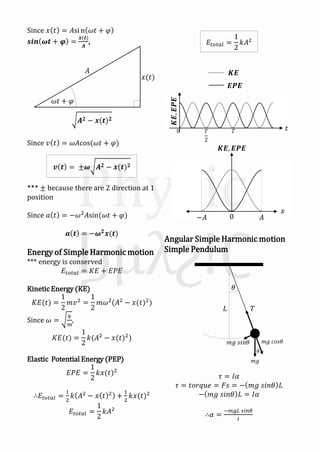
Energy of Simple Harmonic motion
*** energy is conserved
𝐸𝑡𝑜𝑡𝑎𝑙 = 𝐾𝐸 + 𝐸𝑃𝐸
Kinetic Energy (KE)
𝐾𝐸(𝑡) =
1
2
𝑚𝑣2
=
1
2
𝑚𝜔2
(𝐴2
− 𝑥(𝑡)2
)
Since 𝜔 =
𝑘
𝑚
,
𝐾𝐸(𝑡) =
1
2
𝑘(𝐴2
− 𝑥(𝑡)2
)
Elastic Potential Energy (PEP)
𝐸𝑃𝐸 =
1
2
𝑘𝑥(𝑡)2
∴𝐸𝑡𝑜𝑡𝑎𝑙 =
1
2
𝑘 𝐴2
− 𝑥 𝑡 2
+
1
2
𝑘𝑥(𝑡)2
𝐸𝑡𝑜𝑡𝑎𝑙 =
1
2
𝑘𝐴2
𝐸𝑡𝑜𝑡𝑎𝑙 =
1
2
𝑘𝐴2
𝜔𝑡 + 𝜑
𝑥(𝑡)
𝐴
𝑨 𝟐 − 𝒙(𝒕) 𝟐
𝒗 𝒕 = ±𝝎 𝑨 𝟐 − 𝒙(𝒕) 𝟐
𝑲𝑬,𝑬𝑷𝑬
𝑡
𝑲𝑬
𝑬𝑷𝑬
0 𝑇𝑇
2
𝑲𝑬, 𝑬𝑷𝑬
−𝐴 0 𝐴
𝑥
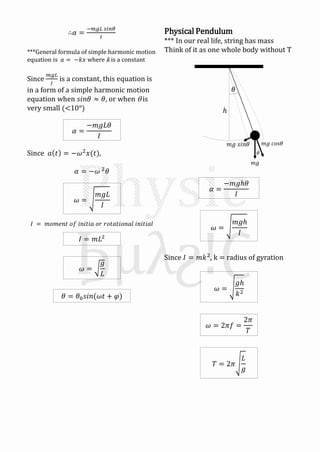
Angular Simple Harmonic motion
Simple Pendulum
𝜏 = 𝐼𝛼
𝜏 = 𝑡𝑜𝑟𝑞𝑢𝑒 = 𝐹𝑠 = − 𝑚𝑔 𝑠𝑖𝑛𝜃 𝐿
− 𝑚𝑔 𝑠𝑖𝑛𝜃 𝐿 = 𝐼𝛼
∴𝛼 =
−𝑚𝑔𝐿 𝑠𝑖𝑛𝜃
𝐼
𝜃
𝐿
𝑚𝑔
𝜃
𝑚𝑔 𝑐𝑜𝑠𝜃𝑚𝑔 𝑠𝑖𝑛𝜃
𝑇
∴𝛼 =
−𝑚𝑔𝐿 𝑠𝑖𝑛𝜃
𝐼
***General formula of simple harmonic motion
equation is 𝑎 = −𝑘𝑥 where k is a constant
Since
𝑚𝑔𝐿
𝐼
is a constant, this equation is
in a form of a simple harmonic motion
equation when 𝑠𝑖𝑛𝜃 ≈ 𝜃, or when  is
very small (<10°)
Since 𝑎 𝑡 = −𝜔2
𝑥(𝑡),
𝛼 = −𝜔 2
𝜃
𝐼 = 𝑚𝑜𝑚𝑒𝑛𝑡 𝑜𝑓 𝑖𝑛𝑖𝑡𝑖𝑎 𝑜𝑟 𝑟𝑜𝑡𝑎𝑡𝑖𝑜𝑛𝑎𝑙 𝑖𝑛𝑖𝑡𝑖𝑎𝑙
𝜔 =
𝑚𝑔𝐿
𝐼
𝛼 =
−𝑚𝑔𝐿𝜃
𝐼
𝐼 = 𝑚𝐿2
𝜔 =
𝑔
𝐿
𝜃 = 𝜃0 𝑠𝑖𝑛(𝜔𝑡 + 𝜑)
𝜃
ℎ
𝑚𝑔
𝜃
𝑚𝑔 𝑐𝑜𝑠𝜃𝑚𝑔 𝑠𝑖𝑛𝜃
Physical Pendulum
*** In our real life, string has mass
Think of it as one whole body without T
Since 𝐼 = 𝑚𝑘2
, k = radius of gyration
𝛼 =
−𝑚𝑔ℎ𝜃
𝐼
𝜔 =
𝑚𝑔ℎ
𝐼
𝜔 =
𝑔ℎ
𝑘2
𝜔 = 2𝜋𝑓 =
2𝜋
𝑇
𝑇 = 2𝜋
𝐿
𝑔
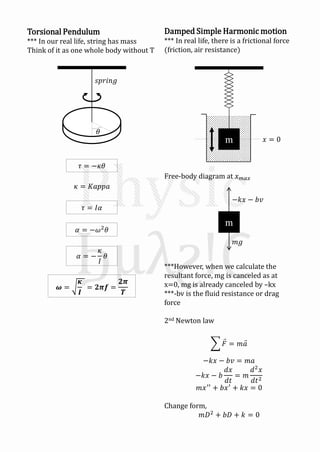
Torsional Pendulum
*** In our real life, string has mass
Think of it as one whole body without T
𝜏 = −𝜅𝜃
𝜅 = 𝐾𝑎𝑝𝑝𝑎
𝜏 = 𝐼𝛼
𝛼 = −𝜔2
𝜃
𝛼 = −
𝜅
𝐼
𝜃
𝝎 =
𝜿
𝑰
= 𝟐𝝅𝒇 =
𝟐𝝅
𝑻
Damped Simple Harmonic motion
*** In real life, there is a frictional force
(friction, air resistance)
Free-body diagram at 𝑥 𝑚𝑎𝑥
***However, when we calculate the
resultant force, mg is canceled as at
x=0, mg is already canceled by –kx
***-bv is the fluid resistance or drag
force
2nd Newton law
𝐹 = 𝑚𝑎
−𝑘𝑥 − 𝑏𝑣 = 𝑚𝑎
−𝑘𝑥 − 𝑏
𝑑𝑥
𝑑𝑡
= 𝑚
𝑑2
𝑥
𝑑𝑡2
𝑚𝑥′′
+ 𝑏𝑥′
+ 𝑘𝑥 = 0
Change form,
𝑚𝐷2
+ 𝑏𝐷 + 𝑘 = 0
m 𝑥 = 0
m
−𝑘𝑥 − 𝑏𝑣
𝑚𝑔
𝜃
𝑠𝑝𝑟𝑖𝑛𝑔
𝑚𝐷2
+ 𝑏𝐷 + 𝑘 = 0
𝐷 =
−𝑏 ± 𝑏2 − 4𝑚𝑘
2𝑚
𝐷 = −
𝑏
2𝑚
±
𝑏2
4𝑚2
−
𝑘
𝑚
There will be 3 cases
1. If there are 2 distinct roots, 𝐷1, 𝐷2
Over damped
𝑏2
4𝑚2
>
𝑘
𝑚
𝑥(𝑡) = 𝑐1 𝑒 𝑟1 𝑡
+ 𝑐2 𝑒 𝑟2 𝑡
2. If there are a repeated single root, (D)
Critically damped
𝑏2
4𝑚2
=
𝑘
𝑚
𝑥(𝑡) = 𝑐1 𝑒 𝑟𝑡
+ 𝑐2 𝑡𝑒 𝑟𝑡
3. If there are complex roots, (𝛼 ± 𝛽𝑗)
Under damped
𝑏2
4𝑚2
<
𝑘
𝑚
𝑥(𝑡) = 𝑒 𝛼𝑡
[𝑐1 cos 𝛽𝑡 + 𝑐2 𝑠𝑖𝑛 𝛽𝑡 ]
The x-t Graph
𝑡
𝑥
𝐶𝑟𝑖𝑡𝑖𝑐𝑎𝑙𝑙𝑦 𝑑𝑎𝑚𝑝𝑒𝑑
𝑂𝑣𝑒𝑟 𝑑𝑎𝑚𝑝𝑒𝑑
𝑈𝑛𝑑𝑒𝑟 𝑑𝑎𝑚𝑝𝑒𝑑
In this level, we will learn only
underdamped;
𝑏2
4𝑚2 <
𝑘
𝑚
Suppose, 𝛾 =
𝑏
2𝑚
, 𝜔0 =
𝑘
𝑚
𝛾 = 𝑑𝑎𝑚𝑝𝑖𝑛𝑔 𝑐𝑜𝑛𝑠𝑡𝑎𝑛𝑡
𝜔0 = 𝑢𝑛𝑑𝑎𝑚𝑝𝑒𝑑 𝑛𝑎𝑡𝑢𝑟𝑎𝑙 𝑓𝑟𝑒𝑞𝑢𝑒𝑛𝑐𝑦
Since, 𝐷 = −
𝑏
2𝑚
±
𝑏2
4𝑚2 −
𝑘
𝑚
𝐷 = −𝛾 ± 𝑗 𝛾2 − 𝜔0
2
𝐷 = −𝛾 ± 𝑗 𝜔0
2 − 𝛾2
𝑥(𝑡) = 𝑒−𝛾𝑡[𝑐1 cos 𝑡 𝜔0
2 − 𝛾2 + 𝑐2 𝑠𝑖𝑛 𝑡 𝜔0
2 − 𝛾2 ]
𝑥(𝑡) = 𝑒−𝛾𝑡
[𝐴 sin 𝑡 𝜔0
2 − 𝛾2 + 𝜑 ]
Suppose 𝜔′
= 𝜔0
2 − 𝛾2
𝐴 = 𝑖𝑛𝑖𝑡𝑖𝑎𝑙 𝑎𝑚𝑝𝑙𝑖𝑡𝑢𝑑𝑒
𝑒−𝛾𝑡
𝑤𝑖𝑙𝑙 𝑚𝑎𝑘𝑒 𝑡ℎ𝑒 𝐴 𝑑𝑖𝑒 𝑑𝑜𝑤𝑛
𝑥(𝑡) = 𝐴𝑒−𝛾𝑡
cos 𝜔′
𝑡 + 𝜑 ]

6). oscillatory motion (finished)

  • 1.
  • 2.
    Oscillatory Motion ; periodicmovement Simple Harmonic motion E.g.; mass-spring system (no friction) 2nd Newton law 𝐹 = 𝑚𝑎 At (a); 𝐹 = −𝑘 𝑠𝑝𝑟𝑖𝑛𝑔 𝑥 = 𝑚𝑎 Since 𝑎 = 𝑑2 𝑥 𝑑𝑡2, −𝑘 𝑠𝑝𝑟𝑖𝑛𝑔 𝑥 = 𝑚 𝑑2 𝑥 𝑑𝑡2 𝑑2 𝑥 𝑑𝑡2 = − 𝑘 𝑠𝑝𝑟𝑖𝑛𝑔 𝑚 𝑥 Let 𝑘 𝑠𝑝𝑟𝑖𝑛𝑔 𝑚 be 𝜔2 , 𝑑2 𝑥 𝑑𝑡2 = −𝜔2 𝑥 m m m (𝑎) (𝑏) (𝑐) 𝑥 -𝑥 𝑥 = 0 𝐹𝑠 𝐹𝑠 Math Differential equation 𝑑𝑦 𝑑𝑥 = 𝑥2 𝑦 𝑑𝑦 𝑦 = 𝑥2 𝑑𝑥 𝑑𝑦 𝑦 = 𝑥2 𝑑𝑥 𝑙𝑛 𝑦 = 𝑥3 3 + 𝑐 Homogeneous Second Order Linear Differential Equations (2nd ODE) 𝑃 𝑥 𝑦′′ + 𝑄 𝑥 𝑦′ + 𝑅 𝑥 𝑦 = 𝐺(𝑥) With constant coefficient 𝑎𝑦′′ + 𝑏𝑦′ + 𝑐𝑦 = 0 Change the form 𝑎𝑟2 + 𝑏𝑟 + 𝑐 = 0 1. If there are 2 distinct roots, 𝑟1, 𝑟2 𝑦 = 𝑐1 𝑒 𝑟1 𝑥 + 𝑐2 𝑒 𝑟2 𝑥 2. If there are a repeated single root, (𝑟) 𝑦 = 𝑐1 𝑒 𝑟𝑥 + 𝑐2 𝑥𝑒 𝑟𝑥 3. If there are complex roots, (𝛼 ± 𝛽𝑗) 𝑦 = 𝑒 𝛼𝑥 [𝑐1 cos 𝛽𝑥 + 𝑐2 𝑠𝑖𝑛 𝛽𝑥 ] Euler’s identity 𝑒 𝑗𝜃 = 𝑐𝑜𝑠𝜃 + 𝑗𝑠𝑖𝑛𝜃 ***  is in radian R-Formulae 𝑎 𝑐𝑜𝑠𝜃 + 𝑏 𝑠𝑖𝑛𝜃 = 𝑅 cos(𝜃 − 𝜑) 𝑎 𝑠𝑖𝑛𝜃 + 𝑏 𝑐𝑜𝑠𝜃 = 𝑅 sin(𝜃 + 𝜑) 𝑅 = 𝑎2 + 𝑏2, 𝜑 = 𝑡𝑎𝑛−1 𝑏 𝑎 𝐹𝑠 = 𝑟𝑒𝑠𝑡𝑜𝑟𝑖𝑛𝑔 𝑓𝑜𝑟𝑐𝑒
  • 3.
    Graph plotted when𝝋 = 𝟎𝑑2 𝑥 𝑑𝑡2 = −𝜔2 𝑥 𝑥′′ + 0𝑥′ + 𝜔2 𝑥 = 0 Change form, 𝑚2 + 𝜔2 = 0 𝑚2 = −𝜔2 𝑚 = 𝑗𝜔 𝑚 = ±𝑗𝜔 The roots are complex (𝑚 = 0 ± 𝑗𝜔) 𝑥 𝑡 = 𝑐1 cos 𝜔𝑡 + 𝑐2 𝑠𝑖𝑛 𝜔𝑡 Using R-Formulae, 𝑥 𝑡 = Acos(𝜔𝑡 + 𝜑) Or 𝒙 𝒕 = 𝐀𝐬𝐢𝐧(𝝎𝒕 + 𝝋) 𝒗 𝒕 = 𝒅𝒙 𝒅𝒕 = 𝝎𝐀𝐜𝐨𝐬(𝝎𝒕 + 𝝋) 𝒂 𝒕 = 𝒅𝒗 𝒅𝒕 = −𝝎 𝟐 𝐀𝐬𝐢𝐧(𝝎𝒕 + 𝝋) ***When 𝜑 ≠ 0, the graph is shifted to the left or right 𝐴 = 𝐴𝑚𝑝𝑙𝑖𝑡𝑢𝑑𝑒 𝑚 𝜔 = 𝑎𝑛𝑔𝑢𝑙𝑎𝑟 𝑣𝑒𝑙𝑜𝑐𝑖𝑡𝑦 𝑟𝑎𝑑 𝑠 𝜑 = 𝑝ℎ𝑟𝑎𝑠𝑒 𝑐𝑜𝑛𝑠𝑡𝑎𝑛𝑡 [𝑟𝑎𝑑] There are Sinusoidal functions as they can be shifted to the left or right 𝒙 𝒎𝒂𝒙 = 𝑨 𝒗 𝒎𝒂𝒙 = 𝝎𝐀 𝒂 𝒎𝒂𝒙 = −𝝎 𝟐 𝐀 𝒙(𝒕) 𝒗(𝒕) 𝒂(𝒕) 𝑡 𝑡 𝑡 𝐴 −𝐴 𝜔𝐴 −𝜔𝐴 −𝜔2 𝐴 𝜔2 𝐴 𝐹 = −𝑘 𝑠𝑝𝑟𝑖𝑛𝑔 𝑥 = 𝑚𝑎 𝑎 = − 𝑘 𝑚 𝑥, 𝑎 = −𝜔2 𝑥 ***every motion with this form of equation is Simple Harmonic motion 𝑘 = 𝑐𝑜𝑛𝑠𝑡𝑎𝑛𝑡 𝑜𝑓 𝑠𝑖𝑚𝑝𝑙𝑒 𝑚𝑎ℎ𝑜𝑛𝑖𝑐 𝑚𝑜𝑡𝑖𝑜𝑛 𝑎 = − 𝑘 𝑚 𝑥 𝑎 = −𝜔2 𝑥 𝜔 = 2𝜋 𝑇 = 2𝜋𝑓 = 𝑘 𝑚
  • 4.
    Since 𝑥 𝑡= 𝐴si n 𝜔𝑡 + 𝜑 𝒔𝒊𝒏 𝝎𝒕 + 𝝋 = 𝒙(𝒕) 𝑨 , Since 𝑣 𝑡 = 𝜔𝐴cos(𝜔𝑡 + 𝜑) *** ± because there are 2 direction at 1 position Since 𝑎 𝑡 = −𝜔2 𝐴sin(𝜔𝑡 + 𝜑) 𝒂 𝒕 = −𝝎 𝟐 𝒙(𝒕) Energy of Simple Harmonic motion *** energy is conserved 𝐸𝑡𝑜𝑡𝑎𝑙 = 𝐾𝐸 + 𝐸𝑃𝐸 Kinetic Energy (KE) 𝐾𝐸(𝑡) = 1 2 𝑚𝑣2 = 1 2 𝑚𝜔2 (𝐴2 − 𝑥(𝑡)2 ) Since 𝜔 = 𝑘 𝑚 , 𝐾𝐸(𝑡) = 1 2 𝑘(𝐴2 − 𝑥(𝑡)2 ) Elastic Potential Energy (PEP) 𝐸𝑃𝐸 = 1 2 𝑘𝑥(𝑡)2 ∴𝐸𝑡𝑜𝑡𝑎𝑙 = 1 2 𝑘 𝐴2 − 𝑥 𝑡 2 + 1 2 𝑘𝑥(𝑡)2 𝐸𝑡𝑜𝑡𝑎𝑙 = 1 2 𝑘𝐴2 𝐸𝑡𝑜𝑡𝑎𝑙 = 1 2 𝑘𝐴2 𝜔𝑡 + 𝜑 𝑥(𝑡) 𝐴 𝑨 𝟐 − 𝒙(𝒕) 𝟐 𝒗 𝒕 = ±𝝎 𝑨 𝟐 − 𝒙(𝒕) 𝟐 𝑲𝑬,𝑬𝑷𝑬 𝑡 𝑲𝑬 𝑬𝑷𝑬 0 𝑇𝑇 2 𝑲𝑬, 𝑬𝑷𝑬 −𝐴 0 𝐴 𝑥 Angular Simple Harmonic motion Simple Pendulum 𝜏 = 𝐼𝛼 𝜏 = 𝑡𝑜𝑟𝑞𝑢𝑒 = 𝐹𝑠 = − 𝑚𝑔 𝑠𝑖𝑛𝜃 𝐿 − 𝑚𝑔 𝑠𝑖𝑛𝜃 𝐿 = 𝐼𝛼 ∴𝛼 = −𝑚𝑔𝐿 𝑠𝑖𝑛𝜃 𝐼 𝜃 𝐿 𝑚𝑔 𝜃 𝑚𝑔 𝑐𝑜𝑠𝜃𝑚𝑔 𝑠𝑖𝑛𝜃 𝑇
  • 5.
    ∴𝛼 = −𝑚𝑔𝐿 𝑠𝑖𝑛𝜃 𝐼 ***Generalformula of simple harmonic motion equation is 𝑎 = −𝑘𝑥 where k is a constant Since 𝑚𝑔𝐿 𝐼 is a constant, this equation is in a form of a simple harmonic motion equation when 𝑠𝑖𝑛𝜃 ≈ 𝜃, or when  is very small (<10°) Since 𝑎 𝑡 = −𝜔2 𝑥(𝑡), 𝛼 = −𝜔 2 𝜃 𝐼 = 𝑚𝑜𝑚𝑒𝑛𝑡 𝑜𝑓 𝑖𝑛𝑖𝑡𝑖𝑎 𝑜𝑟 𝑟𝑜𝑡𝑎𝑡𝑖𝑜𝑛𝑎𝑙 𝑖𝑛𝑖𝑡𝑖𝑎𝑙 𝜔 = 𝑚𝑔𝐿 𝐼 𝛼 = −𝑚𝑔𝐿𝜃 𝐼 𝐼 = 𝑚𝐿2 𝜔 = 𝑔 𝐿 𝜃 = 𝜃0 𝑠𝑖𝑛(𝜔𝑡 + 𝜑) 𝜃 ℎ 𝑚𝑔 𝜃 𝑚𝑔 𝑐𝑜𝑠𝜃𝑚𝑔 𝑠𝑖𝑛𝜃 Physical Pendulum *** In our real life, string has mass Think of it as one whole body without T Since 𝐼 = 𝑚𝑘2 , k = radius of gyration 𝛼 = −𝑚𝑔ℎ𝜃 𝐼 𝜔 = 𝑚𝑔ℎ 𝐼 𝜔 = 𝑔ℎ 𝑘2 𝜔 = 2𝜋𝑓 = 2𝜋 𝑇 𝑇 = 2𝜋 𝐿 𝑔
  • 6.
    Torsional Pendulum *** Inour real life, string has mass Think of it as one whole body without T 𝜏 = −𝜅𝜃 𝜅 = 𝐾𝑎𝑝𝑝𝑎 𝜏 = 𝐼𝛼 𝛼 = −𝜔2 𝜃 𝛼 = − 𝜅 𝐼 𝜃 𝝎 = 𝜿 𝑰 = 𝟐𝝅𝒇 = 𝟐𝝅 𝑻 Damped Simple Harmonic motion *** In real life, there is a frictional force (friction, air resistance) Free-body diagram at 𝑥 𝑚𝑎𝑥 ***However, when we calculate the resultant force, mg is canceled as at x=0, mg is already canceled by –kx ***-bv is the fluid resistance or drag force 2nd Newton law 𝐹 = 𝑚𝑎 −𝑘𝑥 − 𝑏𝑣 = 𝑚𝑎 −𝑘𝑥 − 𝑏 𝑑𝑥 𝑑𝑡 = 𝑚 𝑑2 𝑥 𝑑𝑡2 𝑚𝑥′′ + 𝑏𝑥′ + 𝑘𝑥 = 0 Change form, 𝑚𝐷2 + 𝑏𝐷 + 𝑘 = 0 m 𝑥 = 0 m −𝑘𝑥 − 𝑏𝑣 𝑚𝑔 𝜃 𝑠𝑝𝑟𝑖𝑛𝑔
  • 7.
    𝑚𝐷2 + 𝑏𝐷 +𝑘 = 0 𝐷 = −𝑏 ± 𝑏2 − 4𝑚𝑘 2𝑚 𝐷 = − 𝑏 2𝑚 ± 𝑏2 4𝑚2 − 𝑘 𝑚 There will be 3 cases 1. If there are 2 distinct roots, 𝐷1, 𝐷2 Over damped 𝑏2 4𝑚2 > 𝑘 𝑚 𝑥(𝑡) = 𝑐1 𝑒 𝑟1 𝑡 + 𝑐2 𝑒 𝑟2 𝑡 2. If there are a repeated single root, (D) Critically damped 𝑏2 4𝑚2 = 𝑘 𝑚 𝑥(𝑡) = 𝑐1 𝑒 𝑟𝑡 + 𝑐2 𝑡𝑒 𝑟𝑡 3. If there are complex roots, (𝛼 ± 𝛽𝑗) Under damped 𝑏2 4𝑚2 < 𝑘 𝑚 𝑥(𝑡) = 𝑒 𝛼𝑡 [𝑐1 cos 𝛽𝑡 + 𝑐2 𝑠𝑖𝑛 𝛽𝑡 ] The x-t Graph 𝑡 𝑥 𝐶𝑟𝑖𝑡𝑖𝑐𝑎𝑙𝑙𝑦 𝑑𝑎𝑚𝑝𝑒𝑑 𝑂𝑣𝑒𝑟 𝑑𝑎𝑚𝑝𝑒𝑑 𝑈𝑛𝑑𝑒𝑟 𝑑𝑎𝑚𝑝𝑒𝑑 In this level, we will learn only underdamped; 𝑏2 4𝑚2 < 𝑘 𝑚 Suppose, 𝛾 = 𝑏 2𝑚 , 𝜔0 = 𝑘 𝑚 𝛾 = 𝑑𝑎𝑚𝑝𝑖𝑛𝑔 𝑐𝑜𝑛𝑠𝑡𝑎𝑛𝑡 𝜔0 = 𝑢𝑛𝑑𝑎𝑚𝑝𝑒𝑑 𝑛𝑎𝑡𝑢𝑟𝑎𝑙 𝑓𝑟𝑒𝑞𝑢𝑒𝑛𝑐𝑦 Since, 𝐷 = − 𝑏 2𝑚 ± 𝑏2 4𝑚2 − 𝑘 𝑚 𝐷 = −𝛾 ± 𝑗 𝛾2 − 𝜔0 2 𝐷 = −𝛾 ± 𝑗 𝜔0 2 − 𝛾2 𝑥(𝑡) = 𝑒−𝛾𝑡[𝑐1 cos 𝑡 𝜔0 2 − 𝛾2 + 𝑐2 𝑠𝑖𝑛 𝑡 𝜔0 2 − 𝛾2 ] 𝑥(𝑡) = 𝑒−𝛾𝑡 [𝐴 sin 𝑡 𝜔0 2 − 𝛾2 + 𝜑 ] Suppose 𝜔′ = 𝜔0 2 − 𝛾2 𝐴 = 𝑖𝑛𝑖𝑡𝑖𝑎𝑙 𝑎𝑚𝑝𝑙𝑖𝑡𝑢𝑑𝑒 𝑒−𝛾𝑡 𝑤𝑖𝑙𝑙 𝑚𝑎𝑘𝑒 𝑡ℎ𝑒 𝐴 𝑑𝑖𝑒 𝑑𝑜𝑤𝑛 𝑥(𝑡) = 𝐴𝑒−𝛾𝑡 cos 𝜔′ 𝑡 + 𝜑 ]