Primary funding is provided by
The SPE Foundation through member donations
and a contribution from Offshore Europe
The Society is grateful to those companies that allow their
professionals to serve as lecturers
Additional support provided by AIME
Society of Petroleum Engineers
Distinguished Lecturer Program
www.spe.org/dl
1
Society of Petroleum Engineers
Distinguished Lecturer Program
www.spe.org/dl
2
Controlling Scale Deposition:
Advances in Using Technology to
Preserve Production in the Oil Field
Charles Hinrichsen
Chevron Energy Technology Company
(Retired)
Houston, Texas USA
Outline:
• Scale: Description and Causes
• Scale Inhibition Strategy
• Scale Prediction: Scale Tendency and Inhibitor Dosage
• Scale Inhibitors: Evaluation and Application
• Case Histories
• Other Scale Mitigation Methods
• Chemical Quality Control
• Summary
“Imagine an oilfield menace that can smother a productive well within 24 hours. The
buildup of scale inside wellbores does exactly that, causing millions of dollars in
damage every year!" Crabtree, et. al., “Fighting Scale - Removal and Prevention”,
Oilfield Review (Schlumberger), 1999, pp 30 – 45.
3
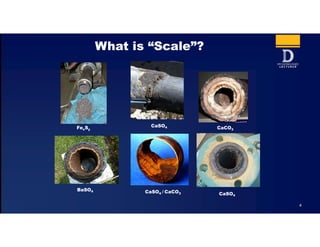
What is “Scale”?
FexSy
CaSO4 CaCO3
BaSO4 CaSO4 / CaCO3 CaSO4
4
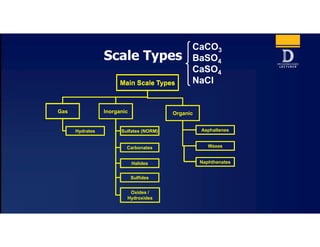
Main Scale Types
Inorganic OrganicGas
Naphthenates
Hydrates Asphaltenes
Waxes
Halides
Carbonates
Sulfates (NORM)
Sulfides
Oxides /
Hydroxides
Main Scale Types
Scale Types
CaCO3
BaSO4
CaSO4
NaCl
6
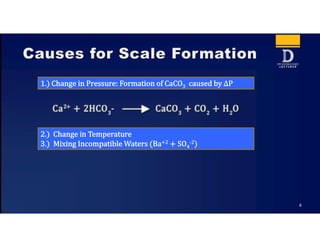
3
+2
4
-2
7
The Most Cost-Effective
Method for Dealing with
Scale Formation….
PREVENT scale
before
it starts to form!!
8
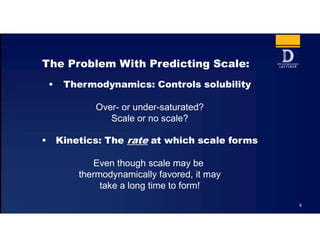
The Problem With Predicting Scale:
• Thermodynamics: Controls solubility
Over- or under-saturated?
Scale or no scale?
• Kinetics: The rate at which scale forms
Even though scale may be
thermodynamically favored, it may
take a long time to form!
9
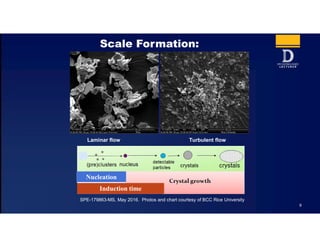
Scale Formation:
Laminar flow Turbulent flow
SPE-179863-MS, May 2016. Photos and chart courtesy of BCC Rice University
Nucleation
Induction time
10
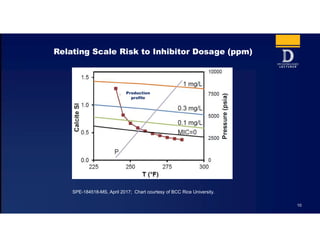
Relating Scale Risk to Inhibitor Dosage (ppm)
SPE-184518-MS, April 2017; Chart courtesy of BCC Rice University.
Production
profile
11
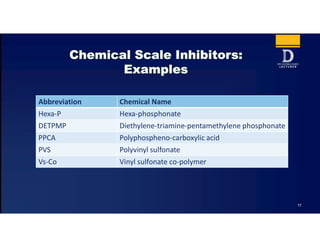
Abbreviation Chemical Name
Hexa-P Hexa-phosphonate
DETPMP Diethylene-triamine-pentamethylene phosphonate
PPCA Polyphospheno-carboxylic acid
PVS Polyvinyl sulfonate
Vs-Co Vinyl sulfonate co-polymer
12
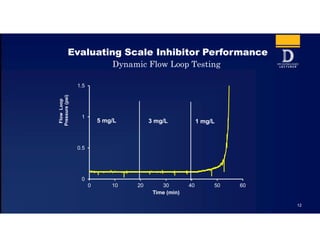
Evaluating Scale Inhibitor Performance
Dynamic Flow Loop Testing
0
0.5
1
1.5
0 10 20 30 40 50 60
FlowLoop
Pressure(psi)
Time (min)
5 mg/L 3 mg/L 1 mg/L
13
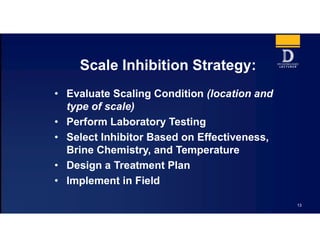
Scale Inhibition Strategy:
• Evaluate Scaling Condition (location and
type of scale)
• Perform Laboratory Testing
• Select Inhibitor Based on Effectiveness,
Brine Chemistry, and Temperature
• Design a Treatment Plan
• Implement in Field
14
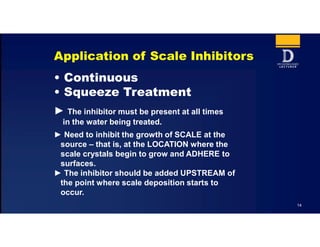
Application of Scale Inhibitors
• Continuous
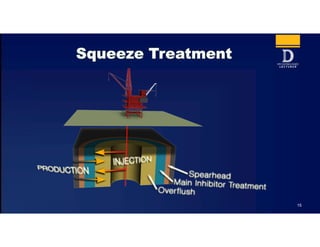
• Squeeze Treatment
► The inhibitor must be present at all times
in the water being treated.
► Need to inhibit the growth of SCALE at the
source – that is, at the LOCATION where the
scale crystals begin to grow and ADHERE to
surfaces.
► The inhibitor should be added UPSTREAM of
the point where scale deposition starts to
occur.
15
16
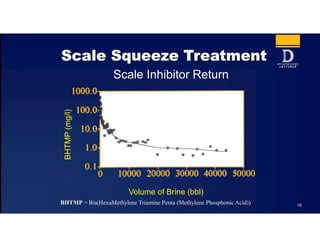
Scale Inhibitor Return
Volume of Brine (bbl)
BHTMP(mg/l)
BHTMP = Bis(HexaMethylene Triamine Penta (Methylene Phosphonic Acid))
17
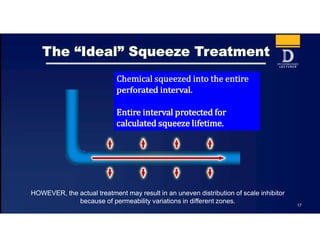
HOWEVER, the actual treatment may result in an uneven distribution of scale inhibitor
because of permeability variations in different zones.
18
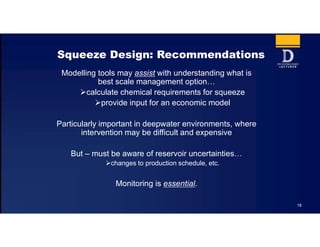
Squeeze Design: Recommendations
Modelling tools may assist with understanding what is
best scale management option…
calculate chemical requirements for squeeze
provide input for an economic model
Particularly important in deepwater environments, where
intervention may be difficult and expensive
But – must be aware of reservoir uncertainties…
changes to production schedule, etc.
Monitoring is essential.
19
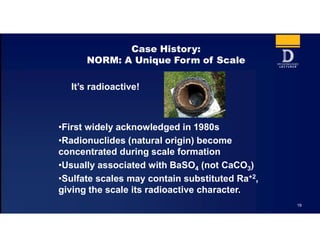
Case History:
NORM: A Unique Form of Scale
It’s radioactive!
•First widely acknowledged in 1980s
•Radionuclides (natural origin) become
concentrated during scale formation
•Usually associated with BaSO4 (not CaCO3)
•Sulfate scales may contain substituted Ra+2,
giving the scale its radioactive character.
20
NORM Scale:
Safety Concerns: Handling and disposal of
radioactive waste require proper training.
•Hazards arise primarily from exposure to NORM
material in decommissioned equipment: well
tubulars, surface piping, vessels, pumps,
processing equipment
•Inhalation, ingestion, dermal (skin) adsorption
•Litigation more expensive than prevention
“The trend in upstream environmental litigation is simply
that more litigation is on the horizon.”1
SPE 125661, 2010
21
Other Scale Mitigation
Methods:
• Sequestrant Addition (EDTA?)
• Dilution (may not be practical)
• Temperature and Pressure Control
• Control Water Handling Strategy
• Acid Addition (used for calcite only)
• Ion Exchange Softeners / RO Membranes
Scale Removal (if necessary):
HCl, Chelants (EDTA), etc.
22
Chemical Quality Control
• How do I know if the chemical I ordered is
the same as what is delivered to the field?
• Will the chemical quality / composition remain
the same from one shipment to the next?
23
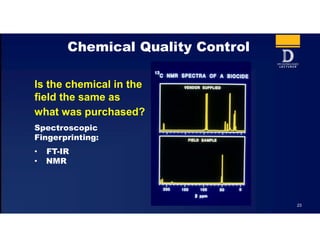
Chemical Quality Control
Is the chemical in the
field the same as
what was purchased?
Spectroscopic
Fingerprinting:
• FT-IR
• NMR
24
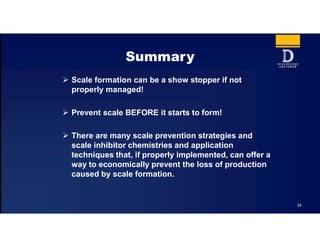
Summary
 Scale formation can be a show stopper if not
properly managed!
 Prevent scale BEFORE it starts to form!
 There are many scale prevention strategies and
scale inhibitor chemistries and application
techniques that, if properly implemented, can offer a
way to economically prevent the loss of production
caused by scale formation.
25
Thank You!
corrosionchemist@gmail.com
Society of Petroleum Engineers
Distinguished Lecturer Program
www.spe.org/dl 26
Your Feedback is Important
Enter your section in the DL Evaluation Contest by
completing the evaluation form for this presentation
Visit SPE.org/dl
#SPEDL

Charles Hinrichsen

  • 1.
    Primary funding isprovided by The SPE Foundation through member donations and a contribution from Offshore Europe The Society is grateful to those companies that allow their professionals to serve as lecturers Additional support provided by AIME Society of Petroleum Engineers Distinguished Lecturer Program www.spe.org/dl 1
  • 2.
    Society of PetroleumEngineers Distinguished Lecturer Program www.spe.org/dl 2 Controlling Scale Deposition: Advances in Using Technology to Preserve Production in the Oil Field Charles Hinrichsen Chevron Energy Technology Company (Retired) Houston, Texas USA
  • 3.
    Outline: • Scale: Descriptionand Causes • Scale Inhibition Strategy • Scale Prediction: Scale Tendency and Inhibitor Dosage • Scale Inhibitors: Evaluation and Application • Case Histories • Other Scale Mitigation Methods • Chemical Quality Control • Summary “Imagine an oilfield menace that can smother a productive well within 24 hours. The buildup of scale inside wellbores does exactly that, causing millions of dollars in damage every year!" Crabtree, et. al., “Fighting Scale - Removal and Prevention”, Oilfield Review (Schlumberger), 1999, pp 30 – 45. 3
  • 4.
    What is “Scale”? FexSy CaSO4CaCO3 BaSO4 CaSO4 / CaCO3 CaSO4 4
  • 5.
    Main Scale Types InorganicOrganicGas Naphthenates Hydrates Asphaltenes Waxes Halides Carbonates Sulfates (NORM) Sulfides Oxides / Hydroxides Main Scale Types Scale Types CaCO3 BaSO4 CaSO4 NaCl
  • 6.
  • 7.
    7 The Most Cost-Effective Methodfor Dealing with Scale Formation…. PREVENT scale before it starts to form!!
  • 8.
    8 The Problem WithPredicting Scale: • Thermodynamics: Controls solubility Over- or under-saturated? Scale or no scale? • Kinetics: The rate at which scale forms Even though scale may be thermodynamically favored, it may take a long time to form!
  • 9.
    9 Scale Formation: Laminar flowTurbulent flow SPE-179863-MS, May 2016. Photos and chart courtesy of BCC Rice University Nucleation Induction time
  • 10.
    10 Relating Scale Riskto Inhibitor Dosage (ppm) SPE-184518-MS, April 2017; Chart courtesy of BCC Rice University. Production profile
  • 11.
    11 Abbreviation Chemical Name Hexa-PHexa-phosphonate DETPMP Diethylene-triamine-pentamethylene phosphonate PPCA Polyphospheno-carboxylic acid PVS Polyvinyl sulfonate Vs-Co Vinyl sulfonate co-polymer
  • 12.
    12 Evaluating Scale InhibitorPerformance Dynamic Flow Loop Testing 0 0.5 1 1.5 0 10 20 30 40 50 60 FlowLoop Pressure(psi) Time (min) 5 mg/L 3 mg/L 1 mg/L
  • 13.
    13 Scale Inhibition Strategy: •Evaluate Scaling Condition (location and type of scale) • Perform Laboratory Testing • Select Inhibitor Based on Effectiveness, Brine Chemistry, and Temperature • Design a Treatment Plan • Implement in Field
  • 14.
    14 Application of ScaleInhibitors • Continuous • Squeeze Treatment ► The inhibitor must be present at all times in the water being treated. ► Need to inhibit the growth of SCALE at the source – that is, at the LOCATION where the scale crystals begin to grow and ADHERE to surfaces. ► The inhibitor should be added UPSTREAM of the point where scale deposition starts to occur.
  • 15.
  • 16.
    16 Scale Inhibitor Return Volumeof Brine (bbl) BHTMP(mg/l) BHTMP = Bis(HexaMethylene Triamine Penta (Methylene Phosphonic Acid))
  • 17.
    17 HOWEVER, the actualtreatment may result in an uneven distribution of scale inhibitor because of permeability variations in different zones.
  • 18.
    18 Squeeze Design: Recommendations Modellingtools may assist with understanding what is best scale management option… calculate chemical requirements for squeeze provide input for an economic model Particularly important in deepwater environments, where intervention may be difficult and expensive But – must be aware of reservoir uncertainties… changes to production schedule, etc. Monitoring is essential.
  • 19.
    19 Case History: NORM: AUnique Form of Scale It’s radioactive! •First widely acknowledged in 1980s •Radionuclides (natural origin) become concentrated during scale formation •Usually associated with BaSO4 (not CaCO3) •Sulfate scales may contain substituted Ra+2, giving the scale its radioactive character.
  • 20.
    20 NORM Scale: Safety Concerns:Handling and disposal of radioactive waste require proper training. •Hazards arise primarily from exposure to NORM material in decommissioned equipment: well tubulars, surface piping, vessels, pumps, processing equipment •Inhalation, ingestion, dermal (skin) adsorption •Litigation more expensive than prevention “The trend in upstream environmental litigation is simply that more litigation is on the horizon.”1 SPE 125661, 2010
  • 21.
    21 Other Scale Mitigation Methods: •Sequestrant Addition (EDTA?) • Dilution (may not be practical) • Temperature and Pressure Control • Control Water Handling Strategy • Acid Addition (used for calcite only) • Ion Exchange Softeners / RO Membranes Scale Removal (if necessary): HCl, Chelants (EDTA), etc.
  • 22.
    22 Chemical Quality Control •How do I know if the chemical I ordered is the same as what is delivered to the field? • Will the chemical quality / composition remain the same from one shipment to the next?
  • 23.
    23 Chemical Quality Control Isthe chemical in the field the same as what was purchased? Spectroscopic Fingerprinting: • FT-IR • NMR
  • 24.
    24 Summary  Scale formationcan be a show stopper if not properly managed!  Prevent scale BEFORE it starts to form!  There are many scale prevention strategies and scale inhibitor chemistries and application techniques that, if properly implemented, can offer a way to economically prevent the loss of production caused by scale formation.
  • 25.
  • 26.
    Society of PetroleumEngineers Distinguished Lecturer Program www.spe.org/dl 26 Your Feedback is Important Enter your section in the DL Evaluation Contest by completing the evaluation form for this presentation Visit SPE.org/dl #SPEDL