CPT test Soil investigation FoundationEngineering.pptx
1.
WALCHAND COLLEGE OFENGINEERING, SANGLI
Department of Civil Engineering
Foundation Engineering Laboratory
CONE PENETRATION TEST
Presented by
Vinay Vitekari – 22110029
Gaurav Rathod – 22110037
Anvesha Wadar – 22110040
2.
Contents
• Introduction toCPT test
• History and Development
• Instruments Used in CPT test
• Types of CPT Equipments
• Principle of CPT test
• Procedure of CPT test
• Interpretation of Results of CPT test
• Advantages & Limitations of CPT test
• Application of CPT test
• Conclusion
3.
Introduction to CPT
•CPT is the currently most used and accepted in-situ test method for soil
investigation world wide.
• It is used in Geotechnical engineering to determine engineering properties of
soils which involves the pushing of cone shaped probe into the soil at a
constant rate and measuring the resistance
• It was used in 1950s at the Dutch Lab for soil Mechanics so that it also has
been called the Dutch cone test
4.
History &Development
• First Developed in the Netherlands as a mechanical cone in
1930s.
• Electric cones are developed in 1960’s.
• Standardized as per ASTM D5778 and ISO 22476-1.
• Used worldwide for foundation design, soil stratification, and
liquefaction assessment.
5.
Equipment Used
•CPT Rig: A heavy vehicle or truck-mounted system that provides
hydraulic force or it can be hand operated.
• Steel Cone with a 60° apex angle and base area of 10 cm² or 15
cm².
• Friction Sleeve: Measures side friction during penetration.
• Push Rods: Drive the cone into the soil.
• Data Acquisition System: It includes the computer system which
Records cone resistance, sleeve friction, and pore water
pressure (if piezo cone is used).
• Some of Cones are equipped with a geophone in order to
perform shear wave velocity measurements.
6.
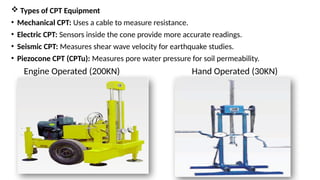
Types ofCPT Equipment
• Mechanical CPT: Uses a cable to measure resistance.
• Electric CPT: Sensors inside the cone provide more accurate readings.
• Seismic CPT: Measures shear wave velocity for earthquake studies.
• Piezocone CPT (CPTu): Measures pore water pressure for soil permeability.
Engine Operated (200KN) Hand Operated (30KN)
7.
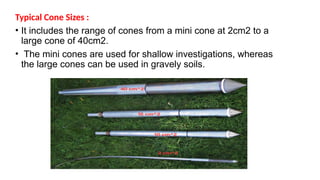
Typical Cone Sizes:
• It includes the range of cones from a mini cone at 2cm2 to a
large cone of 40cm2.
• The mini cones are used for shallow investigations, whereas
the large cones can be used in gravely soils.
8.
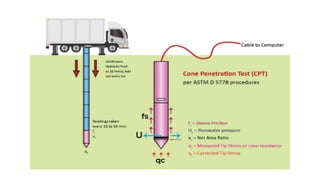
Principle ofCPT :
• The CPT works on the principle of penetration resistance.
• A cone is pushed into the soil at a standard penetration rate of
2 cm/sec, and resistance is measured.
Key Parameters measured from CPT Test :
• Tip or Cone Resistance (qc): Measures resistance at the cone
tip, indicating soil strength.
• Sleeve Friction (fs): Measures friction along the sleeve, helping
classify soil type.
• Pore Water Pressure (u): Measured in Piezo cone(if used) tests
(CPTu) to assess drainage and soil permeability.
9.
Procedure ofCPT Test :
Step-by-Step Process
• Site Preparation: The CPT rig is positioned on the test site.
• Cone Insertion: The cone is pushed into the soil at a constant rate
(2 cm/sec).
• Data Collection:
• Tip resistance (qc) and sleeve friction (fs) are measured.
• Piezo cone tests also measure pore water pressure (u).
• Depth Measurement: The test is conducted to the required depth.
• Data Interpretation: Readings are analyzed to classify soil and
determine geotechnical properties.
Interpretation ofResults
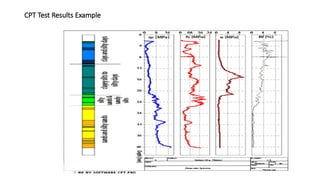
CPT results help in
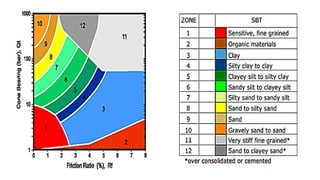
• Soil classification (based on fs/qc ratio).
• Estimating un-drained shear strength in clayey soils.
• Determining relative density in sandy soils.
• Assessing liquefaction potential (using pore pressure readings).
Soil behavior charts are used to correlate CPT data with engineering
properties.
14.
Advantages of CPT
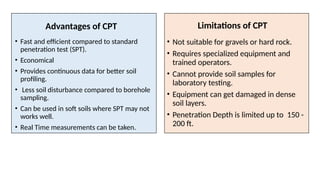
•Fast and efficient compared to standard
penetration test (SPT).
• Economical
• Provides continuous data for better soil
profiling.
• Less soil disturbance compared to borehole
sampling.
• Can be used in soft soils where SPT may not
works well.
• Real Time measurements can be taken.
Limitations of CPT
• Not suitable for gravels or hard rock.
• Requires specialized equipment and
trained operators.
• Cannot provide soil samples for
laboratory testing.
• Equipment can get damaged in dense
soil layers.
• Penetration Depth is limited up to 150 -
200 ft.
15.
Applications ofCPT
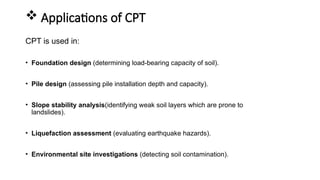
CPT is used in:
• Foundation design (determining load-bearing capacity of soil).
• Pile design (assessing pile installation depth and capacity).
• Slope stability analysis(identifying weak soil layers which are prone to
landslides).
• Liquefaction assessment (evaluating earthquake hazards).
• Environmental site investigations (detecting soil contamination).
16.
Conclusion
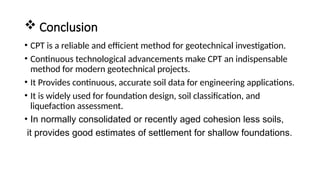
• CPTis a reliable and efficient method for geotechnical investigation.
• Continuous technological advancements make CPT an indispensable
method for modern geotechnical projects.
• It Provides continuous, accurate soil data for engineering applications.
• It is widely used for foundation design, soil classification, and
liquefaction assessment.
• In normally consolidated or recently aged cohesion less soils,
it provides good estimates of settlement for shallow foundations.