
PRESENTED BY :
ABHILASHA VERMA
M.SC.NURSING PREV.
Govt. College Of Nursing ( Jaipur)
( SMS Medical College)
BATCH (2015-2016)
PRESENTATION
ON
I) SIGNS & SYMPTOMS OF PREGNANCY
II) MINOR AILMENTS IN PREGNANCY
At the end of presentation students will be:
•Able to define pregnancy.
•Able to explain signs and symptoms of first trimester.
•Able to explain signs and symptoms of second trimester.
•Able to explain signs and symptoms of third trimester.
OBJECTIVES OF PRESENTATION
It is the state of carrying a developing embryo or fetus within the female
body from conception to birth. After the egg is fertilized by sperm and
then implanted in the lining of the uterus, it develops into placenta and
embryo or fetus.
DEFINITION OF PREGNANCY
I) Usually 40 weeks or
II) 280 days or 10 lunar months or
III) 9 months and 7 days, calculated from the first day of last menstrual
period.
Beginning from the first day of last menstrual period , It is divided into
three trimesters, each lasting three months.
First trimester ( First 12 weeks)
Second trimester ( 13-28 weeks)
Third trimester ( 29-40 weeks)
DURATION OF PREGNANCY
SIGNS & SYMPTOMS OF
PREGNANCY
PRESUMPTIVE SIGNS
OR
SUBJECTIVE SIGNS
POSITIVE SIGNS
PROBABLE SIGNS
OR
OBJECTIVE SIGNS
2 31
FIRST
TRIMESTER
( FIRST 12
WEEKS)
SECOND
TRIMESTER
(13-28
WEEKS)
THIRD
TRIMESTER
(29-40
WEEKS)
FIRST TRIMESTER
PRESUMPTIVE SIGNS OR
SUBJECTIVE SYMPTOMS
AMENORRHOEA
MORNING SICKNESS
FREQUENCY OF MICTURITION
BREAST DISCOMFORT
FATIGUE
FAINTING
INTRODUCTION:
Absence of menstruation in woman of reproductive age.
However, cyclic bleeding may occur up to 12 weeks until decicua space is
obliterated by the fusion of deciduas vera with deciduas capsularis.
(Implantation bleeding/ Placental sign)
Such bleeding is scanty, lasting for shorter duration and corresponds with
date of expected periods.
DIFFERENTIAL DIAGNOSIS:
•Extreme weight loss
•Emotional or physical stress
•Rigorous exercise.
•Severe illness
•Hypothyroidism
•Polycystic ovarian syndrome.
AMENORRHOEA
INTRODUCTION :
It is present in about 50% cases, mostly during first pregnancy.
Nausea and vomiting begins about 6 weeks after the last menstrual period and
usually disappears by about 14 weeks.
It is due to the high level of pregnancy hormones.
DIFFERENTIAL DIAGNOSIS:
•Hydatiform mole
•Choriocarcinoma
•Pre-eclampsia
MORNING SICKNESS
It is present during 8-12 week of pregnancy and subside after 12 weeks.
DIFFERENTIAL DIAGNOSIS:
•U.T.I
•Vaginitis
•Diuretics medications
•Over active bladder syndrome
•Tumor in pelvis.
FREQUENCY OF MICTURITION
It is present during 6th week in the form of feeling of :
* Tenderness.
* Tingling.
* Fullness.
* Increase in size.
* Pigmentation of areaola.
* Pricking sensation.
DIFFERENTIAL DIAGNOSIS :
Breast contusion / trauma
Chest trauma
Chest wall injury
Mastitis
Breast abscess
Neoplastic disorder
BREAST DISCOMFORT
 It is frequent in early pregnancy and subside around 12-14 weeks of
pregnancy with bringing renew energy.
DIFFERENTIAL DIAGNOSIS
Chronic heart disease
Thyroid disease
Chronic anaemia
Liver disease
Inflammatory bowel disease.
FATIGUE
FIRST TRIMESTER
PROBABLE SIGNS OR
OBJECTIVE SIGNS
BREAST CHANGES
CARDIO-VASCULAR CHANGES
RESPIRATORY CHANGES
INTEGUMENTORY CHANGES
MUSCULO-SKELETAL CHANGES
ABDOMEN AND UTERINE CHANGES
PELVIC CHANGES
These are valuable only in primiparae, compared to multiparae.
Breast changes are evident between 6-8 weeks.
There is enlargement with vascular engorgement with delicate veins visible
under the skin due to increased blood supply, making the veins more noticeable.
Nipples and areola (primary) become more pigmented or darker.
Montgomery’s tubercles are prominent.
The thick yellowish secretion (colostrums) can be expressed as early as 12th
week.
BREAST CHANGES
BREAST CHANGES
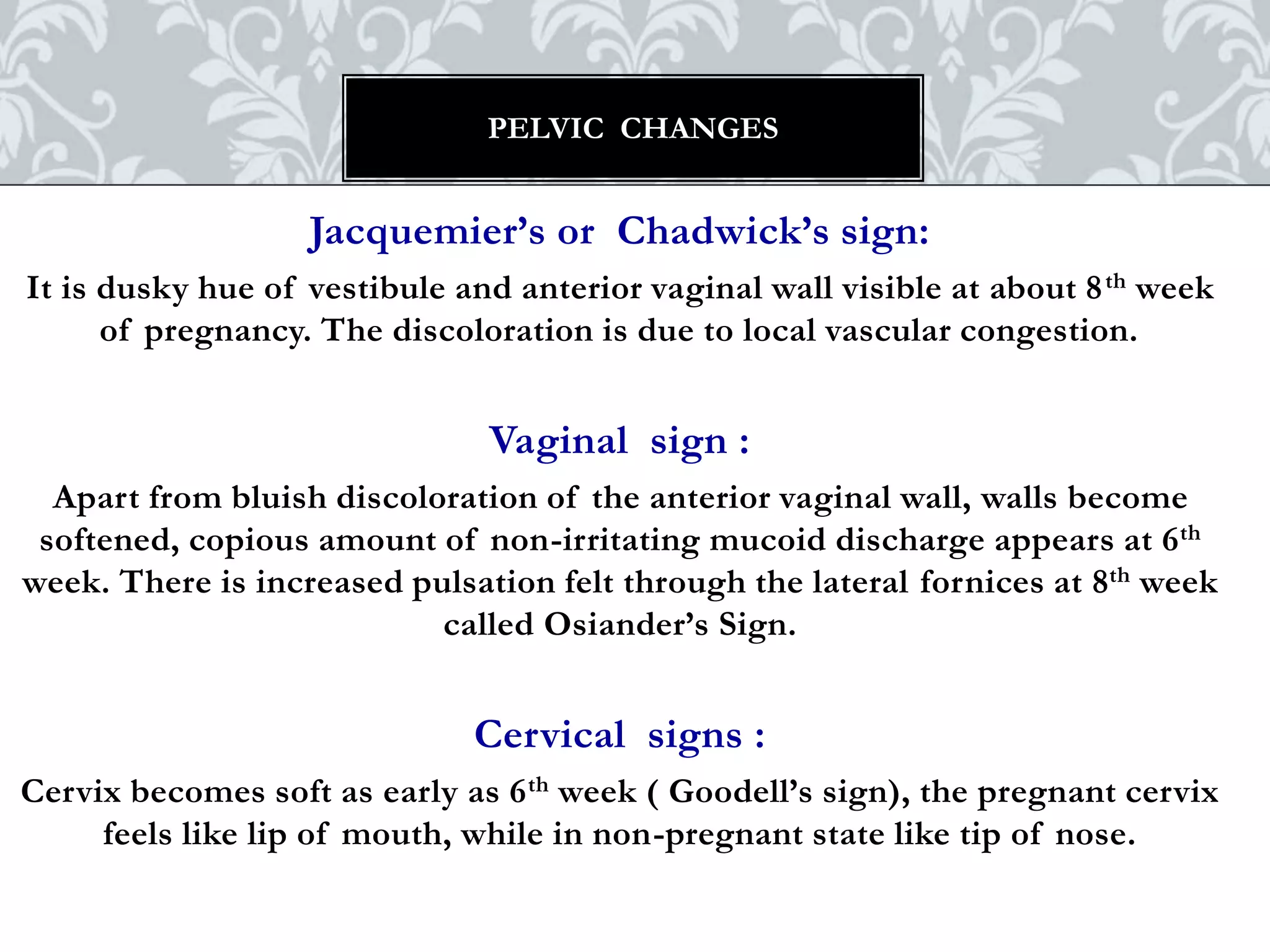
Jacquemier’s or Chadwick’s sign:
It is dusky hue of vestibule and anterior vaginal wall visible at about 8th week
of pregnancy. The discoloration is due to local vascular congestion.
Vaginal sign :
Apart from bluish discoloration of the anterior vaginal wall, walls become
softened, copious amount of non-irritating mucoid discharge appears at 6th
week. There is increased pulsation felt through the lateral fornices at 8th week
called Osiander’s Sign.
Cervical signs :
Cervix becomes soft as early as 6th week ( Goodell’s sign), the pregnant cervix
feels like lip of mouth, while in non-pregnant state like tip of nose.
PELVIC CHANGES
A) Size, shape and consistency :
Uterus enlarged to:
• size of hen’s egg at 6th week
•Size of cricket ball at 8th week
•Size of fetal head at 12th week
Pyriform shape of nonpregnant uterus becomes globular by 12th week
There may be asymmetrical enlargement of uterus if there is lateral
implantation.
( One half is more firm than other half. As pregnancy advances, symmery is
restored, uterus feels soft and elastic)
.
UTERINE CHANGES
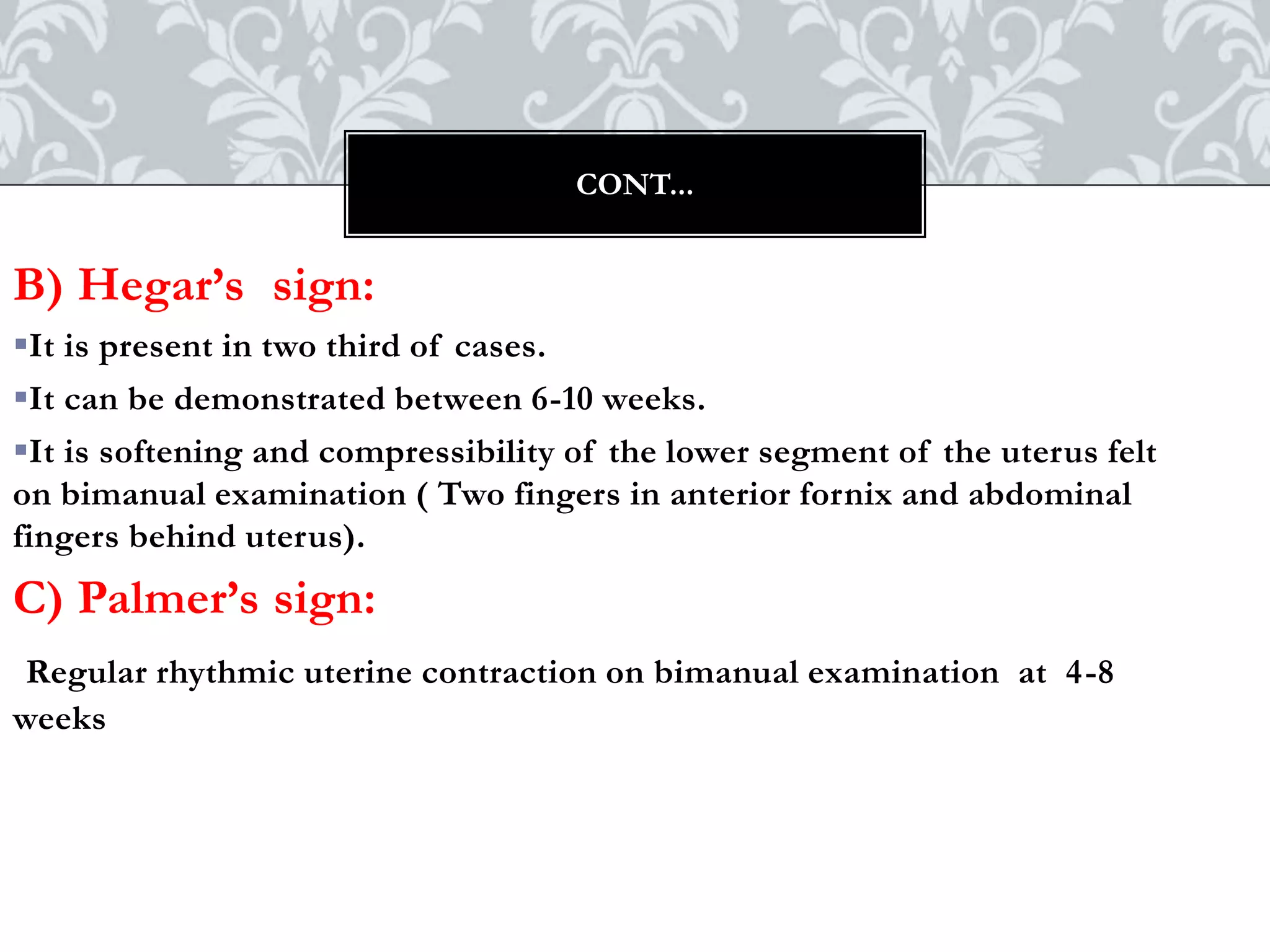
B) Hegar’s sign:
It is present in two third of cases.
It can be demonstrated between 6-10 weeks.
It is softening and compressibility of the lower segment of the uterus felt
on bimanual examination ( Two fingers in anterior fornix and abdominal
fingers behind uterus).
C) Palmer’s sign:
Regular rhythmic uterine contraction on bimanual examination at 4-8
weeks
CONT...
HEGAR’ S SIGN
POSITIVE SIGNS
COMMON TO ALL
THREE TRIMESTER
IMMUNOLOGICAL
TESTS
ULTRA
SONOGRAPHY
1
• I) URINE PREGNANCY TESTS:
• Agglutination test
• Dip stick test
• Enzyme linked monoclonal antibody tests.
2
• II) SERUM PREGNANCY TESTS:
• Fluoro-immunoassay (FIA)
• Radioimmunoassay (RIA)
• Immuno-radiometric assay (IRMA)
• ELISA
IMMUNOLOGICAL TESTS
SECOND TRIMESTER
SUBJECTIVE SYMPTOMS
AMENORRHOEA
DECREASE MORNING
SICKNESS & URINARY
SYMPTOMS
ENLARGEMENT OF
LOWER ABDOMEN
QUICKENING
SECOND TRIMESTER
OBJECTIVE SYMPTOMS
SKIN SIGNS
* Cholasma
ABDOMINAL
SIGNS
VAGINAL SIGNS
SKIN
• LINEA NIGRA
• CHOLASMA GRAVIDARUM
• STRIAE GRAVIDARUM
PALPATION
• FUNDAL HEIGHT
• SHAPE & CONSISITENCY OF UTERUS
• BRAXTON- HICKS CONTRACTION
• PALPATION OF FETAL PARTS
• ACTIVE FETAL MOVEMENTS
AUSCULTATION
• FETAL HEART SOUND:
• - UTERINE SOUFFLE
• -FETAL SOUFFLE
ABDOMINAL SIGNS
LINEA NIGRA
STRIAE GRAVIDARUM
CHOLASMA GRAVIDARUM
FUNDAL HEIGHT
Pregnancy in weeks Fundal Height
At 16th week Uterus is midway between symphysis pubis and
umbilicus.
At 24th week At the level of the umbilicus.
At 28th week At the junction of lower third and upper two third
of the distance between the umbilicus and
ensiform cartilage.
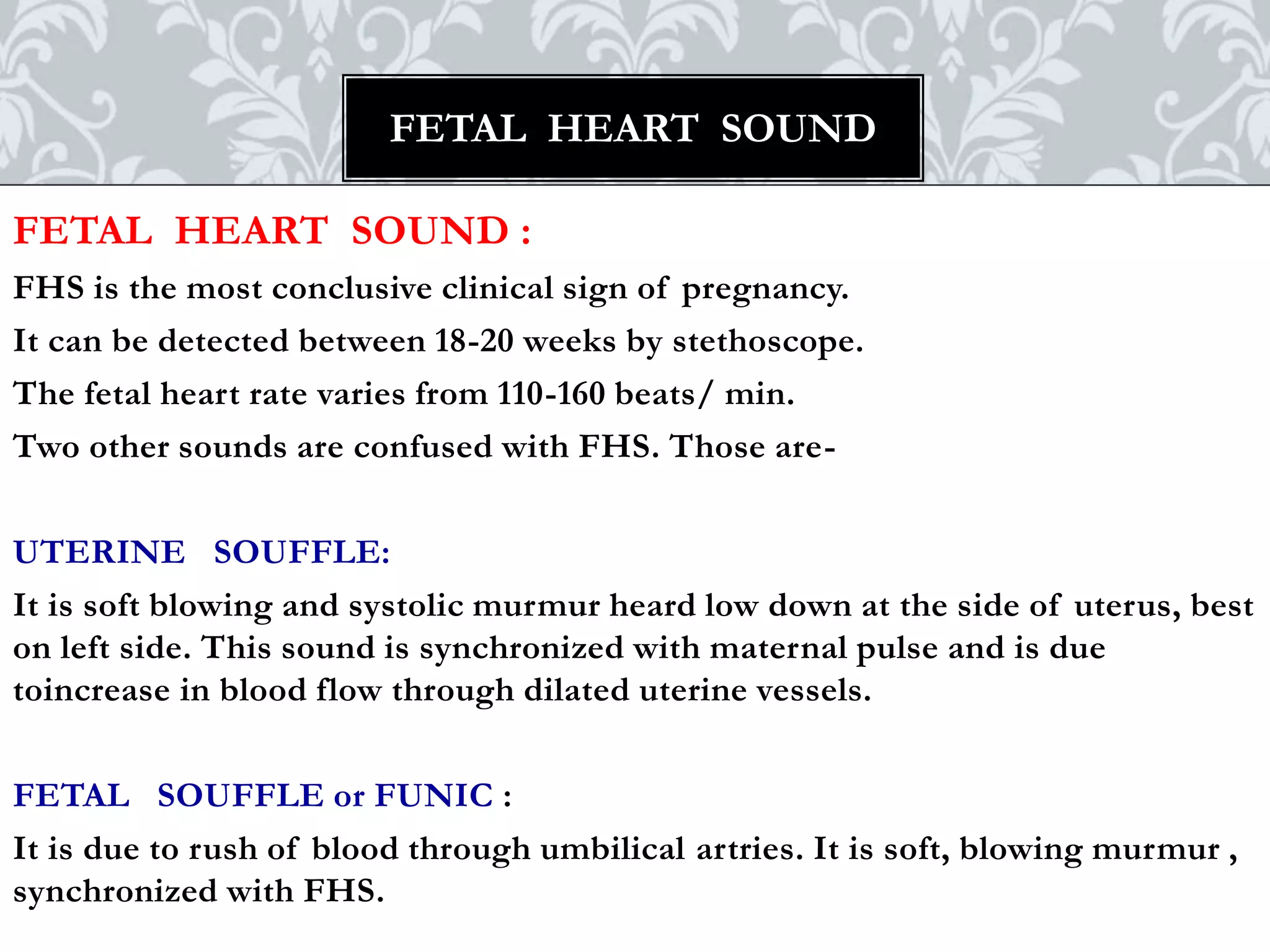
FETAL HEART SOUND :
FHS is the most conclusive clinical sign of pregnancy.
It can be detected between 18-20 weeks by stethoscope.
The fetal heart rate varies from 110-160 beats/ min.
Two other sounds are confused with FHS. Those are-
UTERINE SOUFFLE:
It is soft blowing and systolic murmur heard low down at the side of uterus, best
on left side. This sound is synchronized with maternal pulse and is due
toincrease in blood flow through dilated uterine vessels.
FETAL SOUFFLE or FUNIC :
It is due to rush of blood through umbilical artries. It is soft, blowing murmur ,
synchronized with FHS.
FETAL HEART SOUND
THIRD TRIMESTER
SUBJECTIVE SYMPTOMS
OBJECTIVE SIGNS
i) Amenorrhoea.
ii) Progressive enlargement of abdomen.
iii) Palpitation and dysponea following exertion due to enlarge abdomen.
iv) Lightening: At about 38 week, sense of relief of pressure symptoms
obtained due to engagement of presenting part.
v) Frequency of micturition reappears.
vi) Fetal movements are more pronounced.
SUBJECTIVE SYMPTOMS
i) Palpation of fetal parts.
ii) Palpation of fetal movements.
iii) Auscultation of fetal heart sound.
iv) Occasional auscultation of funic soufflé.
v) Cutaneous changes are more prominent with increase
pigmentation and striae.
vi) Uterine shape is changed from cylindrical to spherical by 36th week.
vii) Fundal height: The distance between umbilicus and ensiform
cartilage is divided into three equal parts.
OBJECTIVE SYMPTOMS
Pregnancy in weeks Fundal height
At 32th week Junction of upper and middle third of ensiform
cartilage
At 36th week Up to the level of ensiform cartilage.
At 40th week Down to the 32th week due to engagement of
presenting part.
FUNDAL HEIGHT
MINOR AILEMENTS
DURING PREGNANCY
At the end of study students will be :
Able to define minor ailments.
Able to explain minor ailments related to Cardio-vascular system.
Able to explain minor ailments related to Gastrointestinal system.
Able to explain minor ailments related to Respiratory system.
Able to explain minor ailments related to Musculoskeletal system.
Able to explain minor ailments related to Neurological system.
Able to explain minor ailments related to Uro-genital system.
Able to explain minor ailments related to Integumentary system.
OBJECTIVES OF PRESENTATION
“The minor complaints of pregnant women that occur due
to physiological alterations of hormones ( oestrogen,
progesterone, prolectin) and other causative factors which
can be managed without medical interventions.”
DEFINITION
CARDIO-VASCULAR
SYSTEM
SUPINE HYPOTENSION SYNDROME
VARICOSE VEINS & HAEMORRHOIDS
OEDEMA
Supine hypotensive syndrome is caused when the inferior vena cava is
compressed by the weight of a pregnant female’s uterus, fetus, placenta and
amniotic fluids while lying in the supine position.
 These condition can develop as early as the second trimester but is maximal
during the third trimester (36-38 weeks).
MANAGEMENT :
•Place patient in left lateral recumbent position or elevate right hip.
•High flow oxygen via non-rebreather.
•Treat for shock if other signs of shock are present.
•Keep patient warm.
•Transport with quite gentle ride to the hospital.
SUPINE HYPOTENSION
SYNDROME
SUPINE HYPO TENSION
SYNDROME
Varicose vein in legs and vulva= Varicosity.
Varicose vein in rectum = Haemorrhoids.
Varicose veins are swollen veins that may bulge near the surface of the skin due to
hormonal changes, increase blood volume & decrease venous return.
Haemorrhoids – swollen and inflamed veins in anus and lower rectum are another
form of varicose veins.
CAUSES:
Increased volume of circulating blood during pregnancy
Pressure of pregnant uterus on larger veins.
Obstruction in venous return by pregnant uterus.
Due to raised progesterone level causing walls of vein to relax.
Due to progestin hormone, which cause veins to be more dilated or open.
Multiple pregnancy.
Tendency to constipation.
VARICOSE VEINS &
HAEMORRHOIDS
Management:
•Exercise daily.
•Elevate feet higher to the level of heart and legs on regular time
interval.
•Use a stool or box to rest legs when sitting.
•Don’t cross legs or ankle when sitting.
•Don’t sit or stand for long periods without taking.
•Sleep on left side- use a pillow to keep body tilled to the left and elevate
feet with pillow since inferior vena cava is on right side.
•Keep constipation away by drinking plenty fluids, add extra fiber to
diet.
CONT...
VARICOSE VEINS
HAEMORRHOIDS
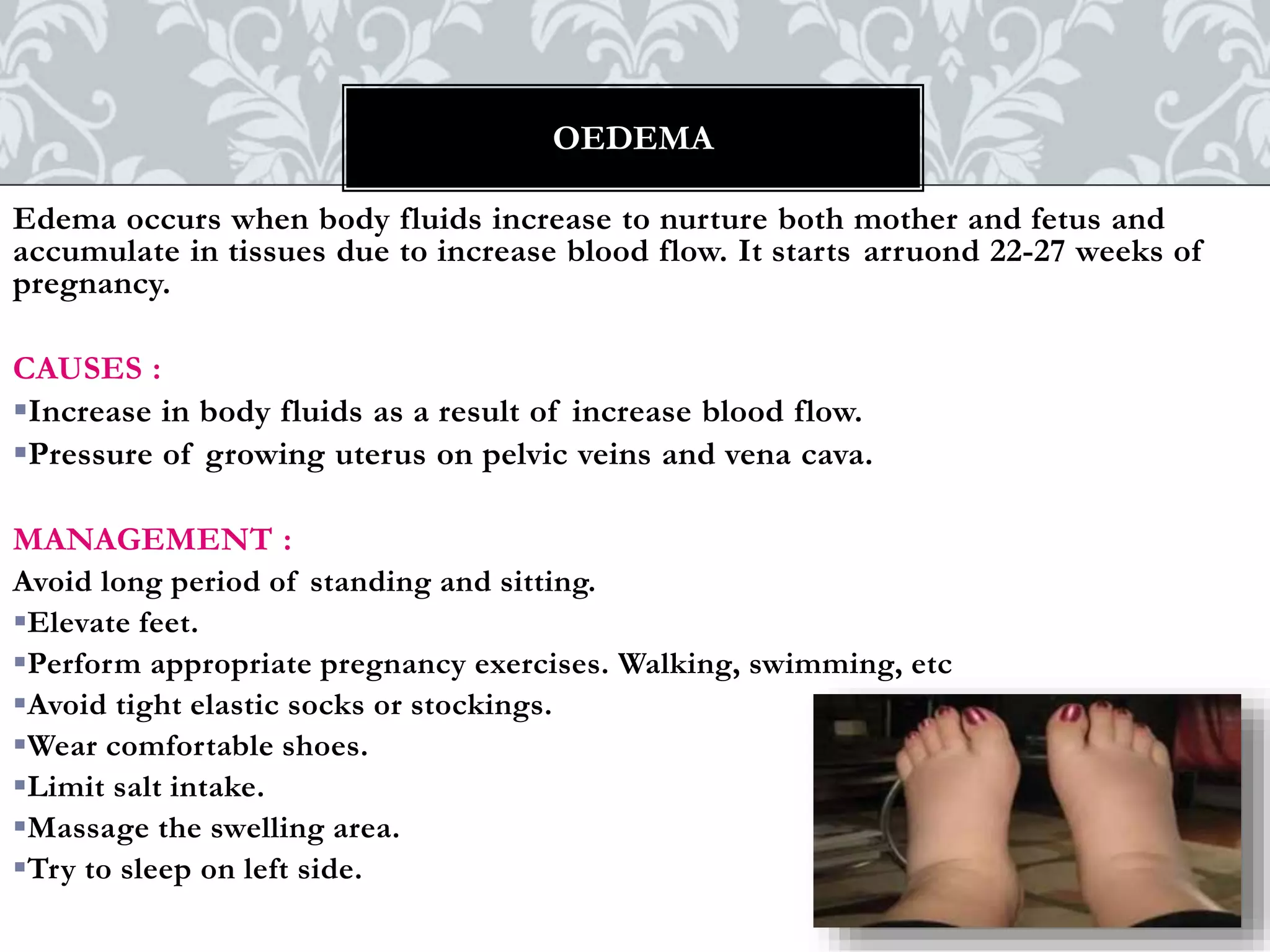
Edema occurs when body fluids increase to nurture both mother and fetus and
accumulate in tissues due to increase blood flow. It starts arruond 22-27 weeks of
pregnancy.
CAUSES :
Increase in body fluids as a result of increase blood flow.
Pressure of growing uterus on pelvic veins and vena cava.
MANAGEMENT :
Avoid long period of standing and sitting.
Elevate feet.
Perform appropriate pregnancy exercises. Walking, swimming, etc
Avoid tight elastic socks or stockings.
Wear comfortable shoes.
Limit salt intake.
Massage the swelling area.
Try to sleep on left side.
OEDEMA
GASTRO-INTESTINAL
SYSTEM
MORNING SICKNESS
HEART BURN & ACIDITY
CONSTIPATION
PICA
PTYLISM ( SIALORRHOEA)
GINGIVITIS
It appear following the first or second missed period (around 6th week) and
subside by the end of first trimester( 12th week).
It can continue for longer or return at around 32 weeks.
Causes-
i. Increase level of HCG hormone.
ii. An enhanced sense of smell and sensitivity to odors.
iii. A sensitive stomach ( mainly empty stomach)
iv. Psychological stress
v. Multiple pregnancy ( Twin or more )
MORNING SICKNESS
Management –
1. Eat small amounts of food often rather than several large meals to avoid empty
stomach.
2. Drink plenty of fluids in between meals to avoid stomach fullness.
3. Quit smoking and ask family members to stop smoking as well as.
4. Keep window open for good ventilation.
5. Get plenty of rest and sleep whenever you can. Avoid lying down after eating.
6. Try to avoid foods and smells that trigger nausea of someone.
7. Try to eat food cold or at room temperature because food tends to have stronger
smell when hot.
8. Avoid smell of heavy perfume, warm room, certain visual stimuli.
9. If possible eat some dry food like bread, biscuit, low-fat food, carbohydrate rich
food (e.g – Rice, noodles, mashed potatoes)
10. Try some sour drink ( e.g. Lamonade, plum juice etc)
11. Avoid eating deep fried, greasy food, garlic and other spices and avoid drinking
coffee.
CONT....
Causes :
I. Relaxation of oesophagal sphincter.
II. Decrease frequency of stomach contraction, making digestion sluggish and
leading to acidity.
III. Enlarged uterus can crowd the abdomen, pushing stomach acid upward.
Management:
1) Eat 5-6 smaller meals throughout the days rather than 3 large meals.
2) Wait an hour after eating to lie down.
3) Avoid spicy, greasy, fatty foods.
4) Eat yogurt or drink a glass of cold milk when acidity causes burning sensation.
5) Drink less while eating, drink between meals.
6) Place pillow under shoulder to prevent acid reflex.
7) Sleep with extra pillows so your head is raised.
8) Wear loose fitting clothing.
HEART BURN
Causes:
 Emotional stress :
 Minimal physical exercise :
 Relaxation of intestinal muscle due to pregnancy hormone :
 Pressure of expanding uterus on intestine :
 Sometimes due to iron tablet
Management:
Drink plenty of fluid at least 8-12 glasss every day in form of water, milk, juice,
soup etc.
Increase dietary fiber ( e.g. wheat, fresh fruit and vegetables, legumes)
Low impact exercises such as swimming, walking or yoga.
Maintain active lifestyle.
Find natural way to get iron.
CONSTIPATION
RESPIRATORY SYSTEM
DYSPONEA & BREATHLESNESS
NASAL STUFFIENESS
Causes:
Body’s adaption to carry fetus.
Upward shifting of ribcage due to pregnant uterus.
Progesterone hormone help in adaptation by absorbing oxygen in blood stream via lungs.
Enlargement of uterus.
Pressure of gravid uterus on lungs.
Stair climbing.
Management:
Sits up straight and keep shoulders back to give space to the lungs to expands.
Stands up, this will relieve some of pressure on diaphragm.
Stay hydrated and maintain body weight.
Yoga and light exercise with rest in between them.
Use extra pillows while sleeping
BREATHLESSNESS
Causes:
•Estrogen and progesterone.
•Allergies and infections.
•Season
Management:
Use right blow techniques means use thumb to close one nostril and blow
gently out the other side.
Put warm mist humidifier in room
Use petroleum jelly in each nostril to smoothen.
Vitamin c , reduce chances of nose bleed.
NASAL STUFFINESS
MUSCULOSKELETAL
SYSTEM
BACK ACHE & LORDOSIS
LEG CRAMPS
Causes –
1. Hormone change
2. Anterior tilt of pelvis
3. Weight gain
4. Posture change
5. Muscle separation
6. Stress
7. Hyperlordosis
BACK ACHE & LORDOSIS
LORDOSIS
Causes:
Deficiency of diffusible calcium and magnesium ions.
Increase serum phosphorus.
Compression of blood vessels in legs.
Due to fatigue from carrying pregnancy weight.
Management:
Stretch and massage affected muscle to disperse the builds up of acids.
Apply a warm peck to affected muscle.
Walk around.
Leg exercises.
Stay active with regular physical activity.
Stay hydrated.
Choose proper footwear, flat soles.
Take calcium and magnesium supplement. Warm bath before going to bed.
LEG CRAMPS
NEUROLOGICAL SYSTEM
SLEEP DISTURBANCE
CARPEL TUNNEL SYNDROME
FAINTING
Causes:
Urgency of urination.
Physical and emotional stress.
Excess daytime sleepiness.
Pressure of growing fetus.
Heart burn, cramps, congestion in nose.
Caffeinated drinks.
Over exertion.
Management:
Avoid caffine.
Daily work out .
Take warm bath.
Deep breathing exercises.
Meditation & yoga.
Noise free atmosphere.
Wear loose cotton clothes.
Stay stress free
SLEEP DISTURBANCE
Causes:
Pressure of extra fluid on median nerve.
Repetitive wrist movements such as typing.
Management:
Try to sleep with hands slightly raised up on pillow.
Avoid repetitive movements and sustained positions.
Carry things with forearms, not with arms.
Massage wrist.
Hold hands on pillow to distribute body’s weight while sleeping.
Light exercises-
Hold fingers stretched out and then relax.
Make a fist and straighten out fingers.
Move hands slowly up and down, side to side, in round circle.
CARPEL TUNNEL SYNDROME
CARPAL TUNNEL SUNDROME
UROLOGICAL SYSTEM
FREQUENCY OF URINATION
LEUKORRHOEA
Causes:
Increase in blood flow to kidneys by 50%.
Hcg hormone.
Extra weight during pregnancy causes pressure on bladder and pelvic floor.
Relaxation effects of progesterone on smooth muscle of urinary tract.
Urinary tract infection.
Management:
Never restrict fluid intake because this might increase chance of UTI.
Regular pelvic exercise during pregnancy and after pregnancy will help.
Stay away from caffeinated drinks.
Avoid drinking fluid right before bed time.
Empty bladder completely.
Wear sanitary pads or panty shield.
FREQUENCY OF URINATION
INTEGUMENTARY
SYSTEM
ITCHING
STRETCH MARKS
Some warning signs that should not be ignored because theses may results
in life threatening complications are as follows:
 Excess nausea vomiting.
High fever.
Foul vaginal discharge or infection.
Pain or burning during urination.
Slowed or stopped fetal movements less than usual.
Spotting or bleeding more than usual along with camps.
Excess swelling.
Shortness of breath.
Severe or persistent abdominal pain & tenderness.
Pelvic pressure( feeling of pushing down of fetus)
Persistent leg cramps.
Trauma to abdomen.
WARNING SIGNS OF MINOR
AILMENTS DURING PREGNANCY
Sign and symptoms of pregnancy  &  Minor Ailments during pregnancy

Sign and symptoms of pregnancy & Minor Ailments during pregnancy

  • 1.
    PRESENTED BY : ABHILASHAVERMA M.SC.NURSING PREV. Govt. College Of Nursing ( Jaipur) ( SMS Medical College) BATCH (2015-2016) PRESENTATION ON I) SIGNS & SYMPTOMS OF PREGNANCY II) MINOR AILMENTS IN PREGNANCY
  • 3.
    At the endof presentation students will be: •Able to define pregnancy. •Able to explain signs and symptoms of first trimester. •Able to explain signs and symptoms of second trimester. •Able to explain signs and symptoms of third trimester. OBJECTIVES OF PRESENTATION
  • 4.
    It is thestate of carrying a developing embryo or fetus within the female body from conception to birth. After the egg is fertilized by sperm and then implanted in the lining of the uterus, it develops into placenta and embryo or fetus. DEFINITION OF PREGNANCY
  • 5.
    I) Usually 40weeks or II) 280 days or 10 lunar months or III) 9 months and 7 days, calculated from the first day of last menstrual period. Beginning from the first day of last menstrual period , It is divided into three trimesters, each lasting three months. First trimester ( First 12 weeks) Second trimester ( 13-28 weeks) Third trimester ( 29-40 weeks) DURATION OF PREGNANCY
  • 6.
    SIGNS & SYMPTOMSOF PREGNANCY PRESUMPTIVE SIGNS OR SUBJECTIVE SIGNS POSITIVE SIGNS PROBABLE SIGNS OR OBJECTIVE SIGNS 2 31 FIRST TRIMESTER ( FIRST 12 WEEKS) SECOND TRIMESTER (13-28 WEEKS) THIRD TRIMESTER (29-40 WEEKS)
  • 8.
    FIRST TRIMESTER PRESUMPTIVE SIGNSOR SUBJECTIVE SYMPTOMS AMENORRHOEA MORNING SICKNESS FREQUENCY OF MICTURITION BREAST DISCOMFORT FATIGUE FAINTING
  • 9.
    INTRODUCTION: Absence of menstruationin woman of reproductive age. However, cyclic bleeding may occur up to 12 weeks until decicua space is obliterated by the fusion of deciduas vera with deciduas capsularis. (Implantation bleeding/ Placental sign) Such bleeding is scanty, lasting for shorter duration and corresponds with date of expected periods. DIFFERENTIAL DIAGNOSIS: •Extreme weight loss •Emotional or physical stress •Rigorous exercise. •Severe illness •Hypothyroidism •Polycystic ovarian syndrome. AMENORRHOEA
  • 10.
    INTRODUCTION : It ispresent in about 50% cases, mostly during first pregnancy. Nausea and vomiting begins about 6 weeks after the last menstrual period and usually disappears by about 14 weeks. It is due to the high level of pregnancy hormones. DIFFERENTIAL DIAGNOSIS: •Hydatiform mole •Choriocarcinoma •Pre-eclampsia MORNING SICKNESS
  • 11.
    It is presentduring 8-12 week of pregnancy and subside after 12 weeks. DIFFERENTIAL DIAGNOSIS: •U.T.I •Vaginitis •Diuretics medications •Over active bladder syndrome •Tumor in pelvis. FREQUENCY OF MICTURITION
  • 12.
    It is presentduring 6th week in the form of feeling of : * Tenderness. * Tingling. * Fullness. * Increase in size. * Pigmentation of areaola. * Pricking sensation. DIFFERENTIAL DIAGNOSIS : Breast contusion / trauma Chest trauma Chest wall injury Mastitis Breast abscess Neoplastic disorder BREAST DISCOMFORT
  • 13.
     It isfrequent in early pregnancy and subside around 12-14 weeks of pregnancy with bringing renew energy. DIFFERENTIAL DIAGNOSIS Chronic heart disease Thyroid disease Chronic anaemia Liver disease Inflammatory bowel disease. FATIGUE
  • 14.
    FIRST TRIMESTER PROBABLE SIGNSOR OBJECTIVE SIGNS BREAST CHANGES CARDIO-VASCULAR CHANGES RESPIRATORY CHANGES INTEGUMENTORY CHANGES MUSCULO-SKELETAL CHANGES ABDOMEN AND UTERINE CHANGES PELVIC CHANGES
  • 15.
    These are valuableonly in primiparae, compared to multiparae. Breast changes are evident between 6-8 weeks. There is enlargement with vascular engorgement with delicate veins visible under the skin due to increased blood supply, making the veins more noticeable. Nipples and areola (primary) become more pigmented or darker. Montgomery’s tubercles are prominent. The thick yellowish secretion (colostrums) can be expressed as early as 12th week. BREAST CHANGES
  • 16.
  • 17.
    Jacquemier’s or Chadwick’ssign: It is dusky hue of vestibule and anterior vaginal wall visible at about 8th week of pregnancy. The discoloration is due to local vascular congestion. Vaginal sign : Apart from bluish discoloration of the anterior vaginal wall, walls become softened, copious amount of non-irritating mucoid discharge appears at 6th week. There is increased pulsation felt through the lateral fornices at 8th week called Osiander’s Sign. Cervical signs : Cervix becomes soft as early as 6th week ( Goodell’s sign), the pregnant cervix feels like lip of mouth, while in non-pregnant state like tip of nose. PELVIC CHANGES
  • 18.
    A) Size, shapeand consistency : Uterus enlarged to: • size of hen’s egg at 6th week •Size of cricket ball at 8th week •Size of fetal head at 12th week Pyriform shape of nonpregnant uterus becomes globular by 12th week There may be asymmetrical enlargement of uterus if there is lateral implantation. ( One half is more firm than other half. As pregnancy advances, symmery is restored, uterus feels soft and elastic) . UTERINE CHANGES
  • 19.
    B) Hegar’s sign: Itis present in two third of cases. It can be demonstrated between 6-10 weeks. It is softening and compressibility of the lower segment of the uterus felt on bimanual examination ( Two fingers in anterior fornix and abdominal fingers behind uterus). C) Palmer’s sign: Regular rhythmic uterine contraction on bimanual examination at 4-8 weeks CONT...
  • 20.
  • 21.
    POSITIVE SIGNS COMMON TOALL THREE TRIMESTER IMMUNOLOGICAL TESTS ULTRA SONOGRAPHY
  • 22.
    1 • I) URINEPREGNANCY TESTS: • Agglutination test • Dip stick test • Enzyme linked monoclonal antibody tests. 2 • II) SERUM PREGNANCY TESTS: • Fluoro-immunoassay (FIA) • Radioimmunoassay (RIA) • Immuno-radiometric assay (IRMA) • ELISA IMMUNOLOGICAL TESTS
  • 24.
    SECOND TRIMESTER SUBJECTIVE SYMPTOMS AMENORRHOEA DECREASEMORNING SICKNESS & URINARY SYMPTOMS ENLARGEMENT OF LOWER ABDOMEN QUICKENING
  • 25.
    SECOND TRIMESTER OBJECTIVE SYMPTOMS SKINSIGNS * Cholasma ABDOMINAL SIGNS VAGINAL SIGNS
  • 26.
    SKIN • LINEA NIGRA •CHOLASMA GRAVIDARUM • STRIAE GRAVIDARUM PALPATION • FUNDAL HEIGHT • SHAPE & CONSISITENCY OF UTERUS • BRAXTON- HICKS CONTRACTION • PALPATION OF FETAL PARTS • ACTIVE FETAL MOVEMENTS AUSCULTATION • FETAL HEART SOUND: • - UTERINE SOUFFLE • -FETAL SOUFFLE ABDOMINAL SIGNS
  • 27.
  • 28.
  • 29.
  • 30.
    FUNDAL HEIGHT Pregnancy inweeks Fundal Height At 16th week Uterus is midway between symphysis pubis and umbilicus. At 24th week At the level of the umbilicus. At 28th week At the junction of lower third and upper two third of the distance between the umbilicus and ensiform cartilage.
  • 31.
    FETAL HEART SOUND: FHS is the most conclusive clinical sign of pregnancy. It can be detected between 18-20 weeks by stethoscope. The fetal heart rate varies from 110-160 beats/ min. Two other sounds are confused with FHS. Those are- UTERINE SOUFFLE: It is soft blowing and systolic murmur heard low down at the side of uterus, best on left side. This sound is synchronized with maternal pulse and is due toincrease in blood flow through dilated uterine vessels. FETAL SOUFFLE or FUNIC : It is due to rush of blood through umbilical artries. It is soft, blowing murmur , synchronized with FHS. FETAL HEART SOUND
  • 33.
  • 34.
    i) Amenorrhoea. ii) Progressiveenlargement of abdomen. iii) Palpitation and dysponea following exertion due to enlarge abdomen. iv) Lightening: At about 38 week, sense of relief of pressure symptoms obtained due to engagement of presenting part. v) Frequency of micturition reappears. vi) Fetal movements are more pronounced. SUBJECTIVE SYMPTOMS
  • 35.
    i) Palpation offetal parts. ii) Palpation of fetal movements. iii) Auscultation of fetal heart sound. iv) Occasional auscultation of funic soufflé. v) Cutaneous changes are more prominent with increase pigmentation and striae. vi) Uterine shape is changed from cylindrical to spherical by 36th week. vii) Fundal height: The distance between umbilicus and ensiform cartilage is divided into three equal parts. OBJECTIVE SYMPTOMS
  • 36.
    Pregnancy in weeksFundal height At 32th week Junction of upper and middle third of ensiform cartilage At 36th week Up to the level of ensiform cartilage. At 40th week Down to the 32th week due to engagement of presenting part. FUNDAL HEIGHT
  • 37.
  • 38.
    At the endof study students will be : Able to define minor ailments. Able to explain minor ailments related to Cardio-vascular system. Able to explain minor ailments related to Gastrointestinal system. Able to explain minor ailments related to Respiratory system. Able to explain minor ailments related to Musculoskeletal system. Able to explain minor ailments related to Neurological system. Able to explain minor ailments related to Uro-genital system. Able to explain minor ailments related to Integumentary system. OBJECTIVES OF PRESENTATION
  • 39.
    “The minor complaintsof pregnant women that occur due to physiological alterations of hormones ( oestrogen, progesterone, prolectin) and other causative factors which can be managed without medical interventions.” DEFINITION
  • 40.
  • 41.
    Supine hypotensive syndromeis caused when the inferior vena cava is compressed by the weight of a pregnant female’s uterus, fetus, placenta and amniotic fluids while lying in the supine position.  These condition can develop as early as the second trimester but is maximal during the third trimester (36-38 weeks). MANAGEMENT : •Place patient in left lateral recumbent position or elevate right hip. •High flow oxygen via non-rebreather. •Treat for shock if other signs of shock are present. •Keep patient warm. •Transport with quite gentle ride to the hospital. SUPINE HYPOTENSION SYNDROME
  • 42.
  • 43.
    Varicose vein inlegs and vulva= Varicosity. Varicose vein in rectum = Haemorrhoids. Varicose veins are swollen veins that may bulge near the surface of the skin due to hormonal changes, increase blood volume & decrease venous return. Haemorrhoids – swollen and inflamed veins in anus and lower rectum are another form of varicose veins. CAUSES: Increased volume of circulating blood during pregnancy Pressure of pregnant uterus on larger veins. Obstruction in venous return by pregnant uterus. Due to raised progesterone level causing walls of vein to relax. Due to progestin hormone, which cause veins to be more dilated or open. Multiple pregnancy. Tendency to constipation. VARICOSE VEINS & HAEMORRHOIDS
  • 44.
    Management: •Exercise daily. •Elevate feethigher to the level of heart and legs on regular time interval. •Use a stool or box to rest legs when sitting. •Don’t cross legs or ankle when sitting. •Don’t sit or stand for long periods without taking. •Sleep on left side- use a pillow to keep body tilled to the left and elevate feet with pillow since inferior vena cava is on right side. •Keep constipation away by drinking plenty fluids, add extra fiber to diet. CONT...
  • 45.
  • 46.
  • 47.
    Edema occurs whenbody fluids increase to nurture both mother and fetus and accumulate in tissues due to increase blood flow. It starts arruond 22-27 weeks of pregnancy. CAUSES : Increase in body fluids as a result of increase blood flow. Pressure of growing uterus on pelvic veins and vena cava. MANAGEMENT : Avoid long period of standing and sitting. Elevate feet. Perform appropriate pregnancy exercises. Walking, swimming, etc Avoid tight elastic socks or stockings. Wear comfortable shoes. Limit salt intake. Massage the swelling area. Try to sleep on left side. OEDEMA
  • 48.
    GASTRO-INTESTINAL SYSTEM MORNING SICKNESS HEART BURN& ACIDITY CONSTIPATION PICA PTYLISM ( SIALORRHOEA) GINGIVITIS
  • 49.
    It appear followingthe first or second missed period (around 6th week) and subside by the end of first trimester( 12th week). It can continue for longer or return at around 32 weeks. Causes- i. Increase level of HCG hormone. ii. An enhanced sense of smell and sensitivity to odors. iii. A sensitive stomach ( mainly empty stomach) iv. Psychological stress v. Multiple pregnancy ( Twin or more ) MORNING SICKNESS
  • 50.
    Management – 1. Eatsmall amounts of food often rather than several large meals to avoid empty stomach. 2. Drink plenty of fluids in between meals to avoid stomach fullness. 3. Quit smoking and ask family members to stop smoking as well as. 4. Keep window open for good ventilation. 5. Get plenty of rest and sleep whenever you can. Avoid lying down after eating. 6. Try to avoid foods and smells that trigger nausea of someone. 7. Try to eat food cold or at room temperature because food tends to have stronger smell when hot. 8. Avoid smell of heavy perfume, warm room, certain visual stimuli. 9. If possible eat some dry food like bread, biscuit, low-fat food, carbohydrate rich food (e.g – Rice, noodles, mashed potatoes) 10. Try some sour drink ( e.g. Lamonade, plum juice etc) 11. Avoid eating deep fried, greasy food, garlic and other spices and avoid drinking coffee. CONT....
  • 51.
    Causes : I. Relaxationof oesophagal sphincter. II. Decrease frequency of stomach contraction, making digestion sluggish and leading to acidity. III. Enlarged uterus can crowd the abdomen, pushing stomach acid upward. Management: 1) Eat 5-6 smaller meals throughout the days rather than 3 large meals. 2) Wait an hour after eating to lie down. 3) Avoid spicy, greasy, fatty foods. 4) Eat yogurt or drink a glass of cold milk when acidity causes burning sensation. 5) Drink less while eating, drink between meals. 6) Place pillow under shoulder to prevent acid reflex. 7) Sleep with extra pillows so your head is raised. 8) Wear loose fitting clothing. HEART BURN
  • 52.
    Causes:  Emotional stress:  Minimal physical exercise :  Relaxation of intestinal muscle due to pregnancy hormone :  Pressure of expanding uterus on intestine :  Sometimes due to iron tablet Management: Drink plenty of fluid at least 8-12 glasss every day in form of water, milk, juice, soup etc. Increase dietary fiber ( e.g. wheat, fresh fruit and vegetables, legumes) Low impact exercises such as swimming, walking or yoga. Maintain active lifestyle. Find natural way to get iron. CONSTIPATION
  • 53.
    RESPIRATORY SYSTEM DYSPONEA &BREATHLESNESS NASAL STUFFIENESS
  • 54.
    Causes: Body’s adaption tocarry fetus. Upward shifting of ribcage due to pregnant uterus. Progesterone hormone help in adaptation by absorbing oxygen in blood stream via lungs. Enlargement of uterus. Pressure of gravid uterus on lungs. Stair climbing. Management: Sits up straight and keep shoulders back to give space to the lungs to expands. Stands up, this will relieve some of pressure on diaphragm. Stay hydrated and maintain body weight. Yoga and light exercise with rest in between them. Use extra pillows while sleeping BREATHLESSNESS
  • 55.
    Causes: •Estrogen and progesterone. •Allergiesand infections. •Season Management: Use right blow techniques means use thumb to close one nostril and blow gently out the other side. Put warm mist humidifier in room Use petroleum jelly in each nostril to smoothen. Vitamin c , reduce chances of nose bleed. NASAL STUFFINESS
  • 56.
  • 57.
    Causes – 1. Hormonechange 2. Anterior tilt of pelvis 3. Weight gain 4. Posture change 5. Muscle separation 6. Stress 7. Hyperlordosis BACK ACHE & LORDOSIS
  • 58.
  • 59.
    Causes: Deficiency of diffusiblecalcium and magnesium ions. Increase serum phosphorus. Compression of blood vessels in legs. Due to fatigue from carrying pregnancy weight. Management: Stretch and massage affected muscle to disperse the builds up of acids. Apply a warm peck to affected muscle. Walk around. Leg exercises. Stay active with regular physical activity. Stay hydrated. Choose proper footwear, flat soles. Take calcium and magnesium supplement. Warm bath before going to bed. LEG CRAMPS
  • 60.
  • 61.
    Causes: Urgency of urination. Physicaland emotional stress. Excess daytime sleepiness. Pressure of growing fetus. Heart burn, cramps, congestion in nose. Caffeinated drinks. Over exertion. Management: Avoid caffine. Daily work out . Take warm bath. Deep breathing exercises. Meditation & yoga. Noise free atmosphere. Wear loose cotton clothes. Stay stress free SLEEP DISTURBANCE
  • 62.
    Causes: Pressure of extrafluid on median nerve. Repetitive wrist movements such as typing. Management: Try to sleep with hands slightly raised up on pillow. Avoid repetitive movements and sustained positions. Carry things with forearms, not with arms. Massage wrist. Hold hands on pillow to distribute body’s weight while sleeping. Light exercises- Hold fingers stretched out and then relax. Make a fist and straighten out fingers. Move hands slowly up and down, side to side, in round circle. CARPEL TUNNEL SYNDROME
  • 63.
  • 64.
    UROLOGICAL SYSTEM FREQUENCY OFURINATION LEUKORRHOEA
  • 65.
    Causes: Increase in bloodflow to kidneys by 50%. Hcg hormone. Extra weight during pregnancy causes pressure on bladder and pelvic floor. Relaxation effects of progesterone on smooth muscle of urinary tract. Urinary tract infection. Management: Never restrict fluid intake because this might increase chance of UTI. Regular pelvic exercise during pregnancy and after pregnancy will help. Stay away from caffeinated drinks. Avoid drinking fluid right before bed time. Empty bladder completely. Wear sanitary pads or panty shield. FREQUENCY OF URINATION
  • 66.
  • 67.
    Some warning signsthat should not be ignored because theses may results in life threatening complications are as follows:  Excess nausea vomiting. High fever. Foul vaginal discharge or infection. Pain or burning during urination. Slowed or stopped fetal movements less than usual. Spotting or bleeding more than usual along with camps. Excess swelling. Shortness of breath. Severe or persistent abdominal pain & tenderness. Pelvic pressure( feeling of pushing down of fetus) Persistent leg cramps. Trauma to abdomen. WARNING SIGNS OF MINOR AILMENTS DURING PREGNANCY