

Pregnancy
Presented by-
Atul Yadav (RN,RM)
Midwifery And
Obstetrical
Presented by –
Atul Yadav (RN,RM)
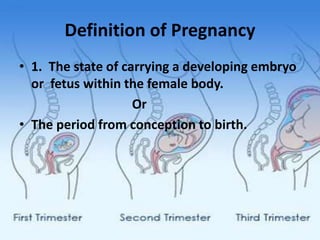
Definition of Pregnancy
• 1. The state of carrying a developing embryo
or fetus within the female body.
Or
• The period from conception to birth.
Trends in Midwifery and Obstetrical
Nursing:-
• As we all know that trends are the changes
occurring from time to time. These changes
are must for the success. Hence there are
many changes which have taken place in
midwifery and obstetrics and raised the
standard of work.
Cont…
• Trends in Midwifery:-
• 1. Changing trends in birth practice: birthing
practice ensures the safest birth at utmost
priority. Earlier the vaginal deliveries and home
deliveries were given the preference but today it
is considered as archaic. Now institutional
deliveries and c-section is preferred.
• 2. Change in the midwifery visits: Earlier the child
was taken care after he was born, now the trend
has changed today antenatal care is more
emphasised.
Cont…
• 3. Change in the care: In the olden days the care of
mother & child disease was problem based but now
the care is the holistic care is more emphasized.
• 4. More importance to health education: In recent
trends counselling to the parents for how to bring up
the child is given more-over the mother is also given
the health education about immunization etc.
• 5. Specialized delivery kits: In recent trends the dais are
given thee education regarding the aseptic way of
conducting the deliveries& are also provided with the
kits for the same.
Cont…
• Trends in Obstetrics:
• 1. Changing trends in caesarean section: Earlier normal
vaginal deliveries were preferred but today the number of
caesarean section deliveries has increased. The basic
indications for caesarean section are:
• a. Malpresentations
• b. Placenta praevia
• c. Foetal distress
• d. PIH
• This is due to the painless deliveries which are conducted
now a days. Now a days trend of horizontal incision and
suturing is there and earlier it was given vertically.
Cont…
• Change in episiotomy:- In earlier times, either
the episiotomy was not given or given straight
but now episiotomy is given laterally. Earlier J-
shaped episiotomies were given but now
trend of mediolateral episiotomies are given
but in some countries trends of central
episiotomy is present.
Sign and symptoms of pregnancy:-
• First Trimester (First 12 weeks):
Symptoms:
Amenorrhoea
Morning sickness
Frequency of micturition
Breast discomfort
Fatigue
• Signs:
Breast changes:
Breasts become enlarged
Nipple and aerola become more pigmented
Mentgomery's tubercles are prominent
Colostrum can be expressed.
Increased vascularity.
Cont…
• Pelvic changes:
a. Jacquemier's or Chadwick's sign: It is the dusty hue of the
vestibule and anterior vaginal wall.
b.Vaginal sign/Osiander's sign: Increased pulsation felt
through the lateral fornices at 8th week.
c.Goodell's sign: Cervix becomes soft as early as 6th week.
d.Piskacek's sign: Asymmetrical enlargement of the uterus if
there is lateral implantation.
e.Hegar's sing: It is present in 2/3rd of cases. This is based on
the fact that:
• Upper part of the body of the uterus is enlarged.
• Lower part of the body becomes empty and soft.
• Cervix becomes firm.
Cont…
• Second Trimester (13-28 weeks):
Symptoms:
a. Amenorrhea
b. Nausea
c. Vomiting
d. Frequency of Micturition
e. Quickening (perception of active fetal movements by the women)
f. Progressive enlargement of lower abdomen.
• Signs:
a. Chloasma: Pigmentation over the forehead and cheeks.
b. Linea Nigra: Linear pigmentation from the symphysis pubis to
umbilicus and extending to xiphoid sternum.
c. Braxton hicks contraction: Uterine contractions which are irregular,
infrequent, spasmodic and painless without any effect on dilatation of the
cervix.
d. Palpation of fetal parts
e. External Ballotment
Cont…
• Third Trimester (29-40 weeks):
Symptoms:
a. Amenorrhoea
b. Enlargement of the abdomen
c. Lightening: a sense of relief of the pressure symptoms is obtained due to
engagement of the presenting part.
d. Frequency of Micturition
e. Fetal Movements.
Signs:
a. Cutaneous changes: increased pigmentation and striae.
b. Uterine shape is changed from cylindrical to spherical.
c. Braxton hicks contractions are more evident.
d. Fetal movements easily felt.
e. Fetal heart sound audible.
Diagnosis of pregnancy:
• The first trimester (0-12 weeks):
Symptoms:
1. Amenorrhoea: Sudden cessation of a previously regular
menstruation is the most common symptom denoting
pregnancy.
2. Morning sickness: Nausea with or without vomiting
commences in the morning. It usually appears about 6 weeks
after onset of the last menstrual period and usually
disappears 6-12 weeks later.
3. Frequency of micturition: Due to congestion and
pressure on the bladder and disappear after the first
trimester.
4. Breast symptoms: As enlargement, sensation of fullness,
tingling and tenderness.
5. Appetite changes and sleepiness.
Cont…
• Signs:
1. Breast signs:
a. Increase in size and vascularity.
b. Increase pigmentation of the nipple and primary areola.
c. Appearance of the secondary areola.
2. Uterine signs:
a. The uterus becomes enlarged, globular and soft.
b. Palmer's sign.
c. Hegar's sign.
3. Cervix becomes soft, hypertrophied and violet.
4. Vagina becomes violet, moist, warm with increased acidity.
Cont…
• The second trimester (13-28 weeks):
• Symptoms:
• 1. Amenorrhoea.
• 2. Morning sickness and urinary symptoms decrease.
• 3. Quickening: The first sensation of the foetal movement by the mother,
occurs at 18-20 weeks in primigravida and at 16-18 weeks in multiparas.
• 4. Abdominal enlargement.
• Signs:
• 1. Breast signs: Become more manifested.
• 2. Skin signs: Cloasma, linea nigra and striae gravidarum appear.
• 3. Uterine signs:
• a. The uterus is felt abdominally.
• b. Braxton Hick's contractions: intermittent painless contractions can be
felt by abdominal examination.
Cont…
• 4. Fetal signs:
• a. Internal ballottement: can be elicited at 16 weeks by a
push to the foetal parts with the two fingers through the
anterior fornix.
• b. External ballottement: can be elicited at 20 weeks by a
push to the foetal parts with one hand abdominally and the
other hand receiving the impulse.
• c. Palpation of foetal parts and movement: by the
obstetrician at 20 weeks.
• d. Foetal heart sound: can be auscultated at 20-24 weeks by
the Pinard's stethoscope.
• e. Umbilical (funic) souffle: A murmur with the same rate of
FHS due to rush of blood in the umbilical arteries. It is
occasionally detected when a loop of the cord lies below the
stethoscope.
Cont…
• The third trimester (29-40 weeks): All signs of
pregnancy become more evident. Pregnancy
tests are positive, sonar and X-ray are
diagnostic.
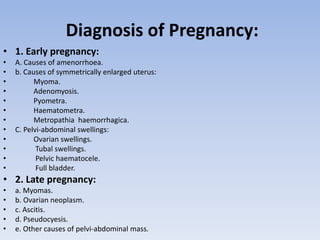
Diagnosis of Pregnancy:
• 1. Early pregnancy:
• A. Causes of amenorrhoea.
• b. Causes of symmetrically enlarged uterus:
• Myoma.
• Adenomyosis.
• Pyometra.
• Haematometra.
• Metropathia haemorrhagica.
• C. Pelvi-abdominal swellings:
• Ovarian swellings.
• Tubal swellings.
• Pelvic haematocele.
• Full bladder.
• 2. Late pregnancy:
• a. Myomas.
• b. Ovarian neoplasm.
• c. Ascitis.
• d. Pseudocyesis.
• e. Other causes of pelvi-abdominal mass.
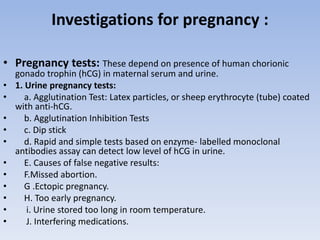
Investigations for pregnancy :
• Pregnancy tests: These depend on presence of human chorionic
gonado trophin (hCG) in maternal serum and urine.
• 1. Urine pregnancy tests:
• a. Agglutination Test: Latex particles, or sheep erythrocyte (tube) coated
with anti-hCG.
• b. Agglutination Inhibition Tests
• c. Dip stick
• d. Rapid and simple tests based on enzyme- labelled monoclonal
antibodies assay can detect low level of hCG in urine.
• E. Causes of false negative results:
• F.Missed abortion.
• G .Ectopic pregnancy.
• H. Too early pregnancy.
• i. Urine stored too long in room temperature.
• J. Interfering medications.
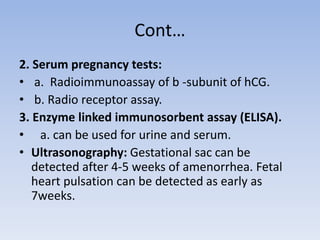
Cont…
2. Serum pregnancy tests:
• a. Radioimmunoassay of b -subunit of hCG.
• b. Radio receptor assay.
3. Enzyme linked immunosorbent assay (ELISA).
• a. can be used for urine and serum.
• Ultrasonography: Gestational sac can be
detected after 4-5 weeks of amenorrhea. Fetal
heart pulsation can be detected as early as
7weeks.
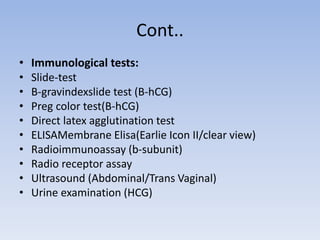
Cont..
• Immunological tests:
• Slide-test
• B-gravindexslide test (B-hCG)
• Preg color test(B-hCG)
• Direct latex agglutination test
• ELISAMembrane Elisa(Earlie Icon II/clear view)
• Radioimmunoassay (b-subunit)
• Radio receptor assay
• Ultrasound (Abdominal/Trans Vaginal)
• Urine examination (HCG)
Minor Disorder in Pregnancy
1. Nausea and vomiting: It specially in the morning, soon after getting
out of bed, are usually common in primigravida.
• Management:
• a. Advice to move the limbs for few minutes before getting out of bed.
• b. Taking a dry toast or biscuit before rising from bed.
• c. Avoidance of fatty foods.
• d. If simple measure fails, antiemetic drugs with plenty of glucose drink
usually cure the condition.
2. Backache: It may appear during later months of pregnancy.
• Management:
• a. Improvement of posture.
• b. Well fitted girdle belt which correct lumbar lordosis.
• c. Massaging the back muscle.
• d. Analgesic and rest relieve the pain due to muscle spasm.
Cont…
3. Leg Cramps: It may be due to deficiency of diffusible serum
calcium or elevation of serum phosphorous.
• Management:
• Supplementary calcium therapy in tablet or syrup149an
provided to mother.
• a. Massaging the leg.
• b. Application of local heat and vitamin B, daily may be
effective.
4. Acidity and Heat burn:
• Management:
• a. Antacid preparation either chewable tablets or gels after
meals can be prescribed.
• b. Advice to sleeping in semirecting position with high
pillows relieves the feature of hiatus hernia.
Cont…
• 5. Varicose veins: Varicose veins in the legs and vulva or rectum may
appear for the first time during pregnancy usually in later months.
• Management:
• a. For legs varicosities, elastic crepe bandage during movement sand
elevation of the limbs during rest and can give symptom-atic relief.
• b. Specific therapy is better to avoided.
• 6. Ankle oedema: Excessive fluid retention as evidenced by mark edge
in a weight.
• Management:
• Advice mother to take rest with slight elevation of the limbs.
• 7. Vaginal discharge:
• Management:
• a. Advice mother for local cleanliness are all which are required.
• b. Presence of any infection should be treated with vaginal application of
metronidazole.
Warning signs of pregnancy:
• Certain symptoms should be reported to your physician
immediately, during any stage of the pregnancy. These include,
but are not limited to the following:
• 1. Bleeding or spotting from your vagina.
• 2. A gush or leak of water from your vagina.
• 3. Uterine cramping or tightening 6 or more times per hour if you
are less than 37 weeks pregnant.
• 4. Vague signs of preterm labor :
a. Menstrual-like cramping.
b. A dull, low backache.
c. Pelvic pressure or heaviness.
d. Intestinal cramping, with or without diarrhoea.
e. An increase or change in the character of vaginal discharge.
f . A general feeling that "something is not right.”
Cont…
• 5. Sharp, non-stop pain in your belly.
• 6. Fever over 100°F or 38°C.
• 7. Nausea or vomiting that won't go away.
• 8. Sudden swelling of your face, hands or feet.
• 9. Decrease in baby's movements
• 10. Dizziness
Nursing Care Plan For Normal
Pregnancy
• Nurses specializing in obstetrics understand the importance of
ensuring a healthy mother and healthy baby. In order to design a
tailored pregnancy nursing care plan, it is necessary to have a
baseline of the pregnant or post-partum patient's condition
whether that be hemorrhage , preeclampsia or ectopic pregnancy.
An effective nursing care plan for pregnancy should include
assessment, promoting autonomy and patient teaching.
• Assessment: Assessment, the first element in the nursing process
is to establish baseline information for patients. This begins with a
head-to-be overview. Assess the patient's head and neck, noting
any enlarged lymph nodes, thyroid or other abnormalities. Check
patient's vital signs and report any signs of shortness. Also
document patient's fundal height and fetal assessment. Pay special
attention to any edema in the extremities or subjective reports of
pain in the calves. Laboratory tests are also reviewed and
documented.
Nursing Diagnosis:
• 1. Maternal weight gain related to fetal growth.
• 2. Knowledge deficit related to normal and
abnormal symptoms in her body.
• 3. Lack of knowledge related to antenatal
exercises.
• 4. Lack of knowledge related to diet required
during pregnancy.
• 5. Anxiety related to child birth process and post
natal care.
S
.
N
O
Nursing
Diagnosis
Goal Planning Implementation Rational Evaluatio
n
1 Increased
maternal
weight
gain is a
given
related to
fetal
growth.
Maternal
weight
gain is a
indicator
of
maternal
and fetal
weel
being.
1. To encourage the
client for regular
antenatal care.
2. To screen out
high risk cases to
find out the
factors affecting
healthy fetal
growth.
3. To encourage the
mother to take
nutritious diet.
4. To advice the
mother to wear
loose and
comfortable
garments.
1. Client is
encouraged
for regular
antenatal
check-ups.
2. Factors
affecting fetal
growth are
monitored.
3. Mother is
encouraged
to take
nutritionist
diet.
4. Mother is
advised to
wear loose
and
comfortable
garments.
1. It will help
to calculate
the exact
weight gain
during
each
trimester.
2. It will help
to detect
risk cases.
3. 3.it will
promote
maternal
weight gain
and fetal
well beign.
Increase
weight
gain is a
good
sign of
pregnanc
y.
Principles of managing drugs in
pregnancy:-
• 1. Drugs used during pregnancy requires special consideration be-
cause both the mother and the child are affected. Few drugs are
considered safe and drug are generally contraindicated. Many
pregnant take drugs for acute or chronic disorders or habitual use
of alcohol and tobacco.
• 2. Give medications only when clearly indicated, weighing benefits
to the mother against the risks to the fetus. Any drugs used during
pregnancy should be given in the lowest effective doses and for the
shortest effective time. The choice of drug should be based on the
stage of pregnancy and drug information.
• 3. During the first trimester, an older safe drug is preferred over a
newer drug of unknown teratogenicity. Teratogenicity is the ability
of a substance to cause abnormal counsel pregnant women about
the use of fetal development when taken by immunizations during
pregnancy.
Cont…
• 4. Live virus vaccines (measles, mumps, polio, rubella)
should be avoided because of possible harmful effects
to the fetus. Inactive virus vaccines (influenza, rabies,
hepatitis B) and toxoids (diphtheria, tetanus) are
considered safe for use. Hyperimmune globulins can be
given to pregnant women who are exposed to hepatitis
B, rabies, tetanus or varicella.
• 5. Hyperimmune immunoglobulin are IGIVS with high
titers of anti-bodies against viruses or toxins.
Hyperimmune IGIVS are avail-able for hepatitis B virus,
rabies, tetanus and digoxin over dose. Intravenous
administration of the hyperimmune globulins reduces
risk or severity of infection.
Antenatal advice
• Antenatal Preparation: It is define as preparation of the mother
during antenatal period.
• Antenatal advice:
• Principles of antenatal advice are:
• 1. To impress the patient about the importance of the regular
check-ups.
• 2. To maintain and improve the health status of woman till
delivery.
• 3. To improve and tone up the psychology and to remove the fear
regarding the pregnancy, delivery and pueperium.
• The antenatal period is defined as the period between conception
of the fetus and delivery. It covers the time of pregnancy from the
first day of last menstrual period (LMP) to the start of true labour,
which makes the beginning of intranatal period.
Diet in normal Pregnancy:-
• The diet should be adequate to maintain the maternal health
, meet the needs of growing fetus and provide the strength
and vitality required during labour and for successful
lactation. The pregnancy diet ideally should be light,
nutritious, easily digestible and rich in protein, minerals and
vitamins. It should consist of in addition to the principal food
at least half litre, if not, 1litre milk (1 litre of milk contain 1g of
calcium), plenty of green vegetables and fruits. The diet
should be adequate and balanced, it should provide the
following nutrients:
• 1. Calories - 330065g
• 2. Protein
• 3. Iron40mg
• 4. Calcium1g
Antenatal hygiene:
• 1. Rest and sleep: 8 hours sleep at night and 2 hours
rest after midday meals should be advised.
• 2. Bowel: Constipation should be avoided by regular
intake of green leafy vegetables and fruits and extra
fluids. Purgatives like castor oil should be avoided.
• 3. Bathing: The pregnant woman should take daily bath
but be careful in the bathroom due to imbalance.
• 4. Clothing Shoes and Belt: Pregnant woman should
wear loose but comfortable garments. High heel should
be avoided in advanced pregnancy.
• 5. Dental care: The women should be given information
about oral hygiene.
Cont…
• 6.Care of breast: If nipples are anatomically normal nothing is to
done beyond ordinary cleanliness. If the nipples are retracted
correction is to be in the later months by manipulation.
• 7. Coitus: Coitus should be avoided during the first trimester
preferably during the time of missed periods and also during the
last 6 weeks. Coitus is also avoided if there is risk of abortion or
preterm labor. Otherwise it is not harmful.
• 8. Travel: Travel by vehicles should be avoided specially in first
trimester and the last 6 weeks.
• 9. Smoking and alcohol: Smoking and alcohol should be avoided in
pregnancy as it is injurious to health.
• 10. Immunization: The mother should be immunized against
tetanus. If the mother was not immunized earlier, 2 doses of
tetanus toxoid should be given- the first dose at 20-24 weeks of
pregnancy. The minimum interval between two doses should be
one month. The second dose preferably be given one month
before the expected date of delivery.
Cont…
• 11. Drugs: All most all the drugs given to mother will cross the placenta to
reach the fetus. Possibility of pregnancy should be kept in mind while
prescribing drugs to any pregnant woman of reproductive age.
• 12. Pica: Pica is the practice of craving substances with little or no
nutritional value. Most pregnancy and pica related cravings involve non-
food substances such as dirt or chalk. For this Inform your health care
provider and review your prenatal health records.
• a. Monitor your iron status along with other vitamin and mineral in take.
• b. Consider potential substitutes for the cravings such as chewing sugarless
gum.
• C. Inform a friend of your craving who can help you avoid non-food items.
• 13. Others: The pregnant woman should not unnecessary exposed her self
to X-RAYS of the abdomen, especially during four months of pregnancy. X-
ray may cause malformation of the fetus.
• 14. Family planning: Exposure to family planning advise and motivation
should begin during antenatal period as the mother is psychological more
receptive to advise on family planning during pregnancy than at other
times.
Cont…
• 15. Warning signs:
The mother should be instructed that she should
report immediately in case of the following
warning signs:
a. Swelling feet
b. Fits
c. Headache
d. Blurring vision
e. Bleeding or discharge per vagina
f. Any other unusual symptoms.
Antenatal Counselling:-
• 1. Strengthening prenatal bonding.
• 2 Overcome the anticipatory fears of labour, birth and parenting.
• 3. Reduce the stress that can negatively impact labour and birth.
• 4. Find one's own individual style for coping with labour and
choosing the birthing facility.
• 5. Paying proper attention to the personal hygiene.
• 6. Having adequate rest and sleep in a comfortable position.
• 7. Wearing loose and comfortable clothing and avoiding high heel
shoes.
• 8. Travelling must be avoided.
• 9. Specific attention should be given to diet and the smoking and
alcohol should be restrained.
• 10. Immunization.
Pregnancy (Midwifery and obstetrical)

Pregnancy (Midwifery and obstetrical)

  • 1.
  • 2.
  • 3.
    Definition of Pregnancy •1. The state of carrying a developing embryo or fetus within the female body. Or • The period from conception to birth.
  • 4.
    Trends in Midwiferyand Obstetrical Nursing:- • As we all know that trends are the changes occurring from time to time. These changes are must for the success. Hence there are many changes which have taken place in midwifery and obstetrics and raised the standard of work.
  • 5.
    Cont… • Trends inMidwifery:- • 1. Changing trends in birth practice: birthing practice ensures the safest birth at utmost priority. Earlier the vaginal deliveries and home deliveries were given the preference but today it is considered as archaic. Now institutional deliveries and c-section is preferred. • 2. Change in the midwifery visits: Earlier the child was taken care after he was born, now the trend has changed today antenatal care is more emphasised.
  • 6.
    Cont… • 3. Changein the care: In the olden days the care of mother & child disease was problem based but now the care is the holistic care is more emphasized. • 4. More importance to health education: In recent trends counselling to the parents for how to bring up the child is given more-over the mother is also given the health education about immunization etc. • 5. Specialized delivery kits: In recent trends the dais are given thee education regarding the aseptic way of conducting the deliveries& are also provided with the kits for the same.
  • 7.
    Cont… • Trends inObstetrics: • 1. Changing trends in caesarean section: Earlier normal vaginal deliveries were preferred but today the number of caesarean section deliveries has increased. The basic indications for caesarean section are: • a. Malpresentations • b. Placenta praevia • c. Foetal distress • d. PIH • This is due to the painless deliveries which are conducted now a days. Now a days trend of horizontal incision and suturing is there and earlier it was given vertically.
  • 8.
    Cont… • Change inepisiotomy:- In earlier times, either the episiotomy was not given or given straight but now episiotomy is given laterally. Earlier J- shaped episiotomies were given but now trend of mediolateral episiotomies are given but in some countries trends of central episiotomy is present.
  • 9.
    Sign and symptomsof pregnancy:- • First Trimester (First 12 weeks): Symptoms: Amenorrhoea Morning sickness Frequency of micturition Breast discomfort Fatigue • Signs: Breast changes: Breasts become enlarged Nipple and aerola become more pigmented Mentgomery's tubercles are prominent Colostrum can be expressed. Increased vascularity.
  • 10.
    Cont… • Pelvic changes: a.Jacquemier's or Chadwick's sign: It is the dusty hue of the vestibule and anterior vaginal wall. b.Vaginal sign/Osiander's sign: Increased pulsation felt through the lateral fornices at 8th week. c.Goodell's sign: Cervix becomes soft as early as 6th week. d.Piskacek's sign: Asymmetrical enlargement of the uterus if there is lateral implantation. e.Hegar's sing: It is present in 2/3rd of cases. This is based on the fact that: • Upper part of the body of the uterus is enlarged. • Lower part of the body becomes empty and soft. • Cervix becomes firm.
  • 11.
    Cont… • Second Trimester(13-28 weeks): Symptoms: a. Amenorrhea b. Nausea c. Vomiting d. Frequency of Micturition e. Quickening (perception of active fetal movements by the women) f. Progressive enlargement of lower abdomen. • Signs: a. Chloasma: Pigmentation over the forehead and cheeks. b. Linea Nigra: Linear pigmentation from the symphysis pubis to umbilicus and extending to xiphoid sternum. c. Braxton hicks contraction: Uterine contractions which are irregular, infrequent, spasmodic and painless without any effect on dilatation of the cervix. d. Palpation of fetal parts e. External Ballotment
  • 12.
    Cont… • Third Trimester(29-40 weeks): Symptoms: a. Amenorrhoea b. Enlargement of the abdomen c. Lightening: a sense of relief of the pressure symptoms is obtained due to engagement of the presenting part. d. Frequency of Micturition e. Fetal Movements. Signs: a. Cutaneous changes: increased pigmentation and striae. b. Uterine shape is changed from cylindrical to spherical. c. Braxton hicks contractions are more evident. d. Fetal movements easily felt. e. Fetal heart sound audible.
  • 13.
    Diagnosis of pregnancy: •The first trimester (0-12 weeks): Symptoms: 1. Amenorrhoea: Sudden cessation of a previously regular menstruation is the most common symptom denoting pregnancy. 2. Morning sickness: Nausea with or without vomiting commences in the morning. It usually appears about 6 weeks after onset of the last menstrual period and usually disappears 6-12 weeks later. 3. Frequency of micturition: Due to congestion and pressure on the bladder and disappear after the first trimester. 4. Breast symptoms: As enlargement, sensation of fullness, tingling and tenderness. 5. Appetite changes and sleepiness.
  • 14.
    Cont… • Signs: 1. Breastsigns: a. Increase in size and vascularity. b. Increase pigmentation of the nipple and primary areola. c. Appearance of the secondary areola. 2. Uterine signs: a. The uterus becomes enlarged, globular and soft. b. Palmer's sign. c. Hegar's sign. 3. Cervix becomes soft, hypertrophied and violet. 4. Vagina becomes violet, moist, warm with increased acidity.
  • 15.
    Cont… • The secondtrimester (13-28 weeks): • Symptoms: • 1. Amenorrhoea. • 2. Morning sickness and urinary symptoms decrease. • 3. Quickening: The first sensation of the foetal movement by the mother, occurs at 18-20 weeks in primigravida and at 16-18 weeks in multiparas. • 4. Abdominal enlargement. • Signs: • 1. Breast signs: Become more manifested. • 2. Skin signs: Cloasma, linea nigra and striae gravidarum appear. • 3. Uterine signs: • a. The uterus is felt abdominally. • b. Braxton Hick's contractions: intermittent painless contractions can be felt by abdominal examination.
  • 16.
    Cont… • 4. Fetalsigns: • a. Internal ballottement: can be elicited at 16 weeks by a push to the foetal parts with the two fingers through the anterior fornix. • b. External ballottement: can be elicited at 20 weeks by a push to the foetal parts with one hand abdominally and the other hand receiving the impulse. • c. Palpation of foetal parts and movement: by the obstetrician at 20 weeks. • d. Foetal heart sound: can be auscultated at 20-24 weeks by the Pinard's stethoscope. • e. Umbilical (funic) souffle: A murmur with the same rate of FHS due to rush of blood in the umbilical arteries. It is occasionally detected when a loop of the cord lies below the stethoscope.
  • 17.
    Cont… • The thirdtrimester (29-40 weeks): All signs of pregnancy become more evident. Pregnancy tests are positive, sonar and X-ray are diagnostic.
  • 18.
    Diagnosis of Pregnancy: •1. Early pregnancy: • A. Causes of amenorrhoea. • b. Causes of symmetrically enlarged uterus: • Myoma. • Adenomyosis. • Pyometra. • Haematometra. • Metropathia haemorrhagica. • C. Pelvi-abdominal swellings: • Ovarian swellings. • Tubal swellings. • Pelvic haematocele. • Full bladder. • 2. Late pregnancy: • a. Myomas. • b. Ovarian neoplasm. • c. Ascitis. • d. Pseudocyesis. • e. Other causes of pelvi-abdominal mass.
  • 19.
    Investigations for pregnancy: • Pregnancy tests: These depend on presence of human chorionic gonado trophin (hCG) in maternal serum and urine. • 1. Urine pregnancy tests: • a. Agglutination Test: Latex particles, or sheep erythrocyte (tube) coated with anti-hCG. • b. Agglutination Inhibition Tests • c. Dip stick • d. Rapid and simple tests based on enzyme- labelled monoclonal antibodies assay can detect low level of hCG in urine. • E. Causes of false negative results: • F.Missed abortion. • G .Ectopic pregnancy. • H. Too early pregnancy. • i. Urine stored too long in room temperature. • J. Interfering medications.
  • 20.
    Cont… 2. Serum pregnancytests: • a. Radioimmunoassay of b -subunit of hCG. • b. Radio receptor assay. 3. Enzyme linked immunosorbent assay (ELISA). • a. can be used for urine and serum. • Ultrasonography: Gestational sac can be detected after 4-5 weeks of amenorrhea. Fetal heart pulsation can be detected as early as 7weeks.
  • 21.
    Cont.. • Immunological tests: •Slide-test • B-gravindexslide test (B-hCG) • Preg color test(B-hCG) • Direct latex agglutination test • ELISAMembrane Elisa(Earlie Icon II/clear view) • Radioimmunoassay (b-subunit) • Radio receptor assay • Ultrasound (Abdominal/Trans Vaginal) • Urine examination (HCG)
  • 22.
    Minor Disorder inPregnancy 1. Nausea and vomiting: It specially in the morning, soon after getting out of bed, are usually common in primigravida. • Management: • a. Advice to move the limbs for few minutes before getting out of bed. • b. Taking a dry toast or biscuit before rising from bed. • c. Avoidance of fatty foods. • d. If simple measure fails, antiemetic drugs with plenty of glucose drink usually cure the condition. 2. Backache: It may appear during later months of pregnancy. • Management: • a. Improvement of posture. • b. Well fitted girdle belt which correct lumbar lordosis. • c. Massaging the back muscle. • d. Analgesic and rest relieve the pain due to muscle spasm.
  • 23.
    Cont… 3. Leg Cramps:It may be due to deficiency of diffusible serum calcium or elevation of serum phosphorous. • Management: • Supplementary calcium therapy in tablet or syrup149an provided to mother. • a. Massaging the leg. • b. Application of local heat and vitamin B, daily may be effective. 4. Acidity and Heat burn: • Management: • a. Antacid preparation either chewable tablets or gels after meals can be prescribed. • b. Advice to sleeping in semirecting position with high pillows relieves the feature of hiatus hernia.
  • 24.
    Cont… • 5. Varicoseveins: Varicose veins in the legs and vulva or rectum may appear for the first time during pregnancy usually in later months. • Management: • a. For legs varicosities, elastic crepe bandage during movement sand elevation of the limbs during rest and can give symptom-atic relief. • b. Specific therapy is better to avoided. • 6. Ankle oedema: Excessive fluid retention as evidenced by mark edge in a weight. • Management: • Advice mother to take rest with slight elevation of the limbs. • 7. Vaginal discharge: • Management: • a. Advice mother for local cleanliness are all which are required. • b. Presence of any infection should be treated with vaginal application of metronidazole.
  • 25.
    Warning signs ofpregnancy: • Certain symptoms should be reported to your physician immediately, during any stage of the pregnancy. These include, but are not limited to the following: • 1. Bleeding or spotting from your vagina. • 2. A gush or leak of water from your vagina. • 3. Uterine cramping or tightening 6 or more times per hour if you are less than 37 weeks pregnant. • 4. Vague signs of preterm labor : a. Menstrual-like cramping. b. A dull, low backache. c. Pelvic pressure or heaviness. d. Intestinal cramping, with or without diarrhoea. e. An increase or change in the character of vaginal discharge. f . A general feeling that "something is not right.”
  • 26.
    Cont… • 5. Sharp,non-stop pain in your belly. • 6. Fever over 100°F or 38°C. • 7. Nausea or vomiting that won't go away. • 8. Sudden swelling of your face, hands or feet. • 9. Decrease in baby's movements • 10. Dizziness
  • 27.
    Nursing Care PlanFor Normal Pregnancy • Nurses specializing in obstetrics understand the importance of ensuring a healthy mother and healthy baby. In order to design a tailored pregnancy nursing care plan, it is necessary to have a baseline of the pregnant or post-partum patient's condition whether that be hemorrhage , preeclampsia or ectopic pregnancy. An effective nursing care plan for pregnancy should include assessment, promoting autonomy and patient teaching. • Assessment: Assessment, the first element in the nursing process is to establish baseline information for patients. This begins with a head-to-be overview. Assess the patient's head and neck, noting any enlarged lymph nodes, thyroid or other abnormalities. Check patient's vital signs and report any signs of shortness. Also document patient's fundal height and fetal assessment. Pay special attention to any edema in the extremities or subjective reports of pain in the calves. Laboratory tests are also reviewed and documented.
  • 28.
    Nursing Diagnosis: • 1.Maternal weight gain related to fetal growth. • 2. Knowledge deficit related to normal and abnormal symptoms in her body. • 3. Lack of knowledge related to antenatal exercises. • 4. Lack of knowledge related to diet required during pregnancy. • 5. Anxiety related to child birth process and post natal care.
  • 29.
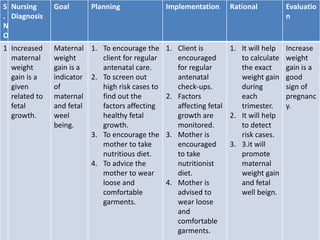
    S . N O Nursing Diagnosis Goal Planning ImplementationRational Evaluatio n 1 Increased maternal weight gain is a given related to fetal growth. Maternal weight gain is a indicator of maternal and fetal weel being. 1. To encourage the client for regular antenatal care. 2. To screen out high risk cases to find out the factors affecting healthy fetal growth. 3. To encourage the mother to take nutritious diet. 4. To advice the mother to wear loose and comfortable garments. 1. Client is encouraged for regular antenatal check-ups. 2. Factors affecting fetal growth are monitored. 3. Mother is encouraged to take nutritionist diet. 4. Mother is advised to wear loose and comfortable garments. 1. It will help to calculate the exact weight gain during each trimester. 2. It will help to detect risk cases. 3. 3.it will promote maternal weight gain and fetal well beign. Increase weight gain is a good sign of pregnanc y.
  • 30.
    Principles of managingdrugs in pregnancy:- • 1. Drugs used during pregnancy requires special consideration be- cause both the mother and the child are affected. Few drugs are considered safe and drug are generally contraindicated. Many pregnant take drugs for acute or chronic disorders or habitual use of alcohol and tobacco. • 2. Give medications only when clearly indicated, weighing benefits to the mother against the risks to the fetus. Any drugs used during pregnancy should be given in the lowest effective doses and for the shortest effective time. The choice of drug should be based on the stage of pregnancy and drug information. • 3. During the first trimester, an older safe drug is preferred over a newer drug of unknown teratogenicity. Teratogenicity is the ability of a substance to cause abnormal counsel pregnant women about the use of fetal development when taken by immunizations during pregnancy.
  • 31.
    Cont… • 4. Livevirus vaccines (measles, mumps, polio, rubella) should be avoided because of possible harmful effects to the fetus. Inactive virus vaccines (influenza, rabies, hepatitis B) and toxoids (diphtheria, tetanus) are considered safe for use. Hyperimmune globulins can be given to pregnant women who are exposed to hepatitis B, rabies, tetanus or varicella. • 5. Hyperimmune immunoglobulin are IGIVS with high titers of anti-bodies against viruses or toxins. Hyperimmune IGIVS are avail-able for hepatitis B virus, rabies, tetanus and digoxin over dose. Intravenous administration of the hyperimmune globulins reduces risk or severity of infection.
  • 32.
    Antenatal advice • AntenatalPreparation: It is define as preparation of the mother during antenatal period. • Antenatal advice: • Principles of antenatal advice are: • 1. To impress the patient about the importance of the regular check-ups. • 2. To maintain and improve the health status of woman till delivery. • 3. To improve and tone up the psychology and to remove the fear regarding the pregnancy, delivery and pueperium. • The antenatal period is defined as the period between conception of the fetus and delivery. It covers the time of pregnancy from the first day of last menstrual period (LMP) to the start of true labour, which makes the beginning of intranatal period.
  • 33.
    Diet in normalPregnancy:- • The diet should be adequate to maintain the maternal health , meet the needs of growing fetus and provide the strength and vitality required during labour and for successful lactation. The pregnancy diet ideally should be light, nutritious, easily digestible and rich in protein, minerals and vitamins. It should consist of in addition to the principal food at least half litre, if not, 1litre milk (1 litre of milk contain 1g of calcium), plenty of green vegetables and fruits. The diet should be adequate and balanced, it should provide the following nutrients: • 1. Calories - 330065g • 2. Protein • 3. Iron40mg • 4. Calcium1g
  • 34.
    Antenatal hygiene: • 1.Rest and sleep: 8 hours sleep at night and 2 hours rest after midday meals should be advised. • 2. Bowel: Constipation should be avoided by regular intake of green leafy vegetables and fruits and extra fluids. Purgatives like castor oil should be avoided. • 3. Bathing: The pregnant woman should take daily bath but be careful in the bathroom due to imbalance. • 4. Clothing Shoes and Belt: Pregnant woman should wear loose but comfortable garments. High heel should be avoided in advanced pregnancy. • 5. Dental care: The women should be given information about oral hygiene.
  • 35.
    Cont… • 6.Care ofbreast: If nipples are anatomically normal nothing is to done beyond ordinary cleanliness. If the nipples are retracted correction is to be in the later months by manipulation. • 7. Coitus: Coitus should be avoided during the first trimester preferably during the time of missed periods and also during the last 6 weeks. Coitus is also avoided if there is risk of abortion or preterm labor. Otherwise it is not harmful. • 8. Travel: Travel by vehicles should be avoided specially in first trimester and the last 6 weeks. • 9. Smoking and alcohol: Smoking and alcohol should be avoided in pregnancy as it is injurious to health. • 10. Immunization: The mother should be immunized against tetanus. If the mother was not immunized earlier, 2 doses of tetanus toxoid should be given- the first dose at 20-24 weeks of pregnancy. The minimum interval between two doses should be one month. The second dose preferably be given one month before the expected date of delivery.
  • 36.
    Cont… • 11. Drugs:All most all the drugs given to mother will cross the placenta to reach the fetus. Possibility of pregnancy should be kept in mind while prescribing drugs to any pregnant woman of reproductive age. • 12. Pica: Pica is the practice of craving substances with little or no nutritional value. Most pregnancy and pica related cravings involve non- food substances such as dirt or chalk. For this Inform your health care provider and review your prenatal health records. • a. Monitor your iron status along with other vitamin and mineral in take. • b. Consider potential substitutes for the cravings such as chewing sugarless gum. • C. Inform a friend of your craving who can help you avoid non-food items. • 13. Others: The pregnant woman should not unnecessary exposed her self to X-RAYS of the abdomen, especially during four months of pregnancy. X- ray may cause malformation of the fetus. • 14. Family planning: Exposure to family planning advise and motivation should begin during antenatal period as the mother is psychological more receptive to advise on family planning during pregnancy than at other times.
  • 37.
    Cont… • 15. Warningsigns: The mother should be instructed that she should report immediately in case of the following warning signs: a. Swelling feet b. Fits c. Headache d. Blurring vision e. Bleeding or discharge per vagina f. Any other unusual symptoms.
  • 38.
    Antenatal Counselling:- • 1.Strengthening prenatal bonding. • 2 Overcome the anticipatory fears of labour, birth and parenting. • 3. Reduce the stress that can negatively impact labour and birth. • 4. Find one's own individual style for coping with labour and choosing the birthing facility. • 5. Paying proper attention to the personal hygiene. • 6. Having adequate rest and sleep in a comfortable position. • 7. Wearing loose and comfortable clothing and avoiding high heel shoes. • 8. Travelling must be avoided. • 9. Specific attention should be given to diet and the smoking and alcohol should be restrained. • 10. Immunization.