Psychoanalysis
• Psychoanalysis- the most famous of all personality theories.
• The two cornerstones of psychoanalysis
-Sex and aggression
• Spread beyond its Viennese
• Brilliant command of language
• Based on his experiences with patients, his analysis of his own
dreams and his vast readings in the various science and
humanities.
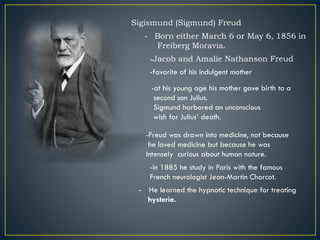
Sigismund (Sigmund) Freud
- Born either March 6 or May 6, 1856 in
Freiberg Moravia.
-Jacob and Amalie Nathanson Freud
-favorite of his indulgent mother
-at his young age his mother gave birth to a
second son Julius.
Sigmund harbored an unconscious
wish for Julius’ death.
-Freud was drawn into medicine, not because
he loved medicine but because he was
Intensely curious about human nature.
-in 1885 he study in Paris with the famous
French neurologist Jean-Martin Charcot.
- He learned the hypnotic technique for treating
hysteria.
• Hysteria- a disorder typically characterized by paralysis or in the
improper functioning of certain parts of the body.
• Josef Breuer- a well-known Viennese physician who taught Freud
catharsis.
• Catharsis- the process of removing hysterical symptoms through
“talking them out.”
• From as early as adolescence, Freud literally dreamed of making
monumental discovery and achieving fame.
• In 1886 he had learned about male hysteria.
• Breuer discussed the case of Anna O to Freud
• He cannot accept Freud’s notion that hysteria came from childhood
sexual experiences.
• During 1890’s Freud suffer personal crisis.
• Neuroses have their etiology in a child’s seduction by a parent.
• 1897 he abandoned the seduction theory.
• Freud sank even more deeply in his midlife crisis.
• Henri Ellenberger said Freud’s life is a time of “creative illness”.
• “It is not the scientific differences that are so important; it is
usually some other kind of animosity, jealousy or revenge, that
gives the impulse to enmity. The scientific differences come
later.”
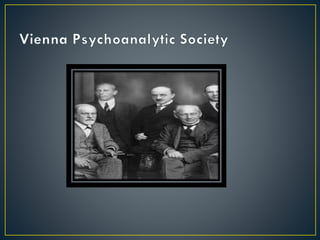
• 1902- Freud invited small group and they are – Alfred Adler,
Wilhelm Stekel, Max Kahane and Rudolf Reitler.
• 1910- Freud founded International Psychoanalytical Association
• Carl Jung of Zurich as a president of association .
• “Crown Prince” and “the man of the future”
•
“My emotional life has always insisted that I should have an
intimate friend and hated enemy. I have always been able to
provide myself afresh with both”
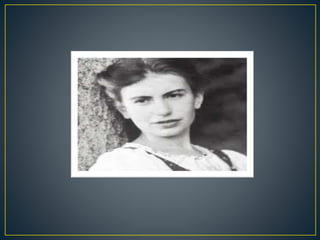
• 1895- his youngest child was born , Anna Freud.
• He never won the coveted Nobel prize for science, he was
awarded the Goethe prize for literature.
• He was a master of German tongue and knew several other
languages.
• Why did Freud have such a disdain for Americans?
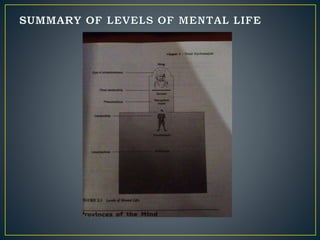
• Mental life is divided into two levels.
-the unconscious and the conscious
• Unconscious has two different levels.
-the unconscious proper and the preconscious
• Contains all drives, urges or instincts that are
beyond our awareness.
• To him the unconscious is the explanation for he
meaning behind dreams slips of the tongue and
certain kind of forgetting called repression.
• To enter the conscious level of mind, the
unconscious images first must be sufficiently
disguised to slip past the primary censor and then
they must elude a final censor.
• Punishment and suppression often create feelings
of anxiety and the anxiety in turn stimulates
repression.
• Phylogenetic endowment- according to Freud this is
the inherited unconscious images from our early
ancestors.
• Unconscious drives may appear in consciousness,
but only after undergoing certain transformations.
• The unconscious mind of one person can
communicate with the unconscious of another
without aware of the process.
• Unconscious does not mean inactive or dormant.
• Contains all those elements that are not conscious
but can become conscious either quite readily with
some difficulty.
• The contents of the preconscious comes form two
sources:
-conscious perception
-unconscious
• Plays a relatively minor role psychoanalytic theory.
• It is the only level of mental life directly available to us.
• Ideas can reach consciousness from two different directions:
- Perceptual conscious
-from within the mental structure and includes non
threatening ideas.
• A term derived from the impersonal pronoun
meaning “the it” or the not yet owned component of
personality.
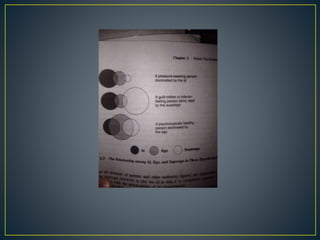
• Id serves as pleasure principle.
• Primitive, chaotic, inaccessible to
consciousness, unchangeable, amoral, illogical,
unorganized.
• The Id operates through the primary process.
• The ego or I.
• The only region of the mind in contact with reality.
• It is governed by the reality principle.
• It uses repression and other defense mechanism to
defend itself against the anxiety.
• The ego becomes differentiated from the Id when infants
learn to distinguished from the outer world.
• Freud used the analogy of a person on a horseback.
• The super ego or above-I, represents the moral and
ideal aspects of personality.
• Guided by the moralistic and idealistic principles.
• Like an ego it has no energy on its own.
• The super ego has to subsystems:
- The conscience
-The ego-idea
• It cannot produce repressions by itself, but it can
order the ego to do so.
• The super ego is not concerned in the happiness of
the ego.
• Is like an Id in that it is completely ignorant of and
unconcerned with the practicability of its
requirements.
• From a German word Trieb to refer to a drive or a
stimulus within the person.
• Constant motivational force
• The various drives can all be grouped under two major
headings:
- Sex or Eros
- Aggression and distraction or Thanatos.
• This drives originates from the ego.
• Libido- a psychic energy for the sex drive.
• Every basic drive is characterized by :
-an impetus
-a source
-an aim
-an object.
• The aim of the sexual drive is pleasure.
• Erogenous zones- mouth and anus are especially
capable of producing sexual pleasure.
• Sex can take may forms including:
- narcissism
- love
- sadism
-masochism
• Primary narcissism- Infants are primarily self-centered, with
their libido invested almost exclusively on their own ego.
• Secondary narcissism- adolescents often redirect their libido
back to the ego and become preoccupied with personal
appearance and other self interest.
• Love- second manifestation of Eros.
- develops when people invest their libido on an
object or person other than themselves.
• Sadism- the need of sexual pleasure from inflicting pain or
humiliation on another person.
- it is a common need and exists to some in all sexual
relationships.
•
• Masochism- like sadism it is a common need but it becomes a
perversion when Eros becomes subservient to the destructive
drive.
• The aim of the destructive drive is to return the
organism to an inorganic state.
• Ultimate inorganic condition is death and the final
aim of the aggressive drive is self-destructive.
• Aggression can also take many forms:
-teasing
-gossip
-sarcasm
-humiliation
-humor
-enjoyment of other people’s suffering.
• It is a felt, affective, unpleasant state accompanied
by a physical sensation that warns the person
against impending danger.
• Only ego can produce or feel anxiety.
• The ego’s dependence on the id results neurotic
anxiety.
• The ego’s dependence on the superego produces
moral anxiety.
• The ego’s dependence on the outer world leads to
realistic anxiety.
• Neurotic Anxiety- defined as apprehension about an
unknown danger.
• Moral anxiety- conflict between ego and superego.
• Realistic Anxiety- defined as unpleasant, non
specific feeling involving a possible danger.
• Anxiety serves as an ego- preserving mechanism
because it signals us that some danger is at hand.
• We must expend psychic energy to establish and
maintain defense mechanisms, the more defensive
we are, the psychic energy we have left to satisfy id
impulses.
• Ego’s purpose in establishing defense mechanisms-
to avoid dealing directly with sexual and aggressive
implosives and to defend itself against the anxiety
that accompanies them.
• The most basic defense mechanism.
• Ego protects itself by repressing those impulses.
• Repressed drives may be disguised as physical
symptoms.
• Repressed drives may also find an outlet in dreams,
slips of the tongues or one of the other defense
mechanisms.
• Repressed impulse may become conscious is
through adopting a disguise that is directly
opposite its original form.
• People can redirect their unacceptable urges onto a
variety of people or objects so that the original
impulse is disguised or concealed.
• Sticking to a certain way of reaction although its
ineffectiveness has been proved repeatedly.
• Can be recognized if a person in frustrating
situation acts in an immature and outworn
manner.
• Seeing in others unacceptable feelings or
tendencies that actually reside in one’s own
unconscious.
• People incorporate positive qualities of another person into
their own ego.
• Redirecting unacceptable, instinctual drives into personally and
socially acceptable channels.
• Oral phase
-obtain life sustaining nourishment through the oral cavity.
-gain pleasure through the art of sucking
-oral sadistic period
• Anal phase
-anal character
-anal triad
-Penis,baby and feces
• Phallic phase
-genital area becomes the leading erogenous zone.
-”History is destiny” changed into “Anatomy is destiny”
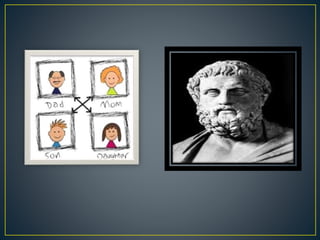
• Male Oedipus Complex
-castration anxiety
• Female Oedipus Complex
-penis envy
• Laius and Jocasta – parents of Oedipus, the king and queen of
Thebes
• Polybus and Merope-the King and Queen of Corinth, who don't
have any children.
Latency Period
-brought about partly by parents attempts to punish or
discourage sexual activity in their young children.
Genital Period
• Maturity
-psychological maturity
• Freud’s Early Therapeutic Technique
• Freud’s Later Therapeutic Technique
-free association
-Transference
-negative transference
-resistance
-psychoses
• Manifest content
• Latent content
• Repetition compulsion
• Posttraumatic stress disorder
Freudian Slips
• “faulty functions”
• parapraxes
• Did Freud understand women,
gender and sexuality?
• Was Freud a Scientist?

1 s.-freud

  • 1.
  • 2.
    • Psychoanalysis- themost famous of all personality theories. • The two cornerstones of psychoanalysis -Sex and aggression • Spread beyond its Viennese • Brilliant command of language • Based on his experiences with patients, his analysis of his own dreams and his vast readings in the various science and humanities.
  • 4.
    Sigismund (Sigmund) Freud -Born either March 6 or May 6, 1856 in Freiberg Moravia. -Jacob and Amalie Nathanson Freud -favorite of his indulgent mother -at his young age his mother gave birth to a second son Julius. Sigmund harbored an unconscious wish for Julius’ death. -Freud was drawn into medicine, not because he loved medicine but because he was Intensely curious about human nature. -in 1885 he study in Paris with the famous French neurologist Jean-Martin Charcot. - He learned the hypnotic technique for treating hysteria.
  • 5.
    • Hysteria- adisorder typically characterized by paralysis or in the improper functioning of certain parts of the body. • Josef Breuer- a well-known Viennese physician who taught Freud catharsis. • Catharsis- the process of removing hysterical symptoms through “talking them out.” • From as early as adolescence, Freud literally dreamed of making monumental discovery and achieving fame. • In 1886 he had learned about male hysteria. • Breuer discussed the case of Anna O to Freud • He cannot accept Freud’s notion that hysteria came from childhood sexual experiences. • During 1890’s Freud suffer personal crisis. • Neuroses have their etiology in a child’s seduction by a parent. • 1897 he abandoned the seduction theory. • Freud sank even more deeply in his midlife crisis. • Henri Ellenberger said Freud’s life is a time of “creative illness”.
  • 6.
    • “It isnot the scientific differences that are so important; it is usually some other kind of animosity, jealousy or revenge, that gives the impulse to enmity. The scientific differences come later.” • 1902- Freud invited small group and they are – Alfred Adler, Wilhelm Stekel, Max Kahane and Rudolf Reitler. • 1910- Freud founded International Psychoanalytical Association • Carl Jung of Zurich as a president of association . • “Crown Prince” and “the man of the future” • “My emotional life has always insisted that I should have an intimate friend and hated enemy. I have always been able to provide myself afresh with both”
  • 7.
    • 1895- hisyoungest child was born , Anna Freud. • He never won the coveted Nobel prize for science, he was awarded the Goethe prize for literature. • He was a master of German tongue and knew several other languages. • Why did Freud have such a disdain for Americans?
  • 11.
    • Mental lifeis divided into two levels. -the unconscious and the conscious • Unconscious has two different levels. -the unconscious proper and the preconscious
  • 13.
    • Contains alldrives, urges or instincts that are beyond our awareness. • To him the unconscious is the explanation for he meaning behind dreams slips of the tongue and certain kind of forgetting called repression. • To enter the conscious level of mind, the unconscious images first must be sufficiently disguised to slip past the primary censor and then they must elude a final censor. • Punishment and suppression often create feelings of anxiety and the anxiety in turn stimulates repression.
  • 14.
    • Phylogenetic endowment-according to Freud this is the inherited unconscious images from our early ancestors. • Unconscious drives may appear in consciousness, but only after undergoing certain transformations. • The unconscious mind of one person can communicate with the unconscious of another without aware of the process. • Unconscious does not mean inactive or dormant.
  • 16.
    • Contains allthose elements that are not conscious but can become conscious either quite readily with some difficulty. • The contents of the preconscious comes form two sources: -conscious perception -unconscious
  • 18.
    • Plays arelatively minor role psychoanalytic theory. • It is the only level of mental life directly available to us. • Ideas can reach consciousness from two different directions: - Perceptual conscious -from within the mental structure and includes non threatening ideas.
  • 21.
    • A termderived from the impersonal pronoun meaning “the it” or the not yet owned component of personality. • Id serves as pleasure principle. • Primitive, chaotic, inaccessible to consciousness, unchangeable, amoral, illogical, unorganized. • The Id operates through the primary process.
  • 22.
    • The egoor I. • The only region of the mind in contact with reality. • It is governed by the reality principle. • It uses repression and other defense mechanism to defend itself against the anxiety. • The ego becomes differentiated from the Id when infants learn to distinguished from the outer world. • Freud used the analogy of a person on a horseback.
  • 23.
    • The superego or above-I, represents the moral and ideal aspects of personality. • Guided by the moralistic and idealistic principles. • Like an ego it has no energy on its own. • The super ego has to subsystems: - The conscience -The ego-idea • It cannot produce repressions by itself, but it can order the ego to do so. • The super ego is not concerned in the happiness of the ego. • Is like an Id in that it is completely ignorant of and unconcerned with the practicability of its requirements.
  • 26.
    • From aGerman word Trieb to refer to a drive or a stimulus within the person. • Constant motivational force • The various drives can all be grouped under two major headings: - Sex or Eros - Aggression and distraction or Thanatos. • This drives originates from the ego. • Libido- a psychic energy for the sex drive.
  • 27.
    • Every basicdrive is characterized by : -an impetus -a source -an aim -an object.
  • 28.
    • The aimof the sexual drive is pleasure. • Erogenous zones- mouth and anus are especially capable of producing sexual pleasure. • Sex can take may forms including: - narcissism - love - sadism -masochism
  • 29.
    • Primary narcissism-Infants are primarily self-centered, with their libido invested almost exclusively on their own ego. • Secondary narcissism- adolescents often redirect their libido back to the ego and become preoccupied with personal appearance and other self interest. • Love- second manifestation of Eros. - develops when people invest their libido on an object or person other than themselves. • Sadism- the need of sexual pleasure from inflicting pain or humiliation on another person. - it is a common need and exists to some in all sexual relationships. • • Masochism- like sadism it is a common need but it becomes a perversion when Eros becomes subservient to the destructive drive.
  • 30.
    • The aimof the destructive drive is to return the organism to an inorganic state. • Ultimate inorganic condition is death and the final aim of the aggressive drive is self-destructive. • Aggression can also take many forms: -teasing -gossip -sarcasm -humiliation -humor -enjoyment of other people’s suffering.
  • 31.
    • It isa felt, affective, unpleasant state accompanied by a physical sensation that warns the person against impending danger. • Only ego can produce or feel anxiety. • The ego’s dependence on the id results neurotic anxiety. • The ego’s dependence on the superego produces moral anxiety. • The ego’s dependence on the outer world leads to realistic anxiety.
  • 32.
    • Neurotic Anxiety-defined as apprehension about an unknown danger. • Moral anxiety- conflict between ego and superego. • Realistic Anxiety- defined as unpleasant, non specific feeling involving a possible danger. • Anxiety serves as an ego- preserving mechanism because it signals us that some danger is at hand.
  • 34.
    • We mustexpend psychic energy to establish and maintain defense mechanisms, the more defensive we are, the psychic energy we have left to satisfy id impulses. • Ego’s purpose in establishing defense mechanisms- to avoid dealing directly with sexual and aggressive implosives and to defend itself against the anxiety that accompanies them.
  • 35.
    • The mostbasic defense mechanism. • Ego protects itself by repressing those impulses. • Repressed drives may be disguised as physical symptoms. • Repressed drives may also find an outlet in dreams, slips of the tongues or one of the other defense mechanisms.
  • 36.
    • Repressed impulsemay become conscious is through adopting a disguise that is directly opposite its original form.
  • 37.
    • People canredirect their unacceptable urges onto a variety of people or objects so that the original impulse is disguised or concealed.
  • 38.
    • Sticking toa certain way of reaction although its ineffectiveness has been proved repeatedly.
  • 39.
    • Can berecognized if a person in frustrating situation acts in an immature and outworn manner.
  • 40.
    • Seeing inothers unacceptable feelings or tendencies that actually reside in one’s own unconscious.
  • 41.
    • People incorporatepositive qualities of another person into their own ego.
  • 42.
    • Redirecting unacceptable,instinctual drives into personally and socially acceptable channels.
  • 44.
    • Oral phase -obtainlife sustaining nourishment through the oral cavity. -gain pleasure through the art of sucking -oral sadistic period • Anal phase -anal character -anal triad -Penis,baby and feces • Phallic phase -genital area becomes the leading erogenous zone. -”History is destiny” changed into “Anatomy is destiny”
  • 45.
    • Male OedipusComplex -castration anxiety • Female Oedipus Complex -penis envy • Laius and Jocasta – parents of Oedipus, the king and queen of Thebes • Polybus and Merope-the King and Queen of Corinth, who don't have any children.
  • 47.
    Latency Period -brought aboutpartly by parents attempts to punish or discourage sexual activity in their young children. Genital Period • Maturity -psychological maturity
  • 48.
    • Freud’s EarlyTherapeutic Technique • Freud’s Later Therapeutic Technique -free association -Transference -negative transference -resistance -psychoses
  • 49.
    • Manifest content •Latent content • Repetition compulsion • Posttraumatic stress disorder Freudian Slips • “faulty functions” • parapraxes
  • 50.
    • Did Freudunderstand women, gender and sexuality? • Was Freud a Scientist?