Realtime Apache Hadoop at Facebook


Jonathan Gray & Dhruba Borthakur
June 14, 2011 at SIGMOD, Athens
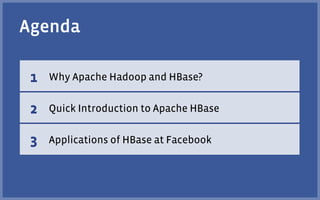
Agenda

 1   Why Apache Hadoop and HBase?


 2   Quick Introduction to Apache HBase


 3   Applications of HBase at Facebook
Why Hadoop and HBase?
For Realtime Data?
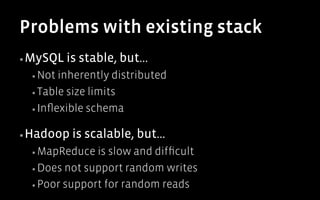
Problems with existing stack
▪ MySQL   is stable, but...
 ▪  Not inherently distributed
 ▪  Table size limits

 ▪  Inflexible schema


▪ Hadoop   is scalable, but...
 ▪  MapReduce  is slow and difficult
 ▪  Does not support random writes

 ▪  Poor support for random reads
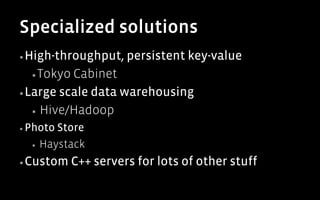
Specialized solutions
▪ High-throughput,    persistent key-value
  ▪ Tokyo  Cabinet
▪ Large scale data warehousing

   ▪  Hive/Hadoop

▪  PhotoStore
  ▪  Haystack

▪ Custom    C++ servers for lots of other stuff
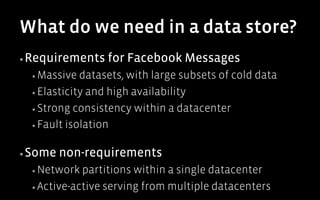
What do we need in a data store?
▪ Requirements    for Facebook Messages
  ▪  Massive  datasets, with large subsets of cold data
  ▪  Elasticity and high availability

  ▪  Strong consistency within a datacenter

  ▪  Fault isolation


▪ Some   non-requirements
  ▪  Network  partitions within a single datacenter
  ▪  Active-active serving from multiple datacenters
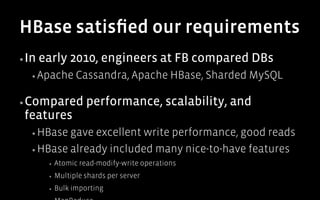
HBase satisfied our requirements
▪ In   early 2010, engineers at FB compared DBs
   ▪  Apache       Cassandra, Apache HBase, Sharded MySQL

▪ Compared            performance, scalability, and
 features
   ▪  HBase gave excellent write performance, good reads
   ▪  HBase already included many nice-to-have features
        ▪    Atomic read-modify-write operations
        ▪    Multiple shards per server
        ▪    Bulk importing
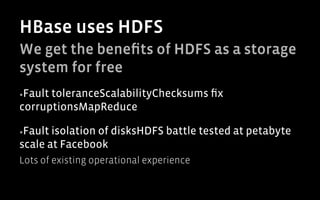
HBase uses HDFS
We get the benefits of HDFS as a storage
system for free
▪ Fault
      toleranceScalabilityChecksums fix
corruptionsMapReduce

▪ Faultisolation of disksHDFS battle tested at petabyte
scale at Facebook
Lots of existing operational experience
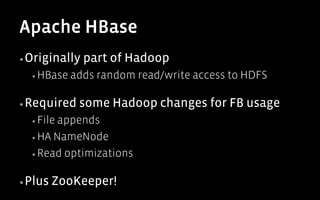
Apache HBase
▪ Originally   part of Hadoop
  ▪  HBase   adds random read/write access to HDFS

▪ Required    some Hadoop changes for FB usage
  ▪  Fileappends
  ▪  HA NameNode

  ▪  Read optimizations


▪ Plus   ZooKeeper!
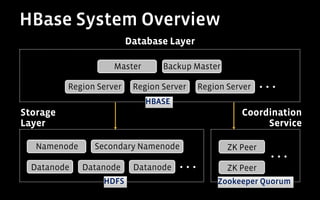
HBase System Overview
                          Database Layer

                     Master       Backup Master

          Region Server    Region Server    Region Server    ...
                              HBASE
Storage                                               Coordination
Layer                                                      Service

   Namenode     Secondary Namenode                 ZK Peer
                                                               ...
  Datanode    Datanode     Datanode   ...          ZK Peer
                  HDFS                          Zookeeper Quorum
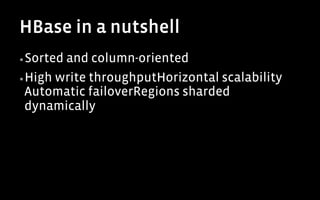
HBase in a nutshell
▪ Sortedand column-oriented
▪ High write throughputHorizontal scalability
  Automatic failoverRegions sharded
  dynamically
Applications of HBase at
Facebook
Use Case 1
    Titan
(Facebook Messages)
The New Facebook Messages


Messages   IM/Chat   email   SMS
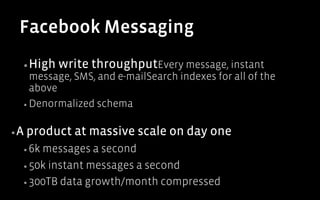
Facebook Messaging
  ▪ High   write throughputEvery message, instant
     message, SMS, and e-mailSearch indexes for all of the
     above
  ▪  Denormalized schema


▪ A   product at massive scale on day one
  ▪  6kmessages a second
  ▪  50k instant messages a second

  ▪  300TB data growth/month compressed
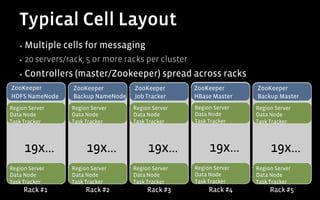
Typical Cell Layout
   ▪  Multiple       cells for messaging	

   ▪    20 servers/rack; 5 or more racks per cluster         	

   ▪  Controllers       (master/Zookeeper) spread across racks
ZooKeeper              ZooKeeper          ZooKeeper                ZooKeeper          ZooKeeper
HDFS NameNode          Backup NameNode    Job Tracker              HBase Master       Backup Master


Region Server
Data Node


                       Region Server
                       Data Node


                                          Region Server
                                          Data Node


                                                                   Region Server
                                                                   Data Node


                                                                                      Region Server
                                                                                      Data Node
                                                                                                   	

Task Tracker           Task Tracker       Task Tracker             Task Tracker       Task Tracker


        19x...              19x...             19x...                   19x...             19x...
           	

Region Server
Data Node


                       Region Server
                       Data Node


                                          Region Server
                                          Data Node


                                                                   Region Server
                                                                   Data Node


                                                                                      Region Server
                                                                                      Data Node
                                                                                                   	

Task Tracker           Task Tracker       Task Tracker             Task Tracker       Task Tracker
        Rack #1             Rack #2            Rack #3                  Rack #4            Rack #5
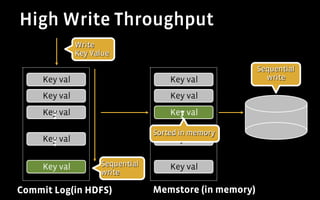
High Write Throughput
               Write
               Key Value

                                                         Sequential
     Key val                          Key val              write

     Key val                          Key val
       .
       .
       .
     Key val                            .
                                        .
                                        .
                                      Key val

       .
       .
       .
     Key val
                                  Sorted in memory
                                      Key val


     Key val         Sequential       Key val
                     write

Commit Log(in HDFS)               Memstore (in memory)
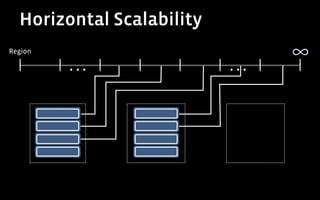
Horizontal Scalability
Region

         ...               ...
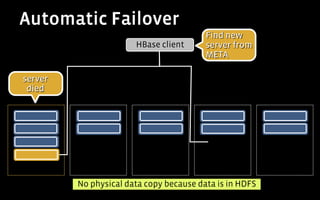
Automatic Failover
                                         Find new
                       HBase client      server from
                                         META

server
 died


         No physical data copy because data is in HDFS
Use Case 2
   Puma
(Facebook Insights)
Puma
▪ Realtime      Data Pipeline
  ▪  Utilize   existing log aggregation pipeline (Scribe-
     HDFS)
  ▪  Extend low-latency capabilities of HDFS (Sync+PTail)

  ▪  High-throughput writes (HBase)


▪ Support      for Realtime Aggregation
  ▪  Utilize
          HBase atomic increments to maintain roll-ups
  ▪  Complex HBase schemas for unique-user calculations
Puma as Realtime MapReduce
▪ Map   phase with PTail
  ▪  Divide  the input log stream into N shards
  ▪  First version only supported random bucketing

  ▪  Now supports application-level bucketing


▪ Reduce      phase with HBase
  ▪  Every row+column in HBase is an output key
  ▪  Aggregate key counts using atomic counters

  ▪  Can also maintain per-key lists or other structures
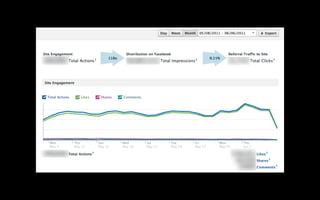
Puma for Facebook Insights
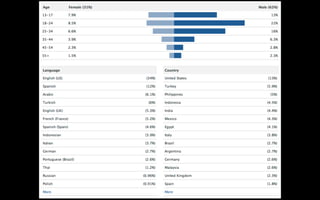
▪ Realtime      URL/Domain Insights
  ▪  Domain    owners can see deep analytics for their site
  ▪  Clicks, Likes, Shares, Comments, Impressions

  ▪  Detailed demographic breakdowns (anonymized)

  ▪  Top URLs calculated per-domain and globally


▪ Massive   Throughput
  ▪  Billions of URLs
  ▪  > 1 Million counter increments per second
Use Case 3
         ODS
(Facebook Internal Metrics)
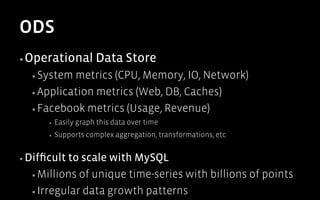
ODS
▪ Operational           Data Store
  ▪  System metrics (CPU, Memory, IO, Network)
  ▪  Application metrics (Web, DB, Caches)

  ▪  Facebook metrics (Usage, Revenue)
       ▪    Easily graph this data over time
       ▪    Supports complex aggregation, transformations, etc.


▪  Difficultto scale with MySQL
  ▪  Millions of unique time-series with billions of points

  ▪  Irregular data growth patterns
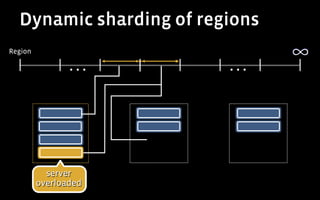
Dynamic sharding of regions
Region

                ...      ...


           server
         overloaded
Future of HBase at Facebook
User and Graph Data
      in HBase
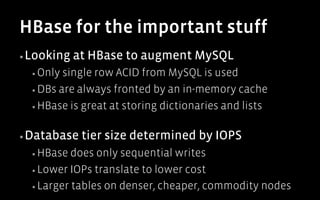
HBase for the important stuff
▪ Looking    at HBase to augment MySQL
  ▪  Only single row ACID from MySQL is used
  ▪  DBs are always fronted by an in-memory cache

  ▪  HBase is great at storing dictionaries and lists


▪ Database    tier size determined by IOPS
  ▪  HBase  does only sequential writes
  ▪  Lower IOPs translate to lower cost

  ▪  Larger tables on denser, cheaper, commodity nodes
Conclusion
▪ Facebook   investing in Realtime Hadoop/HBase
  ▪  Work  of a large team of Facebook engineers
  ▪  Close collaboration with open source developers


▪ Much   more detail in Realtime Hadoop paper
  ▪  Technical   details about changes to Hadoop and
     HBase
  ▪  Operational experiences in production
Questions?
jgray@fb.com
dhruba@fb.com

Realtime Apache Hadoop at Facebook

  • 2.
    Realtime Apache Hadoopat Facebook Jonathan Gray & Dhruba Borthakur June 14, 2011 at SIGMOD, Athens
  • 3.
    Agenda 1 Why Apache Hadoop and HBase? 2 Quick Introduction to Apache HBase 3 Applications of HBase at Facebook
  • 4.
    Why Hadoop andHBase? For Realtime Data?
  • 6.
    Problems with existingstack ▪ MySQL is stable, but... ▪  Not inherently distributed ▪  Table size limits ▪  Inflexible schema ▪ Hadoop is scalable, but... ▪  MapReduce is slow and difficult ▪  Does not support random writes ▪  Poor support for random reads
  • 7.
    Specialized solutions ▪ High-throughput, persistent key-value ▪ Tokyo Cabinet ▪ Large scale data warehousing ▪  Hive/Hadoop ▪  PhotoStore ▪  Haystack ▪ Custom C++ servers for lots of other stuff
  • 8.
    What do weneed in a data store? ▪ Requirements for Facebook Messages ▪  Massive datasets, with large subsets of cold data ▪  Elasticity and high availability ▪  Strong consistency within a datacenter ▪  Fault isolation ▪ Some non-requirements ▪  Network partitions within a single datacenter ▪  Active-active serving from multiple datacenters
  • 9.
    HBase satisfied ourrequirements ▪ In early 2010, engineers at FB compared DBs ▪  Apache Cassandra, Apache HBase, Sharded MySQL ▪ Compared performance, scalability, and features ▪  HBase gave excellent write performance, good reads ▪  HBase already included many nice-to-have features ▪  Atomic read-modify-write operations ▪  Multiple shards per server ▪  Bulk importing
  • 10.
    HBase uses HDFS Weget the benefits of HDFS as a storage system for free ▪ Fault toleranceScalabilityChecksums fix corruptionsMapReduce ▪ Faultisolation of disksHDFS battle tested at petabyte scale at Facebook Lots of existing operational experience
  • 11.
    Apache HBase ▪ Originally part of Hadoop ▪  HBase adds random read/write access to HDFS ▪ Required some Hadoop changes for FB usage ▪  Fileappends ▪  HA NameNode ▪  Read optimizations ▪ Plus ZooKeeper!
  • 12.
    HBase System Overview Database Layer Master Backup Master Region Server Region Server Region Server ... HBASE Storage Coordination Layer Service Namenode Secondary Namenode ZK Peer ... Datanode Datanode Datanode ... ZK Peer HDFS Zookeeper Quorum
  • 13.
    HBase in anutshell ▪ Sortedand column-oriented ▪ High write throughputHorizontal scalability Automatic failoverRegions sharded dynamically
  • 14.
  • 15.
    Use Case 1 Titan (Facebook Messages)
  • 16.
    The New FacebookMessages Messages IM/Chat email SMS
  • 17.
    Facebook Messaging ▪ High write throughputEvery message, instant message, SMS, and e-mailSearch indexes for all of the above ▪  Denormalized schema ▪ A product at massive scale on day one ▪  6kmessages a second ▪  50k instant messages a second ▪  300TB data growth/month compressed
  • 18.
    Typical Cell Layout ▪  Multiple cells for messaging ▪  20 servers/rack; 5 or more racks per cluster ▪  Controllers (master/Zookeeper) spread across racks ZooKeeper ZooKeeper ZooKeeper ZooKeeper ZooKeeper HDFS NameNode Backup NameNode Job Tracker HBase Master Backup Master Region Server Data Node Region Server Data Node Region Server Data Node Region Server Data Node Region Server Data Node Task Tracker Task Tracker Task Tracker Task Tracker Task Tracker 19x... 19x... 19x... 19x... 19x... Region Server Data Node Region Server Data Node Region Server Data Node Region Server Data Node Region Server Data Node Task Tracker Task Tracker Task Tracker Task Tracker Task Tracker Rack #1 Rack #2 Rack #3 Rack #4 Rack #5
  • 19.
    High Write Throughput Write Key Value Sequential Key val Key val write Key val Key val . . . Key val . . . Key val . . . Key val Sorted in memory Key val Key val Sequential Key val write Commit Log(in HDFS) Memstore (in memory)
  • 20.
  • 21.
    Automatic Failover Find new HBase client server from META server died No physical data copy because data is in HDFS
  • 22.
    Use Case 2 Puma (Facebook Insights)
  • 25.
    Puma ▪ Realtime Data Pipeline ▪  Utilize existing log aggregation pipeline (Scribe- HDFS) ▪  Extend low-latency capabilities of HDFS (Sync+PTail) ▪  High-throughput writes (HBase) ▪ Support for Realtime Aggregation ▪  Utilize HBase atomic increments to maintain roll-ups ▪  Complex HBase schemas for unique-user calculations
  • 26.
    Puma as RealtimeMapReduce ▪ Map phase with PTail ▪  Divide the input log stream into N shards ▪  First version only supported random bucketing ▪  Now supports application-level bucketing ▪ Reduce phase with HBase ▪  Every row+column in HBase is an output key ▪  Aggregate key counts using atomic counters ▪  Can also maintain per-key lists or other structures
  • 27.
    Puma for FacebookInsights ▪ Realtime URL/Domain Insights ▪  Domain owners can see deep analytics for their site ▪  Clicks, Likes, Shares, Comments, Impressions ▪  Detailed demographic breakdowns (anonymized) ▪  Top URLs calculated per-domain and globally ▪ Massive Throughput ▪  Billions of URLs ▪  > 1 Million counter increments per second
  • 30.
    Use Case 3 ODS (Facebook Internal Metrics)
  • 31.
    ODS ▪ Operational Data Store ▪  System metrics (CPU, Memory, IO, Network) ▪  Application metrics (Web, DB, Caches) ▪  Facebook metrics (Usage, Revenue) ▪  Easily graph this data over time ▪  Supports complex aggregation, transformations, etc. ▪  Difficultto scale with MySQL ▪  Millions of unique time-series with billions of points ▪  Irregular data growth patterns
  • 32.
    Dynamic sharding ofregions Region ... ... server overloaded
  • 33.
    Future of HBaseat Facebook
  • 34.
    User and GraphData in HBase
  • 35.
    HBase for theimportant stuff ▪ Looking at HBase to augment MySQL ▪  Only single row ACID from MySQL is used ▪  DBs are always fronted by an in-memory cache ▪  HBase is great at storing dictionaries and lists ▪ Database tier size determined by IOPS ▪  HBase does only sequential writes ▪  Lower IOPs translate to lower cost ▪  Larger tables on denser, cheaper, commodity nodes
  • 36.
    Conclusion ▪ Facebook investing in Realtime Hadoop/HBase ▪  Work of a large team of Facebook engineers ▪  Close collaboration with open source developers ▪ Much more detail in Realtime Hadoop paper ▪  Technical details about changes to Hadoop and HBase ▪  Operational experiences in production
  • 37.