Hadoop	
  –	
  Taming	
  Big	
  Data	
  
Jax	
  ArcSig,	
  June	
  2012	


Ovidiu	
  Dimulescu	
  
About	
  @odimulescu	
  
•    Working	
  on	
  the	
  Web	
  since	
  1997	
  
•    Likes	
  stuff	
  well	
  done	
  
•    Into	
  engineering	
  cultures	
  and	
  all	
  around	
  automaEon	
  
•    Speaker	
  at	
  local	
  user	
  groups	
  
•    Organizer	
  for	
  the	
  local	
  Mobile	
  User	
  Group	
  jaxmug.com	
  
Agenda	
  

•  IntroducEon	
  
•  Use	
  cases	
  
•  Architecture	
  
•  MapReduce	
  Examples	
  
•  Q&A	
  
What	
  is	


  ?	
  
•  Apache	
  Hadoop	
  is	
  an	
  open	
  source	
  Java	
  soSware	
  
   framework	
  for	
  running	
  data-­‐intensive	
  applicaEons	
  
   on	
  large	
  clusters	
  of	
  commodity	
  hardware	
  

•  Created	
  by	
  Doug	
  CuVng	
  (Lucene	
  &	
  Nutch	
  creator)	
  

•  Named	
  aSer	
  Doug’s	
  son’s	
  toy	
  elephant	
  
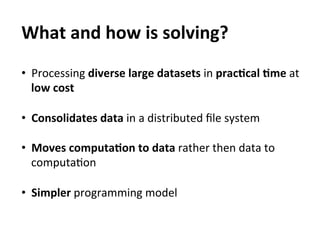
What	
  and	
  how	
  is	
  solving?	


•  Processing	
  diverse	
  large	
  datasets	
  in	
  pracAcal	
  Ame	
  at	
  
     low	
  cost	


•  Consolidates	
  data	
  in	
  a	
  distributed	
  file	
  system	
  

•  Moves	
  computaAon	
  to	
  data	
  rather	
  then	
  data	
  to	
  
   computaEon	
  

•  Simpler	
  programming	
  model	
  
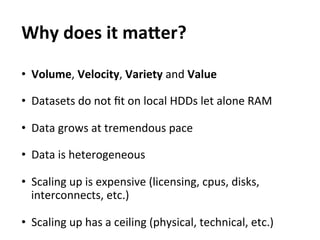
Why	
  does	
  it	
  maEer?	


•  Volume,	
  Velocity,	
  Variety	
  and	
  Value	
  

•  Datasets	
  do	
  not	
  fit	
  on	
  local	
  HDDs	
  let	
  alone	
  RAM	
  

•  Data	
  grows	
  at	
  tremendous	
  pace	
  

•  Data	
  is	
  heterogeneous	


•  Scaling	
  up	
  is	
  expensive	
  (licensing,	
  cpus,	
  disks,	
  
     interconnects,	
  etc.)	
  

•  Scaling	
  up	
  has	
  a	
  ceiling	
  (physical,	
  technical,	
  etc.)	
  
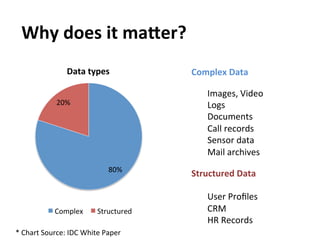
Why	
  does	
  it	
  maEer?	
  
                       Data	
  types	
                 Complex	
  Data	


                                                              Images,	
  Video	
  
                   20%	
                                      Logs	
  
                                                              Documents	
  
                                                              Call	
  records	
  
                                                              Sensor	
  data	
  
                                                              Mail	
  archives	


                                           80%	
  
                                                       Structured	
  Data	


                                                            User	
  Profiles	
  
                  Complex	
           Structured	
          CRM	
  
                                                            HR	
  Records	
  
*	
  Chart	
  Source:	
  IDC	
  White	
  Paper	
  
Why	
  does	
  it	
  maEer?	


•  Need	
  to	
  process	
  a	
  10TB	
  dataset	
  

•  Assume	
  sustained	
  transfer	
  of	
  75MB/s	
  

•  On	
  1	
  node	
  -­‐	
  Scanning	
  data	
  ~	
  2	
  days	


•  On	
  10	
  node	
  cluster	
  -­‐	
  Scanning	
  data	
  ~	
  5	
  hrs	
  

•  Low	
  $/TB	
  for	
  commodity	
  drives	
  

•  Low-­‐end	
  servers	
  are	
  mulEcore	
  capable	
  
Use	
  Cases	


•  ETL	
  -­‐	
  Extract	
  Transform	
  Load	
  

•  RecommendaEon	
  Engines	
  

•  Customer	
  Churn	
  Analysis	


•  Ad	
  TargeEng	


•  Data	
  “sandbox”	
  
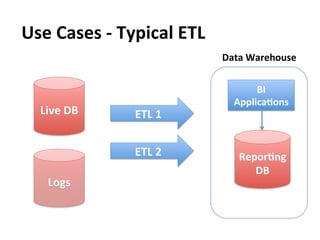
Use	
  Cases	
  -­‐	
  Typical	
  ETL	
  
                                            Data	
  Warehouse	


                                                    BI	
  
                                               ApplicaAons	
  
    Live	
  DB	
        ETL	
  1	


                        ETL	
  2	
              ReporAng	
  
                                                   DB	
  
      Logs	
  
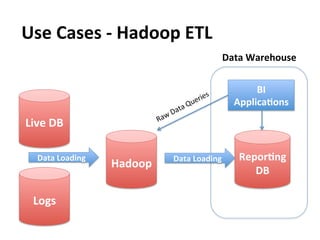
Use	
  Cases	
  -­‐	
  Hadoop	
  ETL	
  
                                                         Data	
  Warehouse	


                                                                  BI	
  
                                                             ApplicaAons	
  
Live	
  DB	
  

    Data	
  Loading	
                  Data	
  Loading	
      ReporAng	
  
                          Hadoop	
  
                                                                 DB	
  

  Logs	
  
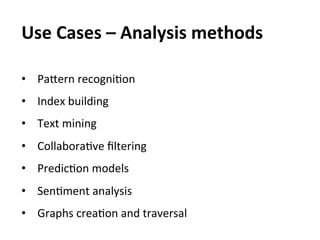
Use	
  Cases	
  –	
  Analysis	
  methods	
  

•  Pakern	
  recogniEon	
  
•  Index	
  building	
  
•  Text	
  mining	
  
•  CollaboraEve	
  filtering	
  
•  PredicEon	
  models	
  
•  SenEment	
  analysis	
  
•  Graphs	
  creaEon	
  and	
  traversal	
  
Who	
  uses	
  it?	
  
Who	
  supports	
  it?	
  
Why	
  use	
  Hadoop?	
  
•  PracEcal	
  to	
  do	
  things	
  that	
  were	
  previously	
  not	
  

    ü  Shorter	
  execuEon	
  Eme	


    ü  Costs	
  less	
  

    ü  Simpler	
  programming	
  model	


•  Open	
  system	
  with	
  greater	
  flexibility	
  

•  Large	
  and	
  growing	
  ecosystem	
  
Hadoop	
  –	
  Silver	
  bullet?	
  
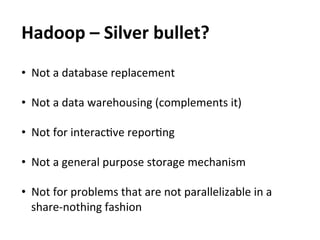
•  Not	
  a	
  database	
  replacement	
  

•  Not	
  a	
  data	
  warehousing	
  (complements	
  it)	
  

•  Not	
  for	
  interacEve	
  reporEng	


•  Not	
  a	
  general	
  purpose	
  storage	
  mechanism	
  

•  Not	
  for	
  problems	
  that	
  are	
  not	
  parallelizable	
  in	
  a	
  
   share-­‐nothing	
  fashion	
  
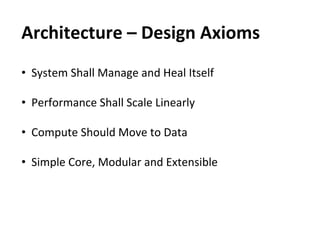
Architecture	
  –	
  Design	
  Axioms	
  
•  System	
  Shall	
  Manage	
  and	
  Heal	
  Itself	
  

•  Performance	
  Shall	
  Scale	
  Linearly	


•  Compute	
  Should	
  Move	
  to	
  Data	


•  Simple	
  Core,	
  Modular	
  and	
  Extensible	
  
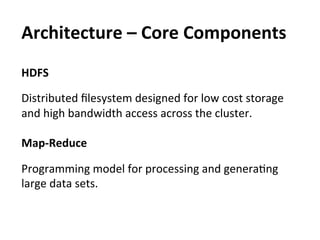
Architecture	
  –	
  Core	
  Components	
  
HDFS	


Distributed	
  filesystem	
  designed	
  for	
  low	
  cost	
  storage	
  
and	
  high	
  bandwidth	
  access	
  across	
  the	
  cluster.	
  

Map-­‐Reduce	


Programming	
  model	
  for	
  processing	
  and	
  generaEng	
  
large	
  data	
  sets.	
  
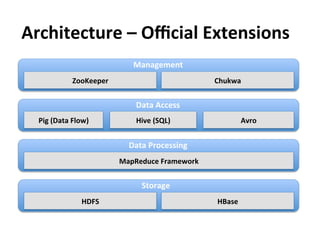
Architecture	
  –	
  Official	
  Extensions	
  
                                      Management	
  
                  ZooKeeper	
                                  Chukwa	


                                       Data	
  Access	
  
  Pig	
  (Data	
  Flow)	
              Hive	
  (SQL)	
                      Avro	


                                     Data	
  Processing	
  
                                  MapReduce	
  Framework	


                                         Storage	
  
                      HDFS	
                                    HBase	
  
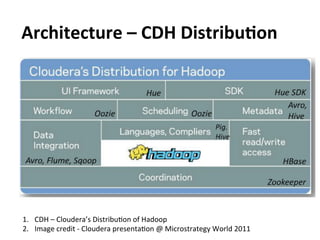
Architecture	
  –	
  CDH	
  DistribuAon	


1.  CDH	
  –	
  Cloudera’s	
  DistribuEon	
  of	
  Hadoop	
  
2.  Image	
  credit	
  -­‐	
  Cloudera	
  presentaEon	
  @	
  Microstrategy	
  World	
  2011	
  
HDFS	
  -­‐	
  Design	
  
•  Based	
  on	
  Google’s	
  GFS	
  
•  Files	
  are	
  stored	
  as	
  blocks	
  (64MB	
  default	
  size)	


•  Configurable	
  data	
  replicaEon	
  (3x,	
  Rack	
  Aware)	


•  Fault	
  Tolerant,	
  Expects	
  HW	
  failures	
  
•  HUGE	
  files,	
  Expects	
  Streaming	
  not	
  Low	
  Latency	
  
•  Mostly	
  WORM	
  
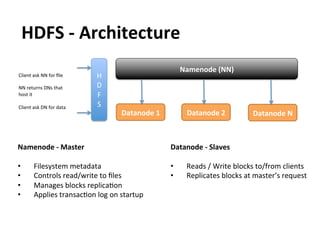
HDFS	
  -­‐	
  Architecture	
  
                                                                         Namenode	
  (NN)	
  
Client	
  ask	
  NN	
  for	
  file	
      H	


NN	
  returns	
  DNs	
  that	
           D	
  
host	
  it	
                             F	


Client	
  ask	
  DN	
  for	
  data	
     S	
  
                                                 Datanode	
  1	
            Datanode	
  2	
             Datanode	
  N	


Namenode	
  -­‐	
  Master	
                                          Datanode	
  -­‐	
  Slaves	


•    Filesystem	
  metadata	
                                        •    Reads	
  /	
  Write	
  blocks	
  to/from	
  clients	
  
•    Controls	
  read/write	
  to	
  files	
                          •    Replicates	
  blocks	
  at	
  master’s	
  request	
  
•    Manages	
  blocks	
  replicaEon	
  
•    Applies	
  transacEon	
  log	
  on	
  startup	


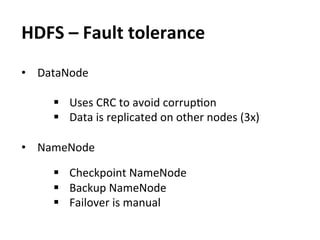
HDFS	
  –	
  Fault	
  tolerance	
  
•  DataNode	


        §  Uses	
  CRC	
  to	
  avoid	
  corrupEon	
  
        §  Data	
  is	
  replicated	
  on	
  other	
  nodes	
  (3x)	


•  NameNode	


        §  Checkpoint	
  NameNode	
  
        §  Backup	
  NameNode	
  	
  
        §  Failover	
  is	
  manual	
  
MapReduce	
  -­‐	
  Design	
  
•  Based	
  on	
  Google’s	
  MR	
  paper	
  
•  Borrows	
  from	
  funcEonal	
  programming	
  
•  Simpler	
  programming	
  model	


       §  map	
  (in_key,	
  in_value)	
  
           	
  -­‐>	
  (out_key,	
  intermediate_value)	
  list	
  

       §  reduce	
  (out_key,	
  intermediate_value	
  list)	
  	
  
            -­‐>	
  out_value	
  list	


•  No	
  user	
  synchronizaEon	
  and	
  coordinaEon	
  
       Input	
  -­‐>	
  Map	
  -­‐>	
  Reduce	
  -­‐>	
  Output	
  
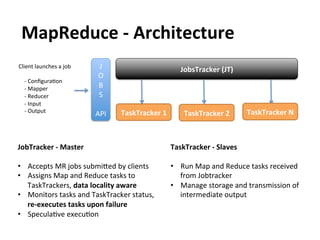
MapReduce	
  -­‐	
  Architecture	
  
Client	
  launches	
  a	
  job	
       J	
                                JobsTracker	
  (JT)	
  
	
                                    O	
  
     -­‐	
  ConfiguraEon	
  
     -­‐	
  Mapper	
                  B	
  
     -­‐	
  Reducer	
                 S	
  
     -­‐	
  Input	
                   	
  
     -­‐	
  Output	
                           TaskTracker	
  1	
          TaskTracker	
  2	
         TaskTracker	
  N	
  
                                     API	


JobTracker	
  -­‐	
  Master	
                                         TaskTracker	
  -­‐	
  Slaves	


•  Accepts	
  MR	
  jobs	
  submiked	
  by	
  clients	
               •  Run	
  Map	
  and	
  Reduce	
  tasks	
  received	
  
•  Assigns	
  Map	
  and	
  Reduce	
  tasks	
  to	
                        from	
  Jobtracker	
  	
  
     TaskTrackers,	
  data	
  locality	
  aware	
                     •  Manage	
  storage	
  and	
  transmission	
  of	
  
•  Monitors	
  tasks	
  and	
  TaskTracker	
  status,	
                    intermediate	
  output	
  
     re-­‐executes	
  tasks	
  upon	
  failure	
                      	
  
•  SpeculaEve	
  execuEon	
  
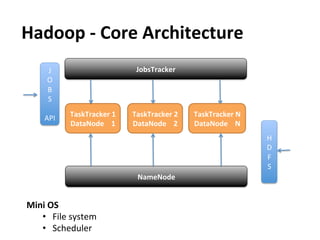
Hadoop	
  -­‐	
  Core	
  Architecture	
  
       J	
                                       JobsTracker	
  
      O	
  
      B	
  
      S	


     API	
     TaskTracker	
  1	
              TaskTracker	
  2	
              TaskTracker	
  N	
  
               DataNode	


  1	
     DataNode	


  2	
     DataNode	


  N	
  
                                                                                                               H	
  
                                                                                                               D	
  
                                                                                                               F	
  
                                                                                                               S	
  
                                                  NameNode	


Mini	
  OS	
  
   •  File	
  system	
  
   •  Scheduler	
  
MapReduce	
  –	
  Head	
  First	
  Style	


hkp://www.slideshare.net/esaliya/mapreduce-­‐
in-­‐simple-­‐terms	
  
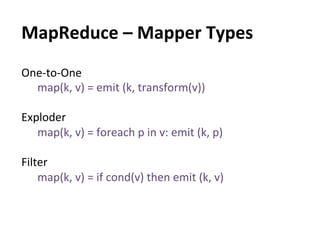
MapReduce	
  –	
  Mapper	
  Types	
  
One-­‐to-­‐One	
  
    map(k,	
  v)	
  =	
  emit	
  (k,	
  transform(v))	


Exploder	
  
    map(k,	
  v)	
  =	
  foreach	
  p	
  in	
  v:	
  emit	
  (k,	
  p)	


Filter	
  
    map(k,	
  v)	
  =	
  if	
  cond(v)	
  then	
  emit	
  (k,	
  v)	
  
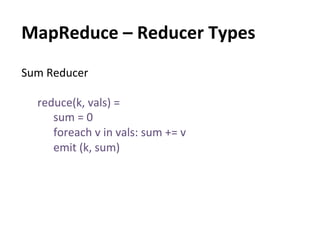
MapReduce	
  –	
  Reducer	
  Types	
  
Sum	
  Reducer	


     reduce(k,	
  vals)	
  =	
  	
  
          sum	
  =	
  0	
  
          foreach	
  v	
  in	
  vals:	
  sum	
  +=	
  v	
  
          emit	
  (k,	
  sum)	


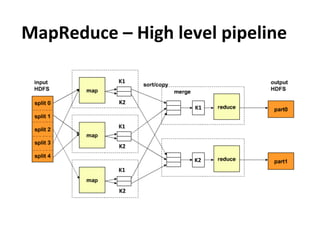
MapReduce	
  –	
  High	
  level	
  pipeline	
  

                K1	


                K2	
  
                              K1	


                K1	


                K2	
  

                              K2	
  
                K1	


                 K2	
  
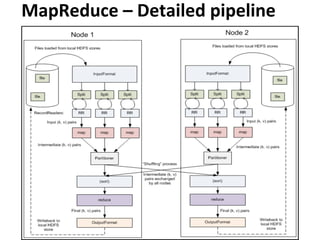
MapReduce	
  –	
  Detailed	
  pipeline	


Diagram:	
  hkp://developer.yahoo.com/hadoop/tutorial/module4.html	
  
MapReduce	
  –	
  Combiner	
  Phase	


•    OpEonal	
  
•    Runs	
  on	
  mapper	
  nodes	
  aSer	
  map	
  phase	
  	
  
•    “	
  Mini-­‐reduce,”	
  only	
  on	
  local	
  map	
  output	
  	
  
•    Used	
  to	
  save	
  bandwidth	
  before	
  sending	
  data	
  to	
  full	
  reducer	
  	
  
•    The	
  Reducer	
  can	
  be	
  Combiner	
  if	
  	
  
          1.  Output	
  key,	
  values	
  are	
  the	
  same	
  as	
  input	
  key,	
  values	
  
          2.  CommutaEve	
  and	
  AssociaEve	
  (SUM,	
  MAX	
  ok	
  but	
  AVG	
  not)	
  
Diagram:	
  hkp://developer.yahoo.com/hadoop/tutorial/module4.html	
  
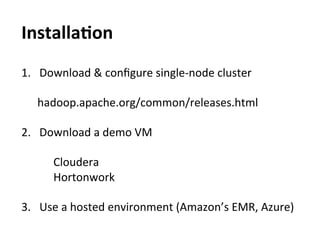
InstallaAon	
  
1.  Download	
  &	
  configure	
  single-­‐node	
  cluster	
  

    hadoop.apache.org/common/releases.html	
  

2.  Download	
  a	
  demo	
  VM	


      Cloudera	
  
      Hortonwork	
  

3.  Use	
  a	
  hosted	
  environment	
  (Amazon’s	
  EMR,	
  Azure)	
  
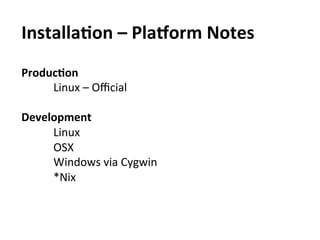
InstallaAon	
  –	
  Pla[orm	
  Notes	
  
ProducAon	


  Linux	
  –	
  Official	


Development	


  Linux	


  OSX	


  Windows	
  via	
  Cygwin	


  *Nix	
  
MapReduce	
  –	
  Client	
  Languages	
  
Java,	
  Any	
  JVM	
  Languages	
  -­‐	
  NaEve	
  
	
   hadoop	
  jar	
  jar_path	
  main_class	
  input_path	
  output_path	


C++	
  -­‐	
  Pipes	
  framework	
  –	
  Socket	
  IO	
  
	
   hadoop	
  pipes	
  -­‐input	
  path_in	
  -­‐output	
  path_out	
  -­‐program	
  exec_program	


Any	
  –	
  Streaming	
  –	
  Stdin	
  /	
  Stdout	


   hadoop	
  jar	
  hadoop-­‐streaming.jar	
  -­‐mapper	
  map_prog	
  -­‐reducer	
  reduce_prog	
  -­‐input	
  
     path_in	
  -­‐output	
  path_out	


Pig	
  LaEn,	
  Hive	
  HQL,	
  C	
  via	
  JNI	
  
MapReduce	
  –	
  Client	
  Anatomy	
  
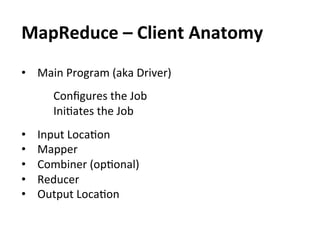
•  Main	
  Program	
  (aka	
  Driver)	


  Configures	
  the	
  Job	
  
          	
  IniEates	
  the	
  Job	
  
•      Input	
  LocaEon	
  
•      Mapper	
  
•      Combiner	
  (opEonal)	
  
•      Reducer	
  
•      Output	
  LocaEon	
  
MapReduce	
  –	
  Word	
  Count	
  Example	
  
MapReduce	
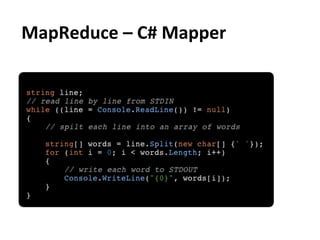
  –	
  C#	
  Mapper	
  
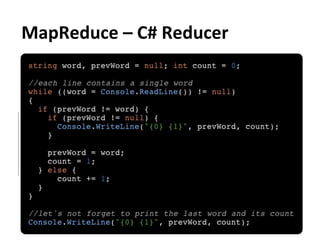
MapReduce	
  –	
  C#	
  Reducer	
  
MapReduce	
  –	
  Java	
  Mapper	
  
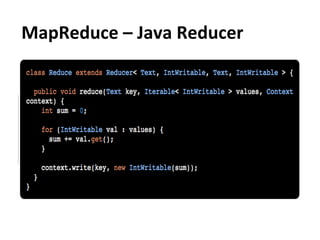
MapReduce	
  –	
  Java	
  Reducer	
  
MapReduce	
  –	
  JavaScript	
  Mapper	
  
MapReduce	
  –	
  JavaScript	
  Reducer	
  
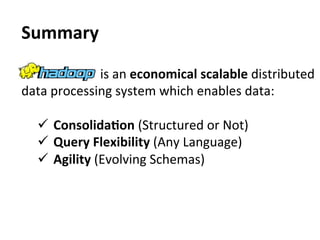
Summary	


  is	
  an	
  economical	
  scalable	
  distributed	
  
data	
  processing	
  system	
  which	
  enables	
  data:	


     ü  ConsolidaAon	
  (Structured	
  or	
  Not)	
  
     ü  Query	
  Flexibility	
  (Any	
  Language)	
  
     ü  Agility	
  (Evolving	
  Schemas)	
  
QuesAons	
  ?	
  
References	
  
Hadoop	
  at	
  Yahoo!,	
  by	
  Y!	
  Developer	
  Network	


MapReduce	
  in	
  Simple	
  Terms,	
  by Saliya Ekanayake	


Hadoop	
  Architecture,	
  by Phillipe Julio	


10	
  Hadoop-­‐able	
  Problems,	
  by Cloudera	


Hadoop,	
  An	
  Industry	
  PerspecEve,	
  by Amr Awadallah

Anatomy of a MapReduce Job Run by Tom White

MapReduceJobs in Hadoop

Introduction to Hadoop

  • 1.
    Hadoop  –  Taming  Big  Data   Jax  ArcSig,  June  2012   Ovidiu  Dimulescu  
  • 2.
    About  @odimulescu   •  Working  on  the  Web  since  1997   •  Likes  stuff  well  done   •  Into  engineering  cultures  and  all  around  automaEon   •  Speaker  at  local  user  groups   •  Organizer  for  the  local  Mobile  User  Group  jaxmug.com  
  • 3.
    Agenda   •  IntroducEon   •  Use  cases   •  Architecture   •  MapReduce  Examples   •  Q&A  
  • 4.
    What  is                                          ?   •  Apache  Hadoop  is  an  open  source  Java  soSware   framework  for  running  data-­‐intensive  applicaEons   on  large  clusters  of  commodity  hardware   •  Created  by  Doug  CuVng  (Lucene  &  Nutch  creator)   •  Named  aSer  Doug’s  son’s  toy  elephant  
  • 5.
    What  and  how  is  solving?     •  Processing  diverse  large  datasets  in  pracAcal  Ame  at   low  cost     •  Consolidates  data  in  a  distributed  file  system   •  Moves  computaAon  to  data  rather  then  data  to   computaEon   •  Simpler  programming  model  
  • 6.
    Why  does  it  maEer?     •  Volume,  Velocity,  Variety  and  Value   •  Datasets  do  not  fit  on  local  HDDs  let  alone  RAM   •  Data  grows  at  tremendous  pace   •  Data  is  heterogeneous     •  Scaling  up  is  expensive  (licensing,  cpus,  disks,   interconnects,  etc.)   •  Scaling  up  has  a  ceiling  (physical,  technical,  etc.)  
  • 7.
    Why  does  it  maEer?   Data  types   Complex  Data     Images,  Video   20%   Logs   Documents   Call  records   Sensor  data   Mail  archives     80%   Structured  Data     User  Profiles   Complex   Structured   CRM   HR  Records   *  Chart  Source:  IDC  White  Paper  
  • 8.
    Why  does  it  maEer?     •  Need  to  process  a  10TB  dataset   •  Assume  sustained  transfer  of  75MB/s   •  On  1  node  -­‐  Scanning  data  ~  2  days     •  On  10  node  cluster  -­‐  Scanning  data  ~  5  hrs   •  Low  $/TB  for  commodity  drives   •  Low-­‐end  servers  are  mulEcore  capable  
  • 9.
    Use  Cases     •  ETL  -­‐  Extract  Transform  Load   •  RecommendaEon  Engines   •  Customer  Churn  Analysis     •  Ad  TargeEng     •  Data  “sandbox”  
  • 10.
    Use  Cases  -­‐  Typical  ETL   Data  Warehouse   BI   ApplicaAons   Live  DB   ETL  1   ETL  2   ReporAng   DB   Logs  
  • 11.
    Use  Cases  -­‐  Hadoop  ETL   Data  Warehouse   BI   ApplicaAons   Live  DB   Data  Loading   Data  Loading   ReporAng   Hadoop   DB   Logs  
  • 12.
    Use  Cases  –  Analysis  methods   •  Pakern  recogniEon   •  Index  building   •  Text  mining   •  CollaboraEve  filtering   •  PredicEon  models   •  SenEment  analysis   •  Graphs  creaEon  and  traversal  
  • 13.
  • 14.
  • 15.
    Why  use  Hadoop?   •  PracEcal  to  do  things  that  were  previously  not   ü  Shorter  execuEon  Eme     ü  Costs  less   ü  Simpler  programming  model     •  Open  system  with  greater  flexibility   •  Large  and  growing  ecosystem  
  • 16.
    Hadoop  –  Silver  bullet?   •  Not  a  database  replacement   •  Not  a  data  warehousing  (complements  it)   •  Not  for  interacEve  reporEng     •  Not  a  general  purpose  storage  mechanism   •  Not  for  problems  that  are  not  parallelizable  in  a   share-­‐nothing  fashion  
  • 17.
    Architecture  –  Design  Axioms   •  System  Shall  Manage  and  Heal  Itself   •  Performance  Shall  Scale  Linearly     •  Compute  Should  Move  to  Data     •  Simple  Core,  Modular  and  Extensible  
  • 18.
    Architecture  –  Core  Components   HDFS     Distributed  filesystem  designed  for  low  cost  storage   and  high  bandwidth  access  across  the  cluster.   Map-­‐Reduce     Programming  model  for  processing  and  generaEng   large  data  sets.  
  • 19.
    Architecture  –  Official  Extensions   Management   ZooKeeper   Chukwa   Data  Access   Pig  (Data  Flow)   Hive  (SQL)   Avro   Data  Processing   MapReduce  Framework   Storage   HDFS   HBase  
  • 20.
    Architecture  –  CDH  DistribuAon   1.  CDH  –  Cloudera’s  DistribuEon  of  Hadoop   2.  Image  credit  -­‐  Cloudera  presentaEon  @  Microstrategy  World  2011  
  • 21.
    HDFS  -­‐  Design   •  Based  on  Google’s  GFS   •  Files  are  stored  as  blocks  (64MB  default  size)     •  Configurable  data  replicaEon  (3x,  Rack  Aware)     •  Fault  Tolerant,  Expects  HW  failures   •  HUGE  files,  Expects  Streaming  not  Low  Latency   •  Mostly  WORM  
  • 22.
    HDFS  -­‐  Architecture   Namenode  (NN)   Client  ask  NN  for  file   H     NN  returns  DNs  that   D   host  it   F     Client  ask  DN  for  data   S   Datanode  1   Datanode  2   Datanode  N   Namenode  -­‐  Master   Datanode  -­‐  Slaves       •  Filesystem  metadata   •  Reads  /  Write  blocks  to/from  clients   •  Controls  read/write  to  files   •  Replicates  blocks  at  master’s  request   •  Manages  blocks  replicaEon   •  Applies  transacEon  log  on  startup    
  • 23.
    HDFS  –  Fault  tolerance   •  DataNode     §  Uses  CRC  to  avoid  corrupEon   §  Data  is  replicated  on  other  nodes  (3x)     •  NameNode     §  Checkpoint  NameNode   §  Backup  NameNode     §  Failover  is  manual  
  • 24.
    MapReduce  -­‐  Design   •  Based  on  Google’s  MR  paper   •  Borrows  from  funcEonal  programming   •  Simpler  programming  model     §  map  (in_key,  in_value)    -­‐>  (out_key,  intermediate_value)  list   §  reduce  (out_key,  intermediate_value  list)     -­‐>  out_value  list     •  No  user  synchronizaEon  and  coordinaEon   Input  -­‐>  Map  -­‐>  Reduce  -­‐>  Output  
  • 25.
    MapReduce  -­‐  Architecture   Client  launches  a  job   J   JobsTracker  (JT)     O   -­‐  ConfiguraEon   -­‐  Mapper   B   -­‐  Reducer   S   -­‐  Input     -­‐  Output   TaskTracker  1   TaskTracker  2   TaskTracker  N   API   JobTracker  -­‐  Master   TaskTracker  -­‐  Slaves       •  Accepts  MR  jobs  submiked  by  clients   •  Run  Map  and  Reduce  tasks  received   •  Assigns  Map  and  Reduce  tasks  to   from  Jobtracker     TaskTrackers,  data  locality  aware   •  Manage  storage  and  transmission  of   •  Monitors  tasks  and  TaskTracker  status,   intermediate  output   re-­‐executes  tasks  upon  failure     •  SpeculaEve  execuEon  
  • 26.
    Hadoop  -­‐  Core  Architecture   J   JobsTracker   O   B   S     API   TaskTracker  1   TaskTracker  2   TaskTracker  N   DataNode        1   DataNode        2   DataNode        N   H   D   F   S   NameNode   Mini  OS   •  File  system   •  Scheduler  
  • 27.
    MapReduce  –  Head  First  Style   hkp://www.slideshare.net/esaliya/mapreduce-­‐ in-­‐simple-­‐terms  
  • 28.
    MapReduce  –  Mapper  Types   One-­‐to-­‐One   map(k,  v)  =  emit  (k,  transform(v))     Exploder   map(k,  v)  =  foreach  p  in  v:  emit  (k,  p)     Filter   map(k,  v)  =  if  cond(v)  then  emit  (k,  v)  
  • 29.
    MapReduce  –  Reducer  Types   Sum  Reducer     reduce(k,  vals)  =     sum  =  0   foreach  v  in  vals:  sum  +=  v   emit  (k,  sum)    
  • 30.
    MapReduce  –  High  level  pipeline   K1   K2   K1   K1   K2   K2   K1   K2  
  • 31.
    MapReduce  –  Detailed  pipeline   Diagram:  hkp://developer.yahoo.com/hadoop/tutorial/module4.html  
  • 32.
    MapReduce  –  Combiner  Phase   •  OpEonal   •  Runs  on  mapper  nodes  aSer  map  phase     •  “  Mini-­‐reduce,”  only  on  local  map  output     •  Used  to  save  bandwidth  before  sending  data  to  full  reducer     •  The  Reducer  can  be  Combiner  if     1.  Output  key,  values  are  the  same  as  input  key,  values   2.  CommutaEve  and  AssociaEve  (SUM,  MAX  ok  but  AVG  not)   Diagram:  hkp://developer.yahoo.com/hadoop/tutorial/module4.html  
  • 33.
    InstallaAon   1.  Download  &  configure  single-­‐node  cluster   hadoop.apache.org/common/releases.html   2.  Download  a  demo  VM     Cloudera   Hortonwork   3.  Use  a  hosted  environment  (Amazon’s  EMR,  Azure)  
  • 34.
    InstallaAon  –  Pla[orm  Notes   ProducAon        Linux  –  Official     Development        Linux      OSX      Windows  via  Cygwin      *Nix  
  • 35.
    MapReduce  –  Client  Languages   Java,  Any  JVM  Languages  -­‐  NaEve     hadoop  jar  jar_path  main_class  input_path  output_path     C++  -­‐  Pipes  framework  –  Socket  IO     hadoop  pipes  -­‐input  path_in  -­‐output  path_out  -­‐program  exec_program     Any  –  Streaming  –  Stdin  /  Stdout       hadoop  jar  hadoop-­‐streaming.jar  -­‐mapper  map_prog  -­‐reducer  reduce_prog  -­‐input   path_in  -­‐output  path_out       Pig  LaEn,  Hive  HQL,  C  via  JNI  
  • 36.
    MapReduce  –  Client  Anatomy   •  Main  Program  (aka  Driver)      Configures  the  Job    IniEates  the  Job   •  Input  LocaEon   •  Mapper   •  Combiner  (opEonal)   •  Reducer   •  Output  LocaEon  
  • 37.
    MapReduce  –  Word  Count  Example  
  • 38.
  • 39.
  • 40.
  • 41.
  • 42.
  • 43.
  • 44.
    Summary                                                          is  an  economical  scalable  distributed   data  processing  system  which  enables  data:     ü  ConsolidaAon  (Structured  or  Not)   ü  Query  Flexibility  (Any  Language)   ü  Agility  (Evolving  Schemas)  
  • 45.
  • 46.
    References   Hadoop  at  Yahoo!,  by  Y!  Developer  Network     MapReduce  in  Simple  Terms,  by Saliya Ekanayake     Hadoop  Architecture,  by Phillipe Julio     10  Hadoop-­‐able  Problems,  by Cloudera     Hadoop,  An  Industry  PerspecEve,  by Amr Awadallah Anatomy of a MapReduce Job Run by Tom White MapReduceJobs in Hadoop