Arthur Charpentier, SIDE Summer School, July 2019
# 1 Introduction & Geometry of Least Squares
Arthur Charpentier (Universit´e du Qu´ebec `a Montr´eal)
Machine Learning & Econometrics
SIDE Summer School - July 2019
@freakonometrics freakonometrics freakonometrics.hypotheses.org 1
Arthur Charpentier, SIDE Summer School, July 2019
Preamble : complex does not mean better...
Econometrics Machine Learning
@freakonometrics freakonometrics freakonometrics.hypotheses.org 2
Arthur Charpentier, SIDE Summer School, July 2019
Econometrics Courses in a Nutshell
Haavelno (1944, The Probabilistic Approach in Econometrics)
Data (yi, xi) are seen as realizations of (iid) random varibles (Y, X) on some
probabilistic space (Ω, F, P).
@freakonometrics freakonometrics freakonometrics.hypotheses.org 3
Arthur Charpentier, SIDE Summer School, July 2019
The Linear Regression
Consider some sample Sn = {(yi, xi)} where yi ∈ R and xi ∈ Rp
.
Sn is the realization of n i.i.d. random vectors (Yi, X1,i, · · · , Xp,i) with unknown
distribution P
Assume that Yi = β0 + β1x1,i + · · · + βpxp,i + εi, or Y = Xβ + ε
where εi’s satisfy E[εi] = 0, Var[εi] = σ2
, Var[εi, εj] = 0
Least square estimator of (unknown) β is
β = argmin
β∈Rp+1
y − Xβ
2
= X X
−1
X y
@freakonometrics freakonometrics freakonometrics.hypotheses.org 4
Arthur Charpentier, SIDE Summer School, July 2019
Geometric Perspective
Define the orthogonal projection on X,
ΠX = X[XT
X]−1
XT
y = X[XT
X]−1
X
ΠX
y = ΠXy.
Pythagoras’ theorem can be written
y 2
= ΠXy 2
+ ΠX⊥ y 2
= ΠXy 2
+ y − ΠXy 2
which can be expressed as
n
i=1
y2
i
n×total variance
=
n
i=1
y2
i
n×explained variance
+
n
i=1
(yi − yi)2
n×residual variance
@freakonometrics freakonometrics freakonometrics.hypotheses.org 5
Arthur Charpentier, SIDE Summer School, July 2019
Geometric Perspective
Define the angle θ between y and ΠXy,
R2
=
ΠXy 2
y 2
= 1 −
ΠX⊥ y 2
y 2
= cos2
(θ)
see Davidson & MacKinnon (2003)
y = β0 + X1β1 + X2β2 + ε
If y2 = ΠX⊥
1
y and X2 = ΠX⊥
1
X2, then
β2 = [X2
T
X2]−1
X2
T
y2
X2 = X2 if X1 ⊥ X2,
Frisch-Waugh theorem.
@freakonometrics freakonometrics freakonometrics.hypotheses.org 6
Arthur Charpentier, SIDE Summer School, July 2019
Least Squares ? The probabilistic interpretation
Recall that we assumed that (Yi, Xi) were i.i.d. with unknown distribution P.
In the (standard) linear model, we assume that (Y |X = x) ∼ N(x β, σ2
).
The maximum-likelihood estimator of β is then
β = argmax
β∈Rp+1
−
n
i=1
(yi − xi β)2
For the logistic regression, (Y |X = x) ∼ B(logit−1
(x β)).
The maximum-likelihood estimator of β is then
β = argmin
β∈Rp+1
n
i=1
yi · log(logit−1
(xi β)) + (1 − yi) · log(1 − logit−1
(xi β))
@freakonometrics freakonometrics freakonometrics.hypotheses.org 7
Arthur Charpentier, SIDE Summer School, July 2019
Least Squares ?
Consider a linear model, yi = xi β + εi.
In a general setting, consider some loss function : R × R → R+, e.g.
(y, m) = (y − m)2
(quadratic 2 norm)
For inference, we try to minimize the empirical risk associated with ,
β ∈ argmin
β∈Rp+1
n
i=1
(yi, xi β)
where xi = (1, x1,i, x2,i, · · · , xp,i). But cannot be used for validation.
@freakonometrics freakonometrics freakonometrics.hypotheses.org 8
Arthur Charpentier, SIDE Summer School, July 2019
Least Squares and Quadratic Risk
The risk associated with model m is RP(m) = EP (Y, m(X)) . Hence
E Y |X = x = argmin RP(m) = EP 2(Y, m(X))
where 2(y, m) = (y − m)2
, so m depends on (unknown) P.
Average Risks
The average risk associated with mn is RP(mn) = EP (Y, mn(X))
Empirical Risks
The empirical risk associated with mn is Rn(mn) =
1
n
n
i=1
yi, mn(xi) .
If we minimize the average risk, we overfit...
@freakonometrics freakonometrics freakonometrics.hypotheses.org 9
Arthur Charpentier, SIDE Summer School, July 2019
Cross Validation
Classical Approach : split the sample Sn in two parts
Hold-Out Cross Validation
1. Split {1, 2, · · · , n} in T (training) and V (validation)
2 . Estimate m on sample (yi, xi), i ∈ T : mT
3. Compute
1
|V |
i∈V
yi, mT (x1,i, · · · , Xp,i)
1 chicago <- read.table("http:// freakonometrics .free.fr/
chicago.txt", header=TRUE ,sep=";")
2 idx <- sample (1: nrow(chicago),nrow(chicago)*.7)
3 train <- chicago[idx ,]
4 valid <- chicago[-idx ,]
@freakonometrics freakonometrics freakonometrics.hypotheses.org 10
Arthur Charpentier, SIDE Summer School, July 2019
Cross Validation
Leave-one-Out Cross Validation
1. Estimate n models : m−j on sample (yi, xi), i ∈
{1, · · · , n}{j}
2. Compute
1
n
n
i=1
yi, m−i(xi)
Can be computationally intensive...
In the case of a linear regression, there is a simple formula to compute β−j when
observation j is removed. Let H = ΠX
= X(X X)−1
X
(X(j)X(j))−1
X(j) =
1
1 − Hj,j
(X X)−1
X(j)
@freakonometrics freakonometrics freakonometrics.hypotheses.org 11
Arthur Charpentier, SIDE Summer School, July 2019
Cross Validation
Instead of fitting n models, fit only K
K-Fold Cross Validation
1. Split {1, 2, · · · , n} in K groups V1, · · · , VK
2. Estimate K models : mk on sample (yi, xi), i ∈ {1, · · · , n}Vk
3. Compute
1
K
K
k=1
1
|Vk|
i∈Vk
yi, mk(x1,i, · · · , Xp,i)
If K = 10 we fit on 90% of the observation, and validate on the
remaining 10%
Here the K groups should be created randomly...
@freakonometrics freakonometrics freakonometrics.hypotheses.org 12
Arthur Charpentier, SIDE Summer School, July 2019
Cross Validation
Bootstrap Cross Validation
1. Generate B boostrap samples from {1, 2, · · · , n}, I1, · · · , IB
2. Estimate B models : mb on sample (yi, xi), i ∈ Ib
3. Compute
1
B
B
b=1
1
n − |Ib|
i∈Ib
yi, mb(x1,i, · · · , Xp,i)
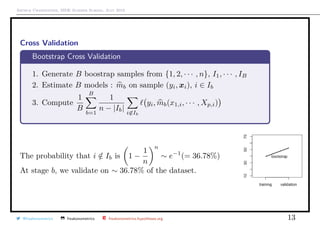
The probability that i /∈ Ib is 1 −
1
n
n
∼ e−1
(= 36.78%)
At stage b, we validate on ∼ 36.78% of the dataset.
@freakonometrics freakonometrics freakonometrics.hypotheses.org 13
Arthur Charpentier, SIDE Summer School, July 2019
Norms, Inner Products and Kernels
Most properties are related to the geometry the Euclidean space of Rn
.
Inner Product
An inner product on a vector space H is the application (f, g) → f, g H
(taking value in R) bilinear, symmetric, definite positive:
• f, g H = g, f H
• αf + βg, h H = α f, h H + β g, h H
• f, f H ≥ 0 and f, f H = 0 if and only if f = 0.
Example : H = Rn
, x, y = x y
Example : H = 2 = u :
∞
i=1
u2
i < ∞ , u, v =
∞
i=1
uivi
Example : H = L2(µ) = f : f(x)2
dµ(x) < ∞ , f, g = f(x)g(x)dµ(x)
@freakonometrics freakonometrics freakonometrics.hypotheses.org 14
Arthur Charpentier, SIDE Summer School, July 2019
Norms, Inner Products and Kernels
If H is finite, H = {h1 · · · , hd}, x, y take value Ki,j if x = hi and y = hj. Let
K = [Ki,j]
K is a symmetric d × d matrix, K = V ΛV for some orthogonal matrix V
where columns are eigenvectors, and Λ = diag[λi] (positive values). Let
Φ(x) = λ1Vi,1, λ2V2,i, · · · , λdVd,i if x = hi
Note that
Ki,j = [K = V ΛV ]i,j =
d
l=1
λlVi,lVl,j = Φ(hi), Φ(hj)
Matrix K defines an inner product, it is called a kernel. It is symmetric,
associated with a positive semi-definite matrix.
Then K(u, u) ≥ 0 and K(u, v) ≤ K(u, u) · K(v, v).
@freakonometrics freakonometrics freakonometrics.hypotheses.org 15
Arthur Charpentier, SIDE Summer School, July 2019
Norms, Inner Products and Kernels
Let ϕ : u → K(·, u), then K(x, y) = ϕ(x), ϕ(y)
In a general setting, let f H = f, f
1/2
H , and define the distance from f to
G ⊂ H
d(f, G) = inf
g∈G
{ f − g H} = d(f, g ) where g ∈ G
Note that g, f − g H = 0, ∀g ∈ G. And H = G ⊕ G⊥
.
Riesz representation theorem
For any continuous linear functionals L from H into the field R, there exists
a unique gL ∈ H such that ∀f ∈ H, gL, f H = Lf.
Consider the case where H = Rn
. Let Σ denote some symmetric n × n positive
definite matrix. Then
f, g Σ
= f Σ−1
gs is an inner product on Rn
.
@freakonometrics freakonometrics freakonometrics.hypotheses.org 16
Arthur Charpentier, SIDE Summer School, July 2019
Norms, Inner Products and Kernels
Note that if σi denote columns of Σ σi, σj Σ
= σi Σ−1
σj = Σi,j, and more
generally, σi, f Σ
= fi
The space H of functions Rp
→ R is a Reproducing Kernel Hilbert Space (RKHS)
if there is an inner product ·, · H such that H with ·, · H is an Hilbert space, and
for all x ∈ Rp
, linear functional δx : H → R defined as δx(f) = f(x) is bounded.
Thus, H is a RKHS if and only if ∀f ∈ H and x ∈ Rp
, there exists Mx such that
|f(x)| ≤ Mx · f H.
From Riesz theorem, there exists a unique ζx ∈ H associated with δx, i.e.
ζx, f H = f(x)
Reproducing Kernel of H
Function x → ζx is called reproducing function in x and K : Rp
× Rp
→ R
defined as K(x, y) = ζx(t) is the reproducing kernel of H.
@freakonometrics freakonometrics freakonometrics.hypotheses.org 17
Arthur Charpentier, SIDE Summer School, July 2019
Norms, Inner Products and Kernels
Observe that K(x, ·), K(y, ·) H = K(x, y).
The kernel is unique, and is (semi-)definite positive.
If H is a closed subspace of Hilbert space X. For any function f ∈ X,
x → f, K(·, x) X is the projection of f on H.
Note that conversely, Moore-Aronszajn’s theorem allows to create a RKHS from a
definite positive kernel K.
@freakonometrics freakonometrics freakonometrics.hypotheses.org 18
Arthur Charpentier, SIDE Summer School, July 2019
Norms, Inner Products and Kernels
Mercer’s kernel
Let µ denote some measure on Rp
and H = L2
(Rp
, µ), define
(LKf)(x) = K(x, y)f(y)dµ(y)
which is a compact bounded linear operator, self-adjoint and positive. Let
λ1 ≥ λ2 ≥ · · · denote eigenvalues of Lk, with (orthonormal) eigenvectors
ψ1, ψ2, · · · , then
K(x, y) =
p
k=1
λkψk(x)ψk(y) = Ψ(x) Ψ(y) = Ψ(x), Ψ(y) L2
where Ψ(x) = (
√
λkψk(x)).
@freakonometrics freakonometrics freakonometrics.hypotheses.org 19
Arthur Charpentier, SIDE Summer School, July 2019
Norms, Inner Products and Kernels
Example : Consider the space H defined as
H1 = f : [0, 1] → R continuously differentiable, with f ∈ L2
([0, 1]) and f(0) = 0
H1 is an Hilbert space on [0, 1] with inner product
f, g H1
=
1
0
f (t)g (t)dt
with (definite positive) kernel K1(x, y) = min{x, y} :
f, K(x, ·) H1
=
1
0
f (t)
∂K1(t, x)
∂x
=1[0,x](t)
=
x
0
f (t)dt = f(x)
@freakonometrics freakonometrics freakonometrics.hypotheses.org 20
Arthur Charpentier, SIDE Summer School, July 2019
Norms, Inner Products and Kernels
Example : Consider the Sobolev space W1
([0, 1]) defined as
W1
([0, 1]) = f : [0, 1] → R continuously differentiable, with f ∈ L2
([0, 1])
Observe that W1
([0, 1]) = H0 ⊕ H1 where
H0 = f : [0, 1] → R continuously differentiable, with f = 0
The later is an Hilbert space with kernel K0(x, y) = 1.
One can consider kernel K(x, y) = K0(x, y) + K1(x, y) (related to linear splines).
More generally, consider
H2 = f : [0, 1] → R twice cont. diff., with f ∈ L2
([0, 1] with f (0) = 0)
Then f, g H2
=
1
0
f (t)g (t)dt is an inner product, with kernel
K2(x, y) =
1
0
(x − t)+(y − t)+dt
@freakonometrics freakonometrics freakonometrics.hypotheses.org 21
Arthur Charpentier, SIDE Summer School, July 2019
Norms, Inner Products and Kernels
Consider some Hilbert space H with kernel K and some functional
Ψ : Rn+1
→ R, increasing in its last argument.
Representation theorem
Given x1, · · · , xn, min
f∈H
Ψ(f(x1), · · · , f(xn), f H) admits solution
∀x, f(x) =
n
i=1
αiK(xi, x)
A classical expression for Ψ is, for some convex function ψ,
Ψ(f(x1), · · · , f(xn), f H) = ψ(y, f(x1), · · · , f(xn)) + λ f H
Ψ(f(x1), · · · , f(xn), f H) =
n
i=1
(y, f(xi)) + λ f H
@freakonometrics freakonometrics freakonometrics.hypotheses.org 22
Arthur Charpentier, SIDE Summer School, July 2019
Norms, Inner Products and Kernels
Assume that yi = m(xi) + εi, where m ∈ W2([0, 1]), then polynomial splines of
degree 2 is the solution of
min
m∈W2
1
n
n
i=1
yi − m(xi)
2
+ ν
1
0
[m (t)]2
dt
then m (x) = β0 + β1x +
n
i=1
γiK2(xi, x) Note that one can use a matrix
representation
min y − Xβ − Qγ y − Xβ − Qγ + nνγ Qγ
where Q = [K1(xi, xj)]. If M = Q + nνI,
β = X M−1
X
−1
X M−1
y and γ = M−1
I−X(X M−1
X)−1
X M−1
y
@freakonometrics freakonometrics freakonometrics.hypotheses.org 23
Arthur Charpentier, SIDE Summer School, July 2019
Norms, Inner Products and Kernels
Kimeldorf & Wahba’s representation theorem
Consider a kernel K and HK
the associated RKHS. For any (convex) loss
function : R2
→ R, the solution
m ∈ argmin
m∈HK
n
i=1
(yi, m(xi)) + m 2
HK
can be expressed
m (·) =
n
i=1
αiK(xi, ·)
See Kimeldorf & Wahba (1971, Some results on Tchebycheffian spline functions),
some slides and later on, on SVM.
@freakonometrics freakonometrics freakonometrics.hypotheses.org 24
Arthur Charpentier, SIDE Summer School, July 2019
What’s going on, here ?
For more technical (mathematical) results, see
Wahba (1990, Spline Models for Observational Data)
We’ve seen that in many cases, K(x, y) = ϕ(x) ϕ(y)
for some ϕ : Rp
→ Rq
(here q = p)
Consider for example ϕ :


x1
x2

 →


x2
1
x2
2


so that K(x, y) = x2
1y2
1 + x2
2y2
2
@freakonometrics freakonometrics freakonometrics.hypotheses.org 25
Arthur Charpentier, SIDE Summer School, July 2019
What’s going on, here ?
Consider ϕ :


x1
x2

 →


x2
1
x2
2


K(x, y) = x2
1y2
1 + x2
2y2
2
From data (yi, xi), transform the covariates
into (yi, φ(xi)), and use a (classical) linear model
@freakonometrics freakonometrics freakonometrics.hypotheses.org 26
Arthur Charpentier, SIDE Summer School, July 2019
What’s going on, here ?
Consider ϕ :


x1
x2

 →


x1
x2
1 + x2
2


K(x, y) = x1y1 + (x2
1 + x2
2)(y2
1 + y2
2)
@freakonometrics freakonometrics freakonometrics.hypotheses.org 27
Arthur Charpentier, SIDE Summer School, July 2019
What’s going on, here ?
But we can have ϕ : Rp
→ Rq
(with q = p)
Consider ϕ :


x1
x2

 →




x1
x2
x1 · x2




A classical idea with SVM will be to consider q > p
to be able to find a linear separator of points
red and blue
@freakonometrics freakonometrics freakonometrics.hypotheses.org 28
−1.0 −0.5 0.0 0.5 1.0
−1.0−0.50.00.51.0
−1.0
−0.5
0.0
0.5
1.0
q
q
q
q
q
q
q
q
q
q
q
q
qq
q q q
q
q
qq qq
q
q
q
q
q
q
q
q
q
q
q
q
q
q
q
q
q
Arthur Charpentier, SIDE Summer School, July 2019
What’s going on, here ?
Consider ϕ :


x1
x2

 →













1
√
2x1
√
2x2
x2
1
x2
2
√
2x1x2













K(x, y) = 1 + x y
2
is called polynomial kernel (of order 2). More generally
K(x, y) = 1 + x y
d
, with d ∈ N.
For any degree d ≥ 2, ϕ : Rp
→ Rq
with q =
p + d
d
(default in R, d = 3)
@freakonometrics freakonometrics freakonometrics.hypotheses.org 29
Arthur Charpentier, SIDE Summer School, July 2019
How to get those kernels ?
If K1 and K2 are two kernels, so are
K(x, y) = a1K1(x, y) + a2K2(x, y) and K(x, y) = K1(x, y) · K2(x, y)
If h is some Rn
→ Rn
function, K(x, y) = K1(h(x), h(y))
If h is some Rn
→ R function, K(x, y) = h(x) · h(y)
If P is a polynomial with positive coefficients, k(x, y) = P(K1(x, y)) as well as
K(x, y) = exp[1(x, y)]
@freakonometrics freakonometrics freakonometrics.hypotheses.org 30

Side 2019, part 1

  • 1.
    Arthur Charpentier, SIDESummer School, July 2019 # 1 Introduction & Geometry of Least Squares Arthur Charpentier (Universit´e du Qu´ebec `a Montr´eal) Machine Learning & Econometrics SIDE Summer School - July 2019 @freakonometrics freakonometrics freakonometrics.hypotheses.org 1
  • 2.
    Arthur Charpentier, SIDESummer School, July 2019 Preamble : complex does not mean better... Econometrics Machine Learning @freakonometrics freakonometrics freakonometrics.hypotheses.org 2
  • 3.
    Arthur Charpentier, SIDESummer School, July 2019 Econometrics Courses in a Nutshell Haavelno (1944, The Probabilistic Approach in Econometrics) Data (yi, xi) are seen as realizations of (iid) random varibles (Y, X) on some probabilistic space (Ω, F, P). @freakonometrics freakonometrics freakonometrics.hypotheses.org 3
  • 4.
    Arthur Charpentier, SIDESummer School, July 2019 The Linear Regression Consider some sample Sn = {(yi, xi)} where yi ∈ R and xi ∈ Rp . Sn is the realization of n i.i.d. random vectors (Yi, X1,i, · · · , Xp,i) with unknown distribution P Assume that Yi = β0 + β1x1,i + · · · + βpxp,i + εi, or Y = Xβ + ε where εi’s satisfy E[εi] = 0, Var[εi] = σ2 , Var[εi, εj] = 0 Least square estimator of (unknown) β is β = argmin β∈Rp+1 y − Xβ 2 = X X −1 X y @freakonometrics freakonometrics freakonometrics.hypotheses.org 4
  • 5.
    Arthur Charpentier, SIDESummer School, July 2019 Geometric Perspective Define the orthogonal projection on X, ΠX = X[XT X]−1 XT y = X[XT X]−1 X ΠX y = ΠXy. Pythagoras’ theorem can be written y 2 = ΠXy 2 + ΠX⊥ y 2 = ΠXy 2 + y − ΠXy 2 which can be expressed as n i=1 y2 i n×total variance = n i=1 y2 i n×explained variance + n i=1 (yi − yi)2 n×residual variance @freakonometrics freakonometrics freakonometrics.hypotheses.org 5
  • 6.
    Arthur Charpentier, SIDESummer School, July 2019 Geometric Perspective Define the angle θ between y and ΠXy, R2 = ΠXy 2 y 2 = 1 − ΠX⊥ y 2 y 2 = cos2 (θ) see Davidson & MacKinnon (2003) y = β0 + X1β1 + X2β2 + ε If y2 = ΠX⊥ 1 y and X2 = ΠX⊥ 1 X2, then β2 = [X2 T X2]−1 X2 T y2 X2 = X2 if X1 ⊥ X2, Frisch-Waugh theorem. @freakonometrics freakonometrics freakonometrics.hypotheses.org 6
  • 7.
    Arthur Charpentier, SIDESummer School, July 2019 Least Squares ? The probabilistic interpretation Recall that we assumed that (Yi, Xi) were i.i.d. with unknown distribution P. In the (standard) linear model, we assume that (Y |X = x) ∼ N(x β, σ2 ). The maximum-likelihood estimator of β is then β = argmax β∈Rp+1 − n i=1 (yi − xi β)2 For the logistic regression, (Y |X = x) ∼ B(logit−1 (x β)). The maximum-likelihood estimator of β is then β = argmin β∈Rp+1 n i=1 yi · log(logit−1 (xi β)) + (1 − yi) · log(1 − logit−1 (xi β)) @freakonometrics freakonometrics freakonometrics.hypotheses.org 7
  • 8.
    Arthur Charpentier, SIDESummer School, July 2019 Least Squares ? Consider a linear model, yi = xi β + εi. In a general setting, consider some loss function : R × R → R+, e.g. (y, m) = (y − m)2 (quadratic 2 norm) For inference, we try to minimize the empirical risk associated with , β ∈ argmin β∈Rp+1 n i=1 (yi, xi β) where xi = (1, x1,i, x2,i, · · · , xp,i). But cannot be used for validation. @freakonometrics freakonometrics freakonometrics.hypotheses.org 8
  • 9.
    Arthur Charpentier, SIDESummer School, July 2019 Least Squares and Quadratic Risk The risk associated with model m is RP(m) = EP (Y, m(X)) . Hence E Y |X = x = argmin RP(m) = EP 2(Y, m(X)) where 2(y, m) = (y − m)2 , so m depends on (unknown) P. Average Risks The average risk associated with mn is RP(mn) = EP (Y, mn(X)) Empirical Risks The empirical risk associated with mn is Rn(mn) = 1 n n i=1 yi, mn(xi) . If we minimize the average risk, we overfit... @freakonometrics freakonometrics freakonometrics.hypotheses.org 9
  • 10.
    Arthur Charpentier, SIDESummer School, July 2019 Cross Validation Classical Approach : split the sample Sn in two parts Hold-Out Cross Validation 1. Split {1, 2, · · · , n} in T (training) and V (validation) 2 . Estimate m on sample (yi, xi), i ∈ T : mT 3. Compute 1 |V | i∈V yi, mT (x1,i, · · · , Xp,i) 1 chicago <- read.table("http:// freakonometrics .free.fr/ chicago.txt", header=TRUE ,sep=";") 2 idx <- sample (1: nrow(chicago),nrow(chicago)*.7) 3 train <- chicago[idx ,] 4 valid <- chicago[-idx ,] @freakonometrics freakonometrics freakonometrics.hypotheses.org 10
  • 11.
    Arthur Charpentier, SIDESummer School, July 2019 Cross Validation Leave-one-Out Cross Validation 1. Estimate n models : m−j on sample (yi, xi), i ∈ {1, · · · , n}{j} 2. Compute 1 n n i=1 yi, m−i(xi) Can be computationally intensive... In the case of a linear regression, there is a simple formula to compute β−j when observation j is removed. Let H = ΠX = X(X X)−1 X (X(j)X(j))−1 X(j) = 1 1 − Hj,j (X X)−1 X(j) @freakonometrics freakonometrics freakonometrics.hypotheses.org 11
  • 12.
    Arthur Charpentier, SIDESummer School, July 2019 Cross Validation Instead of fitting n models, fit only K K-Fold Cross Validation 1. Split {1, 2, · · · , n} in K groups V1, · · · , VK 2. Estimate K models : mk on sample (yi, xi), i ∈ {1, · · · , n}Vk 3. Compute 1 K K k=1 1 |Vk| i∈Vk yi, mk(x1,i, · · · , Xp,i) If K = 10 we fit on 90% of the observation, and validate on the remaining 10% Here the K groups should be created randomly... @freakonometrics freakonometrics freakonometrics.hypotheses.org 12
  • 13.
    Arthur Charpentier, SIDESummer School, July 2019 Cross Validation Bootstrap Cross Validation 1. Generate B boostrap samples from {1, 2, · · · , n}, I1, · · · , IB 2. Estimate B models : mb on sample (yi, xi), i ∈ Ib 3. Compute 1 B B b=1 1 n − |Ib| i∈Ib yi, mb(x1,i, · · · , Xp,i) The probability that i /∈ Ib is 1 − 1 n n ∼ e−1 (= 36.78%) At stage b, we validate on ∼ 36.78% of the dataset. @freakonometrics freakonometrics freakonometrics.hypotheses.org 13
  • 14.
    Arthur Charpentier, SIDESummer School, July 2019 Norms, Inner Products and Kernels Most properties are related to the geometry the Euclidean space of Rn . Inner Product An inner product on a vector space H is the application (f, g) → f, g H (taking value in R) bilinear, symmetric, definite positive: • f, g H = g, f H • αf + βg, h H = α f, h H + β g, h H • f, f H ≥ 0 and f, f H = 0 if and only if f = 0. Example : H = Rn , x, y = x y Example : H = 2 = u : ∞ i=1 u2 i < ∞ , u, v = ∞ i=1 uivi Example : H = L2(µ) = f : f(x)2 dµ(x) < ∞ , f, g = f(x)g(x)dµ(x) @freakonometrics freakonometrics freakonometrics.hypotheses.org 14
  • 15.
    Arthur Charpentier, SIDESummer School, July 2019 Norms, Inner Products and Kernels If H is finite, H = {h1 · · · , hd}, x, y take value Ki,j if x = hi and y = hj. Let K = [Ki,j] K is a symmetric d × d matrix, K = V ΛV for some orthogonal matrix V where columns are eigenvectors, and Λ = diag[λi] (positive values). Let Φ(x) = λ1Vi,1, λ2V2,i, · · · , λdVd,i if x = hi Note that Ki,j = [K = V ΛV ]i,j = d l=1 λlVi,lVl,j = Φ(hi), Φ(hj) Matrix K defines an inner product, it is called a kernel. It is symmetric, associated with a positive semi-definite matrix. Then K(u, u) ≥ 0 and K(u, v) ≤ K(u, u) · K(v, v). @freakonometrics freakonometrics freakonometrics.hypotheses.org 15
  • 16.
    Arthur Charpentier, SIDESummer School, July 2019 Norms, Inner Products and Kernels Let ϕ : u → K(·, u), then K(x, y) = ϕ(x), ϕ(y) In a general setting, let f H = f, f 1/2 H , and define the distance from f to G ⊂ H d(f, G) = inf g∈G { f − g H} = d(f, g ) where g ∈ G Note that g, f − g H = 0, ∀g ∈ G. And H = G ⊕ G⊥ . Riesz representation theorem For any continuous linear functionals L from H into the field R, there exists a unique gL ∈ H such that ∀f ∈ H, gL, f H = Lf. Consider the case where H = Rn . Let Σ denote some symmetric n × n positive definite matrix. Then f, g Σ = f Σ−1 gs is an inner product on Rn . @freakonometrics freakonometrics freakonometrics.hypotheses.org 16
  • 17.
    Arthur Charpentier, SIDESummer School, July 2019 Norms, Inner Products and Kernels Note that if σi denote columns of Σ σi, σj Σ = σi Σ−1 σj = Σi,j, and more generally, σi, f Σ = fi The space H of functions Rp → R is a Reproducing Kernel Hilbert Space (RKHS) if there is an inner product ·, · H such that H with ·, · H is an Hilbert space, and for all x ∈ Rp , linear functional δx : H → R defined as δx(f) = f(x) is bounded. Thus, H is a RKHS if and only if ∀f ∈ H and x ∈ Rp , there exists Mx such that |f(x)| ≤ Mx · f H. From Riesz theorem, there exists a unique ζx ∈ H associated with δx, i.e. ζx, f H = f(x) Reproducing Kernel of H Function x → ζx is called reproducing function in x and K : Rp × Rp → R defined as K(x, y) = ζx(t) is the reproducing kernel of H. @freakonometrics freakonometrics freakonometrics.hypotheses.org 17
  • 18.
    Arthur Charpentier, SIDESummer School, July 2019 Norms, Inner Products and Kernels Observe that K(x, ·), K(y, ·) H = K(x, y). The kernel is unique, and is (semi-)definite positive. If H is a closed subspace of Hilbert space X. For any function f ∈ X, x → f, K(·, x) X is the projection of f on H. Note that conversely, Moore-Aronszajn’s theorem allows to create a RKHS from a definite positive kernel K. @freakonometrics freakonometrics freakonometrics.hypotheses.org 18
  • 19.
    Arthur Charpentier, SIDESummer School, July 2019 Norms, Inner Products and Kernels Mercer’s kernel Let µ denote some measure on Rp and H = L2 (Rp , µ), define (LKf)(x) = K(x, y)f(y)dµ(y) which is a compact bounded linear operator, self-adjoint and positive. Let λ1 ≥ λ2 ≥ · · · denote eigenvalues of Lk, with (orthonormal) eigenvectors ψ1, ψ2, · · · , then K(x, y) = p k=1 λkψk(x)ψk(y) = Ψ(x) Ψ(y) = Ψ(x), Ψ(y) L2 where Ψ(x) = ( √ λkψk(x)). @freakonometrics freakonometrics freakonometrics.hypotheses.org 19
  • 20.
    Arthur Charpentier, SIDESummer School, July 2019 Norms, Inner Products and Kernels Example : Consider the space H defined as H1 = f : [0, 1] → R continuously differentiable, with f ∈ L2 ([0, 1]) and f(0) = 0 H1 is an Hilbert space on [0, 1] with inner product f, g H1 = 1 0 f (t)g (t)dt with (definite positive) kernel K1(x, y) = min{x, y} : f, K(x, ·) H1 = 1 0 f (t) ∂K1(t, x) ∂x =1[0,x](t) = x 0 f (t)dt = f(x) @freakonometrics freakonometrics freakonometrics.hypotheses.org 20
  • 21.
    Arthur Charpentier, SIDESummer School, July 2019 Norms, Inner Products and Kernels Example : Consider the Sobolev space W1 ([0, 1]) defined as W1 ([0, 1]) = f : [0, 1] → R continuously differentiable, with f ∈ L2 ([0, 1]) Observe that W1 ([0, 1]) = H0 ⊕ H1 where H0 = f : [0, 1] → R continuously differentiable, with f = 0 The later is an Hilbert space with kernel K0(x, y) = 1. One can consider kernel K(x, y) = K0(x, y) + K1(x, y) (related to linear splines). More generally, consider H2 = f : [0, 1] → R twice cont. diff., with f ∈ L2 ([0, 1] with f (0) = 0) Then f, g H2 = 1 0 f (t)g (t)dt is an inner product, with kernel K2(x, y) = 1 0 (x − t)+(y − t)+dt @freakonometrics freakonometrics freakonometrics.hypotheses.org 21
  • 22.
    Arthur Charpentier, SIDESummer School, July 2019 Norms, Inner Products and Kernels Consider some Hilbert space H with kernel K and some functional Ψ : Rn+1 → R, increasing in its last argument. Representation theorem Given x1, · · · , xn, min f∈H Ψ(f(x1), · · · , f(xn), f H) admits solution ∀x, f(x) = n i=1 αiK(xi, x) A classical expression for Ψ is, for some convex function ψ, Ψ(f(x1), · · · , f(xn), f H) = ψ(y, f(x1), · · · , f(xn)) + λ f H Ψ(f(x1), · · · , f(xn), f H) = n i=1 (y, f(xi)) + λ f H @freakonometrics freakonometrics freakonometrics.hypotheses.org 22
  • 23.
    Arthur Charpentier, SIDESummer School, July 2019 Norms, Inner Products and Kernels Assume that yi = m(xi) + εi, where m ∈ W2([0, 1]), then polynomial splines of degree 2 is the solution of min m∈W2 1 n n i=1 yi − m(xi) 2 + ν 1 0 [m (t)]2 dt then m (x) = β0 + β1x + n i=1 γiK2(xi, x) Note that one can use a matrix representation min y − Xβ − Qγ y − Xβ − Qγ + nνγ Qγ where Q = [K1(xi, xj)]. If M = Q + nνI, β = X M−1 X −1 X M−1 y and γ = M−1 I−X(X M−1 X)−1 X M−1 y @freakonometrics freakonometrics freakonometrics.hypotheses.org 23
  • 24.
    Arthur Charpentier, SIDESummer School, July 2019 Norms, Inner Products and Kernels Kimeldorf & Wahba’s representation theorem Consider a kernel K and HK the associated RKHS. For any (convex) loss function : R2 → R, the solution m ∈ argmin m∈HK n i=1 (yi, m(xi)) + m 2 HK can be expressed m (·) = n i=1 αiK(xi, ·) See Kimeldorf & Wahba (1971, Some results on Tchebycheffian spline functions), some slides and later on, on SVM. @freakonometrics freakonometrics freakonometrics.hypotheses.org 24
  • 25.
    Arthur Charpentier, SIDESummer School, July 2019 What’s going on, here ? For more technical (mathematical) results, see Wahba (1990, Spline Models for Observational Data) We’ve seen that in many cases, K(x, y) = ϕ(x) ϕ(y) for some ϕ : Rp → Rq (here q = p) Consider for example ϕ :   x1 x2   →   x2 1 x2 2   so that K(x, y) = x2 1y2 1 + x2 2y2 2 @freakonometrics freakonometrics freakonometrics.hypotheses.org 25
  • 26.
    Arthur Charpentier, SIDESummer School, July 2019 What’s going on, here ? Consider ϕ :   x1 x2   →   x2 1 x2 2   K(x, y) = x2 1y2 1 + x2 2y2 2 From data (yi, xi), transform the covariates into (yi, φ(xi)), and use a (classical) linear model @freakonometrics freakonometrics freakonometrics.hypotheses.org 26
  • 27.
    Arthur Charpentier, SIDESummer School, July 2019 What’s going on, here ? Consider ϕ :   x1 x2   →   x1 x2 1 + x2 2   K(x, y) = x1y1 + (x2 1 + x2 2)(y2 1 + y2 2) @freakonometrics freakonometrics freakonometrics.hypotheses.org 27
  • 28.
    Arthur Charpentier, SIDESummer School, July 2019 What’s going on, here ? But we can have ϕ : Rp → Rq (with q = p) Consider ϕ :   x1 x2   →     x1 x2 x1 · x2     A classical idea with SVM will be to consider q > p to be able to find a linear separator of points red and blue @freakonometrics freakonometrics freakonometrics.hypotheses.org 28 −1.0 −0.5 0.0 0.5 1.0 −1.0−0.50.00.51.0 −1.0 −0.5 0.0 0.5 1.0 q q q q q q q q q q q q qq q q q q q qq qq q q q q q q q q q q q q q q q q q
  • 29.
    Arthur Charpentier, SIDESummer School, July 2019 What’s going on, here ? Consider ϕ :   x1 x2   →              1 √ 2x1 √ 2x2 x2 1 x2 2 √ 2x1x2              K(x, y) = 1 + x y 2 is called polynomial kernel (of order 2). More generally K(x, y) = 1 + x y d , with d ∈ N. For any degree d ≥ 2, ϕ : Rp → Rq with q = p + d d (default in R, d = 3) @freakonometrics freakonometrics freakonometrics.hypotheses.org 29
  • 30.
    Arthur Charpentier, SIDESummer School, July 2019 How to get those kernels ? If K1 and K2 are two kernels, so are K(x, y) = a1K1(x, y) + a2K2(x, y) and K(x, y) = K1(x, y) · K2(x, y) If h is some Rn → Rn function, K(x, y) = K1(h(x), h(y)) If h is some Rn → R function, K(x, y) = h(x) · h(y) If P is a polynomial with positive coefficients, k(x, y) = P(K1(x, y)) as well as K(x, y) = exp[1(x, y)] @freakonometrics freakonometrics freakonometrics.hypotheses.org 30