Welcome
To My
Presentation
Abid Hasan Khan
Presented By…
Abid Hasan Khan
Year: 2nd
Session: 2015-16
Department of Physiotherapy
Bangladesh Health Professions Institute
(BHPI),
CRP- Chapain, Savar, Dhaka – 1343.
Abid Hasan Khan
Topic
The Sternoclavicular joint &
the Acromioclavicular joint
Abid Hasan Khan
Contents…
 Definition
 Capsule properties
 Capsule reinforcers-
i)Muscle ii)Ligaments iii)Neurovascular Supply
 Movements of the joint
 Physiological importance
 Injuries of the joint
Abid Hasan Khan
The Sternoclavicular joint
Abid Hasan Khan
The Sternoclavicular joint
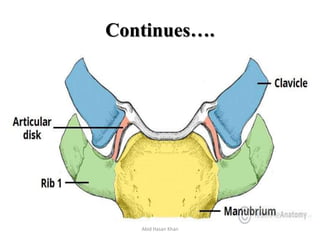
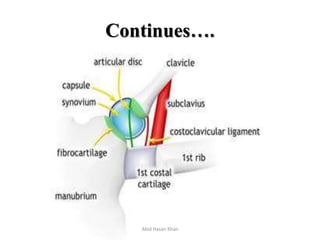
The Sternoclavicular joint is a saddle
type of synovial joint between the
sternal end of clavicle & the
manubrium of sternum with the
articulation of 1st costal cartilage.
Abid Hasan Khan
Continues….
Abid Hasan Khan
Capsule properties
Strong joint capsule-
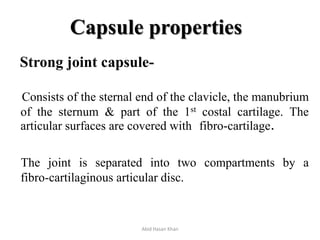
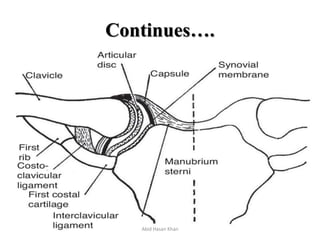
Consists of the sternal end of the clavicle, the manubrium
of the sternum & part of the 1st costal cartilage. The
articular surfaces are covered with fibro-cartilage.
The joint is separated into two compartments by a
fibro-cartilaginous articular disc.
Abid Hasan Khan
Continues….
Abid Hasan Khan
Capsule reinforcers
Muscle:
 Subclavius muscle :
 Originates at costal cartilage of first rib
 Inserts on inferior aspect of clavicle.
Abid Hasan Khan
Continues….
Ligaments :
There are three major ligaments present in the
Sternoclavicular joint :
 Posterior and anterior sternoclavicular ligament.
 Interclavicular ligament.
 Costoclavicular ligament.
Abid Hasan Khan
Continues….
Neurovascular Supply :
Arterial supply to the sternoclavicular joint is from the
internal thoracic artery and the suprascapular artery.
The veins of the joint follow the major arteries.
The joint is supplied by the medial supraclavicular nerve (C3
and C4) and the nerve to subclavius (C5 and C6).
Abid Hasan Khan
Continues….
Abid Hasan Khan
Movements of the joint
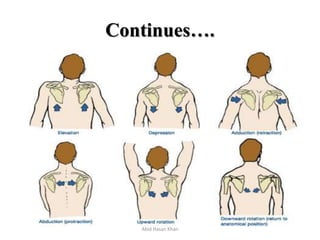
The Sternoclavicular joint has a large degree of
mobility. There are several movements that require this
joint involvement :
 Elevation
 Depression
 Retraction
 Protraction
 Rotation
Abid Hasan Khan
Continues….
Abid Hasan Khan
Continues….
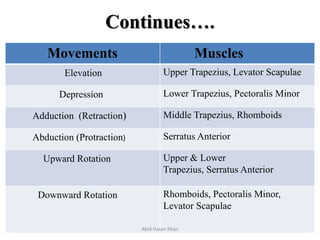
Movements Muscles
Elevation Upper Trapezius, Levator Scapulae
Depression Lower Trapezius, Pectoralis Minor
Adduction (Retraction) Middle Trapezius, Rhomboids
Abduction (Protraction) Serratus Anterior
Upward Rotation Upper & Lower
Trapezius, Serratus Anterior
Downward Rotation Rhomboids, Pectoralis Minor,
Levator Scapulae
Abid Hasan Khan
Physiological importance
The Sternoclavicular (SC) joint is
important because it helps to support
the shoulder. The SC joint links the
bones of the arms and shoulder to the
vertical skeleton.
Abid Hasan Khan
Injuries of the joint
 Dislocation of the clavicle
 Sprains
 Fractures
 Degenarative arthritis
Abid Hasan Khan
The Acromioclavicular joint
Abid Hasan Khan
The Acromioclavicular joint
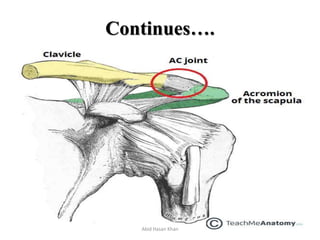
The Acromioclavicular (AC) joint is a
plane type of synovial joint which is a top
joint at the shoulder. It is the junction
between the acromion of scapula and the
clavicle.
Abid Hasan Khan
Continues….
Abid Hasan Khan
Capsule properties
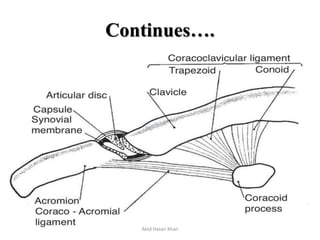
The joint capsule consists of a loose
fibrous layer which encloses the two
articulation surfaces. It also give rise
to the articular disk.
Abid Hasan Khan
Continues….
The joint mainly consists of an
articulation between the acromion of
scapula and the lateral end of
clavicle.
Abid Hasan Khan
Continues….
It has two atypical features :
 The articular surfaces of the joint are lined with
fibrocartilage (as opposed to hyaline cartilage).
 The joint cavity is partially divided by an
articular disc.
Abid Hasan Khan
Continues….
Abid Hasan Khan
Capsule reinforcers
Muscle :
There’s no muscle connects the bones to move the joint.
The Clavicle serves as an attachment for many of the
muscles that act on the joint’s movements. These

include:
 Pectoralis Major (Clavicular head)
 Sternocleidomastoid
 Deltoid
 Trapezius
Abid Hasan Khan
Continues….
Ligaments :
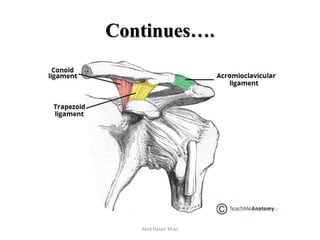
There are three major ligaments present in
the acromioclavicular joint:
 Acromioclavicular ligament
 Conoid ligament
 Trapezoid ligament
Abid Hasan Khan
Continues….
Abid Hasan Khan
Continues….
Neurovascular Supply –
Vessels :
The arterial supply to the joint is via two
vessels:
 Suprascapular artery
 Thoraco-acromial artery
Abid Hasan Khan
Continues….
Nerves :
The acromioclavicular joint is innervated by
articular branches of the suprascapular and
lateral pectoral nerves. They both arise
directly from the brachial plexus.
Abid Hasan Khan
Movements of the joint
The AC joint allows a degree of axial
rotation and anteroposterior movement.
As no muscles act directly on the joint, all
movement is passive, and is initiated by
movement at other joints (such as the
sternoclavicular joint).
Abid Hasan Khan
Continues….
Muscles which move the scapula cause it
to move on the clavicle. Scapular
movements on the chest wall fall into
three groups:
 Protraction and retraction around the
chest wall
 Rotation
 Elevation or depression.
Abid Hasan Khan
Physiological importance
The AC joint provides the ability to raise
the arm above the head. This joint
functions as a pivot point acting like a
strut to help with movement of the
scapula resulting in a greater degree of
arm rotation.
Abid Hasan Khan
Injuries of the joint
 Dislocation of the clavicle
 Sprains
 Fractures
 Degenarative arthritis
Abid Hasan Khan
Abid Hasan Khan
Abid Hasan Khan

Sterno-clavicular and acromio-clavicular joint

  • 1.
  • 2.
    Presented By… Abid HasanKhan Year: 2nd Session: 2015-16 Department of Physiotherapy Bangladesh Health Professions Institute (BHPI), CRP- Chapain, Savar, Dhaka – 1343. Abid Hasan Khan
  • 3.
    Topic The Sternoclavicular joint& the Acromioclavicular joint Abid Hasan Khan
  • 4.
    Contents…  Definition  Capsuleproperties  Capsule reinforcers- i)Muscle ii)Ligaments iii)Neurovascular Supply  Movements of the joint  Physiological importance  Injuries of the joint Abid Hasan Khan
  • 5.
  • 6.
    The Sternoclavicular joint TheSternoclavicular joint is a saddle type of synovial joint between the sternal end of clavicle & the manubrium of sternum with the articulation of 1st costal cartilage. Abid Hasan Khan
  • 7.
  • 8.
    Capsule properties Strong jointcapsule- Consists of the sternal end of the clavicle, the manubrium of the sternum & part of the 1st costal cartilage. The articular surfaces are covered with fibro-cartilage. The joint is separated into two compartments by a fibro-cartilaginous articular disc. Abid Hasan Khan
  • 9.
  • 10.
    Capsule reinforcers Muscle:  Subclaviusmuscle :  Originates at costal cartilage of first rib  Inserts on inferior aspect of clavicle. Abid Hasan Khan
  • 11.
    Continues…. Ligaments : There arethree major ligaments present in the Sternoclavicular joint :  Posterior and anterior sternoclavicular ligament.  Interclavicular ligament.  Costoclavicular ligament. Abid Hasan Khan
  • 12.
    Continues…. Neurovascular Supply : Arterialsupply to the sternoclavicular joint is from the internal thoracic artery and the suprascapular artery. The veins of the joint follow the major arteries. The joint is supplied by the medial supraclavicular nerve (C3 and C4) and the nerve to subclavius (C5 and C6). Abid Hasan Khan
  • 13.
  • 14.
    Movements of thejoint The Sternoclavicular joint has a large degree of mobility. There are several movements that require this joint involvement :  Elevation  Depression  Retraction  Protraction  Rotation Abid Hasan Khan
  • 15.
  • 16.
    Continues…. Movements Muscles Elevation UpperTrapezius, Levator Scapulae Depression Lower Trapezius, Pectoralis Minor Adduction (Retraction) Middle Trapezius, Rhomboids Abduction (Protraction) Serratus Anterior Upward Rotation Upper & Lower Trapezius, Serratus Anterior Downward Rotation Rhomboids, Pectoralis Minor, Levator Scapulae Abid Hasan Khan
  • 17.
    Physiological importance The Sternoclavicular(SC) joint is important because it helps to support the shoulder. The SC joint links the bones of the arms and shoulder to the vertical skeleton. Abid Hasan Khan
  • 18.
    Injuries of thejoint  Dislocation of the clavicle  Sprains  Fractures  Degenarative arthritis Abid Hasan Khan
  • 19.
  • 20.
    The Acromioclavicular joint TheAcromioclavicular (AC) joint is a plane type of synovial joint which is a top joint at the shoulder. It is the junction between the acromion of scapula and the clavicle. Abid Hasan Khan
  • 21.
  • 22.
    Capsule properties The jointcapsule consists of a loose fibrous layer which encloses the two articulation surfaces. It also give rise to the articular disk. Abid Hasan Khan
  • 23.
    Continues…. The joint mainlyconsists of an articulation between the acromion of scapula and the lateral end of clavicle. Abid Hasan Khan
  • 24.
    Continues…. It has twoatypical features :  The articular surfaces of the joint are lined with fibrocartilage (as opposed to hyaline cartilage).  The joint cavity is partially divided by an articular disc. Abid Hasan Khan
  • 25.
  • 26.
    Capsule reinforcers Muscle : There’sno muscle connects the bones to move the joint. The Clavicle serves as an attachment for many of the muscles that act on the joint’s movements. These include:  Pectoralis Major (Clavicular head)  Sternocleidomastoid  Deltoid  Trapezius Abid Hasan Khan
  • 27.
    Continues…. Ligaments : There arethree major ligaments present in the acromioclavicular joint:  Acromioclavicular ligament  Conoid ligament  Trapezoid ligament Abid Hasan Khan
  • 28.
  • 29.
    Continues…. Neurovascular Supply – Vessels: The arterial supply to the joint is via two vessels:  Suprascapular artery  Thoraco-acromial artery Abid Hasan Khan
  • 30.
    Continues…. Nerves : The acromioclavicularjoint is innervated by articular branches of the suprascapular and lateral pectoral nerves. They both arise directly from the brachial plexus. Abid Hasan Khan
  • 31.
    Movements of thejoint The AC joint allows a degree of axial rotation and anteroposterior movement. As no muscles act directly on the joint, all movement is passive, and is initiated by movement at other joints (such as the sternoclavicular joint). Abid Hasan Khan
  • 32.
    Continues…. Muscles which movethe scapula cause it to move on the clavicle. Scapular movements on the chest wall fall into three groups:  Protraction and retraction around the chest wall  Rotation  Elevation or depression. Abid Hasan Khan
  • 33.
    Physiological importance The ACjoint provides the ability to raise the arm above the head. This joint functions as a pivot point acting like a strut to help with movement of the scapula resulting in a greater degree of arm rotation. Abid Hasan Khan
  • 34.
    Injuries of thejoint  Dislocation of the clavicle  Sprains  Fractures  Degenarative arthritis Abid Hasan Khan
  • 35.
  • 36.