RETINACULAR
ARTERIES
Rahilla Khatoon, Moza Al-Khulaifa, Irsalan Asif and James
Alexander
Overview
 Retinacular arteries
 Role of the retinacular arteries
 Childhood Adult
 Failure
 Treatment
 Surgery
 Complications
Vasculature of the femur
1. Illio-femoral artery
2. Ligamentum teres
3. Obturator artery
4. Femoral artery
5. Profunda femoris- 4a. perforating arteries
6. Lateral circumflex femoral artery (LCFA) -
5a. Ascending, 5b. Transverse and
5c.Descending
7. From the ascending – ascending cervical
arteries
8. Subsynovial
9. Medial circumflex artery
Pixgood.com, (2015). Pix For > Medial Circumflex Femoral Artery. [online] Available from: http://pixgood.com/medial-circumflex-femoral-artery.html
[Accessed 19 Mar. 2015].
Retinacular arteries
ALPF Medical Research, (2015). Vascular Supply To The Femoral Head. Femoral head. [online] Available from: http//http://www.alpfmedical.info/femoral-head/vascular-supply-to-
the-femoral-head.html [Acessed 17 Mar 2015].
The Role
 Vascularise femoral head.
 Lateral retinacular artery –important
 Anastomose at base
 subsynovial interarticular ring.
 Epiphyseal arteries supply head.
Koval, K., & Zuckerman, J. (2000). Hip fractures: a practical guide to management. Springer Science & Business
Change in role from childhood to
adulthood.
 LFCA and artery of ligamentum teres
 Posterosuperior lateral epiphyseal and posteroinferior retinacular
branch -4 years
 Metaphyseal vessels < 3 years old, after 14-17years
 14-17 years
 physis blocks metaphyseal.
 anastomoses between metaphyseal-epiphyseal vessels.
Woon, C. (2015). Proximal Femur Fractures - Pediatric - Pediatrics - Orthobullets.com. [online] Orthobullets.com. Available at:
http://www.orthobullets.com/pediatrics/4018/proximal-femur-fractures--pediatric [Accessed 14 Mar. 2015].
Change in role from childhood to
adulthood.
 Arteries- intramedullary at neck.
 Anastomose with obturator artery.
 Epiphyseal cartilage prevents retinacular artery
vascularising the head.
Virtual Anatomy Lab: Study notes. (2015). 1st ed. [ebook] Ottawa, p.1. Available at:
http://www.med.uottawa.ca/research/edemonstrator/w1/en/EN-study-notes-week-1.pdf [Accessed 19 Mar. 2015].
Causes of failure
 In fractures of the neck of the femur, the fate of the
head depends upon the residual vascularity.
 Blood supply depends wholly on the retinacular and
foveolar vessels.
 Displacement of the fragments is greatest when the
fracture line is vertical, and least when it is more
horizontal.
Ellis H, Mahadevan V. Clinical anatomy. Chichester, West Sussex, UK: Wiley-Blackwell; 2013.
Snell R. Clinical anatomy by systems. Philadelphia: Lippincott Williams & Wilkins; 2007.
Michelson J, Riley L. Considerations in the comparison of cemented and cementless total hip prostheses. The Journal of Arthroplasty. 1989;4(4):327-334.
Causes of failure
 The nearer the fracture to the femoral head, the
weaker the retinacular blood supply
 Hip resurfacing can also disrupt the retinacular blood
flow.
 This is because as part of the procedure they
sacrifice a branch of the medial circumflex femoral
artery.
 Depending on how much of the head has lost blood
supply, will determine its salvation.
Ellis H, Mahadevan V. Clinical anatomy. Chichester, West Sussex, UK: Wiley-Blackwell; 2013.
Snell R. Clinical anatomy by systems. Philadelphia: Lippincott Williams & Wilkins; 2007.
Michelson J, Riley L. Considerations in the comparison of cemented and cementless total hip prostheses. The Journal of Arthroplasty. 1989;4(4):327-334.
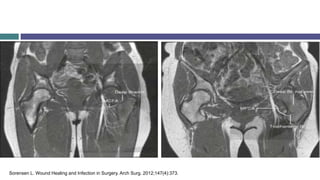
Sorensen L. Wound Healing and Infection in Surgery. Arch Surg. 2012;147(4):373.
Polismed.com. Index of /upfiles/other/artgen/134 [Internet]. 2015 [cited 22 March 2015]. Available from:
http://www.polismed.com/upfiles/other/artgen/134/
Design considerations of the hip
implant
 Cemented or cement-less hip prosthesis
 Unibody or modular femoral stems
 Material consideration
 Cemented or cementless acetabular component
 Single component acetabular cup or modular cup
 Bearing surfaces
Michelson J, Riley L. Considerations in the comparison of cemented and cementless total hip prostheses. The Journal of Arthroplasty. 1989;4(4):327-334.
Hip resurfacing
 Adolescence/minor necrosis
 Bone preservation
 Bone is sculpted to accept a cap/short stem
 Replacement acetabulum needed
 Increased amount of femoral neck fracture
 Heterotopic ossification
Laskin RS, Su EP, Padgett DE. Hip Resurfacing: an Overview [online]. Available from: http://www.hss.edu/conditions_hip-resurfacing-overview.asp#.VQ_lrfmzKG4 [Accessed
14/03/15]
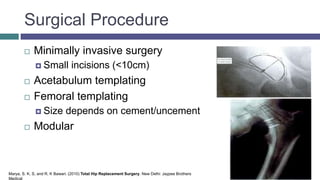
Surgical Procedure
 Minimally invasive surgery
 Small incisions (<10cm)
 Acetabulum templating
 Femoral templating
 Size depends on cement/uncement
 Modular
Marya, S. K. S, and R. K Bawari. (2010) Total Hip Replacement Surgery. New Delhi: Jaypee Brothers
Medical
Complications
 Wear & corrosion products
 Inflammation
 Infection
 Thrombosis
 Nerve damage
 Loosening
 Leg length discrepancy
Ochsner, P.E. (2003) Total Hip Replacement. Berlin: Springer
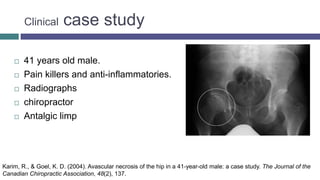
Clinical case study
 41 years old male.
 Pain killers and anti-inflammatories.
 Radiographs
 chiropractor
 Antalgic limp
Karim, R., & Goel, K. D. (2004). Avascular necrosis of the hip in a 41-year-old male: a case study. The Journal of the
Canadian Chiropractic Association, 48(2), 137.
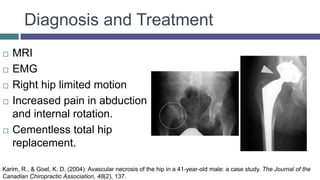
Diagnosis and Treatment
 MRI
 EMG
 Right hip limited motion
 Increased pain in abduction
and internal rotation.
 Cementless total hip
replacement.
Karim, R., & Goel, K. D. (2004). Avascular necrosis of the hip in a 41-year-old male: a case study. The Journal of the
Canadian Chiropractic Association, 48(2), 137.
Summary
 Retinacular arteries
 Increasing importance in adulthood
 Femoral neck fractures
 Hip implants
 Surgical considerations
 Complications

Retinacular arteries

  • 1.
    RETINACULAR ARTERIES Rahilla Khatoon, MozaAl-Khulaifa, Irsalan Asif and James Alexander
  • 2.
    Overview  Retinacular arteries Role of the retinacular arteries  Childhood Adult  Failure  Treatment  Surgery  Complications
  • 3.
    Vasculature of thefemur 1. Illio-femoral artery 2. Ligamentum teres 3. Obturator artery 4. Femoral artery 5. Profunda femoris- 4a. perforating arteries 6. Lateral circumflex femoral artery (LCFA) - 5a. Ascending, 5b. Transverse and 5c.Descending 7. From the ascending – ascending cervical arteries 8. Subsynovial 9. Medial circumflex artery Pixgood.com, (2015). Pix For > Medial Circumflex Femoral Artery. [online] Available from: http://pixgood.com/medial-circumflex-femoral-artery.html [Accessed 19 Mar. 2015].
  • 4.
    Retinacular arteries ALPF MedicalResearch, (2015). Vascular Supply To The Femoral Head. Femoral head. [online] Available from: http//http://www.alpfmedical.info/femoral-head/vascular-supply-to- the-femoral-head.html [Acessed 17 Mar 2015].
  • 5.
    The Role  Vascularisefemoral head.  Lateral retinacular artery –important  Anastomose at base  subsynovial interarticular ring.  Epiphyseal arteries supply head. Koval, K., & Zuckerman, J. (2000). Hip fractures: a practical guide to management. Springer Science & Business
  • 6.
    Change in rolefrom childhood to adulthood.  LFCA and artery of ligamentum teres  Posterosuperior lateral epiphyseal and posteroinferior retinacular branch -4 years  Metaphyseal vessels < 3 years old, after 14-17years  14-17 years  physis blocks metaphyseal.  anastomoses between metaphyseal-epiphyseal vessels. Woon, C. (2015). Proximal Femur Fractures - Pediatric - Pediatrics - Orthobullets.com. [online] Orthobullets.com. Available at: http://www.orthobullets.com/pediatrics/4018/proximal-femur-fractures--pediatric [Accessed 14 Mar. 2015].
  • 7.
    Change in rolefrom childhood to adulthood.  Arteries- intramedullary at neck.  Anastomose with obturator artery.  Epiphyseal cartilage prevents retinacular artery vascularising the head. Virtual Anatomy Lab: Study notes. (2015). 1st ed. [ebook] Ottawa, p.1. Available at: http://www.med.uottawa.ca/research/edemonstrator/w1/en/EN-study-notes-week-1.pdf [Accessed 19 Mar. 2015].
  • 8.
    Causes of failure In fractures of the neck of the femur, the fate of the head depends upon the residual vascularity.  Blood supply depends wholly on the retinacular and foveolar vessels.  Displacement of the fragments is greatest when the fracture line is vertical, and least when it is more horizontal. Ellis H, Mahadevan V. Clinical anatomy. Chichester, West Sussex, UK: Wiley-Blackwell; 2013. Snell R. Clinical anatomy by systems. Philadelphia: Lippincott Williams & Wilkins; 2007. Michelson J, Riley L. Considerations in the comparison of cemented and cementless total hip prostheses. The Journal of Arthroplasty. 1989;4(4):327-334.
  • 9.
    Causes of failure The nearer the fracture to the femoral head, the weaker the retinacular blood supply  Hip resurfacing can also disrupt the retinacular blood flow.  This is because as part of the procedure they sacrifice a branch of the medial circumflex femoral artery.  Depending on how much of the head has lost blood supply, will determine its salvation. Ellis H, Mahadevan V. Clinical anatomy. Chichester, West Sussex, UK: Wiley-Blackwell; 2013. Snell R. Clinical anatomy by systems. Philadelphia: Lippincott Williams & Wilkins; 2007. Michelson J, Riley L. Considerations in the comparison of cemented and cementless total hip prostheses. The Journal of Arthroplasty. 1989;4(4):327-334.
  • 10.
    Sorensen L. WoundHealing and Infection in Surgery. Arch Surg. 2012;147(4):373.
  • 11.
    Polismed.com. Index of/upfiles/other/artgen/134 [Internet]. 2015 [cited 22 March 2015]. Available from: http://www.polismed.com/upfiles/other/artgen/134/
  • 12.
    Design considerations ofthe hip implant  Cemented or cement-less hip prosthesis  Unibody or modular femoral stems  Material consideration  Cemented or cementless acetabular component  Single component acetabular cup or modular cup  Bearing surfaces Michelson J, Riley L. Considerations in the comparison of cemented and cementless total hip prostheses. The Journal of Arthroplasty. 1989;4(4):327-334.
  • 13.
    Hip resurfacing  Adolescence/minornecrosis  Bone preservation  Bone is sculpted to accept a cap/short stem  Replacement acetabulum needed  Increased amount of femoral neck fracture  Heterotopic ossification Laskin RS, Su EP, Padgett DE. Hip Resurfacing: an Overview [online]. Available from: http://www.hss.edu/conditions_hip-resurfacing-overview.asp#.VQ_lrfmzKG4 [Accessed 14/03/15]
  • 14.
    Surgical Procedure  Minimallyinvasive surgery  Small incisions (<10cm)  Acetabulum templating  Femoral templating  Size depends on cement/uncement  Modular Marya, S. K. S, and R. K Bawari. (2010) Total Hip Replacement Surgery. New Delhi: Jaypee Brothers Medical
  • 15.
    Complications  Wear &corrosion products  Inflammation  Infection  Thrombosis  Nerve damage  Loosening  Leg length discrepancy Ochsner, P.E. (2003) Total Hip Replacement. Berlin: Springer
  • 16.
    Clinical case study 41 years old male.  Pain killers and anti-inflammatories.  Radiographs  chiropractor  Antalgic limp Karim, R., & Goel, K. D. (2004). Avascular necrosis of the hip in a 41-year-old male: a case study. The Journal of the Canadian Chiropractic Association, 48(2), 137.
  • 17.
    Diagnosis and Treatment MRI  EMG  Right hip limited motion  Increased pain in abduction and internal rotation.  Cementless total hip replacement. Karim, R., & Goel, K. D. (2004). Avascular necrosis of the hip in a 41-year-old male: a case study. The Journal of the Canadian Chiropractic Association, 48(2), 137.
  • 18.
    Summary  Retinacular arteries Increasing importance in adulthood  Femoral neck fractures  Hip implants  Surgical considerations  Complications

Editor's Notes

  • #6 LRA :largest provider to the blood supply of the femoral head
  • #7 Posterosuperior lateral epiphyseal becomes main blood supply after 4 years. After regression of LFCA and artery of ligamentum teres Lateral femoral circumflex artery regresses in late childhood. Artery of the ligamentum teres diminishes after 4 years old. Metaphyseal vessels also contribute to blood supply to the head < 3 years old and after 14-17years between 3 to 14-17 years, the physis blocks metaphyseal supply after 14-17 years, anastomoses between metaphyseal-epiphyseal vessels develop
  • #9 In fractures of the neck of the femur, the fate of the head depends upon the residual vascularity, which is decided at the moment of maximal displacement of the bone. It is obvious that all intra-osseous vessels in the neck are disrupted and that blood supply depends wholly on the retinacular and foveolar vessels. Displacement of the fragments is greatest when the fracture line is vertical, and least when it is more horizontalon of the fragments. The fracture-shaft angle may be accepted as an index of the degree of displacement, and probably therefore as a guide to the likelihood of damage to the retinacular arteries. The statistics of Eyre-Brook and Pridie (1941) suggest that when the fracture-shaft angle is greater than 40 degrees, displacement of the fragments is insufficient to cause disruption of the retinacular vessels. It is difficult to estimate the frequency with which the adult femoral head can be nourished fully by the foveolar artery. 1. Ellis H, Mahadevan V. Clinical anatomy. Chichester, West Sussex, UK: Wiley-Blackwell; 2013. 2. Snell R. Clinical anatomy by systems. Philadelphia: Lippincott Williams & Wilkins; 2007. 3. Michelson J, Riley L. Considerations in the comparison of cemented and cementless total hip prostheses. The Journal of Arthroplasty. 1989;4(4):327-334.
  • #10 Fractures of the femoral neck will interrupt completely the blood supply from the diaphysis and, should the retinacula also be torn, avascular necrosis of the head will be inevitable. The nearer the fracture to the femoral head, the more tenuous the retinacular blood supply and the more likely it is to be disrupted. Hip resurfacing can also disrupt the retinacular blood flow. This is because as part of the procedure they sacrifice the medial circumflex femoral artery which branches two of the three groups of the retinacular arteries: posterior inferior - posterior superior. This can lead to a loss of blood supply and avascular necrosis. This only occurs if the intraosseous blood supply is weak.
  • #11 4. Sorensen L. Wound Healing and Infection in Surgery. Arch Surg. 2012;147(4):373.
  • #12 5. Polismed.com. Index of /upfiles/other/artgen/134 [Internet]. 2015 [cited 22 March 2015]. Available from: http://www.polismed.com/upfiles/other/artgen/134/
  • #13 3. Michelson J, Riley L. Considerations in the comparison of cemented and cementless total hip prostheses. The Journal of Arthroplasty. 1989;4(4):327-334.
  • #14 Laskin RS, Su EP, Padgett DE. Hip Resurfacing: an Overview [online]. Available from: http://www.hss.edu/conditions_hip-resurfacing-overview.asp#.VQ_lrfmzKG4 [Accessed 14/03/15]
  • #15 Marya, S. K. S, and R. K Bawari. (2010) Total Hip Replacement Surgery. New Delhi: Jaypee Brothers Medical
  • #16 Ochner PE. surgical procedure total hip replacement. Ochsner, P.E. Total Hip Replacement. Berlin: Springer, 2003