• Cloud computing basics
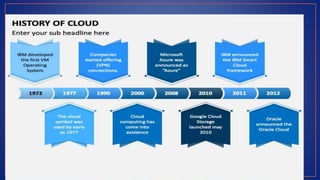
• History of cloud computing
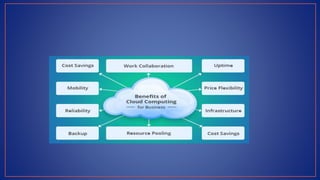
• Importance of cloud computing in the current era
• Characteristics of cloud computing
• What cloud computing really is
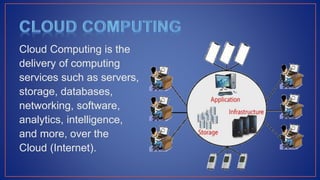
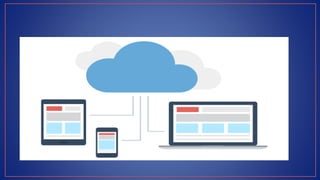
Cloud Computing is the
delivery of computing
services such as servers,
storage, databases,
networking, software,
analytics, intelligence,
and more, over the
Cloud (Internet).
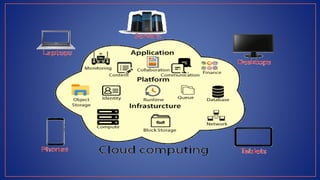
• Cloud computing is a model for enabling convenient, on-
demand network access to a shared pool of configurable
computing resources (e.g., networks, servers, storage,
applications, and services) [Mell_2009], [Berkely_2009].
• It can be rapidly provisioned and released with minimal
management effort.
• It provides high level abstraction of computation and
storage model.
• It has some essential characteristics, service models,
and deployment models.
• Cloud Computing provides an alternative to the on-premises
datacentre.
• With an on-premises datacentre, we have to manage
everything, such as purchasing and installing hardware,
virtualization, installing the operating system, and any other
required applications, setting up the network, configuring the
firewall, and setting up storage for data.
• After doing all the set-up, we become responsible for
maintaining it through its entire lifecycle.
• But if we choose Cloud Computing, a cloud vendor is
responsible for the hardware purchase and maintenance.
• They also provide a wide variety of software and platform as
a service. We can take any required services on rent.
• The cloud computing services will be charged based on
usage.
•
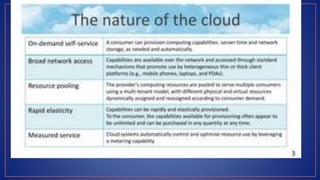
• There are basically 5 essential characteristics of Cloud
Computing.
• On-demand self-services:
The Cloud computing services does not require any
human administrators, user themselves are able to
provision, monitor and manage computing resources as
needed.
• Broad network access:
The Computing services are generally provided over
standard networks and heterogeneous devices.
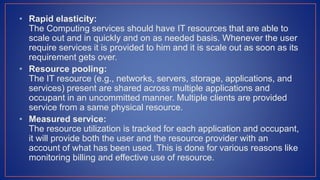
• Rapid elasticity:
The Computing services should have IT resources that are able to
scale out and in quickly and on as needed basis. Whenever the user
require services it is provided to him and it is scale out as soon as its
requirement gets over.
• Resource pooling:
The IT resource (e.g., networks, servers, storage, applications, and
services) present are shared across multiple applications and
occupant in an uncommitted manner. Multiple clients are provided
service from a same physical resource.
• Measured service:
The resource utilization is tracked for each application and occupant,
it will provide both the user and the resource provider with an
account of what has been used. This is done for various reasons like
monitoring billing and effective use of resource.
• Biggest benefit is storage
• Not a data centre
• Not a client server computing
• Not a grid computing
• Not a centralized system
• Pros and cons of Cloud computing
• Nature of the cloud
• Technologies in cloud computing
• Migrating into the cloud
• Seven step model
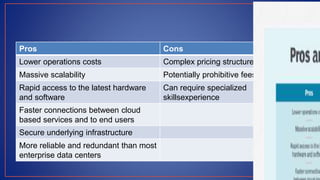
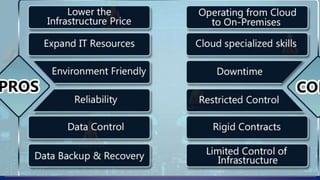
Pros Cons
Lower operations costs Complex pricing structures
Massive scalability Potentially prohibitive fees
Rapid access to the latest hardware
and software
Can require specialized
skillsexperience
Faster connections between cloud
based services and to end users
Secure underlying infrastructure
More reliable and redundant than most
enterprise data centers
• What Is Cloud Migration?
• Cloud migration transfers digital business processes
and workflows to cloud platforms. This process
entails moving information, applications, processes,
and other digitized business components from an on-
premise or existing cloud database to a cloud-based
data center.
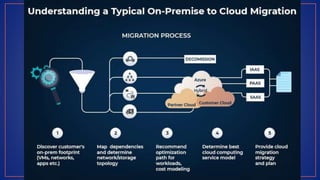
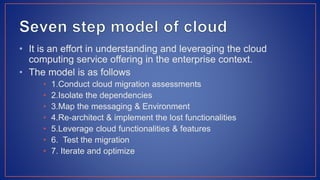
• It is an effort in understanding and leveraging the cloud
computing service offering in the enterprise context.
• The model is as follows
• 1.Conduct cloud migration assessments
• 2.Isolate the dependencies
• 3.Map the messaging & Environment
• 4.Re-architect & implement the lost functionalities
• 5.Leverage cloud functionalities & features
• 6. Test the migration
• 7. Iterate and optimize

Cloud Computing Basics.pptx

  • 2.
    • Cloud computingbasics • History of cloud computing • Importance of cloud computing in the current era • Characteristics of cloud computing • What cloud computing really is
  • 3.
    Cloud Computing isthe delivery of computing services such as servers, storage, databases, networking, software, analytics, intelligence, and more, over the Cloud (Internet).
  • 5.
    • Cloud computingis a model for enabling convenient, on- demand network access to a shared pool of configurable computing resources (e.g., networks, servers, storage, applications, and services) [Mell_2009], [Berkely_2009]. • It can be rapidly provisioned and released with minimal management effort. • It provides high level abstraction of computation and storage model. • It has some essential characteristics, service models, and deployment models.
  • 7.
    • Cloud Computingprovides an alternative to the on-premises datacentre. • With an on-premises datacentre, we have to manage everything, such as purchasing and installing hardware, virtualization, installing the operating system, and any other required applications, setting up the network, configuring the firewall, and setting up storage for data. • After doing all the set-up, we become responsible for maintaining it through its entire lifecycle. • But if we choose Cloud Computing, a cloud vendor is responsible for the hardware purchase and maintenance. • They also provide a wide variety of software and platform as a service. We can take any required services on rent. • The cloud computing services will be charged based on usage. •
  • 14.
    • There arebasically 5 essential characteristics of Cloud Computing. • On-demand self-services: The Cloud computing services does not require any human administrators, user themselves are able to provision, monitor and manage computing resources as needed. • Broad network access: The Computing services are generally provided over standard networks and heterogeneous devices.
  • 15.
    • Rapid elasticity: TheComputing services should have IT resources that are able to scale out and in quickly and on as needed basis. Whenever the user require services it is provided to him and it is scale out as soon as its requirement gets over. • Resource pooling: The IT resource (e.g., networks, servers, storage, applications, and services) present are shared across multiple applications and occupant in an uncommitted manner. Multiple clients are provided service from a same physical resource. • Measured service: The resource utilization is tracked for each application and occupant, it will provide both the user and the resource provider with an account of what has been used. This is done for various reasons like monitoring billing and effective use of resource.
  • 16.
  • 17.
    • Not adata centre • Not a client server computing • Not a grid computing • Not a centralized system
  • 18.
    • Pros andcons of Cloud computing • Nature of the cloud • Technologies in cloud computing • Migrating into the cloud • Seven step model
  • 20.
    Pros Cons Lower operationscosts Complex pricing structures Massive scalability Potentially prohibitive fees Rapid access to the latest hardware and software Can require specialized skillsexperience Faster connections between cloud based services and to end users Secure underlying infrastructure More reliable and redundant than most enterprise data centers
  • 24.
    • What IsCloud Migration? • Cloud migration transfers digital business processes and workflows to cloud platforms. This process entails moving information, applications, processes, and other digitized business components from an on- premise or existing cloud database to a cloud-based data center.
  • 27.
    • It isan effort in understanding and leveraging the cloud computing service offering in the enterprise context. • The model is as follows • 1.Conduct cloud migration assessments • 2.Isolate the dependencies • 3.Map the messaging & Environment • 4.Re-architect & implement the lost functionalities • 5.Leverage cloud functionalities & features • 6. Test the migration • 7. Iterate and optimize