20CS5102 ARTIFICIAL INTELLIGENCE
OBJECTIVES
To acquire knowledge on intelligent systems and agents.
COURSE OUTCOMES
1. Use appropriate search algorithms for any AI problem
2. Represent a problem using first order and predicate logic
3. Provide the apt agent strategy to solve a given problem
4. Design software agents to solve a problem
5. Design applications for NLP that use Artificial Intelligence.
UNIT 1 – INTRODUCTION
Introduction–Definition - Future of Artificial Intelligence – Characteristics of Intelligent
Agents– Typical Intelligent Agents – Problem Solving Approach to Typical AI problems
Total Periods :9
Artificial Intelligence is a method of making a computer, a computer-controlled
robot, or a software think intelligently like the human mind. AI is accomplished by
studying the patterns of the human brain and by analyzing the cognitive process. The
outcome of these studies develops intelligent software and systems.
Artificial intelligence is a constellation of many different technologies working
together to enable machines to sense, comprehend, act, and learn with human-like levels of
intelligence. Maybe that's why it seems as though everyone's definition of artificial
intelligence is different: AI isn't just one thing.
INTRODUCTION
Artificial Intelligence is not just a part of computer science even it's so vast and
requires lots of other factors which can contribute to it. To create the AI first we should
know that how intelligence is composed, so the Intelligence is an intangible part of our
brain which is a combination of Reasoning, learning, problem-solving perception,
language understanding, etc.
The Evolution of AI
AI’s influence on technology is due in part because of how it impacts
computing. Through AI, computers have the ability to harness massive amounts of data
and use their learned intelligence to make optimal decisions and discoveries in fractions of
the time that it would take humans.
There’s virtually no major industry that modern AI — more specifically,
“narrow AI,” which performs objective functions using data-trained models and often falls
into the categories of deep learning or machine learning
FUTURE OF AI
AI IN TRANSPORTATION
Transportation is one industry that is certainly teed up to be drastically changed
by AI. Self-driving cars and AI travel planners are just a couple of facets of how we get
from point A to point B that will be influenced by AI. Even though autonomous vehicles
are far from perfect, they will one day ferry us from place to place.
AI IN MANUFACTURING
Manufacturing has been benefiting from AI for years. With AI-enabled robotic
arms and other manufacturing bots dating back to the 1960s and 1970s, the industry has
adapted well to the powers of AI. These industrial robots typically work alongside humans
to perform a limited range of tasks like assembly and stacking, and predictive analysis
sensors keep equipment running smoothly.
AI IN HEALTHCARE
It may seem unlikely, but AI healthcare is already changing the way humans interact
with medical providers. Thanks to its big data analysis capabilities, AI helps identify diseases
more quickly and accurately, speed up and streamline drug discovery and even monitor patients
through virtual nursing assistants.
AI IN EDUCATION
AI in education will change the way humans of all ages learn. AI’s use of machine
learning, natural language processing and facial recognition help digitize textbooks, detect
plagiarism and gauge the emotions of students to help determine who’s struggling or bored.
Both presently and in the future, AI tailors the experience of learning to student’s individual
needs.
AI IN MEDIA
Journalism is harnessing AI too, and will continue to benefit from it. One
example can be seen in The Associated Press’ use of Automated Insights, which produces
thousands of earning reports stories per year. But as generative AI writing tools, such as
ChatGPT, enter the market, questions about their use in journalism abound.
AI IN CUSTOMER SERVICE
Most people dread getting a robo-call, but AI in customer service can provide
the industry with data-driven tools that bring meaningful insights to both the customer and
the provider. AI tools powering the customer service industry come in the form of chatbots
and virtual assistants.
Intelligent Systems:
To design intelligent systems, it is important to categorize them into four
categories (Luger and
Stubberfield 1993), (Russell and Norvig, 2003)
1. Systems that think like humans
2. Systems that think rationally
3. Systems that behave like humans
4. Systems that behave rationally
Cognitive Science: Think Human-Like
a. Requires a model for human cognition. Precise enough models allow simulation by
computers.
b. Focus is not just on behavior and I/O, but looks like reasoning process.
c. Goal is not just to produce human-like behavior but to produce a sequence of steps of
the
reasoning process, similar to the steps followed by a human in solving the same task.
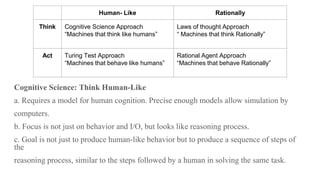
Human- Like Rationally
Think Cognitive Science Approach
“Machines that think like humans”
Laws of thought Approach
“ Machines that think Rationally”
Act Turing Test Approach
“Machines that behave like humans”
Rational Agent Approach
“Machines that behave Rationally”
Laws of thought: Think Rationally
a. The study of mental faculties through the use of computational models; that it is, the
study of
computations that make it possible to perceive reason and act.
b. Focus is on inference mechanisms that are probably correct and guarantee an optimal
solution.
c. Goal is to formalize the reasoning process as a system of logical rules and procedures of
inference.
d. Develop systems of representation to allow inferences to be like
“Socrates is a man. All men are mortal. Therefore Socrates is mortal”
Turing Test: Act Human-Like
a. The art of creating machines that perform functions requiring intelligence when
performed by people; that it is the study of, how to make computers do things which, at
the moment, people do better.
b. Focus is on action, and not intelligent behavior centered around the representation of
the world Example: Turing Test
1. 3 rooms contain: a person, a computer and an interrogator.
2. The interrogator can communicate with the other 2 by teletype (to avoid the
machine imitate the appearance of voice of the person)
3. The interrogator tries to determine which the person is and which the machine is.
4. The machine tries to fool the interrogator to believe that it is the human, and
the person also tries to convince the interrogator that it is the human.
5. If the machine succeeds in fooling the interrogator, then conclude that the
machine is intelligent.
Rational agent: Act Rationally
a. Tries to explain and emulate intelligent behavior in terms of computational process; that
it is
concerned with the automation of the intelligence.
b. Focus is on systems that act sufficiently if not optimally in all situations.
c. Goal is to develop systems that are rational and sufficient
INTELLIGENT AGENTS
An agent can be anything that perceiveits environment through sensors and act upon that
environment through actuators. An Agent runs in the cycle of perceiving, thinking, and
acting. An agent can be:
○ Human-Agent: A human agent has eyes, ears, and other organs which work for
sensors and hand, legs, vocal tract work for actuators.
○ Robotic Agent: A robotic agent can have cameras, infrared range finder, NLP for
sensors and various motors for actuators.
○ Software Agent: Software agent can have keystrokes, file contents as sensory input
and act on those inputs and display output on the screen.
Intelligent Agents:
○ Rule 1: An AI agent must have the ability to perceive the environment.
○ Rule 2: The observation must be used to make decisions.
○ Rule 3: Decision should result in an action.
○ Rule 4: The action taken by an AI agent must be a rational action.
CHARACTERISTICS OF INTELLIGENT AGENTS
● Autonomy is the most important property of an IA and is defined as the ability of an
agent to make decisions and control its actions and internal states without direct
intervention from other entities (human or machine). In other words, an IA is
independent and makes its own decisions.
● Reactivity refers to the ability of an agent to perceive and react to environmental
changes in order to achieve the goal(s).
● Proactivity is the ability of an agent to plan and perform the required actions to
achieve its goal(s).
● Social Ability enables agents to communicate and interact with each other and other
entities in the environment. This interaction can be in the form of coordination,
cooperation, negotiation, and even competition.
● Mobility is the agent’s ability to move from its origin to other machines across a network
and perform design objectives locally on remote hosts. Mobile agents can increase the
processing speeds of the system as a whole and reduce network traffic and communication
costs.
● Rationality is the ability of an agent to make decisions that are dynamically based on the
state of the environment. A detailed analysis of what rationality means can be found in.
This analysis forms the basis of the Beliefs, Desires, and Intentions (BDI) model for
software agents.
● Learning is the ability of an agent to learn from interactions and changes in the
environment through experience in order to improve its performance over time. With a
learning ability, an agent is able to add and improve its features dynamically.
● Cooperation is establishing a voluntary relationship with another agent to adopt its
goal. Cooperation with an agent enables the two agents to establish a voluntary
relationship with each other to adopt mutual goals and form a combined team.
● Coordination is the ability to manage the interdependencies between humans or
other agents and form a team with them. Depending on the application and purpose of
where and how agents are used, these properties can be desirable or undesirable.
Types of AI Agents
Agents can be grouped into five classes based on their degree of perceived intelligence and
capability. All these agents can improve their performance and generate better action over
the time.
○ Simple Reflex Agent
○ Model-based reflex agent
○ Goal-based agents
○ Utility-based agent
○ Learning agent
○ Multi-agent systems
○ Hierarchical agents
Simple Reflex agent:
○ The Simple reflex agents are the simplest agents. These agents take decisions on the basis of the current percepts and
ignore the rest of the percept history.
○ The Simple reflex agent does not consider any part of percepts history during their decision and action process.
○ They have very limited intelligence
○ They do not have knowledge of non-perceptual parts of the current state
Model-based reflex agent
The Model-based agent can work in a partially observable environment, and track the
situation.
●Model: It is knowledge about "how things happen in the world," so it is called a Model-
based agent.
●Internal State: It is a representation of the current state based on percept history.
Goal-based agents
○ The knowledge of the current state environment is not always sufficient to decide for an agent to what to do.
○ The agent needs to know its goal which describes desirable situations.
○ Goal-based agents expand the capabilities of the model-based agent by having the "goal" information.
○ Possible actions before deciding whether the goal is achieved or not. Such considerations of different scenario
are called searching and planning, which makes an agent proactive.
Utility-based agents
○ These agents are similar to the goal-based agent but provide an extra component of utility measurement which
makes them different by providing a measure of success at a given state.
○ Utility-based agent act based not only goals but also the best way to achieve the goal.
Learning Agents
○ A learning agent in AI is the type of agent which can learn from its past experiences, or it has learning
capabilities.
○ It starts to act with basic knowledge and then able to act and adapt automatically through learning.
○ A learning agent has mainly four conceptual components, which are:
a. Learning element: It is responsible for making improvements by learning from environment
b. Critic: Learning element takes feedback from critic which describes that how well the agent is
doing with respect to a fixed performance standard.
c. Performance element: It is responsible for selecting external action
d. Problem generator: This component is responsible for suggesting actions that will lead to new
and informative experiences.
Multi-agent systems
● A multi-agent system consists of multiple decision-making agents which
interact in a shared environment to achieve common or conflicting goals.
● Types of Multi agent Systems
Hierarchical agents
● Agent hierarchies are a way for you to organize agents into teams and groups
for reporting purposes. It's useful to organize them based on their location
and their skill sets.
PROBLEM SOLVING APPROACH TO AI PROBLEMS
It should first sense the problem, and this information that the agent gets through the
sensing should be converted into machine-understandable form. For this, a particular
sequence should be followed by the agent in which a particular format for the
representation of agent's knowledge is defined and each time a problem arises, the agent
can follow that particular approach to find a solution to it.
1. Ignorable: In which solution steps can be ignored.
2. Recoverable: In which solution steps can be undone.
3. Irrecoverable: Solution steps cannot be undo.
Steps problem-solving in AI: The problem of AI is directly associated with the nature of
humans and their activities. So we need a number of finite steps to solve a problem which
makes human easy works.
● Problem definition: Detailed specification of inputs and acceptable system
solutions.
● Problem analysis: Analyse the problem thoroughly.
● Knowledge Representation: collect detailed information about the problem and
define all possible techniques.
● Problem-solving: Selection of best techniques.
Components to Formulate the Associated Problem
1. Initial State
2. Action
3. Transition
4. Goal Test
5. Path Costing
● Initial State: This state requires an initial state for the problem which starts the AI agent towards
a specified goal. In this state new methods also initialize problem domain solving by a specific
class.
● Action: This stage of problem formulation works with function with a specific class taken from
the initial state and all possible actions done in this stage.
● Transition: This stage of problem formulation integrates the actual action done by the previous
action stage and collects the final stage to forward it to their next stage.
● Goal test: This stage determines that the specified goal achieved by the integrated transition
model or not, whenever the goal achieves stop the action and forward into the next stage to
determines the cost to achieve the goal.
● Path costing: This component of problem-solving numerical assigned what will be the cost to
achieve the goal. It requires all hardware software and human working cost.
Cases involving Artificial Intelligence Issues
○ Chess
○ N-Queen problem
○ Tower of Hanoi Problem
○ Travelling Salesman Problem
○ Water-Jug Problem
Approaches for Resolving Problems
The effective approaches of artificial intelligence make it useful for resolving
complicated issues. All fundamental problem-solving methods used throughout AI were
listed below. In accordance with the criteria set, may learn information regarding different
problem-solving methods.
Heuristics
The heuristic approach focuses solely upon experimentation as well as test procedures
to comprehend a problem and create a solution. These heuristics don't always offer better
ideal answer to something like a particular issue, though. Such, however, unquestionably
provide effective means of achieving short-term objectives. Consequently, if conventional
techniques are unable to solve the issue effectively, developers turn to them. Heuristics are
employed in conjunction with optimization algorithms to increase the efficiency because
they merely offer moment alternatives while compromising precision.
Searching Algorithms
Several of the fundamental ways that AI solves every challenge is through searching.
These searching algorithms are used by rational agents or problem-solving agents for
select the most appropriate answers. Intelligent entities use molecular representations and
seem to be frequently main objective when finding solutions. Depending upon that calibre
of the solutions they produce, most searching algorithms also have attributes of
completeness, optimality, time complexity, and high computational.
Genetic Algorithms
Genetic algorithms have been proposed upon that evolutionary theory. These
programs employ a technique called direct random search. In order to combine the two
healthiest possibilities and produce a desirable offspring, the developers calculate the fit
factor. Overall health of each individual is determined by first gathering demographic
information and afterwards assessing each individual. According on how well each
member matches that intended need, a calculation is made. Next, its creators employ a
variety of methodologies to retain their finest participants.
1. Rank Selection
2. Tournament Selection
3. Steady Selection
4. Roulette Wheel Selection (Fitness Proportionate Selection)
5. Elitism
THANK YOU !

UNIT I - AI.pptx

  • 1.
  • 2.
    OBJECTIVES To acquire knowledgeon intelligent systems and agents. COURSE OUTCOMES 1. Use appropriate search algorithms for any AI problem 2. Represent a problem using first order and predicate logic 3. Provide the apt agent strategy to solve a given problem 4. Design software agents to solve a problem 5. Design applications for NLP that use Artificial Intelligence.
  • 3.
    UNIT 1 –INTRODUCTION Introduction–Definition - Future of Artificial Intelligence – Characteristics of Intelligent Agents– Typical Intelligent Agents – Problem Solving Approach to Typical AI problems Total Periods :9
  • 4.
    Artificial Intelligence isa method of making a computer, a computer-controlled robot, or a software think intelligently like the human mind. AI is accomplished by studying the patterns of the human brain and by analyzing the cognitive process. The outcome of these studies develops intelligent software and systems. Artificial intelligence is a constellation of many different technologies working together to enable machines to sense, comprehend, act, and learn with human-like levels of intelligence. Maybe that's why it seems as though everyone's definition of artificial intelligence is different: AI isn't just one thing.
  • 5.
    INTRODUCTION Artificial Intelligence isnot just a part of computer science even it's so vast and requires lots of other factors which can contribute to it. To create the AI first we should know that how intelligence is composed, so the Intelligence is an intangible part of our brain which is a combination of Reasoning, learning, problem-solving perception, language understanding, etc.
  • 6.
    The Evolution ofAI AI’s influence on technology is due in part because of how it impacts computing. Through AI, computers have the ability to harness massive amounts of data and use their learned intelligence to make optimal decisions and discoveries in fractions of the time that it would take humans. There’s virtually no major industry that modern AI — more specifically, “narrow AI,” which performs objective functions using data-trained models and often falls into the categories of deep learning or machine learning
  • 7.
    FUTURE OF AI AIIN TRANSPORTATION Transportation is one industry that is certainly teed up to be drastically changed by AI. Self-driving cars and AI travel planners are just a couple of facets of how we get from point A to point B that will be influenced by AI. Even though autonomous vehicles are far from perfect, they will one day ferry us from place to place. AI IN MANUFACTURING Manufacturing has been benefiting from AI for years. With AI-enabled robotic arms and other manufacturing bots dating back to the 1960s and 1970s, the industry has adapted well to the powers of AI. These industrial robots typically work alongside humans to perform a limited range of tasks like assembly and stacking, and predictive analysis sensors keep equipment running smoothly.
  • 8.
    AI IN HEALTHCARE Itmay seem unlikely, but AI healthcare is already changing the way humans interact with medical providers. Thanks to its big data analysis capabilities, AI helps identify diseases more quickly and accurately, speed up and streamline drug discovery and even monitor patients through virtual nursing assistants. AI IN EDUCATION AI in education will change the way humans of all ages learn. AI’s use of machine learning, natural language processing and facial recognition help digitize textbooks, detect plagiarism and gauge the emotions of students to help determine who’s struggling or bored. Both presently and in the future, AI tailors the experience of learning to student’s individual needs.
  • 9.
    AI IN MEDIA Journalismis harnessing AI too, and will continue to benefit from it. One example can be seen in The Associated Press’ use of Automated Insights, which produces thousands of earning reports stories per year. But as generative AI writing tools, such as ChatGPT, enter the market, questions about their use in journalism abound. AI IN CUSTOMER SERVICE Most people dread getting a robo-call, but AI in customer service can provide the industry with data-driven tools that bring meaningful insights to both the customer and the provider. AI tools powering the customer service industry come in the form of chatbots and virtual assistants.
  • 10.
    Intelligent Systems: To designintelligent systems, it is important to categorize them into four categories (Luger and Stubberfield 1993), (Russell and Norvig, 2003) 1. Systems that think like humans 2. Systems that think rationally 3. Systems that behave like humans 4. Systems that behave rationally
  • 11.
    Cognitive Science: ThinkHuman-Like a. Requires a model for human cognition. Precise enough models allow simulation by computers. b. Focus is not just on behavior and I/O, but looks like reasoning process. c. Goal is not just to produce human-like behavior but to produce a sequence of steps of the reasoning process, similar to the steps followed by a human in solving the same task. Human- Like Rationally Think Cognitive Science Approach “Machines that think like humans” Laws of thought Approach “ Machines that think Rationally” Act Turing Test Approach “Machines that behave like humans” Rational Agent Approach “Machines that behave Rationally”
  • 12.
    Laws of thought:Think Rationally a. The study of mental faculties through the use of computational models; that it is, the study of computations that make it possible to perceive reason and act. b. Focus is on inference mechanisms that are probably correct and guarantee an optimal solution. c. Goal is to formalize the reasoning process as a system of logical rules and procedures of inference. d. Develop systems of representation to allow inferences to be like “Socrates is a man. All men are mortal. Therefore Socrates is mortal”
  • 13.
    Turing Test: ActHuman-Like a. The art of creating machines that perform functions requiring intelligence when performed by people; that it is the study of, how to make computers do things which, at the moment, people do better. b. Focus is on action, and not intelligent behavior centered around the representation of the world Example: Turing Test 1. 3 rooms contain: a person, a computer and an interrogator. 2. The interrogator can communicate with the other 2 by teletype (to avoid the machine imitate the appearance of voice of the person) 3. The interrogator tries to determine which the person is and which the machine is. 4. The machine tries to fool the interrogator to believe that it is the human, and the person also tries to convince the interrogator that it is the human. 5. If the machine succeeds in fooling the interrogator, then conclude that the machine is intelligent.
  • 14.
    Rational agent: ActRationally a. Tries to explain and emulate intelligent behavior in terms of computational process; that it is concerned with the automation of the intelligence. b. Focus is on systems that act sufficiently if not optimally in all situations. c. Goal is to develop systems that are rational and sufficient
  • 15.
    INTELLIGENT AGENTS An agentcan be anything that perceiveits environment through sensors and act upon that environment through actuators. An Agent runs in the cycle of perceiving, thinking, and acting. An agent can be: ○ Human-Agent: A human agent has eyes, ears, and other organs which work for sensors and hand, legs, vocal tract work for actuators. ○ Robotic Agent: A robotic agent can have cameras, infrared range finder, NLP for sensors and various motors for actuators. ○ Software Agent: Software agent can have keystrokes, file contents as sensory input and act on those inputs and display output on the screen.
  • 16.
    Intelligent Agents: ○ Rule1: An AI agent must have the ability to perceive the environment. ○ Rule 2: The observation must be used to make decisions. ○ Rule 3: Decision should result in an action. ○ Rule 4: The action taken by an AI agent must be a rational action.
  • 17.
    CHARACTERISTICS OF INTELLIGENTAGENTS ● Autonomy is the most important property of an IA and is defined as the ability of an agent to make decisions and control its actions and internal states without direct intervention from other entities (human or machine). In other words, an IA is independent and makes its own decisions. ● Reactivity refers to the ability of an agent to perceive and react to environmental changes in order to achieve the goal(s). ● Proactivity is the ability of an agent to plan and perform the required actions to achieve its goal(s). ● Social Ability enables agents to communicate and interact with each other and other entities in the environment. This interaction can be in the form of coordination, cooperation, negotiation, and even competition.
  • 18.
    ● Mobility isthe agent’s ability to move from its origin to other machines across a network and perform design objectives locally on remote hosts. Mobile agents can increase the processing speeds of the system as a whole and reduce network traffic and communication costs. ● Rationality is the ability of an agent to make decisions that are dynamically based on the state of the environment. A detailed analysis of what rationality means can be found in. This analysis forms the basis of the Beliefs, Desires, and Intentions (BDI) model for software agents. ● Learning is the ability of an agent to learn from interactions and changes in the environment through experience in order to improve its performance over time. With a learning ability, an agent is able to add and improve its features dynamically.
  • 19.
    ● Cooperation isestablishing a voluntary relationship with another agent to adopt its goal. Cooperation with an agent enables the two agents to establish a voluntary relationship with each other to adopt mutual goals and form a combined team. ● Coordination is the ability to manage the interdependencies between humans or other agents and form a team with them. Depending on the application and purpose of where and how agents are used, these properties can be desirable or undesirable.
  • 20.
    Types of AIAgents Agents can be grouped into five classes based on their degree of perceived intelligence and capability. All these agents can improve their performance and generate better action over the time. ○ Simple Reflex Agent ○ Model-based reflex agent ○ Goal-based agents ○ Utility-based agent ○ Learning agent ○ Multi-agent systems ○ Hierarchical agents
  • 21.
    Simple Reflex agent: ○The Simple reflex agents are the simplest agents. These agents take decisions on the basis of the current percepts and ignore the rest of the percept history. ○ The Simple reflex agent does not consider any part of percepts history during their decision and action process. ○ They have very limited intelligence ○ They do not have knowledge of non-perceptual parts of the current state
  • 22.
    Model-based reflex agent TheModel-based agent can work in a partially observable environment, and track the situation. ●Model: It is knowledge about "how things happen in the world," so it is called a Model- based agent. ●Internal State: It is a representation of the current state based on percept history.
  • 23.
    Goal-based agents ○ Theknowledge of the current state environment is not always sufficient to decide for an agent to what to do. ○ The agent needs to know its goal which describes desirable situations. ○ Goal-based agents expand the capabilities of the model-based agent by having the "goal" information. ○ Possible actions before deciding whether the goal is achieved or not. Such considerations of different scenario are called searching and planning, which makes an agent proactive.
  • 24.
    Utility-based agents ○ Theseagents are similar to the goal-based agent but provide an extra component of utility measurement which makes them different by providing a measure of success at a given state. ○ Utility-based agent act based not only goals but also the best way to achieve the goal.
  • 25.
    Learning Agents ○ Alearning agent in AI is the type of agent which can learn from its past experiences, or it has learning capabilities. ○ It starts to act with basic knowledge and then able to act and adapt automatically through learning. ○ A learning agent has mainly four conceptual components, which are: a. Learning element: It is responsible for making improvements by learning from environment b. Critic: Learning element takes feedback from critic which describes that how well the agent is doing with respect to a fixed performance standard. c. Performance element: It is responsible for selecting external action d. Problem generator: This component is responsible for suggesting actions that will lead to new and informative experiences.
  • 27.
    Multi-agent systems ● Amulti-agent system consists of multiple decision-making agents which interact in a shared environment to achieve common or conflicting goals.
  • 28.
    ● Types ofMulti agent Systems
  • 29.
    Hierarchical agents ● Agenthierarchies are a way for you to organize agents into teams and groups for reporting purposes. It's useful to organize them based on their location and their skill sets.
  • 30.
    PROBLEM SOLVING APPROACHTO AI PROBLEMS It should first sense the problem, and this information that the agent gets through the sensing should be converted into machine-understandable form. For this, a particular sequence should be followed by the agent in which a particular format for the representation of agent's knowledge is defined and each time a problem arises, the agent can follow that particular approach to find a solution to it. 1. Ignorable: In which solution steps can be ignored. 2. Recoverable: In which solution steps can be undone. 3. Irrecoverable: Solution steps cannot be undo. Steps problem-solving in AI: The problem of AI is directly associated with the nature of humans and their activities. So we need a number of finite steps to solve a problem which makes human easy works.
  • 31.
    ● Problem definition:Detailed specification of inputs and acceptable system solutions. ● Problem analysis: Analyse the problem thoroughly. ● Knowledge Representation: collect detailed information about the problem and define all possible techniques. ● Problem-solving: Selection of best techniques. Components to Formulate the Associated Problem 1. Initial State 2. Action 3. Transition 4. Goal Test 5. Path Costing
  • 32.
    ● Initial State:This state requires an initial state for the problem which starts the AI agent towards a specified goal. In this state new methods also initialize problem domain solving by a specific class. ● Action: This stage of problem formulation works with function with a specific class taken from the initial state and all possible actions done in this stage. ● Transition: This stage of problem formulation integrates the actual action done by the previous action stage and collects the final stage to forward it to their next stage. ● Goal test: This stage determines that the specified goal achieved by the integrated transition model or not, whenever the goal achieves stop the action and forward into the next stage to determines the cost to achieve the goal. ● Path costing: This component of problem-solving numerical assigned what will be the cost to achieve the goal. It requires all hardware software and human working cost.
  • 33.
    Cases involving ArtificialIntelligence Issues ○ Chess ○ N-Queen problem ○ Tower of Hanoi Problem ○ Travelling Salesman Problem ○ Water-Jug Problem
  • 34.
    Approaches for ResolvingProblems The effective approaches of artificial intelligence make it useful for resolving complicated issues. All fundamental problem-solving methods used throughout AI were listed below. In accordance with the criteria set, may learn information regarding different problem-solving methods. Heuristics The heuristic approach focuses solely upon experimentation as well as test procedures to comprehend a problem and create a solution. These heuristics don't always offer better ideal answer to something like a particular issue, though. Such, however, unquestionably provide effective means of achieving short-term objectives. Consequently, if conventional techniques are unable to solve the issue effectively, developers turn to them. Heuristics are employed in conjunction with optimization algorithms to increase the efficiency because they merely offer moment alternatives while compromising precision.
  • 35.
    Searching Algorithms Several ofthe fundamental ways that AI solves every challenge is through searching. These searching algorithms are used by rational agents or problem-solving agents for select the most appropriate answers. Intelligent entities use molecular representations and seem to be frequently main objective when finding solutions. Depending upon that calibre of the solutions they produce, most searching algorithms also have attributes of completeness, optimality, time complexity, and high computational.
  • 36.
    Genetic Algorithms Genetic algorithmshave been proposed upon that evolutionary theory. These programs employ a technique called direct random search. In order to combine the two healthiest possibilities and produce a desirable offspring, the developers calculate the fit factor. Overall health of each individual is determined by first gathering demographic information and afterwards assessing each individual. According on how well each member matches that intended need, a calculation is made. Next, its creators employ a variety of methodologies to retain their finest participants. 1. Rank Selection 2. Tournament Selection 3. Steady Selection 4. Roulette Wheel Selection (Fitness Proportionate Selection) 5. Elitism
  • 37.