MQTT and CoAP
Author : ITVoyagers
Website : itvoyagers.in
Content
 MQTT
 Components
 Diagram
 Example
 Decoupling in Pub/Sub
 CoAP
 Description
 Layers
 Types of message
 CoAP Header
ITVoyagers - itvoyagers.in 2
MQTT (Message Queuing Telemetry
Transport)
 MQTT is a M2M (Machine-To-Machine) connectivity protocol.
 MQTT is based on Publisher/Subscriber model.
 It was created to connect to the systems situated in remote place and to get
data from those sensor.
 Decoupling can be done because of Publisher/Subscriber model which is hard
to achieve in Client/Server model.
ITVoyagers - itvoyagers.in 3
MQTT Components
 MQTT has 3 basic components
 Publisher (e.g. Motor, Mobile Devices, etc.)
 Subscriber (e.g. Temperature sensor, Motion Sensor, etc.)
 Broker
ITVoyagers - itvoyagers.in 4
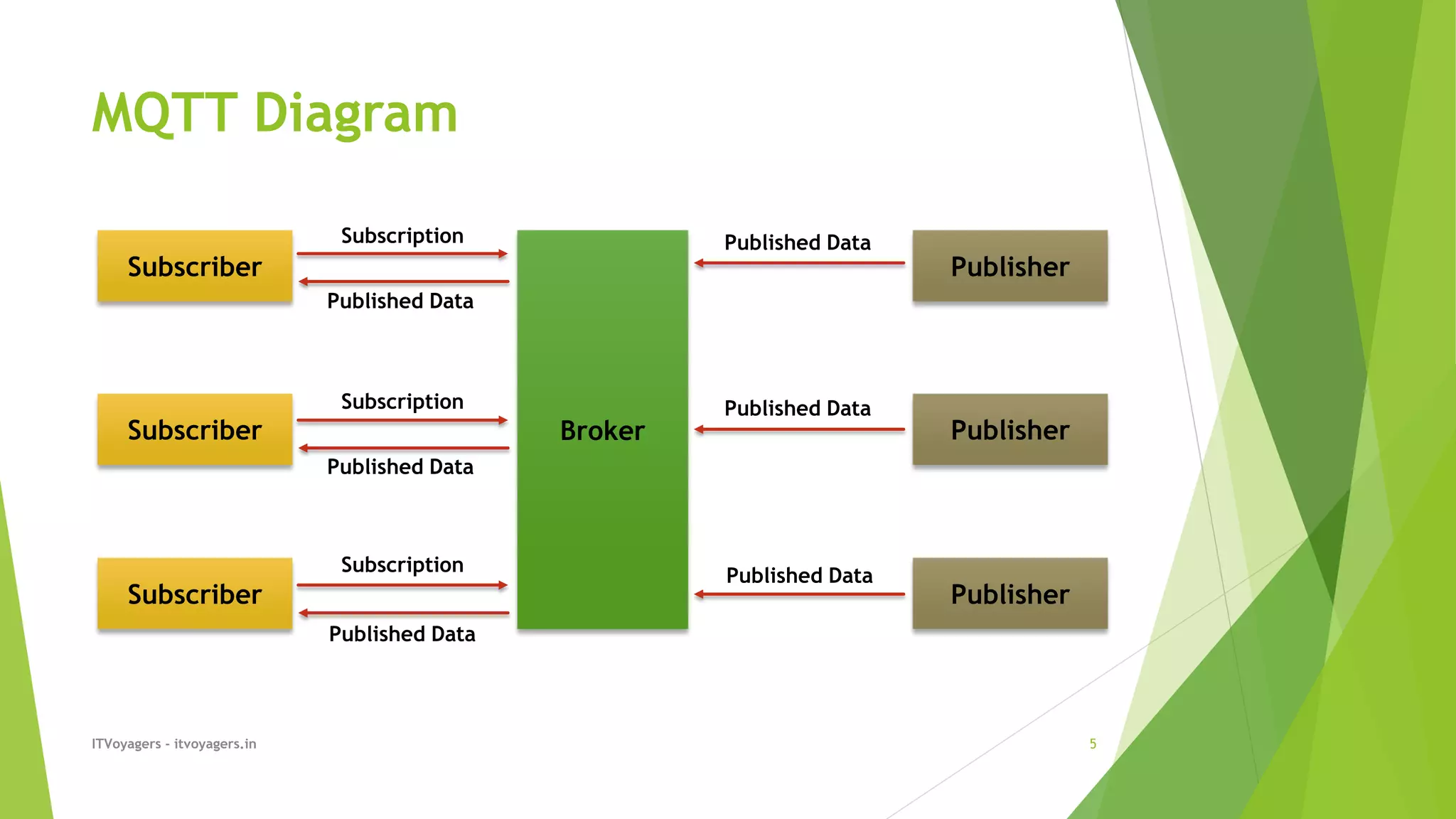
MQTT Diagram
ITVoyagers - itvoyagers.in 5
Broker
Subscriber
Subscriber
Subscriber
Publisher
Publisher
Publisher
Subscription
Subscription
Subscription
Published Data
Published Data
Published Data
Published Data
Published Data
Published Data
MQTT Publisher
 System or sensors which collects data and send it to the broker which further
sends it to multiple subscribers.
 Example motion sensor, water level sensor, etc.
 Publisher publish data in following formats
 Binary
 JSON
 SDC Record
 Text
ITVoyagers - itvoyagers.in 6
MQTT Subscriber
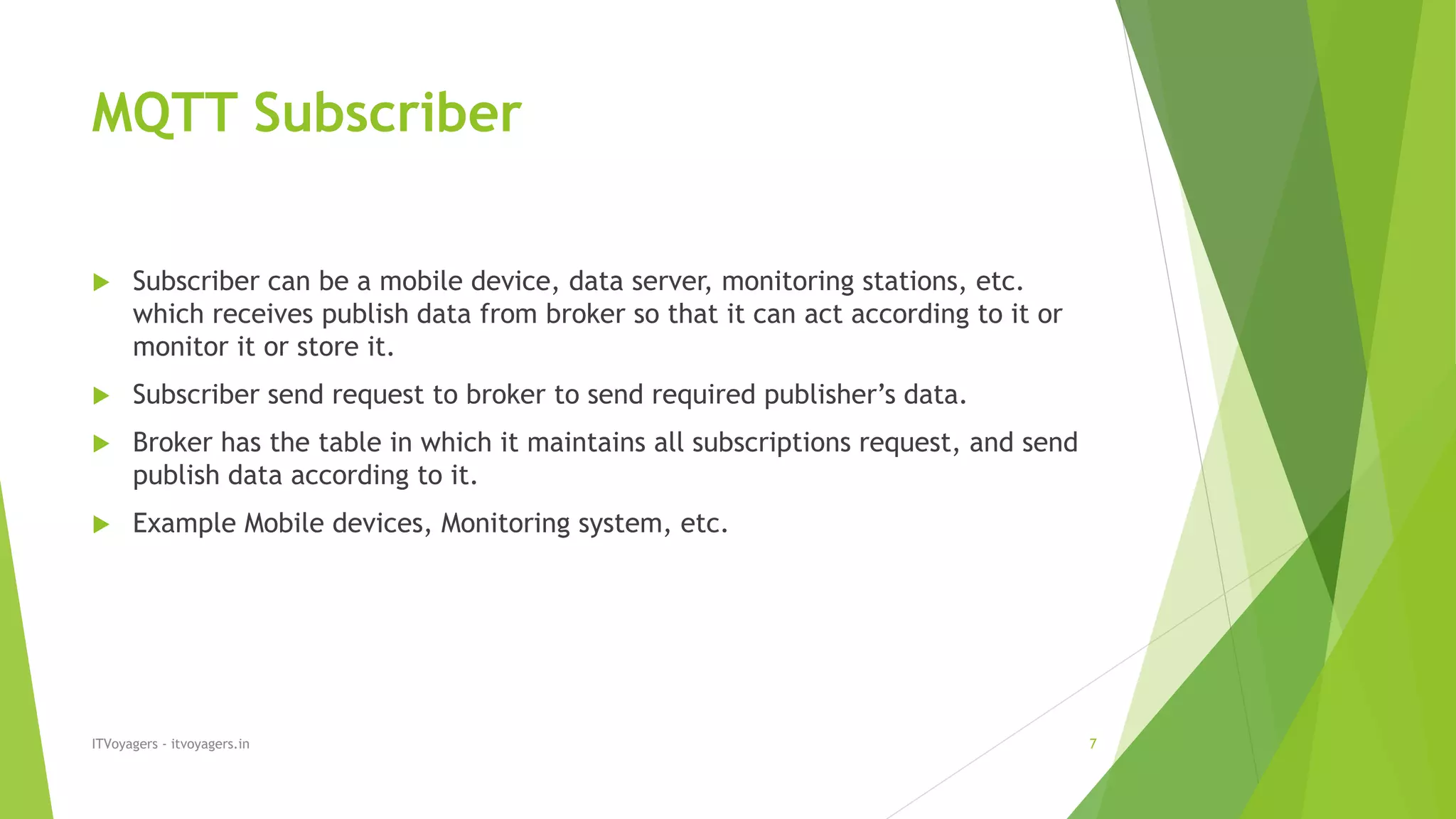
 Subscriber can be a mobile device, data server, monitoring stations, etc.
which receives publish data from broker so that it can act according to it or
monitor it or store it.
 Subscriber send request to broker to send required publisher’s data.
 Broker has the table in which it maintains all subscriptions request, and send
publish data according to it.
 Example Mobile devices, Monitoring system, etc.
ITVoyagers - itvoyagers.in 7
MQTT Broker
 Broker is the component which take care of receiving data from Publisher and
sending it to Subscriber accordingly.
 Broker has to filter messages, broker can filter messages in following ways.
 Subject based
 Content based
 Type based
 Broker has a subscription table in which it store all the request from the
subscriber for the publisher’s data.
 Broker sends publish data to multiple subscriber according to this list.
ITVoyagers - itvoyagers.in 8
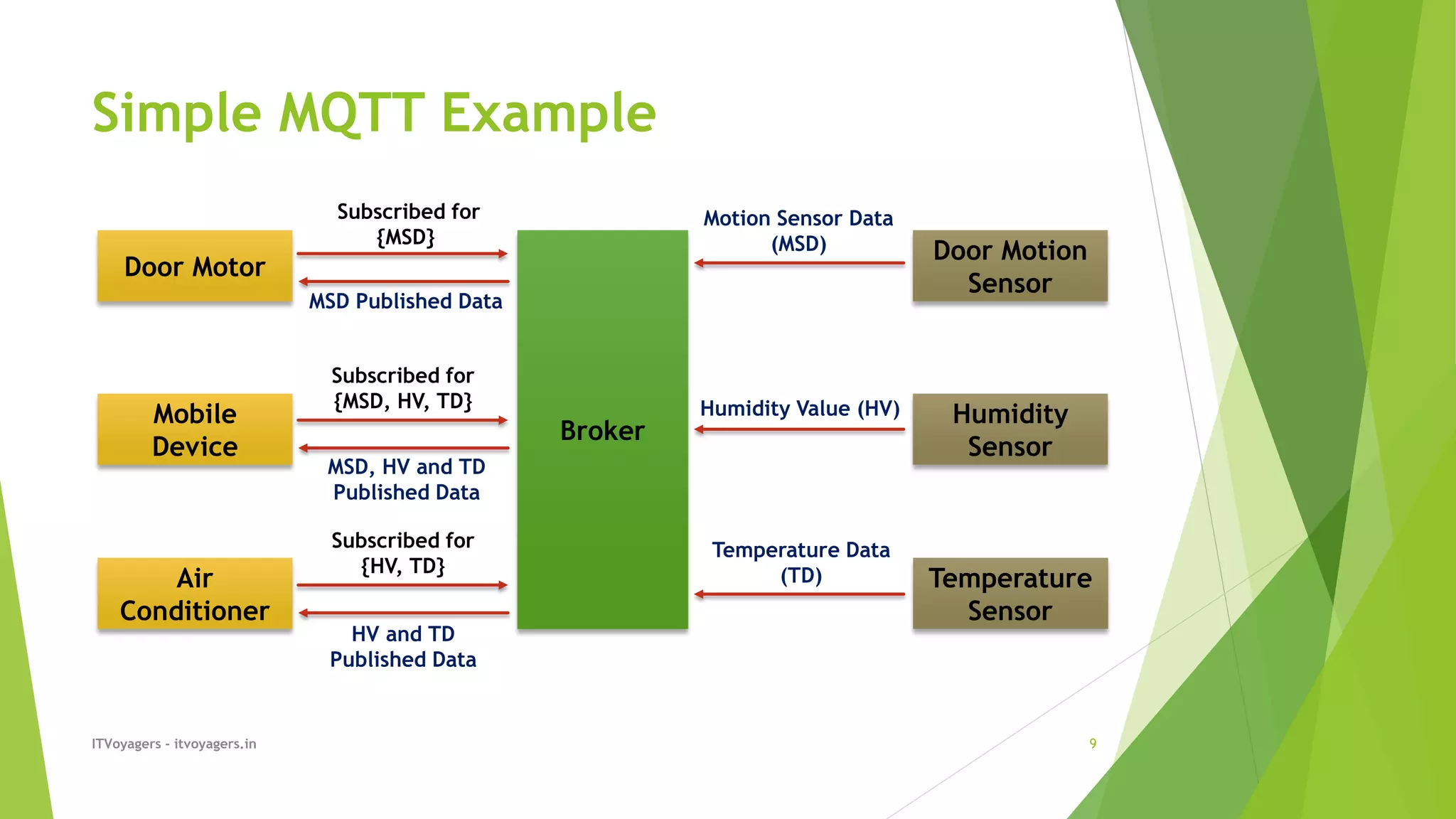
Simple MQTT Example
ITVoyagers - itvoyagers.in 9
Broker
Door Motor
Mobile
Device
Air
Conditioner
Door Motion
Sensor
Humidity
Sensor
Temperature
Sensor
Subscribed for
{MSD}
Subscribed for
{MSD, HV, TD}
Subscribed for
{HV, TD}
Motion Sensor Data
(MSD)
Humidity Value (HV)
Temperature Data
(TD)
MSD Published Data
MSD, HV and TD
Published Data
HV and TD
Published Data
Decoupling in Pub/Sub
 Space decoupling
 In MQTT there no need for publisher and subscriber to know each other, since it is
Pub/Sub model there no need to exchange IP address.
 Time decoupling
 Since it is Pub/Sub model there is no need for publisher and subscriber to run on
same time.
 Synchronization decoupling
 Operations on both publisher and subscriber do not need to be interrupt during the
publishing and receiving.
ITVoyagers - itvoyagers.in 10
CoAP (Constrained Application
Protocol)
 CoAP is developed BY IETF (Internet Engineering Task Force)
 As the name suggest CoAP has been developed for data transmission in
constrained network.
 In network where devices are low power, and network is lossy, we need
protocols like UDP for transmission, but UDP has its own disadvantages, here
comes CoAP in scene which uses UDP but it is more reliable, secured, etc.
 CoAP has become more important for IoT and M2M because of its features.
 CoAP runs on UDP enable devices, it support less memory devices and also
low power devices.
ITVoyagers - itvoyagers.in 11
CoAP (Constrained Application
Protocol)
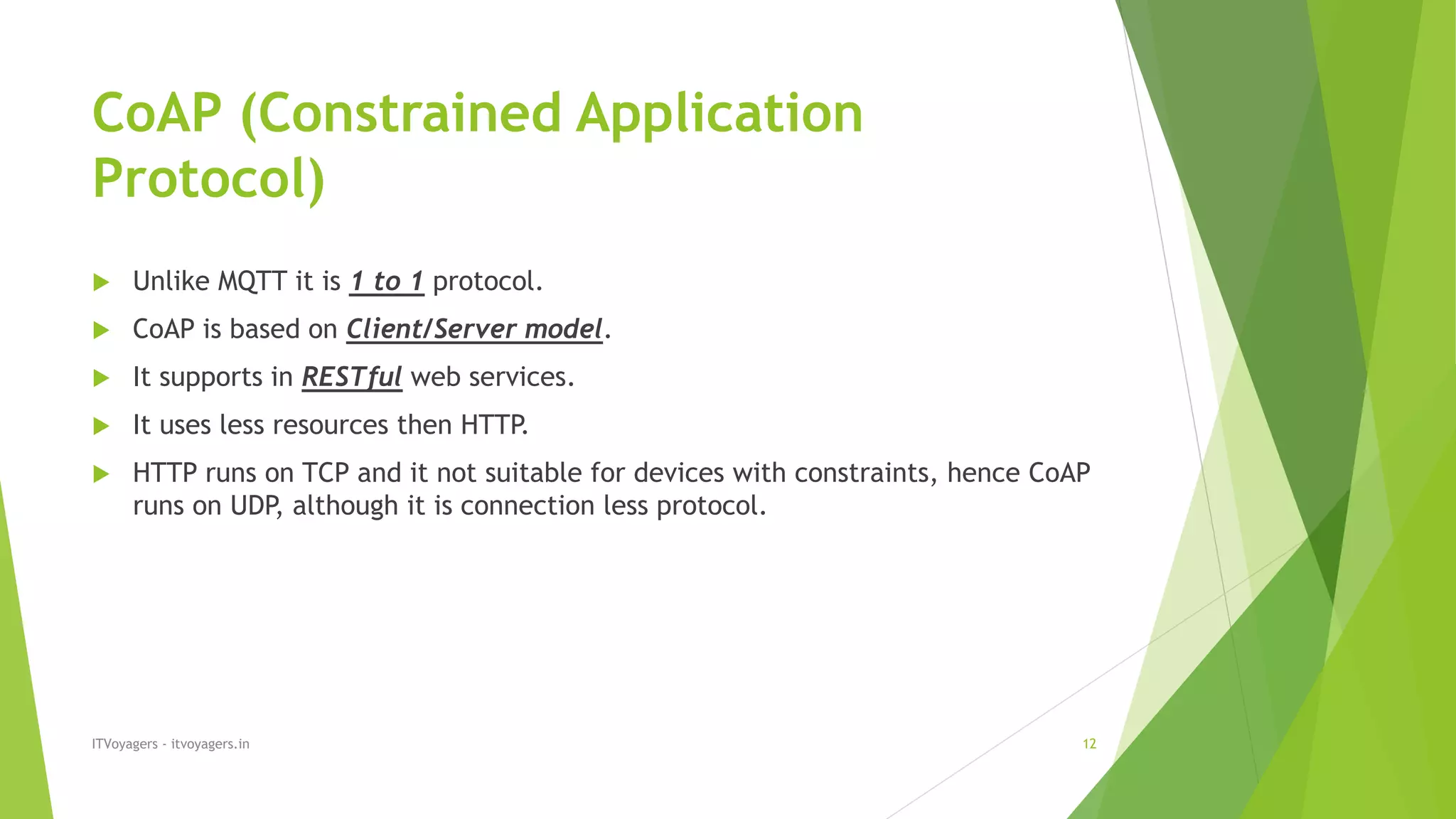
 Unlike MQTT it is 1 to 1 protocol.
 CoAP is based on Client/Server model.
 It supports in RESTful web services.
 It uses less resources then HTTP.
 HTTP runs on TCP and it not suitable for devices with constraints, hence CoAP
runs on UDP, although it is connection less protocol.
ITVoyagers - itvoyagers.in 12
CoAP (Constrained Application
Protocol)
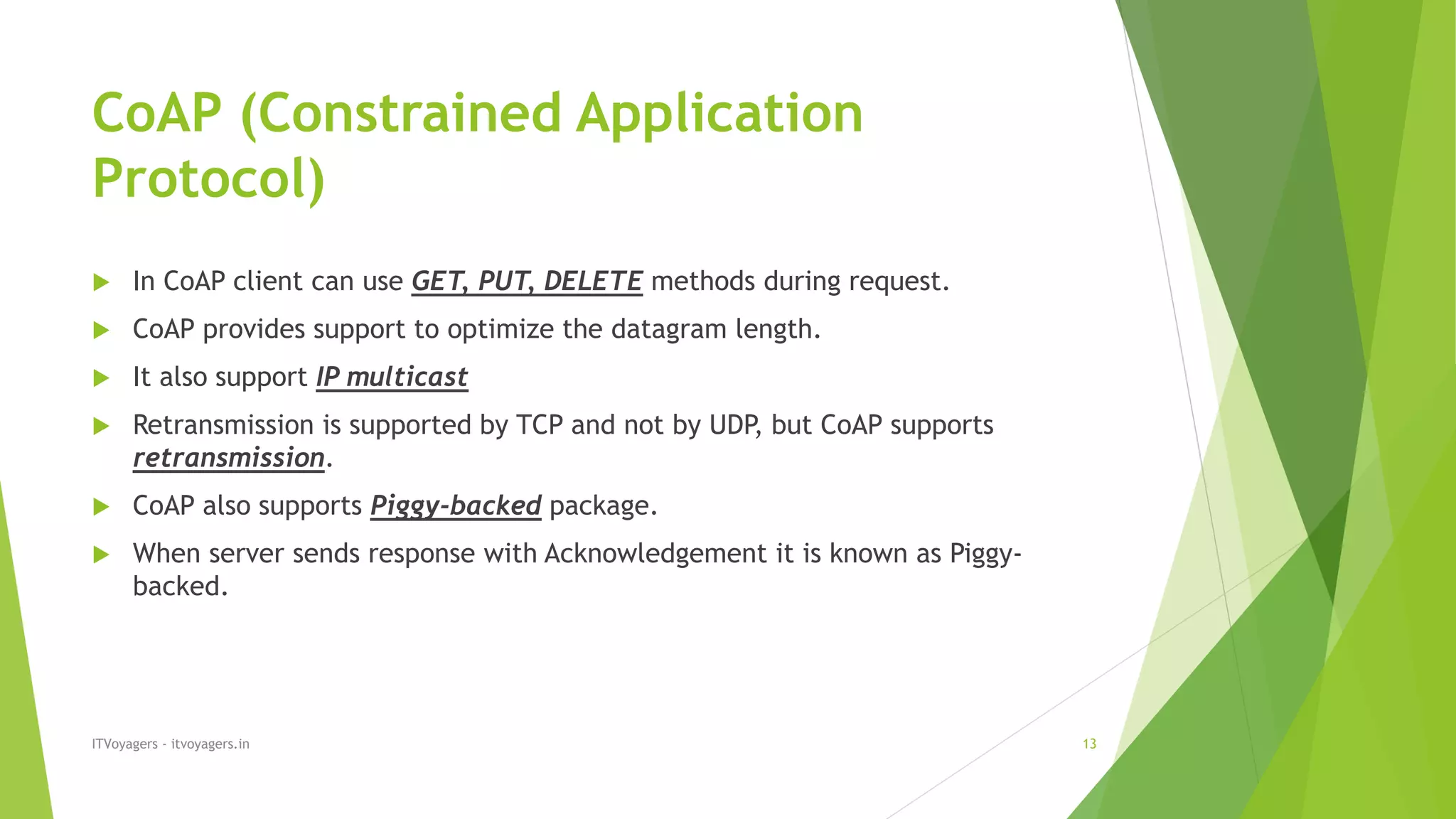
 In CoAP client can use GET, PUT, DELETE methods during request.
 CoAP provides support to optimize the datagram length.
 It also support IP multicast
 Retransmission is supported by TCP and not by UDP, but CoAP supports
retransmission.
 CoAP also supports Piggy-backed package.
 When server sends response with Acknowledgement it is known as Piggy-
backed.
ITVoyagers - itvoyagers.in 13
CoAP Layers
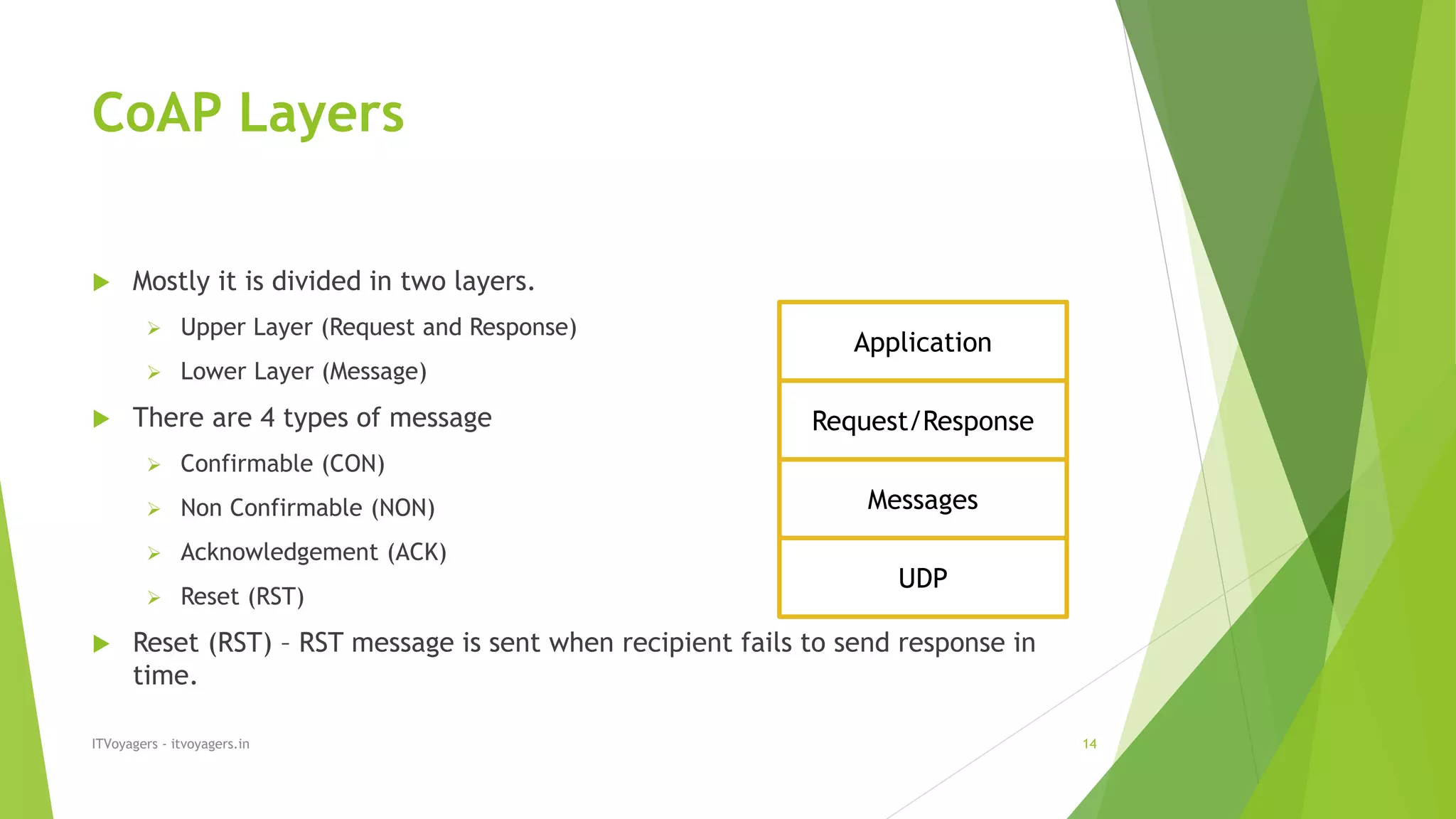
 Mostly it is divided in two layers.
 Upper Layer (Request and Response)
 Lower Layer (Message)
 There are 4 types of message
 Confirmable (CON)
 Non Confirmable (NON)
 Acknowledgement (ACK)
 Reset (RST)
 Reset (RST) – RST message is sent when recipient fails to send response in
time.
ITVoyagers - itvoyagers.in 14
Application
Request/Response
Messages
UDP
Types of message
 Confirmable (CON)
 If sender wants receiver to send ACK for its message sender will add CON in header.
 Non Confirmable (NON)
 If sender don’t want receiver to send ACK for its message sender will add NON in header.
ITVoyagers - itvoyagers.in 15
Client Server
CON/GET/Temp Data
Temp Data
Client Server
NON/GET/Temp Data
Temp Data
ACK
COAP Header
ITVoyagers - itvoyagers.in 16
Credits : Wikipedia
 VER (2 bits) – CoAP version.
 Type (2 bits) – Type of messages [CON (0), NON (1), ACK (2), RST (3)]
 Token Length (4 bits) – Indicates the length of variable
 CoAP Request/Response Code (8 bits) – It has Request/Response code.
 Message ID (16 bits) – Stores message ID which is use to detect message
duplication.
Follow us on
https://www.facebook.com/itvoyagers/
https://twitter.com/ITVoyagers
https://www.instagram.com/itvoyagers_official/
https://www.linkedin.com/in/itvoyagers-vgitcs-673642172/
https://in.pinterest.com/itvoyagers/
https://www.reddit.com/user/ITVoyagers
ITVoyagers OFFICIAL
https://www.slideshare.net/vgitcsofficialedupoi
ITVoyagers - itvoyagers.in 17

MQTT and CoAP

  • 1.
    MQTT and CoAP Author: ITVoyagers Website : itvoyagers.in
  • 2.
    Content  MQTT  Components Diagram  Example  Decoupling in Pub/Sub  CoAP  Description  Layers  Types of message  CoAP Header ITVoyagers - itvoyagers.in 2
  • 3.
    MQTT (Message QueuingTelemetry Transport)  MQTT is a M2M (Machine-To-Machine) connectivity protocol.  MQTT is based on Publisher/Subscriber model.  It was created to connect to the systems situated in remote place and to get data from those sensor.  Decoupling can be done because of Publisher/Subscriber model which is hard to achieve in Client/Server model. ITVoyagers - itvoyagers.in 3
  • 4.
    MQTT Components  MQTThas 3 basic components  Publisher (e.g. Motor, Mobile Devices, etc.)  Subscriber (e.g. Temperature sensor, Motion Sensor, etc.)  Broker ITVoyagers - itvoyagers.in 4
  • 5.
    MQTT Diagram ITVoyagers -itvoyagers.in 5 Broker Subscriber Subscriber Subscriber Publisher Publisher Publisher Subscription Subscription Subscription Published Data Published Data Published Data Published Data Published Data Published Data
  • 6.
    MQTT Publisher  Systemor sensors which collects data and send it to the broker which further sends it to multiple subscribers.  Example motion sensor, water level sensor, etc.  Publisher publish data in following formats  Binary  JSON  SDC Record  Text ITVoyagers - itvoyagers.in 6
  • 7.
    MQTT Subscriber  Subscribercan be a mobile device, data server, monitoring stations, etc. which receives publish data from broker so that it can act according to it or monitor it or store it.  Subscriber send request to broker to send required publisher’s data.  Broker has the table in which it maintains all subscriptions request, and send publish data according to it.  Example Mobile devices, Monitoring system, etc. ITVoyagers - itvoyagers.in 7
  • 8.
    MQTT Broker  Brokeris the component which take care of receiving data from Publisher and sending it to Subscriber accordingly.  Broker has to filter messages, broker can filter messages in following ways.  Subject based  Content based  Type based  Broker has a subscription table in which it store all the request from the subscriber for the publisher’s data.  Broker sends publish data to multiple subscriber according to this list. ITVoyagers - itvoyagers.in 8
  • 9.
    Simple MQTT Example ITVoyagers- itvoyagers.in 9 Broker Door Motor Mobile Device Air Conditioner Door Motion Sensor Humidity Sensor Temperature Sensor Subscribed for {MSD} Subscribed for {MSD, HV, TD} Subscribed for {HV, TD} Motion Sensor Data (MSD) Humidity Value (HV) Temperature Data (TD) MSD Published Data MSD, HV and TD Published Data HV and TD Published Data
  • 10.
    Decoupling in Pub/Sub Space decoupling  In MQTT there no need for publisher and subscriber to know each other, since it is Pub/Sub model there no need to exchange IP address.  Time decoupling  Since it is Pub/Sub model there is no need for publisher and subscriber to run on same time.  Synchronization decoupling  Operations on both publisher and subscriber do not need to be interrupt during the publishing and receiving. ITVoyagers - itvoyagers.in 10
  • 11.
    CoAP (Constrained Application Protocol) CoAP is developed BY IETF (Internet Engineering Task Force)  As the name suggest CoAP has been developed for data transmission in constrained network.  In network where devices are low power, and network is lossy, we need protocols like UDP for transmission, but UDP has its own disadvantages, here comes CoAP in scene which uses UDP but it is more reliable, secured, etc.  CoAP has become more important for IoT and M2M because of its features.  CoAP runs on UDP enable devices, it support less memory devices and also low power devices. ITVoyagers - itvoyagers.in 11
  • 12.
    CoAP (Constrained Application Protocol) Unlike MQTT it is 1 to 1 protocol.  CoAP is based on Client/Server model.  It supports in RESTful web services.  It uses less resources then HTTP.  HTTP runs on TCP and it not suitable for devices with constraints, hence CoAP runs on UDP, although it is connection less protocol. ITVoyagers - itvoyagers.in 12
  • 13.
    CoAP (Constrained Application Protocol) In CoAP client can use GET, PUT, DELETE methods during request.  CoAP provides support to optimize the datagram length.  It also support IP multicast  Retransmission is supported by TCP and not by UDP, but CoAP supports retransmission.  CoAP also supports Piggy-backed package.  When server sends response with Acknowledgement it is known as Piggy- backed. ITVoyagers - itvoyagers.in 13
  • 14.
    CoAP Layers  Mostlyit is divided in two layers.  Upper Layer (Request and Response)  Lower Layer (Message)  There are 4 types of message  Confirmable (CON)  Non Confirmable (NON)  Acknowledgement (ACK)  Reset (RST)  Reset (RST) – RST message is sent when recipient fails to send response in time. ITVoyagers - itvoyagers.in 14 Application Request/Response Messages UDP
  • 15.
    Types of message Confirmable (CON)  If sender wants receiver to send ACK for its message sender will add CON in header.  Non Confirmable (NON)  If sender don’t want receiver to send ACK for its message sender will add NON in header. ITVoyagers - itvoyagers.in 15 Client Server CON/GET/Temp Data Temp Data Client Server NON/GET/Temp Data Temp Data ACK
  • 16.
    COAP Header ITVoyagers -itvoyagers.in 16 Credits : Wikipedia  VER (2 bits) – CoAP version.  Type (2 bits) – Type of messages [CON (0), NON (1), ACK (2), RST (3)]  Token Length (4 bits) – Indicates the length of variable  CoAP Request/Response Code (8 bits) – It has Request/Response code.  Message ID (16 bits) – Stores message ID which is use to detect message duplication.
  • 17.