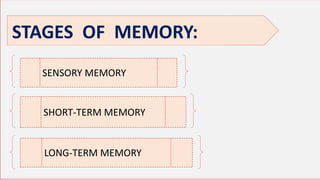
STAGES OF MEMORY:
SENSORY MEMORY
SHORT-TERM MEMORY
LONG-TERM MEMORY
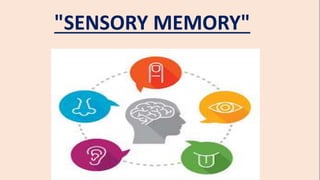
"SENSORY MEMORY"
SENSORY
/ˈsɛns(ə)ri/
Adjective: Connected with the physical senses of touch,
smell, taste, hearing, and sight
What is sensory memory?
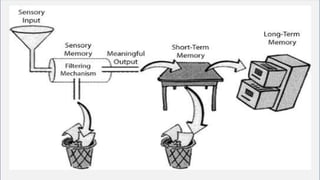
Sensory memory is a very short-term, but large capacity
memory source. It is the start of your memory. It’s when you take in
everything around you before transmitting a portion of what you see to short-
term memory.
It is often thought of as the first stage of memory that involves registering a
tremendous amount of information about the environment.
How Does Sensory Memory Work?
A common analogy for sensory memory is that the memories are your “raw
data” that your brain then processes to make sense and order.
During every moment of your existence, your senses are
constantly taking in an enormous amount of information about
what you see, feel, smell, hear, and taste.
Sensory memory creates something of
a quick "snapshot" of the world around
you, allowing you to briefly focus your
attention on relevant details.
An example could be when you read a word with your
eyes, yet recall how a person sounds when saying it.
Types of sensory memory:
- Visual memory
- Auditory memory
- Touch memory

SENSORY MEMORY

  • 1.
    STAGES OF MEMORY: SENSORYMEMORY SHORT-TERM MEMORY LONG-TERM MEMORY
  • 2.
  • 3.
    SENSORY /ˈsɛns(ə)ri/ Adjective: Connected withthe physical senses of touch, smell, taste, hearing, and sight What is sensory memory? Sensory memory is a very short-term, but large capacity memory source. It is the start of your memory. It’s when you take in everything around you before transmitting a portion of what you see to short- term memory. It is often thought of as the first stage of memory that involves registering a tremendous amount of information about the environment.
  • 5.
    How Does SensoryMemory Work? A common analogy for sensory memory is that the memories are your “raw data” that your brain then processes to make sense and order. During every moment of your existence, your senses are constantly taking in an enormous amount of information about what you see, feel, smell, hear, and taste. Sensory memory creates something of a quick "snapshot" of the world around you, allowing you to briefly focus your attention on relevant details.
  • 6.
    An example couldbe when you read a word with your eyes, yet recall how a person sounds when saying it. Types of sensory memory: - Visual memory - Auditory memory - Touch memory