Unit 1: Cognitive Psychology (Memory)
L/O: to be able to outline the Multi-store model
of memory with some evidence for its processes.
• Cognitive Psychology aims to understand
  behaviour by our mental processes.
• In Unit One, we study HUMAN MEMORY.

Learning is the process of acquiring new
  information.
Memory is the persistence of learning that can be
  accessed at a later time.
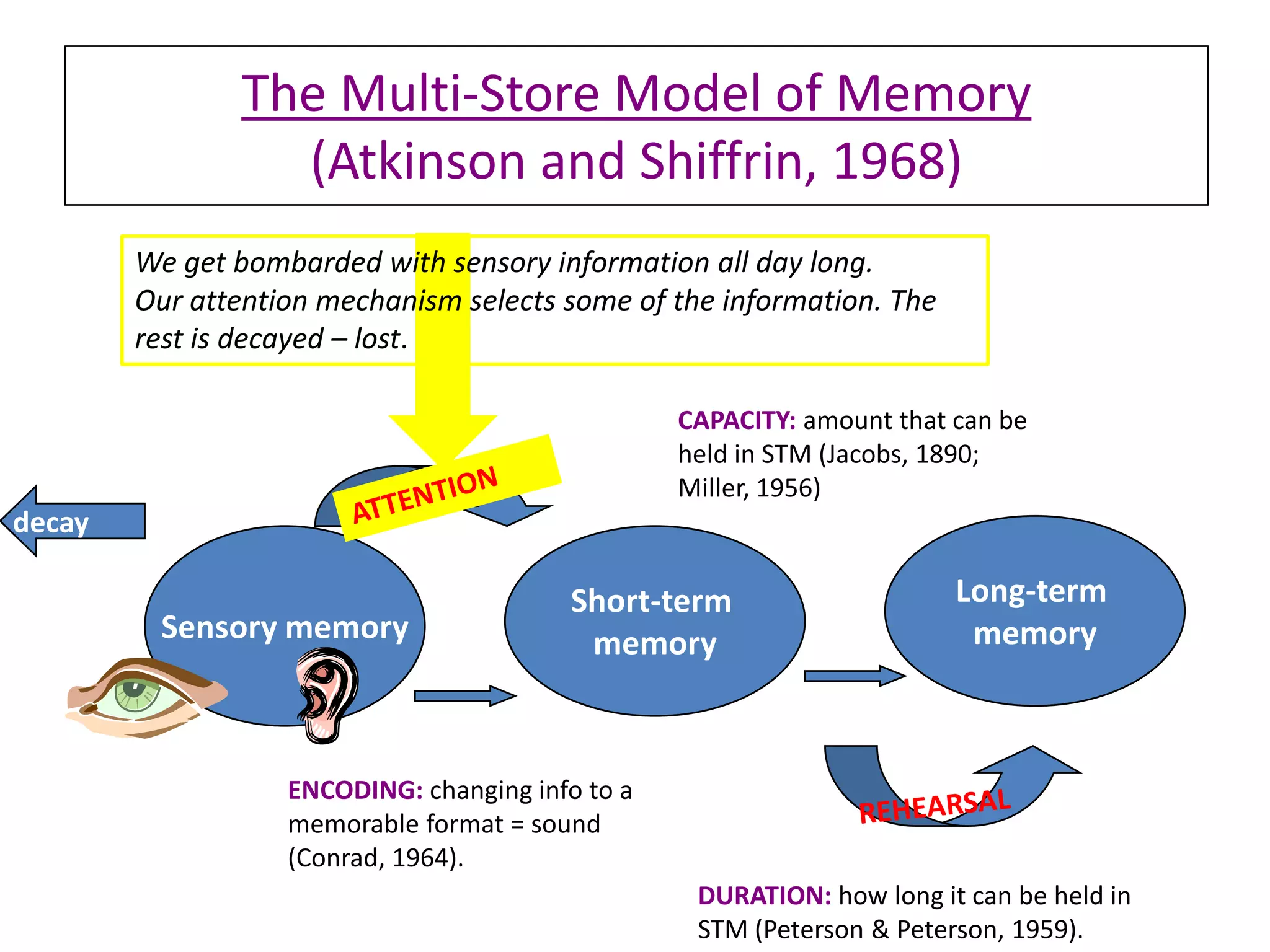
The Multi-Store Model of Memory
               (Atkinson and Shiffrin, 1968)
    • First attempt to explain making a memory like
      the one you just tried.
    • Formulated a structure for memory.
    • 3 components:            CAPACITY: amount that can be
                               held in STM (Jacobs, 1890;
                                              Miller, 1956)
decay

                                     Short-term                     Long-term
        Sensory memory                memory                         memory


               ENCODING: changing info to a
               memorable format = sound
               (Conrad, 1964).
                                               DURATION: how long it can be held in
                                               STM (Peterson & Peterson, 1959).
• What was the difference in the two tasks?

• Was your memory better for the first 5 or the
  second 5 items?

                 Attention!
     Why would that make memory better?
Eye-conic!
                           • Echoic memories go
                             into the echoic store.
                           • Sound memories.
    • Iconic memories go
      into the iconic      Decay time = several
      store.               seconds.
    • Sight memories.

    Decay time = ½ a
    second.                                     Hear an
                                                echo-ic!
The Multi-Store Model of Memory
                 (Atkinson and Shiffrin, 1968)
        We get bombarded with sensory information all day long.
        Our attention mechanism selects some of the information. The
        rest is decayed – lost.

                                                  CAPACITY: amount that can be
                                                  held in STM (Jacobs, 1890;
                                                  Miller, 1956)
decay

                                         Short-term                     Long-term
         Sensory memory                   memory                         memory


                   ENCODING: changing info to a
                   memorable format = sound
                   (Conrad, 1964).
                                                   DURATION: how long it can be held in
                                                   STM (Peterson & Peterson, 1959).
Research associated with MSM
Short-term Memory STM:
• Conrad (1964) pg. 62
• Jacobs (1890) pg. 63
• Peterson & Peterson (1959) pg. 64
                                Take notes on:
Long-term Memory LTM:             • What they wanted to
                                     test (aim/hypothesis).
• Bahrick et al (1975) pg. 67         • What they did.
                                      • Who took part.
                                    • What they found.
Friday 21st September 2012
   Sharing notes on the research for
                MSM.
• You have detailed notes on one or two of the four
  studies.
• Group together with people who have taken
  notes on different studies.
= all have notes on all four.

       *try to use your research methods knowledge
       and terminology when presenting*
(e.g. participants, population, sample)
Short-term Memory STM
 1. Get definitions for these terms.
Which studies are evidence for which?

• Capacity:                Which study?
                           Peterson & Peterson (1959)

• Encoding:                Jacobs (1890)

                           Conrad (1964)
• Duration:


     Which does Bahrick’s study provide evidence for? (in LTM)
Semantic Memory
• Semantic = meaning.
• Acoustic = sound.

For example:
Chair vs. table
Chair vs. stair
Come up with a semantically related
word to help you to remember these
              symbols.
L/O: to be able to outline the Multi-
   store model of memory with some
       evidence for its processes.
Can you?
• Example exam question:

Outline the Multi-store Model of memory
(4 marks)
Evaluation of the Multi-store Model of Memory

 L/O: to be able to outline and evaluate
          the MSM of memory.

Starter:


• Try to draw the MSM diagram from
  memory.
The Multi-Store Model of Memory
  (Atkinson and Shiffrin, 1968)
The Multi-Store Model of Memory
              (Atkinson and Shiffrin, 1968)


                                              CAPACITY: amount that can be
                                              held in STM (Jacobs, 1890;
                                              Miller, 1956)
decay

                                     Short-term                     Long-term
        Sensory memory                memory                         memory


               ENCODING: changing info to a
               memorable format = sound
               (Conrad, 1964).
                                               DURATION: how long it can be held in
                                               STM (Peterson & Peterson, 1959).
L/O: to be able to outline and evaluate
          the MSM of memory.
The STM store in the model

Chunking: changing the size of items by
reorganising information e.g. 07958-245- 124
becomes 3 ‘items’.              CAPACITY IN STM


Interference: any gap / time/ distraction in
memory model process e.g. a task in between
list of words to be remembered. DURATION IN STM
L/O: to be able to outline and evaluate
            the MSM of memory.
The STM store in the model

Rehearsal
Maintenance rehearsal: simply repeating information
                        = keeps it in STM.
Elaborate rehearsal: using the info and changing it
                        = transfer to LTM.

How could you apply these types of rehearsal to your
experience of learning? Discuss and write a sentence or
two using the terminology of the two types of rehearsal.
L/O: to be able to outline and evaluate
           the MSM of memory.
The LTM store inisthe model errors
           This why semantic
               occur for things we know
                      well (LTM)
Encoding is present when information goes from
the STM to LTM too.barn – shed.
                e.g.

                It is very rare for acoustic
                           Short-term               Long-term
               errors to occur in our LTM
  Sensory memory            memory                   memory

                      e.g.
               ENCODING:     barn – born
                                       ENCODING:
               Sound                   Meaning
               (acoustic)              (semantic)
EXAM TIP!
You may be asked about the differences
   between encoding, capacity and
 duration in STM and LTM in the MSM.

• Textbook p.g. 65.
• Read and copy table of differences.
Evaluation of the MSM
• Strengths (evidence
  for it)                              • Weaknesses
1.   Studies of brain damaged          (evidence against it)
     patients have suggested that
     the STM and LTM are two
     separate stores in the brain
     (Shallice & Warrington – KF).
2.   Murdock - Primacy effect
     (remember first few of a word
     list): support for rehearsal in
     STM; Recency effect
     (remember last few of a word
     list): support for duration in
     STM.

Multi store model of memory

  • 1.
    Unit 1: CognitivePsychology (Memory) L/O: to be able to outline the Multi-store model of memory with some evidence for its processes. • Cognitive Psychology aims to understand behaviour by our mental processes. • In Unit One, we study HUMAN MEMORY. Learning is the process of acquiring new information. Memory is the persistence of learning that can be accessed at a later time.
  • 2.
    The Multi-Store Modelof Memory (Atkinson and Shiffrin, 1968) • First attempt to explain making a memory like the one you just tried. • Formulated a structure for memory. • 3 components: CAPACITY: amount that can be held in STM (Jacobs, 1890; Miller, 1956) decay Short-term Long-term Sensory memory memory memory ENCODING: changing info to a memorable format = sound (Conrad, 1964). DURATION: how long it can be held in STM (Peterson & Peterson, 1959).
  • 3.
    • What wasthe difference in the two tasks? • Was your memory better for the first 5 or the second 5 items? Attention! Why would that make memory better?
  • 4.
    Eye-conic! • Echoic memories go into the echoic store. • Sound memories. • Iconic memories go into the iconic Decay time = several store. seconds. • Sight memories. Decay time = ½ a second. Hear an echo-ic!
  • 5.
    The Multi-Store Modelof Memory (Atkinson and Shiffrin, 1968) We get bombarded with sensory information all day long. Our attention mechanism selects some of the information. The rest is decayed – lost. CAPACITY: amount that can be held in STM (Jacobs, 1890; Miller, 1956) decay Short-term Long-term Sensory memory memory memory ENCODING: changing info to a memorable format = sound (Conrad, 1964). DURATION: how long it can be held in STM (Peterson & Peterson, 1959).
  • 6.
    Research associated withMSM Short-term Memory STM: • Conrad (1964) pg. 62 • Jacobs (1890) pg. 63 • Peterson & Peterson (1959) pg. 64 Take notes on: Long-term Memory LTM: • What they wanted to test (aim/hypothesis). • Bahrick et al (1975) pg. 67 • What they did. • Who took part. • What they found.
  • 7.
    Friday 21st September2012 Sharing notes on the research for MSM. • You have detailed notes on one or two of the four studies. • Group together with people who have taken notes on different studies. = all have notes on all four. *try to use your research methods knowledge and terminology when presenting* (e.g. participants, population, sample)
  • 8.
    Short-term Memory STM 1. Get definitions for these terms. Which studies are evidence for which? • Capacity: Which study? Peterson & Peterson (1959) • Encoding: Jacobs (1890) Conrad (1964) • Duration: Which does Bahrick’s study provide evidence for? (in LTM)
  • 9.
    Semantic Memory • Semantic= meaning. • Acoustic = sound. For example: Chair vs. table Chair vs. stair
  • 10.
    Come up witha semantically related word to help you to remember these symbols.
  • 11.
    L/O: to beable to outline the Multi- store model of memory with some evidence for its processes. Can you? • Example exam question: Outline the Multi-store Model of memory (4 marks)
  • 12.
    Evaluation of theMulti-store Model of Memory L/O: to be able to outline and evaluate the MSM of memory. Starter: • Try to draw the MSM diagram from memory.
  • 13.
    The Multi-Store Modelof Memory (Atkinson and Shiffrin, 1968)
  • 14.
    The Multi-Store Modelof Memory (Atkinson and Shiffrin, 1968) CAPACITY: amount that can be held in STM (Jacobs, 1890; Miller, 1956) decay Short-term Long-term Sensory memory memory memory ENCODING: changing info to a memorable format = sound (Conrad, 1964). DURATION: how long it can be held in STM (Peterson & Peterson, 1959).
  • 15.
    L/O: to beable to outline and evaluate the MSM of memory. The STM store in the model Chunking: changing the size of items by reorganising information e.g. 07958-245- 124 becomes 3 ‘items’. CAPACITY IN STM Interference: any gap / time/ distraction in memory model process e.g. a task in between list of words to be remembered. DURATION IN STM
  • 16.
    L/O: to beable to outline and evaluate the MSM of memory. The STM store in the model Rehearsal Maintenance rehearsal: simply repeating information = keeps it in STM. Elaborate rehearsal: using the info and changing it = transfer to LTM. How could you apply these types of rehearsal to your experience of learning? Discuss and write a sentence or two using the terminology of the two types of rehearsal.
  • 17.
    L/O: to beable to outline and evaluate the MSM of memory. The LTM store inisthe model errors This why semantic occur for things we know well (LTM) Encoding is present when information goes from the STM to LTM too.barn – shed. e.g. It is very rare for acoustic Short-term Long-term errors to occur in our LTM Sensory memory memory memory e.g. ENCODING: barn – born ENCODING: Sound Meaning (acoustic) (semantic)
  • 18.
    EXAM TIP! You maybe asked about the differences between encoding, capacity and duration in STM and LTM in the MSM. • Textbook p.g. 65. • Read and copy table of differences.
  • 19.
    Evaluation of theMSM • Strengths (evidence for it) • Weaknesses 1. Studies of brain damaged (evidence against it) patients have suggested that the STM and LTM are two separate stores in the brain (Shallice & Warrington – KF). 2. Murdock - Primacy effect (remember first few of a word list): support for rehearsal in STM; Recency effect (remember last few of a word list): support for duration in STM.