SHOCK AND ITS NURSING
MANAGEMENT
CN 2011 BATCH, BPKIHS
Leadership and management
NAME OF STUDENTS
Sonali Koiri(514)
Soni Shrestha(515)
Srijana Neupane(516)
Sujata Devkota(517)
Sushila Ku. Hamal(518)
Tashi Dolma Lama(519)
Triza Napit(520)
Objectives:
General objectives:
All the participants will be able to explain about
shock.
Specific Objectives:
1.Define Shock
2.Stages of shock
3.Types of shock
4.Prevention of Shock
5.Nursing Care of patients with shock
PRE TEST
1 Which is not the stage of shock?
•Progressive
•Compensatory
•Initial
•Reversible
2 which is not the type of shock?
•Cardiogenic
•Hypovolemic
•Anaphylactic
•Aseptic
3 most common type of shock?
•Cardiogenic
•Hypovolemic
•Anaphylactic
contd
4 Shock results from:
Decreased blood flow to tissues
Increase blood flow to tissues
Adequate perfusion
Both 2nd
and 3rd
5 which is not the cause of cardiogenic shock?
•CHF
•Pulmonary embolism
•Spinal cord injury
•cardiomyopathy
DEFINITION OF SHOCK
Shock is defined as a complex, life threatening
condition or syndrome characterized by
inadequate blood flow to the tissues and cells of
the body.
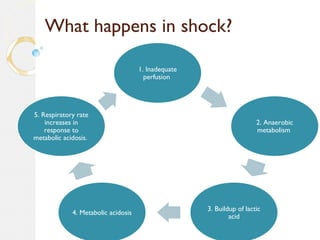
What happens in shock?
1. Inadequate
perfusion
2. Anaerobic
metabolism
3. Buildup of lactic
acid
4. Metabolic acidosis
5. Respiratory rate
increases in
response to
metabolic acidosis.
7
STAGES OF SHOCK
There are four stages of shock.
a)INITIAL STAGE: the cardiac output is
insufficient to supply the normal nutritional needs
of tissues but not low enough to cause serious
symptoms
b)COMPENSATORY STAGE:The cardiac
output is reduced further but due to
compensatory vasoconstriction, the BP tends to
remain within the normal range. Blood flow to
the skin and kidney decrease while blood flow to
CNS and myocardium is maintained.
contd
C)PROGRESSIVE STAGE :The unfavorable
change become more and more apparent falling
BP , increased vasoconstriction, increased heart
rate and oliguria .If compensatory mechanism
are unable to cope with the reduce output
shock becomes progressively more severe and
passed onto .
d)IRREVERSIBLE STAGE: In this stage of
shock no type of therapy can save the patients
life , BP decreases, blood volume can be can be
normal in this stage. Fluid transfusion may
restore BP Only temporary BP decline until
DEATH occurs.
TYPES OF SHOCK
• a) Hypovolemic shock
• b) cardiogenic shock
• c) neurogenic shock
• d) septic shock
• e) Anaphylactic shock
HYPOVOLEMIC SHOCK
It occurs when a significant amount of fluid is lost from the
intravascular space, fluid are may be blood, plasma,
electrolytes solution .It is the most common type of shock .
CAUSES;
a)Severe bleeding e.g. ; PPH , ectopic pregnancy ,uterus
rupture , severe polytrauma , haemonumothorax , UGI
bleeding , hematemesis , haemoptysis.
b)Severe persistent vomiting eg ;DVA ,minor and major
disorder in pregnancy , prolong vomiting.
c)Severe diarrhea eg ; cholera
d)Severe edemas or ascities ,peritonitis , pancreatitis
contd…….
e)Diuresis and rapid remove of amniotic fluid
f)Severe burns
g)Inadequate fluid
CLINICAL FEATURE;
a)BP decrease , hypotension
b)Skin cold and clammy
c)Pallor
d)Tachycardia ,Tachypnea
e)Restlessness , Anxiety , Weakness
f)Altered sensorium
g)Oliguria<20 ml/hour ; progressive stage
contd…..
Metabolic acidosis ;PaCO2 and HCO3 decreased
Nausea and vomiting , thirst
Pulse rapid , weak and thready
Irritability
Dilated with decrease response to light ; progressive
stage
Respiration rate rapid >20b/min, shallow ;
progressive stage
Cyanosis ; progressive stage
Increased serum electrolyte ,blood glucose , serum
creatinine , odium, potassium
Unconsciousness and unresponsive to pain
CARDIOGENIC SHOCK
Introduction
Cardiogenic shock occurs when the heart’s ability to
pump blood is impaired.
This is a condition that results from inadequate
perfusion of body tissue with oxygenated blood that
is insufficient to sustain life ,cardiac output is
decreased.
Causes
1.Acute myocardial infraction resulting in massive
damage to myocardium.
2.CHF ,Pulmonary embolism
3.Cardiac temponade Cardiomyopathy
Clinical features
1.Same as hypovolemic shock
2.Dysrythmias,chest pain
3.Respiratory distress , multi organ dysfunction
syndrome and death are its complication
4.Left and Right ventricular failure
5.Mechanical complication including ventricular
septal rupture
NEUROGENIC SHOCK
Introduction
Inability of nervous system to control dilation
of blood vessels.
Neurogenic shock results from generalized
vasodilation and loss of vasomotor tone due
to
a.Massive increase in vascular capacity
b. Pooling of blood in periphery
c. Decreased venous return to Heart.
Causes:
Brain traumatic injury
Brain damage, vasomotor depression
Spinal cord injury
Deep spinal anesthesia
During LP
Severe pain, hypoglycemia, emotional stress
Drugs causing vasomotor center depression
Anti snake venom
Clinical features
Nervousness
LOC
Confusion
Skin warm but dry
Respiration depress
Hypotension
ANAPHYLACTIC SHOCK
Anaphylaxis is a life threatening systemic
hypersensitivity reaction contact with an allergen.
Causes
Drugs: penicillin , radio contrast, lignocaine ,
anesthetic drugs, iron injectable . . etc.
Blood transfusion
Stings and snake bite
New clothes
Dusting smokes
Suddenly climate change
Clinical features
Cough, wheezing, laryngeal edema,
bronchospasm
Hypotension, tachycardia, palpitation
Syncope
Urticaria, angeodema , pruritus
Nausea ,vomiting
Seizures
Respiratory depression, cardiovascular
collapse
coma
SEPTIC SHOCK
Introduction
It is the most common type of shock and caused by
widespread infection due to gram positive and
negative bacteria and viruses.
Causes
UTI , abortion
RTA
Severe burn
CSOM
Due to chronic disesases : diabetes,AIDS
Indwelling lines and catheter
Improper wound care and management
Clinical features
• Hyperthermia
• Severe headache
• Respiration distress
• Decreased cardiac output
• Hypotension
• Skin cold and pale
• Multiple organ failure
• Anuria
Prevention of Shock
• Primary prevention of shock is an essential
focus on nursing intervention; hypovolemic
shock can be prevented in some instances by
closely monitoring patients who is at risk for
fluid deficit and assisting with fluid replacement
before Intravascular volume is depleted.
• General nursing measures include safe
administration of prescribed fluids and
medication and proper documentation,
monitoring sign of complication and side effects
and early reporting
• Safe blood administration
Blood sample should be obtained foe CBC, cross
match grouping before BT
Patient receiving BT must be closely monitored for
adverse effect.
• Proper care of wound and using aseptic technique
in any invasive procedures.
• Proper pain management.
• Skin test should be done before giving antibiotics
as anaphylaxis reaction may occur.
• Early detection and management of cardiac
diseases.
Nursing care of patient on
SHOCK
Check for a response. Give Rescue Breaths or CPR
as needed.
1.Lay the person flat, face-up, but do not move him
or her if you suspect a head, back, or neck injury.
2.Raise the person's feet about 12 inches. Use a box,
etc. If raising the legs will cause pain or further injury,
keep him or her flat. Keep the person still.
3.Do not raise the feet or move the legs if hip or leg
bones are broken. Keep the person lying flat.
4.Check for signs of circulation. If absent, begin
6. Turn the person on his or her side to
prevent choking if the person vomits or
bleeds from the mouth.
7. Keep the person warm and
comfortable. Loosen belt (s) and tight
clothing and cover the person with a blanket.
8. NPO: Even if the person complains of thirst,
give nothing by mouth. If the person wants
water, moisten the lips.
9. Reassure the person. Make him or her as
comfortable as you can.
Contd…
6. Fluid and blood replacement: Open IV
line on both hands with two wide bore
cannula and start fluid rapidly as advised.
7. Administer oxygen via face mask.
8. Identify the cause and treat accordingly.
9. Vasoactive medications to improve cardiac
contractility, i.e. Dopamine, Dobutamine,
Noradrenaline.
10. Other care are same as the care of
unconscious patient.
Post test
1)Which is the best position for hypovolemic
shock?
Dorsal recumbent
Prone position
Semi fowlers
Left lateral
2) Which of following happens in compensatory
stage?
•Hypotension
•Hypertension
•Normal BP
•Both 2nd
and 3rd
contd………
3) Which is not the sign and symptoms of
neurogenic shock?
•LOC
•Nervousness
•Confusion
•Dehydration
4)Which is not the cause of septic shock?
UTI
Abortion
Massive infected wounds
Smokes and dust
Answers
 Pre test
1) Reversible
2) Aseptic
3) Hypovolemic
4) Decreased blood flow to tissues
5) Spinal cord Injury
Post test
1) Dorsal recumbent
2) Normal BP
3) Dehydration
4) Smokes and dust
5) Metabolic acidosis
References
Sandra M. Nettine ,The Lippincott
Manuals of Nursing practice, 7th
edition,
Jaypee brothers medical publisher Pvt.Ltd
page no:1076-1078
Suzzanne C . Smeltzer, Brunner and
Suddharth Medical Surgical nursing 8th
edition
Sharma Asha, Lewis medical surgical
nursing, Elsevier publication, page no 1722-
1750
contd…….
Joycee M. Black, Medical Surgical Nursing,
6th
edition, volume 2, page no 2231-2258
Sharon Mantik Lewis Medical Surgical
Nursing, Mosby's year book publication 3rd
Edition page no 740-757
Wilma Plipps , Shafers Medical Surgical
Nursing, 7th
edition, page no 35-37
contd……
5) What happens in shock?
•Adequate perfusion
•Aerobic perfusion
•Metabolic acidosis
•Metabolic alkalosis
THANK YOU

Shock and its nursing management

  • 1.
    SHOCK AND ITSNURSING MANAGEMENT CN 2011 BATCH, BPKIHS Leadership and management NAME OF STUDENTS Sonali Koiri(514) Soni Shrestha(515) Srijana Neupane(516) Sujata Devkota(517) Sushila Ku. Hamal(518) Tashi Dolma Lama(519) Triza Napit(520)
  • 2.
    Objectives: General objectives: All theparticipants will be able to explain about shock. Specific Objectives: 1.Define Shock 2.Stages of shock 3.Types of shock 4.Prevention of Shock 5.Nursing Care of patients with shock
  • 3.
    PRE TEST 1 Whichis not the stage of shock? •Progressive •Compensatory •Initial •Reversible 2 which is not the type of shock? •Cardiogenic •Hypovolemic •Anaphylactic •Aseptic 3 most common type of shock? •Cardiogenic •Hypovolemic •Anaphylactic
  • 4.
    contd 4 Shock resultsfrom: Decreased blood flow to tissues Increase blood flow to tissues Adequate perfusion Both 2nd and 3rd 5 which is not the cause of cardiogenic shock? •CHF •Pulmonary embolism •Spinal cord injury •cardiomyopathy
  • 5.
    DEFINITION OF SHOCK Shockis defined as a complex, life threatening condition or syndrome characterized by inadequate blood flow to the tissues and cells of the body.
  • 6.
    What happens inshock? 1. Inadequate perfusion 2. Anaerobic metabolism 3. Buildup of lactic acid 4. Metabolic acidosis 5. Respiratory rate increases in response to metabolic acidosis.
  • 7.
    7 STAGES OF SHOCK Thereare four stages of shock. a)INITIAL STAGE: the cardiac output is insufficient to supply the normal nutritional needs of tissues but not low enough to cause serious symptoms b)COMPENSATORY STAGE:The cardiac output is reduced further but due to compensatory vasoconstriction, the BP tends to remain within the normal range. Blood flow to the skin and kidney decrease while blood flow to CNS and myocardium is maintained.
  • 8.
    contd C)PROGRESSIVE STAGE :Theunfavorable change become more and more apparent falling BP , increased vasoconstriction, increased heart rate and oliguria .If compensatory mechanism are unable to cope with the reduce output shock becomes progressively more severe and passed onto . d)IRREVERSIBLE STAGE: In this stage of shock no type of therapy can save the patients life , BP decreases, blood volume can be can be normal in this stage. Fluid transfusion may restore BP Only temporary BP decline until DEATH occurs.
  • 9.
    TYPES OF SHOCK •a) Hypovolemic shock • b) cardiogenic shock • c) neurogenic shock • d) septic shock • e) Anaphylactic shock
  • 10.
    HYPOVOLEMIC SHOCK It occurswhen a significant amount of fluid is lost from the intravascular space, fluid are may be blood, plasma, electrolytes solution .It is the most common type of shock . CAUSES; a)Severe bleeding e.g. ; PPH , ectopic pregnancy ,uterus rupture , severe polytrauma , haemonumothorax , UGI bleeding , hematemesis , haemoptysis. b)Severe persistent vomiting eg ;DVA ,minor and major disorder in pregnancy , prolong vomiting. c)Severe diarrhea eg ; cholera d)Severe edemas or ascities ,peritonitis , pancreatitis
  • 11.
    contd……. e)Diuresis and rapidremove of amniotic fluid f)Severe burns g)Inadequate fluid CLINICAL FEATURE; a)BP decrease , hypotension b)Skin cold and clammy c)Pallor d)Tachycardia ,Tachypnea e)Restlessness , Anxiety , Weakness f)Altered sensorium g)Oliguria<20 ml/hour ; progressive stage
  • 12.
    contd….. Metabolic acidosis ;PaCO2and HCO3 decreased Nausea and vomiting , thirst Pulse rapid , weak and thready Irritability Dilated with decrease response to light ; progressive stage Respiration rate rapid >20b/min, shallow ; progressive stage Cyanosis ; progressive stage Increased serum electrolyte ,blood glucose , serum creatinine , odium, potassium Unconsciousness and unresponsive to pain
  • 13.
    CARDIOGENIC SHOCK Introduction Cardiogenic shockoccurs when the heart’s ability to pump blood is impaired. This is a condition that results from inadequate perfusion of body tissue with oxygenated blood that is insufficient to sustain life ,cardiac output is decreased. Causes 1.Acute myocardial infraction resulting in massive damage to myocardium. 2.CHF ,Pulmonary embolism 3.Cardiac temponade Cardiomyopathy
  • 14.
    Clinical features 1.Same ashypovolemic shock 2.Dysrythmias,chest pain 3.Respiratory distress , multi organ dysfunction syndrome and death are its complication 4.Left and Right ventricular failure 5.Mechanical complication including ventricular septal rupture
  • 15.
    NEUROGENIC SHOCK Introduction Inability ofnervous system to control dilation of blood vessels. Neurogenic shock results from generalized vasodilation and loss of vasomotor tone due to a.Massive increase in vascular capacity b. Pooling of blood in periphery c. Decreased venous return to Heart.
  • 16.
    Causes: Brain traumatic injury Braindamage, vasomotor depression Spinal cord injury Deep spinal anesthesia During LP Severe pain, hypoglycemia, emotional stress Drugs causing vasomotor center depression Anti snake venom
  • 17.
    Clinical features Nervousness LOC Confusion Skin warmbut dry Respiration depress Hypotension
  • 18.
    ANAPHYLACTIC SHOCK Anaphylaxis isa life threatening systemic hypersensitivity reaction contact with an allergen. Causes Drugs: penicillin , radio contrast, lignocaine , anesthetic drugs, iron injectable . . etc. Blood transfusion Stings and snake bite New clothes Dusting smokes Suddenly climate change
  • 19.
    Clinical features Cough, wheezing,laryngeal edema, bronchospasm Hypotension, tachycardia, palpitation Syncope Urticaria, angeodema , pruritus Nausea ,vomiting Seizures Respiratory depression, cardiovascular collapse coma
  • 20.
    SEPTIC SHOCK Introduction It isthe most common type of shock and caused by widespread infection due to gram positive and negative bacteria and viruses. Causes UTI , abortion RTA Severe burn CSOM Due to chronic disesases : diabetes,AIDS Indwelling lines and catheter Improper wound care and management
  • 21.
    Clinical features • Hyperthermia •Severe headache • Respiration distress • Decreased cardiac output • Hypotension • Skin cold and pale • Multiple organ failure • Anuria
  • 22.
    Prevention of Shock •Primary prevention of shock is an essential focus on nursing intervention; hypovolemic shock can be prevented in some instances by closely monitoring patients who is at risk for fluid deficit and assisting with fluid replacement before Intravascular volume is depleted. • General nursing measures include safe administration of prescribed fluids and medication and proper documentation, monitoring sign of complication and side effects and early reporting
  • 23.
    • Safe bloodadministration Blood sample should be obtained foe CBC, cross match grouping before BT Patient receiving BT must be closely monitored for adverse effect. • Proper care of wound and using aseptic technique in any invasive procedures. • Proper pain management. • Skin test should be done before giving antibiotics as anaphylaxis reaction may occur. • Early detection and management of cardiac diseases.
  • 24.
    Nursing care ofpatient on SHOCK Check for a response. Give Rescue Breaths or CPR as needed. 1.Lay the person flat, face-up, but do not move him or her if you suspect a head, back, or neck injury. 2.Raise the person's feet about 12 inches. Use a box, etc. If raising the legs will cause pain or further injury, keep him or her flat. Keep the person still. 3.Do not raise the feet or move the legs if hip or leg bones are broken. Keep the person lying flat. 4.Check for signs of circulation. If absent, begin
  • 25.
    6. Turn theperson on his or her side to prevent choking if the person vomits or bleeds from the mouth. 7. Keep the person warm and comfortable. Loosen belt (s) and tight clothing and cover the person with a blanket. 8. NPO: Even if the person complains of thirst, give nothing by mouth. If the person wants water, moisten the lips. 9. Reassure the person. Make him or her as comfortable as you can.
  • 26.
    Contd… 6. Fluid andblood replacement: Open IV line on both hands with two wide bore cannula and start fluid rapidly as advised. 7. Administer oxygen via face mask. 8. Identify the cause and treat accordingly. 9. Vasoactive medications to improve cardiac contractility, i.e. Dopamine, Dobutamine, Noradrenaline. 10. Other care are same as the care of unconscious patient.
  • 27.
    Post test 1)Which isthe best position for hypovolemic shock? Dorsal recumbent Prone position Semi fowlers Left lateral 2) Which of following happens in compensatory stage? •Hypotension •Hypertension •Normal BP •Both 2nd and 3rd
  • 28.
    contd……… 3) Which isnot the sign and symptoms of neurogenic shock? •LOC •Nervousness •Confusion •Dehydration 4)Which is not the cause of septic shock? UTI Abortion Massive infected wounds Smokes and dust
  • 29.
    Answers  Pre test 1)Reversible 2) Aseptic 3) Hypovolemic 4) Decreased blood flow to tissues 5) Spinal cord Injury Post test 1) Dorsal recumbent 2) Normal BP 3) Dehydration 4) Smokes and dust 5) Metabolic acidosis
  • 30.
    References Sandra M. Nettine,The Lippincott Manuals of Nursing practice, 7th edition, Jaypee brothers medical publisher Pvt.Ltd page no:1076-1078 Suzzanne C . Smeltzer, Brunner and Suddharth Medical Surgical nursing 8th edition Sharma Asha, Lewis medical surgical nursing, Elsevier publication, page no 1722- 1750
  • 31.
    contd……. Joycee M. Black,Medical Surgical Nursing, 6th edition, volume 2, page no 2231-2258 Sharon Mantik Lewis Medical Surgical Nursing, Mosby's year book publication 3rd Edition page no 740-757 Wilma Plipps , Shafers Medical Surgical Nursing, 7th edition, page no 35-37
  • 32.
    contd…… 5) What happensin shock? •Adequate perfusion •Aerobic perfusion •Metabolic acidosis •Metabolic alkalosis
  • 33.