Group Member
 Kalpana Kawan
 Bibechana Gautam
 Bhagishori Singh
 Buddhisara Sunar
 Gunjan Rawal
 Khushi Hirachan
 Lalita Devi Kumai
Presentation on
Isoimmunization
GENERAL OBJECTIVES
At the end of this teaching learning session the
participants will be able to explain about
ISOIMMUNIZATION.
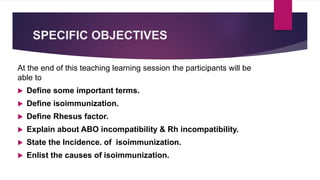
SPECIFIC OBJECTIVES
At the end of this teaching learning session the participants will be
able to
 Define some important terms.
 Define isoimmunization.
 Define Rhesus factor.
 Explain about ABO incompatibility & Rh incompatibility.
 State the Incidence. of isoimmunization.
 Enlist the causes of isoimmunization.
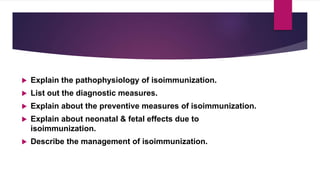
 Explain the pathophysiology of isoimmunization.
 List out the diagnostic measures.
 Explain about the preventive measures of isoimmunization.
 Explain about neonatal & fetal effects due to
isoimmunization.
 Describe the management of isoimmunization.
ISOIMMUNIZATION
SOME TERMINOLOGIES
 ANTIGEN: is any substance that causes your immune system to
produce antibodies against it.
 ANTIBODY: is a protein produced by the body’s immune
system when it detects harmful substances called, antigens.
 HAEMOLYSIS: destruction of RBCs within the body, it may
result from poisoning, infection or the action of antibodies.
 ALLELE: in (x, y) gene x is an allele, i.e, is one of a number of
alternative forms of same gene.
 HYDROPS FETALIS: Is a severe, life threatening
problem in which abnormal amounts of fluid build up
in two or more body areas of a fetus or a newborn.
 SALINE AGGLUTININ[IgM]: This type of antibody is
1st to appear in the maternal circulation. They are
large molecules cannot pass through the placental
barrier & is not harmful to fetus.
 ALBUMIN AGGLUTININ[IgG]: It is also called incomplete
or blocking antibody. Because of its small molecule it can
cross the placenta barrier & cause damage to the fetus.
 TITRE: is a laboratory test that measures the level of
antibodies in a blood sample.
 COOMBS’ TEST: Is used to detect antibodies that are
stuck to the surface of red blood cells.
 KERNICTERUS: is staining and subsequent damage of
the brain by bile pigment(bilirubin), which may occur in
severe cases of hemolytic disease of the newborn.
 AMNIOCENTESIS: Is a the process of withdrawl of a
sample of amniotic fluid surrounding a fetus in the uterus,
by means of a syringe inserted through the abdominal wall
under direct ultrasound guidance.
DEFINITION
Isoimmunization is defined as a
production of immune antibodies in an
individual in response to an antigen
derived from another individual of
same species.
It occurs in two stages.
Sensitization
Immunization
SENSITIZATION
Is defined as alteration of the responsiveness of the body to
the presence of foreign substance. In the development of an
allergy, an individual becomes sensitized to a particular
allergen. The phenomena of sensitization are due to the
production of antibodies. It occurs in the women having Rh
factor negative blood with fetus having Rh positive in utero,
sensitization may occur at first pregnancy and is more likely
in subsequent one.
IMMUNIZATION
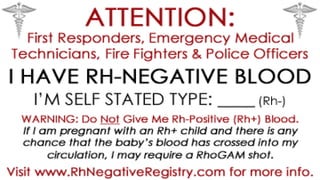
An individual who is Rh negative doesn’t naturally carry
antibodies to the Rhesus factor. If by some means Rh positive
RBCs enter her circulation, they alert the immune system &
antibodies may be produced in order to destroy the foreign
protein. This is most likely to occur if blood from an Rh positive
fetus leaks across the placental barrier and enters the next blood
stream. It may also occur as a result of a mismatched blood
transfusion.
THE RHESUS FACTOR
A group of antigens that may or may not be
present on the surface of the red blood cells. It
forms the basis of the rhesus blood group
system. Most people have the rhesus factor that
is they are rh positive. People who lack the
factor are termed rh negative.
Contd……
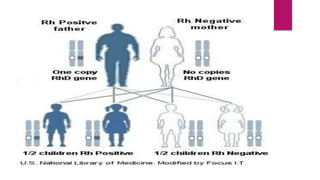
heterozygous positive father: Dd
Homozygous positive father: DD
Rh negative mother: dd
Therefore a heterozygous father may transmit either a positive
or negative gene to his children. But a homozygous father will
always transmit a positive gene therefore the child could be
affected.
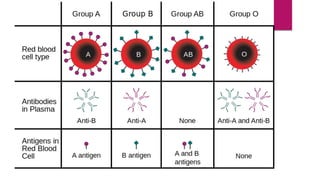
ABO INCOMPATIBILITY
 ABO incompatibility describes an immune reaction that
occurs in the body if two blood samples of different,
incompatible ABO types are mixed together, when these
RBC act as antigen & an immune response is triggered. It
afflicts newborns whose mothers are blood type O, and who
have a baby with type A, B or AB.
Rh INCOMPATIBILITY
 is a condition which develops when a pregnant women has an
Rh negative blood type and the fetus she carries has Rh
positive blood type.
INCIDENCE
Incidence varies in different racial and
geographical groups. It is lowest amongst the
mongoloid races, intermediate amongst the
Asian and Africans and higher amongst the
Caucasians. India got 5%.
CAUSES
 Transfusion of Rh positive blood to a Rh negative women.
 Sizable feto-maternal leak from an Rh positive fetus to an Rh
negative mother. Such a leakage may occur during:
 Early pregnancy loss
• Miscarriage
• Missed abortion
• Elective abortion
1. Contd…
• Ectopic abortion
 Procedures
• Chorionic villus sampling
• Amniocentesis
• Fetal blood sampling
• Caesarean section
 Others
• idiopathic
Contd….
• Maternal trauma
• Manual removal of placenta
• Internal and External version
• Leakage during normal delivery
PATHOPHYSIOLOGY
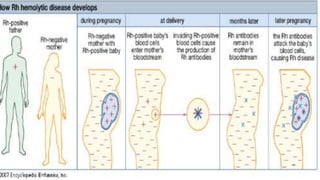
There is normally no mixing of fetal & maternal blood
during pregnancy & labour.
When the placenta begins to separate & the chorionic villi
tear, the risk of feto-maternal transfusion is increased.
Rhesus antigens of the fetal red cell stimulate the
production of maternal antibodies.
Contd…
The first encounter may not result in actual antibody
formation but the women will be sensitized: on a second
encounter antibodies are produced in abundance. Once
formed there antibodies are permanent.
The antibody formed in the maternal system [IgG] crosses
the placenta barrier & enters into fetal circulation.
Contd…
The antibody will not have any effect on Rh negative fetus.
If the fetus is Rh positive, the antibody becomes attached
to the antigen sites on the surface of the erythrocytes.
The affected cells are rapidly removed from the circulation
by the reticulo-endothelial system.
Depending upon the degree of destruction of the fetal red
cells, various types of fetal hemolytic disease appear.
Fetal RBC are broken down, there is decreased level of
RBCs then anemia is seen.
Bilirubin, the end product of RBC breakdown accumulates
in the body cause jaundice.
Due to anemia, the fetal growth is retarded.
Due to jaundice, kernicterus is seen which cause FETAL
DEATH.
DIAGNOSIS
 The essential diagnosis are:
1. The mother must be Rh negative.
2. Presence of maternal Rh antibodies as shown by a positive
indirect coombs’ test on mother’s blood.
3. Maternal antibody titre posing risk to fetus.
4. History of birth of previous affected baby.
5. Fetal cord blood shows low level of Hb% at birth & raised
bilirubins.
6. Recently amniotic fluid bilirubin concentration
evaluate Rh disease which shows bright yellow
color.
DIRECT COOMBS’ TEST
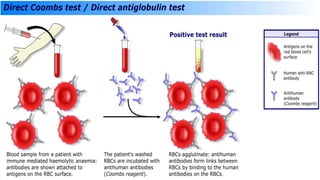
 The direct coombs’ is used to detect these antibodies or
complement proteins that are bound to the surface of RBC. A
blood sample is taken & the RBCs are washed & then
incubated with antihuman globulin[also known as coombs’
reagent]. If this produces agglutination [clumping together] of
RBCs, THE DIRECT COOMBS’ TEST IS POSITIVE.
INDIRECT COOMBS’ TEST
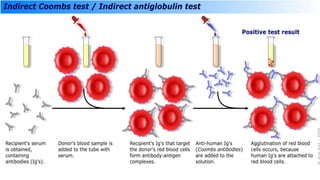
 INDIRECT COOMBS’ TEST: The indirect coomb’s test is used in
prenatal testing of pregnant women , & in testing blood prior to a
blood transfusion. It detects antibodies against RBCs that are
present unbound in the patient’s serum. In this case serum is
extracted from the blood sample taken from the patient. Then the
serum is incubated with the RBC of known reference values from
other patient blood samples. If this produces agglutination of RBCs,
THE INDIRECT COOMBS’ TEST IS POSITIVE.
PREVENTION OF MATERNAL
ISOIMMUNIZATION
There are three ways of preventing a women from
producing rhesus antibodies.
 Avoiding transfusion of Rh positive blood.
o Even a small amount of Rh positive blood introduced into
the circulation of Rh negative person will result in
SENSITIZATION.
o Rh positive blood should never be administered if the
individual’s blood group is unknown & whenever possible
cross matching should be undertaken prior
Contd……
blood transfusion.
 Prevention of avoidable feto-maternal transfusion.
o Precautions during caesarean section; to prevent blood
spilling into the peritoneal cavity.
o Prophylactic ergometrine; with the delivery of the
anterior should preferably be witheld, as it may facilitate
fetomaternal bleed.
Contd……
o Amniocentesis;should be done after sonographic
localisation of the placenta to prevent it’s injury.
o Forcible attempt; to perform external verson under
anaesthesia should be avoided.
o Manual removal of placenta should be done gently.
o To refrain from abdominal palpation as far as possible in
abruptio placenta.
Contd…….
 Administration of ANTI D immunoglobulin
When to administer?
 It should be administered within 72 hours or
preferably earlier following delivery or abortion.
 It should be given provided the baby born is Rh
positive and the direct coombs test is negative.
 In case,where the specified time limit is over
(>72hour)
Contd……..
She may be given up to 14-28 days after delivery
to avoid sensitization.
DOSE;ANTI ‘D’gamma glubulin is administered
intramuscularly to the mother 300 microgram
followig delivery.
Contd…..
 All Rh negative unsensitized women should receive
50 microgram of Rh-immune globulin im within 72
hours of induced abortion, spontaneous abortion,
ectopic pregnancy or chronic villus biopsy in the
first trimester.
 Women with pregnancy beyond 12 weeks should
have full dose of 300 microgram.
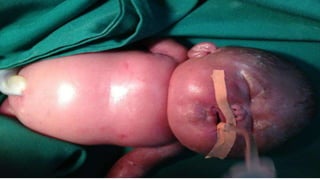
Fetal effects
The effect of Rh isoimmunization on the fetus include
• Destruction of fetal RBC’s cause anaemia with
continious during intrauterine life.
• Erythroblastosis fetalis.
• Hydrops fetalis: tissue hypoxia and acidosis eventually
lead to intra uterine fetal death.
NEONATAL EFFECTS
• Congenital hemolytic anaemia .
• Hyperbilirubinemia, if timely actions are not taken
the hyperbilirubinemia results in deposition of
bilirubin in the basal cerebral ganglia leading to
kernicterus.
• Progressive anemia can lead to congestive
cardiac failure.
• Icterus gravid neonatrum.
MEDICAL MANAGEMENT OF
ISOIMMUNIZATION
 ANTENATAL MANAGEMENT
• Detection of maternal sensitization.
Detection of maternal sensitization is confirmed by the detection of Rh
antibodies in maternal circulation, it is done by titre technique. Titre
below 4IU/ml are unlikely to produce severe fetal disease.
All Rh negative pregnant women should have their blood tested for Rh
antibodies at the 1st antenatal visit and again at 28th & 34th weeks of
gestation. .[acc. To DC Dutta, textbook of obstetrics, 16th edition]
Contd…….
• Management of affected fetus by intrauterine intravascular
transfusion.
Blood may be given to the baby by a needle introduced through
mothers abdomen. Blood is given either intravascularly [into the
umbilical vein] or intraperitoneally.
The first method is preferable, as blood enters the fetal
circulation directly and severely anemic fetuses may be saved.
Contd….
 POSTNATAL MANAGEMENT
Evaluation & management at birth requires close
coordination between obstetrician & neonatologist. The
neonates may be born with anemia, hepato-spleenomegaly &
ascites and rapidly develops hyperbilirubinemia. These infants
are hypo-coagulable & have a tendency of developing
hypoglycemia. The presence of positive DCT is sufficient to
confirm the diagnosis in an Rh positive neonate born to a
sensitized Rh negative women.
Contd…
Treatment of neonatal anemia
In those infants who exhibit only anemia, fresh packed red cells
are to correct this defect.
The management of hydrops fetalis which is the several form of
the disorder is usually done by the rapid correction of anemia
by small exchange transfusion 20 to 40 ml/kg body wt raises
the hematocrit sufficiently.
Contd…
 TREATMENT OF NEONATAL JAUNDICE.
Phototherapy exposure of neonates to light with wave length
of 420-470mm results in addition of bilirubin & convertion to
products that are water soluble, are not neurotoxic and which
can be excreted via stool and urine. It takes 12-24 hrs to be
effective.
Contd…
Exchange transfusion: helps by removing unconjugated
bilirubin & Rh positive cells coated with antibodies.
Traditionally double volume exchange transfusion done via
umbilical vein using group specific negative blood cross
matched with mothers serum effectively.
NURSING MANAGEMENT
1. All pregnant women should be screened for blood ABO & Rh
groups at the first antenatal visit.
2. If negative, she is advised to obtain her husband’s ABO & Rh
group.
3. At 35wks, repeat maternal blood for Rh antibodies. If negative,
observe her until delivery. If positive, treat her like any Rh
sensitized patient.
4. Collect previous history.
Contd…..
5 .The prevention of maternal sensitization due to Rh positive fetal
RBCs that leak into the maternal circulation, when the placenta
separation at delivery, is achieved by the administration of HUMAN
Rh ANTI-D within 72 hrs of the event.
6. send grouping & Rh typing of baby after delivery as well as
serum bilirubin to detect neonatal jaundice.
7. observe for anemia, jaundice, sucking reflex, irritability,etc.
Contd……
8. Observe the child for change in color of urine & stool.
9.counsel the patient party before phototherapy & exchange blood
transfusion.
10.phototherapy care should be provided.
11. Prevent from complications of phototherapy
REFERENCES
 Cunningham F, Macdonald P, & Leveno k, William’s obstetrics, 19th
edition,1993 page no:1004-1006.
 Bennett V, Brown L, Myles textbook for midwives, 12th edition,1996, page
no: 543-545.
 Daffary N, Shirish, Manual of obstetrics, 2nd edition, 2007, Read elsevier
India Pvt. Ltd.page no:167-171.
 Mudaliar & Menons, Clinical obstetrics, 9th edition, 1995, Orientlongman,
397-399, 202
 Thomas R, Moore, Robert R, Gynaecology & obstetrics, 7th edition, 1993,
page no; 444.
 Chamberlian G, Turnbull’s obstetrics, 3rd edition, 2004, Library of
congress cataloging in publication data, page no: 247-261.
 Tuitui R, Suwal SN, Mannual of Midwifery-I, 8th edition, 2012, page no:
321-324.
 Tuitui R, Suwal SN, Mannual of Midwifery-III, 8th edition, 2012, page no:
234-235.
 Shrestha U, Tuladhar K, Integrated science, 4th edition, 2009, Makalu
publication, page no: 83-85.
Isoimmunization
Isoimmunization

Isoimmunization

  • 2.
    Group Member  KalpanaKawan  Bibechana Gautam  Bhagishori Singh  Buddhisara Sunar  Gunjan Rawal  Khushi Hirachan  Lalita Devi Kumai
  • 3.
  • 5.
    GENERAL OBJECTIVES At theend of this teaching learning session the participants will be able to explain about ISOIMMUNIZATION.
  • 6.
    SPECIFIC OBJECTIVES At theend of this teaching learning session the participants will be able to  Define some important terms.  Define isoimmunization.  Define Rhesus factor.  Explain about ABO incompatibility & Rh incompatibility.  State the Incidence. of isoimmunization.  Enlist the causes of isoimmunization.
  • 7.
     Explain thepathophysiology of isoimmunization.  List out the diagnostic measures.  Explain about the preventive measures of isoimmunization.  Explain about neonatal & fetal effects due to isoimmunization.  Describe the management of isoimmunization.
  • 8.
  • 9.
    SOME TERMINOLOGIES  ANTIGEN:is any substance that causes your immune system to produce antibodies against it.  ANTIBODY: is a protein produced by the body’s immune system when it detects harmful substances called, antigens.  HAEMOLYSIS: destruction of RBCs within the body, it may result from poisoning, infection or the action of antibodies.  ALLELE: in (x, y) gene x is an allele, i.e, is one of a number of alternative forms of same gene.
  • 10.
     HYDROPS FETALIS:Is a severe, life threatening problem in which abnormal amounts of fluid build up in two or more body areas of a fetus or a newborn.  SALINE AGGLUTININ[IgM]: This type of antibody is 1st to appear in the maternal circulation. They are large molecules cannot pass through the placental barrier & is not harmful to fetus.
  • 11.
     ALBUMIN AGGLUTININ[IgG]:It is also called incomplete or blocking antibody. Because of its small molecule it can cross the placenta barrier & cause damage to the fetus.  TITRE: is a laboratory test that measures the level of antibodies in a blood sample.  COOMBS’ TEST: Is used to detect antibodies that are stuck to the surface of red blood cells.
  • 12.
     KERNICTERUS: isstaining and subsequent damage of the brain by bile pigment(bilirubin), which may occur in severe cases of hemolytic disease of the newborn.  AMNIOCENTESIS: Is a the process of withdrawl of a sample of amniotic fluid surrounding a fetus in the uterus, by means of a syringe inserted through the abdominal wall under direct ultrasound guidance.
  • 13.
    DEFINITION Isoimmunization is definedas a production of immune antibodies in an individual in response to an antigen derived from another individual of same species.
  • 14.
    It occurs intwo stages. Sensitization Immunization
  • 15.
    SENSITIZATION Is defined asalteration of the responsiveness of the body to the presence of foreign substance. In the development of an allergy, an individual becomes sensitized to a particular allergen. The phenomena of sensitization are due to the production of antibodies. It occurs in the women having Rh factor negative blood with fetus having Rh positive in utero, sensitization may occur at first pregnancy and is more likely in subsequent one.
  • 16.
    IMMUNIZATION An individual whois Rh negative doesn’t naturally carry antibodies to the Rhesus factor. If by some means Rh positive RBCs enter her circulation, they alert the immune system & antibodies may be produced in order to destroy the foreign protein. This is most likely to occur if blood from an Rh positive fetus leaks across the placental barrier and enters the next blood stream. It may also occur as a result of a mismatched blood transfusion.
  • 17.
    THE RHESUS FACTOR Agroup of antigens that may or may not be present on the surface of the red blood cells. It forms the basis of the rhesus blood group system. Most people have the rhesus factor that is they are rh positive. People who lack the factor are termed rh negative.
  • 18.
    Contd…… heterozygous positive father:Dd Homozygous positive father: DD Rh negative mother: dd Therefore a heterozygous father may transmit either a positive or negative gene to his children. But a homozygous father will always transmit a positive gene therefore the child could be affected.
  • 20.
    ABO INCOMPATIBILITY  ABOincompatibility describes an immune reaction that occurs in the body if two blood samples of different, incompatible ABO types are mixed together, when these RBC act as antigen & an immune response is triggered. It afflicts newborns whose mothers are blood type O, and who have a baby with type A, B or AB.
  • 22.
    Rh INCOMPATIBILITY  isa condition which develops when a pregnant women has an Rh negative blood type and the fetus she carries has Rh positive blood type.
  • 23.
    INCIDENCE Incidence varies indifferent racial and geographical groups. It is lowest amongst the mongoloid races, intermediate amongst the Asian and Africans and higher amongst the Caucasians. India got 5%.
  • 24.
    CAUSES  Transfusion ofRh positive blood to a Rh negative women.  Sizable feto-maternal leak from an Rh positive fetus to an Rh negative mother. Such a leakage may occur during:  Early pregnancy loss • Miscarriage • Missed abortion • Elective abortion
  • 25.
    1. Contd… • Ectopicabortion  Procedures • Chorionic villus sampling • Amniocentesis • Fetal blood sampling • Caesarean section  Others • idiopathic
  • 26.
    Contd…. • Maternal trauma •Manual removal of placenta • Internal and External version • Leakage during normal delivery
  • 27.
    PATHOPHYSIOLOGY There is normallyno mixing of fetal & maternal blood during pregnancy & labour. When the placenta begins to separate & the chorionic villi tear, the risk of feto-maternal transfusion is increased. Rhesus antigens of the fetal red cell stimulate the production of maternal antibodies.
  • 28.
    Contd… The first encountermay not result in actual antibody formation but the women will be sensitized: on a second encounter antibodies are produced in abundance. Once formed there antibodies are permanent. The antibody formed in the maternal system [IgG] crosses the placenta barrier & enters into fetal circulation.
  • 29.
    Contd… The antibody willnot have any effect on Rh negative fetus. If the fetus is Rh positive, the antibody becomes attached to the antigen sites on the surface of the erythrocytes.
  • 30.
    The affected cellsare rapidly removed from the circulation by the reticulo-endothelial system. Depending upon the degree of destruction of the fetal red cells, various types of fetal hemolytic disease appear.
  • 31.
    Fetal RBC arebroken down, there is decreased level of RBCs then anemia is seen. Bilirubin, the end product of RBC breakdown accumulates in the body cause jaundice.
  • 32.
    Due to anemia,the fetal growth is retarded. Due to jaundice, kernicterus is seen which cause FETAL DEATH.
  • 34.
    DIAGNOSIS  The essentialdiagnosis are: 1. The mother must be Rh negative. 2. Presence of maternal Rh antibodies as shown by a positive indirect coombs’ test on mother’s blood. 3. Maternal antibody titre posing risk to fetus. 4. History of birth of previous affected baby. 5. Fetal cord blood shows low level of Hb% at birth & raised bilirubins.
  • 35.
    6. Recently amnioticfluid bilirubin concentration evaluate Rh disease which shows bright yellow color.
  • 36.
    DIRECT COOMBS’ TEST The direct coombs’ is used to detect these antibodies or complement proteins that are bound to the surface of RBC. A blood sample is taken & the RBCs are washed & then incubated with antihuman globulin[also known as coombs’ reagent]. If this produces agglutination [clumping together] of RBCs, THE DIRECT COOMBS’ TEST IS POSITIVE.
  • 38.
    INDIRECT COOMBS’ TEST INDIRECT COOMBS’ TEST: The indirect coomb’s test is used in prenatal testing of pregnant women , & in testing blood prior to a blood transfusion. It detects antibodies against RBCs that are present unbound in the patient’s serum. In this case serum is extracted from the blood sample taken from the patient. Then the serum is incubated with the RBC of known reference values from other patient blood samples. If this produces agglutination of RBCs, THE INDIRECT COOMBS’ TEST IS POSITIVE.
  • 40.
    PREVENTION OF MATERNAL ISOIMMUNIZATION Thereare three ways of preventing a women from producing rhesus antibodies.  Avoiding transfusion of Rh positive blood. o Even a small amount of Rh positive blood introduced into the circulation of Rh negative person will result in SENSITIZATION. o Rh positive blood should never be administered if the individual’s blood group is unknown & whenever possible cross matching should be undertaken prior
  • 41.
    Contd…… blood transfusion.  Preventionof avoidable feto-maternal transfusion. o Precautions during caesarean section; to prevent blood spilling into the peritoneal cavity. o Prophylactic ergometrine; with the delivery of the anterior should preferably be witheld, as it may facilitate fetomaternal bleed.
  • 42.
    Contd…… o Amniocentesis;should bedone after sonographic localisation of the placenta to prevent it’s injury. o Forcible attempt; to perform external verson under anaesthesia should be avoided. o Manual removal of placenta should be done gently. o To refrain from abdominal palpation as far as possible in abruptio placenta.
  • 43.
    Contd…….  Administration ofANTI D immunoglobulin When to administer?  It should be administered within 72 hours or preferably earlier following delivery or abortion.  It should be given provided the baby born is Rh positive and the direct coombs test is negative.  In case,where the specified time limit is over (>72hour)
  • 44.
    Contd…….. She may begiven up to 14-28 days after delivery to avoid sensitization. DOSE;ANTI ‘D’gamma glubulin is administered intramuscularly to the mother 300 microgram followig delivery.
  • 45.
    Contd…..  All Rhnegative unsensitized women should receive 50 microgram of Rh-immune globulin im within 72 hours of induced abortion, spontaneous abortion, ectopic pregnancy or chronic villus biopsy in the first trimester.  Women with pregnancy beyond 12 weeks should have full dose of 300 microgram.
  • 46.
    Fetal effects The effectof Rh isoimmunization on the fetus include • Destruction of fetal RBC’s cause anaemia with continious during intrauterine life. • Erythroblastosis fetalis. • Hydrops fetalis: tissue hypoxia and acidosis eventually lead to intra uterine fetal death.
  • 48.
    NEONATAL EFFECTS • Congenitalhemolytic anaemia . • Hyperbilirubinemia, if timely actions are not taken the hyperbilirubinemia results in deposition of bilirubin in the basal cerebral ganglia leading to kernicterus. • Progressive anemia can lead to congestive cardiac failure. • Icterus gravid neonatrum.
  • 49.
    MEDICAL MANAGEMENT OF ISOIMMUNIZATION ANTENATAL MANAGEMENT • Detection of maternal sensitization. Detection of maternal sensitization is confirmed by the detection of Rh antibodies in maternal circulation, it is done by titre technique. Titre below 4IU/ml are unlikely to produce severe fetal disease. All Rh negative pregnant women should have their blood tested for Rh antibodies at the 1st antenatal visit and again at 28th & 34th weeks of gestation. .[acc. To DC Dutta, textbook of obstetrics, 16th edition]
  • 50.
    Contd……. • Management ofaffected fetus by intrauterine intravascular transfusion. Blood may be given to the baby by a needle introduced through mothers abdomen. Blood is given either intravascularly [into the umbilical vein] or intraperitoneally. The first method is preferable, as blood enters the fetal circulation directly and severely anemic fetuses may be saved.
  • 51.
    Contd….  POSTNATAL MANAGEMENT Evaluation& management at birth requires close coordination between obstetrician & neonatologist. The neonates may be born with anemia, hepato-spleenomegaly & ascites and rapidly develops hyperbilirubinemia. These infants are hypo-coagulable & have a tendency of developing hypoglycemia. The presence of positive DCT is sufficient to confirm the diagnosis in an Rh positive neonate born to a sensitized Rh negative women.
  • 52.
    Contd… Treatment of neonatalanemia In those infants who exhibit only anemia, fresh packed red cells are to correct this defect. The management of hydrops fetalis which is the several form of the disorder is usually done by the rapid correction of anemia by small exchange transfusion 20 to 40 ml/kg body wt raises the hematocrit sufficiently.
  • 53.
    Contd…  TREATMENT OFNEONATAL JAUNDICE. Phototherapy exposure of neonates to light with wave length of 420-470mm results in addition of bilirubin & convertion to products that are water soluble, are not neurotoxic and which can be excreted via stool and urine. It takes 12-24 hrs to be effective.
  • 54.
    Contd… Exchange transfusion: helpsby removing unconjugated bilirubin & Rh positive cells coated with antibodies. Traditionally double volume exchange transfusion done via umbilical vein using group specific negative blood cross matched with mothers serum effectively.
  • 55.
    NURSING MANAGEMENT 1. Allpregnant women should be screened for blood ABO & Rh groups at the first antenatal visit. 2. If negative, she is advised to obtain her husband’s ABO & Rh group. 3. At 35wks, repeat maternal blood for Rh antibodies. If negative, observe her until delivery. If positive, treat her like any Rh sensitized patient. 4. Collect previous history.
  • 56.
    Contd….. 5 .The preventionof maternal sensitization due to Rh positive fetal RBCs that leak into the maternal circulation, when the placenta separation at delivery, is achieved by the administration of HUMAN Rh ANTI-D within 72 hrs of the event. 6. send grouping & Rh typing of baby after delivery as well as serum bilirubin to detect neonatal jaundice. 7. observe for anemia, jaundice, sucking reflex, irritability,etc.
  • 57.
    Contd…… 8. Observe thechild for change in color of urine & stool. 9.counsel the patient party before phototherapy & exchange blood transfusion. 10.phototherapy care should be provided. 11. Prevent from complications of phototherapy
  • 60.
    REFERENCES  Cunningham F,Macdonald P, & Leveno k, William’s obstetrics, 19th edition,1993 page no:1004-1006.  Bennett V, Brown L, Myles textbook for midwives, 12th edition,1996, page no: 543-545.  Daffary N, Shirish, Manual of obstetrics, 2nd edition, 2007, Read elsevier India Pvt. Ltd.page no:167-171.  Mudaliar & Menons, Clinical obstetrics, 9th edition, 1995, Orientlongman, 397-399, 202  Thomas R, Moore, Robert R, Gynaecology & obstetrics, 7th edition, 1993, page no; 444.
  • 61.
     Chamberlian G,Turnbull’s obstetrics, 3rd edition, 2004, Library of congress cataloging in publication data, page no: 247-261.  Tuitui R, Suwal SN, Mannual of Midwifery-I, 8th edition, 2012, page no: 321-324.  Tuitui R, Suwal SN, Mannual of Midwifery-III, 8th edition, 2012, page no: 234-235.  Shrestha U, Tuladhar K, Integrated science, 4th edition, 2009, Makalu publication, page no: 83-85.

Editor's Notes