`Young Adulthood
Lifesty`T56156OIle
:Family Planning
Prepared By:
Group: 5
Sita Shah
Sarita Tripathi
Smriti Gautam
General Objective:
At the end of this session participants
would be able to explain about lifestyle of
young adulthood regarding family planning.
Specific Objectives:
 At the end of the session participants would be able to
expalin about :
family planning
 Reason for childbearing
 Developmental task for the couple during the
expectant stage .
 Developmental Task that must be mastered during
pregnancy and intra partum period to ensure
readiness for the maternal role are:
Young Adulthood
Lifestyle :Family Planning
 Young adulthood is a crucial period for marriage
and child bearing in Nepal. It can be termed as the
expectancy and parenthood Stage .
 Family planning: is a conscious activity of
reproductive age that inclines, not only to regulate
the number and timing of birth, but also to have a
healthy child and to fulfill all its role throughout
the life cycle.
Data:
Source: reproduced from Aguilar and Cortez 2015 , based on NDHS 2011 data.
Early marriage : (i.e below the legally specified threshold) remains
common. In 2011 , 29% of adolescent girls age 15 to 19 were in
formal marriage compared to 7 % boys of the same age group. The
proportion of married women and men is 77% and 45% at age 20-24
years.
Child Bearing : Adolescents childbearing is still common but
decreasing . The percentage of adolescents girls and young women aged
15-24 who are pregnant or have had children decreased from 48% in 1966
to 39% in 2011.Child bearing is far more prevalent among women age
20-40 then women age 15-19 years . The decline in adolescent child
bearing between 1996 and 2011 is pronounced in both age groups.
 Parenthood and Family Planning are options for the
couple; as there is availability of family planning
methods.
 There are variety of family Planning methods like
temporary .Example: Oral Contraceptives , norplant,
IUCD, condom as well as Permanent Family planning
methods .Examples :Minilap , Laparoscopy for female
and Vasectomy for male.
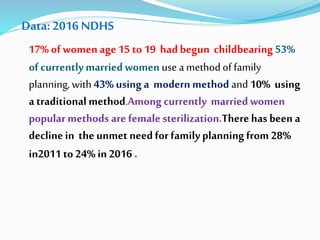
Data: 2016 NDHS
17% of womenage 15 to 19 had begun childbearing 53%
of currentlymarriedwomen use a methodof family
planning,with 43% using a modern method and 10% using
a traditionalmethod.Among currently marriedwomen
popular methods are femalesterilization.Therehas been a
declinein the unmet need for familyplanning from 28%
in2011 to 24% in 2016 .
 These methods make possible couple to say “we don’t
want children now “, “We don’t want children ever”,
“We want to have two children spaced three years
apart.”
 All Family planning methods help to avoid unwanted
birth and some of them even prevent from sexually
transmitted infections.
Reasons For Child Bearing :
The couple may have child for variety of reasons:
 Psychological and spiritual fulfillment of having a child.
 Extension of self .
 Sense of pride or joy.
 Offset of loneliness.
 Have someone to love self.
 Attempt to hold marriage together.
 Feeling of power, generated by ability to create life
 Representation of wealth.
 Have an heir for family name and wealth or family business.
 10.Religious convictions.
Developmental Task for the
couple during the expectant stage
 Re –arrange the home to provide space , facilities and
supplies for expected babies.
 Re-work the budget and determine how to obtain and
spend income to accommodate changing needs and
maintain the family unit financially.
 Evaluate the changing roles , divisions of labour ,how
responsibility of child care will be divided, who has the
final authority, and weather the mother should continue
working outside the home if she has a career or profession.
 Adapt pattern of sexual behaviors to the pregnant
status .
 Re-work the communication system between the
couple , explore feelings about the pregnancy and
ideas about children and parenthood.
 Acquire knowledge about pregnancy, childbirth and
parenthood.
Developmental Task that must be mastered during pregnancy
and intra partum period to ensure readiness for the maternal
role are:
 Pregnancy Validation: Accepting the reality of the
pregnancy, working through feeling of ambivalence.
 Fetal Embodiment: Incorporating the fetus and
enlarging body into image .
 Fetal Distinction: seeing a fetus as the separate
entity, fantasizing what the baby will be like.
 Role Transition: After birth an increasing readiness
to take on the task of parenthood.
Transition to parenthood, feelings, symptoms, body
image changes and need for social support during
pregnancy all affect family functioning and child
care after birth.
REFERENCES
 Murray,R.B.,Zentner,J.P and Yakima,R,2009.Health
promotion strategies through the life span 8th
edition.page no.534,535,536
 http:/www.dhsprogram.com>pubs>pdf

Young adulthood(1)

  • 1.
    `Young Adulthood Lifesty`T56156OIle :Family Planning PreparedBy: Group: 5 Sita Shah Sarita Tripathi Smriti Gautam
  • 2.
    General Objective: At theend of this session participants would be able to explain about lifestyle of young adulthood regarding family planning.
  • 3.
    Specific Objectives:  Atthe end of the session participants would be able to expalin about : family planning  Reason for childbearing  Developmental task for the couple during the expectant stage .  Developmental Task that must be mastered during pregnancy and intra partum period to ensure readiness for the maternal role are:
  • 4.
    Young Adulthood Lifestyle :FamilyPlanning  Young adulthood is a crucial period for marriage and child bearing in Nepal. It can be termed as the expectancy and parenthood Stage .  Family planning: is a conscious activity of reproductive age that inclines, not only to regulate the number and timing of birth, but also to have a healthy child and to fulfill all its role throughout the life cycle.
  • 5.
    Data: Source: reproduced fromAguilar and Cortez 2015 , based on NDHS 2011 data. Early marriage : (i.e below the legally specified threshold) remains common. In 2011 , 29% of adolescent girls age 15 to 19 were in formal marriage compared to 7 % boys of the same age group. The proportion of married women and men is 77% and 45% at age 20-24 years. Child Bearing : Adolescents childbearing is still common but decreasing . The percentage of adolescents girls and young women aged 15-24 who are pregnant or have had children decreased from 48% in 1966 to 39% in 2011.Child bearing is far more prevalent among women age 20-40 then women age 15-19 years . The decline in adolescent child bearing between 1996 and 2011 is pronounced in both age groups.
  • 6.
     Parenthood andFamily Planning are options for the couple; as there is availability of family planning methods.  There are variety of family Planning methods like temporary .Example: Oral Contraceptives , norplant, IUCD, condom as well as Permanent Family planning methods .Examples :Minilap , Laparoscopy for female and Vasectomy for male.
  • 7.
    Data: 2016 NDHS 17%of womenage 15 to 19 had begun childbearing 53% of currentlymarriedwomen use a methodof family planning,with 43% using a modern method and 10% using a traditionalmethod.Among currently marriedwomen popular methods are femalesterilization.Therehas been a declinein the unmet need for familyplanning from 28% in2011 to 24% in 2016 .
  • 8.
     These methodsmake possible couple to say “we don’t want children now “, “We don’t want children ever”, “We want to have two children spaced three years apart.”  All Family planning methods help to avoid unwanted birth and some of them even prevent from sexually transmitted infections.
  • 9.
    Reasons For ChildBearing : The couple may have child for variety of reasons:  Psychological and spiritual fulfillment of having a child.  Extension of self .  Sense of pride or joy.  Offset of loneliness.  Have someone to love self.  Attempt to hold marriage together.  Feeling of power, generated by ability to create life  Representation of wealth.  Have an heir for family name and wealth or family business.  10.Religious convictions.
  • 10.
    Developmental Task forthe couple during the expectant stage  Re –arrange the home to provide space , facilities and supplies for expected babies.  Re-work the budget and determine how to obtain and spend income to accommodate changing needs and maintain the family unit financially.  Evaluate the changing roles , divisions of labour ,how responsibility of child care will be divided, who has the final authority, and weather the mother should continue working outside the home if she has a career or profession.
  • 11.
     Adapt patternof sexual behaviors to the pregnant status .  Re-work the communication system between the couple , explore feelings about the pregnancy and ideas about children and parenthood.  Acquire knowledge about pregnancy, childbirth and parenthood.
  • 12.
    Developmental Task thatmust be mastered during pregnancy and intra partum period to ensure readiness for the maternal role are:  Pregnancy Validation: Accepting the reality of the pregnancy, working through feeling of ambivalence.  Fetal Embodiment: Incorporating the fetus and enlarging body into image .
  • 13.
     Fetal Distinction:seeing a fetus as the separate entity, fantasizing what the baby will be like.  Role Transition: After birth an increasing readiness to take on the task of parenthood. Transition to parenthood, feelings, symptoms, body image changes and need for social support during pregnancy all affect family functioning and child care after birth.
  • 14.
    REFERENCES  Murray,R.B.,Zentner,J.P andYakima,R,2009.Health promotion strategies through the life span 8th edition.page no.534,535,536  http:/www.dhsprogram.com>pubs>pdf