SHOCK
Dr. S M Safayet Hosen
MD-(Resident) Phase A
Definition
Shock is the clinical syndrome
 Inadequate tissue perfusion
 The hypoperfusion-induced imbalance
between the delivery & requirements for
oxygen
 Substrate leads to cellular dysfunction
Types of Shock
SHOCK
Low stroke
volume
Hypovolaemic
Haemorrhage
Burn
Salt & water loss
Cardiogenic
MI
acute mitral
regurgitation
Obstructive
PE
Cardiac Tamponade
Tension
pneumothorax
Vasodilatation/
Distributive
Sepsis/SIRS
infection
Anaphylactic
Injection-penicillin
Bee sting
Anesthetics
selfish
Neurogenic Trauma to spinal cord
Spinal anesthesia
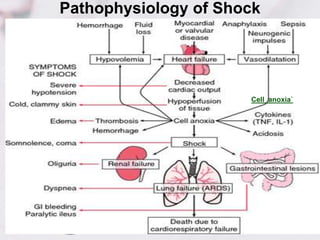
Pathophysiology of Shock
Cell anoxia`
HYPOVOLAEMIC
SHOCK
Hypovolaemic shock
Due to
a) Haemorrhage
-External from wounds, open fractures
-Internal from injury to spleen, liver,
mesentery or pelvis
b) Severe burn which result in loss of plasma
C) intestinal obstruction
c) Diarrhoea & vomiting of any cause
Hypovolaemic shock- Pathophysiology
Due to sudden loss blood volume or fluid from the vascular space.
Loss of blood
Filling of rt. Heart
Filling of pulmonary
vasculature
Filling of left
atrium & ventricle
Stroke
volume
Arterial
BP
SHOCK
Stages of Shock
Hypovolaemic shock- Management
ABC (AIRWAY is always first)
Control hemorrhage (splint the limb)
Obtain IV access with wide bore cannula
Resuscitate with fluids and blood
- Isotonic saline/ ringer’s lactate solution
- Blood transfusion if Hb <10g/dl
**Supplemental oxygen should always be
provided
Management goals AFTER securing the ABCs..
• STOP THE BLEEDING
• RESTORE VOLUME
• CORRECT ANY ELECTROLYTE/ACID-BASE
DISTURBANCES
Monitoring
Urine output
Vital signs
Skin perfusion
SP02 - Pulse Oximetry
CARDIOGENIC
SHOCK
Cardiogenic shock /Acute circulatory Failure
• Is a state of end-organ hypoperfusion due to
cardiac failure.
• Cardiogenic shock
-systemic hypoperfusion due to severe
depression of the cardiac index (<2.2 [L/min]/m2)
- sustained systolic arterial hypotension (<90
mmHg) despite an elevated filling pressure
(pulmonary capillary wedge pressure [PCWP]
>18 mmHg)
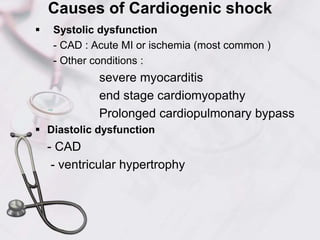
Causes of Cardiogenic shock
 Systolic dysfunction
- CAD : Acute MI or ischemia (most common )
- Other conditions :
severe myocarditis
end stage cardiomyopathy
Prolonged cardiopulmonary bypass
 Diastolic dysfunction
- CAD
- ventricular hypertrophy
 Valvular or structural abnormality
(acute valve failure)
Aortic Regurgitation
-Aortic dissection
-Infective endocarditis
Mitral regurgitation
-Papillary muscle rupture due to acute MI
-Infective endocarditis
Prosthetic valve failure
-Mechanical valves: fracture , jamming, thrombosis
-Biological valves: degeneration with cusp tear
 Arrhythmia
- VT/VF, bradycardia can cause shock
- sinus tachycardia can aggravate shock
 Others
Restrictive cardiomyopathy
HOCM with Severe outflow obstruction
Prolong hypovolemia or septic shock
β-Blocker/CCB overdose
Pathophysiology of cardiogenic shock
Risk factors for Cardiogenic Shock
Older Age
Prior MI
Diabetes Mellitus
HTN
Anterior MI
Extensive coronary artery stenosis
History of HF
STEMI New LBBB
Diagnosis
• Proper history & clinical examination
• ECG
• Chest X-ray
• Echocardiogram
• Blood specimen for laboratory investigation
** Supportive therapy must be initiated
simultaneously with diagnostic evaluation
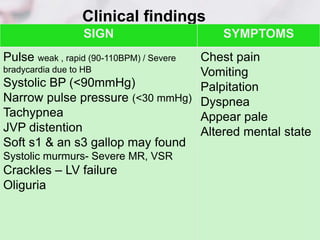
Clinical findings
SIGN SYMPTOMS
Pulse weak , rapid (90-110BPM) / Severe
bradycardia due to HB
Systolic BP (<90mmHg)
Narrow pulse pressure (<30 mmHg)
Tachypnea
JVP distention
Soft s1 & an s3 gallop may found
Systolic murmurs- Severe MR, VSR
Crackles – LV failure
Oliguria
Chest pain
Vomiting
Palpitation
Dyspnea
Appear pale
Altered mental state
A. General Measures
• In addition to immediate treatment of acute MI initial
therapy aimed
• Maintaining systemic BP by Vasopressors
• Ensure LV filling pressure by adjusting volume status
• Correct hypoxemia & acidosis
• May need ventilatory support
• Negative ionotropics must stopped
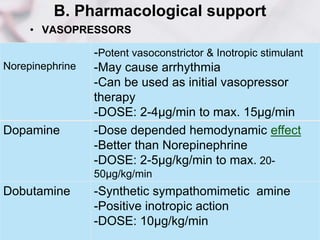
B. Pharmacological support
• VASOPRESSORS
Norepinephrine
-Potent vasoconstrictor & Inotropic stimulant
-May cause arrhythmia
-Can be used as initial vasopressor
therapy
-DOSE: 2-4µg/min to max. 15µg/min
Dopamine -Dose depended hemodynamic effect
-Better than Norepinephrine
-DOSE: 2-5µg/kg/min to max. 20-
50µg/kg/min
Dobutamine -Synthetic sympathomimetic amine
-Positive inotropic action
-DOSE: 10µg/kg/min
Inotropes and Vasopressors
(ACC/AHA Guidelines)
• SBP <70 mmHg
Norepinephrine (2-4µg/min to max. 15µg/min)
Switch to Dopamine (2-4µg/min to max. 15µg/min) once SBP ≥80
• SBP 70-100 mmHg
Dopamine (2-4µg/min to max. 15µg/min)
Add Dobutamine (2-20 g/kg/min) once SBP ≥90
C. Mechanical support
 IABP
- Improve coronary & peripheral perfussion
- Initiate as quick as possible
- Higher rates of survival in high use centers
 Newer devices
- LV, RV or BiV assist. Devices
- Impella, tendem heart, Extarcorporeal life
support (ECLS)
- Trials have shown hemodynamic
improvement but no survival benefit found
D. REPERFUSION-REVASCULARIZATION
Early revascularization with PCI / CABG is recommended
**from ACC/AHA guidelines. IRA, infarct-related artery , IABP- Intra-aortic balloon
counterpulsation/pump
E. Treatment according to cause
Shock due to
RV infract
-3% of cardiogenic shock due to RV infract
& inf. Ischemia
-Fluid resuscitation
-Dopamine / Dobutamine
-Early reestablishment of infract artery flow
MR -Severe MR due to rupture papillary muscle
-Diagnosis: Echo-Doppler
-Rapid stabilization with IABP
-Dopamine / Dobutamine
VSR -Diagnosis: Echo-Doppler(Blood shunting Lt. to
Rt. & open in interventricular septum)
-Rapid stabilization with IABP
-Dopamine / Dobutamine
AHA Guideline
 Class I
1. Early revascularization (PCI/CABG)
2. Fibrinolysis in candidates unsuitable for ERV with
no contraindications
 Class II a
1. Use of IABP can be useful in pt. with CS who
don’t quickly stabilize with pharmacologic therapy
 Class II b
Alternative LV assist device may be considered in pt
with refractory CS
ANAPHYLACTIC
SHOCK
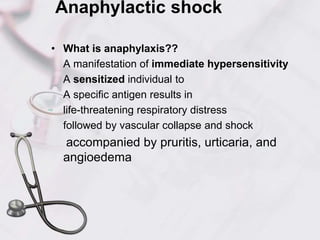
Anaphylactic shock
• What is anaphylaxis??
A manifestation of immediate hypersensitivity
A sensitized individual to
A specific antigen results in
life-threatening respiratory distress
followed by vascular collapse and shock
accompanied by pruritis, urticaria, and
angioedema
Etiology
• Medications, including antibiotics (especially penicillin
and sulfa), vaccines, opiates, aspirin, NSAIDs, local
anesthetics, intravenous fluids with dextran, and insulin
• Foods, such as nuts, milk, eggs, soy, wheat, and
seafood
• Stings by fire ants and Hymenoptera species (eg, bees,
wasps, yellow jackets, hornets)
• Latex
• Blood products, including plasma, immunoglobulin,
cryoprecipitate, and whole blood
• Idiopathic origins
• Exercise causes
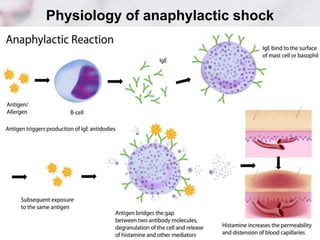
Physiology of anaphylactic shock
OBSTRUCTIVE
SHOCK
Obstructive shock
• Extra-cardiac obstruction to flow in the
cardiovascular circuit
• Either impairment of diastolic filling or excessive
afterload
Etiology
- Tension pneumothorax
- Pericardial tamponade
-Massive Pulmonary embolus
-IVC Obstruction
DVT
Gravid uterus on IVC
Neoplasm
-Increased intrathoracic pressure
Excess positive end expiratory pressure
neoplasm
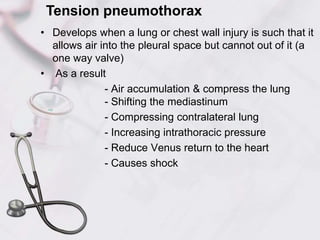
• Develops when a lung or chest wall injury is such that it
allows air into the pleural space but cannot out of it (a
one way valve)
• As a result
- Air accumulation & compress the lung
- Shifting the mediastinum
- Compressing contralateral lung
- Increasing intrathoracic pressure
- Reduce Venus return to the heart
- Causes shock
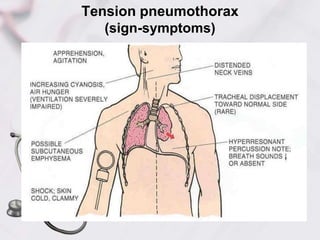
Tension pneumothorax
(sign-symptoms)
Tension pneumothorax
(Management)
1.initial management – needle thoracostomy
Convert the tension pneumothorax to a simple
pneumothorax
2. Definitive management : Chest tube insertion
3. Supportive management:
-Analgesia
-Ventilatory support
-CXR monitoring
-Chest physiotherapy
NEUROGENIC
SHOCK
NEUROGENIC SHOCK
• A type of distributive shock that results from the loss or
suppression of sympathetic tone
• Causes massive vasodilatation in the venous vasculature
→ ↓venous return to heart → ↓cardiac output
• Most common etiology: Spinal cord injury
**Neurogenic shock is the rarest form of
shock
Causes of Neurogenic Shock
The Common Causes Of Neurogenic Shock Include:
• Blunt or penetrating injury to the spinal cord
• Trauma to the spinal cord from
motor vehicle accidents, sports injuries, falls, stab
and gunshot wounds.
• Improper administration of regional anesthesia can
also cause neurogenic shock.
• Devastating head injury
• Drugs and medications which affect the autonomic
nervous system can also cause neurogenic shock.
Pathophysiology of Neurogenic Shock
Disruption of sympathetic nervous system
Loss of sympathetic tone
Venous and arterial vasodilation
↓ venous return
↓ stroke volume
↓ cardiac output
↓ cellular oxygen supply
↓ tissue perfusion
Impaired cellular metabolism
Assessment of Neurogenic Shock
• PATIENT ASSESSMENT
-Hypotension
-Bradycardia
-Hypothermia
-Warm, dry skin
- ↓CO
-Flaccid paralysis below level of the spinal lesion
Patient Also Experiences
-SOB , rapid and deep shallow breathing.
-Facial pallor, Dizziness, lightheadedness, fainting.
-Nausea and vomiting.
- weakness due to insufficient blood supply.
-may changes in mental state or disorientation.
-Has bluish discoloration of lips and fingers (cyanosis).
-Decreased or absent urine output.
-Sweats profusely.
-Considerable chest pain
-Loss of consciousness
Treatment For Neurogenic Shock
• Neurogenic shock is a serious condition
• Requires emergent medical care
• Airway, Breathing and Circulation (ABC)
• Immobilize the patient, especially the spinal region
to prevent any further damage to the spinal cord.
• IV fluids to stabilize the patient's blood pressure
• Inotropic agents, such as dopamine may be infused
for fluid resuscitation, if needed.
• Atropine is given intravenously to manage severe
bradycardia.
• Surgery is needed in case of accident/trauma/ injury/
to the patient
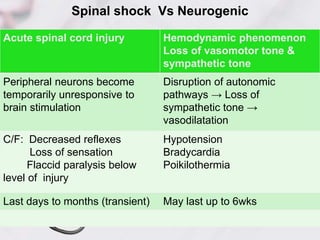
Spinal shock Vs Neurogenic
Acute spinal cord injury Hemodynamic phenomenon
Loss of vasomotor tone &
sympathetic tone
Peripheral neurons become
temporarily unresponsive to
brain stimulation
Disruption of autonomic
pathways → Loss of
sympathetic tone →
vasodilatation
C/F: Decreased reflexes
Loss of sensation
Flaccid paralysis below
level of injury
Hypotension
Bradycardia
Poikilothermia
Last days to months (transient) May last up to 6wks
Shock

Shock

  • 1.
    SHOCK Dr. S MSafayet Hosen MD-(Resident) Phase A
  • 2.
    Definition Shock is theclinical syndrome  Inadequate tissue perfusion  The hypoperfusion-induced imbalance between the delivery & requirements for oxygen  Substrate leads to cellular dysfunction
  • 3.
    Types of Shock SHOCK Lowstroke volume Hypovolaemic Haemorrhage Burn Salt & water loss Cardiogenic MI acute mitral regurgitation Obstructive PE Cardiac Tamponade Tension pneumothorax Vasodilatation/ Distributive Sepsis/SIRS infection Anaphylactic Injection-penicillin Bee sting Anesthetics selfish Neurogenic Trauma to spinal cord Spinal anesthesia
  • 4.
  • 5.
  • 6.
    Hypovolaemic shock Due to a)Haemorrhage -External from wounds, open fractures -Internal from injury to spleen, liver, mesentery or pelvis b) Severe burn which result in loss of plasma C) intestinal obstruction c) Diarrhoea & vomiting of any cause
  • 7.
    Hypovolaemic shock- Pathophysiology Dueto sudden loss blood volume or fluid from the vascular space. Loss of blood Filling of rt. Heart Filling of pulmonary vasculature Filling of left atrium & ventricle Stroke volume Arterial BP SHOCK
  • 8.
  • 9.
    Hypovolaemic shock- Management ABC(AIRWAY is always first) Control hemorrhage (splint the limb) Obtain IV access with wide bore cannula Resuscitate with fluids and blood - Isotonic saline/ ringer’s lactate solution - Blood transfusion if Hb <10g/dl **Supplemental oxygen should always be provided
  • 10.
    Management goals AFTERsecuring the ABCs.. • STOP THE BLEEDING • RESTORE VOLUME • CORRECT ANY ELECTROLYTE/ACID-BASE DISTURBANCES Monitoring Urine output Vital signs Skin perfusion SP02 - Pulse Oximetry
  • 11.
  • 12.
    Cardiogenic shock /Acutecirculatory Failure • Is a state of end-organ hypoperfusion due to cardiac failure. • Cardiogenic shock -systemic hypoperfusion due to severe depression of the cardiac index (<2.2 [L/min]/m2) - sustained systolic arterial hypotension (<90 mmHg) despite an elevated filling pressure (pulmonary capillary wedge pressure [PCWP] >18 mmHg)
  • 13.
    Causes of Cardiogenicshock  Systolic dysfunction - CAD : Acute MI or ischemia (most common ) - Other conditions : severe myocarditis end stage cardiomyopathy Prolonged cardiopulmonary bypass  Diastolic dysfunction - CAD - ventricular hypertrophy
  • 14.
     Valvular orstructural abnormality (acute valve failure) Aortic Regurgitation -Aortic dissection -Infective endocarditis Mitral regurgitation -Papillary muscle rupture due to acute MI -Infective endocarditis Prosthetic valve failure -Mechanical valves: fracture , jamming, thrombosis -Biological valves: degeneration with cusp tear
  • 15.
     Arrhythmia - VT/VF,bradycardia can cause shock - sinus tachycardia can aggravate shock  Others Restrictive cardiomyopathy HOCM with Severe outflow obstruction Prolong hypovolemia or septic shock β-Blocker/CCB overdose
  • 16.
  • 17.
    Risk factors forCardiogenic Shock Older Age Prior MI Diabetes Mellitus HTN Anterior MI Extensive coronary artery stenosis History of HF STEMI New LBBB
  • 18.
    Diagnosis • Proper history& clinical examination • ECG • Chest X-ray • Echocardiogram • Blood specimen for laboratory investigation ** Supportive therapy must be initiated simultaneously with diagnostic evaluation
  • 19.
    Clinical findings SIGN SYMPTOMS Pulseweak , rapid (90-110BPM) / Severe bradycardia due to HB Systolic BP (<90mmHg) Narrow pulse pressure (<30 mmHg) Tachypnea JVP distention Soft s1 & an s3 gallop may found Systolic murmurs- Severe MR, VSR Crackles – LV failure Oliguria Chest pain Vomiting Palpitation Dyspnea Appear pale Altered mental state
  • 21.
    A. General Measures •In addition to immediate treatment of acute MI initial therapy aimed • Maintaining systemic BP by Vasopressors • Ensure LV filling pressure by adjusting volume status • Correct hypoxemia & acidosis • May need ventilatory support • Negative ionotropics must stopped
  • 22.
    B. Pharmacological support •VASOPRESSORS Norepinephrine -Potent vasoconstrictor & Inotropic stimulant -May cause arrhythmia -Can be used as initial vasopressor therapy -DOSE: 2-4µg/min to max. 15µg/min Dopamine -Dose depended hemodynamic effect -Better than Norepinephrine -DOSE: 2-5µg/kg/min to max. 20- 50µg/kg/min Dobutamine -Synthetic sympathomimetic amine -Positive inotropic action -DOSE: 10µg/kg/min
  • 23.
    Inotropes and Vasopressors (ACC/AHAGuidelines) • SBP <70 mmHg Norepinephrine (2-4µg/min to max. 15µg/min) Switch to Dopamine (2-4µg/min to max. 15µg/min) once SBP ≥80 • SBP 70-100 mmHg Dopamine (2-4µg/min to max. 15µg/min) Add Dobutamine (2-20 g/kg/min) once SBP ≥90
  • 24.
    C. Mechanical support IABP - Improve coronary & peripheral perfussion - Initiate as quick as possible - Higher rates of survival in high use centers  Newer devices - LV, RV or BiV assist. Devices - Impella, tendem heart, Extarcorporeal life support (ECLS) - Trials have shown hemodynamic improvement but no survival benefit found
  • 25.
    D. REPERFUSION-REVASCULARIZATION Early revascularizationwith PCI / CABG is recommended **from ACC/AHA guidelines. IRA, infarct-related artery , IABP- Intra-aortic balloon counterpulsation/pump
  • 26.
    E. Treatment accordingto cause Shock due to RV infract -3% of cardiogenic shock due to RV infract & inf. Ischemia -Fluid resuscitation -Dopamine / Dobutamine -Early reestablishment of infract artery flow
  • 27.
    MR -Severe MRdue to rupture papillary muscle -Diagnosis: Echo-Doppler -Rapid stabilization with IABP -Dopamine / Dobutamine VSR -Diagnosis: Echo-Doppler(Blood shunting Lt. to Rt. & open in interventricular septum) -Rapid stabilization with IABP -Dopamine / Dobutamine
  • 28.
    AHA Guideline  ClassI 1. Early revascularization (PCI/CABG) 2. Fibrinolysis in candidates unsuitable for ERV with no contraindications  Class II a 1. Use of IABP can be useful in pt. with CS who don’t quickly stabilize with pharmacologic therapy  Class II b Alternative LV assist device may be considered in pt with refractory CS
  • 29.
  • 30.
    Anaphylactic shock • Whatis anaphylaxis?? A manifestation of immediate hypersensitivity A sensitized individual to A specific antigen results in life-threatening respiratory distress followed by vascular collapse and shock accompanied by pruritis, urticaria, and angioedema
  • 31.
    Etiology • Medications, includingantibiotics (especially penicillin and sulfa), vaccines, opiates, aspirin, NSAIDs, local anesthetics, intravenous fluids with dextran, and insulin • Foods, such as nuts, milk, eggs, soy, wheat, and seafood • Stings by fire ants and Hymenoptera species (eg, bees, wasps, yellow jackets, hornets) • Latex • Blood products, including plasma, immunoglobulin, cryoprecipitate, and whole blood • Idiopathic origins • Exercise causes
  • 32.
  • 35.
  • 36.
    Obstructive shock • Extra-cardiacobstruction to flow in the cardiovascular circuit • Either impairment of diastolic filling or excessive afterload Etiology - Tension pneumothorax - Pericardial tamponade -Massive Pulmonary embolus -IVC Obstruction DVT Gravid uterus on IVC Neoplasm -Increased intrathoracic pressure Excess positive end expiratory pressure neoplasm
  • 37.
    • Develops whena lung or chest wall injury is such that it allows air into the pleural space but cannot out of it (a one way valve) • As a result - Air accumulation & compress the lung - Shifting the mediastinum - Compressing contralateral lung - Increasing intrathoracic pressure - Reduce Venus return to the heart - Causes shock Tension pneumothorax
  • 38.
  • 39.
    Tension pneumothorax (Management) 1.initial management– needle thoracostomy Convert the tension pneumothorax to a simple pneumothorax 2. Definitive management : Chest tube insertion 3. Supportive management: -Analgesia -Ventilatory support -CXR monitoring -Chest physiotherapy
  • 40.
  • 41.
    NEUROGENIC SHOCK • Atype of distributive shock that results from the loss or suppression of sympathetic tone • Causes massive vasodilatation in the venous vasculature → ↓venous return to heart → ↓cardiac output • Most common etiology: Spinal cord injury **Neurogenic shock is the rarest form of shock
  • 42.
    Causes of NeurogenicShock The Common Causes Of Neurogenic Shock Include: • Blunt or penetrating injury to the spinal cord • Trauma to the spinal cord from motor vehicle accidents, sports injuries, falls, stab and gunshot wounds. • Improper administration of regional anesthesia can also cause neurogenic shock. • Devastating head injury • Drugs and medications which affect the autonomic nervous system can also cause neurogenic shock.
  • 43.
    Pathophysiology of NeurogenicShock Disruption of sympathetic nervous system Loss of sympathetic tone Venous and arterial vasodilation ↓ venous return ↓ stroke volume ↓ cardiac output ↓ cellular oxygen supply ↓ tissue perfusion Impaired cellular metabolism
  • 44.
    Assessment of NeurogenicShock • PATIENT ASSESSMENT -Hypotension -Bradycardia -Hypothermia -Warm, dry skin - ↓CO -Flaccid paralysis below level of the spinal lesion
  • 45.
    Patient Also Experiences -SOB, rapid and deep shallow breathing. -Facial pallor, Dizziness, lightheadedness, fainting. -Nausea and vomiting. - weakness due to insufficient blood supply. -may changes in mental state or disorientation. -Has bluish discoloration of lips and fingers (cyanosis). -Decreased or absent urine output. -Sweats profusely. -Considerable chest pain -Loss of consciousness
  • 46.
    Treatment For NeurogenicShock • Neurogenic shock is a serious condition • Requires emergent medical care • Airway, Breathing and Circulation (ABC) • Immobilize the patient, especially the spinal region to prevent any further damage to the spinal cord. • IV fluids to stabilize the patient's blood pressure • Inotropic agents, such as dopamine may be infused for fluid resuscitation, if needed. • Atropine is given intravenously to manage severe bradycardia. • Surgery is needed in case of accident/trauma/ injury/ to the patient
  • 47.
    Spinal shock VsNeurogenic Acute spinal cord injury Hemodynamic phenomenon Loss of vasomotor tone & sympathetic tone Peripheral neurons become temporarily unresponsive to brain stimulation Disruption of autonomic pathways → Loss of sympathetic tone → vasodilatation C/F: Decreased reflexes Loss of sensation Flaccid paralysis below level of injury Hypotension Bradycardia Poikilothermia Last days to months (transient) May last up to 6wks