Chapter 8 Communication and the  Nurse-Patient Relationship
Chapter 8 Lesson 8.1
Learning Objectives Theory Describe components of communication process List three factors that influence the way a person communicates Compare effective communication techniques with blocks to communication Describe difference between a therapeutic nurse-patient relationship and a social relationship
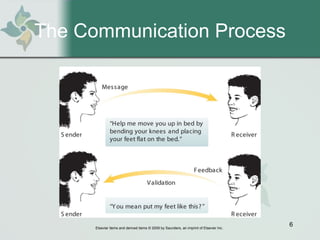
The Communication Process Communication occurs when one person sends a message and another person receives it, processes it, and indicates that the message has been interpreted Is a continual circular process  Can be either verbal or nonverbal
The Communication Process Verbal communication: spoken or written words Nonverbal communication: without words Nonverbal communication may be by: Gesture Body posture Intonation General appearance
The Communication Process
Factors Affecting Communication Cultural differences Past experiences Emotions and mood Attitude of the individual
Cultural Differences Personal space Eye contact Averting eyes is normal in some cultures Meanings of words Yes may not mean “yes” Cultural norms Older adults may not want instructions from younger people Religious beliefs
Past Experience and Communication How we perceive what is communicated to us depends on: Cultural values Level of education Familiarity with the topic Occupation Previous life experiences
Emotions and Mood Anxious patients may not hear all that is said or may not interpret it correctly An upset person may speak  more loudly than usual A depressed person may communicate minimally A person’s attitude may affect how a message is received
Communication Skills Active listening Requires concentration and focused energy Uses all the senses to interpret verbal and nonverbal messages (feedback) Listens for feelings as well as words Maintains eye contact without staring and makes a conscious effort to block out distractions
Interpreting Nonverbal Messages Observe for:  Posture Gestures Tone Facial expression Smiling or frowning Eye contact
Obtaining Feedback A vital part of communication is checking to see if you interpreted a message in the way the speaker meant it  Accomplished by rephrasing the meaning of the message or directly asking a feedback question
Focusing Keeping attention focused on the communication task at hand  Continually check to see that the patient is still the topic of the interaction
Adjusting Style Patient’s style and level of usual communication should be considered when interacting If the person is a slow, calm communicator, adjust to that pace  If a response is slow in coming, allow plenty of time for consideration and a response
Therapeutic Communication Techniques Promoting communication between sender  and receiver, obtaining feedback Focusing on the communicator Using silence and open-ended questions Restating the message Clarifying  Using therapeutic touch
Therapeutic Communication Techniques Giving general leads Offering self Encouraging elaboration  Giving information Looking at alternatives Summarizing
Blocks to Effective Communication Changing the subject Offering false reassurance Giving advice  Making defensive comments Asking prying or probing questions Not listening attentively Using clichés
Chapter 8 Lesson 8.2
Learning Objectives Theory Discuss importance of communication in the collaborative process List three guidelines for effective communication with a physician by telephone Identify four ways to delegate effectively Discuss five ways that a computer is used for communication within the health care agency
Learning Objectives Clinical Practice Use interviewing skills to obtain admission history from a patient Interact therapeutically in a goal-directed situation with a patient Communicate effectively with a patient who has an impairment of communication Give an effective report on assigned patients to your team leader or charge nurse
Challenges for Nurses Developing interviewing skills Using the nurse-patient relationship Using empathy Becoming nonjudgmental Maintaining hope Applying the nursing process Communicating with hearing-impaired patients, elderly, children, and people from other cultures
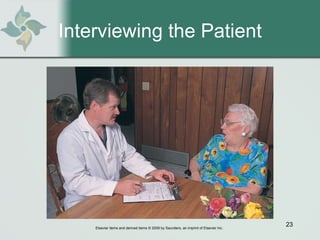
Interviewing the Patient
Communicating with the  Hearing Impaired Speak very distinctly Do not shout Speak slowly Get the person’s attention Maintain a good distance (2 1/2 to 4 feet) Watch for nonverbal feedback Use short sentences  Paraphrase for clarification
Communicating with the Elderly Assess for hearing deficits Assess for visual deficits Give time for elders to formulate responses Wait for an answer to one question before asking another Obtain feedback
Communicating with Children Approach at eye level Use a calm, friendly voice Keep mother in the room when possible Use short sentences Give simple explanations and demonstrations Allow child to handle equipment
Communicating with People from Other Cultures Determine the language spoken Obtain an interpreter if necessary Enlist the aid of a family member if appropriate Give printed materials if available and answer questions Beware of cultural differences in Eye contact Personal distance
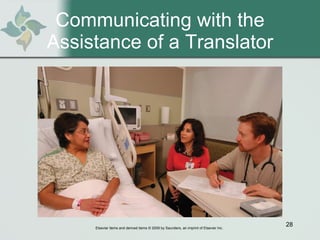
Communicating with the Assistance of a Translator
Communicating with  Health Care Team Members Nurses’ notes Physician’s orders and progress notes Dietitian’s notes  OT, PT, and speech therapy notes Shift report Radiology and laboratory findings
Telephoning Physicians Have patient data on hand: laboratory data, vital signs, urinary output, medication received Keep chart handy and anticipate information that the physician may request Know patient allergies and perform a quick assessment before calling Prepare a concise problem statement Document the call and physician’s response
Assignment Considerations and Delegating Give clear, concise messages and listen carefully to feedback  Include the result desired and the time line for completion along with the task assignment  Ask person to whom you are assigning a task if any questions about what is to be done, and ask for a summary of what is understood about the task to be done
Computer Communication Ability to use a computer for communication is essential for today’s nurse Transmit requests for laboratory, dietary, radiology, physical therapy, respiratory therapy, and other services  Medication orders Supplies for patient care  Update patient care plans  Computerized form of charting
Communication in the  Home and Community Essential to state when instructions are about to be given so active listening can occur Leave written step-by-step instructions with the patient whenever possible  Office and clinic nurses often assess patients who call in to see if they have an urgent need for medical attention

L&E Chapter 008

  • 1.
    Chapter 8 Communicationand the Nurse-Patient Relationship
  • 2.
  • 3.
    Learning Objectives TheoryDescribe components of communication process List three factors that influence the way a person communicates Compare effective communication techniques with blocks to communication Describe difference between a therapeutic nurse-patient relationship and a social relationship
  • 4.
    The Communication ProcessCommunication occurs when one person sends a message and another person receives it, processes it, and indicates that the message has been interpreted Is a continual circular process Can be either verbal or nonverbal
  • 5.
    The Communication ProcessVerbal communication: spoken or written words Nonverbal communication: without words Nonverbal communication may be by: Gesture Body posture Intonation General appearance
  • 6.
  • 7.
    Factors Affecting CommunicationCultural differences Past experiences Emotions and mood Attitude of the individual
  • 8.
    Cultural Differences Personalspace Eye contact Averting eyes is normal in some cultures Meanings of words Yes may not mean “yes” Cultural norms Older adults may not want instructions from younger people Religious beliefs
  • 9.
    Past Experience andCommunication How we perceive what is communicated to us depends on: Cultural values Level of education Familiarity with the topic Occupation Previous life experiences
  • 10.
    Emotions and MoodAnxious patients may not hear all that is said or may not interpret it correctly An upset person may speak more loudly than usual A depressed person may communicate minimally A person’s attitude may affect how a message is received
  • 11.
    Communication Skills Activelistening Requires concentration and focused energy Uses all the senses to interpret verbal and nonverbal messages (feedback) Listens for feelings as well as words Maintains eye contact without staring and makes a conscious effort to block out distractions
  • 12.
    Interpreting Nonverbal MessagesObserve for: Posture Gestures Tone Facial expression Smiling or frowning Eye contact
  • 13.
    Obtaining Feedback Avital part of communication is checking to see if you interpreted a message in the way the speaker meant it Accomplished by rephrasing the meaning of the message or directly asking a feedback question
  • 14.
    Focusing Keeping attentionfocused on the communication task at hand Continually check to see that the patient is still the topic of the interaction
  • 15.
    Adjusting Style Patient’sstyle and level of usual communication should be considered when interacting If the person is a slow, calm communicator, adjust to that pace If a response is slow in coming, allow plenty of time for consideration and a response
  • 16.
    Therapeutic Communication TechniquesPromoting communication between sender and receiver, obtaining feedback Focusing on the communicator Using silence and open-ended questions Restating the message Clarifying Using therapeutic touch
  • 17.
    Therapeutic Communication TechniquesGiving general leads Offering self Encouraging elaboration Giving information Looking at alternatives Summarizing
  • 18.
    Blocks to EffectiveCommunication Changing the subject Offering false reassurance Giving advice Making defensive comments Asking prying or probing questions Not listening attentively Using clichés
  • 19.
  • 20.
    Learning Objectives TheoryDiscuss importance of communication in the collaborative process List three guidelines for effective communication with a physician by telephone Identify four ways to delegate effectively Discuss five ways that a computer is used for communication within the health care agency
  • 21.
    Learning Objectives ClinicalPractice Use interviewing skills to obtain admission history from a patient Interact therapeutically in a goal-directed situation with a patient Communicate effectively with a patient who has an impairment of communication Give an effective report on assigned patients to your team leader or charge nurse
  • 22.
    Challenges for NursesDeveloping interviewing skills Using the nurse-patient relationship Using empathy Becoming nonjudgmental Maintaining hope Applying the nursing process Communicating with hearing-impaired patients, elderly, children, and people from other cultures
  • 23.
  • 24.
    Communicating with the Hearing Impaired Speak very distinctly Do not shout Speak slowly Get the person’s attention Maintain a good distance (2 1/2 to 4 feet) Watch for nonverbal feedback Use short sentences Paraphrase for clarification
  • 25.
    Communicating with theElderly Assess for hearing deficits Assess for visual deficits Give time for elders to formulate responses Wait for an answer to one question before asking another Obtain feedback
  • 26.
    Communicating with ChildrenApproach at eye level Use a calm, friendly voice Keep mother in the room when possible Use short sentences Give simple explanations and demonstrations Allow child to handle equipment
  • 27.
    Communicating with Peoplefrom Other Cultures Determine the language spoken Obtain an interpreter if necessary Enlist the aid of a family member if appropriate Give printed materials if available and answer questions Beware of cultural differences in Eye contact Personal distance
  • 28.
    Communicating with theAssistance of a Translator
  • 29.
    Communicating with Health Care Team Members Nurses’ notes Physician’s orders and progress notes Dietitian’s notes OT, PT, and speech therapy notes Shift report Radiology and laboratory findings
  • 30.
    Telephoning Physicians Havepatient data on hand: laboratory data, vital signs, urinary output, medication received Keep chart handy and anticipate information that the physician may request Know patient allergies and perform a quick assessment before calling Prepare a concise problem statement Document the call and physician’s response
  • 31.
    Assignment Considerations andDelegating Give clear, concise messages and listen carefully to feedback Include the result desired and the time line for completion along with the task assignment Ask person to whom you are assigning a task if any questions about what is to be done, and ask for a summary of what is understood about the task to be done
  • 32.
    Computer Communication Abilityto use a computer for communication is essential for today’s nurse Transmit requests for laboratory, dietary, radiology, physical therapy, respiratory therapy, and other services Medication orders Supplies for patient care Update patient care plans Computerized form of charting
  • 33.
    Communication in the Home and Community Essential to state when instructions are about to be given so active listening can occur Leave written step-by-step instructions with the patient whenever possible Office and clinic nurses often assess patients who call in to see if they have an urgent need for medical attention

Editor's Notes

  • #5 The receiver must acknowledge that the message has been received and comprehended for communication to be complete. Anxiety, fear, and pain are often expressed by nonverbal cues.
  • #6 Nonverbal communication is often referred to as body language. Sometimes a person’s nonverbal communication is incongruent, or in agreement with, the verbal communication. Can you give an example of a situation in which verbal communication and nonverbal communication are incongruent? Nurses can learn a lot about patients by observing nonverbal behavior because anxiety, fear, and pain are often expressed by nonverbal cues.
  • #8 These factors can affect the communication process. Can you think of others not on this list?
  • #9 Every culture has norms for appropriate communication. Can you provide an example? Other cultural aspects of communication include tone of voice and the amount of gesturing used.
  • #10 How might one’s occupation or level of education influence communication? How might a nurse communicate differently than a person with no medical training?
  • #11 Emotions and mood have a huge effect on the way messages are sent or interpreted. How might a nurse project body language that suggests he has an open, accepting attitude toward a patient? Can you demonstrate this to the class?
  • #12 Nurses who are active listeners are demonstrating an interest in the patient and are building a trusting relationship. Active listeners do not interrupt the speaker. What are some nonverbal cues that indicate that a nurse is an active listener? (leaning forward, focusing on the patient’s face, nodding slightly, and maintaining an open body posture)
  • #13 Nonverbal messages must be interpreted in the context of the speaker’s, not the listener’s, culture. When verbal and nonverbal messages are not congruent, the listener should probe the speaker further to determine the real meaning.
  • #14 The response received from the question should verify whether the original message sent was interpreted correctly.
  • #15 What does the effective communicator do when the focus of communication has wandered?
  • #16 If it is comfortable for the patient to display feelings only in the context of telling a story about a related topic, allow enough time for full development of the topic so that the feelings can be adequately expressed
  • #17 The techniques of therapeutic communication should be used judiciously and in a varied manner so that the interaction does not feel stilted or uncomfortable. Silence gives the patient time to think and respond. Open-ended questions allow the patient to elaborate on a subject and create an inviting atmosphere. Restating the message encourages the patient to continue to provide information on the topic. Therapeutic touch can signify support for the person; however, in some cultures it is not appropriate. Clarifying helps verify that the message is heard, especially when the conversation has rambled.
  • #18 Providing general leads like, “Tell me more about that,” can get the interaction under way. Encouraging elaboration can elicit more information from the patient. Stating information concisely and allowing time for questions is important to the patient. Looking at alternatives while refraining from giving advice can help patients make their own decisions. Summarizing what has occurred during the interaction can provide closure to the discussion.
  • #19 What are some examples of behaviors that block effective communication? Changing the subject deprives the patient of the chance to discuss concerns. Giving false assurance can lead to false hope and destroy trust in the nurse. Making defensive comments makes patients feel that they cannot express their concerns. Using clich é s negates the patient’s individual situation and sounds flippant. Giving advice makes the nurse sound controlling and diminishes the patient’s responsibility for his or her own health. Inattentive listening sends the message that the patient is not that important.
  • #23 Why is an interview more directed than a therapeutic communication interaction? (because it has a planned and definite purpose) An admission interview usually starts with closed questions that call for specific and definite answers, and then moves on to open-ended questions to determine a patient’s concerns. The nurse-patient relationship is defined by specific boundaries. The nurse is in a helper role rather than a social role. Empathy is important. A nurse should maintain a focus on the patient’s feelings and acknowledge them, but not say, “I know how you feel.”
  • #25 If the patient has hearing aids, make sure that they are used and turned on before communicating. A person with a hearing aid still might not hear very well, so these techniques should help promote comprehension.
  • #26 Elderly individuals vary greatly in their ability to communicate. Older adults may have hearing, sensory, visual, or motor impairments. Eliminate outside distractions. Also, don’t rush through the communication because this may cause confusion. What other communication strategies might you use when communicating with the elderly?
  • #27 Language, thought processes, and cognitive abilities are still developing in children. Young children are responsive to nonverbal messages. Do not make sudden movements. With infants, keep the mother in view. With toddlers and preschoolers, focus on the child’s needs and concerns. With school-age children, give simple explanations and demonstrate how equipment works. Listen to the child’s concerns. With adolescents, use active listening, avoid interrupting, and show acceptance. Be honest and tell the child what to expect.
  • #28 Do not show impatience with a patient’s inability to speak English. Follow the patient’s lead in terms of eye contact.
  • #30 Communication with the health care team is crucial to ensure continuity of care for the patient. Many different formats are used to give a shift report. Refer to Box 8-2 for information included in an end-of-shift report.
  • #31 The nurse should follow these steps when calling a physician regarding a change in a patient’s condition or any situation in which new orders are anticipated. If an order is given by the physician, note it in the chart and read it back to the physician to ensure that it is correct. The student nurse should have an instructor or another registered nurse standing by to take the new orders from the physician because students cannot legally take telephone orders.
  • #32 You must communicate well in order to assign tasks and delegate (authorize another person to do something) to others effectively.
  • #34 Nurses who work in home care often have both a professional role and a social role with their patients and families.