Shock Dr. Tanuj Paul Bhatia
Definition Inadequate delivery of oxygen and nutrients to maintain normal tissue and cellular function.
DISTRIBUTION OF BODY FLUIDS
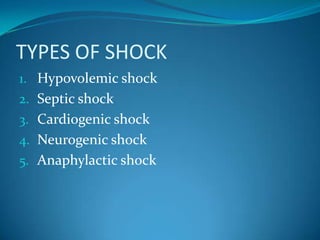
TYPES OF SHOCKHypovolemic shockSeptic shockCardiogenic shockNeurogenic shockAnaphylactic shock
Hypovolaemic shockMost common form seen clinically.Results from depletion of circulating blood volume.This may result fromHemorrhagePlasma loss eg. BurnsLoss of ECF eg.  Intestinal fistulas,VomitingDiarrhoea
Pathophysiology
Autoregulation
Other mechanisms Renin from JGA,Angiotensin ,Aldosterone from adrenal cortex,Anti-diuretic hormone from pituitary
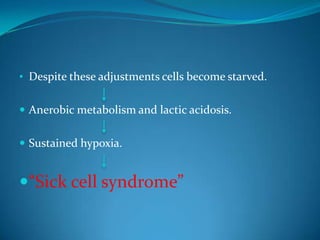
Despite these adjustments cells become starved.Anerobic metabolism and lactic acidosis.Sustained hypoxia.“Sick cell syndrome”
Clinical picture
Mild hypovolaemiaDeficit <20% of blood volume.Cool, damp extremities.Patient is thirsty.Maybe chilly.UOP and BP are normal in supine position but BP may fall on standing.
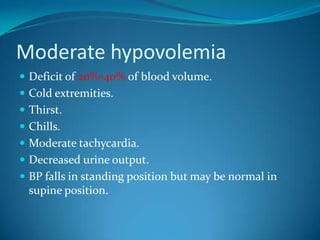
Moderate hypovolemiaDeficit of 20%-40% of blood volume.Cold extremities.Thirst.Chills.Moderate tachycardia.Decreased urine output.BP falls in standing position but may be normal in supine position.
Severe hypovolaemiaDeficit >40% of blood volume.All above signs.Decreased urinary output.Rapid, thready pulse.Low BP.Restlessness and agitation due to decreased cerebral perfusion.
Parameters α competence of circulationLevel of cerebral activity.Hourly urine output (normal = 30-50ml/hr in adults).Central venous pressure.Normal range of CVP is 3-5 cm of H2O above the manubriosternal angle.
Investigations Baseline investigations.ABG = arterial blood gases (pH,pO2,pCO2)ECG monitoring.Serum electrolytes.
Management Aim – to increase cardiac output and tissue perfusion.Plan :    1. Tackle the primary problem eg. Hemorrhage.    2. Adequate fluid replacement.    3. Improving cardiac function with inotropic drugs.    4. Correcting acid base disturbance and electrolyte                     abnormalities.
Outline of treatmentResuscitation  = A + BFluid replacementCrystalloid solution used for initial resuscitation.
Glucose should not be used as it may cause diuresis  and further depletion of circulating volume.
2 litres of crystalloid are given as fast as possible in sever shock.
Severity of shock determines the rate of fluid.
CVP acts as a guideline.3. Positioning: elevation of both legs.
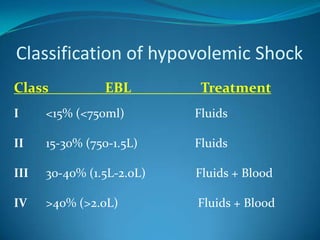
Classification of hypovolemicShockClass	        EBLTreatmentI	<15% (<750ml)	                 FluidsII	15-30% (750-1.5L)	                 FluidsIII	30-40% (1.5L-2.0L)                Fluids + BloodIV	>40% (>2.0L)	                  Fluids + Blood
Vasopressor drugsUse of vasopressor drugs not recommended in routine.They raise blood pressure by increasing peripheral vascular resistance  decreasing tissue perfusion.Inotropic drugs like Dopamine and Dobutamine may need to be used to improve cardiac action.
Indicators of successful resuscitationWarm skin.Well perfused skin.Urine output 30-60 ml/hr.Alert sensorium.
Venous accessPeripheral line Central lineFemoral
Internal jugular
SubclavianParenteral fluid therapyCrystalloidsIsotonicHypertonicHypotonic Colloids Albumin preperationsDextranHydroxyethyl starch
Crystalloids Crystalloids are solutions that contain sodium as the major osmotically active particle.Relatively inexpensiveReadily availableUseful for :                - volume expansion                - maintenance infusion                - correction of electrolyte disorders
Isotonic crystalloidsE.g.. Lactated ringer’s solution(RL), 0.9% NaCl(normal saline)Distribute uniformly throughout the ECF.RL mimics ECF and is considered a BALANCED SALT SOLUTION.RL preferred for replacing GI losses and extracellular fluid volume losses.Normal Saline preferred in the presence of hyperkalemia, hypercalcemia, hyponatremia, hypochloremia, or metabolic alkalosis.
Other crystalloidsHypertonic saline solutions(e.g. 10%NaCl) : can be used for resuscitation in combination with colloids.BUT, there is more danger of complications like hypernatremia, hyperchloremia, hypokalemia with rapid infusion.Hypotonic saline solutions (e.g. 0.45%NaCL): expand the intravascular compartment by as little as 10% of the volume infused.Not used for resuscitation for the same reason.
Colloid solutionsContain high–molecular-weight substances that remain in the intravascular space.Lessens the total amount of fluid needed for resuscitation.Substantially more expensive than crystalloids .Indicated when crystalloids fail to sustain plasma volume because of low colloid osmotic pressure. E.g. Burns.E.g. Dextran, Albumin preperations, Hydroxyethyl starch.
Maintenance fluids 100 mL/kg per day for the first 10 kg.50 mL/kg per day for the second 10 kg. 20 mL/kg per day for each subsequent 10 kg.
THANK YOU
Glasgow coma score
SEPTIC SHOCK
Septic shockResults either by gram +ve or gram –ve bacterial infection.Gram –ve sepsis is more dangerous, common scources of gram –ve organisms are:Genitourinary tract
Respiratory tract
Intestines.
Commonly involved gram –ve organisms are E. coli, Proteus, Klebsiella, P. aeruginosa.Why is gram negative sepsis becoming more important?There is indiscriminate use of potent antibiotics now a days.Leads to development of virulent RESISTANT ORGANISMS. Hospitals are major reservoir of such infection.This can easily transmit from one patient to another.
Pathophysiology of septic shock‘ENDOTOXINS’Bacterial lipopolysaccharides.Part of bacterial cell wall.Released mainly when bacteria die.
These lead to :-Activation of complement, fibrinolytic, kinin systems,Activation of platelets and neutrophils.Endovascular injury at microvascular level.Sudden release of vasoactive substances from injured endo. cells .Macrophage stimulation and release of mediators ( IL-6,TNF,Arachidonic acid metabolites)All these further lead to more endovascular damage.
Risk factors for septic shockLiver failure,Immune deficiency,Diabetes,Malnutrition,Long term steroid administration,Cytotoxic drugs,Massive bacterial load. E.g. intestinal perforation.
MOFS/MODSMulti organ failure/dysfunction syndrome.Mediators from neutrophils act in a non specific fashion, when activated systemically, can produce injury to normal micro-circulation.Features : Stress ulceration,Biochemical signs of liver failure,Lethargy,May progress to coma and later death.
Clinical presentation of septic shockEARLY RECOGNITION IS VERY IMPORTANTChills,Elevated temperature above 101 F,Hyperventilation,Oliguria,Altered sensorium,White blood cell count is raised.
Management Shift to ICU,CVP monitoring,Urinary output monitoring,IV fluid infusion : RL@20ml/kg bolus..... further Mx according to CVP.Thorough search of the source of infection.Drain the infective process as soon and when possible.
Pulmonary therapySepsis endothelial damage to pulmonary capillaries.Pronounced alveolar injury, interstitial oedema and hemorrhage.Treatment is by maintaining controlled airway and an assisted ventilation.Not needed if sepsis is controlled early.
CARDIOGENIC SHOCK
Etiology Massive myocardial infarctionSevere valvular heart diseaseArrhythmiasPulmonary embolism – right side of heart comes under sudden strain.
Pathogenesis
Diagnosis Previous history of cardiovascular disease,Distended neck veins,Low BP,Peripheral edema,Enlarged and tender liver,Rales on lung auscultation,ECG signs of ischaemia,Enlarged heart on X Ray.
Treatment Opioids to relieve pain and provide sedation.Diuretics, decrease afterload ,alleviate peripheral and pulmonary edema.Inotropic drugs improve cardiac contractility. E.g. dopamine in low doses.Sometimes, Mechanical support to heart with an intra aortic balloon.
NEUROGENIC SHOCK
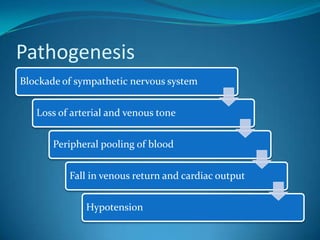
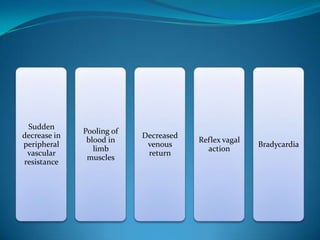
Neurogenic shock

Shock

  • 1.
    Shock Dr. TanujPaul Bhatia
  • 2.
    Definition Inadequate deliveryof oxygen and nutrients to maintain normal tissue and cellular function.
  • 3.
  • 6.
    TYPES OF SHOCKHypovolemicshockSeptic shockCardiogenic shockNeurogenic shockAnaphylactic shock
  • 7.
    Hypovolaemic shockMost commonform seen clinically.Results from depletion of circulating blood volume.This may result fromHemorrhagePlasma loss eg. BurnsLoss of ECF eg. Intestinal fistulas,VomitingDiarrhoea
  • 8.
  • 9.
  • 10.
    Other mechanisms Reninfrom JGA,Angiotensin ,Aldosterone from adrenal cortex,Anti-diuretic hormone from pituitary
  • 11.
    Despite these adjustmentscells become starved.Anerobic metabolism and lactic acidosis.Sustained hypoxia.“Sick cell syndrome”
  • 12.
  • 13.
    Mild hypovolaemiaDeficit <20%of blood volume.Cool, damp extremities.Patient is thirsty.Maybe chilly.UOP and BP are normal in supine position but BP may fall on standing.
  • 14.
    Moderate hypovolemiaDeficit of20%-40% of blood volume.Cold extremities.Thirst.Chills.Moderate tachycardia.Decreased urine output.BP falls in standing position but may be normal in supine position.
  • 15.
    Severe hypovolaemiaDeficit >40%of blood volume.All above signs.Decreased urinary output.Rapid, thready pulse.Low BP.Restlessness and agitation due to decreased cerebral perfusion.
  • 16.
    Parameters α competenceof circulationLevel of cerebral activity.Hourly urine output (normal = 30-50ml/hr in adults).Central venous pressure.Normal range of CVP is 3-5 cm of H2O above the manubriosternal angle.
  • 17.
    Investigations Baseline investigations.ABG= arterial blood gases (pH,pO2,pCO2)ECG monitoring.Serum electrolytes.
  • 18.
    Management Aim –to increase cardiac output and tissue perfusion.Plan : 1. Tackle the primary problem eg. Hemorrhage. 2. Adequate fluid replacement. 3. Improving cardiac function with inotropic drugs. 4. Correcting acid base disturbance and electrolyte abnormalities.
  • 19.
    Outline of treatmentResuscitation = A + BFluid replacementCrystalloid solution used for initial resuscitation.
  • 20.
    Glucose should notbe used as it may cause diuresis and further depletion of circulating volume.
  • 21.
    2 litres ofcrystalloid are given as fast as possible in sever shock.
  • 22.
    Severity of shockdetermines the rate of fluid.
  • 23.
    CVP acts asa guideline.3. Positioning: elevation of both legs.
  • 24.
    Classification of hypovolemicShockClass EBLTreatmentI <15% (<750ml) FluidsII 15-30% (750-1.5L) FluidsIII 30-40% (1.5L-2.0L) Fluids + BloodIV >40% (>2.0L) Fluids + Blood
  • 25.
    Vasopressor drugsUse ofvasopressor drugs not recommended in routine.They raise blood pressure by increasing peripheral vascular resistance  decreasing tissue perfusion.Inotropic drugs like Dopamine and Dobutamine may need to be used to improve cardiac action.
  • 26.
    Indicators of successfulresuscitationWarm skin.Well perfused skin.Urine output 30-60 ml/hr.Alert sensorium.
  • 27.
    Venous accessPeripheral lineCentral lineFemoral
  • 28.
  • 29.
    SubclavianParenteral fluid therapyCrystalloidsIsotonicHypertonicHypotonicColloids Albumin preperationsDextranHydroxyethyl starch
  • 30.
    Crystalloids Crystalloids aresolutions that contain sodium as the major osmotically active particle.Relatively inexpensiveReadily availableUseful for : - volume expansion - maintenance infusion - correction of electrolyte disorders
  • 31.
    Isotonic crystalloidsE.g.. Lactatedringer’s solution(RL), 0.9% NaCl(normal saline)Distribute uniformly throughout the ECF.RL mimics ECF and is considered a BALANCED SALT SOLUTION.RL preferred for replacing GI losses and extracellular fluid volume losses.Normal Saline preferred in the presence of hyperkalemia, hypercalcemia, hyponatremia, hypochloremia, or metabolic alkalosis.
  • 32.
    Other crystalloidsHypertonic salinesolutions(e.g. 10%NaCl) : can be used for resuscitation in combination with colloids.BUT, there is more danger of complications like hypernatremia, hyperchloremia, hypokalemia with rapid infusion.Hypotonic saline solutions (e.g. 0.45%NaCL): expand the intravascular compartment by as little as 10% of the volume infused.Not used for resuscitation for the same reason.
  • 33.
    Colloid solutionsContain high–molecular-weightsubstances that remain in the intravascular space.Lessens the total amount of fluid needed for resuscitation.Substantially more expensive than crystalloids .Indicated when crystalloids fail to sustain plasma volume because of low colloid osmotic pressure. E.g. Burns.E.g. Dextran, Albumin preperations, Hydroxyethyl starch.
  • 34.
    Maintenance fluids 100mL/kg per day for the first 10 kg.50 mL/kg per day for the second 10 kg. 20 mL/kg per day for each subsequent 10 kg.
  • 35.
  • 36.
  • 37.
  • 38.
    Septic shockResults eitherby gram +ve or gram –ve bacterial infection.Gram –ve sepsis is more dangerous, common scources of gram –ve organisms are:Genitourinary tract
  • 39.
  • 40.
  • 41.
    Commonly involved gram–ve organisms are E. coli, Proteus, Klebsiella, P. aeruginosa.Why is gram negative sepsis becoming more important?There is indiscriminate use of potent antibiotics now a days.Leads to development of virulent RESISTANT ORGANISMS. Hospitals are major reservoir of such infection.This can easily transmit from one patient to another.
  • 42.
    Pathophysiology of septicshock‘ENDOTOXINS’Bacterial lipopolysaccharides.Part of bacterial cell wall.Released mainly when bacteria die.
  • 43.
    These lead to:-Activation of complement, fibrinolytic, kinin systems,Activation of platelets and neutrophils.Endovascular injury at microvascular level.Sudden release of vasoactive substances from injured endo. cells .Macrophage stimulation and release of mediators ( IL-6,TNF,Arachidonic acid metabolites)All these further lead to more endovascular damage.
  • 45.
    Risk factors forseptic shockLiver failure,Immune deficiency,Diabetes,Malnutrition,Long term steroid administration,Cytotoxic drugs,Massive bacterial load. E.g. intestinal perforation.
  • 46.
    MOFS/MODSMulti organ failure/dysfunctionsyndrome.Mediators from neutrophils act in a non specific fashion, when activated systemically, can produce injury to normal micro-circulation.Features : Stress ulceration,Biochemical signs of liver failure,Lethargy,May progress to coma and later death.
  • 47.
    Clinical presentation ofseptic shockEARLY RECOGNITION IS VERY IMPORTANTChills,Elevated temperature above 101 F,Hyperventilation,Oliguria,Altered sensorium,White blood cell count is raised.
  • 48.
    Management Shift toICU,CVP monitoring,Urinary output monitoring,IV fluid infusion : RL@20ml/kg bolus..... further Mx according to CVP.Thorough search of the source of infection.Drain the infective process as soon and when possible.
  • 49.
    Pulmonary therapySepsis endothelialdamage to pulmonary capillaries.Pronounced alveolar injury, interstitial oedema and hemorrhage.Treatment is by maintaining controlled airway and an assisted ventilation.Not needed if sepsis is controlled early.
  • 50.
  • 51.
    Etiology Massive myocardialinfarctionSevere valvular heart diseaseArrhythmiasPulmonary embolism – right side of heart comes under sudden strain.
  • 52.
  • 53.
    Diagnosis Previous historyof cardiovascular disease,Distended neck veins,Low BP,Peripheral edema,Enlarged and tender liver,Rales on lung auscultation,ECG signs of ischaemia,Enlarged heart on X Ray.
  • 54.
    Treatment Opioids torelieve pain and provide sedation.Diuretics, decrease afterload ,alleviate peripheral and pulmonary edema.Inotropic drugs improve cardiac contractility. E.g. dopamine in low doses.Sometimes, Mechanical support to heart with an intra aortic balloon.
  • 55.
  • 56.