Identifying Optimal Trade-Offs between CPU 
Time Usage and Temporal Constraints 
Using Search" 
Shiva Nejati, Lionel C. Briand" 
SnT Centre, University of Luxembourg" 
" 
"
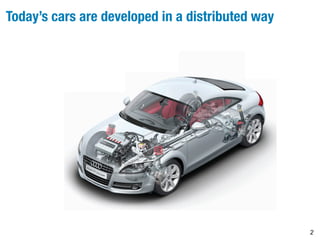
Today’s cars are developed in a distributed way 
2
Integration of software from different sources is 
essential in most embedded software industries 
3
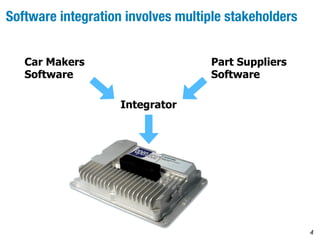
Software integration involves multiple stakeholders 
4 
Car Makers 
Software 
Part Suppliers 
Software 
Integrator
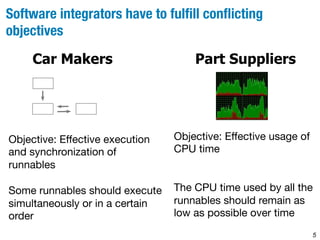
Software integrators have to fulfill conflicting 
objectives 
5 
Car Makers Part Suppliers 
Objective: Effective execution 
and synchronization of 
runnables 
Some runnables should execute 
simultaneously or in a certain 
order 
Objective: Effective usage of 
CPU time 
The CPU time used by all the 
runnables should remain as 
low as possible over time
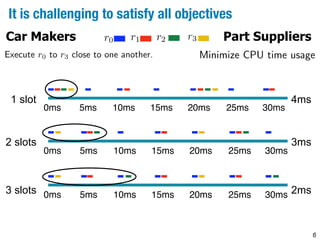
It is challenging to satisfy all objectives 
Car Makers r0 r1 r2 r3 Part Suppliers 
Minimize CPU time usage 
Execute r0 to r3 close to one another. 
0ms 5ms 10ms 15ms 20ms 25ms 30ms 
6 
4ms 
3ms 
2ms 
1 slot 
2 slots 
3 slots
7 
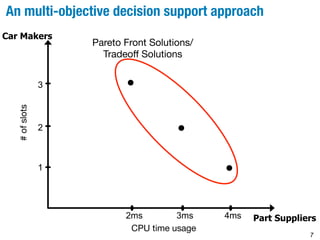
An multi-objective decision support approach 
# of slots 
2ms 3ms 4ms 
CPU time usage 
3 
2 
1 
Pareto Front Solutions/ 
Tradeoff Solutions 
Car Makers 
Part Suppliers
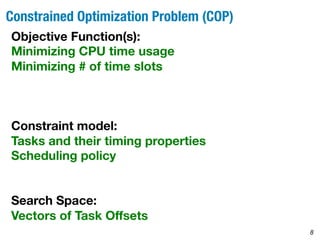
Constrained Optimization Problem (COP) 
8 
Objective Function(s): 
Minimizing CPU time usage 
Minimizing # of time slots 
Constraint model: 
Tasks and their timing properties 
Scheduling policy 
Search Space: 
Vectors of Task Offsets
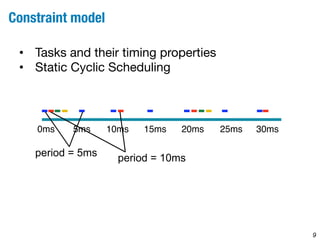
• Tasks and their timing properties 
• Static Cyclic Scheduling 
0ms 5ms 10ms 15ms 20ms 25ms 30ms 
9 
Constraint model 
period = 5ms period = 10ms
10 
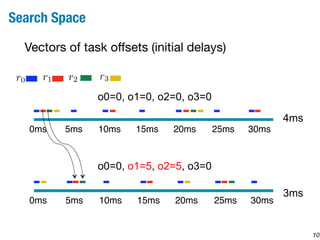
4ms 
3ms 
Search Space 
Vectors of task offsets (initial delays) 
r0 r1 r2 r3 
o0=0, o1=0, o2=0, o3=0 
0ms 5ms 10ms 15ms 20ms 25ms 30ms 
o0=0, o1=5, o2=5, o3=0 
0ms 5ms 10ms 15ms 20ms 25ms 30ms
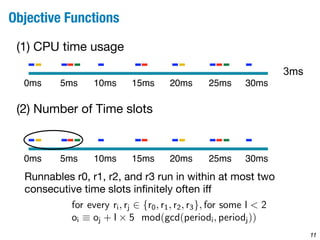
(1) CPU time usage 
0ms 5ms 10ms 15ms 20ms 25ms 30ms 
11 
Objective Functions 
(2) Number of Time slots 
0ms 5ms 10ms 15ms 20ms 25ms 30ms 
Runnables r0, r1, r2, and r3 run in within at most two 
consecutive time slots infinitely often iff 
for every ri, rj 2 {r0, r1, r2, r3}, for some l < 2 
oi ⌘ oj + l ⇥ 5 mod(gcd(periodi, periodj)) 
3ms
12 
Solution Overview
13 
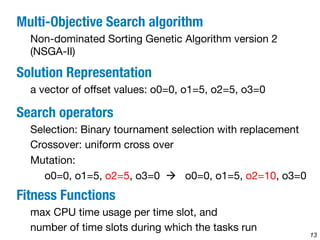
Multi-Objective Search algorithm 
Non-dominated Sorting Genetic Algorithm version 2 
(NSGA-II) 
Solution Representation 
a vector of offset values: o0=0, o1=5, o2=5, o3=0 
Search operators 
Selection: Binary tournament selection with replacement 
Crossover: uniform cross over 
Mutation: 
o0=0, o1=5, o2=5, o3=0 à o0=0, o1=5, o2=10, o3=0 
Fitness Functions 
max CPU time usage per time slot, and 
number of time slots during which the tasks run
14 
Case Study and Experiments 
An automotive software project with 430 
tasks. 
These 430 tasks can be scheduled in almost 
10^320 different ways.
15 
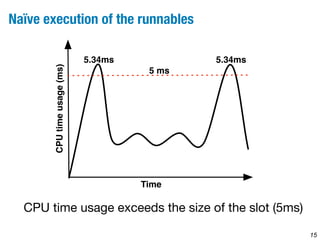
Naïve execution of the runnables 
5.34ms 5.34ms 
5 ms 
Time 
CPU time usage (ms) 
CPU time usage exceeds the size of the slot (5ms)
16 
After applying our work 
5 ms 
ms) 
(usage [2.04ms … 1.45ms] 
time CPU Time Depending on the number of slots, CPU time usage is 
between 2.04ms to 1.45ms. So, around 60% to 70% of 
each time slot is guaranteed to be free.
17 
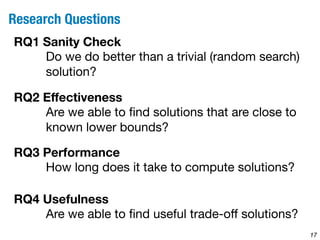
Research Questions 
RQ1 Sanity Check 
Do we do better than a trivial (random search) 
solution? 
RQ2 Effectiveness 
Are we able to find solutions that are close to 
known lower bounds? 
RQ3 Performance 
How long does it take to compute solutions? 
RQ4 Usefulness 
Are we able to find useful trade-off solutions?
18 
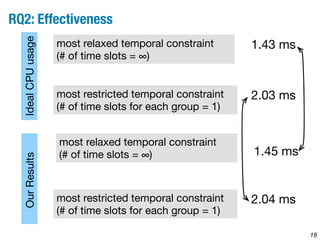
RQ2: Effectiveness 
most relaxed temporal constraint 
(# of time slots = ∞) 
most restricted temporal constraint 
(# of time slots for each group = 1) 
1.43 ms 
2.03 ms 
most relaxed temporal constraint 
(# of time slots = ∞) 
1.45 ms 
most restricted temporal constraint 
(# of time slots for each group = 1) 
2.04 ms 
Our Results Ideal CPU usage
19 
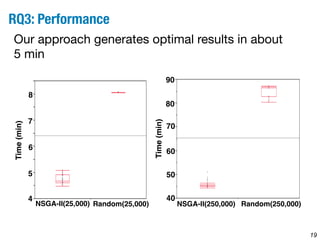
RQ3: Performance 
Our approach generates optimal results in about 
5 min 
90 80 
min) 
(Time 70 
60 
50 
40 
NSGA-II(25,000) Random(25,000) 
Time (min) 
8 
7 
6 
5 
4 
NSGA-II(250,000) Random(250,000)
20 
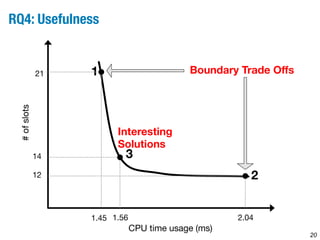
RQ4: Usefulness 
# of slots 
1.452.04 
CPU time usage (ms) 
21 
14 
12 
1.56 
1 
2 
3 
Boundary Trade Offs 
Interesting 
Solutions
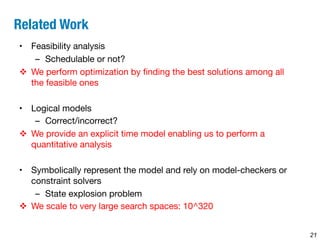
Related Work 
• Feasibility analysis 
– Schedulable or not? 
v We perform optimization by finding the best solutions among all 
the feasible ones 
• Logical models 
– Correct/incorrect? 
v We provide an explicit time model enabling us to perform a 
quantitative analysis 
• Symbolically represent the model and rely on model-checkers or 
constraint solvers 
– State explosion problem 
v We scale to very large search spaces: 10^320 
21
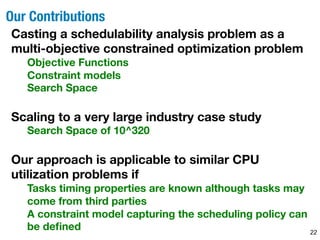
Our Contributions 
22 
Casting a schedulability analysis problem as a 
multi-objective constrained optimization problem 
Objective Functions 
Constraint models 
Search Space 
Scaling to a very large industry case study 
Search Space of 10^320 
Our approach is applicable to similar CPU 
utilization problems if 
Tasks timing properties are known although tasks may 
come from third parties 
A constraint model capturing the scheduling policy can 
be defined

Identifying Optimal Trade-Offs between CPU Time Usage and Temporal Constraints

  • 1.
    Identifying Optimal Trade-Offsbetween CPU Time Usage and Temporal Constraints Using Search" Shiva Nejati, Lionel C. Briand" SnT Centre, University of Luxembourg" " "
  • 2.
    Today’s cars aredeveloped in a distributed way 2
  • 3.
    Integration of softwarefrom different sources is essential in most embedded software industries 3
  • 4.
    Software integration involvesmultiple stakeholders 4 Car Makers Software Part Suppliers Software Integrator
  • 5.
    Software integrators haveto fulfill conflicting objectives 5 Car Makers Part Suppliers Objective: Effective execution and synchronization of runnables Some runnables should execute simultaneously or in a certain order Objective: Effective usage of CPU time The CPU time used by all the runnables should remain as low as possible over time
  • 6.
    It is challengingto satisfy all objectives Car Makers r0 r1 r2 r3 Part Suppliers Minimize CPU time usage Execute r0 to r3 close to one another. 0ms 5ms 10ms 15ms 20ms 25ms 30ms 0ms 5ms 10ms 15ms 20ms 25ms 30ms 0ms 5ms 10ms 15ms 20ms 25ms 30ms 6 4ms 3ms 2ms 1 slot 2 slots 3 slots
  • 7.
    7 An multi-objectivedecision support approach # of slots 2ms 3ms 4ms CPU time usage 3 2 1 Pareto Front Solutions/ Tradeoff Solutions Car Makers Part Suppliers
  • 8.
    Constrained Optimization Problem(COP) 8 Objective Function(s): Minimizing CPU time usage Minimizing # of time slots Constraint model: Tasks and their timing properties Scheduling policy Search Space: Vectors of Task Offsets
  • 9.
    • Tasks andtheir timing properties • Static Cyclic Scheduling 0ms 5ms 10ms 15ms 20ms 25ms 30ms 9 Constraint model period = 5ms period = 10ms
  • 10.
    10 4ms 3ms Search Space Vectors of task offsets (initial delays) r0 r1 r2 r3 o0=0, o1=0, o2=0, o3=0 0ms 5ms 10ms 15ms 20ms 25ms 30ms o0=0, o1=5, o2=5, o3=0 0ms 5ms 10ms 15ms 20ms 25ms 30ms
  • 11.
    (1) CPU timeusage 0ms 5ms 10ms 15ms 20ms 25ms 30ms 11 Objective Functions (2) Number of Time slots 0ms 5ms 10ms 15ms 20ms 25ms 30ms Runnables r0, r1, r2, and r3 run in within at most two consecutive time slots infinitely often iff for every ri, rj 2 {r0, r1, r2, r3}, for some l < 2 oi ⌘ oj + l ⇥ 5 mod(gcd(periodi, periodj)) 3ms
  • 12.
  • 13.
    13 Multi-Objective Searchalgorithm Non-dominated Sorting Genetic Algorithm version 2 (NSGA-II) Solution Representation a vector of offset values: o0=0, o1=5, o2=5, o3=0 Search operators Selection: Binary tournament selection with replacement Crossover: uniform cross over Mutation: o0=0, o1=5, o2=5, o3=0 à o0=0, o1=5, o2=10, o3=0 Fitness Functions max CPU time usage per time slot, and number of time slots during which the tasks run
  • 14.
    14 Case Studyand Experiments An automotive software project with 430 tasks. These 430 tasks can be scheduled in almost 10^320 different ways.
  • 15.
    15 Naïve executionof the runnables 5.34ms 5.34ms 5 ms Time CPU time usage (ms) CPU time usage exceeds the size of the slot (5ms)
  • 16.
    16 After applyingour work 5 ms ms) (usage [2.04ms … 1.45ms] time CPU Time Depending on the number of slots, CPU time usage is between 2.04ms to 1.45ms. So, around 60% to 70% of each time slot is guaranteed to be free.
  • 17.
    17 Research Questions RQ1 Sanity Check Do we do better than a trivial (random search) solution? RQ2 Effectiveness Are we able to find solutions that are close to known lower bounds? RQ3 Performance How long does it take to compute solutions? RQ4 Usefulness Are we able to find useful trade-off solutions?
  • 18.
    18 RQ2: Effectiveness most relaxed temporal constraint (# of time slots = ∞) most restricted temporal constraint (# of time slots for each group = 1) 1.43 ms 2.03 ms most relaxed temporal constraint (# of time slots = ∞) 1.45 ms most restricted temporal constraint (# of time slots for each group = 1) 2.04 ms Our Results Ideal CPU usage
  • 19.
    19 RQ3: Performance Our approach generates optimal results in about 5 min 90 80 min) (Time 70 60 50 40 NSGA-II(25,000) Random(25,000) Time (min) 8 7 6 5 4 NSGA-II(250,000) Random(250,000)
  • 20.
    20 RQ4: Usefulness # of slots 1.452.04 CPU time usage (ms) 21 14 12 1.56 1 2 3 Boundary Trade Offs Interesting Solutions
  • 21.
    Related Work •Feasibility analysis – Schedulable or not? v We perform optimization by finding the best solutions among all the feasible ones • Logical models – Correct/incorrect? v We provide an explicit time model enabling us to perform a quantitative analysis • Symbolically represent the model and rely on model-checkers or constraint solvers – State explosion problem v We scale to very large search spaces: 10^320 21
  • 22.
    Our Contributions 22 Casting a schedulability analysis problem as a multi-objective constrained optimization problem Objective Functions Constraint models Search Space Scaling to a very large industry case study Search Space of 10^320 Our approach is applicable to similar CPU utilization problems if Tasks timing properties are known although tasks may come from third parties A constraint model capturing the scheduling policy can be defined