Scheduling Chapter 17
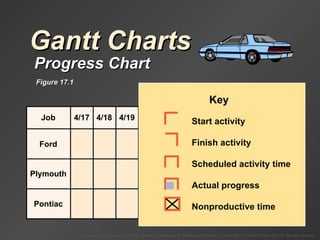
Gantt Charts Progress Chart Figure 17.1 Plymouth Ford Pontiac Job 4/20 4/22 4/23 4/24 4/25 4/26 4/21 4/17 4/18 4/19 Key Start activity Finish activity Scheduled activity time Actual progress Nonproductive time
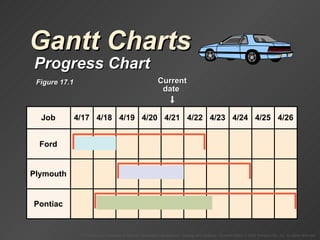
Gantt Charts Progress Chart Figure 17.1 Plymouth Ford Pontiac Job 4/20 4/22 4/23 4/24 4/25 4/26 4/21 4/17 4/18 4/19 Current date
Gantt Charts Figure 17.2 Operating Rooms Chart Operating Room A Workstation 7am Operating Room B Operating Room C 12 noon 8am 9am 10am 11am 1pm 2pm 3pm 4pm 5pm 6pm Time Dr. Jon Adams Dr. Aubrey Brothers Dr. Gary Case Dr. Jeff Dow Dr. Madeline Easton Dr. Dan Gillespie Dr. Jordanne Flowers
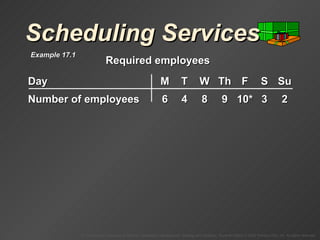
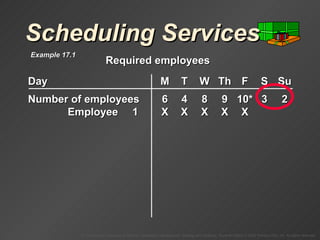
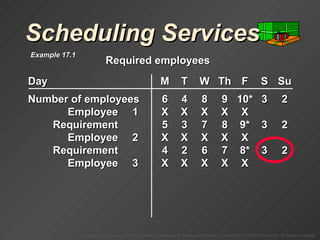
Scheduling Services Example 17.1 Day M T W Th F S Su Number of employees 6 4 8 9 10* 3 2 Required employees
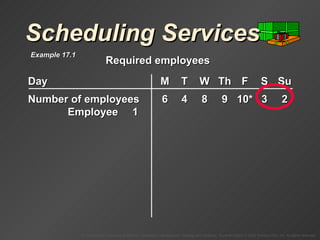
Scheduling Services Day M T W Th F S Su Number of employees 6 4 8 9 10* 3 2 Employee 1 Required employees Example 17.1
Scheduling Services Day M T W Th F S Su Number of employees 6 4 8 9 10* 3 2 Employee 1 X X X X X Required employees Example 17.1
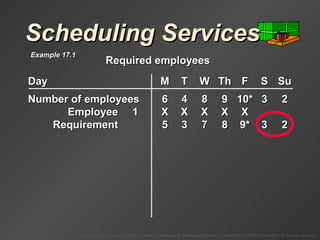
Scheduling Services Day M T W Th F S Su Number of employees 6 4 8 9 10* 3 2 Employee 1 X X X X X Requirement 5 3 7 8 9* 3 2 Required employees Example 17.1
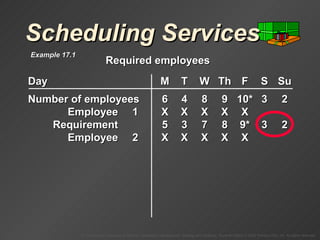
Scheduling Services Day M T W Th F S Su Number of employees 6 4 8 9 10* 3 2 Employee 1 X X X X X Requirement 5 3 7 8 9* 3 2 Employee 2 X X X X X Required employees Example 17.1
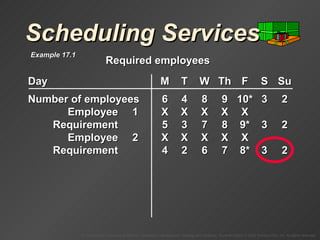
Scheduling Services Day M T W Th F S Su Number of employees 6 4 8 9 10* 3 2 Employee 1 X X X X X Requirement 5 3 7 8 9* 3 2 Employee 2 X X X X X Requirement 4 2 6 7 8* 3 2 Required employees Example 17.1
Scheduling Services Day M T W Th F S Su Number of employees 6 4 8 9 10* 3 2 Employee 1 X X X X X Requirement 5 3 7 8 9* 3 2 Employee 2 X X X X X Requirement 4 2 6 7 8* 3 2 Employee 3 X X X X X Required employees Example 17.1
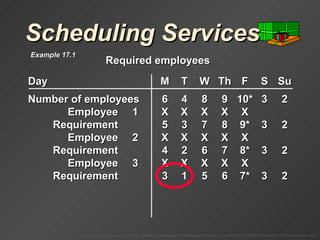
Scheduling Services Day M T W Th F S Su Number of employees 6 4 8 9 10* 3 2 Employee 1 X X X X X Requirement 5 3 7 8 9* 3 2 Employee 2 X X X X X Requirement 4 2 6 7 8* 3 2 Employee 3 X X X X X Requirement 3 1 5 6 7* 3 2 Required employees Example 17.1
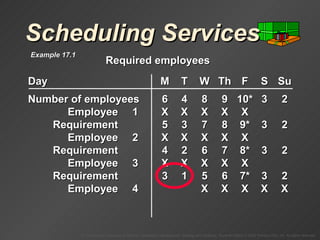
Scheduling Services Day M T W Th F S Su Number of employees 6 4 8 9 10* 3 2 Employee 1 X X X X X Requirement 5 3 7 8 9* 3 2 Employee 2 X X X X X Requirement 4 2 6 7 8* 3 2 Employee 3 X X X X X Requirement 3 1 5 6 7* 3 2 Employee 4 X X X X X Required employees Example 17.1
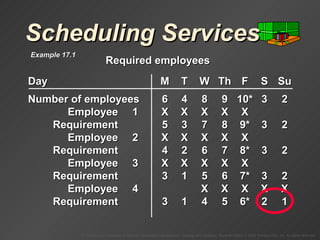
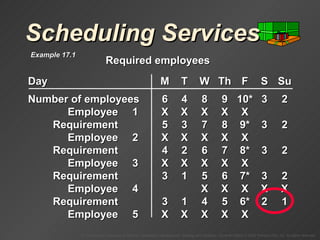
Scheduling Services Day M T W Th F S Su Number of employees 6 4 8 9 10* 3 2 Employee 1 X X X X X Requirement 5 3 7 8 9* 3 2 Employee 2 X X X X X Requirement 4 2 6 7 8* 3 2 Employee 3 X X X X X Requirement 3 1 5 6 7* 3 2 Employee 4 X X X X X Requirement 3 1 4 5 6* 2 1 Required employees Example 17.1
Scheduling Services Day M T W Th F S Su Number of employees 6 4 8 9 10* 3 2 Employee 1 X X X X X Requirement 5 3 7 8 9* 3 2 Employee 2 X X X X X Requirement 4 2 6 7 8* 3 2 Employee 3 X X X X X Requirement 3 1 5 6 7* 3 2 Employee 4 X X X X X Requirement 3 1 4 5 6* 2 1 Employee 5 X X X X X Required employees Example 17.1
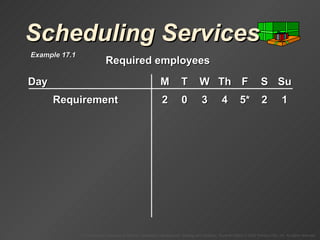
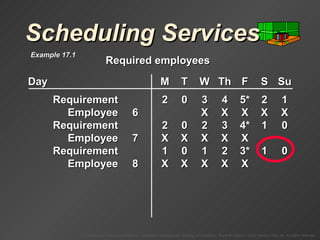
Scheduling Services Day M T W Th F S Su Requirement 2 0 3 4 5* 2 1 Required employees Example 17.1
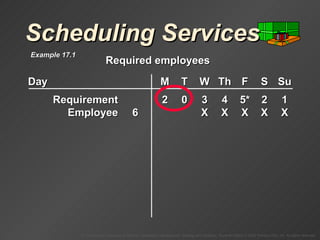
Scheduling Services Day M T W Th F S Su Requirement 2 0 3 4 5* 2 1 Employee 6 X X X X X Required employees Example 17.1
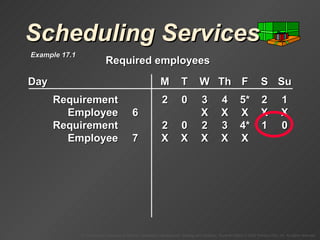
Scheduling Services Day M T W Th F S Su Requirement 2 0 3 4 5* 2 1 Employee 6 X X X X X Requirement 2 0 2 3 4* 1 0 Employee 7 X X X X X Required employees Example 17.1
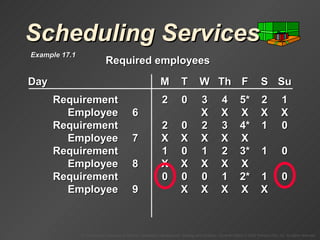
Scheduling Services Day M T W Th F S Su Requirement 2 0 3 4 5* 2 1 Employee 6 X X X X X Requirement 2 0 2 3 4* 1 0 Employee 7 X X X X X Requirement 1 0 1 2 3* 1 0 Employee 8 X X X X X Required employees Example 17.1
Scheduling Services Day M T W Th F S Su Requirement 2 0 3 4 5* 2 1 Employee 6 X X X X X Requirement 2 0 2 3 4* 1 0 Employee 7 X X X X X Requirement 1 0 1 2 3* 1 0 Employee 8 X X X X X Requirement 0 0 0 1 2* 1 0 Employee 9 X X X X X Required employees Example 17.1
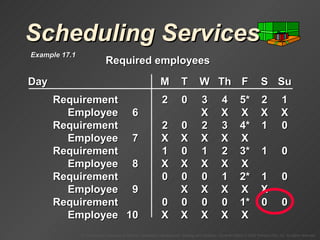
Scheduling Services Day M T W Th F S Su Requirement 2 0 3 4 5* 2 1 Employee 6 X X X X X Requirement 2 0 2 3 4* 1 0 Employee 7 X X X X X Requirement 1 0 1 2 3* 1 0 Employee 8 X X X X X Requirement 0 0 0 1 2* 1 0 Employee 9 X X X X X Requirement 0 0 0 0 1* 0 0 Employee 10 X X X X X Required employees Example 17.1
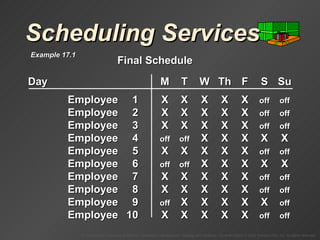
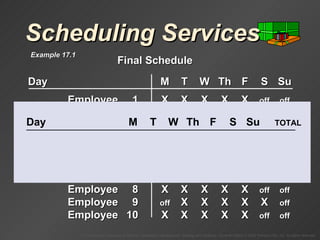
Scheduling Services Day M T W Th F S Su Employee 1 X X X X X off off Employee 2 X X X X X off off Employee 3 X X X X X off off Employee 4 off off X X X X X Employee 5 X X X X X off off Employee 6 off off X X X X X Employee 7 X X X X X off off Employee 8 X X X X X off off Employee 9 off X X X X X off Employee 10 X X X X X off off Final Schedule Example 17.1
Scheduling Services Day M T W Th F S Su Employee 1 X X X X X off off Employee 2 X X X X X off off Employee 3 X X X X X off off Employee 4 off off X X X X X Employee 5 X X X X X off off Employee 6 off off X X X X X Employee 7 X X X X X off off Employee 8 X X X X X off off Employee 9 off X X X X X off Employee 10 X X X X X off off Final Schedule Example 17.1 Day M T W Th F S Su   TOTAL
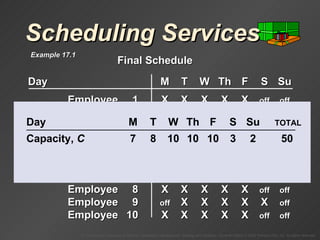
Scheduling Services Day M T W Th F S Su Employee 1 X X X X X off off Employee 2 X X X X X off off Employee 3 X X X X X off off Employee 4 off off X X X X X Employee 5 X X X X X off off Employee 6 off off X X X X X Employee 7 X X X X X off off Employee 8 X X X X X off off Employee 9 off X X X X X off Employee 10 X X X X X off off Final Schedule Example 17.1 Day M T W Th F S Su   TOTAL Capacity,  C 7 8 10 10 10 3 2 50
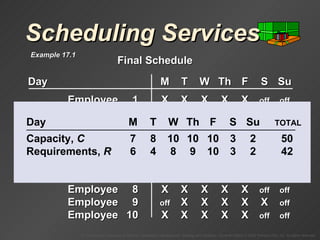
Scheduling Services Day M T W Th F S Su Employee 1 X X X X X off off Employee 2 X X X X X off off Employee 3 X X X X X off off Employee 4 off off X X X X X Employee 5 X X X X X off off Employee 6 off off X X X X X Employee 7 X X X X X off off Employee 8 X X X X X off off Employee 9 off X X X X X off Employee 10 X X X X X off off Final Schedule Example 17.1 Day M T W Th F S Su   TOTAL Capacity,  C 7 8 10 10 10 3 2 50 Requirements,  R 6 4 8 9 10 3 2 42
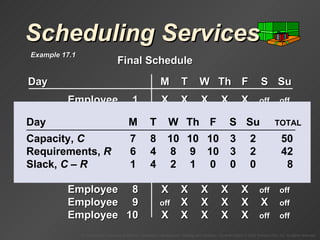
Scheduling Services Day M T W Th F S Su Employee 1 X X X X X off off Employee 2 X X X X X off off Employee 3 X X X X X off off Employee 4 off off X X X X X Employee 5 X X X X X off off Employee 6 off off X X X X X Employee 7 X X X X X off off Employee 8 X X X X X off off Employee 9 off X X X X X off Employee 10 X X X X X off off Final Schedule Example 17.1 Day M T W Th F S Su   TOTAL Capacity,  C 7 8 10 10 10 3 2 50 Requirements,  R 6 4 8 9 10 3 2 42 Slack,  C  –  R 1 4 2 1 0 0 0 8
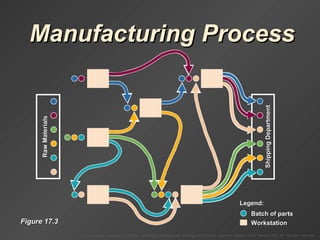
Manufacturing Process Figure 17.3 Shipping Department Raw Materials Legend: Batch of parts Workstation
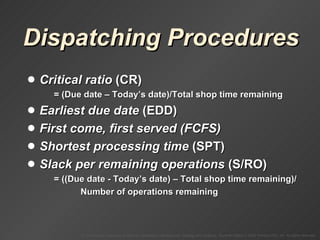
Dispatching Procedures Critical ratio  (CR) = (Due date – Today’s date)/Total shop time remaining Earliest due date  (EDD) First come, first served (FCFS) Shortest processing time  (SPT) Slack per remaining operations  (S/RO) = ((Due date - Today’s date) – Total shop time remaining)/ Number of operations remaining
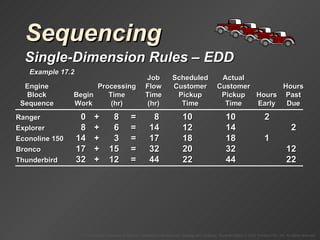
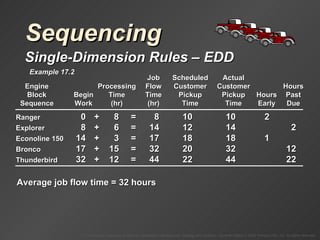
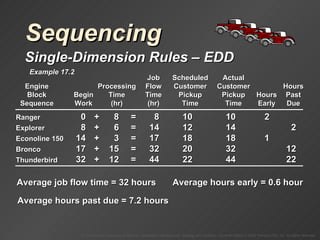
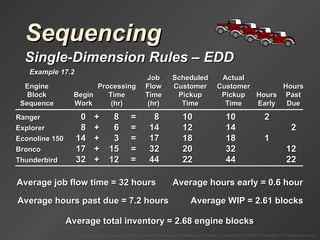
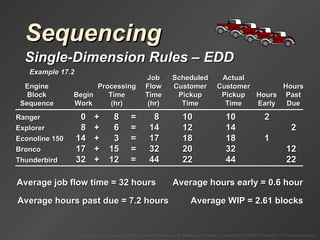
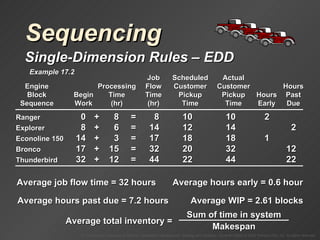
Sequencing Single-Dimension Rules  –  EDD Example 17.2 0 + = 8 10 2 17 + = 32 32 12 8 + = 14 14 2 14 + = 17 18 1 32 + = 44 44 22 Job Scheduled Actual Engine Processing Flow Customer Customer Hours Block Begin Time Time Pickup Pickup Hours Past Sequence Work (hr) (hr) Time Time Early Due Ranger 8 10 Explorer 6 12 Econoline 150 3 18 Bronco 15 20 Thunderbird 12 22
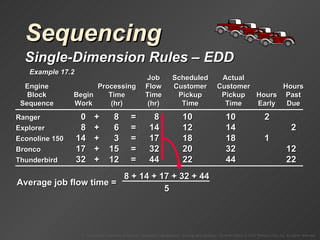
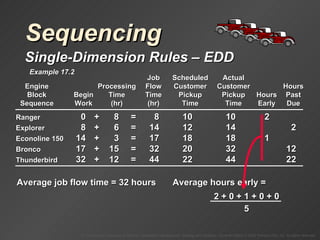
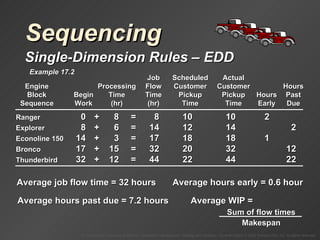
Sequencing Single-Dimension Rules  –  EDD Example 17.2 0 + = 8 10 2 17 + = 32 32 12 8 + = 14 14 2 14 + = 17 18 1 32 + = 44 44 22 Job Scheduled Actual Engine Processing Flow Customer Customer Hours Block Begin Time Time Pickup Pickup Hours Past Sequence Work (hr) (hr) Time Time Early Due Ranger 8 10 Explorer 6 12 Econoline 150 3 18 Bronco 15 20 Thunderbird 12 22 Average job flow time = 8 + 14 + 17 + 32 + 44 5
Sequencing Single-Dimension Rules  –  EDD Example 17.2 0 + = 8 10 2 17 + = 32 32 12 8 + = 14 14 2 14 + = 17 18 1 32 + = 44 44 22 Average job flow time = 32 hours Job Scheduled Actual Engine Processing Flow Customer Customer Hours Block Begin Time Time Pickup Pickup Hours Past Sequence Work (hr) (hr) Time Time Early Due Ranger 8 10 Explorer 6 12 Econoline 150 3 18 Bronco 15 20 Thunderbird 12 22
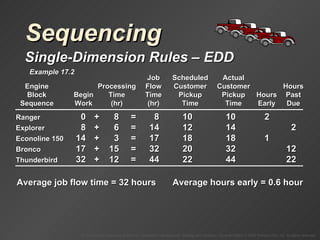
Sequencing Single-Dimension Rules  –  EDD Example 17.2 0 + = 8 10 2 17 + = 32 32 12 8 + = 14 14 2 14 + = 17 18 1 32 + = 44 44 22 Average job flow time = 32 hours Average hours early =  2 + 0 + 1 + 0 + 0 5 Job Scheduled Actual Engine Processing Flow Customer Customer Hours Block Begin Time Time Pickup Pickup Hours Past Sequence Work (hr) (hr) Time Time Early Due Ranger 8 10 Explorer 6 12 Econoline 150 3 18 Bronco 15 20 Thunderbird 12 22
Average hours early = 0.6 hour Sequencing Single-Dimension Rules  –  EDD Example 17.2 0 + = 8 10 2 17 + = 32 32 12 8 + = 14 14 2 14 + = 17 18 1 32 + = 44 44 22 Average job flow time = 32 hours Job Scheduled Actual Engine Processing Flow Customer Customer Hours Block Begin Time Time Pickup Pickup Hours Past Sequence Work (hr) (hr) Time Time Early Due Ranger 8 10 Explorer 6 12 Econoline 150 3 18 Bronco 15 20 Thunderbird 12 22
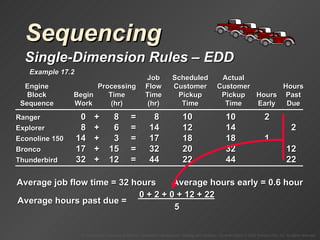
Average hours early = 0.6 hour Sequencing Single-Dimension Rules  –  EDD Example 17.2 0 + = 8 10 2 17 + = 32 32 12 8 + = 14 14 2 14 + = 17 18 1 32 + = 44 44 22 Average job flow time = 32 hours Average hours past due =  Job Scheduled Actual Engine Processing Flow Customer Customer Hours Block Begin Time Time Pickup Pickup Hours Past Sequence Work (hr) (hr) Time Time Early Due Ranger 8 10 Explorer 6 12 Econoline 150 3 18 Bronco 15 20 Thunderbird 12 22 0 + 2 + 0 + 12 + 22 5
Average hours early = 0.6 hour Sequencing Single-Dimension Rules  –  EDD Example 17.2 0 + = 8 10 2 17 + = 32 32 12 8 + = 14 14 2 14 + = 17 18 1 32 + = 44 44 22 Average job flow time = 32 hours Average hours past due = 7.2 hours Job Scheduled Actual Engine Processing Flow Customer Customer Hours Block Begin Time Time Pickup Pickup Hours Past Sequence Work (hr) (hr) Time Time Early Due Ranger 8 10 Explorer 6 12 Econoline 150 3 18 Bronco 15 20 Thunderbird 12 22
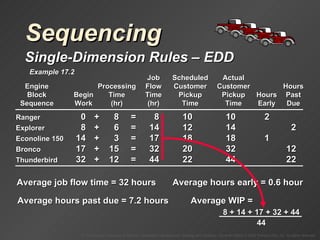
Average hours early = 0.6 hour Sequencing Single-Dimension Rules  –  EDD Example 17.2 0 + = 8 10 2 17 + = 32 32 12 8 + = 14 14 2 14 + = 17 18 1 32 + = 44 44 22 Average job flow time = 32 hours Average hours past due = 7.2 hours Average WIP =  Job Scheduled Actual Engine Processing Flow Customer Customer Hours Block Begin Time Time Pickup Pickup Hours Past Sequence Work (hr) (hr) Time Time Early Due Ranger 8 10 Explorer 6 12 Econoline 150 3 18 Bronco 15 20 Thunderbird 12 22 Sum of flow times Makespan
Average hours early = 0.6 hour Sequencing Single-Dimension Rules  –  EDD Example 17.2 0 + = 8 10 2 17 + = 32 32 12 8 + = 14 14 2 14 + = 17 18 1 32 + = 44 44 22 Average job flow time = 32 hours Average hours past due = 7.2 hours Average WIP =  Job Scheduled Actual Engine Processing Flow Customer Customer Hours Block Begin Time Time Pickup Pickup Hours Past Sequence Work (hr) (hr) Time Time Early Due Ranger 8 10 Explorer 6 12 Econoline 150 3 18 Bronco 15 20 Thunderbird 12 22 8 + 14 + 17 + 32 + 44 44
Average hours early = 0.6 hour Sequencing Single-Dimension Rules  –  EDD Example 17.2 0 + = 8 10 2 17 + = 32 32 12 8 + = 14 14 2 14 + = 17 18 1 32 + = 44 44 22 Average job flow time = 32 hours Average hours past due = 7.2 hours Average WIP = 2.61 blocks Job Scheduled Actual Engine Processing Flow Customer Customer Hours Block Begin Time Time Pickup Pickup Hours Past Sequence Work (hr) (hr) Time Time Early Due Ranger 8 10 Explorer 6 12 Econoline 150 3 18 Bronco 15 20 Thunderbird 12 22
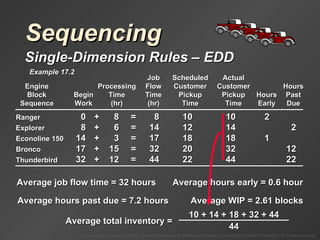
Sequencing Single-Dimension Rules  –  EDD Example 17.2 Average total inventory = Average hours early = 0.6 hour Job Scheduled Actual Engine Processing Flow Customer Customer Hours Block Begin Time Time Pickup Pickup Hours Past Sequence Work (hr) (hr) Time Time Early Due Ranger 8 10 Explorer 6 12 Econoline 150 3 18 Bronco 15 20 Thunderbird 12 22 0 + = 8 10 2 17 + = 32 32 12 8 + = 14 14 2 14 + = 17 18 1 32 + = 44 44 22 Average job flow time = 32 hours Average hours past due = 7.2 hours Average WIP = 2.61 blocks Sum of time in system Makespan
Sequencing Single-Dimension Rules  –  EDD Example 17.2 Average total inventory = Average hours early = 0.6 hour Job Scheduled Actual Engine Processing Flow Customer Customer Hours Block Begin Time Time Pickup Pickup Hours Past Sequence Work (hr) (hr) Time Time Early Due Ranger 8 10 Explorer 6 12 Econoline 150 3 18 Bronco 15 20 Thunderbird 12 22 0 + = 8 10 2 17 + = 32 32 12 8 + = 14 14 2 14 + = 17 18 1 32 + = 44 44 22 Average job flow time = 32 hours Average hours past due = 7.2 hours Average WIP = 2.61 blocks 10 + 14 + 18 + 32 + 44 44
Sequencing Single-Dimension Rules  –  EDD Example 17.2 Average total inventory = 2.68 engine blocks Average hours early = 0.6 hour Job Scheduled Actual Engine Processing Flow Customer Customer Hours Block Begin Time Time Pickup Pickup Hours Past Sequence Work (hr) (hr) Time Time Early Due Ranger 8 10 Explorer 6 12 Econoline 150 3 18 Bronco 15 20 Thunderbird 12 22 0 + = 8 10 2 17 + = 32 32 12 8 + = 14 14 2 14 + = 17 18 1 32 + = 44 44 22 Average job flow time = 32 hours Average hours past due = 7.2 hours Average WIP = 2.61 blocks
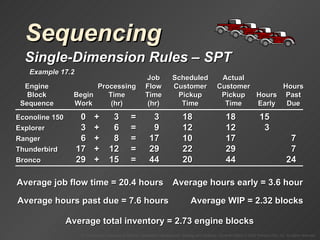
Sequencing Single-Dimension Rules  –  SPT Example 17.2 Job Scheduled Actual Engine Processing Flow Customer Customer Hours Block Begin Time Time Pickup Pickup Hours Past Sequence Work (hr) (hr) Time Time Early Due Econoline 150  0 + 3 =   3 18 18 15 Explorer 3 + 6 = 9 12 12 3 Ranger 6 + 8 = 17 10 17 7 Thunderbird 17 + 12 = 29 22 29 7 Bronco 29 + 15 = 44 20 44 24 Average job flow time = 20.4 hours Average hours early = 3.6 hour Average hours past due = 7.6 hours Average WIP = 2.32 blocks Average total inventory = 2.73 engine blocks
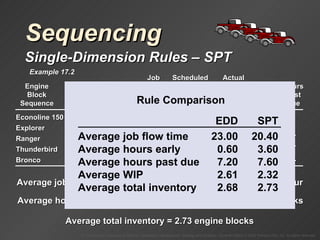
Sequencing Single-Dimension Rules  –  SPT Example 17.2 Job Scheduled Actual Engine Processing Flow Customer Customer Hours Block Begin Time Time Pickup Pickup Hours Past Sequence Work (hr) (hr) Time Time Early Due Econoline 150  0 + 3 =   3 18 18 15 Explorer 3 + 6 = 9 12 12 3 Ranger 6 + 8 = 17 10 17 7 Thunderbird 17 + 12 = 29 22 29 7 Bronco 29 + 15 = 44 20 44 24 Average job flow time = 20.4 hours Average hours early = 3.6 hour Average hours past due = 7.6 hours Average WIP = 2.32 blocks Average total inventory = 2.73 engine blocks Rule Comparison EDD SPT Average job flow time 23.00 20.40 Average hours early 0.60 3.60 Average hours past due 7.20 7.60 Average WIP 2.61 2.32 Average total inventory 2.68 2.73
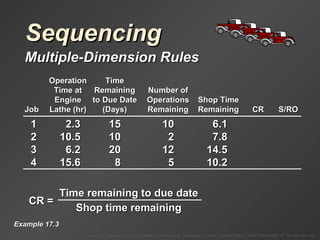
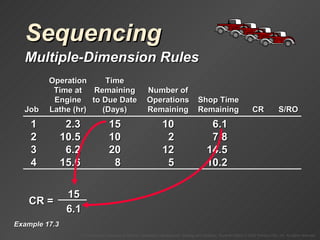
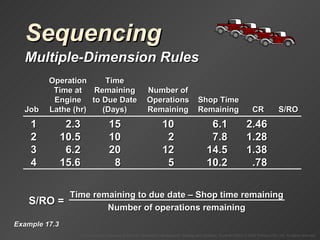
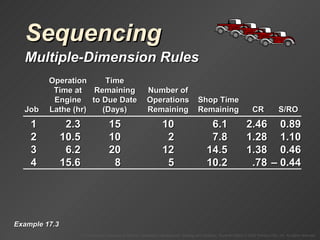
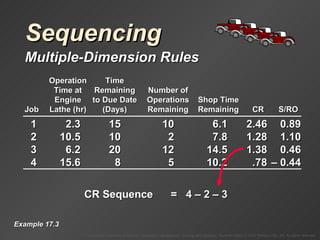
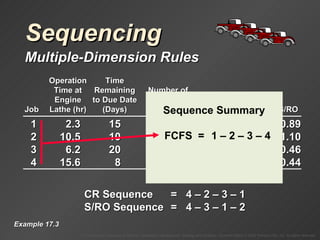
Sequencing Multiple-Dimension Rules Example 17.3 1 2.3 15 10 6.1 2 10.5 10 2 7.8 3 6.2 20 12 14.5 4 15.6 8 5 10.2 Operation Time Time at Remaining Number of Engine to Due Date Operations Shop Time Job Lathe (hr) (Days) Remaining Remaining CR S/RO CR =  Time remaining to due date Shop time remaining
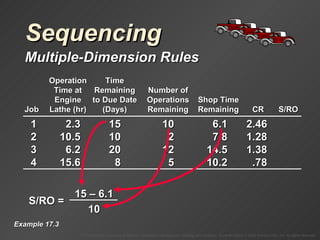
Sequencing Multiple-Dimension Rules Example 17.3 1 2.3 15 10 6.1 2 10.5 10 2 7.8 3 6.2 20 12 14.5 4 15.6 8 5 10.2 Operation Time Time at Remaining Number of Engine to Due Date Operations Shop Time Job Lathe (hr) (Days) Remaining Remaining CR S/RO CR =  15 6.1
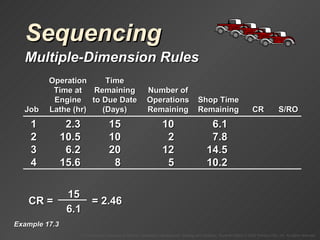
Sequencing Multiple-Dimension Rules Example 17.3 1 2.3 15 10 6.1 2 10.5 10 2 7.8 3 6.2 20 12 14.5 4 15.6 8 5 10.2 Operation Time Time at Remaining Number of Engine to Due Date Operations Shop Time Job Lathe (hr) (Days) Remaining Remaining CR S/RO CR =  = 2.46 15 6.1
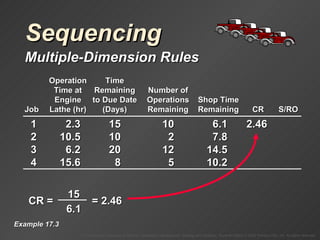
Sequencing Multiple-Dimension Rules Example 17.3 1 2.3 15 10 6.1 2.46 2 10.5 10 2 7.8 3 6.2 20 12 14.5 4 15.6 8 5 10.2 Operation Time Time at Remaining Number of Engine to Due Date Operations Shop Time Job Lathe (hr) (Days) Remaining Remaining CR S/RO CR =  = 2.46 15 6.1
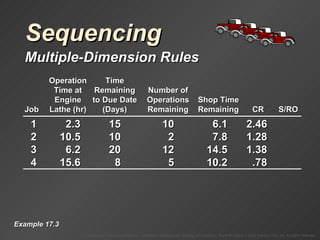
Sequencing Multiple-Dimension Rules Example 17.3 1 2.3 15 10 6.1 2.46 2 10.5 10 2 7.8 1.28 3 6.2 20 12 14.5 1.38 4 15.6 8 5 10.2 .78 Operation Time Time at Remaining Number of Engine to Due Date Operations Shop Time Job Lathe (hr) (Days) Remaining Remaining CR S/RO
Sequencing Multiple-Dimension Rules Example 17.3 S/RO =  Time remaining to due date – Shop time remaining Number of operations remaining 1 2.3 15 10 6.1 2.46 2 10.5 10 2 7.8 1.28 3 6.2 20 12 14.5 1.38 4 15.6 8 5 10.2 .78 Operation Time Time at Remaining Number of Engine to Due Date Operations Shop Time Job Lathe (hr) (Days) Remaining Remaining CR S/RO
Sequencing Multiple-Dimension Rules Example 17.3 S/RO =  1 2.3 15 10 6.1 2.46 2 10.5 10 2 7.8 1.28 3 6.2 20 12 14.5 1.38 4 15.6 8 5 10.2 .78 Operation Time Time at Remaining Number of Engine to Due Date Operations Shop Time Job Lathe (hr) (Days) Remaining Remaining CR S/RO 15 – 6.1 10
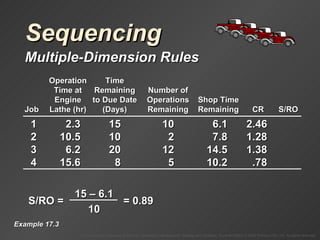
Sequencing Multiple-Dimension Rules Example 17.3 S/RO =  = 0.89 1 2.3 15 10 6.1 2.46 2 10.5 10 2 7.8 1.28 3 6.2 20 12 14.5 1.38 4 15.6 8 5 10.2 .78 Operation Time Time at Remaining Number of Engine to Due Date Operations Shop Time Job Lathe (hr) (Days) Remaining Remaining CR S/RO 15 – 6.1 10
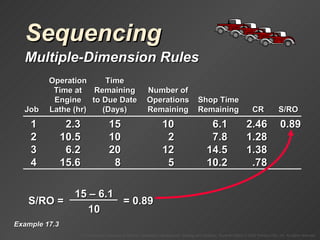
Sequencing Multiple-Dimension Rules Example 17.3 S/RO =  = 0.89 1 2.3 15 10 6.1 2.46 0.89 2 10.5 10 2 7.8 1.28 3 6.2 20 12 14.5 1.38 4 15.6 8 5 10.2 .78 Operation Time Time at Remaining Number of Engine to Due Date Operations Shop Time Job Lathe (hr) (Days) Remaining Remaining CR S/RO 15 – 6.1 10
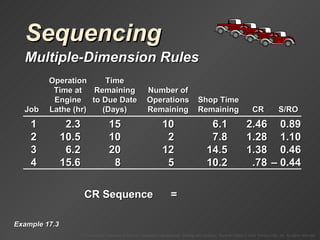
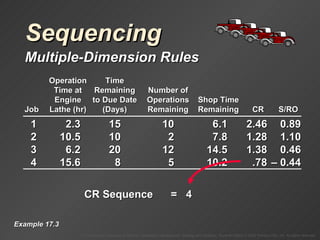
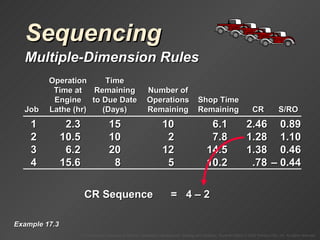
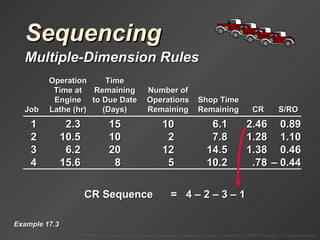
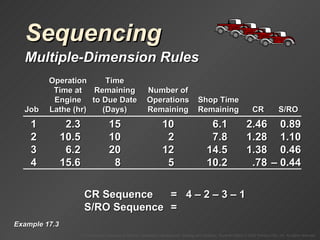
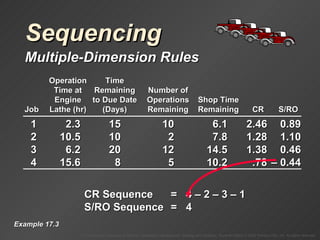
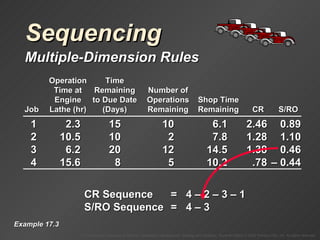
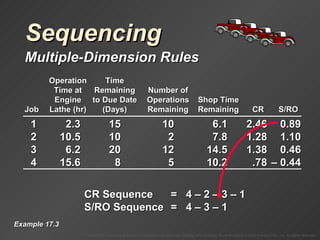
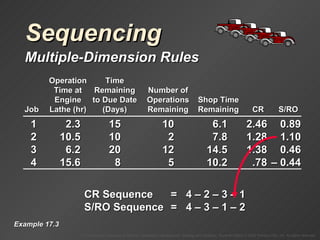
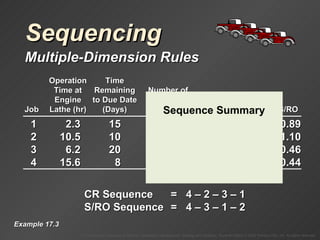
Sequencing Multiple-Dimension Rules Example 17.3 1 2.3 15 10 6.1 2.46 0.89 2 10.5 10 2 7.8 1.28 1.10 3 6.2 20 12 14.5 1.38 0.46 4 15.6 8 5 10.2 .78 – 0.44 Operation Time Time at Remaining Number of Engine to Due Date Operations Shop Time Job Lathe (hr) (Days) Remaining Remaining CR S/RO
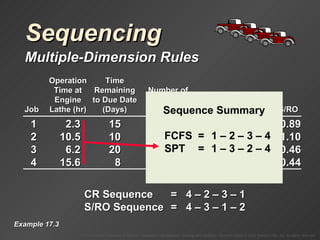
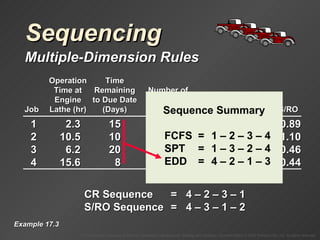
Sequencing Multiple-Dimension Rules Example 17.3 CR Sequence = CR Sequence = 1 2.3 15 10 6.1 2.46 0.89 2 10.5 10 2 7.8 1.28 1.10 3 6.2 20 12 14.5 1.38 0.46 4 15.6 8 5 10.2 .78 – 0.44 Operation Time Time at Remaining Number of Engine to Due Date Operations Shop Time Job Lathe (hr) (Days) Remaining Remaining CR S/RO
Sequencing Multiple-Dimension Rules Example 17.3 CR Sequence =  4 CR Sequence = 1 2.3 15 10 6.1 2.46 0.89 2 10.5 10 2 7.8 1.28 1.10 3 6.2 20 12 14.5 1.38 0.46 4 15.6 8 5 10.2 .78 – 0.44 Operation Time Time at Remaining Number of Engine to Due Date Operations Shop Time Job Lathe (hr) (Days) Remaining Remaining CR S/RO
Sequencing Multiple-Dimension Rules Example 17.3 CR Sequence =  4  – 2 CR Sequence = 1 2.3 15 10 6.1 2.46 0.89 2 10.5 10 2 7.8 1.28 1.10 3 6.2 20 12 14.5 1.38 0.46 4 15.6 8 5 10.2 .78 – 0.44 Operation Time Time at Remaining Number of Engine to Due Date Operations Shop Time Job Lathe (hr) (Days) Remaining Remaining CR S/RO
Sequencing Multiple-Dimension Rules Example 17.3 CR Sequence =  4  – 2 – 3 CR Sequence = 1 2.3 15 10 6.1 2.46 0.89 2 10.5 10 2 7.8 1.28 1.10 3 6.2 20 12 14.5 1.38 0.46 4 15.6 8 5 10.2 .78 – 0.44 Operation Time Time at Remaining Number of Engine to Due Date Operations Shop Time Job Lathe (hr) (Days) Remaining Remaining CR S/RO
Sequencing Multiple-Dimension Rules Example 17.3 CR Sequence =  4  – 2 – 3 – 1 CR Sequence = 1 2.3 15 10 6.1 2.46 0.89 2 10.5 10 2 7.8 1.28 1.10 3 6.2 20 12 14.5 1.38 0.46 4 15.6 8 5 10.2 .78 – 0.44 Operation Time Time at Remaining Number of Engine to Due Date Operations Shop Time Job Lathe (hr) (Days) Remaining Remaining CR S/RO
Sequencing Multiple-Dimension Rules Example 17.3 CR Sequence =  4  – 2 – 3 – 1 S/RO Sequence = CR Sequence = 1 2.3 15 10 6.1 2.46 0.89 2 10.5 10 2 7.8 1.28 1.10 3 6.2 20 12 14.5 1.38 0.46 4 15.6 8 5 10.2 .78 – 0.44 Operation Time Time at Remaining Number of Engine to Due Date Operations Shop Time Job Lathe (hr) (Days) Remaining Remaining CR S/RO
Sequencing Multiple-Dimension Rules Example 17.3 CR Sequence =  4  – 2 – 3 – 1 S/RO Sequence =  4 CR Sequence = 1 2.3 15 10 6.1 2.46 0.89 2 10.5 10 2 7.8 1.28 1.10 3 6.2 20 12 14.5 1.38 0.46 4 15.6 8 5 10.2 .78 – 0.44 Operation Time Time at Remaining Number of Engine to Due Date Operations Shop Time Job Lathe (hr) (Days) Remaining Remaining CR S/RO
Sequencing Multiple-Dimension Rules Example 17.3 CR Sequence =  4  – 2 – 3 – 1 S/RO Sequence =  4  – 3  CR Sequence = 1 2.3 15 10 6.1 2.46 0.89 2 10.5 10 2 7.8 1.28 1.10 3 6.2 20 12 14.5 1.38 0.46 4 15.6 8 5 10.2 .78 – 0.44 Operation Time Time at Remaining Number of Engine to Due Date Operations Shop Time Job Lathe (hr) (Days) Remaining Remaining CR S/RO
Sequencing Multiple-Dimension Rules Example 17.3 CR Sequence =  4  – 2 – 3 – 1 S/RO Sequence =  4  – 3 – 1  CR Sequence = 1 2.3 15 10 6.1 2.46 0.89 2 10.5 10 2 7.8 1.28 1.10 3 6.2 20 12 14.5 1.38 0.46 4 15.6 8 5 10.2 .78 – 0.44 Operation Time Time at Remaining Number of Engine to Due Date Operations Shop Time Job Lathe (hr) (Days) Remaining Remaining CR S/RO
Sequencing Multiple-Dimension Rules Example 17.3 CR Sequence =  4  – 2 – 3 – 1 S/RO Sequence =  4  – 3 – 1 – 2 CR Sequence = 1 2.3 15 10 6.1 2.46 0.89 2 10.5 10 2 7.8 1.28 1.10 3 6.2 20 12 14.5 1.38 0.46 4 15.6 8 5 10.2 .78 – 0.44 Operation Time Time at Remaining Number of Engine to Due Date Operations Shop Time Job Lathe (hr) (Days) Remaining Remaining CR S/RO
Sequencing Multiple-Dimension Rules Example 17.3 CR Sequence =  4  – 2 – 3 – 1 S/RO Sequence =  4  – 3 – 1 – 2 CR Sequence = 1 2.3 15 10 6.1 2.46 0.89 2 10.5 10 2 7.8 1.28 1.10 3 6.2 20 12 14.5 1.38 0.46 4 15.6 8 5 10.2 .78 – 0.44 Operation Time Time at Remaining Number of Engine to Due Date Operations Shop Time Job Lathe (hr) (Days) Remaining Remaining CR S/RO Sequence Summary
Sequencing Multiple-Dimension Rules Example 17.3 CR Sequence =  4  – 2 – 3 – 1 S/RO Sequence =  4  – 3 – 1 – 2 CR Sequence = FCFS = 1 – 2 – 3 – 4 1 2.3 15 10 6.1 2.46 0.89 2 10.5 10 2 7.8 1.28 1.10 3 6.2 20 12 14.5 1.38 0.46 4 15.6 8 5 10.2 .78 – 0.44 Operation Time Time at Remaining Number of Engine to Due Date Operations Shop Time Job Lathe (hr) (Days) Remaining Remaining CR S/RO Sequence Summary
Sequencing Multiple-Dimension Rules Example 17.3 CR Sequence =  4  – 2 – 3 – 1 S/RO Sequence =  4  – 3 – 1 – 2 CR Sequence = FCFS = 1 – 2 – 3 – 4 SPT = 1 – 3 – 2 – 4 1 2.3 15 10 6.1 2.46 0.89 2 10.5 10 2 7.8 1.28 1.10 3 6.2 20 12 14.5 1.38 0.46 4 15.6 8 5 10.2 .78 – 0.44 Operation Time Time at Remaining Number of Engine to Due Date Operations Shop Time Job Lathe (hr) (Days) Remaining Remaining CR S/RO Sequence Summary
Sequencing Multiple-Dimension Rules Example 17.3 CR Sequence =  4  – 2 – 3 – 1 S/RO Sequence =  4  – 3 – 1 – 2 CR Sequence = FCFS = 1 – 2 – 3 – 4 SPT = 1 – 3 – 2 – 4 EDD = 4 – 2 – 1 – 3 1 2.3 15 10 6.1 2.46 0.89 2 10.5 10 2 7.8 1.28 1.10 3 6.2 20 12 14.5 1.38 0.46 4 15.6 8 5 10.2 .78 – 0.44 Operation Time Time at Remaining Number of Engine to Due Date Operations Shop Time Job Lathe (hr) (Days) Remaining Remaining CR S/RO Sequence Summary
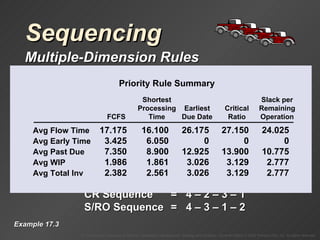
Sequencing Multiple-Dimension Rules Example 17.3 CR Sequence =  4  – 2 – 3 – 1 S/RO Sequence =  4  – 3 – 1 – 2 CR Sequence = FCFS = 1 – 2 – 3 – 4 SPT = 1 – 3 – 2 – 4 EDD = 4 – 2 – 1 – 3 1 2.3 15 10 6.1 2.46 0.89 2 10.5 10 2 7.8 1.28 1.10 3 6.2 20 12 14.5 1.38 0.46 4 15.6 8 5 10.2 .78 – 0.44 Operation Time Time at Remaining Number of Engine to Due Date Operations Shop Time Job Lathe (hr) (Days) Remaining Remaining CR S/RO Sequence Summary Avg Flow Time 17.175 16.100 26.175 27.150 24.025 Avg Early Time 3.425 6.050 0 0 0 Avg Past Due 7.350 8.900 12.925 13.900 10.775 Avg WIP 1.986 1.861 3.026 3.129 2.777 Avg Total Inv 2.382 2.561 3.026 3.129 2.777 Shortest Slack per Processing Earliest Critical Remaining FCFS Time Due Date Ratio Operation Priority Rule Summary
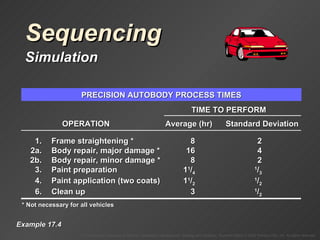
Sequencing Simulation Example 17.4 PRECISION AUTOBODY PROCESS TIMES TIME TO PERFORM 1. Frame straightening * 8 2 2a. Body repair, major damage * 16 4 2b. Body repair, minor damage * 8 2 3. Paint preparation 1 1 / 4 1 / 3 4. Paint application (two coats) 1 1 / 2 1 / 2 6. Clean up 3   1 / 2 OPERATION Average (hr) Standard Deviation * Not necessary for all vehicles
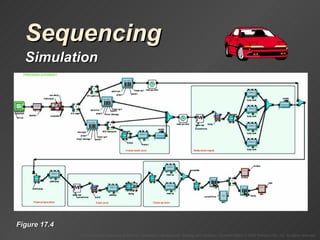
Sequencing Simulation Figure 17.4
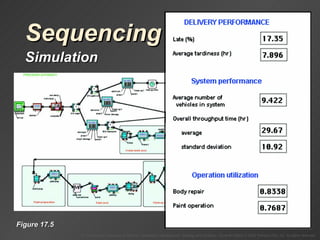
Sequencing Simulation Figure 17.5
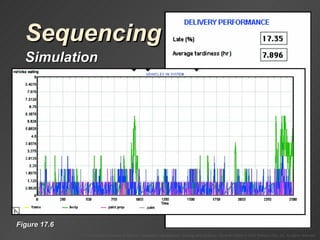
Sequencing Simulation Figure 17.6
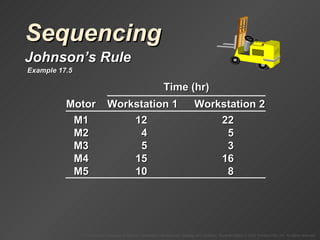
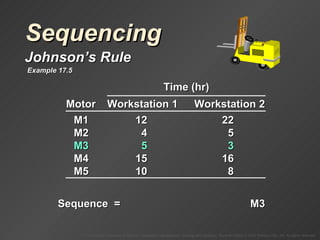
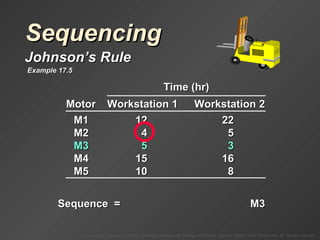
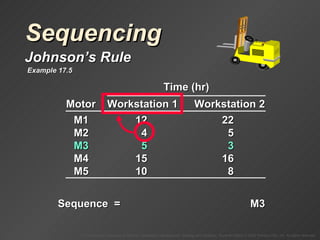
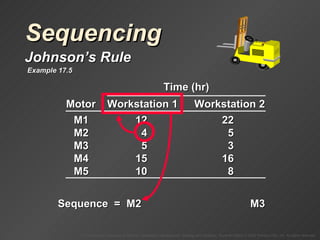
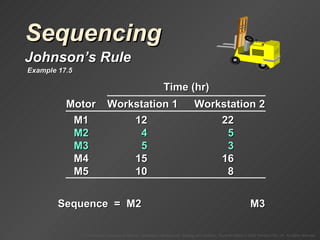
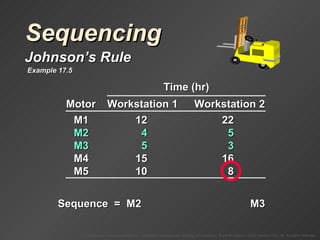
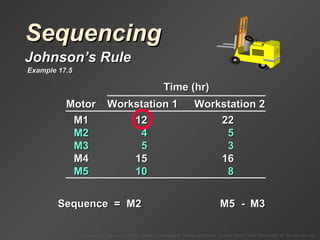
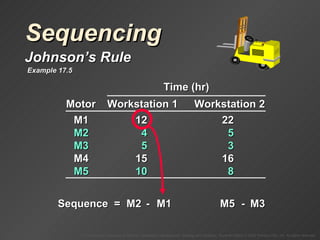
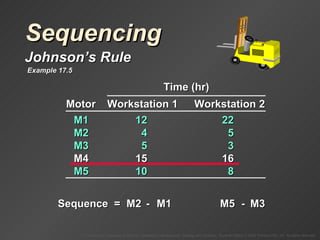
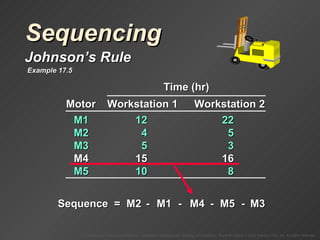
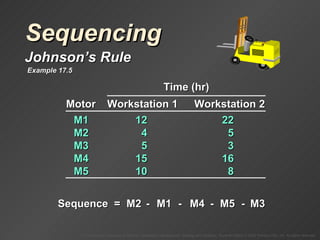
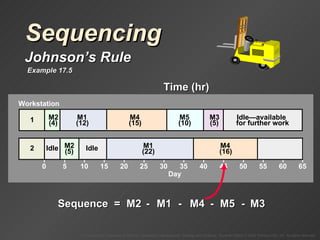
Sequencing Johnson’s Rule Example 17.5 Time (hr) Motor Workstation 1 Workstation 2 M1 12 22 M2 4 5 M3 5 3 M4 15 16 M5 10 8
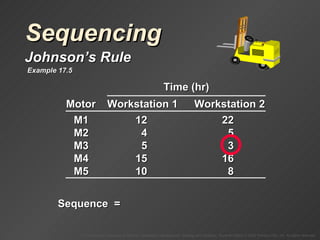
Sequencing Johnson’s Rule Example 17.5 Sequence  =  Time (hr) Motor Workstation 1 Workstation 2 M1 12 22 M2 4 5 M3 5 3 M4 15 16 M5 10 8
Sequencing Johnson’s Rule Sequence  =  Example 17.5 Time (hr) Motor Workstation 1 Workstation 2 M1 12 22 M2 4 5 M3 5 3 M4 15 16 M5 10 8
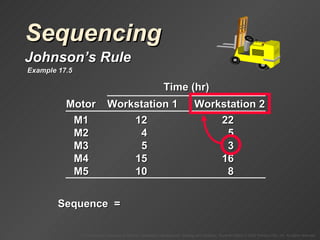
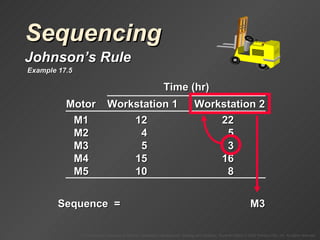
Sequencing Johnson’s Rule Sequence  =  M3 Example 17.5 Time (hr) Motor Workstation 1 Workstation 2 M1 12 22 M2 4 5 M3 5 3 M4 15 16 M5 10 8
Sequencing Johnson’s Rule Sequence  =  M2 M3 Example 17.5 Time (hr) Motor Workstation 1 Workstation 2 M1 12 22 M2 4 5 M3 5 3 M4 15 16 M5 10 8
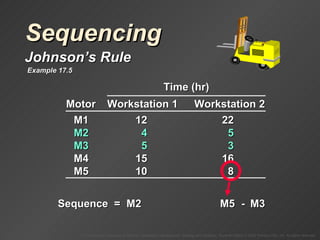
Sequencing Johnson’s Rule Sequence  =  M2 M3 M5 - Example 17.5 Time (hr) Motor Workstation 1 Workstation 2 M1 12 22 M2 4 5 M3 5 3 M4 15 16 M5 10 8
Sequencing Johnson’s Rule Sequence  =  M1 M2 M3 M5 - - Example 17.5 Time (hr) Motor Workstation 1 Workstation 2 M1 12 22 M2 4 5 M3 5 3 M4 15 16 M5 10 8
Sequencing Johnson’s Rule Sequence  =  M1 M2 M3 M4 M5 - - - - Example 17.5 Time (hr) Motor Workstation 1 Workstation 2 M1 12 22 M2 4 5 M3 5 3 M4 15 16 M5 10 8
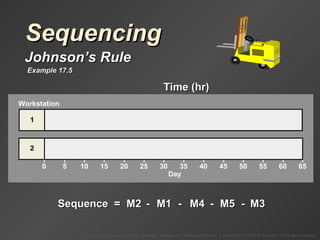
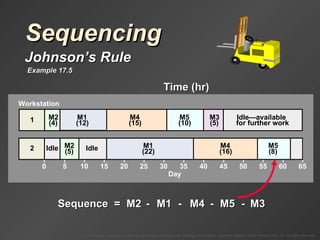
Sequencing Johnson’s Rule Example 17.5 Time (hr) Motor Workstation 1 Workstation 2 M1 12 22 M2 4 5 M3 5 3 M4 15 16 M5 10 8 Sequence  =  M1 M2 M3 M4 M5 - - - - Workstation 0 5 10 15 20 25 30 Day 35 40 45 50 55 60 65 2 1
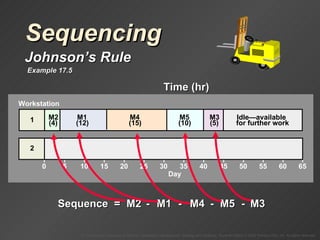
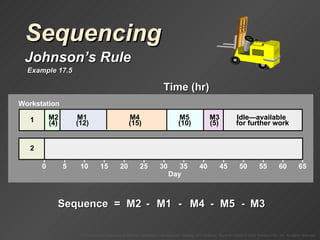
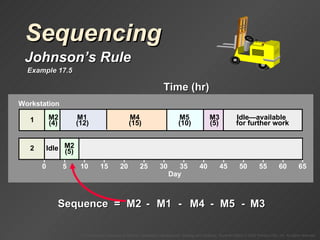
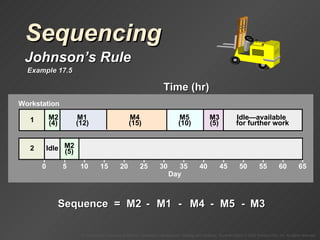
Sequencing Johnson’s Rule Example 17.5 Time (hr) Motor Workstation 1 Workstation 2 M1 12 22 M2 4 5 M3 5 3 M4 15 16 M5 10 8 Sequence  =  M1 M2 M3 M4 M5 - - - - Workstation M2  (4) M1  (12) M4  (15) M5  (10) M3  (5) Idle—available  for further work 0 5 10 15 20 25 30 Day 35 40 45 50 55 60 65 2 1
Sequencing Johnson’s Rule Example 17.5 Time (hr) Motor Workstation 1 Workstation 2 M1 12 22 M2 4 5 M3 5 3 M4 15 16 M5 10 8 Sequence  =  M1 M2 M3 M4 M5 - - - - Workstation M2  (4) M1  (12) M4  (15) M5  (10) M3  (5) Idle—available  for further work 0 5 10 15 20 25 30 Day 35 40 45 50 55 60 65 Idle 2 1
Sequencing Johnson’s Rule Example 17.5 Time (hr) Motor Workstation 1 Workstation 2 M1 12 22 M2 4 5 M3 5 3 M4 15 16 M5 10 8 Sequence  =  M1 M2 M3 M4 M5 - - - - Workstation M2  (4) M1  (12) M4  (15) M5  (10) M3  (5) Idle—available  for further work 0 5 10 15 20 25 30 Day 35 40 45 50 55 60 65 Idle 2 M2  (5) 1
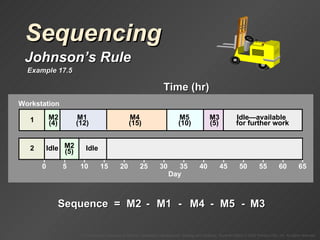
Sequencing Johnson’s Rule Example 17.5 Time (hr) Motor Workstation 1 Workstation 2 M1 12 22 M2 4 5 M3 5 3 M4 15 16 M5 10 8 Sequence  =  M1 M2 M3 M4 M5 - - - - Workstation M2  (4) M1  (12) M4  (15) M5  (10) M3  (5) Idle—available  for further work 0 5 10 15 20 25 30 Day 35 40 45 50 55 60 65 Idle 2 M2  (5) Idle 1
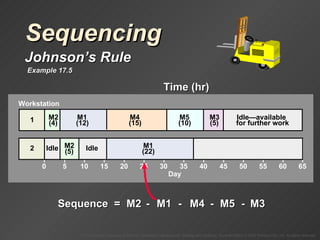
Sequencing Johnson’s Rule Example 17.5 Time (hr) Motor Workstation 1 Workstation 2 M1 12 22 M2 4 5 M3 5 3 M4 15 16 M5 10 8 Sequence  =  M1 M2 M3 M4 M5 - - - - Workstation M2  (4) M1  (12) M4  (15) M5  (10) M3  (5) Idle—available  for further work 0 5 10 15 20 25 30 Day 35 40 45 50 55 60 65 Idle 2 M2  (5) M1  (22) Idle 1
Sequencing Johnson’s Rule Example 17.5 Time (hr) Motor Workstation 1 Workstation 2 M1 12 22 M2 4 5 M3 5 3 M4 15 16 M5 10 8 Sequence  =  M1 M2 M3 M4 M5 - - - - Workstation M2  (4) M1  (12) M4  (15) M5  (10) M3  (5) Idle—available  for further work 0 5 10 15 20 25 30 Day 35 40 45 50 55 60 65 Idle 2 M2  (5) M1  (22) M4  (16) Idle 1
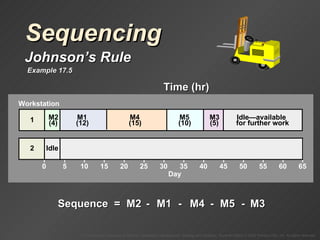
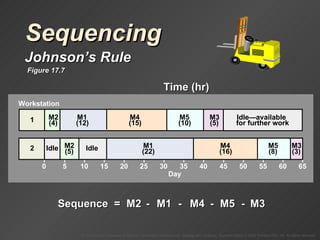
Sequencing Johnson’s Rule Time (hr) Motor Workstation 1 Workstation 2 M1 12 22 M2 4 5 M3 5 3 M4 15 16 M5 10 8 Sequence  =  M1 M2 M3 M4 M5 - - - - Workstation M2  (4) M1  (12) M4  (15) M5  (10) M3  (5) Idle—available  for further work 0 5 10 15 20 25 30 Day 35 40 45 50 55 60 65 Idle 2 M2  (5) M1  (22) M4  (16) M5  (8) Idle 1 Example 17.5
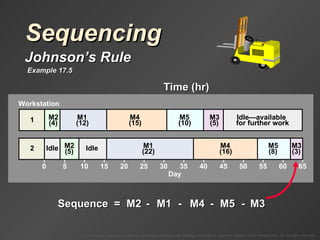
Sequencing Johnson’s Rule Example 17.5 Time (hr) Motor Workstation 1 Workstation 2 M1 12 22 M2 4 5 M3 5 3 M4 15 16 M5 10 8 Sequence  =  M1 M2 M3 M4 M5 - - - - Workstation M2  (4) M1  (12) M4  (15) M5  (10) M3  (5) Idle—available  for further work 0 5 10 15 20 25 30 Day 35 40 45 50 55 60 65 Idle 2 M2  (5) M1  (22) M4  (16) M5  (8) M3  (3) Idle 1
Sequencing Johnson’s Rule Figure 17.7 Time (hr) Motor Workstation 1 Workstation 2 M1 12 22 M2 4 5 M3 5 3 M4 15 16 M5 10 8 Sequence  =  M1 M2 M3 M4 M5 - - - - Workstation M2  (4) M1  (12) M4  (15) M5  (10) M3  (5) Idle—available  for further work 0 5 10 15 20 25 30 Day 35 40 45 50 55 60 65 Idle 2 M2  (5) M1  (22) M4  (16) M5  (8) M3  (3) Idle 1
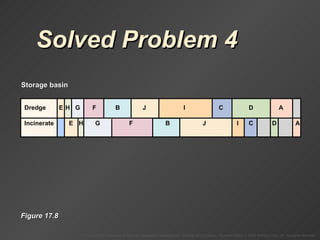
Solved Problem 4 Figure 17.8 Storage basin Dredge E H G F B J I C D A Incinerate E H G F B J I C D A

Ch17

  • 1.
  • 2.
    Gantt Charts ProgressChart Figure 17.1 Plymouth Ford Pontiac Job 4/20 4/22 4/23 4/24 4/25 4/26 4/21 4/17 4/18 4/19 Key Start activity Finish activity Scheduled activity time Actual progress Nonproductive time
  • 3.
    Gantt Charts ProgressChart Figure 17.1 Plymouth Ford Pontiac Job 4/20 4/22 4/23 4/24 4/25 4/26 4/21 4/17 4/18 4/19 Current date
  • 4.
    Gantt Charts Figure17.2 Operating Rooms Chart Operating Room A Workstation 7am Operating Room B Operating Room C 12 noon 8am 9am 10am 11am 1pm 2pm 3pm 4pm 5pm 6pm Time Dr. Jon Adams Dr. Aubrey Brothers Dr. Gary Case Dr. Jeff Dow Dr. Madeline Easton Dr. Dan Gillespie Dr. Jordanne Flowers
  • 5.
    Scheduling Services Example17.1 Day M T W Th F S Su Number of employees 6 4 8 9 10* 3 2 Required employees
  • 6.
    Scheduling Services DayM T W Th F S Su Number of employees 6 4 8 9 10* 3 2 Employee 1 Required employees Example 17.1
  • 7.
    Scheduling Services DayM T W Th F S Su Number of employees 6 4 8 9 10* 3 2 Employee 1 X X X X X Required employees Example 17.1
  • 8.
    Scheduling Services DayM T W Th F S Su Number of employees 6 4 8 9 10* 3 2 Employee 1 X X X X X Requirement 5 3 7 8 9* 3 2 Required employees Example 17.1
  • 9.
    Scheduling Services DayM T W Th F S Su Number of employees 6 4 8 9 10* 3 2 Employee 1 X X X X X Requirement 5 3 7 8 9* 3 2 Employee 2 X X X X X Required employees Example 17.1
  • 10.
    Scheduling Services DayM T W Th F S Su Number of employees 6 4 8 9 10* 3 2 Employee 1 X X X X X Requirement 5 3 7 8 9* 3 2 Employee 2 X X X X X Requirement 4 2 6 7 8* 3 2 Required employees Example 17.1
  • 11.
    Scheduling Services DayM T W Th F S Su Number of employees 6 4 8 9 10* 3 2 Employee 1 X X X X X Requirement 5 3 7 8 9* 3 2 Employee 2 X X X X X Requirement 4 2 6 7 8* 3 2 Employee 3 X X X X X Required employees Example 17.1
  • 12.
    Scheduling Services DayM T W Th F S Su Number of employees 6 4 8 9 10* 3 2 Employee 1 X X X X X Requirement 5 3 7 8 9* 3 2 Employee 2 X X X X X Requirement 4 2 6 7 8* 3 2 Employee 3 X X X X X Requirement 3 1 5 6 7* 3 2 Required employees Example 17.1
  • 13.
    Scheduling Services DayM T W Th F S Su Number of employees 6 4 8 9 10* 3 2 Employee 1 X X X X X Requirement 5 3 7 8 9* 3 2 Employee 2 X X X X X Requirement 4 2 6 7 8* 3 2 Employee 3 X X X X X Requirement 3 1 5 6 7* 3 2 Employee 4 X X X X X Required employees Example 17.1
  • 14.
    Scheduling Services DayM T W Th F S Su Number of employees 6 4 8 9 10* 3 2 Employee 1 X X X X X Requirement 5 3 7 8 9* 3 2 Employee 2 X X X X X Requirement 4 2 6 7 8* 3 2 Employee 3 X X X X X Requirement 3 1 5 6 7* 3 2 Employee 4 X X X X X Requirement 3 1 4 5 6* 2 1 Required employees Example 17.1
  • 15.
    Scheduling Services DayM T W Th F S Su Number of employees 6 4 8 9 10* 3 2 Employee 1 X X X X X Requirement 5 3 7 8 9* 3 2 Employee 2 X X X X X Requirement 4 2 6 7 8* 3 2 Employee 3 X X X X X Requirement 3 1 5 6 7* 3 2 Employee 4 X X X X X Requirement 3 1 4 5 6* 2 1 Employee 5 X X X X X Required employees Example 17.1
  • 16.
    Scheduling Services DayM T W Th F S Su Requirement 2 0 3 4 5* 2 1 Required employees Example 17.1
  • 17.
    Scheduling Services DayM T W Th F S Su Requirement 2 0 3 4 5* 2 1 Employee 6 X X X X X Required employees Example 17.1
  • 18.
    Scheduling Services DayM T W Th F S Su Requirement 2 0 3 4 5* 2 1 Employee 6 X X X X X Requirement 2 0 2 3 4* 1 0 Employee 7 X X X X X Required employees Example 17.1
  • 19.
    Scheduling Services DayM T W Th F S Su Requirement 2 0 3 4 5* 2 1 Employee 6 X X X X X Requirement 2 0 2 3 4* 1 0 Employee 7 X X X X X Requirement 1 0 1 2 3* 1 0 Employee 8 X X X X X Required employees Example 17.1
  • 20.
    Scheduling Services DayM T W Th F S Su Requirement 2 0 3 4 5* 2 1 Employee 6 X X X X X Requirement 2 0 2 3 4* 1 0 Employee 7 X X X X X Requirement 1 0 1 2 3* 1 0 Employee 8 X X X X X Requirement 0 0 0 1 2* 1 0 Employee 9 X X X X X Required employees Example 17.1
  • 21.
    Scheduling Services DayM T W Th F S Su Requirement 2 0 3 4 5* 2 1 Employee 6 X X X X X Requirement 2 0 2 3 4* 1 0 Employee 7 X X X X X Requirement 1 0 1 2 3* 1 0 Employee 8 X X X X X Requirement 0 0 0 1 2* 1 0 Employee 9 X X X X X Requirement 0 0 0 0 1* 0 0 Employee 10 X X X X X Required employees Example 17.1
  • 22.
    Scheduling Services DayM T W Th F S Su Employee 1 X X X X X off off Employee 2 X X X X X off off Employee 3 X X X X X off off Employee 4 off off X X X X X Employee 5 X X X X X off off Employee 6 off off X X X X X Employee 7 X X X X X off off Employee 8 X X X X X off off Employee 9 off X X X X X off Employee 10 X X X X X off off Final Schedule Example 17.1
  • 23.
    Scheduling Services DayM T W Th F S Su Employee 1 X X X X X off off Employee 2 X X X X X off off Employee 3 X X X X X off off Employee 4 off off X X X X X Employee 5 X X X X X off off Employee 6 off off X X X X X Employee 7 X X X X X off off Employee 8 X X X X X off off Employee 9 off X X X X X off Employee 10 X X X X X off off Final Schedule Example 17.1 Day M T W Th F S Su TOTAL
  • 24.
    Scheduling Services DayM T W Th F S Su Employee 1 X X X X X off off Employee 2 X X X X X off off Employee 3 X X X X X off off Employee 4 off off X X X X X Employee 5 X X X X X off off Employee 6 off off X X X X X Employee 7 X X X X X off off Employee 8 X X X X X off off Employee 9 off X X X X X off Employee 10 X X X X X off off Final Schedule Example 17.1 Day M T W Th F S Su TOTAL Capacity, C 7 8 10 10 10 3 2 50
  • 25.
    Scheduling Services DayM T W Th F S Su Employee 1 X X X X X off off Employee 2 X X X X X off off Employee 3 X X X X X off off Employee 4 off off X X X X X Employee 5 X X X X X off off Employee 6 off off X X X X X Employee 7 X X X X X off off Employee 8 X X X X X off off Employee 9 off X X X X X off Employee 10 X X X X X off off Final Schedule Example 17.1 Day M T W Th F S Su TOTAL Capacity, C 7 8 10 10 10 3 2 50 Requirements, R 6 4 8 9 10 3 2 42
  • 26.
    Scheduling Services DayM T W Th F S Su Employee 1 X X X X X off off Employee 2 X X X X X off off Employee 3 X X X X X off off Employee 4 off off X X X X X Employee 5 X X X X X off off Employee 6 off off X X X X X Employee 7 X X X X X off off Employee 8 X X X X X off off Employee 9 off X X X X X off Employee 10 X X X X X off off Final Schedule Example 17.1 Day M T W Th F S Su TOTAL Capacity, C 7 8 10 10 10 3 2 50 Requirements, R 6 4 8 9 10 3 2 42 Slack, C – R 1 4 2 1 0 0 0 8
  • 27.
    Manufacturing Process Figure17.3 Shipping Department Raw Materials Legend: Batch of parts Workstation
  • 28.
    Dispatching Procedures Criticalratio (CR) = (Due date – Today’s date)/Total shop time remaining Earliest due date (EDD) First come, first served (FCFS) Shortest processing time (SPT) Slack per remaining operations (S/RO) = ((Due date - Today’s date) – Total shop time remaining)/ Number of operations remaining
  • 29.
    Sequencing Single-Dimension Rules – EDD Example 17.2 0 + = 8 10 2 17 + = 32 32 12 8 + = 14 14 2 14 + = 17 18 1 32 + = 44 44 22 Job Scheduled Actual Engine Processing Flow Customer Customer Hours Block Begin Time Time Pickup Pickup Hours Past Sequence Work (hr) (hr) Time Time Early Due Ranger 8 10 Explorer 6 12 Econoline 150 3 18 Bronco 15 20 Thunderbird 12 22
  • 30.
    Sequencing Single-Dimension Rules – EDD Example 17.2 0 + = 8 10 2 17 + = 32 32 12 8 + = 14 14 2 14 + = 17 18 1 32 + = 44 44 22 Job Scheduled Actual Engine Processing Flow Customer Customer Hours Block Begin Time Time Pickup Pickup Hours Past Sequence Work (hr) (hr) Time Time Early Due Ranger 8 10 Explorer 6 12 Econoline 150 3 18 Bronco 15 20 Thunderbird 12 22 Average job flow time = 8 + 14 + 17 + 32 + 44 5
  • 31.
    Sequencing Single-Dimension Rules – EDD Example 17.2 0 + = 8 10 2 17 + = 32 32 12 8 + = 14 14 2 14 + = 17 18 1 32 + = 44 44 22 Average job flow time = 32 hours Job Scheduled Actual Engine Processing Flow Customer Customer Hours Block Begin Time Time Pickup Pickup Hours Past Sequence Work (hr) (hr) Time Time Early Due Ranger 8 10 Explorer 6 12 Econoline 150 3 18 Bronco 15 20 Thunderbird 12 22
  • 32.
    Sequencing Single-Dimension Rules – EDD Example 17.2 0 + = 8 10 2 17 + = 32 32 12 8 + = 14 14 2 14 + = 17 18 1 32 + = 44 44 22 Average job flow time = 32 hours Average hours early = 2 + 0 + 1 + 0 + 0 5 Job Scheduled Actual Engine Processing Flow Customer Customer Hours Block Begin Time Time Pickup Pickup Hours Past Sequence Work (hr) (hr) Time Time Early Due Ranger 8 10 Explorer 6 12 Econoline 150 3 18 Bronco 15 20 Thunderbird 12 22
  • 33.
    Average hours early= 0.6 hour Sequencing Single-Dimension Rules – EDD Example 17.2 0 + = 8 10 2 17 + = 32 32 12 8 + = 14 14 2 14 + = 17 18 1 32 + = 44 44 22 Average job flow time = 32 hours Job Scheduled Actual Engine Processing Flow Customer Customer Hours Block Begin Time Time Pickup Pickup Hours Past Sequence Work (hr) (hr) Time Time Early Due Ranger 8 10 Explorer 6 12 Econoline 150 3 18 Bronco 15 20 Thunderbird 12 22
  • 34.
    Average hours early= 0.6 hour Sequencing Single-Dimension Rules – EDD Example 17.2 0 + = 8 10 2 17 + = 32 32 12 8 + = 14 14 2 14 + = 17 18 1 32 + = 44 44 22 Average job flow time = 32 hours Average hours past due = Job Scheduled Actual Engine Processing Flow Customer Customer Hours Block Begin Time Time Pickup Pickup Hours Past Sequence Work (hr) (hr) Time Time Early Due Ranger 8 10 Explorer 6 12 Econoline 150 3 18 Bronco 15 20 Thunderbird 12 22 0 + 2 + 0 + 12 + 22 5
  • 35.
    Average hours early= 0.6 hour Sequencing Single-Dimension Rules – EDD Example 17.2 0 + = 8 10 2 17 + = 32 32 12 8 + = 14 14 2 14 + = 17 18 1 32 + = 44 44 22 Average job flow time = 32 hours Average hours past due = 7.2 hours Job Scheduled Actual Engine Processing Flow Customer Customer Hours Block Begin Time Time Pickup Pickup Hours Past Sequence Work (hr) (hr) Time Time Early Due Ranger 8 10 Explorer 6 12 Econoline 150 3 18 Bronco 15 20 Thunderbird 12 22
  • 36.
    Average hours early= 0.6 hour Sequencing Single-Dimension Rules – EDD Example 17.2 0 + = 8 10 2 17 + = 32 32 12 8 + = 14 14 2 14 + = 17 18 1 32 + = 44 44 22 Average job flow time = 32 hours Average hours past due = 7.2 hours Average WIP = Job Scheduled Actual Engine Processing Flow Customer Customer Hours Block Begin Time Time Pickup Pickup Hours Past Sequence Work (hr) (hr) Time Time Early Due Ranger 8 10 Explorer 6 12 Econoline 150 3 18 Bronco 15 20 Thunderbird 12 22 Sum of flow times Makespan
  • 37.
    Average hours early= 0.6 hour Sequencing Single-Dimension Rules – EDD Example 17.2 0 + = 8 10 2 17 + = 32 32 12 8 + = 14 14 2 14 + = 17 18 1 32 + = 44 44 22 Average job flow time = 32 hours Average hours past due = 7.2 hours Average WIP = Job Scheduled Actual Engine Processing Flow Customer Customer Hours Block Begin Time Time Pickup Pickup Hours Past Sequence Work (hr) (hr) Time Time Early Due Ranger 8 10 Explorer 6 12 Econoline 150 3 18 Bronco 15 20 Thunderbird 12 22 8 + 14 + 17 + 32 + 44 44
  • 38.
    Average hours early= 0.6 hour Sequencing Single-Dimension Rules – EDD Example 17.2 0 + = 8 10 2 17 + = 32 32 12 8 + = 14 14 2 14 + = 17 18 1 32 + = 44 44 22 Average job flow time = 32 hours Average hours past due = 7.2 hours Average WIP = 2.61 blocks Job Scheduled Actual Engine Processing Flow Customer Customer Hours Block Begin Time Time Pickup Pickup Hours Past Sequence Work (hr) (hr) Time Time Early Due Ranger 8 10 Explorer 6 12 Econoline 150 3 18 Bronco 15 20 Thunderbird 12 22
  • 39.
    Sequencing Single-Dimension Rules – EDD Example 17.2 Average total inventory = Average hours early = 0.6 hour Job Scheduled Actual Engine Processing Flow Customer Customer Hours Block Begin Time Time Pickup Pickup Hours Past Sequence Work (hr) (hr) Time Time Early Due Ranger 8 10 Explorer 6 12 Econoline 150 3 18 Bronco 15 20 Thunderbird 12 22 0 + = 8 10 2 17 + = 32 32 12 8 + = 14 14 2 14 + = 17 18 1 32 + = 44 44 22 Average job flow time = 32 hours Average hours past due = 7.2 hours Average WIP = 2.61 blocks Sum of time in system Makespan
  • 40.
    Sequencing Single-Dimension Rules – EDD Example 17.2 Average total inventory = Average hours early = 0.6 hour Job Scheduled Actual Engine Processing Flow Customer Customer Hours Block Begin Time Time Pickup Pickup Hours Past Sequence Work (hr) (hr) Time Time Early Due Ranger 8 10 Explorer 6 12 Econoline 150 3 18 Bronco 15 20 Thunderbird 12 22 0 + = 8 10 2 17 + = 32 32 12 8 + = 14 14 2 14 + = 17 18 1 32 + = 44 44 22 Average job flow time = 32 hours Average hours past due = 7.2 hours Average WIP = 2.61 blocks 10 + 14 + 18 + 32 + 44 44
  • 41.
    Sequencing Single-Dimension Rules – EDD Example 17.2 Average total inventory = 2.68 engine blocks Average hours early = 0.6 hour Job Scheduled Actual Engine Processing Flow Customer Customer Hours Block Begin Time Time Pickup Pickup Hours Past Sequence Work (hr) (hr) Time Time Early Due Ranger 8 10 Explorer 6 12 Econoline 150 3 18 Bronco 15 20 Thunderbird 12 22 0 + = 8 10 2 17 + = 32 32 12 8 + = 14 14 2 14 + = 17 18 1 32 + = 44 44 22 Average job flow time = 32 hours Average hours past due = 7.2 hours Average WIP = 2.61 blocks
  • 42.
    Sequencing Single-Dimension Rules – SPT Example 17.2 Job Scheduled Actual Engine Processing Flow Customer Customer Hours Block Begin Time Time Pickup Pickup Hours Past Sequence Work (hr) (hr) Time Time Early Due Econoline 150 0 + 3 = 3 18 18 15 Explorer 3 + 6 = 9 12 12 3 Ranger 6 + 8 = 17 10 17 7 Thunderbird 17 + 12 = 29 22 29 7 Bronco 29 + 15 = 44 20 44 24 Average job flow time = 20.4 hours Average hours early = 3.6 hour Average hours past due = 7.6 hours Average WIP = 2.32 blocks Average total inventory = 2.73 engine blocks
  • 43.
    Sequencing Single-Dimension Rules – SPT Example 17.2 Job Scheduled Actual Engine Processing Flow Customer Customer Hours Block Begin Time Time Pickup Pickup Hours Past Sequence Work (hr) (hr) Time Time Early Due Econoline 150 0 + 3 = 3 18 18 15 Explorer 3 + 6 = 9 12 12 3 Ranger 6 + 8 = 17 10 17 7 Thunderbird 17 + 12 = 29 22 29 7 Bronco 29 + 15 = 44 20 44 24 Average job flow time = 20.4 hours Average hours early = 3.6 hour Average hours past due = 7.6 hours Average WIP = 2.32 blocks Average total inventory = 2.73 engine blocks Rule Comparison EDD SPT Average job flow time 23.00 20.40 Average hours early 0.60 3.60 Average hours past due 7.20 7.60 Average WIP 2.61 2.32 Average total inventory 2.68 2.73
  • 44.
    Sequencing Multiple-Dimension RulesExample 17.3 1 2.3 15 10 6.1 2 10.5 10 2 7.8 3 6.2 20 12 14.5 4 15.6 8 5 10.2 Operation Time Time at Remaining Number of Engine to Due Date Operations Shop Time Job Lathe (hr) (Days) Remaining Remaining CR S/RO CR = Time remaining to due date Shop time remaining
  • 45.
    Sequencing Multiple-Dimension RulesExample 17.3 1 2.3 15 10 6.1 2 10.5 10 2 7.8 3 6.2 20 12 14.5 4 15.6 8 5 10.2 Operation Time Time at Remaining Number of Engine to Due Date Operations Shop Time Job Lathe (hr) (Days) Remaining Remaining CR S/RO CR = 15 6.1
  • 46.
    Sequencing Multiple-Dimension RulesExample 17.3 1 2.3 15 10 6.1 2 10.5 10 2 7.8 3 6.2 20 12 14.5 4 15.6 8 5 10.2 Operation Time Time at Remaining Number of Engine to Due Date Operations Shop Time Job Lathe (hr) (Days) Remaining Remaining CR S/RO CR = = 2.46 15 6.1
  • 47.
    Sequencing Multiple-Dimension RulesExample 17.3 1 2.3 15 10 6.1 2.46 2 10.5 10 2 7.8 3 6.2 20 12 14.5 4 15.6 8 5 10.2 Operation Time Time at Remaining Number of Engine to Due Date Operations Shop Time Job Lathe (hr) (Days) Remaining Remaining CR S/RO CR = = 2.46 15 6.1
  • 48.
    Sequencing Multiple-Dimension RulesExample 17.3 1 2.3 15 10 6.1 2.46 2 10.5 10 2 7.8 1.28 3 6.2 20 12 14.5 1.38 4 15.6 8 5 10.2 .78 Operation Time Time at Remaining Number of Engine to Due Date Operations Shop Time Job Lathe (hr) (Days) Remaining Remaining CR S/RO
  • 49.
    Sequencing Multiple-Dimension RulesExample 17.3 S/RO = Time remaining to due date – Shop time remaining Number of operations remaining 1 2.3 15 10 6.1 2.46 2 10.5 10 2 7.8 1.28 3 6.2 20 12 14.5 1.38 4 15.6 8 5 10.2 .78 Operation Time Time at Remaining Number of Engine to Due Date Operations Shop Time Job Lathe (hr) (Days) Remaining Remaining CR S/RO
  • 50.
    Sequencing Multiple-Dimension RulesExample 17.3 S/RO = 1 2.3 15 10 6.1 2.46 2 10.5 10 2 7.8 1.28 3 6.2 20 12 14.5 1.38 4 15.6 8 5 10.2 .78 Operation Time Time at Remaining Number of Engine to Due Date Operations Shop Time Job Lathe (hr) (Days) Remaining Remaining CR S/RO 15 – 6.1 10
  • 51.
    Sequencing Multiple-Dimension RulesExample 17.3 S/RO = = 0.89 1 2.3 15 10 6.1 2.46 2 10.5 10 2 7.8 1.28 3 6.2 20 12 14.5 1.38 4 15.6 8 5 10.2 .78 Operation Time Time at Remaining Number of Engine to Due Date Operations Shop Time Job Lathe (hr) (Days) Remaining Remaining CR S/RO 15 – 6.1 10
  • 52.
    Sequencing Multiple-Dimension RulesExample 17.3 S/RO = = 0.89 1 2.3 15 10 6.1 2.46 0.89 2 10.5 10 2 7.8 1.28 3 6.2 20 12 14.5 1.38 4 15.6 8 5 10.2 .78 Operation Time Time at Remaining Number of Engine to Due Date Operations Shop Time Job Lathe (hr) (Days) Remaining Remaining CR S/RO 15 – 6.1 10
  • 53.
    Sequencing Multiple-Dimension RulesExample 17.3 1 2.3 15 10 6.1 2.46 0.89 2 10.5 10 2 7.8 1.28 1.10 3 6.2 20 12 14.5 1.38 0.46 4 15.6 8 5 10.2 .78 – 0.44 Operation Time Time at Remaining Number of Engine to Due Date Operations Shop Time Job Lathe (hr) (Days) Remaining Remaining CR S/RO
  • 54.
    Sequencing Multiple-Dimension RulesExample 17.3 CR Sequence = CR Sequence = 1 2.3 15 10 6.1 2.46 0.89 2 10.5 10 2 7.8 1.28 1.10 3 6.2 20 12 14.5 1.38 0.46 4 15.6 8 5 10.2 .78 – 0.44 Operation Time Time at Remaining Number of Engine to Due Date Operations Shop Time Job Lathe (hr) (Days) Remaining Remaining CR S/RO
  • 55.
    Sequencing Multiple-Dimension RulesExample 17.3 CR Sequence = 4 CR Sequence = 1 2.3 15 10 6.1 2.46 0.89 2 10.5 10 2 7.8 1.28 1.10 3 6.2 20 12 14.5 1.38 0.46 4 15.6 8 5 10.2 .78 – 0.44 Operation Time Time at Remaining Number of Engine to Due Date Operations Shop Time Job Lathe (hr) (Days) Remaining Remaining CR S/RO
  • 56.
    Sequencing Multiple-Dimension RulesExample 17.3 CR Sequence = 4 – 2 CR Sequence = 1 2.3 15 10 6.1 2.46 0.89 2 10.5 10 2 7.8 1.28 1.10 3 6.2 20 12 14.5 1.38 0.46 4 15.6 8 5 10.2 .78 – 0.44 Operation Time Time at Remaining Number of Engine to Due Date Operations Shop Time Job Lathe (hr) (Days) Remaining Remaining CR S/RO
  • 57.
    Sequencing Multiple-Dimension RulesExample 17.3 CR Sequence = 4 – 2 – 3 CR Sequence = 1 2.3 15 10 6.1 2.46 0.89 2 10.5 10 2 7.8 1.28 1.10 3 6.2 20 12 14.5 1.38 0.46 4 15.6 8 5 10.2 .78 – 0.44 Operation Time Time at Remaining Number of Engine to Due Date Operations Shop Time Job Lathe (hr) (Days) Remaining Remaining CR S/RO
  • 58.
    Sequencing Multiple-Dimension RulesExample 17.3 CR Sequence = 4 – 2 – 3 – 1 CR Sequence = 1 2.3 15 10 6.1 2.46 0.89 2 10.5 10 2 7.8 1.28 1.10 3 6.2 20 12 14.5 1.38 0.46 4 15.6 8 5 10.2 .78 – 0.44 Operation Time Time at Remaining Number of Engine to Due Date Operations Shop Time Job Lathe (hr) (Days) Remaining Remaining CR S/RO
  • 59.
    Sequencing Multiple-Dimension RulesExample 17.3 CR Sequence = 4 – 2 – 3 – 1 S/RO Sequence = CR Sequence = 1 2.3 15 10 6.1 2.46 0.89 2 10.5 10 2 7.8 1.28 1.10 3 6.2 20 12 14.5 1.38 0.46 4 15.6 8 5 10.2 .78 – 0.44 Operation Time Time at Remaining Number of Engine to Due Date Operations Shop Time Job Lathe (hr) (Days) Remaining Remaining CR S/RO
  • 60.
    Sequencing Multiple-Dimension RulesExample 17.3 CR Sequence = 4 – 2 – 3 – 1 S/RO Sequence = 4 CR Sequence = 1 2.3 15 10 6.1 2.46 0.89 2 10.5 10 2 7.8 1.28 1.10 3 6.2 20 12 14.5 1.38 0.46 4 15.6 8 5 10.2 .78 – 0.44 Operation Time Time at Remaining Number of Engine to Due Date Operations Shop Time Job Lathe (hr) (Days) Remaining Remaining CR S/RO
  • 61.
    Sequencing Multiple-Dimension RulesExample 17.3 CR Sequence = 4 – 2 – 3 – 1 S/RO Sequence = 4 – 3 CR Sequence = 1 2.3 15 10 6.1 2.46 0.89 2 10.5 10 2 7.8 1.28 1.10 3 6.2 20 12 14.5 1.38 0.46 4 15.6 8 5 10.2 .78 – 0.44 Operation Time Time at Remaining Number of Engine to Due Date Operations Shop Time Job Lathe (hr) (Days) Remaining Remaining CR S/RO
  • 62.
    Sequencing Multiple-Dimension RulesExample 17.3 CR Sequence = 4 – 2 – 3 – 1 S/RO Sequence = 4 – 3 – 1 CR Sequence = 1 2.3 15 10 6.1 2.46 0.89 2 10.5 10 2 7.8 1.28 1.10 3 6.2 20 12 14.5 1.38 0.46 4 15.6 8 5 10.2 .78 – 0.44 Operation Time Time at Remaining Number of Engine to Due Date Operations Shop Time Job Lathe (hr) (Days) Remaining Remaining CR S/RO
  • 63.
    Sequencing Multiple-Dimension RulesExample 17.3 CR Sequence = 4 – 2 – 3 – 1 S/RO Sequence = 4 – 3 – 1 – 2 CR Sequence = 1 2.3 15 10 6.1 2.46 0.89 2 10.5 10 2 7.8 1.28 1.10 3 6.2 20 12 14.5 1.38 0.46 4 15.6 8 5 10.2 .78 – 0.44 Operation Time Time at Remaining Number of Engine to Due Date Operations Shop Time Job Lathe (hr) (Days) Remaining Remaining CR S/RO
  • 64.
    Sequencing Multiple-Dimension RulesExample 17.3 CR Sequence = 4 – 2 – 3 – 1 S/RO Sequence = 4 – 3 – 1 – 2 CR Sequence = 1 2.3 15 10 6.1 2.46 0.89 2 10.5 10 2 7.8 1.28 1.10 3 6.2 20 12 14.5 1.38 0.46 4 15.6 8 5 10.2 .78 – 0.44 Operation Time Time at Remaining Number of Engine to Due Date Operations Shop Time Job Lathe (hr) (Days) Remaining Remaining CR S/RO Sequence Summary
  • 65.
    Sequencing Multiple-Dimension RulesExample 17.3 CR Sequence = 4 – 2 – 3 – 1 S/RO Sequence = 4 – 3 – 1 – 2 CR Sequence = FCFS = 1 – 2 – 3 – 4 1 2.3 15 10 6.1 2.46 0.89 2 10.5 10 2 7.8 1.28 1.10 3 6.2 20 12 14.5 1.38 0.46 4 15.6 8 5 10.2 .78 – 0.44 Operation Time Time at Remaining Number of Engine to Due Date Operations Shop Time Job Lathe (hr) (Days) Remaining Remaining CR S/RO Sequence Summary
  • 66.
    Sequencing Multiple-Dimension RulesExample 17.3 CR Sequence = 4 – 2 – 3 – 1 S/RO Sequence = 4 – 3 – 1 – 2 CR Sequence = FCFS = 1 – 2 – 3 – 4 SPT = 1 – 3 – 2 – 4 1 2.3 15 10 6.1 2.46 0.89 2 10.5 10 2 7.8 1.28 1.10 3 6.2 20 12 14.5 1.38 0.46 4 15.6 8 5 10.2 .78 – 0.44 Operation Time Time at Remaining Number of Engine to Due Date Operations Shop Time Job Lathe (hr) (Days) Remaining Remaining CR S/RO Sequence Summary
  • 67.
    Sequencing Multiple-Dimension RulesExample 17.3 CR Sequence = 4 – 2 – 3 – 1 S/RO Sequence = 4 – 3 – 1 – 2 CR Sequence = FCFS = 1 – 2 – 3 – 4 SPT = 1 – 3 – 2 – 4 EDD = 4 – 2 – 1 – 3 1 2.3 15 10 6.1 2.46 0.89 2 10.5 10 2 7.8 1.28 1.10 3 6.2 20 12 14.5 1.38 0.46 4 15.6 8 5 10.2 .78 – 0.44 Operation Time Time at Remaining Number of Engine to Due Date Operations Shop Time Job Lathe (hr) (Days) Remaining Remaining CR S/RO Sequence Summary
  • 68.
    Sequencing Multiple-Dimension RulesExample 17.3 CR Sequence = 4 – 2 – 3 – 1 S/RO Sequence = 4 – 3 – 1 – 2 CR Sequence = FCFS = 1 – 2 – 3 – 4 SPT = 1 – 3 – 2 – 4 EDD = 4 – 2 – 1 – 3 1 2.3 15 10 6.1 2.46 0.89 2 10.5 10 2 7.8 1.28 1.10 3 6.2 20 12 14.5 1.38 0.46 4 15.6 8 5 10.2 .78 – 0.44 Operation Time Time at Remaining Number of Engine to Due Date Operations Shop Time Job Lathe (hr) (Days) Remaining Remaining CR S/RO Sequence Summary Avg Flow Time 17.175 16.100 26.175 27.150 24.025 Avg Early Time 3.425 6.050 0 0 0 Avg Past Due 7.350 8.900 12.925 13.900 10.775 Avg WIP 1.986 1.861 3.026 3.129 2.777 Avg Total Inv 2.382 2.561 3.026 3.129 2.777 Shortest Slack per Processing Earliest Critical Remaining FCFS Time Due Date Ratio Operation Priority Rule Summary
  • 69.
    Sequencing Simulation Example17.4 PRECISION AUTOBODY PROCESS TIMES TIME TO PERFORM 1. Frame straightening * 8 2 2a. Body repair, major damage * 16 4 2b. Body repair, minor damage * 8 2 3. Paint preparation 1 1 / 4 1 / 3 4. Paint application (two coats) 1 1 / 2 1 / 2 6. Clean up 3 1 / 2 OPERATION Average (hr) Standard Deviation * Not necessary for all vehicles
  • 70.
  • 71.
  • 72.
  • 73.
    Sequencing Johnson’s RuleExample 17.5 Time (hr) Motor Workstation 1 Workstation 2 M1 12 22 M2 4 5 M3 5 3 M4 15 16 M5 10 8
  • 74.
    Sequencing Johnson’s RuleExample 17.5 Sequence = Time (hr) Motor Workstation 1 Workstation 2 M1 12 22 M2 4 5 M3 5 3 M4 15 16 M5 10 8
  • 75.
    Sequencing Johnson’s RuleSequence = Example 17.5 Time (hr) Motor Workstation 1 Workstation 2 M1 12 22 M2 4 5 M3 5 3 M4 15 16 M5 10 8
  • 76.
    Sequencing Johnson’s RuleSequence = M3 Example 17.5 Time (hr) Motor Workstation 1 Workstation 2 M1 12 22 M2 4 5 M3 5 3 M4 15 16 M5 10 8
  • 77.
    Sequencing Johnson’s RuleSequence = M3 Example 17.5 Time (hr) Motor Workstation 1 Workstation 2 M1 12 22 M2 4 5 M3 5 3 M4 15 16 M5 10 8
  • 78.
    Sequencing Johnson’s RuleSequence = M3 Example 17.5 Time (hr) Motor Workstation 1 Workstation 2 M1 12 22 M2 4 5 M3 5 3 M4 15 16 M5 10 8
  • 79.
    Sequencing Johnson’s RuleSequence = M3 Example 17.5 Time (hr) Motor Workstation 1 Workstation 2 M1 12 22 M2 4 5 M3 5 3 M4 15 16 M5 10 8
  • 80.
    Sequencing Johnson’s RuleSequence = M2 M3 Example 17.5 Time (hr) Motor Workstation 1 Workstation 2 M1 12 22 M2 4 5 M3 5 3 M4 15 16 M5 10 8
  • 81.
    Sequencing Johnson’s RuleSequence = M2 M3 Example 17.5 Time (hr) Motor Workstation 1 Workstation 2 M1 12 22 M2 4 5 M3 5 3 M4 15 16 M5 10 8
  • 82.
    Sequencing Johnson’s RuleSequence = M2 M3 Example 17.5 Time (hr) Motor Workstation 1 Workstation 2 M1 12 22 M2 4 5 M3 5 3 M4 15 16 M5 10 8
  • 83.
    Sequencing Johnson’s RuleSequence = M2 M3 M5 - Example 17.5 Time (hr) Motor Workstation 1 Workstation 2 M1 12 22 M2 4 5 M3 5 3 M4 15 16 M5 10 8
  • 84.
    Sequencing Johnson’s RuleSequence = M2 M3 M5 - Example 17.5 Time (hr) Motor Workstation 1 Workstation 2 M1 12 22 M2 4 5 M3 5 3 M4 15 16 M5 10 8
  • 85.
    Sequencing Johnson’s RuleSequence = M1 M2 M3 M5 - - Example 17.5 Time (hr) Motor Workstation 1 Workstation 2 M1 12 22 M2 4 5 M3 5 3 M4 15 16 M5 10 8
  • 86.
    Sequencing Johnson’s RuleSequence = M1 M2 M3 M5 - - Example 17.5 Time (hr) Motor Workstation 1 Workstation 2 M1 12 22 M2 4 5 M3 5 3 M4 15 16 M5 10 8
  • 87.
    Sequencing Johnson’s RuleSequence = M1 M2 M3 M4 M5 - - - - Example 17.5 Time (hr) Motor Workstation 1 Workstation 2 M1 12 22 M2 4 5 M3 5 3 M4 15 16 M5 10 8
  • 88.
    Sequencing Johnson’s RuleSequence = M1 M2 M3 M4 M5 - - - - Example 17.5 Time (hr) Motor Workstation 1 Workstation 2 M1 12 22 M2 4 5 M3 5 3 M4 15 16 M5 10 8
  • 89.
    Sequencing Johnson’s RuleExample 17.5 Time (hr) Motor Workstation 1 Workstation 2 M1 12 22 M2 4 5 M3 5 3 M4 15 16 M5 10 8 Sequence = M1 M2 M3 M4 M5 - - - - Workstation 0 5 10 15 20 25 30 Day 35 40 45 50 55 60 65 2 1
  • 90.
    Sequencing Johnson’s RuleExample 17.5 Time (hr) Motor Workstation 1 Workstation 2 M1 12 22 M2 4 5 M3 5 3 M4 15 16 M5 10 8 Sequence = M1 M2 M3 M4 M5 - - - - Workstation M2 (4) M1 (12) M4 (15) M5 (10) M3 (5) Idle—available for further work 0 5 10 15 20 25 30 Day 35 40 45 50 55 60 65 2 1
  • 91.
    Sequencing Johnson’s RuleExample 17.5 Time (hr) Motor Workstation 1 Workstation 2 M1 12 22 M2 4 5 M3 5 3 M4 15 16 M5 10 8 Sequence = M1 M2 M3 M4 M5 - - - - Workstation M2 (4) M1 (12) M4 (15) M5 (10) M3 (5) Idle—available for further work 0 5 10 15 20 25 30 Day 35 40 45 50 55 60 65 2 1
  • 92.
    Sequencing Johnson’s RuleExample 17.5 Time (hr) Motor Workstation 1 Workstation 2 M1 12 22 M2 4 5 M3 5 3 M4 15 16 M5 10 8 Sequence = M1 M2 M3 M4 M5 - - - - Workstation M2 (4) M1 (12) M4 (15) M5 (10) M3 (5) Idle—available for further work 0 5 10 15 20 25 30 Day 35 40 45 50 55 60 65 Idle 2 1
  • 93.
    Sequencing Johnson’s RuleExample 17.5 Time (hr) Motor Workstation 1 Workstation 2 M1 12 22 M2 4 5 M3 5 3 M4 15 16 M5 10 8 Sequence = M1 M2 M3 M4 M5 - - - - Workstation M2 (4) M1 (12) M4 (15) M5 (10) M3 (5) Idle—available for further work 0 5 10 15 20 25 30 Day 35 40 45 50 55 60 65 Idle 2 M2 (5) 1
  • 94.
    Sequencing Johnson’s RuleExample 17.5 Time (hr) Motor Workstation 1 Workstation 2 M1 12 22 M2 4 5 M3 5 3 M4 15 16 M5 10 8 Sequence = M1 M2 M3 M4 M5 - - - - Workstation M2 (4) M1 (12) M4 (15) M5 (10) M3 (5) Idle—available for further work 0 5 10 15 20 25 30 Day 35 40 45 50 55 60 65 Idle 2 M2 (5) 1
  • 95.
    Sequencing Johnson’s RuleExample 17.5 Time (hr) Motor Workstation 1 Workstation 2 M1 12 22 M2 4 5 M3 5 3 M4 15 16 M5 10 8 Sequence = M1 M2 M3 M4 M5 - - - - Workstation M2 (4) M1 (12) M4 (15) M5 (10) M3 (5) Idle—available for further work 0 5 10 15 20 25 30 Day 35 40 45 50 55 60 65 Idle 2 M2 (5) Idle 1
  • 96.
    Sequencing Johnson’s RuleExample 17.5 Time (hr) Motor Workstation 1 Workstation 2 M1 12 22 M2 4 5 M3 5 3 M4 15 16 M5 10 8 Sequence = M1 M2 M3 M4 M5 - - - - Workstation M2 (4) M1 (12) M4 (15) M5 (10) M3 (5) Idle—available for further work 0 5 10 15 20 25 30 Day 35 40 45 50 55 60 65 Idle 2 M2 (5) M1 (22) Idle 1
  • 97.
    Sequencing Johnson’s RuleExample 17.5 Time (hr) Motor Workstation 1 Workstation 2 M1 12 22 M2 4 5 M3 5 3 M4 15 16 M5 10 8 Sequence = M1 M2 M3 M4 M5 - - - - Workstation M2 (4) M1 (12) M4 (15) M5 (10) M3 (5) Idle—available for further work 0 5 10 15 20 25 30 Day 35 40 45 50 55 60 65 Idle 2 M2 (5) M1 (22) M4 (16) Idle 1
  • 98.
    Sequencing Johnson’s RuleTime (hr) Motor Workstation 1 Workstation 2 M1 12 22 M2 4 5 M3 5 3 M4 15 16 M5 10 8 Sequence = M1 M2 M3 M4 M5 - - - - Workstation M2 (4) M1 (12) M4 (15) M5 (10) M3 (5) Idle—available for further work 0 5 10 15 20 25 30 Day 35 40 45 50 55 60 65 Idle 2 M2 (5) M1 (22) M4 (16) M5 (8) Idle 1 Example 17.5
  • 99.
    Sequencing Johnson’s RuleExample 17.5 Time (hr) Motor Workstation 1 Workstation 2 M1 12 22 M2 4 5 M3 5 3 M4 15 16 M5 10 8 Sequence = M1 M2 M3 M4 M5 - - - - Workstation M2 (4) M1 (12) M4 (15) M5 (10) M3 (5) Idle—available for further work 0 5 10 15 20 25 30 Day 35 40 45 50 55 60 65 Idle 2 M2 (5) M1 (22) M4 (16) M5 (8) M3 (3) Idle 1
  • 100.
    Sequencing Johnson’s RuleFigure 17.7 Time (hr) Motor Workstation 1 Workstation 2 M1 12 22 M2 4 5 M3 5 3 M4 15 16 M5 10 8 Sequence = M1 M2 M3 M4 M5 - - - - Workstation M2 (4) M1 (12) M4 (15) M5 (10) M3 (5) Idle—available for further work 0 5 10 15 20 25 30 Day 35 40 45 50 55 60 65 Idle 2 M2 (5) M1 (22) M4 (16) M5 (8) M3 (3) Idle 1
  • 101.
    Solved Problem 4Figure 17.8 Storage basin Dredge E H G F B J I C D A Incinerate E H G F B J I C D A

Editor's Notes

  • #2 1 This presentation covers Chapter 17 - Scheduling.
  • #3 6 This is the basic chart with the three jobs listed.
  • #4 6 The brackets show the planned work.
  • #5 10
  • #6 90
  • #7 91 This chart is designed to blend both Table 17.2 and 17.3 to show how the staffing pattern is developed and the results of that process.Showing them together resolves the problem of flipping back and forth between them. The first line is the requirements from Table 17.2.
  • #8 92 The second row is the actual schedule from Table 17.3
  • #9 93
  • #10 94
  • #11 95
  • #12 96
  • #13 97
  • #14 98
  • #15 99
  • #16 100
  • #17 101
  • #18 102
  • #19 103
  • #20 104
  • #21 105
  • #22 106
  • #23 107 Clearing off the requirements this essentially presents Table 17.3.
  • #24 108 This note presents the analysis at the bottom of Table 17.3. This slide advances automatically.
  • #25 109
  • #26 110
  • #27 111
  • #28 2
  • #29 11 This slide builds the points presented in the text.
  • #30 12 The first step is to calculate the job flow time.
  • #31 12 The first step is to calculate the job flow time.
  • #32 12 The first step is to calculate the job flow time.
  • #33 12 The first step is to calculate the job flow time.
  • #34 12 The first step is to calculate the job flow time.
  • #35 12 The first step is to calculate the job flow time.
  • #36 12 The first step is to calculate the job flow time.
  • #37 12 The first step is to calculate the job flow time.
  • #38 12 The first step is to calculate the job flow time.
  • #39 12 The first step is to calculate the job flow time.
  • #40 12 The first step is to calculate the job flow time.
  • #41 12 The first step is to calculate the job flow time.
  • #42 12 The first step is to calculate the job flow time.
  • #43 31
  • #44 31
  • #45 34
  • #46 34
  • #47 34
  • #48 34
  • #49 34
  • #50 34
  • #51 34
  • #52 34
  • #53 34
  • #54 34
  • #55 34
  • #56 34
  • #57 34
  • #58 34
  • #59 34
  • #60 34
  • #61 34
  • #62 34
  • #63 34
  • #64 34
  • #65 34
  • #66 34
  • #67 34
  • #68 34
  • #69 34
  • #70 60 This slide presents the basic data for the simulation problem.
  • #71 60 This slide shows the Extend output for the simulation model as shown in Figure 17.4.
  • #72 60 This slide shows the Extend output for the system performance statistics as shown in Figure 17.5.
  • #73 60 This slide shows the graphical output of system performance as shown in Figure 17.6.
  • #74 61 Johnson’s Rule is a technique for sequencing n jobs through two workstations.
  • #75 61 Johnson’s Rule is a technique for sequencing n jobs through two workstations.
  • #76 63 This slide advances automatically.
  • #77 64 As this time is in the second workstation the job is sequenced at the end of the sequence.
  • #78 65
  • #79 66 The next shortest time is then selected and the job is sequenced as early as possible as the time falls in the first workstation.
  • #80 67 This slide advances automatically.
  • #81 68
  • #82 69
  • #83 70 The same process is followed for the remainder of the jobs.
  • #84 71
  • #85 72
  • #86 73
  • #87 74
  • #88 75
  • #89 76
  • #90 77 This sequence can be plotted using a Gantt chart for the tow workstations.
  • #91 78 This slide advances automatically.
  • #92 79
  • #93 80
  • #94 81
  • #95 82
  • #96 83
  • #97 84
  • #98 85
  • #99 86
  • #100 87
  • #101 88
  • #102 89 This slide supports Solved Problem 3 at the end of the Chapter.