MiL Testing of 
Highly Configurable Continuous Controllers: 
Scalable Search Using Surrogate Models 
Reza Matinnejad 
Shiva Nejati 
Lionel Briand 
Software Verification and Validation Group 
SnT Center, University of Luxembourg 
Thomas Bruckmann 
Delphi Automotive Systems, Luxembourg
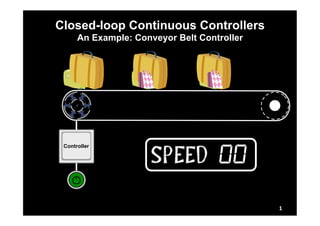
Closed-loop Continuous Controllers 
An Example: Conveyor Belt Controller 
Controller 
1
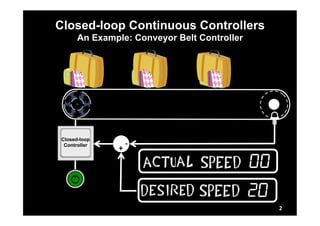
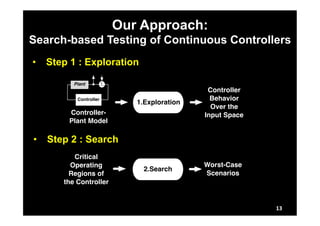
Closed-loop Continuous Controllers 
An Example: Conveyor Belt Controller 
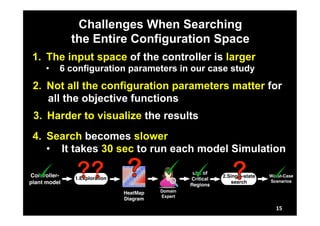
+ 
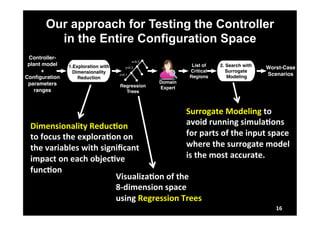
-­‐ 
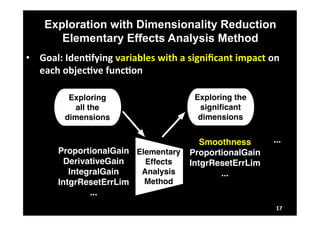
2 
Closed-loop 
Controller
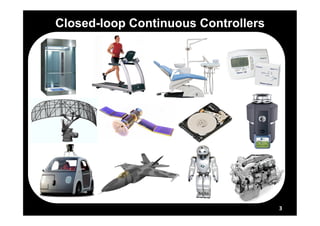
Closed-loop Continuous Controllers 
3
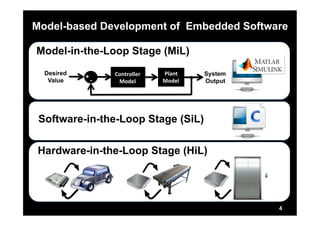
Model-based Development of Embedded Software 
Model-in-the-Loop Stage (MiL) 
Desired 
Value 
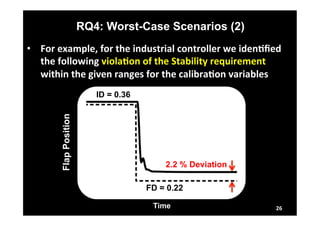
Controller 
Model 
System 
Output 
Plant 
Model 
+ 
- 
Hardware-in-the-Loop Stage (HiL) 
4 
Software-in-the-Loop Stage (SiL)
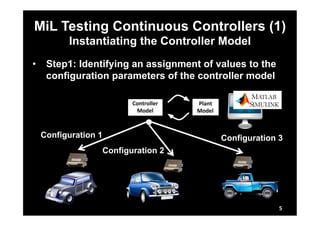
MiL Testing Continuous Controllers (1) 
Configuration 1 
Configuration 2 
Configuration 3 
Controller 
Model 
Plant 
Model 
5 
Instantiating the Controller Model 
• Step1: Identifying an assignment of values to the 
configuration parameters of the controller model
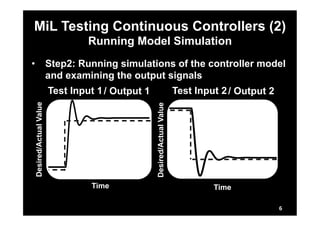
MiL Testing Continuous Controllers (2) 
• Step2: Running simulations of the controller model 
and examining the output signals 
Desired/Actual Value 
Running Model Simulation 
Desired/Actual Value 
Time Time 
6 
Test Input 1 
/ Output 1 Test Input 2 / Output 2
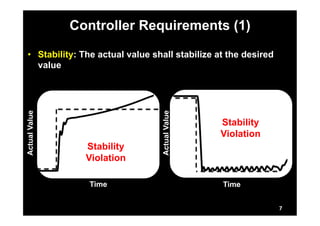
Controller Requirements (1) 
• Stability: The actual value shall stabilize at the desired 
value Actual Value 
Time Time 
Actual Value 
7 
Stability 
Violation 
Stability 
Violation
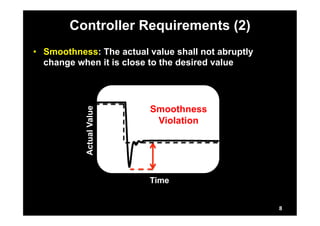
Controller Requirements (2) 
• Smoothness: The actual value shall not abruptly 
change when it is close to the desired value 
Time 
Actual Value 
8 
Smoothness 
Violation
Controller Requirements (2) 
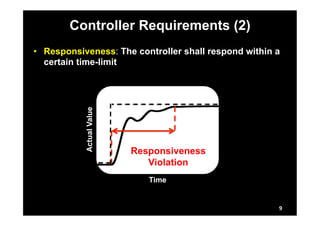
• Responsiveness: The controller shall respond within a 
certain time-limit 
9 
Time 
Actual Value 
Responsiveness 
Violation
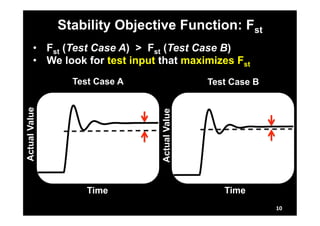
Stability Objective Function: Fst 
• Fst (Test Case A) > Fst (Test Case B) 
• We look for test input that maximizes Fst 
Test Case A Test Case B 
Actual Value 
Actual Value 
Time Time 
10
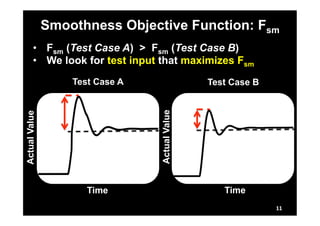
Smoothness Objective Function: Fsm 
• Fsm (Test Case A) > Fsm (Test Case B) 
• We look for test input that maximizes Fsm 
Test Case A Test Case B 
Actual Value Time Time 
11 
Actual Value
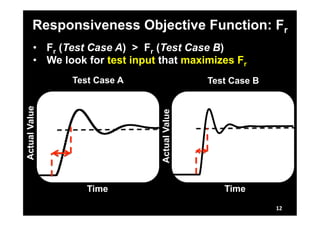
Responsiveness Objective Function: Fr 
• Fr (Test Case A) > Fr (Test Case B) 
• We look for test input that maximizes Fr 
Actual Value 
Test Case A Test Case B 
Actual Value 
Time Time 
12
Our Approach: 
Search-based Testing of Continuous Controllers 
13 
• Step 1 : Exploration 
Controller- 
Plant Model 
• Step 2 : Search 
Controller 
Behavior 
Over the 
Input Space 
1.Exploration 
Plant ⌃ 
Controller 
Worst-Case 
Scenarios 
Critical 
Operating 
Regions of 
the Controller 
2.Search
Our Earlier Work: 
Search-based Testing of Continuous Controllers 
with fixed values for the configuration parameters 
1.Exploration 2.Single-state 
ID FD 
FD 
ID 
Smoothness HeatMap 
Initial Desired (ID) 
Final Desired (FD) 
Smoothness Worst-case Scenario 
Controller-plant 
model 
HeatMap 
Diagram 
Worst-Case 
Scenarios 
List of 
Critical 
Regions 
Domain 
Expert 
search 
Controller Input Space 
Fst 
Fsm 
Fr 
14 
Published 
in 
[IST 
Journal 
2014, 
SSBSE 
2013]
1. The input space of the controller is larger 
• 6 configuration parameters in our case study 
2. Not all the configuration parameters matter for 
4. Search becomes slower 
• It takes 30 sec to run each model Simulation 
Controller-plant 
model 
Challenges When Searching 
the Entire Configuration Space 
1.Exploration 2.Single-state 
HeatMap 
Diagram 
Worst-Case 
Scenarios 
List of 
Critical 
Regions 
Domain 
Expert 
search 
all the objective functions 
3. Harder to visualize the results 
15
Our approach for Testing the Controller 
in the Entire Configuration Space 
Dimensionality 
ReducLon 
to 
focus 
the 
exploraLon 
on 
the 
variables 
with 
significant 
impact 
on 
each 
objecLve 
funcLon 
Surrogate 
Modeling 
to 
avoid 
running 
simulaLons 
for 
parts 
of 
the 
input 
space 
where 
the 
surrogate 
model 
is 
the 
most 
accurate. 
VisualizaLon 
of 
the 
8-­‐dimension 
space 
using 
Regression 
Trees 
16 
Controller-plant 
model 
+ 
Configuration 
parameters 
ranges 
Regression 
Trees 
Worst-Case 
Scenarios 
List of 
Critical 
Regions 
Domain 
Expert 
1.Exploration with 
Dimensionality 
Reduction 
x<0.2 
y<0.3 
z<0.1 
2. Search with 
Surrogate 
Modeling
Exploration with Dimensionality Reduction 
Elementary Effects Analysis Method 
• Goal: 
IdenLfying 
variables 
with 
a 
significant 
impact 
on 
each 
objecLve 
funcLon 
17 
Exploring 
all the 
dimensions 
Exploring the 
significant 
dimensions 
ProportionalGain 
DerivativeGain 
IntegralGain 
IntgrResetErrLim 
... 
Smoothness 
ProportionalGain 
IntgrResetErrLim 
... 
Elementary 
Effects 
Analysis 
Method 
...
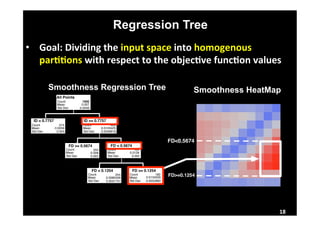
Regression Tree 
• Goal: 
Dividing 
the 
input 
space 
into 
homogenous 
parLLons 
with 
respect 
to 
the 
objecLve 
funcLon 
values 
Smoothness Regression Tree 
18 
All Points 
ID < 0.7757 
Count 
Mean 
Std Dev 
Count 
Mean 
Std Dev 
ID >= 0.7757 
Count 
Mean 
Std Dev 
FD >= 0.5674 FD < 0.5674 
Count 
Count 
Mean 
Mean 
Std Dev 
Std Dev 
1000 
0.007 
0.0049 
574 
0.0059 
0.004 
426 
0.0103425 
0.0049919 
182 
0.0134 
0.005 
244 
0.008 
0.003 
FD < 0.1254 FD >= 0.1254 
Count 
Mean 
Std Dev 
Count 
Mean 
Std Dev 
182 
0.0134555 
0.0052883 
244 
0.0080206 
0.0031751 
Smoothness HeatMap 
FD<0.5674 
FD>=0.1254
Search With Surrogate Modeling 
Supervised Machine Learning 
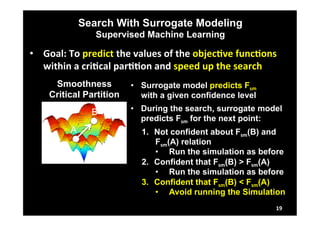
• Goal: 
To 
predict 
the 
values 
of 
the 
objecLve 
funcLons 
within 
a 
criLcal 
parLLon 
and 
speed 
up 
the 
search 
Smoothness 
Critical Partition 
19 
• Surrogate model predicts Fsm 
with a given confidence level 
A 
B 
• During the search, surrogate model 
predicts Fsm for the next point: 
1. Not confident about Fsm(B) and 
Fsm(A) relation 
• Run the simulation as before 
2. Confident that Fsm(B) > Fsm(A) 
• Run the simulation as before 
3. Confident that Fsm(B) < Fsm(A) 
• Avoid running the Simulation
Search With Surrogate Modeling 
Supervised Machine Learning 
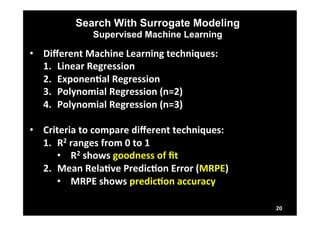
• Different 
Machine 
Learning 
techniques: 
1. Linear 
Regression 
2. ExponenLal 
Regression 
3. Polynomial 
Regression 
(n=2) 
4. Polynomial 
Regression 
(n=3) 
• Criteria 
to 
compare 
different 
techniques: 
1. R2 
ranges 
from 
0 
to 
1 
• R2 
shows 
goodness 
of 
fit 
2. Mean 
RelaLve 
PredicLon 
Error 
(MRPE) 
• MRPE 
shows 
predicLon 
accuracy 
20
Evaluation: Research Questions 
• RQ1 (Which ML Technique): Which Machine Learning 
technique performed the best? 
21 
• RQ2 (Effect of DR): What was the effect of 
Dimensionality Reduction? 
• RQ3 (SM vs. No-SM): How 
did 
the 
search 
with 
Surrogate 
Modeling 
perform 
comparing 
to 
the 
search 
without 
Surrogate 
Modeling? 
• RQ4 (Worst-Case Scenarios): How 
did 
our 
approach 
perform 
in 
finding 
worst-­‐case 
test 
scenarios?
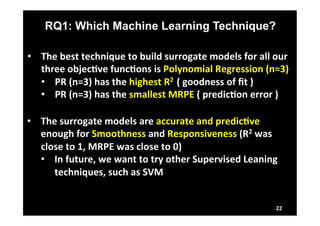
RQ1: Which Machine Learning Technique? 
22 
• The 
best 
technique 
to 
build 
surrogate 
models 
for 
all 
our 
three 
objecLve 
funcLons 
is 
Polynomial 
Regression 
(n=3) 
• PR 
(n=3) 
has 
the 
highest 
R2 
( 
goodness 
of 
fit 
) 
• PR 
(n=3) 
has 
the 
smallest 
MRPE 
( 
predicLon 
error 
) 
• The 
surrogate 
models 
are 
accurate 
and 
predicLve 
enough 
for 
Smoothness 
and 
Responsiveness 
(R2 
was 
close 
to 
1, 
MRPE 
was 
close 
to 
0) 
• In 
future, 
we 
want 
to 
try 
other 
Supervised 
Leaning 
techniques, 
such 
as 
SVM
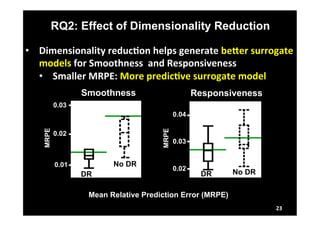
RQ2: Effect of Dimensionality Reduction 
23 
• Dimensionality 
reducLon 
helps 
generate 
beber 
surrogate 
models 
for 
Smoothness 
and 
Responsiveness 
• Smaller 
MRPE: 
More 
predicLve 
surrogate 
model 
Smoothness Responsiveness 
0.03 
MRPE 
0.02 
DR 0.01 No DR 
0.04 
0.03 
0.02 
MRPE 
DR No DR 
Mean Relative Prediction Error (MRPE)
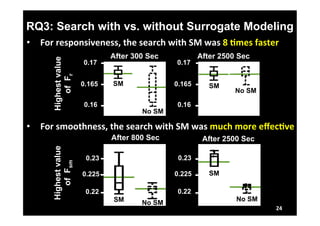
RQ3: Search with vs. without Surrogate Modeling 
24 
• For 
responsiveness, 
the 
search 
with 
SM 
was 
8 
Lmes 
faster 
0.17 
0.165 
0.16 
Highest value 
of Fr 
After 300 Sec 
After 2500 Sec 
• For 
0.17 
0.165 
smoothness, 
the 
search 
with 
SM 
was 
much 
more 
effecLve 
Highest value 
of Fsm 
After 800 Sec 
After 2500 Sec 
SM No SM 
0.23 
0.225 
0.22 
SM No SM 
0.23 
0.225 
0.22 
SM 
No SM 
SM 
0.16 
SM No SM 
No SM
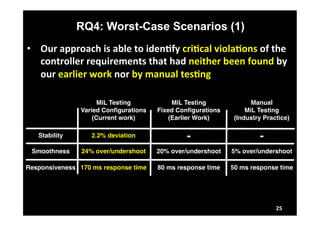
RQ4: Worst-Case Scenarios (1) 
25 
• Our 
approach 
is 
able 
to 
idenLfy 
criLcal 
violaLons 
of 
the 
controller 
requirements 
that 
had 
neither 
been 
found 
by 
our 
earlier 
work 
nor 
by 
manual 
tesLng 
MiL Testing 
Varied Configurations 
(Current work) 
MiL Testing 
Fixed Configurations 
(Earlier Work) 
Manual 
MiL Testing 
(Industry Practice) 
Stability 
Smoothness 
Responsiveness 
2.2% deviation - - 
24% over/undershoot 
170 ms response time 
20% over/undershoot 
80 ms response time 
5% over/undershoot 
50 ms response time
RQ4: Worst-Case Scenarios (2) 
26 
• For 
example, 
for 
the 
industrial 
controller 
we 
idenLfied 
the 
following 
violaLon 
of 
the 
Stability 
requirement 
within 
the 
given 
ranges 
for 
the 
calibraLon 
variables 
ID = 0.36 
2.2 % Deviation 
FD = 0.22 
Flap Position 
Time
27 
Conclusion
28 
MiL Testing of 
Highly Configurable Continuous Controllers: 
Scalable Search Using Surrogate Models 
Reza Matinnejad 
PhD Candidate 
Software Verification and Validation Group 
SnT Center, University of Luxembourg 
Emails: reza.matinnejad@uni.lu 
r.matinnejad@gmail.com
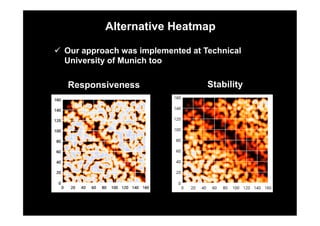
Alternative Heatmap 
ü Our approach was implemented at Technical 
University of Munich too 
Responsiveness Stability
ExisLng 
Tool 
Support 
for 
TesLng 
Simulink/Stateflow 
Models 
• None 
of 
the 
exis,ng 
tools 
specifically 
test 
the 
con,nuous 
proper,es 
of 
Simulink 
output 
signals
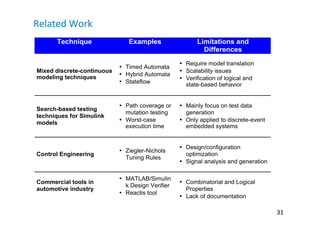
Related 
Work 
Technique Examples Limitations and 
Differences 
Mixed discrete-continuous 
modeling techniques 
• Timed Automata 
• Hybrid Automata 
• Stateflow 
• Require model translation 
• Scalability issues 
• Verification of logical and 
state-based behavior 
Search-based testing 
techniques for Simulink 
models 
• Path coverage or 
mutation testing 
• Worst-case 
execution time 
• Mainly focus on test data 
generation 
• Only applied to discrete-event 
embedded systems 
Control Engineering • Ziegler-Nichols 
Tuning Rules 
• Design/configuration 
optimization 
• Signal analysis and generation 
Commercial tools in 
automotive industry 
• MATLAB/Simulin 
k Design Verifier 
• Reactis tool 
• Combinatorial and Logical 
Properties 
• Lack of documentation 
31
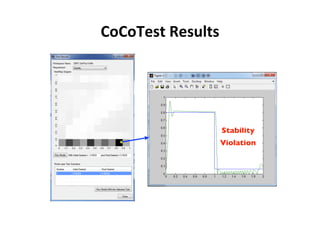
CoCoTest 
Results 
Stability 
Violation 
32

MiL Testing of Highly Configurable Continuous Controllers

  • 1.
    MiL Testing of Highly Configurable Continuous Controllers: Scalable Search Using Surrogate Models Reza Matinnejad Shiva Nejati Lionel Briand Software Verification and Validation Group SnT Center, University of Luxembourg Thomas Bruckmann Delphi Automotive Systems, Luxembourg
  • 2.
    Closed-loop Continuous Controllers An Example: Conveyor Belt Controller Controller 1
  • 3.
    Closed-loop Continuous Controllers An Example: Conveyor Belt Controller + -­‐ 2 Closed-loop Controller
  • 4.
  • 5.
    Model-based Development ofEmbedded Software Model-in-the-Loop Stage (MiL) Desired Value Controller Model System Output Plant Model + - Hardware-in-the-Loop Stage (HiL) 4 Software-in-the-Loop Stage (SiL)
  • 6.
    MiL Testing ContinuousControllers (1) Configuration 1 Configuration 2 Configuration 3 Controller Model Plant Model 5 Instantiating the Controller Model • Step1: Identifying an assignment of values to the configuration parameters of the controller model
  • 7.
    MiL Testing ContinuousControllers (2) • Step2: Running simulations of the controller model and examining the output signals Desired/Actual Value Running Model Simulation Desired/Actual Value Time Time 6 Test Input 1 / Output 1 Test Input 2 / Output 2
  • 8.
    Controller Requirements (1) • Stability: The actual value shall stabilize at the desired value Actual Value Time Time Actual Value 7 Stability Violation Stability Violation
  • 9.
    Controller Requirements (2) • Smoothness: The actual value shall not abruptly change when it is close to the desired value Time Actual Value 8 Smoothness Violation
  • 10.
    Controller Requirements (2) • Responsiveness: The controller shall respond within a certain time-limit 9 Time Actual Value Responsiveness Violation
  • 11.
    Stability Objective Function:Fst • Fst (Test Case A) > Fst (Test Case B) • We look for test input that maximizes Fst Test Case A Test Case B Actual Value Actual Value Time Time 10
  • 12.
    Smoothness Objective Function:Fsm • Fsm (Test Case A) > Fsm (Test Case B) • We look for test input that maximizes Fsm Test Case A Test Case B Actual Value Time Time 11 Actual Value
  • 13.
    Responsiveness Objective Function:Fr • Fr (Test Case A) > Fr (Test Case B) • We look for test input that maximizes Fr Actual Value Test Case A Test Case B Actual Value Time Time 12
  • 14.
    Our Approach: Search-basedTesting of Continuous Controllers 13 • Step 1 : Exploration Controller- Plant Model • Step 2 : Search Controller Behavior Over the Input Space 1.Exploration Plant ⌃ Controller Worst-Case Scenarios Critical Operating Regions of the Controller 2.Search
  • 15.
    Our Earlier Work: Search-based Testing of Continuous Controllers with fixed values for the configuration parameters 1.Exploration 2.Single-state ID FD FD ID Smoothness HeatMap Initial Desired (ID) Final Desired (FD) Smoothness Worst-case Scenario Controller-plant model HeatMap Diagram Worst-Case Scenarios List of Critical Regions Domain Expert search Controller Input Space Fst Fsm Fr 14 Published in [IST Journal 2014, SSBSE 2013]
  • 16.
    1. The inputspace of the controller is larger • 6 configuration parameters in our case study 2. Not all the configuration parameters matter for 4. Search becomes slower • It takes 30 sec to run each model Simulation Controller-plant model Challenges When Searching the Entire Configuration Space 1.Exploration 2.Single-state HeatMap Diagram Worst-Case Scenarios List of Critical Regions Domain Expert search all the objective functions 3. Harder to visualize the results 15
  • 17.
    Our approach forTesting the Controller in the Entire Configuration Space Dimensionality ReducLon to focus the exploraLon on the variables with significant impact on each objecLve funcLon Surrogate Modeling to avoid running simulaLons for parts of the input space where the surrogate model is the most accurate. VisualizaLon of the 8-­‐dimension space using Regression Trees 16 Controller-plant model + Configuration parameters ranges Regression Trees Worst-Case Scenarios List of Critical Regions Domain Expert 1.Exploration with Dimensionality Reduction x<0.2 y<0.3 z<0.1 2. Search with Surrogate Modeling
  • 18.
    Exploration with DimensionalityReduction Elementary Effects Analysis Method • Goal: IdenLfying variables with a significant impact on each objecLve funcLon 17 Exploring all the dimensions Exploring the significant dimensions ProportionalGain DerivativeGain IntegralGain IntgrResetErrLim ... Smoothness ProportionalGain IntgrResetErrLim ... Elementary Effects Analysis Method ...
  • 19.
    Regression Tree •Goal: Dividing the input space into homogenous parLLons with respect to the objecLve funcLon values Smoothness Regression Tree 18 All Points ID < 0.7757 Count Mean Std Dev Count Mean Std Dev ID >= 0.7757 Count Mean Std Dev FD >= 0.5674 FD < 0.5674 Count Count Mean Mean Std Dev Std Dev 1000 0.007 0.0049 574 0.0059 0.004 426 0.0103425 0.0049919 182 0.0134 0.005 244 0.008 0.003 FD < 0.1254 FD >= 0.1254 Count Mean Std Dev Count Mean Std Dev 182 0.0134555 0.0052883 244 0.0080206 0.0031751 Smoothness HeatMap FD<0.5674 FD>=0.1254
  • 20.
    Search With SurrogateModeling Supervised Machine Learning • Goal: To predict the values of the objecLve funcLons within a criLcal parLLon and speed up the search Smoothness Critical Partition 19 • Surrogate model predicts Fsm with a given confidence level A B • During the search, surrogate model predicts Fsm for the next point: 1. Not confident about Fsm(B) and Fsm(A) relation • Run the simulation as before 2. Confident that Fsm(B) > Fsm(A) • Run the simulation as before 3. Confident that Fsm(B) < Fsm(A) • Avoid running the Simulation
  • 21.
    Search With SurrogateModeling Supervised Machine Learning • Different Machine Learning techniques: 1. Linear Regression 2. ExponenLal Regression 3. Polynomial Regression (n=2) 4. Polynomial Regression (n=3) • Criteria to compare different techniques: 1. R2 ranges from 0 to 1 • R2 shows goodness of fit 2. Mean RelaLve PredicLon Error (MRPE) • MRPE shows predicLon accuracy 20
  • 22.
    Evaluation: Research Questions • RQ1 (Which ML Technique): Which Machine Learning technique performed the best? 21 • RQ2 (Effect of DR): What was the effect of Dimensionality Reduction? • RQ3 (SM vs. No-SM): How did the search with Surrogate Modeling perform comparing to the search without Surrogate Modeling? • RQ4 (Worst-Case Scenarios): How did our approach perform in finding worst-­‐case test scenarios?
  • 23.
    RQ1: Which MachineLearning Technique? 22 • The best technique to build surrogate models for all our three objecLve funcLons is Polynomial Regression (n=3) • PR (n=3) has the highest R2 ( goodness of fit ) • PR (n=3) has the smallest MRPE ( predicLon error ) • The surrogate models are accurate and predicLve enough for Smoothness and Responsiveness (R2 was close to 1, MRPE was close to 0) • In future, we want to try other Supervised Leaning techniques, such as SVM
  • 24.
    RQ2: Effect ofDimensionality Reduction 23 • Dimensionality reducLon helps generate beber surrogate models for Smoothness and Responsiveness • Smaller MRPE: More predicLve surrogate model Smoothness Responsiveness 0.03 MRPE 0.02 DR 0.01 No DR 0.04 0.03 0.02 MRPE DR No DR Mean Relative Prediction Error (MRPE)
  • 25.
    RQ3: Search withvs. without Surrogate Modeling 24 • For responsiveness, the search with SM was 8 Lmes faster 0.17 0.165 0.16 Highest value of Fr After 300 Sec After 2500 Sec • For 0.17 0.165 smoothness, the search with SM was much more effecLve Highest value of Fsm After 800 Sec After 2500 Sec SM No SM 0.23 0.225 0.22 SM No SM 0.23 0.225 0.22 SM No SM SM 0.16 SM No SM No SM
  • 26.
    RQ4: Worst-Case Scenarios(1) 25 • Our approach is able to idenLfy criLcal violaLons of the controller requirements that had neither been found by our earlier work nor by manual tesLng MiL Testing Varied Configurations (Current work) MiL Testing Fixed Configurations (Earlier Work) Manual MiL Testing (Industry Practice) Stability Smoothness Responsiveness 2.2% deviation - - 24% over/undershoot 170 ms response time 20% over/undershoot 80 ms response time 5% over/undershoot 50 ms response time
  • 27.
    RQ4: Worst-Case Scenarios(2) 26 • For example, for the industrial controller we idenLfied the following violaLon of the Stability requirement within the given ranges for the calibraLon variables ID = 0.36 2.2 % Deviation FD = 0.22 Flap Position Time
  • 28.
  • 29.
    28 MiL Testingof Highly Configurable Continuous Controllers: Scalable Search Using Surrogate Models Reza Matinnejad PhD Candidate Software Verification and Validation Group SnT Center, University of Luxembourg Emails: reza.matinnejad@uni.lu r.matinnejad@gmail.com
  • 30.
    Alternative Heatmap üOur approach was implemented at Technical University of Munich too Responsiveness Stability
  • 31.
    ExisLng Tool Support for TesLng Simulink/Stateflow Models • None of the exis,ng tools specifically test the con,nuous proper,es of Simulink output signals
  • 32.
    Related Work TechniqueExamples Limitations and Differences Mixed discrete-continuous modeling techniques • Timed Automata • Hybrid Automata • Stateflow • Require model translation • Scalability issues • Verification of logical and state-based behavior Search-based testing techniques for Simulink models • Path coverage or mutation testing • Worst-case execution time • Mainly focus on test data generation • Only applied to discrete-event embedded systems Control Engineering • Ziegler-Nichols Tuning Rules • Design/configuration optimization • Signal analysis and generation Commercial tools in automotive industry • MATLAB/Simulin k Design Verifier • Reactis tool • Combinatorial and Logical Properties • Lack of documentation 31
  • 33.