A Scalable Tridiagonal Solver    For GPUs Team:WenMin Xiao&ChaoQun Li Institute of information science and  technology of Hunan University
Outline Introduction Algorithms Classic algorithms Design algorithm for gpu architecture Performance Summary
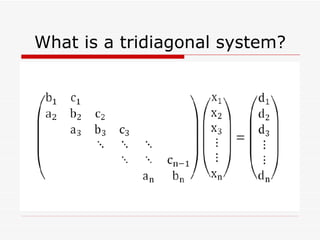
What is a tridiagonal system?
What is it used for? Scientific and engineering application Numerical ocean models Semi-coarsening for multi-grid solvers Spectral Poisson Solvers Cubic Spline Approximation Video and computer-animated films Depth of field blurs Fluid simulation
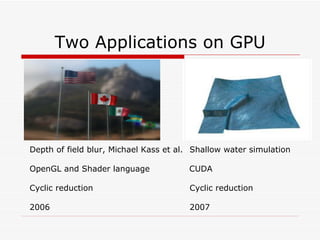
Two Applications on GPU Depth of field blur, Michael Kass et al. Shallow water simulation OpenGL and Shader language  CUDA Cyclic reduction Cyclic reduction 2006 2007
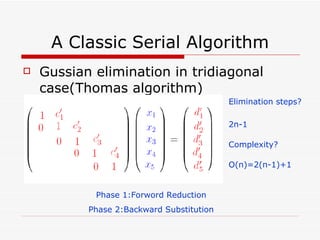
A Classic Serial Algorithm Gussian elimination in tridiagonal case(Thomas algorithm) Phase 1:Forword Reduction Phase 2:Backward Substitution Elimination steps? Complexity? 2n-1 O(n)=2(n-1)+1
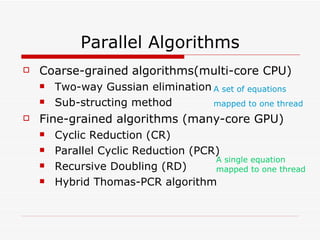
Parallel Algorithms Coarse-grained   algorithms(multi-core CPU) Two-way Gussian elimination Sub-structing method Fine-grained algorithms (many-core GPU) Cyclic Reduction (CR) Parallel Cyclic Reduction (PCR) Recursive Doubling (RD) Hybrid Thomas-PCR algorithm A set of equations mapped to one thread A single equation mapped to one thread
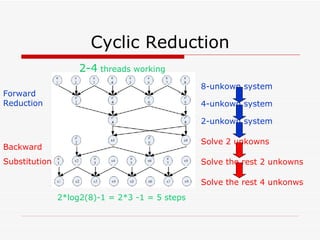
Cyclic Reduction 2-4  threads working Forward Reduction Backward Substitution 8-unkown system 4-unkown system 2-unkown system Solve 2 unkowns Solve the rest 2 unkowns Solve the rest 4 unkonws 2*log2(8)-1 = 2*3 -1 = 5 steps
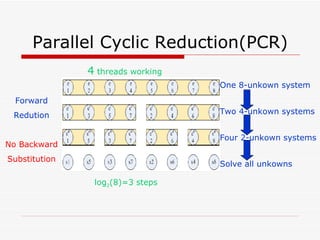
Parallel Cyclic Reduction(PCR) Forward Redution No Backward Substitution One 8-unkown system Two 4-unkown systems Four 2-unkown systems Solve all unkowns 4  threads working log 2 (8)=3 steps
Advantages of Previous Algorithms Thoms It is easy to parallel solve the independent system CR Every step we reduce the system by half PCR Fewer steps required
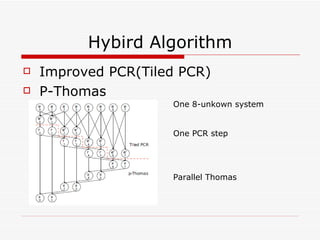
Hybird Algorithm Improved PCR(Tiled PCR) P-Thomas One 8-unkown system One PCR step Parallel Thomas
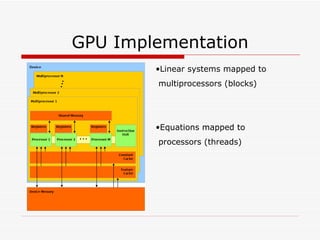
GPU Implementation Linear systems mapped to  multiprocessors (blocks) Equations mapped to  processors (threads)
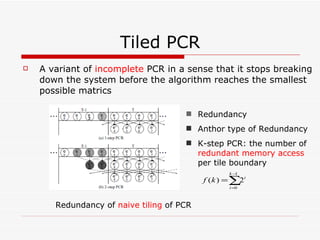
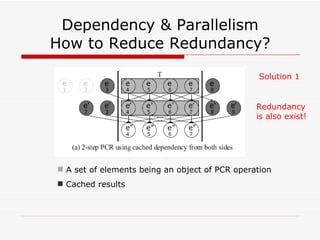
Tiled PCR A variant of  incomplete  PCR in a sense that it stops breaking down the system before the algorithm reaches the smallest possible matrics Redundancy of  naive tiling  of PCR Redundancy Anthor type of Redundancy K-step PCR: the number of  redundant memory access  per tile boundary
Dependency & Parallelism How to Reduce Redundancy? A set of elements being an object of PCR operation Cached results Solution 1 Redundancy is also exist!
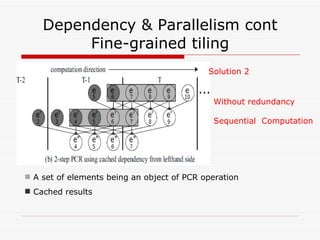
Dependency & Parallelism cont Fine-grained tiling A set of elements being an object of PCR operation Cached results Solution 2 Without redundancy Sequential   Computation
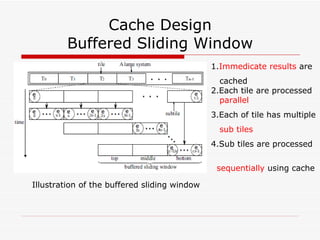
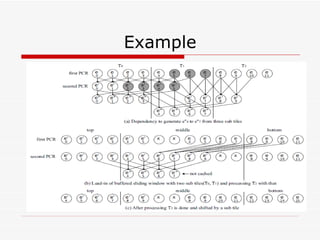
Cache Design Buffered Sliding Window Illustration of the buffered sliding window 1. Immedicate   results  are cached 2.Each tile are processed  parallel 3.Each of tile has multiple sub tiles 4.Sub tiles are processed  sequentially  using cache
Components of Buffered Sliding Window Bottom buffer The input element are just loaded from global memory  and ready to be processed Middle buffer mostly interacts with the elements in the bottom by providing denpendency to them at the same time referring them Top buffer caches elements from the middle buffer for the last step of PCR
Example
Advantages of TPCR Fewer steps  Better memory latency hiding(less idle time of GPU execution) Minimizing redundant global memory access Arbitrary tiling size
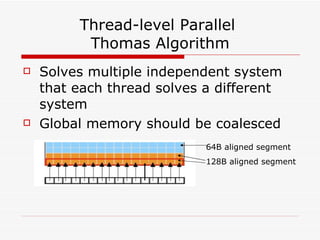
Thread-level Parallel  Thomas Algorithm Solves multiple independent system that each thread solves a different system Global memory should be coalesced 64B aligned segment 128B aligned segment
Performance Evaluation Test-Platform Nvidia GTX480 GPU with 1.5GB memory bandwith 3.33GHZ Intel quad-core i7 975 CPU Fedora 12 Linux CUDA 3.2
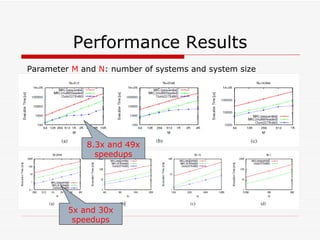
Performance Results Parameter  M  and  N : number of systems and system size 8.3x and 49x speedups 5x and 30x speedups
Performance Analysis Factors that determine performance Size of intermeidate results cache Global/shared memory access Overhead for synchronization Bank conflick
Summary We studied 3 kinds of algorithm for addressing tridiagonal solver We learned Sophisticatedly designed tiling and the buffer sliding window in TPCR algorithm
Reference http:// en.wikipedia.org/wiki/Tridiagonal_matrix_algorithm Fast Tridiagonal Solvers on GPU CUDA Programming Guide 高性能运算之 CUDA
Question? Thanks

Tridiagonal solver in gpu

  • 1.
    A Scalable TridiagonalSolver For GPUs Team:WenMin Xiao&ChaoQun Li Institute of information science and technology of Hunan University
  • 2.
    Outline Introduction AlgorithmsClassic algorithms Design algorithm for gpu architecture Performance Summary
  • 3.
    What is atridiagonal system?
  • 4.
    What is itused for? Scientific and engineering application Numerical ocean models Semi-coarsening for multi-grid solvers Spectral Poisson Solvers Cubic Spline Approximation Video and computer-animated films Depth of field blurs Fluid simulation
  • 5.
    Two Applications onGPU Depth of field blur, Michael Kass et al. Shallow water simulation OpenGL and Shader language CUDA Cyclic reduction Cyclic reduction 2006 2007
  • 6.
    A Classic SerialAlgorithm Gussian elimination in tridiagonal case(Thomas algorithm) Phase 1:Forword Reduction Phase 2:Backward Substitution Elimination steps? Complexity? 2n-1 O(n)=2(n-1)+1
  • 7.
    Parallel Algorithms Coarse-grained algorithms(multi-core CPU) Two-way Gussian elimination Sub-structing method Fine-grained algorithms (many-core GPU) Cyclic Reduction (CR) Parallel Cyclic Reduction (PCR) Recursive Doubling (RD) Hybrid Thomas-PCR algorithm A set of equations mapped to one thread A single equation mapped to one thread
  • 8.
    Cyclic Reduction 2-4 threads working Forward Reduction Backward Substitution 8-unkown system 4-unkown system 2-unkown system Solve 2 unkowns Solve the rest 2 unkowns Solve the rest 4 unkonws 2*log2(8)-1 = 2*3 -1 = 5 steps
  • 9.
    Parallel Cyclic Reduction(PCR)Forward Redution No Backward Substitution One 8-unkown system Two 4-unkown systems Four 2-unkown systems Solve all unkowns 4 threads working log 2 (8)=3 steps
  • 10.
    Advantages of PreviousAlgorithms Thoms It is easy to parallel solve the independent system CR Every step we reduce the system by half PCR Fewer steps required
  • 11.
    Hybird Algorithm ImprovedPCR(Tiled PCR) P-Thomas One 8-unkown system One PCR step Parallel Thomas
  • 12.
    GPU Implementation Linearsystems mapped to multiprocessors (blocks) Equations mapped to processors (threads)
  • 13.
    Tiled PCR Avariant of incomplete PCR in a sense that it stops breaking down the system before the algorithm reaches the smallest possible matrics Redundancy of naive tiling of PCR Redundancy Anthor type of Redundancy K-step PCR: the number of redundant memory access per tile boundary
  • 14.
    Dependency & ParallelismHow to Reduce Redundancy? A set of elements being an object of PCR operation Cached results Solution 1 Redundancy is also exist!
  • 15.
    Dependency & Parallelismcont Fine-grained tiling A set of elements being an object of PCR operation Cached results Solution 2 Without redundancy Sequential Computation
  • 16.
    Cache Design BufferedSliding Window Illustration of the buffered sliding window 1. Immedicate results are cached 2.Each tile are processed parallel 3.Each of tile has multiple sub tiles 4.Sub tiles are processed sequentially using cache
  • 17.
    Components of BufferedSliding Window Bottom buffer The input element are just loaded from global memory and ready to be processed Middle buffer mostly interacts with the elements in the bottom by providing denpendency to them at the same time referring them Top buffer caches elements from the middle buffer for the last step of PCR
  • 18.
  • 19.
    Advantages of TPCRFewer steps Better memory latency hiding(less idle time of GPU execution) Minimizing redundant global memory access Arbitrary tiling size
  • 20.
    Thread-level Parallel Thomas Algorithm Solves multiple independent system that each thread solves a different system Global memory should be coalesced 64B aligned segment 128B aligned segment
  • 21.
    Performance Evaluation Test-PlatformNvidia GTX480 GPU with 1.5GB memory bandwith 3.33GHZ Intel quad-core i7 975 CPU Fedora 12 Linux CUDA 3.2
  • 22.
    Performance Results Parameter M and N : number of systems and system size 8.3x and 49x speedups 5x and 30x speedups
  • 23.
    Performance Analysis Factorsthat determine performance Size of intermeidate results cache Global/shared memory access Overhead for synchronization Bank conflick
  • 24.
    Summary We studied3 kinds of algorithm for addressing tridiagonal solver We learned Sophisticatedly designed tiling and the buffer sliding window in TPCR algorithm
  • 25.
    Reference http:// en.wikipedia.org/wiki/Tridiagonal_matrix_algorithmFast Tridiagonal Solvers on GPU CUDA Programming Guide 高性能运算之 CUDA
  • 26.