
Scheduling in
Distributed Systems
Pragati pilaniya
General
• Scheduling refers to assigning a resource
and a start time end to a task
• Much of scheduling research has been
done in Operations Research Community
e.g Job Shop, Flow shop scheduling etc.
• Scheduling is often an overloaded term in
Grids.
• A related term is mapping that assigns a
resource to a task but not the start time.
Systems taxonomy
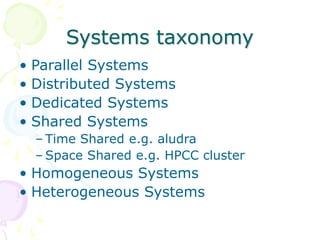
• Parallel Systems
• Distributed Systems
• Dedicated Systems
• Shared Systems
– Time Shared e.g. aludra
– Space Shared e.g. HPCC cluster
• Homogeneous Systems
• Heterogeneous Systems
Scheduling Regimens
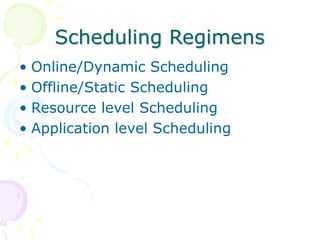
• Online/Dynamic Scheduling
• Offline/Static Scheduling
• Resource level Scheduling
• Application level Scheduling
Applications taxonomy
• Bag of tasks – Independent tasks
• Workflows – dependent tasks
– Generally Directed Acyclic Graphs
(DAGs)
• Performance criteria
– Completion time (makespan), reliability
etc.
Scheduling Bag of Tasks on
Dedicated Systems
• Min-Min
• Max-Min
• Sufferage
Min-Min Heuristic
• For each task determine its minimum
completion time over all machines
• Over all tasks find the minimum
completion time
• Assign the task to the machine that
gives this completion time
• Iterate till all the tasks are scheduled
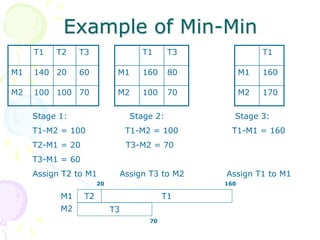
Example of Min-Min
T1 T2 T3
M1 140 20 60
M2 100 100 70
Stage 1: Stage 2: Stage 3:
T1-M2 = 100 T1-M2 = 100 T1-M1 = 160
T2-M1 = 20 T3-M2 = 70
T3-M1 = 60
Assign T2 to M1 Assign T3 to M2 Assign T1 to M1
T1 T3
M1 160 80
M2 100 70
T1
M1 160
M2 170
T2
T3
T1
M1
M2
20
70
160
Max-Min Heuristic
• For each task determine its minimum
completion time over all machines
• Over all tasks find the maximum
completion time
• Assign the task to the machine that
gives this completion time
• Iterate till all the tasks are scheduled
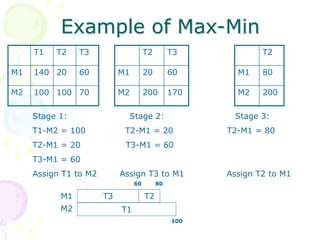
Example of Max-Min
T1 T2 T3
M1 140 20 60
M2 100 100 70
Stage 1: Stage 2: Stage 3:
T1-M2 = 100 T2-M1 = 20 T2-M1 = 80
T2-M1 = 20 T3-M1 = 60
T3-M1 = 60
Assign T1 to M2 Assign T3 to M1 Assign T2 to M1
T2 T3
M1 20 60
M2 200 170
T2
M1 80
M2 200
T3
T1
T2
M1
M2
60
100
80
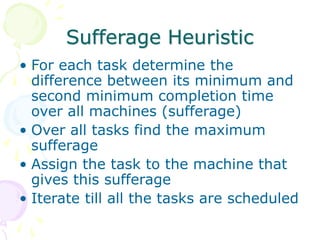
Sufferage Heuristic
• For each task determine the
difference between its minimum and
second minimum completion time
over all machines (sufferage)
• Over all tasks find the maximum
sufferage
• Assign the task to the machine that
gives this sufferage
• Iterate till all the tasks are scheduled
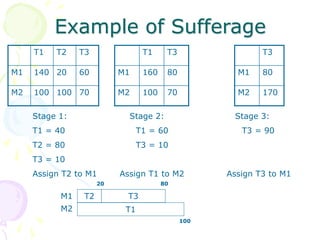
Example of Sufferage
T1 T2 T3
M1 140 20 60
M2 100 100 70
Stage 1: Stage 2: Stage 3:
T1 = 40 T1 = 60 T3 = 90
T2 = 80 T3 = 10
T3 = 10
Assign T2 to M1 Assign T1 to M2 Assign T3 to M1
T1 T3
M1 160 80
M2 100 70
T3
M1 80
M2 170
T2
T1
T3
M1
M2
20
100
80
Grid Environments
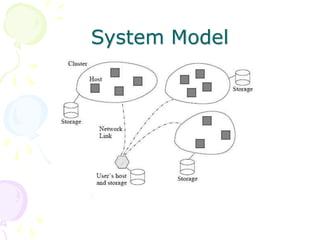
• Time-shared resources
• Heterogeneous resources
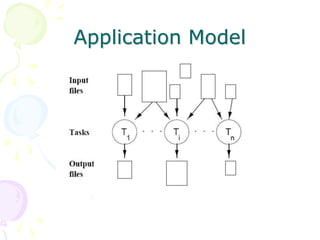
• Tasks require input files that might
be shared
• Data transfer times are important
Application Model
System Model
Scheduling Heuristic
Schedule()
1. Compute the next Scheduling event
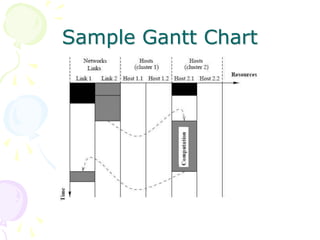
2. Create a Gantt Chart G
3. For each computation and file transfer
underway
1. Compute an estimate of its completion time
2. Update the Gantt Chart G
4. Select a subset of tasks that have not started
execution: T
5. Until each host has been assigned enough
work
1. Heuristically assign tasks to hosts
6. Convert G into a plan
Sample Gantt Chart
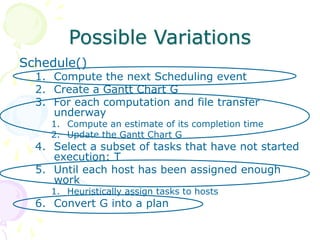
Possible Variations
Schedule()
1. Compute the next Scheduling event
2. Create a Gantt Chart G
3. For each computation and file transfer
underway
1. Compute an estimate of its completion time
2. Update the Gantt Chart G
4. Select a subset of tasks that have not started
execution: T
5. Until each host has been assigned enough
work
1. Heuristically assign tasks to hosts
6. Convert G into a plan
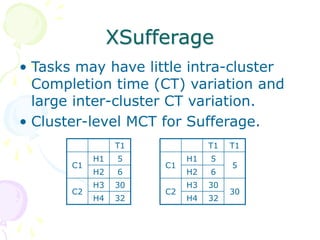
XSufferage
• Tasks may have little intra-cluster
Completion time (CT) variation and
large inter-cluster CT variation.
• Cluster-level MCT for Sufferage.
T1
C1
H1 5
H2 6
C2
H3 30
H4 32
T1 T1
C1
H1 5
5
H2 6
C2
H3 30
30
H4 32
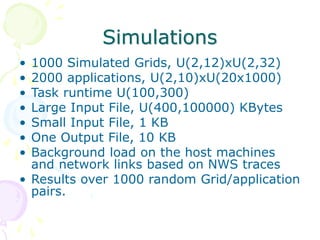
Simulations
• 1000 Simulated Grids, U(2,12)xU(2,32)
• 2000 applications, U(2,10)xU(20x1000)
• Task runtime U(100,300)
• Large Input File, U(400,100000) KBytes
• Small Input File, 1 KB
• One Output File, 10 KB
• Background load on the host machines
and network links based on NWS traces
• Results over 1000 random Grid/application
pairs.
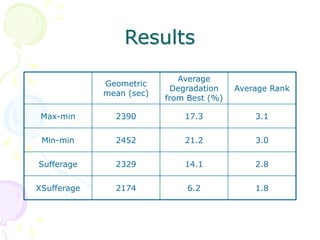
Results
Geometric
mean (sec)
Average
Degradation
from Best (%)
Average Rank
Max-min 2390 17.3 3.1
Min-min 2452 21.2 3.0
Sufferage 2329 14.1 2.8
XSufferage 2174 6.2 1.8
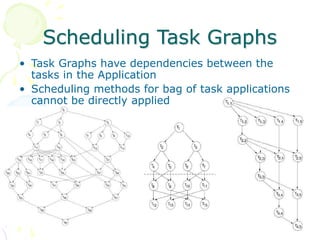
Scheduling Task Graphs
• Task Graphs have dependencies between the
tasks in the Application
• Scheduling methods for bag of task applications
cannot be directly applied
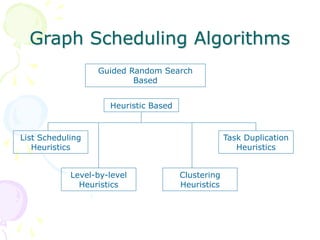
Graph Scheduling Algorithms
Heuristic Based
Guided Random Search
Based
List Scheduling
Heuristics
Clustering
Heuristics
Level-by-level
Heuristics
Task Duplication
Heuristics
Guided Random Search
Based
• Genetic Algorithms
– A chromosome is an ordering of tasks
– A rule is required to convert it to a
schedule
• Simulated Annealing
• Local Search Techniques, taboo etc
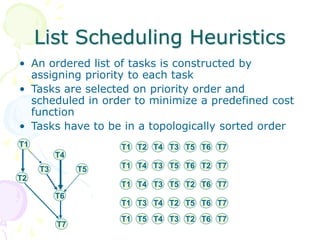
List Scheduling Heuristics
• An ordered list of tasks is constructed by
assigning priority to each task
• Tasks are selected on priority order and
scheduled in order to minimize a predefined cost
function
• Tasks have to be in a topologically sorted order
T1
T2
T3
T4
T5
T6
T7
T1 T2 T4 T3 T5 T6 T7
T1 T2
T4 T3 T5 T6 T7
T1 T2
T4 T3 T5 T6 T7
T1 T2
T4
T3 T5 T6 T7
T1 T2
T4 T3
T5 T6 T7
Level by Level Scheduling
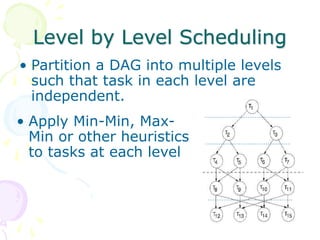
• Partition a DAG into multiple levels
such that task in each level are
independent.
• Apply Min-Min, Max-
Min or other heuristics
to tasks at each level
Clustering Heuristics
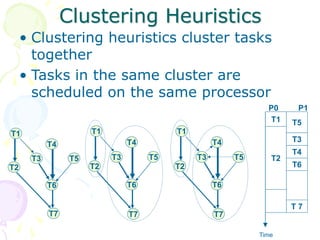
• Clustering heuristics cluster tasks
together
• Tasks in the same cluster are
scheduled on the same processor
T1
T2
T3
T4
T5
T6
T7
T1
T2
T3
T4
T5
T6
T7
T1
T2
T3
T4
T5
T6
T7
T1
T2
T5
T3
T4
T6
T 7
Time
P0 P1
Heterogeneous Earliest
Finish Time
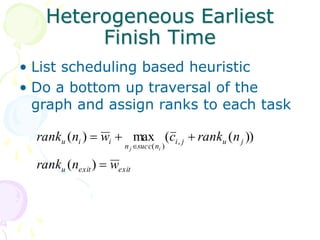
• List scheduling based heuristic
• Do a bottom up traversal of the
graph and assign ranks to each task
exit
exit
u
j
u
j
i
n
succ
n
i
i
u
w
n
rank
n
rank
c
w
n
rank
i
j





)
(
))
(
(
max
)
( ,
)
(
HEFT- contd
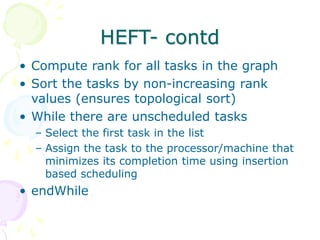
• Compute rank for all tasks in the graph
• Sort the tasks by non-increasing rank
values (ensures topological sort)
• While there are unscheduled tasks
– Select the first task in the list
– Assign the task to the processor/machine that
minimizes its completion time using insertion
based scheduling
• endWhile
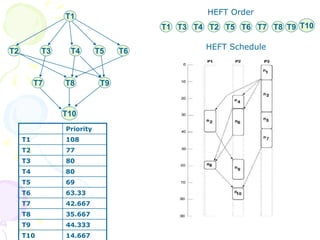
T1
T2 T3 T4 T5 T6
T7 T8 T9
T10
T1 T3 T4 T2 T5 T6 T7 T8 T9 T10
HEFT Order
HEFT Schedule
Priority
T1 108
T2 77
T3 80
T4 80
T5 69
T6 63.33
T7 42.667
T8 35.667
T9 44.333
T10 14.667
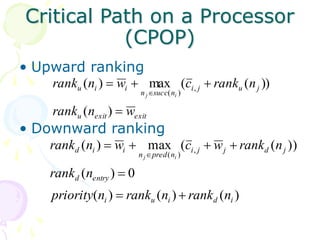
Critical Path on a Processor
(CPOP)
• Upward ranking
• Downward ranking
exit
exit
u
j
u
j
i
n
succ
n
i
i
u
w
n
rank
n
rank
c
w
n
rank
i
j





)
(
))
(
(
max
)
( ,
)
(
)
(
)
(
)
(
0
)
(
))
(
(
max
)
( ,
)
(
i
d
i
u
i
entry
d
j
d
j
j
i
n
pred
n
i
i
d
n
rank
n
rank
n
priority
n
rank
n
rank
w
c
w
n
rank
i
j








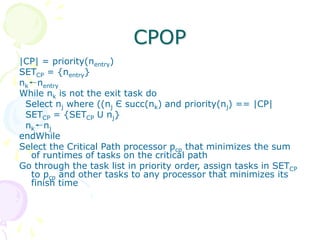
CPOP
|CP| = priority(nentry)
SETCP = {nentry}
nk←nentry
While nk is not the exit task do
Select nj where ((nj Є succ(nk) and priority(nj) == |CP|
SETCP = {SETCP U nj}
nk←nj
endWhile
Select the Critical Path processor pcp that minimizes the sum
of runtimes of tasks on the critical path
Go through the task list in priority order, assign tasks in SETCP
to pcp and other tasks to any processor that minimizes its
finish time
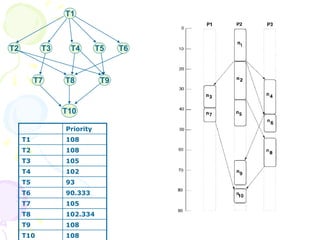
Priority
T1 108
T2 108
T3 105
T4 102
T5 93
T6 90.333
T7 105
T8 102.334
T9 108
T10 108
T1
T2 T3 T4 T5 T6
T7 T8 T9
T10
Conclusions
• Heuristics for scheduling independent
and dependent tasks on distributed
systems
• Rescheduling in order to adapt to
dynamic Grid conditions
• Partitioning in case of task graphs
• Future lecture (Nov 27th) on resource
provisioning for applications.

Distributed systems scheduling

  • 1.
  • 2.
    General • Scheduling refersto assigning a resource and a start time end to a task • Much of scheduling research has been done in Operations Research Community e.g Job Shop, Flow shop scheduling etc. • Scheduling is often an overloaded term in Grids. • A related term is mapping that assigns a resource to a task but not the start time.
  • 3.
    Systems taxonomy • ParallelSystems • Distributed Systems • Dedicated Systems • Shared Systems – Time Shared e.g. aludra – Space Shared e.g. HPCC cluster • Homogeneous Systems • Heterogeneous Systems
  • 4.
    Scheduling Regimens • Online/DynamicScheduling • Offline/Static Scheduling • Resource level Scheduling • Application level Scheduling
  • 5.
    Applications taxonomy • Bagof tasks – Independent tasks • Workflows – dependent tasks – Generally Directed Acyclic Graphs (DAGs) • Performance criteria – Completion time (makespan), reliability etc.
  • 6.
    Scheduling Bag ofTasks on Dedicated Systems • Min-Min • Max-Min • Sufferage
  • 7.
    Min-Min Heuristic • Foreach task determine its minimum completion time over all machines • Over all tasks find the minimum completion time • Assign the task to the machine that gives this completion time • Iterate till all the tasks are scheduled
  • 8.
    Example of Min-Min T1T2 T3 M1 140 20 60 M2 100 100 70 Stage 1: Stage 2: Stage 3: T1-M2 = 100 T1-M2 = 100 T1-M1 = 160 T2-M1 = 20 T3-M2 = 70 T3-M1 = 60 Assign T2 to M1 Assign T3 to M2 Assign T1 to M1 T1 T3 M1 160 80 M2 100 70 T1 M1 160 M2 170 T2 T3 T1 M1 M2 20 70 160
  • 9.
    Max-Min Heuristic • Foreach task determine its minimum completion time over all machines • Over all tasks find the maximum completion time • Assign the task to the machine that gives this completion time • Iterate till all the tasks are scheduled
  • 10.
    Example of Max-Min T1T2 T3 M1 140 20 60 M2 100 100 70 Stage 1: Stage 2: Stage 3: T1-M2 = 100 T2-M1 = 20 T2-M1 = 80 T2-M1 = 20 T3-M1 = 60 T3-M1 = 60 Assign T1 to M2 Assign T3 to M1 Assign T2 to M1 T2 T3 M1 20 60 M2 200 170 T2 M1 80 M2 200 T3 T1 T2 M1 M2 60 100 80
  • 11.
    Sufferage Heuristic • Foreach task determine the difference between its minimum and second minimum completion time over all machines (sufferage) • Over all tasks find the maximum sufferage • Assign the task to the machine that gives this sufferage • Iterate till all the tasks are scheduled
  • 12.
    Example of Sufferage T1T2 T3 M1 140 20 60 M2 100 100 70 Stage 1: Stage 2: Stage 3: T1 = 40 T1 = 60 T3 = 90 T2 = 80 T3 = 10 T3 = 10 Assign T2 to M1 Assign T1 to M2 Assign T3 to M1 T1 T3 M1 160 80 M2 100 70 T3 M1 80 M2 170 T2 T1 T3 M1 M2 20 100 80
  • 13.
    Grid Environments • Time-sharedresources • Heterogeneous resources • Tasks require input files that might be shared • Data transfer times are important
  • 14.
  • 15.
  • 16.
    Scheduling Heuristic Schedule() 1. Computethe next Scheduling event 2. Create a Gantt Chart G 3. For each computation and file transfer underway 1. Compute an estimate of its completion time 2. Update the Gantt Chart G 4. Select a subset of tasks that have not started execution: T 5. Until each host has been assigned enough work 1. Heuristically assign tasks to hosts 6. Convert G into a plan
  • 17.
  • 18.
    Possible Variations Schedule() 1. Computethe next Scheduling event 2. Create a Gantt Chart G 3. For each computation and file transfer underway 1. Compute an estimate of its completion time 2. Update the Gantt Chart G 4. Select a subset of tasks that have not started execution: T 5. Until each host has been assigned enough work 1. Heuristically assign tasks to hosts 6. Convert G into a plan
  • 19.
    XSufferage • Tasks mayhave little intra-cluster Completion time (CT) variation and large inter-cluster CT variation. • Cluster-level MCT for Sufferage. T1 C1 H1 5 H2 6 C2 H3 30 H4 32 T1 T1 C1 H1 5 5 H2 6 C2 H3 30 30 H4 32
  • 20.
    Simulations • 1000 SimulatedGrids, U(2,12)xU(2,32) • 2000 applications, U(2,10)xU(20x1000) • Task runtime U(100,300) • Large Input File, U(400,100000) KBytes • Small Input File, 1 KB • One Output File, 10 KB • Background load on the host machines and network links based on NWS traces • Results over 1000 random Grid/application pairs.
  • 21.
    Results Geometric mean (sec) Average Degradation from Best(%) Average Rank Max-min 2390 17.3 3.1 Min-min 2452 21.2 3.0 Sufferage 2329 14.1 2.8 XSufferage 2174 6.2 1.8
  • 22.
    Scheduling Task Graphs •Task Graphs have dependencies between the tasks in the Application • Scheduling methods for bag of task applications cannot be directly applied
  • 23.
    Graph Scheduling Algorithms HeuristicBased Guided Random Search Based List Scheduling Heuristics Clustering Heuristics Level-by-level Heuristics Task Duplication Heuristics
  • 24.
    Guided Random Search Based •Genetic Algorithms – A chromosome is an ordering of tasks – A rule is required to convert it to a schedule • Simulated Annealing • Local Search Techniques, taboo etc
  • 25.
    List Scheduling Heuristics •An ordered list of tasks is constructed by assigning priority to each task • Tasks are selected on priority order and scheduled in order to minimize a predefined cost function • Tasks have to be in a topologically sorted order T1 T2 T3 T4 T5 T6 T7 T1 T2 T4 T3 T5 T6 T7 T1 T2 T4 T3 T5 T6 T7 T1 T2 T4 T3 T5 T6 T7 T1 T2 T4 T3 T5 T6 T7 T1 T2 T4 T3 T5 T6 T7
  • 26.
    Level by LevelScheduling • Partition a DAG into multiple levels such that task in each level are independent. • Apply Min-Min, Max- Min or other heuristics to tasks at each level
  • 27.
    Clustering Heuristics • Clusteringheuristics cluster tasks together • Tasks in the same cluster are scheduled on the same processor T1 T2 T3 T4 T5 T6 T7 T1 T2 T3 T4 T5 T6 T7 T1 T2 T3 T4 T5 T6 T7 T1 T2 T5 T3 T4 T6 T 7 Time P0 P1
  • 28.
    Heterogeneous Earliest Finish Time •List scheduling based heuristic • Do a bottom up traversal of the graph and assign ranks to each task exit exit u j u j i n succ n i i u w n rank n rank c w n rank i j      ) ( )) ( ( max ) ( , ) (
  • 29.
    HEFT- contd • Computerank for all tasks in the graph • Sort the tasks by non-increasing rank values (ensures topological sort) • While there are unscheduled tasks – Select the first task in the list – Assign the task to the processor/machine that minimizes its completion time using insertion based scheduling • endWhile
  • 30.
    T1 T2 T3 T4T5 T6 T7 T8 T9 T10 T1 T3 T4 T2 T5 T6 T7 T8 T9 T10 HEFT Order HEFT Schedule Priority T1 108 T2 77 T3 80 T4 80 T5 69 T6 63.33 T7 42.667 T8 35.667 T9 44.333 T10 14.667
  • 31.
    Critical Path ona Processor (CPOP) • Upward ranking • Downward ranking exit exit u j u j i n succ n i i u w n rank n rank c w n rank i j      ) ( )) ( ( max ) ( , ) ( ) ( ) ( ) ( 0 ) ( )) ( ( max ) ( , ) ( i d i u i entry d j d j j i n pred n i i d n rank n rank n priority n rank n rank w c w n rank i j        
  • 32.
    CPOP |CP| = priority(nentry) SETCP= {nentry} nk←nentry While nk is not the exit task do Select nj where ((nj Є succ(nk) and priority(nj) == |CP| SETCP = {SETCP U nj} nk←nj endWhile Select the Critical Path processor pcp that minimizes the sum of runtimes of tasks on the critical path Go through the task list in priority order, assign tasks in SETCP to pcp and other tasks to any processor that minimizes its finish time
  • 33.
    Priority T1 108 T2 108 T3105 T4 102 T5 93 T6 90.333 T7 105 T8 102.334 T9 108 T10 108 T1 T2 T3 T4 T5 T6 T7 T8 T9 T10
  • 34.
    Conclusions • Heuristics forscheduling independent and dependent tasks on distributed systems • Rescheduling in order to adapt to dynamic Grid conditions • Partitioning in case of task graphs • Future lecture (Nov 27th) on resource provisioning for applications.