SHIGELLA
How to Stay Safe
INTRODUCTION
•Shigella is a particularly nasty stomach bug
•The trouble these days is that there are so
many food-borne illnesses going around
that it can be tough to figure out which one
you are suffering from in order to get the
correct treatment as quickly as possible
•As with all stomach bugs, children and
seniors are most at risk.
http://EternalSpiralBooks.com/ 2
1-What is Shigella
•Shigellosis is an infectious diarrheal disease
caused by a group of bacteria called Shigella.
According to recent estimates, Shigella bacteria
cause about 500,000 cases of illness in the
United States annually.
•There are several strains of the virus
•Shigella dysenteriae type 1 can cause deadly
epidemics of dysentery, that is, watery and
sometimes bloody diarrhea.
•This can lead to dehydration and death,
especially amongst those who are most at risk,
such as children under 5 and the elderly
http://EternalSpiralBooks.com/ 3
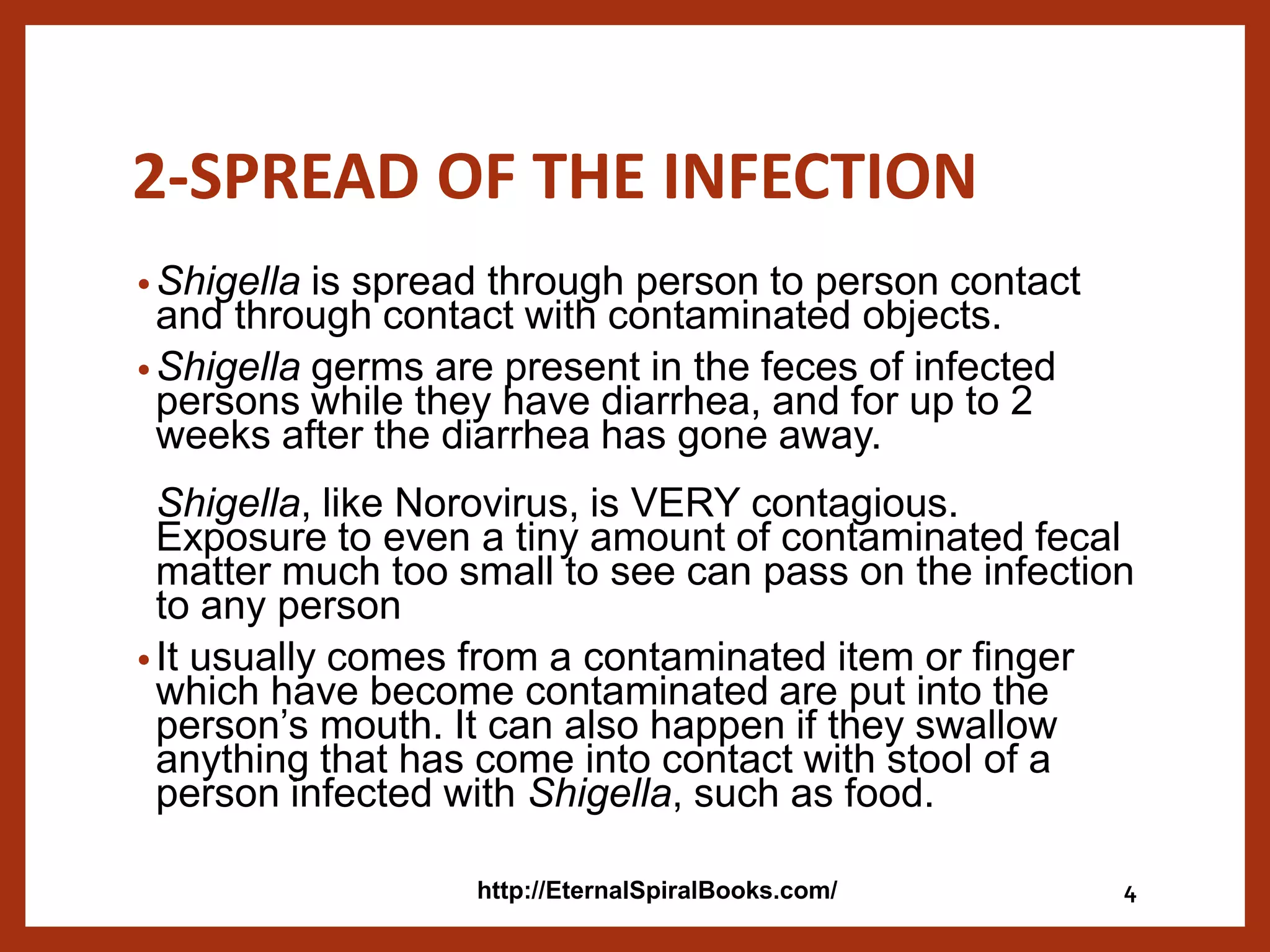
2-SPREAD OF THE INFECTION
•Shigella is spread through person to person contact
and through contact with contaminated objects.
•Shigella germs are present in the feces of infected
persons while they have diarrhea, and for up to 2
weeks after the diarrhea has gone away.
Shigella, like Norovirus, is VERY contagious.
Exposure to even a tiny amount of contaminated fecal
matter much too small to see can pass on the infection
to any person
•It usually comes from a contaminated item or finger
which have become contaminated are put into the
person’s mouth. It can also happen if they swallow
anything that has come into contact with stool of a
person infected with Shigella, such as food.
http://EternalSpiralBooks.com/ 4
3-SYMPTOMS
• Symptoms of shigellosis typically start 1–2 days after
exposure and include:
• Diarrhea (sometimes bloody)
• Fever
• Abdominal pain and cramping
• Tenesmus, a painful sensation of needing to move your
bowels even when they are already empty
• In persons with healthy immune systems, symptoms
usually last about 5 to 7 days, but you can suffer for up to 2
weeks and you can be contagious for that period of time as
well.
• Persons with diarrhea usually recover completely, although
it may be several months before their bowel habits are
entirely normal again.
http://EternalSpiralBooks.com/ 5
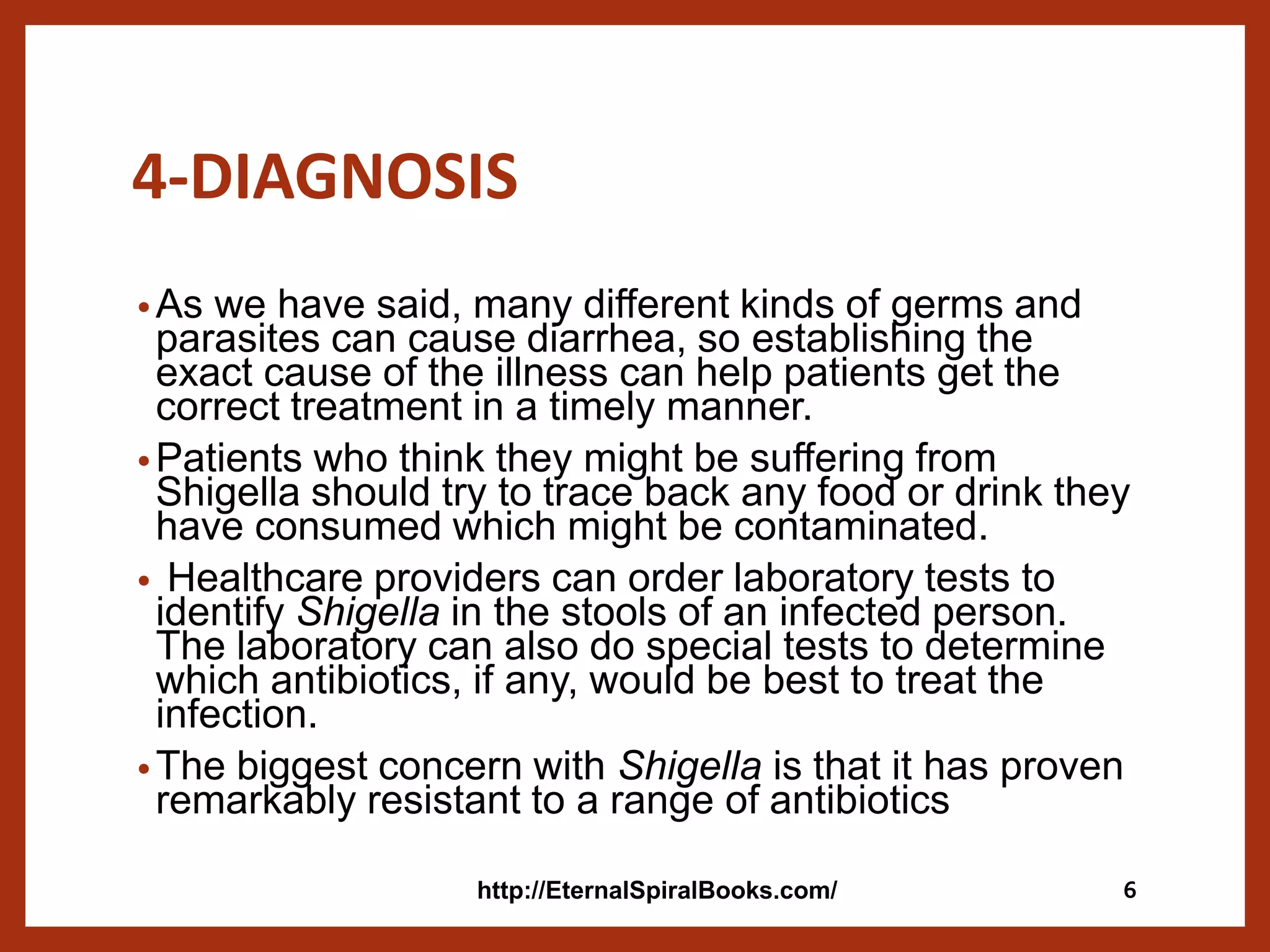
4-DIAGNOSIS
•As we have said, many different kinds of germs and
parasites can cause diarrhea, so establishing the
exact cause of the illness can help patients get the
correct treatment in a timely manner.
•Patients who think they might be suffering from
Shigella should try to trace back any food or drink they
have consumed which might be contaminated.
• Healthcare providers can order laboratory tests to
identify Shigella in the stools of an infected person.
The laboratory can also do special tests to determine
which antibiotics, if any, would be best to treat the
infection.
•The biggest concern with Shigella is that it has proven
remarkably resistant to a range of antibiotics
http://EternalSpiralBooks.com/ 6
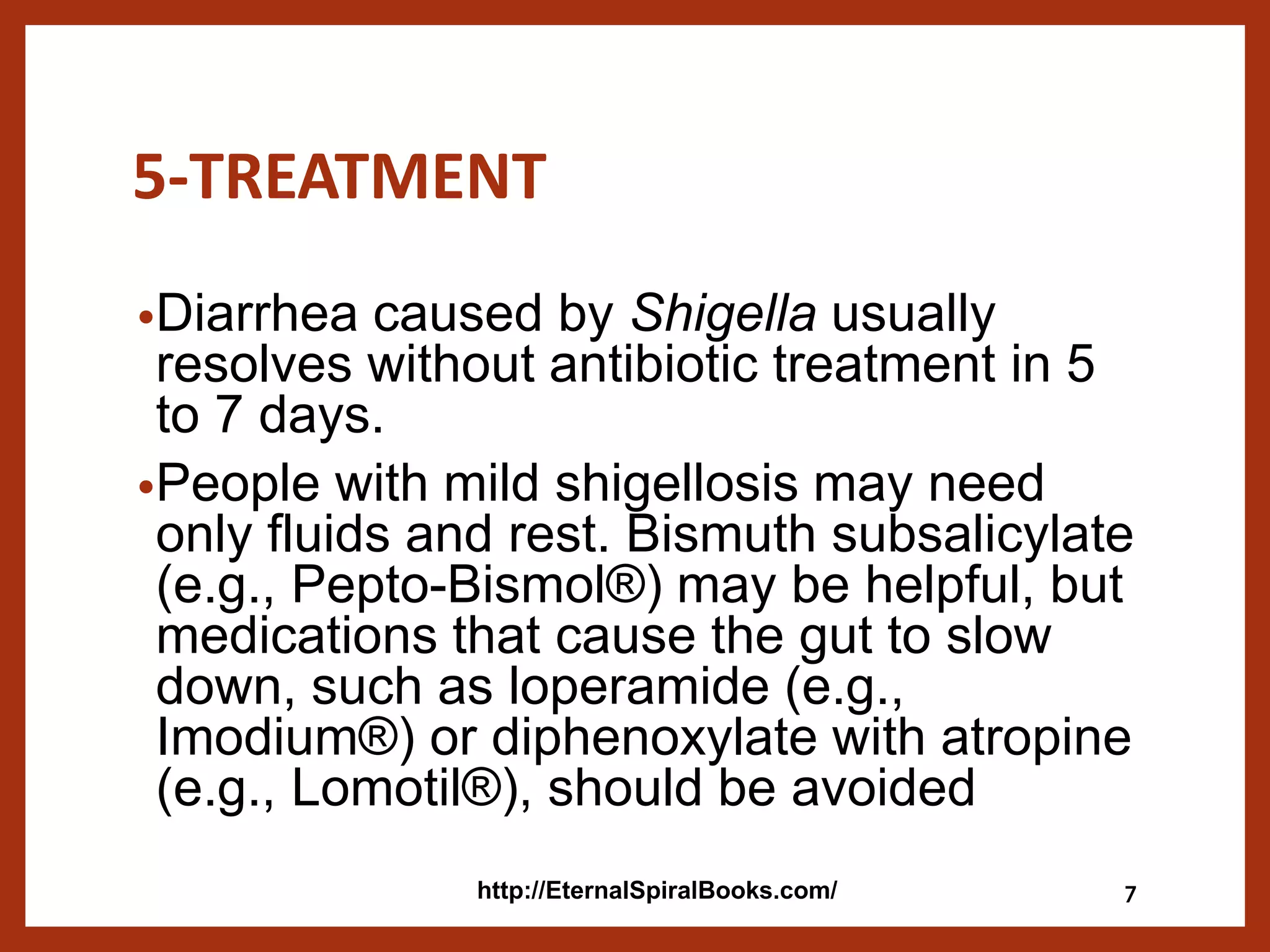
5-TREATMENT
•Diarrhea caused by Shigella usually
resolves without antibiotic treatment in 5
to 7 days.
•People with mild shigellosis may need
only fluids and rest. Bismuth subsalicylate
(e.g., Pepto-Bismol®) may be helpful, but
medications that cause the gut to slow
down, such as loperamide (e.g.,
Imodium®) or diphenoxylate with atropine
(e.g., Lomotil®), should be avoided
http://EternalSpiralBooks.com/ 7
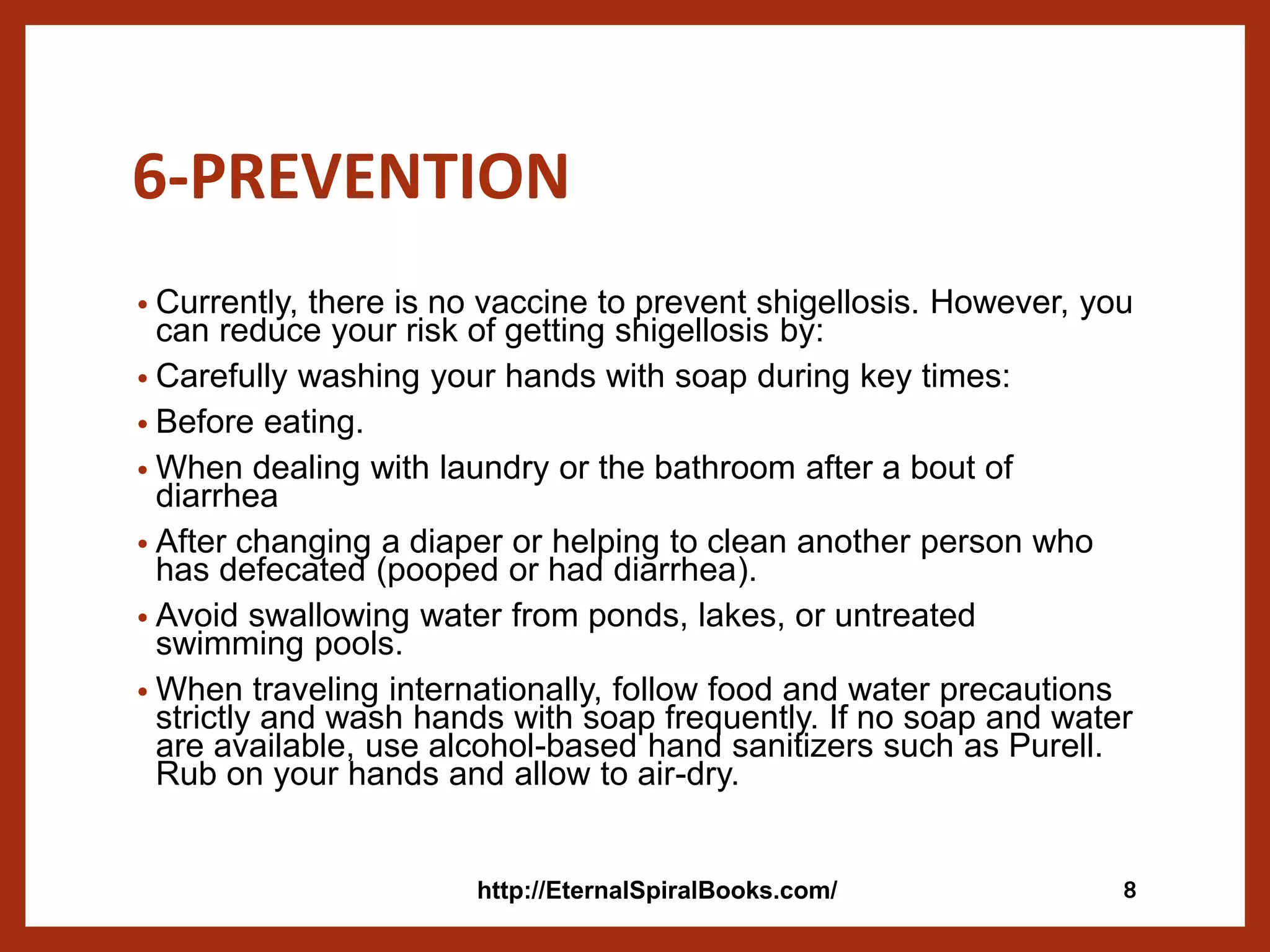
6-PREVENTION
• Currently, there is no vaccine to prevent shigellosis. However, you
can reduce your risk of getting shigellosis by:
• Carefully washing your hands with soap during key times:
• Before eating.
• When dealing with laundry or the bathroom after a bout of
diarrhea
• After changing a diaper or helping to clean another person who
has defecated (pooped or had diarrhea).
• Avoid swallowing water from ponds, lakes, or untreated
swimming pools.
• When traveling internationally, follow food and water precautions
strictly and wash hands with soap frequently. If no soap and water
are available, use alcohol-based hand sanitizers such as Purell.
Rub on your hands and allow to air-dry.
http://EternalSpiralBooks.com/ 8
7-MANAGING RISK
•You can contract Shigella infection no matter
what your age and health status.
• However, a number of groups are most at
risk of being infected by Shigella. People at
highest risk of infection from Shigella
infection include:
•Young children
•Seniors
•Overseas travelers
•Those with compromised immune systems
http://EternalSpiralBooks.com/ 9
8-INFECTIONS IN SOCIAL
SETTINGS
•Shigella can spread easily in:
•Childcare settings
•Senior settings
•Hospital settings
•It is highly contagious
•Handwashing is essential to protect
against the spread of Shigella and other
food-borne illnesses
http://EternalSpiralBooks.com/ 10
9-ANTIBIOTIC-RESISTANT
SHIGELLA ISSUES
•Resistance to traditional first-line drugs
such as ampicillin and trimethoprim-
sulfamethoxazole has become
increasingly common in the past decade
•This has lead to an increase in the
number of Shigella cases and a
desperate quest for other effective ways
to fight this infection.
http://EternalSpiralBooks.com/ 11
10-POSSIBLE COMPLICATIONS
There are a number of possible
complications:
•Post-infectious arthritis
•Blood stream infections.
•Seizures
•Hemolytic-uremic syndrome or HUS- a
side effect of bloody diarrhea
http://EternalSpiralBooks.com/ 12
CONCLUSION
•Knowing what shigella is, the symptoms,
causes, and how it spreads, can help you
and your family stay safe
•It can also stop you from spreading it to
your whole family, or anyone vulnerable
to illness
•Shigella can be avoided if you do all you
can to prevent it-education and care are
key.
http://EternalSpiralBooks.com/ 13
FURTHER READING
•To learn more, visit:
•http://eternalspiralbooks.com/shigella-
how-to-stay-safe/
http://EternalSpiralBooks.com/ 14

Shigella: How to Stay Safe

  • 1.
  • 2.
    INTRODUCTION •Shigella is aparticularly nasty stomach bug •The trouble these days is that there are so many food-borne illnesses going around that it can be tough to figure out which one you are suffering from in order to get the correct treatment as quickly as possible •As with all stomach bugs, children and seniors are most at risk. http://EternalSpiralBooks.com/ 2
  • 3.
    1-What is Shigella •Shigellosisis an infectious diarrheal disease caused by a group of bacteria called Shigella. According to recent estimates, Shigella bacteria cause about 500,000 cases of illness in the United States annually. •There are several strains of the virus •Shigella dysenteriae type 1 can cause deadly epidemics of dysentery, that is, watery and sometimes bloody diarrhea. •This can lead to dehydration and death, especially amongst those who are most at risk, such as children under 5 and the elderly http://EternalSpiralBooks.com/ 3
  • 4.
    2-SPREAD OF THEINFECTION •Shigella is spread through person to person contact and through contact with contaminated objects. •Shigella germs are present in the feces of infected persons while they have diarrhea, and for up to 2 weeks after the diarrhea has gone away. Shigella, like Norovirus, is VERY contagious. Exposure to even a tiny amount of contaminated fecal matter much too small to see can pass on the infection to any person •It usually comes from a contaminated item or finger which have become contaminated are put into the person’s mouth. It can also happen if they swallow anything that has come into contact with stool of a person infected with Shigella, such as food. http://EternalSpiralBooks.com/ 4
  • 5.
    3-SYMPTOMS • Symptoms ofshigellosis typically start 1–2 days after exposure and include: • Diarrhea (sometimes bloody) • Fever • Abdominal pain and cramping • Tenesmus, a painful sensation of needing to move your bowels even when they are already empty • In persons with healthy immune systems, symptoms usually last about 5 to 7 days, but you can suffer for up to 2 weeks and you can be contagious for that period of time as well. • Persons with diarrhea usually recover completely, although it may be several months before their bowel habits are entirely normal again. http://EternalSpiralBooks.com/ 5
  • 6.
    4-DIAGNOSIS •As we havesaid, many different kinds of germs and parasites can cause diarrhea, so establishing the exact cause of the illness can help patients get the correct treatment in a timely manner. •Patients who think they might be suffering from Shigella should try to trace back any food or drink they have consumed which might be contaminated. • Healthcare providers can order laboratory tests to identify Shigella in the stools of an infected person. The laboratory can also do special tests to determine which antibiotics, if any, would be best to treat the infection. •The biggest concern with Shigella is that it has proven remarkably resistant to a range of antibiotics http://EternalSpiralBooks.com/ 6
  • 7.
    5-TREATMENT •Diarrhea caused byShigella usually resolves without antibiotic treatment in 5 to 7 days. •People with mild shigellosis may need only fluids and rest. Bismuth subsalicylate (e.g., Pepto-Bismol®) may be helpful, but medications that cause the gut to slow down, such as loperamide (e.g., Imodium®) or diphenoxylate with atropine (e.g., Lomotil®), should be avoided http://EternalSpiralBooks.com/ 7
  • 8.
    6-PREVENTION • Currently, thereis no vaccine to prevent shigellosis. However, you can reduce your risk of getting shigellosis by: • Carefully washing your hands with soap during key times: • Before eating. • When dealing with laundry or the bathroom after a bout of diarrhea • After changing a diaper or helping to clean another person who has defecated (pooped or had diarrhea). • Avoid swallowing water from ponds, lakes, or untreated swimming pools. • When traveling internationally, follow food and water precautions strictly and wash hands with soap frequently. If no soap and water are available, use alcohol-based hand sanitizers such as Purell. Rub on your hands and allow to air-dry. http://EternalSpiralBooks.com/ 8
  • 9.
    7-MANAGING RISK •You cancontract Shigella infection no matter what your age and health status. • However, a number of groups are most at risk of being infected by Shigella. People at highest risk of infection from Shigella infection include: •Young children •Seniors •Overseas travelers •Those with compromised immune systems http://EternalSpiralBooks.com/ 9
  • 10.
    8-INFECTIONS IN SOCIAL SETTINGS •Shigellacan spread easily in: •Childcare settings •Senior settings •Hospital settings •It is highly contagious •Handwashing is essential to protect against the spread of Shigella and other food-borne illnesses http://EternalSpiralBooks.com/ 10
  • 11.
    9-ANTIBIOTIC-RESISTANT SHIGELLA ISSUES •Resistance totraditional first-line drugs such as ampicillin and trimethoprim- sulfamethoxazole has become increasingly common in the past decade •This has lead to an increase in the number of Shigella cases and a desperate quest for other effective ways to fight this infection. http://EternalSpiralBooks.com/ 11
  • 12.
    10-POSSIBLE COMPLICATIONS There area number of possible complications: •Post-infectious arthritis •Blood stream infections. •Seizures •Hemolytic-uremic syndrome or HUS- a side effect of bloody diarrhea http://EternalSpiralBooks.com/ 12
  • 13.
    CONCLUSION •Knowing what shigellais, the symptoms, causes, and how it spreads, can help you and your family stay safe •It can also stop you from spreading it to your whole family, or anyone vulnerable to illness •Shigella can be avoided if you do all you can to prevent it-education and care are key. http://EternalSpiralBooks.com/ 13
  • 14.
    FURTHER READING •To learnmore, visit: •http://eternalspiralbooks.com/shigella- how-to-stay-safe/ http://EternalSpiralBooks.com/ 14