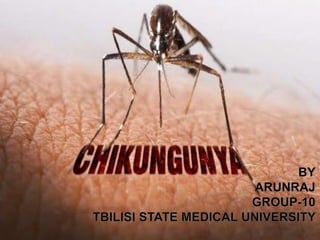
 In Swahili it means ‘to become contorted’ or
 More specifically as ‘that which bends up’
 Refers to the stooped posture of the patient
 A viral infection transmitted to humans
 By the bite of an infected mosquito
 It has become endemic in south and central
India
 First outbreak in 1952 on the Makonde Plateau
 Border between Tanganyika and Mozambique
www.drsarma.in 2
 Genus – alpha virus.
 Family – Togaviridae.
 An enveloped positive-strand RNA virus.
 Genetic analysis showed three distinct
lineages: the West African cluster, the East-
Central and South African cluster (ECSA),
and the Asian cluster.
 To date, no difference in virulence between
the different strains of CHIKV has been
shown in humans.
Anthroponotic transmission
(person to mosquito to person)
 Reservoir – Non-human primates in Africa
 Vector – Aedes aegypti, Ae. albapticus
mosquito
 Same vector as for Dengue and Yellow fevers
 No known mode - other than mosquito bite
 Incubation Period – 2 days to 12 days or 3-7
days
www.drsarma.in 6
 Aedes aegypti and Aedes albaptycus
mosquito, flight range < 100 meters
 Aggressive daytime biter – under lights – bites
ankles
 Once infected – it has the virus until death (30
days)
 Indoor, peridomestic, fresh water mosquito
 Metallic, plastic, rubber, cement and earthen
containers - open, left or unused - get filled
with water
www.drsarma.in 7
www.drsarma.in 8
www.drsarma.in 9
Tiger Mosquito
 Epidemic of CHIKV occurred in Malaysia – 1999
 French island of Réunion in the Indian Ocean- 2005
 Epidemic was recorded in Mauritius – 2005
 Madagascar, Mayotte and Seychelles – 2005
 Hong Kong and Malaysia early 2006
 Present indian epidemic is the largest -from nov ’05
 Maximum # of cases from Andhra Pradesh so far
 Present epidemic has started in Nov 2005
 Andhra Pradesh, Karnataka, Maharashtra,
Madhya Pradesh, Orissa, Gujarat, Tamilnadu,
Rajasthan, Kerala are under its onslaught
 This is spreading far and wide at a rapid rate
 Not much spread to the northern states like
Delhi, Haryana, Punjab as yet.
www.drsarma.in 12
Analysis of the recent Indian epidemic has
suggested that the increased severity of the
disease is due to a change in the genetic
sequence, altering the virus’ coat protein,
which potentially allows it to multiply more
easily in mosquito cells*.
www.drsarma.in 13
 At the early stage of the disease, the organs
targeted for CHIKV replication were
lymphoid tissues, liver, CNS, joints, and
muscle.
 The persistence of CHIKV could be found
later in the lymphoid organs, liver, joints, and
muscle, macrophages being the main
reservoir.
 In humans, acute CHIKV infection is
characterized by a very early viremia at fever
onset that can increase up to 109 to 1012 RNA
copies/ml and lasts up to 12 days .
 In vitro studies have shown that human
epithelial and endothelial cells, primary
fibroblasts, and monocyte-derived
macrophages are susceptible to CHIKV
infection, whereas activated B and T CD4+
lymphocytes, monocytes, and monocyte-
derived dendritic cells were refractory to CHIKV
infection .
 Sudden onset of fever, chills
 Headache, nausea, vomiting, abdominal
pain
 Joint pain with or without swelling,
 Low back pain and Maculopapular rash
 Very similar to those of Dengue but
 Unlike in Dengue, no hemorrhagic or shock
syndrome
www.drsarma.in 16
 Incubation period is 2-12 d; usually 3-7 days
 Viremia last for 5 days (infective period)
 Silent CHIKV – inapparent infections in children
 High grade fever (40°C or 104°F),
 Flu-like symptoms, Severe headache and chills
 Arthralgia or arthritis – lasting several weeks
 Conjunctival suffusion and mild photophobia
 Nausea, vomiting, abd. pain, severe weakness
www.drsarma.in 17
 The small joints of the lower and upper limbs
 Migratory poly arthralgia – not much effusions
 Larger joints may also be affected (knee, ankle)
 Pain worse in the morning – less by evening
 Joints may be swollen & painful to the touch
 Some patients have incapacitating joint pains
 Arthritis may last for weeks or months.
www.drsarma.in 18
www.drsarma.in 19
The Contorted Posture
www.drsarma.in 20
www.drsarma.in 21
www.drsarma.in 22
 A petechial or maculo papular rash usually
involving the limbs may occur.
 Hemorrhage is rare
 Nasal blotchy erythema, freckle-like
pigmentation over centro-facial area,
 Flagellate pigmentation on face and
extremities
 Lichenoid eruption and hyper pigmentation in
exposed areas
www.drsarma.in 23
 Multiple aphthous-like ulcers over
› scrotum, crural areas and axilla
 Unilateral or bilateral lympoedema of the
limbs
 Lymphadenopathy not common
 Multiple ecchymotic spots in children
 Vesiculo-bullous lesions in infants and
 Sub-ungual hemorrhages
 Severe menigo-encephalitis – rare; may be
fatal
www.drsarma.in 24
 Fever typically lasts for 2 - 3 days and comes down
 Fever may reoccur after 3 days – ‘saddle back’ fever
 Some rare cases - fever lasts up to a couple of weeks
 Patients do have prolonged fatigue for several weeks
 High fever & crippling joint pain marked this epidemic
 Joint pain, intense headache, insomnia and an extreme
degree of prostration may last for 5 to 7 days
 Life long immunity, once one suffers this infection
www.drsarma.in 25
 Pregnant women
 Elderly people
 Newborns
 Women in general
 Diabetics
 Immuno-compromised patients
 Patients with severe chronic illnesses
www.drsarma.in 26
 Chikungunya is a self-limiting illness
 Causes of prolonged morbidity are
› Severe dehydration
› Electrolyte imbalance and
› Loss of glycemic control
 Recovery is the rule
 In about 3 to 5%
› Incidence of prolonged arthritis
www.drsarma.in 27
 A few deaths have been reported - Examples
 It was thought to be due mainly to
› Inappropriate use of antibiotics and NSAIDs
› Virus can cause thrombocytopenia
› These drugs can cause gastric erosions - thus
› Leading to fatal upper GI bleed
› Use of steroids for the joint pains & inflammation
› This is dangerous and completely unwarranted
www.drsarma.in 28
 Mother to fetus transmission can occur
 Reported between 3 to 4.5 months of gestation
 Maternal IgG develops in 2 weeks after CHIKV
 This passes through placenta – confers protection
 Intra-partum risk is 48% if mother has viremia
 Neonatal infections are very mild; fully recover
 No miscarriages or congenital malformations
www.drsarma.in 29
Within the first 3 months, the life of patient infected
with CHIKV impaired by –
 Early exacerbation,
 Inflammatory relapses, often triggered after
exposure to cold.
 Long-lasting rheumatism, and
 A significant loss in the quality of life.
 Ocular changes :
Develop a few weeks after disease onset
Anterior uveitis, retinitis, episcleritis, and
optic neuritis,sometimes leading to
blindness.
 Deterioration is more frequent in patients over
40 years of age and/or with underlying diseases
Chikungunya infection, chronic stage with swollen and stiff hands
in a 55-year-old man who was infected 5 years earlier.
Chikungunya infection, chronic stage with
inflammatory osteoarthritis of the second
and third metatarsophalangeal joints on the
left foot of a 43-year-old man who was
infected 5 years earlier
 Dengue fever, DHF, DSS
 Other non specific viral fevers
 Any other acute fever like malaria, UTI etc.
www.drsarma.in 34
CLINICAL
SIGNS
CHIKUNGUNYA DENGUE
Fever Common Common
Rash Day 1 – Day 4 Day 5 – Day 7
Retroorbital pain Rare Common
Arthralgia Constant Rare
Arthritis Common, edematous Absent
Myalgia Common Common
Tenosynovitis Common Absent
Hypotension Possible Common, Day 5 – Day
7
Minor bleeding Rare Common, Day 5 – Day
7
Outcome Possible Raynaud
syndrome,Month2-Month3
Possible Tenosynovitis,Month2-
Month3.
Common persistence of arthralgia
for months to years.
Possible fatigue for
weeks
1. Four fold or more rise of HI Antibody
2. IgM capture ELISA using MAbs
3. Indirect Immuno Flourescence Test (I IFT)
› On infected cells from tissues
4. Virus Isolation – Infant Swiss Albino mice
› Vero BHK-21 cell lines are used
5. Nucleic acid amplification by PCR & RT PCR
www.drsarma.in 36
 IgM capture ELISA – Good serological test
 Not commercially available
 NIV – Pune, NICD – Delhi only
 Positive after 5-10 days & lasts up to 6
months
 HI Antibody appears on day 3 or 4
 RT –PCR confirmatory – before the 5th day
www.drsarma.in 37
 There is no specific treatment for CHIKV
 No vaccine or preventive pill is available
 The illness is usually self-limiting
 It will resolve with time over a week to 10
days
 No relapses occur – no second attacks
 Convalescence may take longer
 Symptomatic treatment only
www.drsarma.in 38
 Rest to the patient and mild movements of joints
 Cold compresses to inflamed joints
 Liberal fluid intake or IV fluids
 Analgesics and NSAIDS
› Paraetamol ± Ibuprofen or aceclofenac or
diclofenac
› Naproxen sodium (Naprasyn, Xenobid)
› Aspirin should be avoided
 Hydroxy chloroquine sulphate (HCQS) 200 mg/od
 Chloroquine phosphate 250 mg/od
www.drsarma.in 39
 No indication for antibiotics
 Never use costly, large spectrum drugs
 No indication for long acting steroids
 No indication for short term steroids also
in the acute phase of illness
 Rarely, if the joint swelling persists – we
may consider use of steroids in short burst.
www.drsarma.in 40
 Using NSAIDs during early or late stages of
pregnancy is not associated with congenital
anomalies, prematurity, or low birth weight, but
 There is a significant link between NSAID use
and miscarriage in the first trimester.
 In third trimester may cause premature delivery
 Recommend stopping NSAIDS 6 to 8 weeks
before delivery to prevent premature closure of
fetal ductus arteriosus.
www.drsarma.in 41
 Use insect repellent such as DEET on exposed skin.
 Wear long sleeves & pants, treat clothes with permethrin
 Have secure screens on windows and doors
 Get rid of mosquito breeding sites by
› Emptying standing water from flower pots, buckets etc.,
› Change the water in pet dishes in bird baths weekly
› Drill holes in tire swings so water drains out
› Keep children's wading pools empty
www.drsarma.in 42
www.drsarma.in 43
 Cover all tanks, cisterns, barrels, containers
 Remove old tyres, tins, buckets and bottles
 Clogged gutters and drains need to be cleared
 Change water in dip trays, plant pots twice
week
 Tanks need to be covered and cleaned - 2
weeks
 Weeds and tall grass to be cut short – ↓ hiding
 Temephos 1 ppm for large water tanks
www.drsarma.in 44
www.drsarma.in 45
www.drsarma.in
46
 CDC. Chikungunya Fever Diagnosed Among International Travelers — United States,
2005‒2006. MMWR 2006; 55(38): 1040‒1042.
 CDC. Update: Chikungunya Fever Diagnosed Among International Travelers —
United States, 2006. MMWR 2007; 56(12): 276-277.
 Gibney KB, et al. Chikungunya fever in the United States: a fifteen year review of
cases. Clin Infect Dis 2011; 52(5): e121‒126.
 Lanciotti RS, et al. Chikungunya virus in US travelers returning from India, 2006.
Emerg Infect Dis 2007; 13(5): 764–767.
 Powers AM, Logue CH. Changing patterns of chikungunya virus: re-emergence of a
zoonotic arbovirus. J Gen Virol 2007; 88(Pt 9): 2363–2377.
 Renault P, et al. A major epidemic of chikungunya virus infection on Reunion Island,
France, 2005–2006. Am J Trop Med Hyg 2007; 77(4): 727–731.
 Rezza G, et al. Infection with chikungunya virus in Italy: an outbreak in a temperate
region. Lancet 2007; 370(9602): 1840–1846.
 Staples JE, et al. Chikungunya fever: an epidemiological review of a re-emerging
infectious disease. Clin Infect Dis 2009; 49(6): 942–948.
 World Health Organization. Outbreak and spread of chikungunya. Wkly Epidemiol
Rec; 82(47): 409–415.

Chikungunya

  • 2.
     In Swahiliit means ‘to become contorted’ or  More specifically as ‘that which bends up’  Refers to the stooped posture of the patient  A viral infection transmitted to humans  By the bite of an infected mosquito  It has become endemic in south and central India  First outbreak in 1952 on the Makonde Plateau  Border between Tanganyika and Mozambique www.drsarma.in 2
  • 4.
     Genus –alpha virus.  Family – Togaviridae.  An enveloped positive-strand RNA virus.  Genetic analysis showed three distinct lineages: the West African cluster, the East- Central and South African cluster (ECSA), and the Asian cluster.  To date, no difference in virulence between the different strains of CHIKV has been shown in humans.
  • 5.
  • 6.
     Reservoir –Non-human primates in Africa  Vector – Aedes aegypti, Ae. albapticus mosquito  Same vector as for Dengue and Yellow fevers  No known mode - other than mosquito bite  Incubation Period – 2 days to 12 days or 3-7 days www.drsarma.in 6
  • 7.
     Aedes aegyptiand Aedes albaptycus mosquito, flight range < 100 meters  Aggressive daytime biter – under lights – bites ankles  Once infected – it has the virus until death (30 days)  Indoor, peridomestic, fresh water mosquito  Metallic, plastic, rubber, cement and earthen containers - open, left or unused - get filled with water www.drsarma.in 7
  • 8.
  • 9.
  • 11.
     Epidemic ofCHIKV occurred in Malaysia – 1999  French island of Réunion in the Indian Ocean- 2005  Epidemic was recorded in Mauritius – 2005  Madagascar, Mayotte and Seychelles – 2005  Hong Kong and Malaysia early 2006  Present indian epidemic is the largest -from nov ’05  Maximum # of cases from Andhra Pradesh so far
  • 12.
     Present epidemichas started in Nov 2005  Andhra Pradesh, Karnataka, Maharashtra, Madhya Pradesh, Orissa, Gujarat, Tamilnadu, Rajasthan, Kerala are under its onslaught  This is spreading far and wide at a rapid rate  Not much spread to the northern states like Delhi, Haryana, Punjab as yet. www.drsarma.in 12
  • 13.
    Analysis of therecent Indian epidemic has suggested that the increased severity of the disease is due to a change in the genetic sequence, altering the virus’ coat protein, which potentially allows it to multiply more easily in mosquito cells*. www.drsarma.in 13
  • 14.
     At theearly stage of the disease, the organs targeted for CHIKV replication were lymphoid tissues, liver, CNS, joints, and muscle.  The persistence of CHIKV could be found later in the lymphoid organs, liver, joints, and muscle, macrophages being the main reservoir.
  • 15.
     In humans,acute CHIKV infection is characterized by a very early viremia at fever onset that can increase up to 109 to 1012 RNA copies/ml and lasts up to 12 days .  In vitro studies have shown that human epithelial and endothelial cells, primary fibroblasts, and monocyte-derived macrophages are susceptible to CHIKV infection, whereas activated B and T CD4+ lymphocytes, monocytes, and monocyte- derived dendritic cells were refractory to CHIKV infection .
  • 16.
     Sudden onsetof fever, chills  Headache, nausea, vomiting, abdominal pain  Joint pain with or without swelling,  Low back pain and Maculopapular rash  Very similar to those of Dengue but  Unlike in Dengue, no hemorrhagic or shock syndrome www.drsarma.in 16
  • 17.
     Incubation periodis 2-12 d; usually 3-7 days  Viremia last for 5 days (infective period)  Silent CHIKV – inapparent infections in children  High grade fever (40°C or 104°F),  Flu-like symptoms, Severe headache and chills  Arthralgia or arthritis – lasting several weeks  Conjunctival suffusion and mild photophobia  Nausea, vomiting, abd. pain, severe weakness www.drsarma.in 17
  • 18.
     The smalljoints of the lower and upper limbs  Migratory poly arthralgia – not much effusions  Larger joints may also be affected (knee, ankle)  Pain worse in the morning – less by evening  Joints may be swollen & painful to the touch  Some patients have incapacitating joint pains  Arthritis may last for weeks or months. www.drsarma.in 18
  • 19.
  • 20.
  • 21.
  • 22.
  • 23.
     A petechialor maculo papular rash usually involving the limbs may occur.  Hemorrhage is rare  Nasal blotchy erythema, freckle-like pigmentation over centro-facial area,  Flagellate pigmentation on face and extremities  Lichenoid eruption and hyper pigmentation in exposed areas www.drsarma.in 23
  • 24.
     Multiple aphthous-likeulcers over › scrotum, crural areas and axilla  Unilateral or bilateral lympoedema of the limbs  Lymphadenopathy not common  Multiple ecchymotic spots in children  Vesiculo-bullous lesions in infants and  Sub-ungual hemorrhages  Severe menigo-encephalitis – rare; may be fatal www.drsarma.in 24
  • 25.
     Fever typicallylasts for 2 - 3 days and comes down  Fever may reoccur after 3 days – ‘saddle back’ fever  Some rare cases - fever lasts up to a couple of weeks  Patients do have prolonged fatigue for several weeks  High fever & crippling joint pain marked this epidemic  Joint pain, intense headache, insomnia and an extreme degree of prostration may last for 5 to 7 days  Life long immunity, once one suffers this infection www.drsarma.in 25
  • 26.
     Pregnant women Elderly people  Newborns  Women in general  Diabetics  Immuno-compromised patients  Patients with severe chronic illnesses www.drsarma.in 26
  • 27.
     Chikungunya isa self-limiting illness  Causes of prolonged morbidity are › Severe dehydration › Electrolyte imbalance and › Loss of glycemic control  Recovery is the rule  In about 3 to 5% › Incidence of prolonged arthritis www.drsarma.in 27
  • 28.
     A fewdeaths have been reported - Examples  It was thought to be due mainly to › Inappropriate use of antibiotics and NSAIDs › Virus can cause thrombocytopenia › These drugs can cause gastric erosions - thus › Leading to fatal upper GI bleed › Use of steroids for the joint pains & inflammation › This is dangerous and completely unwarranted www.drsarma.in 28
  • 29.
     Mother tofetus transmission can occur  Reported between 3 to 4.5 months of gestation  Maternal IgG develops in 2 weeks after CHIKV  This passes through placenta – confers protection  Intra-partum risk is 48% if mother has viremia  Neonatal infections are very mild; fully recover  No miscarriages or congenital malformations www.drsarma.in 29
  • 30.
    Within the first3 months, the life of patient infected with CHIKV impaired by –  Early exacerbation,  Inflammatory relapses, often triggered after exposure to cold.  Long-lasting rheumatism, and  A significant loss in the quality of life.
  • 31.
     Ocular changes: Develop a few weeks after disease onset Anterior uveitis, retinitis, episcleritis, and optic neuritis,sometimes leading to blindness.  Deterioration is more frequent in patients over 40 years of age and/or with underlying diseases
  • 32.
    Chikungunya infection, chronicstage with swollen and stiff hands in a 55-year-old man who was infected 5 years earlier.
  • 33.
    Chikungunya infection, chronicstage with inflammatory osteoarthritis of the second and third metatarsophalangeal joints on the left foot of a 43-year-old man who was infected 5 years earlier
  • 34.
     Dengue fever,DHF, DSS  Other non specific viral fevers  Any other acute fever like malaria, UTI etc. www.drsarma.in 34
  • 35.
    CLINICAL SIGNS CHIKUNGUNYA DENGUE Fever CommonCommon Rash Day 1 – Day 4 Day 5 – Day 7 Retroorbital pain Rare Common Arthralgia Constant Rare Arthritis Common, edematous Absent Myalgia Common Common Tenosynovitis Common Absent Hypotension Possible Common, Day 5 – Day 7 Minor bleeding Rare Common, Day 5 – Day 7 Outcome Possible Raynaud syndrome,Month2-Month3 Possible Tenosynovitis,Month2- Month3. Common persistence of arthralgia for months to years. Possible fatigue for weeks
  • 36.
    1. Four foldor more rise of HI Antibody 2. IgM capture ELISA using MAbs 3. Indirect Immuno Flourescence Test (I IFT) › On infected cells from tissues 4. Virus Isolation – Infant Swiss Albino mice › Vero BHK-21 cell lines are used 5. Nucleic acid amplification by PCR & RT PCR www.drsarma.in 36
  • 37.
     IgM captureELISA – Good serological test  Not commercially available  NIV – Pune, NICD – Delhi only  Positive after 5-10 days & lasts up to 6 months  HI Antibody appears on day 3 or 4  RT –PCR confirmatory – before the 5th day www.drsarma.in 37
  • 38.
     There isno specific treatment for CHIKV  No vaccine or preventive pill is available  The illness is usually self-limiting  It will resolve with time over a week to 10 days  No relapses occur – no second attacks  Convalescence may take longer  Symptomatic treatment only www.drsarma.in 38
  • 39.
     Rest tothe patient and mild movements of joints  Cold compresses to inflamed joints  Liberal fluid intake or IV fluids  Analgesics and NSAIDS › Paraetamol ± Ibuprofen or aceclofenac or diclofenac › Naproxen sodium (Naprasyn, Xenobid) › Aspirin should be avoided  Hydroxy chloroquine sulphate (HCQS) 200 mg/od  Chloroquine phosphate 250 mg/od www.drsarma.in 39
  • 40.
     No indicationfor antibiotics  Never use costly, large spectrum drugs  No indication for long acting steroids  No indication for short term steroids also in the acute phase of illness  Rarely, if the joint swelling persists – we may consider use of steroids in short burst. www.drsarma.in 40
  • 41.
     Using NSAIDsduring early or late stages of pregnancy is not associated with congenital anomalies, prematurity, or low birth weight, but  There is a significant link between NSAID use and miscarriage in the first trimester.  In third trimester may cause premature delivery  Recommend stopping NSAIDS 6 to 8 weeks before delivery to prevent premature closure of fetal ductus arteriosus. www.drsarma.in 41
  • 42.
     Use insectrepellent such as DEET on exposed skin.  Wear long sleeves & pants, treat clothes with permethrin  Have secure screens on windows and doors  Get rid of mosquito breeding sites by › Emptying standing water from flower pots, buckets etc., › Change the water in pet dishes in bird baths weekly › Drill holes in tire swings so water drains out › Keep children's wading pools empty www.drsarma.in 42
  • 43.
  • 44.
     Cover alltanks, cisterns, barrels, containers  Remove old tyres, tins, buckets and bottles  Clogged gutters and drains need to be cleared  Change water in dip trays, plant pots twice week  Tanks need to be covered and cleaned - 2 weeks  Weeds and tall grass to be cut short – ↓ hiding  Temephos 1 ppm for large water tanks www.drsarma.in 44
  • 45.
  • 46.
  • 47.
     CDC. ChikungunyaFever Diagnosed Among International Travelers — United States, 2005‒2006. MMWR 2006; 55(38): 1040‒1042.  CDC. Update: Chikungunya Fever Diagnosed Among International Travelers — United States, 2006. MMWR 2007; 56(12): 276-277.  Gibney KB, et al. Chikungunya fever in the United States: a fifteen year review of cases. Clin Infect Dis 2011; 52(5): e121‒126.  Lanciotti RS, et al. Chikungunya virus in US travelers returning from India, 2006. Emerg Infect Dis 2007; 13(5): 764–767.  Powers AM, Logue CH. Changing patterns of chikungunya virus: re-emergence of a zoonotic arbovirus. J Gen Virol 2007; 88(Pt 9): 2363–2377.  Renault P, et al. A major epidemic of chikungunya virus infection on Reunion Island, France, 2005–2006. Am J Trop Med Hyg 2007; 77(4): 727–731.  Rezza G, et al. Infection with chikungunya virus in Italy: an outbreak in a temperate region. Lancet 2007; 370(9602): 1840–1846.  Staples JE, et al. Chikungunya fever: an epidemiological review of a re-emerging infectious disease. Clin Infect Dis 2009; 49(6): 942–948.  World Health Organization. Outbreak and spread of chikungunya. Wkly Epidemiol Rec; 82(47): 409–415.