Sunset Hills  “ Where Everyone Belongs!” Bullying Prevention Parent Education Night September 15, 2011 Based on research by Celeste Campbell, Ed.D.
Raise awareness about bullying behavior Develop a better understanding of how girls may bully  differently than boys (and why this matters) Create a better understanding of the roles involved in a  bullying incident Share some effective strategies parents can use to support a child who: Exhibits  bullying  behavior Is a  target  of bullying behavior Is a  bystander /witness
 
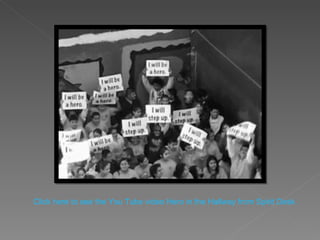
Click here to see the You Tube video Hero in the Hallway from Spirit Desk.
Social and physical bullying are  evident in all ages  from preschool through adulthood. Our young children are using their current relationships to  rehearse their roles for adulthood .  What kind of adults do we want our children to be? Name calling and other lower level forms of bullying behavior  escalate  if they aren’t addressed head on. We have the greatest chance of making a  positive impact  if we act NOW.
What is bullying? What are some examples of bullying behavior?
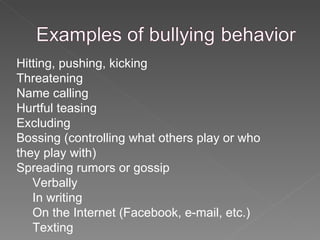
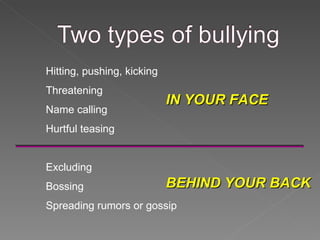
Hitting, pushing, kicking  Threatening Name calling Hurtful teasing Excluding Bossing (controlling what others play or who  they play with) Spreading rumors or gossip Verbally In writing On the Internet (Facebook, e-mail, etc.) Texting
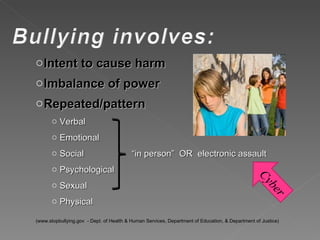
Bullying is a  pattern  of  repeated  behavior (physical, verbal, emotional, social) that is meant to  hurt  someone else and usually involves  an imbalance of power.
Intent to cause harm Imbalance of power Repeated/pattern Verbal Emotional Social “in person”  OR  electronic assault Psychological Sexual Physical (www.stopbullying.gov  - Dept. of Health & Human Services, Department of Education, & Department of Justice) Cyber
Hitting, pushing, kicking  Threatening Name calling  Hurtful teasing Excluding  Bossing Spreading rumors or gossip IN YOUR FACE BEHIND YOUR BACK
Do girls  bully  differently than boys? How?
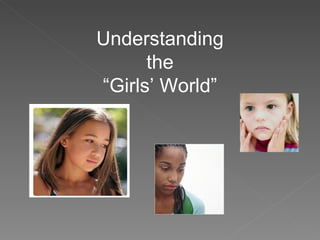
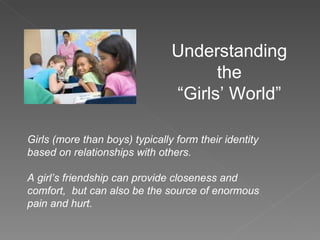
Understanding the “Girls’ World”
Understanding the “Girls’ World” Girls (more than boys) typically form their identity based on relationships with others. A girl’s friendship can provide closeness and comfort,  but can also be the source of enormous pain and hurt.
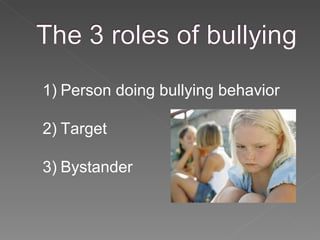
Person doing bullying behavior Target Bystander
 
The target is the person receiving the bullying behavior. A child can be a target  without becoming a victim .
THE GOOD NEWS  - Bystanders have, by far, the most power to make a positive difference in a bullying situation!! When bystanders do not stand up for the target, they are probably either  afraid  or  lack the confidence  to take a stand. Bystanders may join in the bullying behavior, overtly or passively, to  avoid being targeted  themselves.
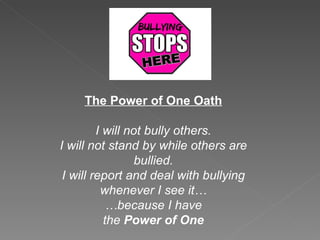
The Power of One Oath I will not bully others. I will not stand by while others are bullied. I will report and deal with bullying whenever I see it… … because I have the  Power of One
 
IF YOUR CHILD IS THE  TARGET Don’t minimize or explain away the bullying behavior Don’t blame your child for doing something to aggravate the bully Don’t rush in to solve the problem for your child Don’t tell your child to fight back Don’t rush to confront the bully or the bully’s parents
IF YOUR CHILD IS A BYSTANDER Don’t tell your child not to get involved
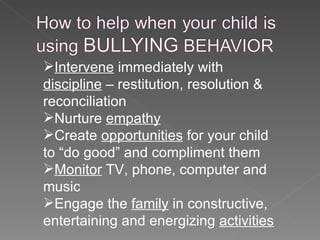
Intervene  immediately with  discipline  – restitution, resolution & reconciliation Nurture  empathy   Create  opportunities  for your child to “do good” and compliment them Monitor  TV, phone, computer and music Engage the  family  in constructive, entertaining and energizing  activities
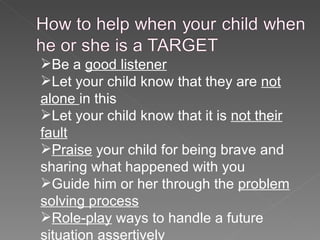
Be a  good listener Let your child know that they are  not alone  in this Let your child know that it is  not their fault Praise  your child for being brave and sharing what happened with you  Guide him or her through the  problem solving process Role-play  ways to handle a future situation assertively
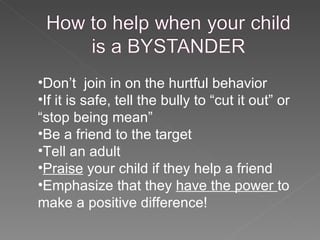
Don’t  join in on the hurtful behavior If it is safe, tell the bully to “cut it out” or “stop being mean” Be a friend to the target Tell an adult Praise  your child if they help a friend Emphasize that they  have the power  to make a positive difference!
What did you learn today? What was  new information ? What  strategies  are you going to commit to try with your child? Please record any burning questions or suggestions you have on the index cards provided and leave them on the table Thank  you  for  making a difference!!
 

Shes antibully

  • 1.
    Sunset Hills “ Where Everyone Belongs!” Bullying Prevention Parent Education Night September 15, 2011 Based on research by Celeste Campbell, Ed.D.
  • 2.
    Raise awareness aboutbullying behavior Develop a better understanding of how girls may bully differently than boys (and why this matters) Create a better understanding of the roles involved in a bullying incident Share some effective strategies parents can use to support a child who: Exhibits bullying behavior Is a target of bullying behavior Is a bystander /witness
  • 3.
  • 4.
    Click here tosee the You Tube video Hero in the Hallway from Spirit Desk.
  • 5.
    Social and physicalbullying are evident in all ages from preschool through adulthood. Our young children are using their current relationships to rehearse their roles for adulthood . What kind of adults do we want our children to be? Name calling and other lower level forms of bullying behavior escalate if they aren’t addressed head on. We have the greatest chance of making a positive impact if we act NOW.
  • 6.
    What is bullying?What are some examples of bullying behavior?
  • 7.
    Hitting, pushing, kicking Threatening Name calling Hurtful teasing Excluding Bossing (controlling what others play or who they play with) Spreading rumors or gossip Verbally In writing On the Internet (Facebook, e-mail, etc.) Texting
  • 8.
    Bullying is a pattern of repeated behavior (physical, verbal, emotional, social) that is meant to hurt someone else and usually involves an imbalance of power.
  • 9.
    Intent to causeharm Imbalance of power Repeated/pattern Verbal Emotional Social “in person” OR electronic assault Psychological Sexual Physical (www.stopbullying.gov - Dept. of Health & Human Services, Department of Education, & Department of Justice) Cyber
  • 10.
    Hitting, pushing, kicking Threatening Name calling Hurtful teasing Excluding Bossing Spreading rumors or gossip IN YOUR FACE BEHIND YOUR BACK
  • 11.
    Do girls bully differently than boys? How?
  • 12.
  • 13.
    Understanding the “Girls’World” Girls (more than boys) typically form their identity based on relationships with others. A girl’s friendship can provide closeness and comfort, but can also be the source of enormous pain and hurt.
  • 14.
    Person doing bullyingbehavior Target Bystander
  • 15.
  • 16.
    The target isthe person receiving the bullying behavior. A child can be a target without becoming a victim .
  • 17.
    THE GOOD NEWS - Bystanders have, by far, the most power to make a positive difference in a bullying situation!! When bystanders do not stand up for the target, they are probably either afraid or lack the confidence to take a stand. Bystanders may join in the bullying behavior, overtly or passively, to avoid being targeted themselves.
  • 18.
    The Power ofOne Oath I will not bully others. I will not stand by while others are bullied. I will report and deal with bullying whenever I see it… … because I have the Power of One
  • 19.
  • 20.
    IF YOUR CHILDIS THE TARGET Don’t minimize or explain away the bullying behavior Don’t blame your child for doing something to aggravate the bully Don’t rush in to solve the problem for your child Don’t tell your child to fight back Don’t rush to confront the bully or the bully’s parents
  • 21.
    IF YOUR CHILDIS A BYSTANDER Don’t tell your child not to get involved
  • 22.
    Intervene immediatelywith discipline – restitution, resolution & reconciliation Nurture empathy Create opportunities for your child to “do good” and compliment them Monitor TV, phone, computer and music Engage the family in constructive, entertaining and energizing activities
  • 23.
    Be a good listener Let your child know that they are not alone in this Let your child know that it is not their fault Praise your child for being brave and sharing what happened with you Guide him or her through the problem solving process Role-play ways to handle a future situation assertively
  • 24.
    Don’t joinin on the hurtful behavior If it is safe, tell the bully to “cut it out” or “stop being mean” Be a friend to the target Tell an adult Praise your child if they help a friend Emphasize that they have the power to make a positive difference!
  • 25.
    What did youlearn today? What was new information ? What strategies are you going to commit to try with your child? Please record any burning questions or suggestions you have on the index cards provided and leave them on the table Thank you for making a difference!!
  • 26.

Editor's Notes

  • #2 Rigor, Relevance, Relationships…..Bullying is not new, I know that everyone in the room has been involved in an incident or has witnessed a bullying incident… Bullying is not a rite of passage or an inevitable part of growing up. We can take steps that will help prevent bullying
  • #3 Regarding confidentiality, I must ask that we all commit to maintaining the confidentiality of the other participants. What we share about our own children in this room needs to stay in this room. This is a painful topic and we need to support one another. Also, I ask that you refrain from naming particular students or sharing enough details about a situation that someone could figure out someone’s identity. Thank you.
  • #6 MOST children think bullying is NOT cool and want to do something We must teach them now.
  • #7 Solicit answers from the group
  • #11 Research tells us that most bullying behavior is NOT physical the number one type of bullying is Verbal.
  • #12 Solicit from group
  • #13 Boys typically use bullying methods such as hitting and kicking – These “in your face” methods are called direct bullying. Girls tend to use “behind your back” or indirect forms of bullying which are harder to see. Indirect bullying behaviors include more subtle behaviors such as getting peers to exclude others and spreading rumors.
  • #14 Girls are typically more socially oriented beings who form their sense of self based on their perception of how they “fit in” within their social group. In an attempt to survive in the girls’ world, our daughters can resort to spreading rumors, gossiping, hurtful teasing, controlling, manipulating or betraying a friend. The reason it is important to talk about social bullying specifically is because it is more difficult to detect, more complex, and the effects usually last much longer than physical aggression…sometimes for a lifetime. When a researcher of female bullying was asked why bullying among girls is on the rise, she responded, “For a long time we accepted cattiness as typical female behavior. But now girls are committing suicide because of this malice.” She was also asked how bullying that occurs in elementary school can leave such permanent scars. She explained that the part of the brain which creates memories and regulates emotions, the amygdala, is quick to learn but slow to forget. So once a bad memory is etched there, it can influence your behavior for years. Many women who were socially bullied as children report that to this day, they avoid groups of females – book clubs, the PTA, playgroups, etc.
  • #16 “ Bullying behavior is often motivated by fear or insecurity about not being a part of a group OR is used in an effort to gain or retain power and prestige. The child uses control to avoid having his or her own weaknesses exposed.” Key words to note in the statement I just read are: fear, insecurity, power, prestige, and control. It is critical that we try to determine what a child is gaining from their behavior in order to counter it. On another note, current research on bullying suggests that we move away from labeling a child as a “BULLY.” It is more effective to emphasize that their mean or hurtful behavior is a bad choice. The child has to have hope of a future that is different than their current reality based on their power to choose to make better choices.
  • #17 With the proper support from school and home, it is not inevitable that a target become a victim. A target becomes a victim when they allow the bullying behavior to affect them in a negative way, such as starting to believe the mean things that are being said. We’ll talk later about how we, as parents, have a great deal of power to help our children build inner strength and confidence so bullying behavior doesn’t change the way they feel about themselves
  • #18 We’ll talk soon about how we can support our children to take appropriate action to help in a bullying situation, rather than standing by and watching, or worse yet, joining in. Transition An interesting learning for me was that everyone typically ends up taking on each of the three roles at different times. Therefore, it is important that we give our children the skills to handle it when they put themselves or find themselves in each of the roles. We will now move on to look at specific strategies that we can use to help our children…no matter what their role in a bullying situation.
  • #19 Before we talk about how to help our children as parents, I want you to know what are we doing at Sunset Hillls. We watched the Power of Oath. Our Counselor will be doing appropriate presentations expecially desigend for 3 rd , 4 th , 5 th graders Through our words and actions we are communicating that things are changing at Sunset Hills. Bullying is not acceptable. We are strongly encouraging students to report bullying behavior to an adult (any adult!) and praising them when they do report. We are communicating the expectation that anyone who sees bullying behavior is expected to DO SOMETHING and not be a silent bystander. As opposed to just saying what we don’t want our kids to do, we are encouraging all our students to CHOOSE TO BE KIND.
  • #20 We will go through each role of what to do as parents….To discipline is to teach. Just punishing is not teaching.
  • #23 Refer to Behavior Change Plan Restitution = fix what you did wrong – apologize, tell others involved that you were wrong Resolution = figure out how you will keep from doing the behavior again – develop a plan; behavior change worksheet Reconciliation = come up with a way to heal the hurt – perhaps by inviting the other child to participate in a friend activity Empathy – Discuss feelings openly to build empathy. When watching TV or reading a book together, discuss the feelings of people in the story. A critical component of countering bullying behavior and bystander indifference is to help your child understand how scared and hurt and alone the target must feel. I’ve seen the change occur in a child’s eyes once they finally understand that their mean behavior is hurting another human being. We have to get to their heart if we want to see lasting change. At home you can also encourage your child to show care and concern for others by helping a sibling with school work, helping a neighbor, or doing volunteer work. Solicit questions or ideas from participants