Saugus Public Schools:
     Bullying in Schools

  "A person is bullied when he or she is
  exposed, repeatedly and over time, to
negative actions on the part of one or more
other persons, and he or she has difficulty
      defending himself or herself."
What Is Bullying?
 There are three aspects that define bullying:


     Bullying is aggressive behavior that involves
      unwanted, negative actions.

     Bullying involves a pattern of behavior
      repeated over time.

     Bullying involves an imbalance of power or
      strength.
What is Cyber-Bullying?
 Is when the Internet, cell phones or other devices
  are used to send or post text or images intended
  to hurt or embarrass another person
      Examples of ways kids are bullied online:
         Sending someone mean or threatening

          emails, instant messages, or text messages
         Excluding someone from an instant messenger

          buddy list or blocking their email for no reason
         Tricking someone into revealing personal or

          embarrassing information and sending it to others
What is Cyber-Bullying? (cont.)
      Breaking into someone's email or instant
       message account to send cruel or untrue
       messages while posing as that person
      Creating websites to make fun of another
       person, such as a classmate or teacher
      Using websites to rate peers as
       prettiest, ugliest, etc.
Reasons Kids Bully

          It is a learned behavior
 They were bullied, or are being bullied
      Want to feel superior to others
              Want attention
 Think it will make them popular, or fit in
 Try to scare others to hide their feelings
       (might be scared about something)
Reasons Kids Bully – (cont.)

 Pick on someone so they won’t get picked
                  on first.
   They are unhappy and take out their
       unhappiness on someone else.
       Feel a need to control others
            Feel a need to win
   May be jealous of the person they are
                  bullying
Identifying Bullies
There is no one single cause of bullying among children. Rather
 individual, family, peer, school, and community factors can place
              a child at risk for bullying his or her peers.


        Characteristics of Children Who Bully:
       May witness physical and verbal violence or
                     aggression at home.
              View violence in a positive way
      May be impulsive, hot-headed, and dominant.
             Have trouble following the rules
    Show little or no concern for the feelings of others.
                      Easily frustrated
Identifying the Kids Being Bullied
  Children who are bullied tend to be:
                      Sensitive

      Socially withdrawn (possibly low self-

         esteem or a quiet temperament)
                       Anxious

     Passive (letting others be in control and

          won’t stand up for themselves)
           More likely to get depressed
Identifying the Kids Being Bullied –
               (cont.)
        Signs A Child is Being Bullied:
                     Poor Sleep
                Unexplained Bruises
      Making up excuses not to go to school
              “Lose” items frequently
       Not speak or show fear when certain
         people or situations are mentioned
         Suddenly receive lower grades or
             develop learning problems
                 Talk about suicide
How Parents Can Help Prevent
         Bullying
    Take your child’s actions seriously.
    Involve the child’s teachers, school
    administrators, and school counselors
 Talk to your child about the importance of
     understanding the feelings of others.
      Supervise your child’s activities.
           Be a good role model.
 Praise your child for kinds words or deeds.
Bullying:
Prevention/Intervention
      Saugus Public Schools:

 Seamless program from K-12
 Educationally compliant
 Creates an awareness of support
 Updated with legislation
 Proactive!
Bullying:
Prevention/Intervention
    Elementary School Students

     •   Second Step Program
     •   20-in-20
     •   Current Events
     •   Self-Esteem Tools
     •   Prevention Methods
Bullying:
Prevention/Intervention
            Belmonte Middle School

 A Kids-to-Kids Prevention Project.
 Jonathan W. Blodgett Essex District Attorney.
 Students participated and presented a skit which
  included the Bully, Victim, and Bystander created by
  Peer Mediators.
 Goal of Program: a better awareness of bullying and
  realizing peers have the power to stop bullying.
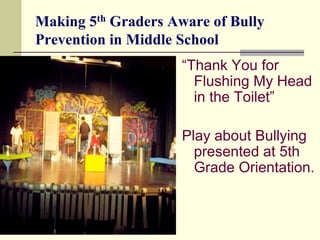
Making 5th Graders Aware of Bully
Prevention in Middle School
                     “Thank You for
                       Flushing My Head
                       in the Toilet”

                     Play about Bullying
                       presented at 5th
                       Grade Orientation.
Helping Kids Identify and
Report Bullying
     Three Types of Bullies:
 Physical– deliberate
  hitting, kicking, pushing.
 Verbal- insults, name calling, deliberate

  comments, cell phones, texting.
 Indirect-alienation, excluded, spreading

  rumors.
Helping Kids Identify and
Report Bullying
               What To Do:
   Talk to school administrators, guidance
    counselors, or teachers.
   Allow kids to explain what is going on .
   Allow kids to write down their side of the
    story.
   Allow kids to identify feelings surrounding
    bullying.
   Counselor intervention to help manage anger.
Red Ribbon Week
  Drug and Alcohol Awareness
Slogan Dress Up, “Put A Lid on Drugs.”
Door Decorating Contest, “Don’t Do Drugs, Wear Uggs.”
Guidance Counselor Presentations in Classrooms.
   Bullying Prevention
   Decision Making Skills
   Peer Pressure
Camfell Productions, three screen multimedia
presentation.
The Buzz
on
Bullying
            Quarterly newsletters to enhance
             parent communication about
             bullying.
            Workshops attended by
             Guidance Counselors to stay
             informed and current on
             addressing student bullying
             issues.
            Websites that keep parents and
             students informed.
“The
Revealers”         Three assemblies for grades 6, 7
                    and 8,where students were able to
by Doug Wilhelm     hear the authors real life
                    experiences.
                   Poster Contest, Small group
                    discussion with the author.
                   Interdisciplinary
                    curriculums, including lessons in
                    English, Developmental Reading
                    and Instructional Technology.
                   Anti-bullying Public Service
                    Announcement was created by
                    teacher and students.
Healing
Abuse                 Bullying Prevention Curriculum
                      Two Day Program sponsored by
      for
Working               HAWC.
                      Major Topics:
                        Day 1:
Change                  Bullying, harassment, skill
                        building, assertiveness, empathy, ri
                        ghts, communication, good friends
                        and role plays.
School Based Youth
                        Day 2: Cyber-bullying and internet
Violence Prevention     safety, bystander action.
Coordinator
Patrick Donovan
SHS Harassment Course
  Taught from a legal perspective-
    Sources of curriculum materials include
     Essex County D.A.’s office and legal
     centers, law offices
    Freshmen course: two weeks in length
    Saugus Police presentation
    Classroom resources include printed and
     audiovisual materials
    Student research project
    SHS Peer Mediation Presentation
SHS Harassment Course (cont.)
 Your Civil Rights and
  Harassment, Bullying, Discrimination
 Terminology regarding Civil Rights
 Examples of Civil Rights Cases from past
  to present
 Current Cases in the Media Regarding
  Young People and Bullying, Harassment
 Statistics on Bullying in High Schools
SHS Harassment Course (cont.)
 Recognizing Harassment/Bullying and other Civil
    Rights Violations at school
   Social aspects of Harassment, Bullying:
        - why people don’t report it
        - what students can do: prevention tools
   how students can support others who are
    bullied/harassed
   Reporting Harassment/Bullying at School:       -
    steps of action for students             -
    administrative follow-up
   Resources for Students on
    Bullying, Harassment, Civil Rights
The District’s Commitment…

  Bullying in the school building, on
  school grounds, on the bus or school
  sanctioned transportation, or at
  school-sponsored functions will not
  be tolerated!

Bullying

  • 1.
    Saugus Public Schools: Bullying in Schools "A person is bullied when he or she is exposed, repeatedly and over time, to negative actions on the part of one or more other persons, and he or she has difficulty defending himself or herself."
  • 2.
    What Is Bullying? There are three aspects that define bullying:  Bullying is aggressive behavior that involves unwanted, negative actions.  Bullying involves a pattern of behavior repeated over time.  Bullying involves an imbalance of power or strength.
  • 3.
    What is Cyber-Bullying? Is when the Internet, cell phones or other devices are used to send or post text or images intended to hurt or embarrass another person  Examples of ways kids are bullied online:  Sending someone mean or threatening emails, instant messages, or text messages  Excluding someone from an instant messenger buddy list or blocking their email for no reason  Tricking someone into revealing personal or embarrassing information and sending it to others
  • 4.
    What is Cyber-Bullying?(cont.)  Breaking into someone's email or instant message account to send cruel or untrue messages while posing as that person  Creating websites to make fun of another person, such as a classmate or teacher  Using websites to rate peers as prettiest, ugliest, etc.
  • 5.
    Reasons Kids Bully  It is a learned behavior  They were bullied, or are being bullied  Want to feel superior to others  Want attention  Think it will make them popular, or fit in  Try to scare others to hide their feelings (might be scared about something)
  • 6.
    Reasons Kids Bully– (cont.)  Pick on someone so they won’t get picked on first.  They are unhappy and take out their unhappiness on someone else.  Feel a need to control others  Feel a need to win  May be jealous of the person they are bullying
  • 7.
    Identifying Bullies There isno one single cause of bullying among children. Rather individual, family, peer, school, and community factors can place a child at risk for bullying his or her peers. Characteristics of Children Who Bully:  May witness physical and verbal violence or aggression at home.  View violence in a positive way  May be impulsive, hot-headed, and dominant.  Have trouble following the rules  Show little or no concern for the feelings of others.  Easily frustrated
  • 8.
    Identifying the KidsBeing Bullied  Children who are bullied tend to be:  Sensitive  Socially withdrawn (possibly low self- esteem or a quiet temperament)  Anxious  Passive (letting others be in control and won’t stand up for themselves)  More likely to get depressed
  • 9.
    Identifying the KidsBeing Bullied – (cont.)  Signs A Child is Being Bullied:  Poor Sleep  Unexplained Bruises  Making up excuses not to go to school  “Lose” items frequently  Not speak or show fear when certain people or situations are mentioned  Suddenly receive lower grades or develop learning problems  Talk about suicide
  • 10.
    How Parents CanHelp Prevent Bullying  Take your child’s actions seriously.  Involve the child’s teachers, school administrators, and school counselors  Talk to your child about the importance of understanding the feelings of others.  Supervise your child’s activities.  Be a good role model.  Praise your child for kinds words or deeds.
  • 11.
    Bullying: Prevention/Intervention Saugus Public Schools:  Seamless program from K-12  Educationally compliant  Creates an awareness of support  Updated with legislation  Proactive!
  • 12.
    Bullying: Prevention/Intervention Elementary School Students • Second Step Program • 20-in-20 • Current Events • Self-Esteem Tools • Prevention Methods
  • 13.
    Bullying: Prevention/Intervention Belmonte Middle School  A Kids-to-Kids Prevention Project.  Jonathan W. Blodgett Essex District Attorney.  Students participated and presented a skit which included the Bully, Victim, and Bystander created by Peer Mediators.  Goal of Program: a better awareness of bullying and realizing peers have the power to stop bullying.
  • 14.
    Making 5th GradersAware of Bully Prevention in Middle School “Thank You for Flushing My Head in the Toilet” Play about Bullying presented at 5th Grade Orientation.
  • 15.
    Helping Kids Identifyand Report Bullying Three Types of Bullies:  Physical– deliberate hitting, kicking, pushing.  Verbal- insults, name calling, deliberate comments, cell phones, texting.  Indirect-alienation, excluded, spreading rumors.
  • 16.
    Helping Kids Identifyand Report Bullying What To Do:  Talk to school administrators, guidance counselors, or teachers.  Allow kids to explain what is going on .  Allow kids to write down their side of the story.  Allow kids to identify feelings surrounding bullying.  Counselor intervention to help manage anger.
  • 17.
    Red Ribbon Week Drug and Alcohol Awareness Slogan Dress Up, “Put A Lid on Drugs.” Door Decorating Contest, “Don’t Do Drugs, Wear Uggs.” Guidance Counselor Presentations in Classrooms. Bullying Prevention Decision Making Skills Peer Pressure Camfell Productions, three screen multimedia presentation.
  • 18.
    The Buzz on Bullying  Quarterly newsletters to enhance parent communication about bullying.  Workshops attended by Guidance Counselors to stay informed and current on addressing student bullying issues.  Websites that keep parents and students informed.
  • 19.
    “The Revealers”  Three assemblies for grades 6, 7 and 8,where students were able to by Doug Wilhelm hear the authors real life experiences.  Poster Contest, Small group discussion with the author.  Interdisciplinary curriculums, including lessons in English, Developmental Reading and Instructional Technology.  Anti-bullying Public Service Announcement was created by teacher and students.
  • 20.
    Healing Abuse Bullying Prevention Curriculum Two Day Program sponsored by for Working HAWC. Major Topics: Day 1: Change Bullying, harassment, skill building, assertiveness, empathy, ri ghts, communication, good friends and role plays. School Based Youth Day 2: Cyber-bullying and internet Violence Prevention safety, bystander action. Coordinator Patrick Donovan
  • 21.
    SHS Harassment Course Taught from a legal perspective-  Sources of curriculum materials include Essex County D.A.’s office and legal centers, law offices  Freshmen course: two weeks in length  Saugus Police presentation  Classroom resources include printed and audiovisual materials  Student research project  SHS Peer Mediation Presentation
  • 22.
    SHS Harassment Course(cont.)  Your Civil Rights and Harassment, Bullying, Discrimination  Terminology regarding Civil Rights  Examples of Civil Rights Cases from past to present  Current Cases in the Media Regarding Young People and Bullying, Harassment  Statistics on Bullying in High Schools
  • 23.
    SHS Harassment Course(cont.)  Recognizing Harassment/Bullying and other Civil Rights Violations at school  Social aspects of Harassment, Bullying: - why people don’t report it - what students can do: prevention tools  how students can support others who are bullied/harassed  Reporting Harassment/Bullying at School: - steps of action for students - administrative follow-up  Resources for Students on Bullying, Harassment, Civil Rights
  • 24.
    The District’s Commitment… Bullying in the school building, on school grounds, on the bus or school sanctioned transportation, or at school-sponsored functions will not be tolerated!