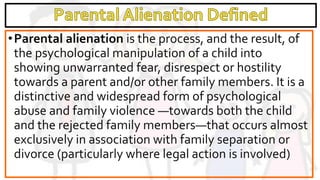
•Parental alienation is the process, and the result, of
the psychological manipulation of a child into
showing unwarranted fear, disrespect or hostility
towards a parent and/or other family members. It is a
distinctive and widespread form of psychological
abuse and family violence —towards both the child
and the rejected family members—that occurs almost
exclusively in association with family separation or
divorce (particularly where legal action is involved)
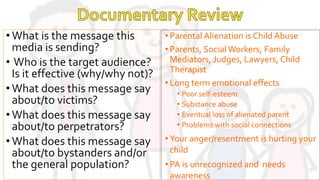
• Parental Alienation is Child Abuse
• Parents, Social Workers, Family
Mediators, Judges, Lawyers, Child
Therapist
• Long term emotional effects
• Poor self-esteem
• Substance abuse
• Eventual loss of alienated parent
• Problems with social connections
• Your anger/resentment is hurting your
child
• PA is unrecognized and needs
awareness
•What is the message this
media is sending?
• Who is the target audience?
Is it effective (why/why not)?
•What does this message say
about/to victims?
•What does this message say
about/to perpetrators?
•What does this message say
about/to bystanders and/or
the general population?
Intimate PersonalViolence in
Canada pg. 65 -67
1. Family Relationship Factors –
specifically a lack of parenting
knowledge and child
development.
2. Expectations about child’s
behaviour are not
developmentally appropriate.
3. Locus of Control – Abusive
parents seem to have a high
external locus of control
4. Self-esteem, a relationship
between self-esteem and abuse
exists.
Emotional Abuse –Child pg. 89
1. Rejecting/Isolation/Coercing by
intimidation
Parental AlienationGradient:
Strategies for a Syndrome
1. Failure to give information about the
children
2. Rewarding disrespectful behaviors in
the child (of rejection toward the RP)
3. Insulting or belittling the RP toward
the children
4. Making decisions without consulting
the RP
5. Preventing visits and Interrogating
the child after visits to the RP
6. Interfering in the child’s symbolic
contact with the RP
7. Hindering telephone contact
8. Seeking caregivers for the child
alternative to the RP
Confusion and Controversy in
Parental Alienation
Parties engaged in PAS may be suffering
from psychiatric disorders such as
• Paranoid
• Narcissistic
• Borderline personality disorder.
Disagreements concerning the rights and
experiences of parents within divorce
proceedings frequently arouse deep
emotions.
Such emotions are often heightened by
gender politics. In a number of countries (the
United Kingdom being a good example),
conflict in this field has become particularly
fierce in recent years. Positions can easily
become polarised and generalisations
abound.
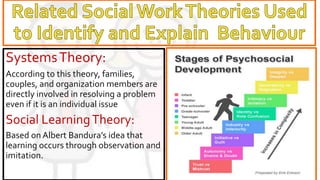
SystemsTheory:
According to this theory, families,
couples, and organization members are
directly involved in resolving a problem
even if it is an individual issue
Social LearningTheory:
Based on Albert Bandura’s idea that
learning occurs through observation and
imitation.
• Northumberland Community Counselling Centre
• http://www.northumberlandccc.com/services/
• Canadian Equal Parenting Council
• Http://canadianepc.org/action/fighting-parental-alienation/
• Canadian Children’s Rights Council
• Parental Alienation Awareness Day is April 25th
• Parental Alienation Awareness Organization
• http://www.paawareness.org/
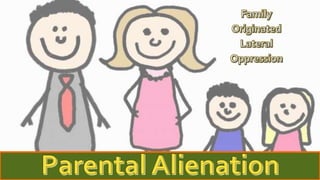
Parental alienation

Parental alienation

  • 3.
    •Parental alienation isthe process, and the result, of the psychological manipulation of a child into showing unwarranted fear, disrespect or hostility towards a parent and/or other family members. It is a distinctive and widespread form of psychological abuse and family violence —towards both the child and the rejected family members—that occurs almost exclusively in association with family separation or divorce (particularly where legal action is involved)
  • 5.
    • Parental Alienationis Child Abuse • Parents, Social Workers, Family Mediators, Judges, Lawyers, Child Therapist • Long term emotional effects • Poor self-esteem • Substance abuse • Eventual loss of alienated parent • Problems with social connections • Your anger/resentment is hurting your child • PA is unrecognized and needs awareness •What is the message this media is sending? • Who is the target audience? Is it effective (why/why not)? •What does this message say about/to victims? •What does this message say about/to perpetrators? •What does this message say about/to bystanders and/or the general population?
  • 6.
    Intimate PersonalViolence in Canadapg. 65 -67 1. Family Relationship Factors – specifically a lack of parenting knowledge and child development. 2. Expectations about child’s behaviour are not developmentally appropriate. 3. Locus of Control – Abusive parents seem to have a high external locus of control 4. Self-esteem, a relationship between self-esteem and abuse exists. Emotional Abuse –Child pg. 89 1. Rejecting/Isolation/Coercing by intimidation Parental AlienationGradient: Strategies for a Syndrome 1. Failure to give information about the children 2. Rewarding disrespectful behaviors in the child (of rejection toward the RP) 3. Insulting or belittling the RP toward the children 4. Making decisions without consulting the RP 5. Preventing visits and Interrogating the child after visits to the RP 6. Interfering in the child’s symbolic contact with the RP 7. Hindering telephone contact 8. Seeking caregivers for the child alternative to the RP Confusion and Controversy in Parental Alienation Parties engaged in PAS may be suffering from psychiatric disorders such as • Paranoid • Narcissistic • Borderline personality disorder. Disagreements concerning the rights and experiences of parents within divorce proceedings frequently arouse deep emotions. Such emotions are often heightened by gender politics. In a number of countries (the United Kingdom being a good example), conflict in this field has become particularly fierce in recent years. Positions can easily become polarised and generalisations abound.
  • 7.
    SystemsTheory: According to thistheory, families, couples, and organization members are directly involved in resolving a problem even if it is an individual issue Social LearningTheory: Based on Albert Bandura’s idea that learning occurs through observation and imitation.
  • 9.
    • Northumberland CommunityCounselling Centre • http://www.northumberlandccc.com/services/ • Canadian Equal Parenting Council • Http://canadianepc.org/action/fighting-parental-alienation/ • Canadian Children’s Rights Council • Parental Alienation Awareness Day is April 25th • Parental Alienation Awareness Organization • http://www.paawareness.org/