Amanda Nickerson, PhD
                   Associate Professor and Director
Dr. Jean Alberti Center for the Prevention of Bullying
                          Abuse and School Violence
                                  University at Buffalo
                                nickersa@buffalo.edu
                         gse.buffalo.edu/alberticenter


                                    St. Mark School
                                   November 2, 2011
 Question   & answer format about bullying
  • Role of parents, peers, and schools
 Theintent of this is to share information
 about an issue of concern for all
  • Not designed to place blame
  • Designed to emphasize responsibility and working
   together to problem-solve
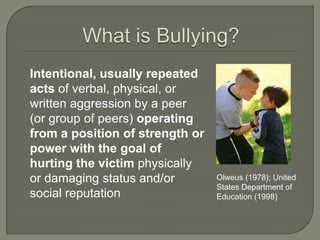
Intentional, usually repeated
acts of verbal, physical, or
written aggression by a peer
(or group of peers) operating
from a position of strength or
power with the goal of
hurting the victim physically
or damaging status and/or        Olweus (1978); United
                                 States Department of
social reputation                Education (1998)
   Physical bullying
    • punching, shoving, acts that hurt people
   Verbal bullying
    • name calling, making offensive remarks
   Indirect bullying
    • spreading rumors, excluding, ganging up
   Cyber bullying
    • sending insulting messages, pictures or threats by e-
      mail, text messaging, chat rooms
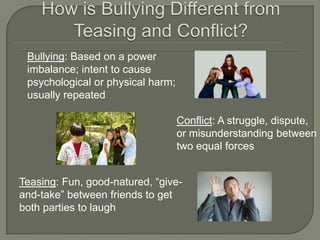
Bullying: Based on a power
 imbalance; intent to cause
 psychological or physical harm;
 usually repeated

                                   Conflict: A struggle, dispute,
                                   or misunderstanding between
                                   two equal forces


Teasing: Fun, good-natured, “give-
and-take” between friends to get
both parties to laugh
 Estimatesvary WIDELY, but according to
 student self-report...
  • 20-25% have bullied at least once
     5-20% bully consistently
  • 15-40% are targets of bullying
     20-25% are bullied regularly
     ~ 18-20% are cyber-bullied
     1-2% are extreme victims who experience
      severe traumatization or distress


    Carylyle & Steinman (2007); Cowie (2000); Nansel et al. (2001);
        Perry, Kusel, & Perry (1988); Skiba & Fontanini (2000)
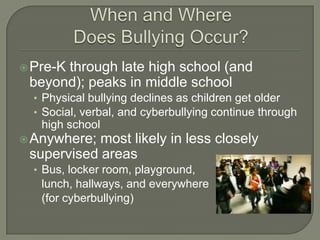
 Pre-K
      through late high school (and
 beyond); peaks in middle school
  • Physical bullying declines as children get older
  • Social, verbal, and cyberbullying continue through
   high school
 Anywhere; most likely in less closely
 supervised areas
  • Bus, locker room, playground,
   lunch, hallways, and everywhere
   (for cyberbullying)
 Boys
  • More direct, physical bullying
  • Bully more frequently than girls
  • Bully both boys and girls

 Girls
  • More indirect
  • More subtle, hard to detect, and often occurs in groups
  • Tend to target other girls of the same age
  • Cyberbullying slightly more common than for males

  Banks (2000); Cook, Williams, Guerra, Kim, & Sadek, (2010); Crick & Grotpeter, (1995); Hinduja & Patchin, (2009); Hoover &
                            Oliver, (1996); Nansel et al., (2001); Olweus, (2002); Underwood, (2003)
 Desire for power and control
 Get satisfaction from others’ suffering
 Justify their behavior (“he deserved it”)
 More exposed to physical punishment
 More likely to be depressed
 Engage in other risky and delinquent
 behaviors
  • Alcohol and drug use
  • Fighting

     Batsche & Knoff (1994); Beaver, Perron, & Howard, (2010); Olweus (1993);
            Swearer et al. (in press); Vaughn, Bender, DeLisi, (in press)
 Have     a position of relative weakness
  • Age, ethnic background, financial status, disability, sexual
     orientation
 Most     are passive and lack assertiveness
  • Do nothing to invite aggression
  • Do not fight back when attacked
  • May relate better to adults than peers

 Fewer  provoke others (provocative victims or
 bully-victims)
  • Offend, irritate, tease others
  • Reactive; fight back when attacked


 Boivin, Poulin, & Vitaro (1994); Hodges & Perry (1999); Olweus (1978, 1993, 2001);
                          Schwartz (2000); Snyder et al. (2003)
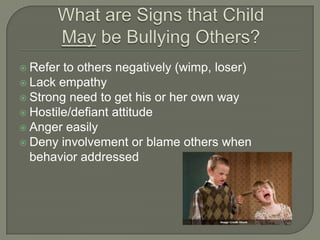
 Refer to others negatively (wimp, loser)
 Lack empathy
 Strong need to get his or her own way
 Hostile/defiant attitude
 Anger easily
 Deny involvement or blame others when
  behavior addressed
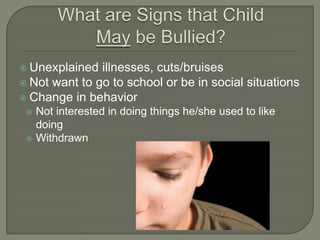
 Unexplained  illnesses, cuts/bruises
 Not want to go to school or be in social situations
 Change in behavior
  Not interested in doing things he/she used to like
   doing
  Withdrawn
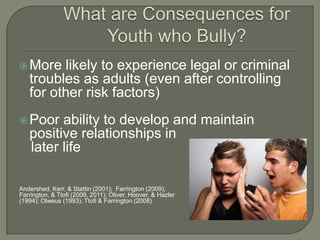
 More   likely to experience legal or criminal
   troubles as adults (even after controlling
   for other risk factors)
 Poor   ability to develop and maintain
   positive relationships in
   later life

Andershed, Kerr, & Stattin (2001); Farrington (2009);
Farrington, & Ttofi (2009, 2011); Oliver, Hoover, & Hazler
(1994); Olweus (1993); Ttofi & Farrington (2008)
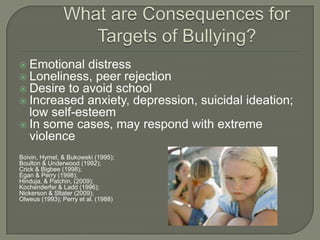
 Emotional distress
 Loneliness, peer rejection
 Desire to avoid school
 Increased anxiety, depression,     suicidal ideation;
  low self-esteem
 In some cases, may respond with extreme
  violence
Boivin, Hymel, & Bukowski (1995);
Boulton & Underwood (1992);
Crick & Bigbee (1998);
Egan & Perry (1998);
Hinduja, & Patchin, (2009);
Kochenderfer & Ladd (1996);
Nickerson & Sltater (2009);
Olweus (1993); Perry et al. (1988)
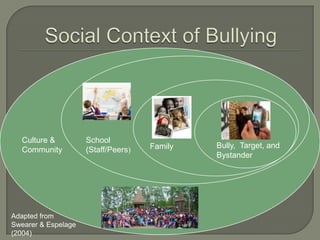
Culture &          School
                                     Family   Bully, Target, and
  Community          (Staff/Peers)
                                              Bystander


Adapted from
Swearer & Espelage
(2004)
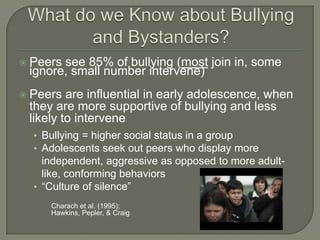
 Peerssee 85% of bullying (most join in, some
 ignore, small number intervene)
 Peers  are influential in early adolescence, when
 they are more supportive of bullying and less
 likely to intervene
  • Bullying = higher social status in a group
  • Adolescents seek out peers who display more
    independent, aggressive as opposed to more adult-
    like, conforming behaviors
  • “Culture of silence”
     Charach et al. (1995);
     Hawkins, Pepler, & Craig
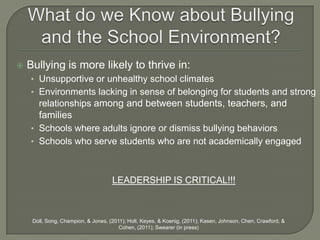
   Bullying is more likely to thrive in:
    • Unsupportive or unhealthy school climates
    • Environments lacking in sense of belonging for students and strong
      relationships among and between students, teachers, and
      families
    • Schools where adults ignore or dismiss bullying behaviors
    • Schools who serve students who are not academically engaged


                                     LEADERSHIP IS CRITICAL!!!


     Doll, Song, Champion, & Jones, (2011); Holt, Keyes, & Koenig, (2011); Kasen, Johnson, Chen, Crawford, &
                                        Cohen, (2011); Swearer (in press)
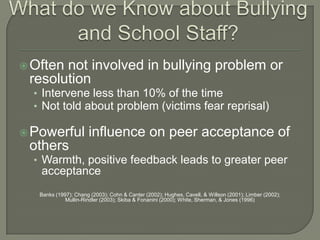
 Oftennot involved in bullying problem or
 resolution
  • Intervene less than 10% of the time
  • Not told about problem (victims fear reprisal)

 Powerful            influence on peer acceptance of
 others
  • Warmth, positive feedback leads to greater peer
   acceptance
   Banks (1997); Chang (2003); Cohn & Canter (2002); Hughes, Cavell, & Willson (2001); Limber (2002);
             Mullin-Rindler (2003); Skiba & Fonanini (2000); White, Sherman, & Jones (1996)
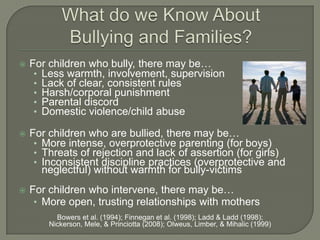
   For children who bully, there may be…
     • Less warmth, involvement, supervision
     • Lack of clear, consistent rules
     • Harsh/corporal punishment
     • Parental discord
     • Domestic violence/child abuse

   For children who are bullied, there may be…
     • More intense, overprotective parenting (for boys)
     • Threats of rejection and lack of assertion (for girls)
     • Inconsistent discipline practices (overprotective and
       neglectful) without warmth for bully-victims
   For children who intervene, there may be…
     • More open, trusting relationships with mothers
          Bowers et al. (1994); Finnegan et al. (1998); Ladd & Ladd (1998);
        Nickerson, Mele, & Princiotta (2008); Olweus, Limber, & Mihalic (1999)
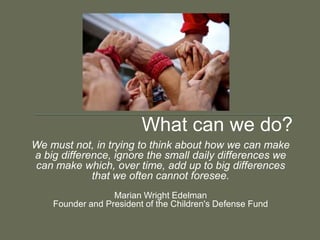
What can we do?
We must not, in trying to think about how we can make
a big difference, ignore the small daily differences we
can make which, over time, add up to big differences
             that we often cannot foresee.
                  Marian Wright Edelman
    Founder and President of the Children's Defense Fund
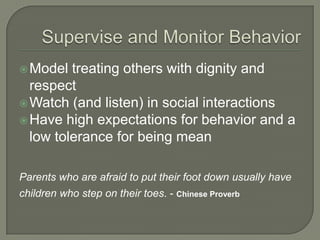
 Model  treating others with dignity and
  respect
 Watch (and listen) in social interactions
 Have high expectations for behavior and a
  low tolerance for being mean

Parents who are afraid to put their foot down usually have
children who step on their toes. - Chinese Proverb
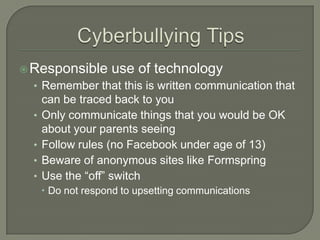
 Responsible       use of technology
  • Remember that this is written communication that
      can be traced back to you
  •   Only communicate things that you would be OK
      about your parents seeing
  •   Follow rules (no Facebook under age of 13)
  •   Beware of anonymous sites like Formspring
  •   Use the “off” switch
       Do not respond to upsetting communications
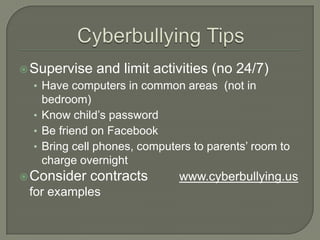
 Supervise   and limit activities (no 24/7)
  • Have computers in common areas (not in
    bedroom)
  • Know child’s password
  • Be friend on Facebook
  • Bring cell phones, computers to parents’ room to
    charge overnight
 Consider   contracts        www.cyberbullying.us
 for examples
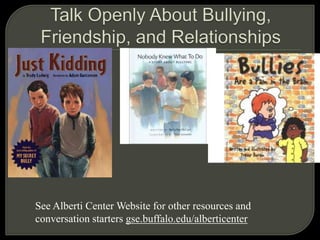
See Alberti Center Website for other resources and
conversation starters gse.buffalo.edu/alberticenter
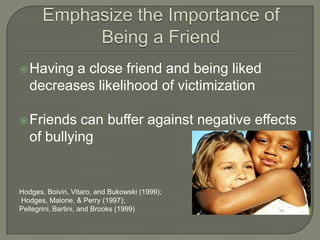
 Having  a close friend and being liked
   decreases likelihood of victimization

 Friends   can buffer against negative effects
   of bullying


Hodges, Boivin, Vitaro, and Bukowski (1999);
Hodges, Malone, & Perry (1997);
Pellegrini, Bartini, and Brooks (1999)
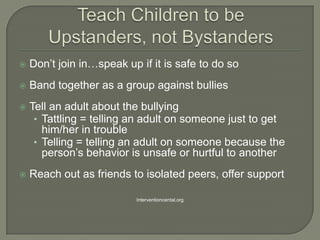
   Don’t join in…speak up if it is safe to do so
   Band together as a group against bullies
   Tell an adult about the bullying
     • Tattling = telling an adult on someone just to get
       him/her in trouble
     • Telling = telling an adult on someone because the
       person’s behavior is unsafe or hurtful to another
   Reach out as friends to isolated peers, offer support

                           Interventioncental.org
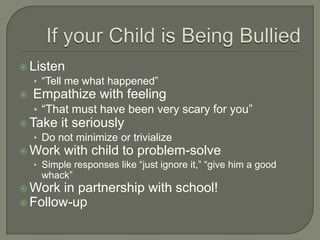
 Listen
   • “Tell me what happened”
 Empathize with feeling
   • “That must have been very scary for you”
 Take it seriously
   • Do not minimize or trivialize
 Work with child to problem-solve
   • Simple responses like “just ignore it,” “give him a good
     whack”
 Work in partnership with school!
 Follow-up
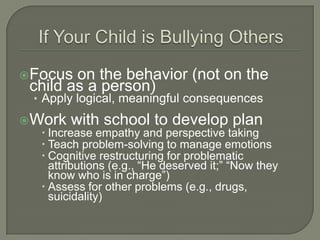
Focus   on the behavior (not on the
  child as a person)
  • Apply logical, meaningful consequences

Work with school to develop plan
   Increase empathy and perspective taking
   Teach problem-solving to manage emotions
   Cognitive restructuring for problematic
    attributions (e.g., “He deserved it;” “Now they
    know who is in charge”)
   Assess for other problems (e.g., drugs,
    suicidality)
Thank you for your attention and interest!


                       For more resources,
                        please visit us at
                        gse.buffalo.edu/alberticen
                        ter

St. Mark School Parent Presentation

  • 1.
    Amanda Nickerson, PhD Associate Professor and Director Dr. Jean Alberti Center for the Prevention of Bullying Abuse and School Violence University at Buffalo nickersa@buffalo.edu gse.buffalo.edu/alberticenter St. Mark School November 2, 2011
  • 2.
     Question & answer format about bullying • Role of parents, peers, and schools  Theintent of this is to share information about an issue of concern for all • Not designed to place blame • Designed to emphasize responsibility and working together to problem-solve
  • 3.
    Intentional, usually repeated actsof verbal, physical, or written aggression by a peer (or group of peers) operating from a position of strength or power with the goal of hurting the victim physically or damaging status and/or Olweus (1978); United States Department of social reputation Education (1998)
  • 4.
    Physical bullying • punching, shoving, acts that hurt people  Verbal bullying • name calling, making offensive remarks  Indirect bullying • spreading rumors, excluding, ganging up  Cyber bullying • sending insulting messages, pictures or threats by e- mail, text messaging, chat rooms
  • 5.
    Bullying: Based ona power imbalance; intent to cause psychological or physical harm; usually repeated Conflict: A struggle, dispute, or misunderstanding between two equal forces Teasing: Fun, good-natured, “give- and-take” between friends to get both parties to laugh
  • 6.
     Estimatesvary WIDELY,but according to student self-report... • 20-25% have bullied at least once  5-20% bully consistently • 15-40% are targets of bullying  20-25% are bullied regularly  ~ 18-20% are cyber-bullied  1-2% are extreme victims who experience severe traumatization or distress Carylyle & Steinman (2007); Cowie (2000); Nansel et al. (2001); Perry, Kusel, & Perry (1988); Skiba & Fontanini (2000)
  • 7.
     Pre-K through late high school (and beyond); peaks in middle school • Physical bullying declines as children get older • Social, verbal, and cyberbullying continue through high school  Anywhere; most likely in less closely supervised areas • Bus, locker room, playground, lunch, hallways, and everywhere (for cyberbullying)
  • 8.
     Boys • More direct, physical bullying • Bully more frequently than girls • Bully both boys and girls  Girls • More indirect • More subtle, hard to detect, and often occurs in groups • Tend to target other girls of the same age • Cyberbullying slightly more common than for males Banks (2000); Cook, Williams, Guerra, Kim, & Sadek, (2010); Crick & Grotpeter, (1995); Hinduja & Patchin, (2009); Hoover & Oliver, (1996); Nansel et al., (2001); Olweus, (2002); Underwood, (2003)
  • 9.
     Desire forpower and control  Get satisfaction from others’ suffering  Justify their behavior (“he deserved it”)  More exposed to physical punishment  More likely to be depressed  Engage in other risky and delinquent behaviors • Alcohol and drug use • Fighting Batsche & Knoff (1994); Beaver, Perron, & Howard, (2010); Olweus (1993); Swearer et al. (in press); Vaughn, Bender, DeLisi, (in press)
  • 10.
     Have a position of relative weakness • Age, ethnic background, financial status, disability, sexual orientation  Most are passive and lack assertiveness • Do nothing to invite aggression • Do not fight back when attacked • May relate better to adults than peers  Fewer provoke others (provocative victims or bully-victims) • Offend, irritate, tease others • Reactive; fight back when attacked Boivin, Poulin, & Vitaro (1994); Hodges & Perry (1999); Olweus (1978, 1993, 2001); Schwartz (2000); Snyder et al. (2003)
  • 11.
     Refer toothers negatively (wimp, loser)  Lack empathy  Strong need to get his or her own way  Hostile/defiant attitude  Anger easily  Deny involvement or blame others when behavior addressed
  • 12.
     Unexplained illnesses, cuts/bruises  Not want to go to school or be in social situations  Change in behavior  Not interested in doing things he/she used to like doing  Withdrawn
  • 13.
     More likely to experience legal or criminal troubles as adults (even after controlling for other risk factors)  Poor ability to develop and maintain positive relationships in later life Andershed, Kerr, & Stattin (2001); Farrington (2009); Farrington, & Ttofi (2009, 2011); Oliver, Hoover, & Hazler (1994); Olweus (1993); Ttofi & Farrington (2008)
  • 14.
     Emotional distress Loneliness, peer rejection  Desire to avoid school  Increased anxiety, depression, suicidal ideation; low self-esteem  In some cases, may respond with extreme violence Boivin, Hymel, & Bukowski (1995); Boulton & Underwood (1992); Crick & Bigbee (1998); Egan & Perry (1998); Hinduja, & Patchin, (2009); Kochenderfer & Ladd (1996); Nickerson & Sltater (2009); Olweus (1993); Perry et al. (1988)
  • 15.
    Culture & School Family Bully, Target, and Community (Staff/Peers) Bystander Adapted from Swearer & Espelage (2004)
  • 16.
     Peerssee 85%of bullying (most join in, some ignore, small number intervene)  Peers are influential in early adolescence, when they are more supportive of bullying and less likely to intervene • Bullying = higher social status in a group • Adolescents seek out peers who display more independent, aggressive as opposed to more adult- like, conforming behaviors • “Culture of silence” Charach et al. (1995); Hawkins, Pepler, & Craig
  • 17.
    Bullying is more likely to thrive in: • Unsupportive or unhealthy school climates • Environments lacking in sense of belonging for students and strong relationships among and between students, teachers, and families • Schools where adults ignore or dismiss bullying behaviors • Schools who serve students who are not academically engaged LEADERSHIP IS CRITICAL!!! Doll, Song, Champion, & Jones, (2011); Holt, Keyes, & Koenig, (2011); Kasen, Johnson, Chen, Crawford, & Cohen, (2011); Swearer (in press)
  • 18.
     Oftennot involvedin bullying problem or resolution • Intervene less than 10% of the time • Not told about problem (victims fear reprisal)  Powerful influence on peer acceptance of others • Warmth, positive feedback leads to greater peer acceptance Banks (1997); Chang (2003); Cohn & Canter (2002); Hughes, Cavell, & Willson (2001); Limber (2002); Mullin-Rindler (2003); Skiba & Fonanini (2000); White, Sherman, & Jones (1996)
  • 19.
    For children who bully, there may be… • Less warmth, involvement, supervision • Lack of clear, consistent rules • Harsh/corporal punishment • Parental discord • Domestic violence/child abuse  For children who are bullied, there may be… • More intense, overprotective parenting (for boys) • Threats of rejection and lack of assertion (for girls) • Inconsistent discipline practices (overprotective and neglectful) without warmth for bully-victims  For children who intervene, there may be… • More open, trusting relationships with mothers Bowers et al. (1994); Finnegan et al. (1998); Ladd & Ladd (1998); Nickerson, Mele, & Princiotta (2008); Olweus, Limber, & Mihalic (1999)
  • 20.
    What can wedo? We must not, in trying to think about how we can make a big difference, ignore the small daily differences we can make which, over time, add up to big differences that we often cannot foresee. Marian Wright Edelman Founder and President of the Children's Defense Fund
  • 22.
     Model treating others with dignity and respect  Watch (and listen) in social interactions  Have high expectations for behavior and a low tolerance for being mean Parents who are afraid to put their foot down usually have children who step on their toes. - Chinese Proverb
  • 23.
     Responsible use of technology • Remember that this is written communication that can be traced back to you • Only communicate things that you would be OK about your parents seeing • Follow rules (no Facebook under age of 13) • Beware of anonymous sites like Formspring • Use the “off” switch  Do not respond to upsetting communications
  • 24.
     Supervise and limit activities (no 24/7) • Have computers in common areas (not in bedroom) • Know child’s password • Be friend on Facebook • Bring cell phones, computers to parents’ room to charge overnight  Consider contracts www.cyberbullying.us for examples
  • 25.
    See Alberti CenterWebsite for other resources and conversation starters gse.buffalo.edu/alberticenter
  • 26.
     Having a close friend and being liked decreases likelihood of victimization  Friends can buffer against negative effects of bullying Hodges, Boivin, Vitaro, and Bukowski (1999); Hodges, Malone, & Perry (1997); Pellegrini, Bartini, and Brooks (1999)
  • 27.
    Don’t join in…speak up if it is safe to do so  Band together as a group against bullies  Tell an adult about the bullying • Tattling = telling an adult on someone just to get him/her in trouble • Telling = telling an adult on someone because the person’s behavior is unsafe or hurtful to another  Reach out as friends to isolated peers, offer support Interventioncental.org
  • 28.
     Listen • “Tell me what happened”  Empathize with feeling • “That must have been very scary for you”  Take it seriously • Do not minimize or trivialize  Work with child to problem-solve • Simple responses like “just ignore it,” “give him a good whack”  Work in partnership with school!  Follow-up
  • 29.
    Focus on the behavior (not on the child as a person) • Apply logical, meaningful consequences Work with school to develop plan  Increase empathy and perspective taking  Teach problem-solving to manage emotions  Cognitive restructuring for problematic attributions (e.g., “He deserved it;” “Now they know who is in charge”)  Assess for other problems (e.g., drugs, suicidality)
  • 30.
    Thank you foryour attention and interest!  For more resources, please visit us at gse.buffalo.edu/alberticen ter