Building Resilient Children Bullying, Harassment& Cyber Safety Kerrie Hayes-Williams & Mark Woolley Catholic Education Office Diocese of Wollongong 25 th  March, 2009
Some Myths ‘ I was bullied and it didn’t do me any harm’ ‘ He’ll just have to learn to stand up for himself’ ‘ Tell him to hit back – harder’ ‘ It’s character building’ ‘ Sticks and stones . . . .’  ‘ That’s not bullying!  It’s just kids teasing.’
Australian Research Results  (Ken Rigby, 2006) 1:6 is bullied on a weekly basis More frequent in primary school for both genders peaking in years 4/5 Reports of lack of support, isolation, absenteeism  (1:5 boys, 1:4 girls) , feeling unsafe Health consequences – perceived or real
‘ Bullying and harassment happens when people  deliberately  and  repeatedly   use and abuse their power to hurt, annoy, torment or put down other people they see as  weaker or smaller  What is bullying??
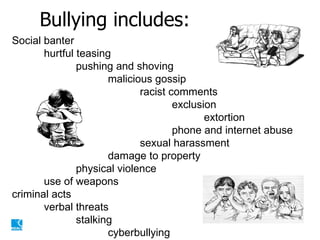
Bullying includes: Social banter hurtful teasing pushing and shoving malicious gossip racist comments exclusion extortion phone and internet abuse sexual harassment damage to property physical violence use of weapons criminal acts verbal threats stalking cyberbullying
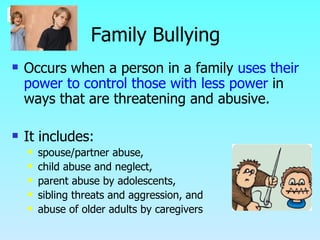
Family Bullying Occurs when a person in a family  uses their power to control those with less power  in ways that are threatening and abusive. It includes: spouse/partner abuse,  child abuse and neglect, parent abuse by adolescents,  sibling threats and aggression, and  abuse of older adults by caregivers
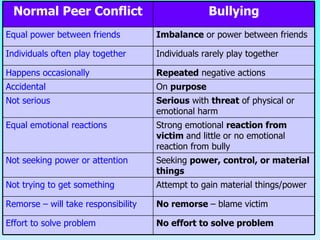
Normal Peer Conflict Bullying Equal power between friends Imbalance  or power between friends Individuals often play together Individuals rarely play together Happens occasionally Repeated  negative actions Accidental On  purpose Not serious Serious  with  threat  of physical or emotional harm Equal emotional reactions Strong emotional  reaction from victim  and little or no emotional reaction from bully Not seeking power or attention Seeking  power, control, or material things Not trying to get something Attempt to gain material things/power Remorse – will take responsibility No remorse  – blame victim Effort to solve problem No effort to solve problem
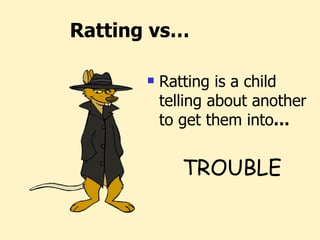
Ratting vs… Ratting is a child telling about another to get them into …   TROUBLE
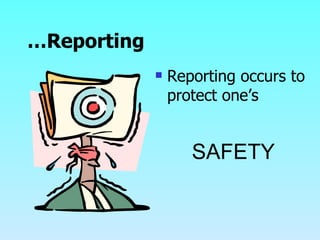
… Reporting Reporting occurs to protect one’s  SAFETY
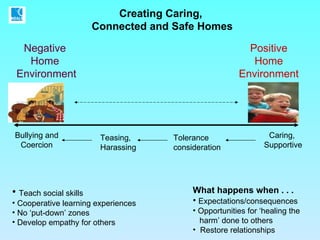
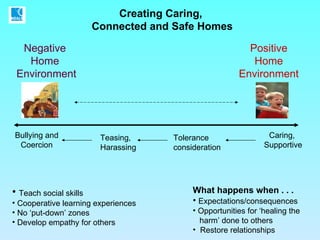
Bullying and Coercion Teasing, Harassing Tolerance consideration Caring,  Supportive Positive Home Environment Negative  Home  Environment Creating Caring,  Connected and Safe Homes Teach social skills Cooperative learning experiences No ‘put-down’ zones Develop empathy for others What happens when . . . Expectations/consequences Opportunities for ‘healing the  harm’ done to others Restore relationships
Girls Bullying  Boys Bullying Starts in year 1-2 Typically use ‘put-downs’ Usually about clothing, hair, or overall appearance Years 3-4 tactics change Isolation from group Promise of inclusion for favours Cliques or groups taunt or harass at recess or lunch Years 5-6 situation worse Intimidating or threatening notes warning of things to happen Gossiping and spreading damaging and embarrassing stories commonplace Typically use physical aggression or by threatening to use it Quick jab, push or shove, elbow or knee or head thrust into a wall or locker Whatever it is – hurts and over quickly before anyone sees. Size and strength is intimidating Create fear and a present threat of harm from physical abuse Boys see bullies as large, strong and powerful Can peak in year 4/5
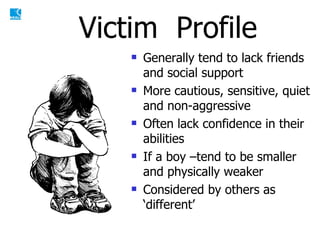
Victim  Profile Generally tend to lack friends and social support More cautious, sensitive, quiet and non-aggressive Often lack confidence in their abilities If a boy –tend to be smaller and physically weaker Considered by others as ‘different’
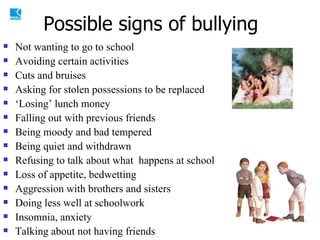
Possible signs of bullying Not wanting to go to school Avoiding certain activities Cuts and bruises Asking for stolen possessions to be replaced ‘ Losing’ lunch money Falling out with previous friends Being moody and bad tempered Being quiet and withdrawn Refusing to talk about what  happens at school Loss of appetite, bedwetting Aggression with brothers and sisters Doing less well at schoolwork Insomnia, anxiety Talking about not having friends
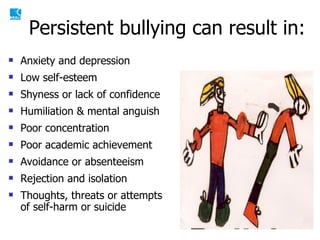
Persistent bullying can result in: Anxiety and depression Low self-esteem Shyness or lack of confidence Humiliation & mental anguish Poor concentration Poor academic achievement Avoidance or absenteeism Rejection and isolation Thoughts, threats or attempts of self-harm or suicide
A typical bully is a person who:  Values power and the rewards aggression bring Has a desire to hurt and expressed in action Someone is hurt Lacks compassion and empathy for others Lacks guilt for his or her actions Believes it is OK to treat others in a cruel fashion Likes to dominate and be in charge Thinks it’s OK to be abusive in order to get something Avoids adults and plays/spends time out of adult sight Is verbally convincing  Projects problems onto others Enjoys the interaction
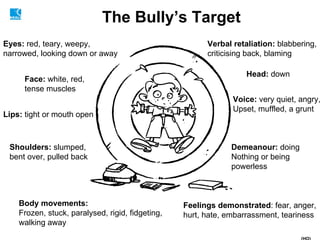
Eyes:  red, teary, weepy,  narrowed, looking down or away Face:  white, red,  tense muscles Lips:  tight or mouth open Head:  down Shoulders:  slumped, bent over, pulled back Voice:  very quiet, angry, Upset, muffled, a grunt Body movements: Frozen, stuck, paralysed, rigid, fidgeting,  walking away Verbal retaliation:  blabbering, criticising back, blaming Feelings demonstrated : fear, anger, hurt, hate, embarrassment, teariness Demeanour:  doing Nothing or being powerless The Bully’s Target (HO)
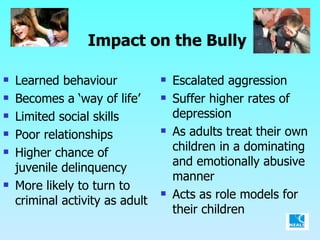
Impact on the Bully Learned behaviour Becomes a ‘way of life’ Limited social skills Poor relationships Higher chance of juvenile delinquency More likely to turn to criminal activity as adult Escalated aggression Suffer higher rates of depression  As adults treat their own children in a dominating and emotionally abusive manner Acts as role models for their children
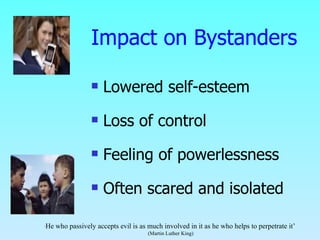
Impact on Bystanders Lowered self-esteem Loss of control Feeling of powerlessness Often scared and isolated ‘ He who passively accepts evil is as much involved in it as he who helps to perpetrate it’ 
 (Martin Luther King)
What stops children? Common urge at times that can involve: A sense of shame (motivational force) Worry about parents’ reactions/disapproval Concerned about the peers judgments It is not cool in their group Witnessing the pain and hurt of victims Learning social and emotional skills for managing relationships
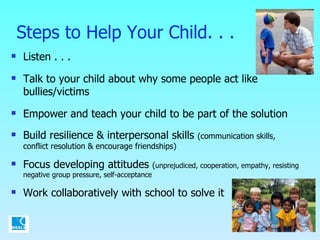
Steps to Help Your Child. . .  Listen . . . Talk to your child about why some people act like bullies/victims Empower and teach your child to be part of the solution Build resilience & interpersonal skills  (communication skills, conflict resolution & encourage friendships) Focus developing attitudes  ( unprejudiced, cooperation, empathy, resisting negative group pressure, self-acceptance Work collaboratively with school to solve it
Faulty beliefs/ attitudes to change I’m not good enough Being different is bad I am to blame I have the right to be sensitive I can’t accept the truth I can do it my own way People should be fair Nothing works No-one can help I think it is a waste of time
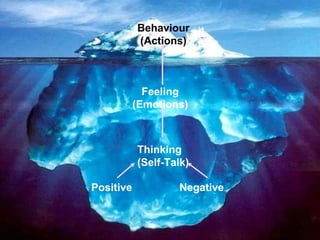
Thinking (Self-Talk) Positive Negative Feeling (Emotions) Behaviour (Actions)
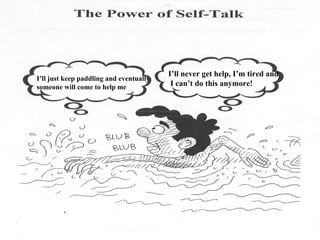
I’ll just keep paddling and eventually  someone will come to help me I’ll never get help, I’m tired and I can’t do this anymore!
The Secrets of Relating for Children Secret 1:  Understand why you are bullied Secret 2:  Build your self-esteem Secret 3:  Become a confident communicator Secret 4:  Create your own ‘power pack’ Secret 5:  Develop a support network
Bullying and Coercion Teasing, Harassing Tolerance consideration Caring,  Supportive Positive Home Environment Negative  Home  Environment Creating Caring,  Connected and Safe Homes Teach social skills Cooperative learning experiences No ‘put-down’ zones Develop empathy for others What happens when . . . Expectations/consequences Opportunities for ‘healing the  harm’ done to others Restore relationships
Safe environments Everyone should be treated with respect. Children need to be held accountable and responsible for their actions.  When actions occur that affect safety,  quick   intervention  is needed. We must work together to stay on target!
Talking with staff at St. Therese List what happened. Be clear and firm about the suffering Be prepared to name the bully If persists – WHO, WHAT, WHERE & WHEN Follow school policy and procedures Collaborate with school on a plan of action Keep in contact until bullying or harassing stops
Together we can  make a difference

Bullying and Harassment

  • 1.
    Building Resilient ChildrenBullying, Harassment& Cyber Safety Kerrie Hayes-Williams & Mark Woolley Catholic Education Office Diocese of Wollongong 25 th March, 2009
  • 2.
    Some Myths ‘I was bullied and it didn’t do me any harm’ ‘ He’ll just have to learn to stand up for himself’ ‘ Tell him to hit back – harder’ ‘ It’s character building’ ‘ Sticks and stones . . . .’ ‘ That’s not bullying! It’s just kids teasing.’
  • 3.
    Australian Research Results (Ken Rigby, 2006) 1:6 is bullied on a weekly basis More frequent in primary school for both genders peaking in years 4/5 Reports of lack of support, isolation, absenteeism (1:5 boys, 1:4 girls) , feeling unsafe Health consequences – perceived or real
  • 4.
    ‘ Bullying andharassment happens when people deliberately and repeatedly use and abuse their power to hurt, annoy, torment or put down other people they see as weaker or smaller What is bullying??
  • 5.
    Bullying includes: Socialbanter hurtful teasing pushing and shoving malicious gossip racist comments exclusion extortion phone and internet abuse sexual harassment damage to property physical violence use of weapons criminal acts verbal threats stalking cyberbullying
  • 6.
    Family Bullying Occurswhen a person in a family uses their power to control those with less power in ways that are threatening and abusive. It includes: spouse/partner abuse, child abuse and neglect, parent abuse by adolescents, sibling threats and aggression, and abuse of older adults by caregivers
  • 7.
    Normal Peer ConflictBullying Equal power between friends Imbalance or power between friends Individuals often play together Individuals rarely play together Happens occasionally Repeated negative actions Accidental On purpose Not serious Serious with threat of physical or emotional harm Equal emotional reactions Strong emotional reaction from victim and little or no emotional reaction from bully Not seeking power or attention Seeking power, control, or material things Not trying to get something Attempt to gain material things/power Remorse – will take responsibility No remorse – blame victim Effort to solve problem No effort to solve problem
  • 8.
    Ratting vs… Rattingis a child telling about another to get them into … TROUBLE
  • 9.
    … Reporting Reportingoccurs to protect one’s SAFETY
  • 10.
    Bullying and CoercionTeasing, Harassing Tolerance consideration Caring, Supportive Positive Home Environment Negative Home Environment Creating Caring, Connected and Safe Homes Teach social skills Cooperative learning experiences No ‘put-down’ zones Develop empathy for others What happens when . . . Expectations/consequences Opportunities for ‘healing the harm’ done to others Restore relationships
  • 11.
    Girls Bullying Boys Bullying Starts in year 1-2 Typically use ‘put-downs’ Usually about clothing, hair, or overall appearance Years 3-4 tactics change Isolation from group Promise of inclusion for favours Cliques or groups taunt or harass at recess or lunch Years 5-6 situation worse Intimidating or threatening notes warning of things to happen Gossiping and spreading damaging and embarrassing stories commonplace Typically use physical aggression or by threatening to use it Quick jab, push or shove, elbow or knee or head thrust into a wall or locker Whatever it is – hurts and over quickly before anyone sees. Size and strength is intimidating Create fear and a present threat of harm from physical abuse Boys see bullies as large, strong and powerful Can peak in year 4/5
  • 12.
    Victim ProfileGenerally tend to lack friends and social support More cautious, sensitive, quiet and non-aggressive Often lack confidence in their abilities If a boy –tend to be smaller and physically weaker Considered by others as ‘different’
  • 13.
    Possible signs ofbullying Not wanting to go to school Avoiding certain activities Cuts and bruises Asking for stolen possessions to be replaced ‘ Losing’ lunch money Falling out with previous friends Being moody and bad tempered Being quiet and withdrawn Refusing to talk about what happens at school Loss of appetite, bedwetting Aggression with brothers and sisters Doing less well at schoolwork Insomnia, anxiety Talking about not having friends
  • 14.
    Persistent bullying canresult in: Anxiety and depression Low self-esteem Shyness or lack of confidence Humiliation & mental anguish Poor concentration Poor academic achievement Avoidance or absenteeism Rejection and isolation Thoughts, threats or attempts of self-harm or suicide
  • 15.
    A typical bullyis a person who: Values power and the rewards aggression bring Has a desire to hurt and expressed in action Someone is hurt Lacks compassion and empathy for others Lacks guilt for his or her actions Believes it is OK to treat others in a cruel fashion Likes to dominate and be in charge Thinks it’s OK to be abusive in order to get something Avoids adults and plays/spends time out of adult sight Is verbally convincing Projects problems onto others Enjoys the interaction
  • 16.
    Eyes: red,teary, weepy, narrowed, looking down or away Face: white, red, tense muscles Lips: tight or mouth open Head: down Shoulders: slumped, bent over, pulled back Voice: very quiet, angry, Upset, muffled, a grunt Body movements: Frozen, stuck, paralysed, rigid, fidgeting, walking away Verbal retaliation: blabbering, criticising back, blaming Feelings demonstrated : fear, anger, hurt, hate, embarrassment, teariness Demeanour: doing Nothing or being powerless The Bully’s Target (HO)
  • 17.
    Impact on theBully Learned behaviour Becomes a ‘way of life’ Limited social skills Poor relationships Higher chance of juvenile delinquency More likely to turn to criminal activity as adult Escalated aggression Suffer higher rates of depression As adults treat their own children in a dominating and emotionally abusive manner Acts as role models for their children
  • 18.
    Impact on BystandersLowered self-esteem Loss of control Feeling of powerlessness Often scared and isolated ‘ He who passively accepts evil is as much involved in it as he who helps to perpetrate it’ 
 (Martin Luther King)
  • 19.
    What stops children?Common urge at times that can involve: A sense of shame (motivational force) Worry about parents’ reactions/disapproval Concerned about the peers judgments It is not cool in their group Witnessing the pain and hurt of victims Learning social and emotional skills for managing relationships
  • 20.
    Steps to HelpYour Child. . . Listen . . . Talk to your child about why some people act like bullies/victims Empower and teach your child to be part of the solution Build resilience & interpersonal skills (communication skills, conflict resolution & encourage friendships) Focus developing attitudes ( unprejudiced, cooperation, empathy, resisting negative group pressure, self-acceptance Work collaboratively with school to solve it
  • 21.
    Faulty beliefs/ attitudesto change I’m not good enough Being different is bad I am to blame I have the right to be sensitive I can’t accept the truth I can do it my own way People should be fair Nothing works No-one can help I think it is a waste of time
  • 22.
    Thinking (Self-Talk) PositiveNegative Feeling (Emotions) Behaviour (Actions)
  • 23.
    I’ll just keeppaddling and eventually someone will come to help me I’ll never get help, I’m tired and I can’t do this anymore!
  • 24.
    The Secrets ofRelating for Children Secret 1: Understand why you are bullied Secret 2: Build your self-esteem Secret 3: Become a confident communicator Secret 4: Create your own ‘power pack’ Secret 5: Develop a support network
  • 25.
    Bullying and CoercionTeasing, Harassing Tolerance consideration Caring, Supportive Positive Home Environment Negative Home Environment Creating Caring, Connected and Safe Homes Teach social skills Cooperative learning experiences No ‘put-down’ zones Develop empathy for others What happens when . . . Expectations/consequences Opportunities for ‘healing the harm’ done to others Restore relationships
  • 26.
    Safe environments Everyoneshould be treated with respect. Children need to be held accountable and responsible for their actions. When actions occur that affect safety, quick intervention is needed. We must work together to stay on target!
  • 27.
    Talking with staffat St. Therese List what happened. Be clear and firm about the suffering Be prepared to name the bully If persists – WHO, WHAT, WHERE & WHEN Follow school policy and procedures Collaborate with school on a plan of action Keep in contact until bullying or harassing stops
  • 28.
    Together we can make a difference