RECOMMENDED SAFER WORK
PRACTICES TO PREVENT SHARPS
          INJURIES
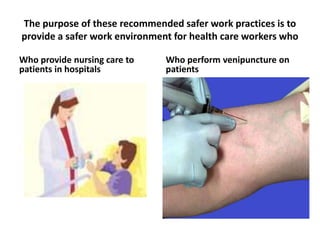
The purpose of these recommended safer work practices is to
provide a safer work environment for health care workers who

Who provide nursing care to    Who perform venipuncture on
patients in hospitals          patients
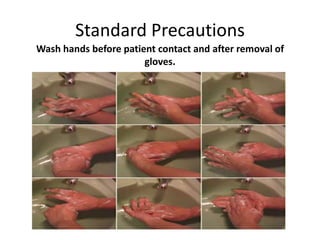
Standard Precautions
Wash hands before patient contact and after removal of
                       gloves.
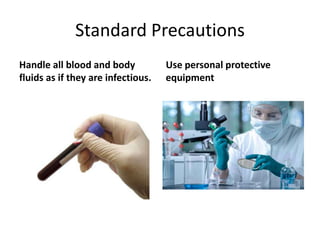
Standard Precautions
Handle all blood and body           Use personal protective
fluids as if they are infectious.   equipment
Engineering Controls
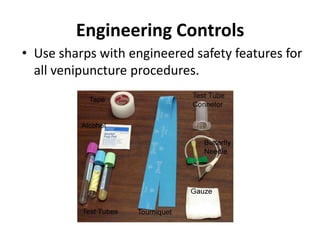
• Use sharps with engineered safety features for
  all venipuncture procedures.
Engineering Controls
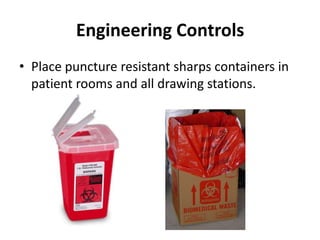
• Place puncture resistant sharps containers in
  patient rooms and all drawing stations.
Engineering Controls
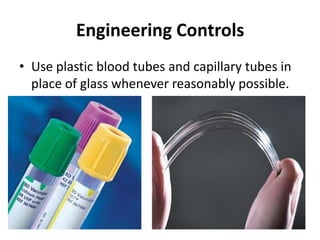
• Use plastic blood tubes and capillary tubes in
  place of glass whenever reasonably possible.
Work Practice Controls
• Always use and activate sharps safety devices.
• Do not pass contaminated sharps from one
  person to another.
• Share information with fellow health care
  workers about patients who may be
  uncooperative.
• Check with the patient’s nurse and/or the log
  book to obtain any special information you may
  need to know.
• Always introduce yourself and get a “feel” for the
  patient before you begin.
Work Practice Controls
• When minor surgical procedures are
  performed outside of the surgical suite, the
  neutral or safe zone concept should be
  utilized. This means that sharps are placed in a
  designated area to be retrieved by the user.
  This avoids hand-to-hand transfer of sharps
  between personnel.
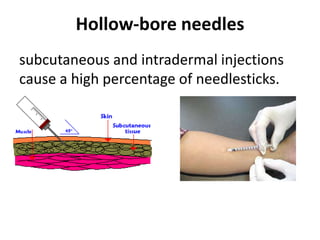
Hollow-bore needles
subcutaneous and intradermal injections
cause a high percentage of needlesticks.
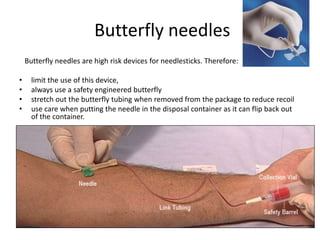
Butterfly needles
    Butterfly needles are high risk devices for needlesticks. Therefore:

•     limit the use of this device,
•     always use a safety engineered butterfly
•     stretch out the butterfly tubing when removed from the package to reduce recoil
•     use care when putting the needle in the disposal container as it can flip back out
      of the container.
Work Practice Controls
• Obtain assistance when drawing blood from an
  uncooperative, combative or confused patient.
• Before you begin the procedure assure that you
  have a stable work surface and a needle disposal
  container available.
• When possible, send two lab technicians to a
  code or trauma so one can help hold the patient.
  If staff is not available, ask a nurse to help hold
  the patient.
Work Practice Controls
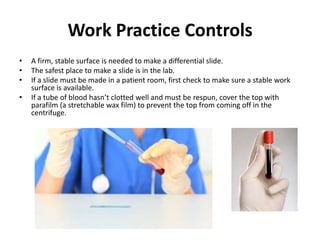
•   A firm, stable surface is needed to make a differential slide.
•   The safest place to make a slide is in the lab.
•   If a slide must be made in a patient room, first check to make sure a stable work
    surface is available.
•   If a tube of blood hasn’t clotted well and must be respun, cover the top with
    parafilm (a stretchable wax film) to prevent the top from coming off in the
    centrifuge.
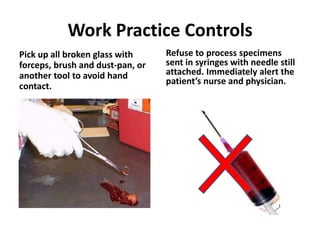
Work Practice Controls
Pick up all broken glass with     Refuse to process specimens
forceps, brush and dust-pan, or   sent in syringes with needle still
another tool to avoid hand        attached. Immediately alert the
                                  patient’s nurse and physician.
contact.
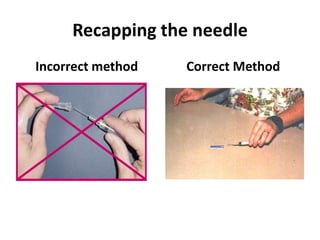
Recapping the needle
Incorrect method   Correct Method
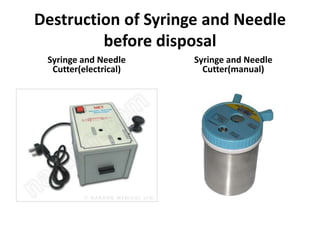
Destruction of Syringe and Needle
         before disposal
 Syringe and Needle    Syringe and Needle
  Cutter(electrical)     Cutter(manual)

Recommended safer work practices for nursing

  • 1.
    RECOMMENDED SAFER WORK PRACTICESTO PREVENT SHARPS INJURIES
  • 2.
    The purpose ofthese recommended safer work practices is to provide a safer work environment for health care workers who Who provide nursing care to Who perform venipuncture on patients in hospitals patients
  • 3.
    Standard Precautions Wash handsbefore patient contact and after removal of gloves.
  • 4.
    Standard Precautions Handle allblood and body Use personal protective fluids as if they are infectious. equipment
  • 5.
    Engineering Controls • Usesharps with engineered safety features for all venipuncture procedures.
  • 6.
    Engineering Controls • Placepuncture resistant sharps containers in patient rooms and all drawing stations.
  • 7.
    Engineering Controls • Useplastic blood tubes and capillary tubes in place of glass whenever reasonably possible.
  • 8.
    Work Practice Controls •Always use and activate sharps safety devices. • Do not pass contaminated sharps from one person to another. • Share information with fellow health care workers about patients who may be uncooperative. • Check with the patient’s nurse and/or the log book to obtain any special information you may need to know. • Always introduce yourself and get a “feel” for the patient before you begin.
  • 9.
    Work Practice Controls •When minor surgical procedures are performed outside of the surgical suite, the neutral or safe zone concept should be utilized. This means that sharps are placed in a designated area to be retrieved by the user. This avoids hand-to-hand transfer of sharps between personnel.
  • 10.
    Hollow-bore needles subcutaneous andintradermal injections cause a high percentage of needlesticks.
  • 11.
    Butterfly needles Butterfly needles are high risk devices for needlesticks. Therefore: • limit the use of this device, • always use a safety engineered butterfly • stretch out the butterfly tubing when removed from the package to reduce recoil • use care when putting the needle in the disposal container as it can flip back out of the container.
  • 12.
    Work Practice Controls •Obtain assistance when drawing blood from an uncooperative, combative or confused patient. • Before you begin the procedure assure that you have a stable work surface and a needle disposal container available. • When possible, send two lab technicians to a code or trauma so one can help hold the patient. If staff is not available, ask a nurse to help hold the patient.
  • 13.
    Work Practice Controls • A firm, stable surface is needed to make a differential slide. • The safest place to make a slide is in the lab. • If a slide must be made in a patient room, first check to make sure a stable work surface is available. • If a tube of blood hasn’t clotted well and must be respun, cover the top with parafilm (a stretchable wax film) to prevent the top from coming off in the centrifuge.
  • 14.
    Work Practice Controls Pickup all broken glass with Refuse to process specimens forceps, brush and dust-pan, or sent in syringes with needle still another tool to avoid hand attached. Immediately alert the patient’s nurse and physician. contact.
  • 15.
    Recapping the needle Incorrectmethod Correct Method
  • 16.
    Destruction of Syringeand Needle before disposal Syringe and Needle Syringe and Needle Cutter(electrical) Cutter(manual)