PREPARED BY :
DR.HANADI ALBASHA
MD,internal medicine specialist
• Gown first
• Mask or respirator
• Goggles or face shield
• Gloves
*Combination of PPE will affect sequence – be practica
PPE Use in Healthcare Settings
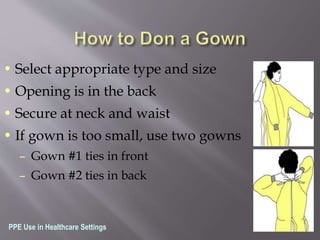
• Select appropriate type and size
• Opening is in the back
• Secure at neck and waist
• If gown is too small, use two gowns
– Gown #1 ties in front
– Gown #2 ties in back
PPE Use in Healthcare Settings
• Place over nose, mouth and chin
• Fit flexible nose piece over nose bridge
• Secure on head with ties or elastic
• Adjust to fit
PPE Use in Healthcare Settings
• Select a fit tested respirator
• Place over nose, mouth and chin
• Fit flexible nose piece over nose bridge
• Secure on head with elastic
• Adjust to fit
• Perform a fit check –
– Inhale – respirator should collapse
– Exhale – check for leakage around face
PPE Use in Healthcare Settings
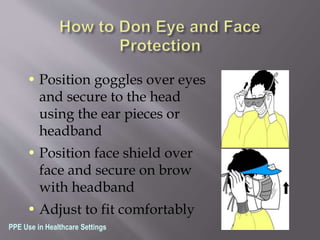
• Position goggles over eyes
and secure to the head
using the ear pieces or
headband
• Position face shield over
face and secure on brow
with headband
• Adjust to fit comfortably
PPE Use in Healthcare Settings
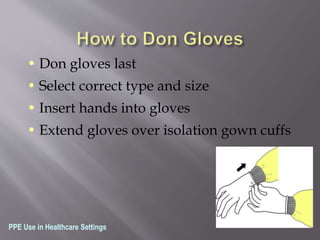
• Don gloves last
• Select correct type and size
• Insert hands into gloves
• Extend gloves over isolation gown cuffs
PPE Use in Healthcare Settings
• Keep gloved hands away from face
• Avoid touching or adjusting other PPE
• Remove gloves if they become torn;
perform hand hygiene before donning
new gloves
• Limit surfaces and items touched
PPE Use in Healthcare Settings
• Contaminated – outside front
• Areas of PPE that have or are likely to have been in contact
with body sites, materials, or environmental surfaces where
the infectious organism may reside
• Clean – inside, outside back, ties on
head and back
• Areas of PPE that are not likely to have been in contact with
the infectious organism
PPE Use in Healthcare Settings
• Gloves
• Face shield or goggles
• Gown
• Mask or respirator
PPE Use in Healthcare Settings
• Slide ungloved finger
under the wrist of
the remaining glove
• Peel off from inside,
creating a bag for
both gloves
• Discard
PPE Use in Healthcare Settings
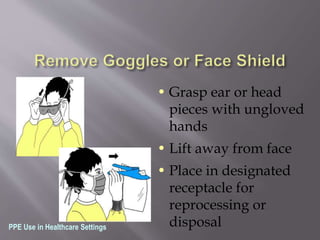
• Grasp ear or head
pieces with ungloved
hands
• Lift away from face
• Place in designated
receptacle for
reprocessing or
disposalPPE Use in Healthcare Settings
• Unfasten ties
• Peel gown away from
neck and shoulder
• Turn contaminated
outside toward the
inside
• Fold or roll into a
bundle
• Discard
PPE Use in Healthcare Settings
• Untie the bottom,
then top, tie
• Remove from face
• Discard
PPE Use in Healthcare Settings
 Lift the bottom
elastic over your
head first
 Then lift off the top
elastic
 Discard
PPE Use in Healthcare Settings
• Perform hand hygiene immediately
after removing PPE.
– If hands become visibly contaminated during PPE removal, wash
hands before continuing to remove PPE
• Wash hands with soap and water or use
an alcohol-based hand rub
PPE Use in Healthcare Settings
* Ensure that hand hygiene facilities are available at the point needed,
e.g., sink or alcohol-based hand rub
• Previously called Universal Precautions
• Assumes blood and body fluid of ANY
patient could be infectious
• Recommends PPE and other infection
control practices to prevent
transmission in any healthcare setting
• Decisions about PPE use determined by
type of clinical interaction with patient
PPE Use in Healthcare Settings
• Gloves – Use when touching blood,
body fluids, secretions, excretions,
contaminated items; for touching
mucus membranes and nonintact skin
• Gowns – Use during procedures and
patient care activities when contact of
clothing/ exposed skin with
blood/body fluids, secretions, or
excretions is anticipated
PPE Use in Healthcare Settings
• Mask and goggles or a face shield –
Use during patient care activities likely
to generate splashes or sprays of blood,
body fluids, secretions, or excretions
PPE Use in Healthcare Settings
• Giving a bed bath?
• Suctioning oral
secretions?
• Transporting a patient
in a wheel chair?
• Responding to an
emergency where
blood is spurting?
• Drawing blood from a
vein?
• Cleaning an incontinent
patient with diarrhea?
• Irrigating a wound?
• Taking vital signs?
PPE Use in Healthcare Settings
• Giving a bed bath?
• Generally none
• Suctioning oral secretions?
• Gloves and
mask/goggles or a face
shield – sometimes gown
• Transporting a patient in a wheel
chair?
• Generally none required
• Responding to an emergency where
blood is spurting?
• Gloves, fluid-resistant
gown, mask/goggles or a
face shield
• Drawing blood from a vein?
• Gloves
• Cleaning an incontinent patient with
diarrhea?
• Gloves w/wo gown
• Irrigating a wound?
• Gloves, gown,
mask/goggles or a face
shield
• Taking vital signs?
– Generally none
PPE Use in Healthcare Settings
• Expanded Precautions include
– Contact Precautions
– Droplet Precautions
– Airborne Infection Isolation
PPE Use in Healthcare Settings
• Contact Precautions – Gown and gloves for
contact with patient or environment of care (e.g.,
medical equipment, environmental surfaces)
• In some instances these are required for entering patient’s
environment
• Droplet Precautions – Surgical masks within 3
feet of patient
• Airborne Infection Isolation – Particulate
respirator*
*Negative pressure isolation room also required
PPE Use in Healthcare Settings
• Required for Standard and Expanded
Precautions
• Perform…
– Immediately after removing PPE
– Between patient contacts
• Wash hands thoroughly with soap and
water or use alcohol-based hand rub
PPE Use in Healthcare Settings
 PPE is available to protect you from
exposure to infectious agents in the
healthcare workplace
 Know what type of PPE is necessary for the
duties you perform and use it correctly
Ppe

Ppe

  • 1.
    PREPARED BY : DR.HANADIALBASHA MD,internal medicine specialist
  • 2.
    • Gown first •Mask or respirator • Goggles or face shield • Gloves *Combination of PPE will affect sequence – be practica PPE Use in Healthcare Settings
  • 3.
    • Select appropriatetype and size • Opening is in the back • Secure at neck and waist • If gown is too small, use two gowns – Gown #1 ties in front – Gown #2 ties in back PPE Use in Healthcare Settings
  • 4.
    • Place overnose, mouth and chin • Fit flexible nose piece over nose bridge • Secure on head with ties or elastic • Adjust to fit PPE Use in Healthcare Settings
  • 5.
    • Select afit tested respirator • Place over nose, mouth and chin • Fit flexible nose piece over nose bridge • Secure on head with elastic • Adjust to fit • Perform a fit check – – Inhale – respirator should collapse – Exhale – check for leakage around face PPE Use in Healthcare Settings
  • 6.
    • Position gogglesover eyes and secure to the head using the ear pieces or headband • Position face shield over face and secure on brow with headband • Adjust to fit comfortably PPE Use in Healthcare Settings
  • 7.
    • Don gloveslast • Select correct type and size • Insert hands into gloves • Extend gloves over isolation gown cuffs PPE Use in Healthcare Settings
  • 8.
    • Keep glovedhands away from face • Avoid touching or adjusting other PPE • Remove gloves if they become torn; perform hand hygiene before donning new gloves • Limit surfaces and items touched PPE Use in Healthcare Settings
  • 10.
    • Contaminated –outside front • Areas of PPE that have or are likely to have been in contact with body sites, materials, or environmental surfaces where the infectious organism may reside • Clean – inside, outside back, ties on head and back • Areas of PPE that are not likely to have been in contact with the infectious organism PPE Use in Healthcare Settings
  • 11.
    • Gloves • Faceshield or goggles • Gown • Mask or respirator PPE Use in Healthcare Settings
  • 12.
    • Slide unglovedfinger under the wrist of the remaining glove • Peel off from inside, creating a bag for both gloves • Discard PPE Use in Healthcare Settings
  • 13.
    • Grasp earor head pieces with ungloved hands • Lift away from face • Place in designated receptacle for reprocessing or disposalPPE Use in Healthcare Settings
  • 14.
    • Unfasten ties •Peel gown away from neck and shoulder • Turn contaminated outside toward the inside • Fold or roll into a bundle • Discard PPE Use in Healthcare Settings
  • 15.
    • Untie thebottom, then top, tie • Remove from face • Discard PPE Use in Healthcare Settings
  • 16.
     Lift thebottom elastic over your head first  Then lift off the top elastic  Discard PPE Use in Healthcare Settings
  • 17.
    • Perform handhygiene immediately after removing PPE. – If hands become visibly contaminated during PPE removal, wash hands before continuing to remove PPE • Wash hands with soap and water or use an alcohol-based hand rub PPE Use in Healthcare Settings * Ensure that hand hygiene facilities are available at the point needed, e.g., sink or alcohol-based hand rub
  • 20.
    • Previously calledUniversal Precautions • Assumes blood and body fluid of ANY patient could be infectious • Recommends PPE and other infection control practices to prevent transmission in any healthcare setting • Decisions about PPE use determined by type of clinical interaction with patient PPE Use in Healthcare Settings
  • 21.
    • Gloves –Use when touching blood, body fluids, secretions, excretions, contaminated items; for touching mucus membranes and nonintact skin • Gowns – Use during procedures and patient care activities when contact of clothing/ exposed skin with blood/body fluids, secretions, or excretions is anticipated PPE Use in Healthcare Settings
  • 22.
    • Mask andgoggles or a face shield – Use during patient care activities likely to generate splashes or sprays of blood, body fluids, secretions, or excretions PPE Use in Healthcare Settings
  • 23.
    • Giving abed bath? • Suctioning oral secretions? • Transporting a patient in a wheel chair? • Responding to an emergency where blood is spurting? • Drawing blood from a vein? • Cleaning an incontinent patient with diarrhea? • Irrigating a wound? • Taking vital signs? PPE Use in Healthcare Settings
  • 24.
    • Giving abed bath? • Generally none • Suctioning oral secretions? • Gloves and mask/goggles or a face shield – sometimes gown • Transporting a patient in a wheel chair? • Generally none required • Responding to an emergency where blood is spurting? • Gloves, fluid-resistant gown, mask/goggles or a face shield • Drawing blood from a vein? • Gloves • Cleaning an incontinent patient with diarrhea? • Gloves w/wo gown • Irrigating a wound? • Gloves, gown, mask/goggles or a face shield • Taking vital signs? – Generally none PPE Use in Healthcare Settings
  • 25.
    • Expanded Precautionsinclude – Contact Precautions – Droplet Precautions – Airborne Infection Isolation PPE Use in Healthcare Settings
  • 26.
    • Contact Precautions– Gown and gloves for contact with patient or environment of care (e.g., medical equipment, environmental surfaces) • In some instances these are required for entering patient’s environment • Droplet Precautions – Surgical masks within 3 feet of patient • Airborne Infection Isolation – Particulate respirator* *Negative pressure isolation room also required PPE Use in Healthcare Settings
  • 27.
    • Required forStandard and Expanded Precautions • Perform… – Immediately after removing PPE – Between patient contacts • Wash hands thoroughly with soap and water or use alcohol-based hand rub PPE Use in Healthcare Settings
  • 28.
     PPE isavailable to protect you from exposure to infectious agents in the healthcare workplace  Know what type of PPE is necessary for the duties you perform and use it correctly