Presented by : Hanadi Albasha
MD,internal medicine specialist
Infection control officer
 Swine influenza is a highly
contagious respiratory disease in
pigs caused by one of several
swine influenza A viruses
 Transmission of swine influenza
viruses to humans is uncommon.
However, the swine influenza virus
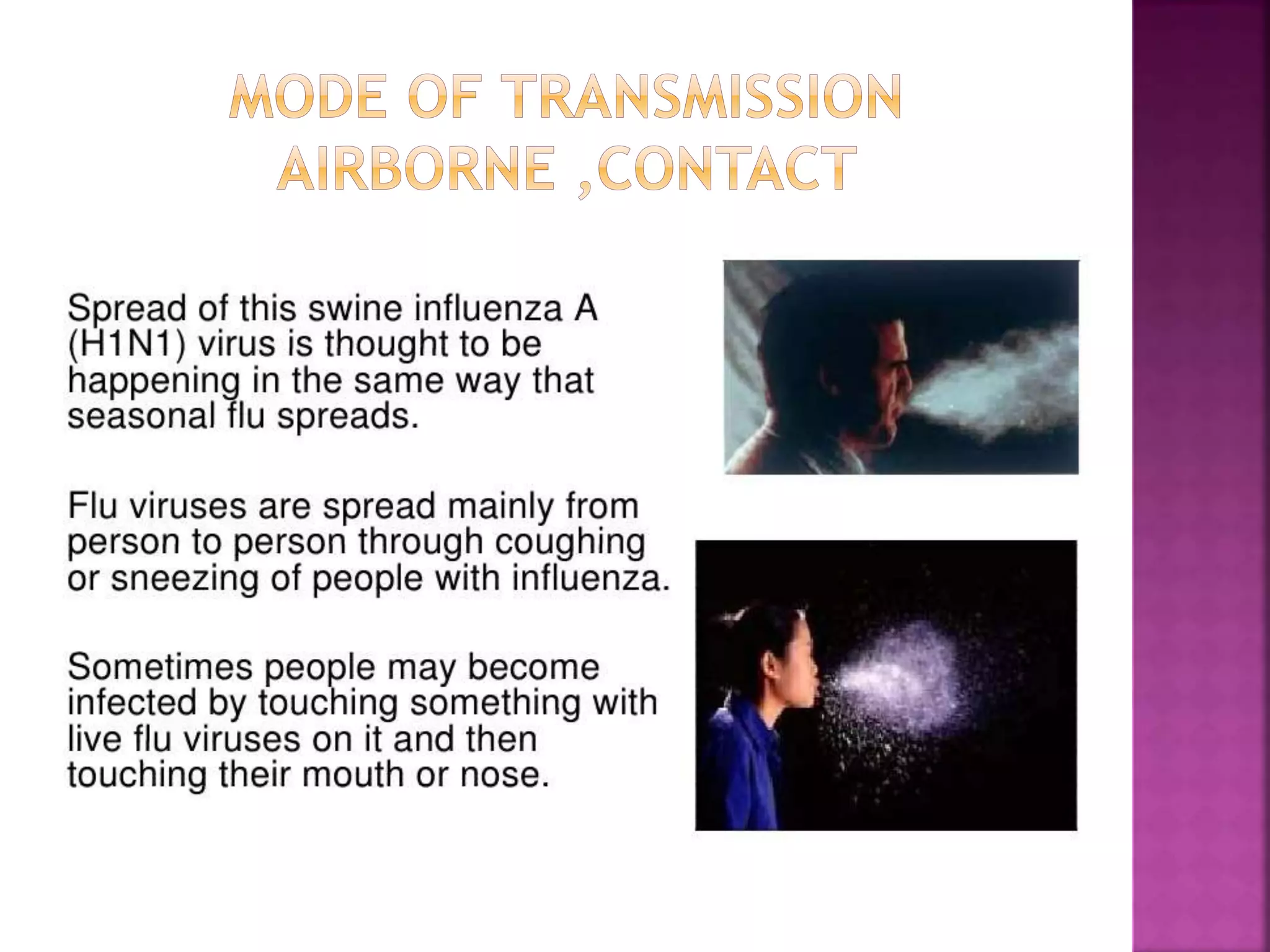
can be transmitted to humans via
contact with infected pigs or
environments contaminated with
swine influenza viruses.
 H1N1 influenza (swine flu) tends
to cause high morbidity but low
mortality rates (1%-4%).
 Onset of acute febrile respiratory illness
within 7 days of close contact with a person
who has a confirmed case of H1N1 influenza
A virus infection, or
 Onset of acute febrile respiratory illness
within 7 days of travel to a community where
one or more H1N1 influenza A cases have
been confirmed, or
 Acute febrile respiratory illness in a person
who resides in a community where at least
one H1N1 influenza case has been confirmed.
 Treatment is largely supportive and consists
of bedrest, increased fluid consumption,
cough suppressants, and antipyretics and
analgesics (eg, acetaminophen, nonsteroidal
anti-inflammatory drugs) for fever and
myalgias.
 Severe cases may require intravenous
hydration and other supportive measures.
Antiviral agents may also be considered for
treatment or prophylaxis.
 Initiate antiviral agents (oseltamivir and
zanamivir) within 48 hours of symptom
onset.
 The recommended duration of treatment is 5
days .
 The 2009 influenza A (H1N1) monovalent
vaccine was released in mid October. The
immunization series consisted of 2 doses for
children younger than 10 years.
 Adults and children 10 years and older
received a single dose.
 included pregnant women.
 household contacts and caregivers of children
younger than 6 months .
 healthcare and emergency medical services
personnel.
 children aged 6 months to 18 years, young adults
aged 19-24 years, and persons aged 25 through
64 years with conditions associated with higher
risk of medical complications from influenza.
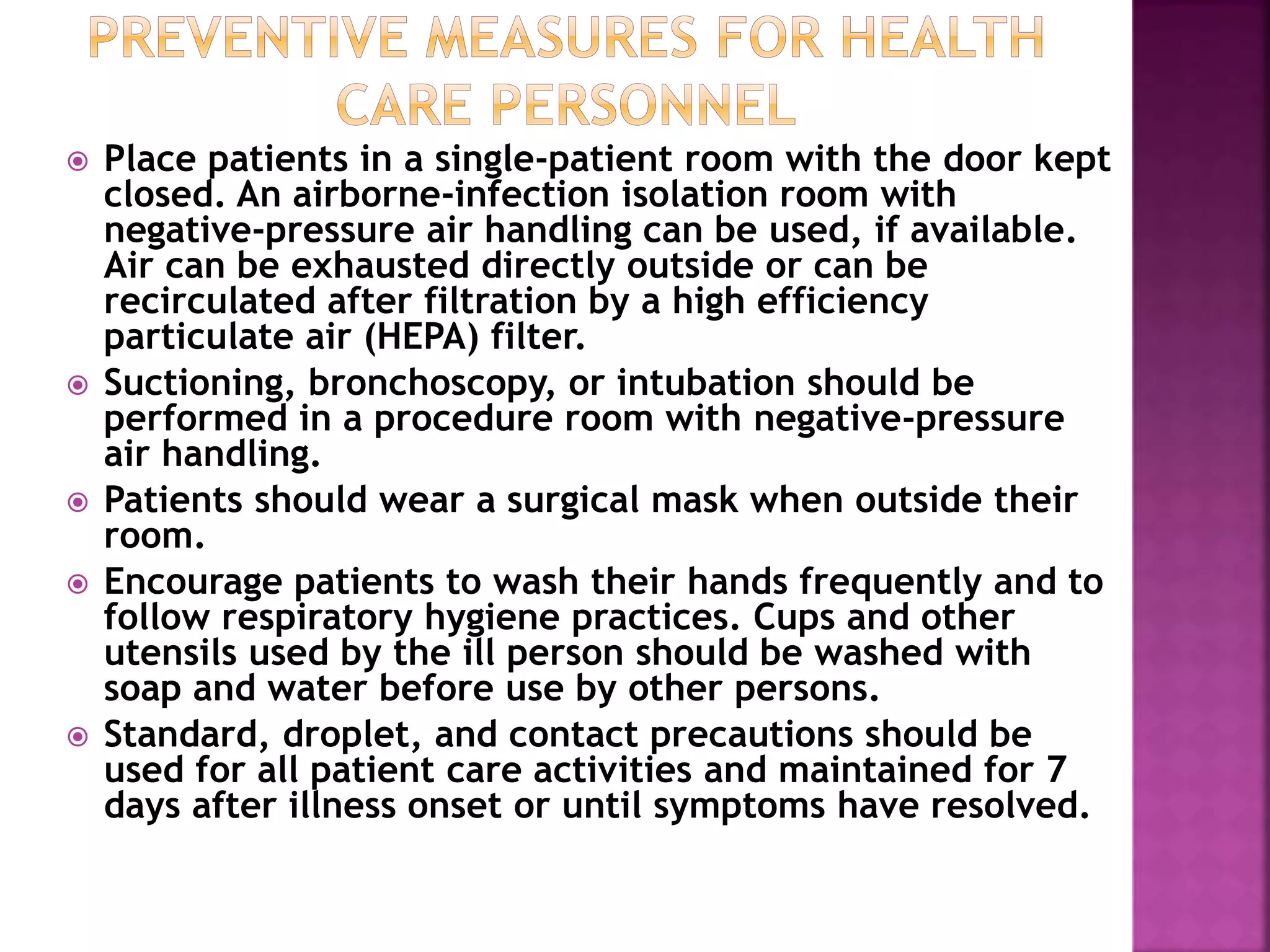
 Place patients in a single-patient room with the door kept
closed. An airborne-infection isolation room with
negative-pressure air handling can be used, if available.
Air can be exhausted directly outside or can be
recirculated after filtration by a high efficiency
particulate air (HEPA) filter.
 Suctioning, bronchoscopy, or intubation should be
performed in a procedure room with negative-pressure
air handling.
 Patients should wear a surgical mask when outside their
room.
 Encourage patients to wash their hands frequently and to
follow respiratory hygiene practices. Cups and other
utensils used by the ill person should be washed with
soap and water before use by other persons.
 Standard, droplet, and contact precautions should be
used for all patient care activities and maintained for 7
days after illness onset or until symptoms have resolved.
 Health care personnel should wash their hands with soap
and water or use hand sanitizer immediately after
removing gloves and other equipment and after any
contact with respiratory secretions.
 Personnel providing care to or collecting clinical
specimens from patients should wear disposable
nonsterile gloves, gowns, and eye protection (eg,
goggles) to prevent conjunctival exposure.
 personnel engaged in aerosol-generating activities (eg,
collection of clinical specimens, endotracheal intubation,
nebulizer treatment, bronchoscopy) and/or resuscitation
involving emergency intubation or cardiac pulmonary
resuscitation should wear a fit-tested disposable N95
respirator.
 personnel providing direct patient care for suspected or
confirmed cases should wear a fit-tested disposable N95
respirator when entering the patient's room.
 relatively rare disease, with
8,273 cases as of 2003
 Severe acute respiratory
syndrome (SARS) is a viral
respiratory disease of
zoonotic origin caused by the
SARS coronavirus (SARS-CoV).
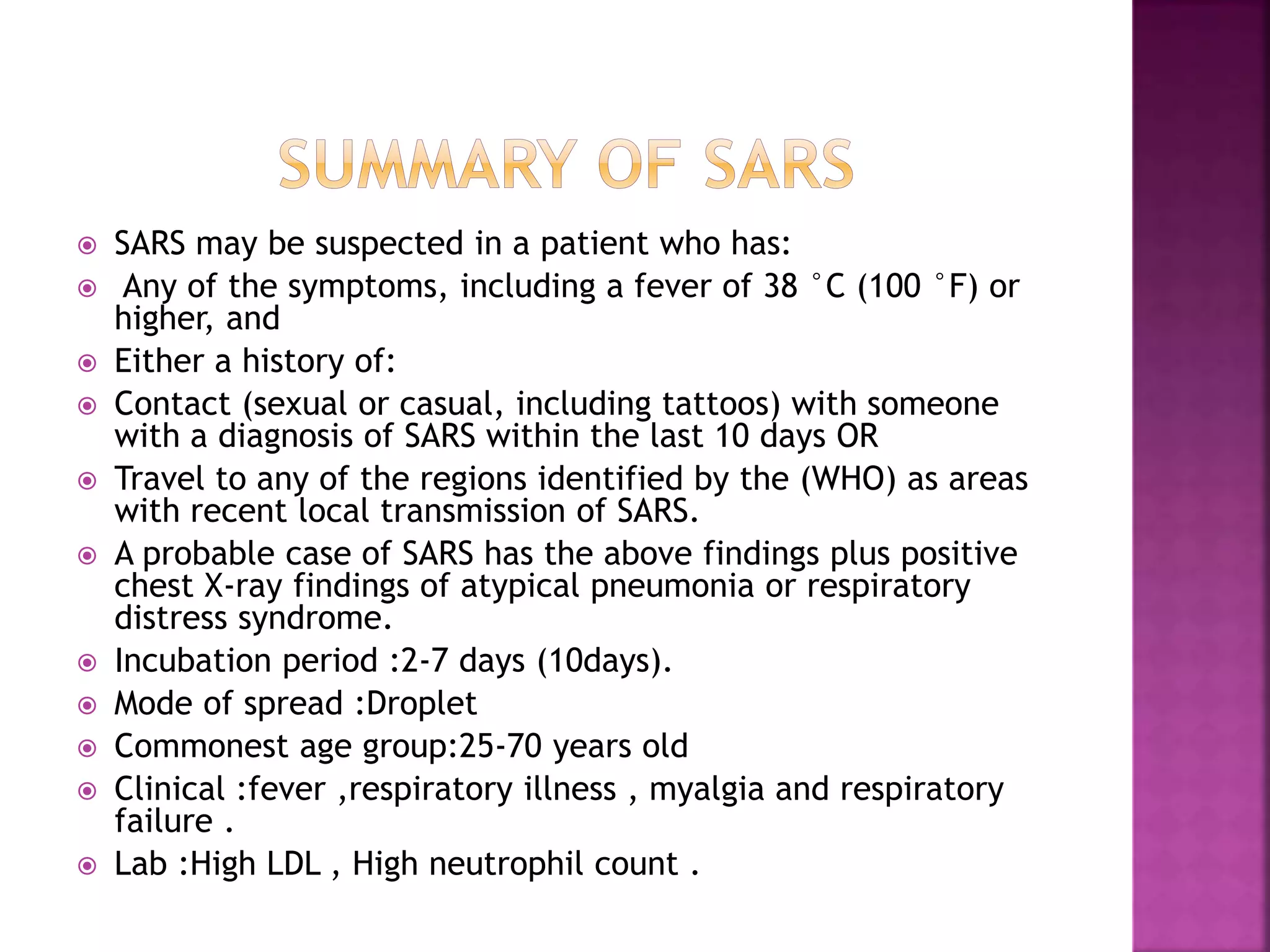
 SARS may be suspected in a patient who has:
 Any of the symptoms, including a fever of 38 °C (100 °F) or
higher, and
 Either a history of:
 Contact (sexual or casual, including tattoos) with someone
with a diagnosis of SARS within the last 10 days OR
 Travel to any of the regions identified by the (WHO) as areas
with recent local transmission of SARS.
 A probable case of SARS has the above findings plus positive
chest X-ray findings of atypical pneumonia or respiratory
distress syndrome.
 Incubation period :2-7 days (10days).
 Mode of spread :Droplet
 Commonest age group:25-70 years old
 Clinical :fever ,respiratory illness , myalgia and respiratory
failure .
 Lab :High LDL , High neutrophil count .
 is largely supportive with antipyretics, supplemental oxygen
and mechanical ventilation as needed.
 Suspected cases of SARS must be isolated, preferably in
negative pressure rooms, with complete barrier nursing
precautions taken for any necessary contact with these
patients.
 Isolation and quarantine remain the most effective means to
prevent the spread of SARS.
 In addition, handwashing, use of universal precautions,
disinfection of surfaces for fomites, and use of a surgical mask
are recommended.
 Avoid contact with bodily fluids.
 Continue with precautions for at least 10 days after the
person's signs and symptoms have disappeared.
 Annual influenza vaccinations and 5-year pneumococcal
vaccinations may be beneficial; but vaccinations only reduce
or weaken the severity of SARS infection.
 As of 2015, there is no cure or protective vaccine for SARS that is safe for
use in humans.
H1 n1+sars

H1 n1+sars

  • 1.
    Presented by :Hanadi Albasha MD,internal medicine specialist Infection control officer
  • 3.
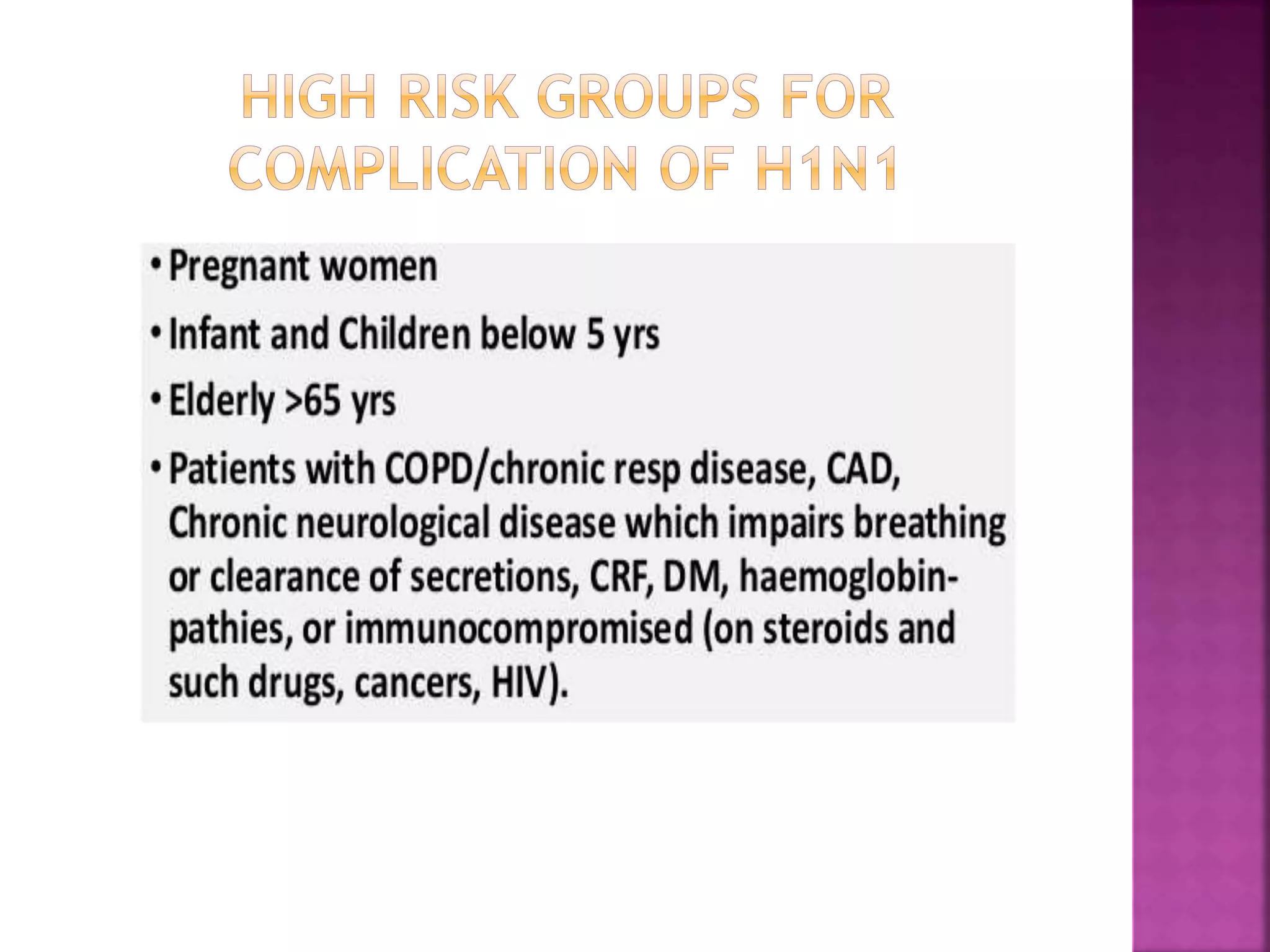
     Swine influenzais a highly contagious respiratory disease in pigs caused by one of several swine influenza A viruses  Transmission of swine influenza viruses to humans is uncommon. However, the swine influenza virus can be transmitted to humans via contact with infected pigs or environments contaminated with swine influenza viruses.  H1N1 influenza (swine flu) tends to cause high morbidity but low mortality rates (1%-4%).
  • 6.
     Onset ofacute febrile respiratory illness within 7 days of close contact with a person who has a confirmed case of H1N1 influenza A virus infection, or  Onset of acute febrile respiratory illness within 7 days of travel to a community where one or more H1N1 influenza A cases have been confirmed, or  Acute febrile respiratory illness in a person who resides in a community where at least one H1N1 influenza case has been confirmed.
  • 10.
     Treatment islargely supportive and consists of bedrest, increased fluid consumption, cough suppressants, and antipyretics and analgesics (eg, acetaminophen, nonsteroidal anti-inflammatory drugs) for fever and myalgias.  Severe cases may require intravenous hydration and other supportive measures. Antiviral agents may also be considered for treatment or prophylaxis.
  • 11.
     Initiate antiviralagents (oseltamivir and zanamivir) within 48 hours of symptom onset.  The recommended duration of treatment is 5 days .
  • 13.
     The 2009influenza A (H1N1) monovalent vaccine was released in mid October. The immunization series consisted of 2 doses for children younger than 10 years.  Adults and children 10 years and older received a single dose.
  • 14.
     included pregnantwomen.  household contacts and caregivers of children younger than 6 months .  healthcare and emergency medical services personnel.  children aged 6 months to 18 years, young adults aged 19-24 years, and persons aged 25 through 64 years with conditions associated with higher risk of medical complications from influenza.
  • 15.
     Place patientsin a single-patient room with the door kept closed. An airborne-infection isolation room with negative-pressure air handling can be used, if available. Air can be exhausted directly outside or can be recirculated after filtration by a high efficiency particulate air (HEPA) filter.  Suctioning, bronchoscopy, or intubation should be performed in a procedure room with negative-pressure air handling.  Patients should wear a surgical mask when outside their room.  Encourage patients to wash their hands frequently and to follow respiratory hygiene practices. Cups and other utensils used by the ill person should be washed with soap and water before use by other persons.  Standard, droplet, and contact precautions should be used for all patient care activities and maintained for 7 days after illness onset or until symptoms have resolved.
  • 16.
     Health carepersonnel should wash their hands with soap and water or use hand sanitizer immediately after removing gloves and other equipment and after any contact with respiratory secretions.  Personnel providing care to or collecting clinical specimens from patients should wear disposable nonsterile gloves, gowns, and eye protection (eg, goggles) to prevent conjunctival exposure.  personnel engaged in aerosol-generating activities (eg, collection of clinical specimens, endotracheal intubation, nebulizer treatment, bronchoscopy) and/or resuscitation involving emergency intubation or cardiac pulmonary resuscitation should wear a fit-tested disposable N95 respirator.  personnel providing direct patient care for suspected or confirmed cases should wear a fit-tested disposable N95 respirator when entering the patient's room.
  • 18.
     relatively raredisease, with 8,273 cases as of 2003  Severe acute respiratory syndrome (SARS) is a viral respiratory disease of zoonotic origin caused by the SARS coronavirus (SARS-CoV).
  • 19.
     SARS maybe suspected in a patient who has:  Any of the symptoms, including a fever of 38 °C (100 °F) or higher, and  Either a history of:  Contact (sexual or casual, including tattoos) with someone with a diagnosis of SARS within the last 10 days OR  Travel to any of the regions identified by the (WHO) as areas with recent local transmission of SARS.  A probable case of SARS has the above findings plus positive chest X-ray findings of atypical pneumonia or respiratory distress syndrome.  Incubation period :2-7 days (10days).  Mode of spread :Droplet  Commonest age group:25-70 years old  Clinical :fever ,respiratory illness , myalgia and respiratory failure .  Lab :High LDL , High neutrophil count .
  • 20.
     is largelysupportive with antipyretics, supplemental oxygen and mechanical ventilation as needed.  Suspected cases of SARS must be isolated, preferably in negative pressure rooms, with complete barrier nursing precautions taken for any necessary contact with these patients.  Isolation and quarantine remain the most effective means to prevent the spread of SARS.  In addition, handwashing, use of universal precautions, disinfection of surfaces for fomites, and use of a surgical mask are recommended.  Avoid contact with bodily fluids.  Continue with precautions for at least 10 days after the person's signs and symptoms have disappeared.  Annual influenza vaccinations and 5-year pneumococcal vaccinations may be beneficial; but vaccinations only reduce or weaken the severity of SARS infection.  As of 2015, there is no cure or protective vaccine for SARS that is safe for use in humans.