What is needlestick injury?
A wound caused by
accidental penetration of the
skin by a needle. Needlestick
injuries can cause
transmission of bloodborne
pathogens.
Epidemiology of Needlesticks
and Other Sharps-related Injuries
Data on needlesticks and other sharps-
related injuries are used to characterize
the who, where, what, when, and
how of such events.
Surveillance data from the National
Surveillance System for Health Care
Workers (NaSH) are used to provide a
general description of the epidemiology
of percutaneous injuries.
Staff:
Sharps pose a serious danger to health care
staff. Providers are at risk when handling,
passing, or using sharps during service
delivery.
Maintenance and waste-disposal staff are at
risk when sharps are not properly disposed
of or when waste containing sharps is
mishandled. Sharps can cause injury and
transmission of serious infections, including
HIV, hepatitis B & Hepatitis C.
Who is at risk?
Clients: Clients can be placed at risk if
improperly discarded sharps are found in
unexpected places, like linens.
Community: Improper disposal of sharps
poses a great threat to members of the
community. Sharps that are discarded
where they may be found by scavengers,
children, and others may cause serious
injury and infection. Everyone in the local
community is at risk of the spread of
infection when scavenged syringes and
needles are reused and improperly
disposed.
Where, When and How Do Injuries Occur?
Where? NaSH data show that the majority
(40%) of injuries occur on inpatient units,
particularly medical floors and intensive care
units, and in operating rooms.
When? Injuries most often occur after use and
before disposal of a sharp device (41%)
How?
 Sharp items are found in areas where they are
unexpected, such as on surgical drapes or
linen
handling or disposing of waste
used hypodermic needles or
that
other
bed
When
contains
sharps.
·When sudden movement by the client at the
time of injection causes a provider to be
accidentally stuck
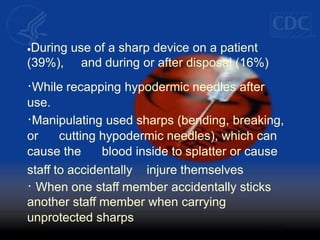
During use of a sharp device on a patient
(39%), and during or after disposal (16%)
·While recapping hypodermic needles after
use.
·Manipulating used sharps (bending, breaking,
or cutting hypodermic needles), which can
cause the blood inside to splatter or cause
staff to accidentally injure themselves
· When one staff member accidentally sticks
another staff member when carrying
unprotected sharps
Your risk of infection following
a needlestick injury varies
depending on the virus being
transmitted.
e.g., the risk of infection after
exposure to hepatitis B is about
20% to 30%, while the risk is 3%
to 10% after exposure to hepatitis
C and about 0.4% after exposure
to HIV.
How can you prevent
injuries from sharps?
 Handle hypodermic needles and other
sharps
extreme care
minimally after use and use
whenever sharps are
when
clinical
handled or passed.
· Use the "hands-free" technique
passing sharps during
procedures.
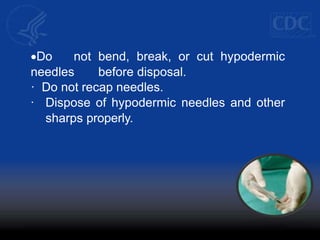
Do not bend, break, or cut hypodermic
needles before disposal.
· Do not recap needles.
· Dispose of hypodermic needles and other
sharps properly.
Many accidental needlesticks occur when
staff are recapping needles. Recapping is a
dangerous practice: If at all possible, dispose
of needles immediately without recapping
them.
If it does become necessary for you to recap
a needle (for example, to avoid carrying an
unprotected sharp when immediate disposal
is not possible), do not bend or break the
needle and do not remove a hypodermic
needle from the syringe by hand.
Recapping: The "one-hand" technique
To safely recap needles, use the "one-
hand" technique:
Step 1
Place the cap on a flat surface, then
remove your hand from the cap.
Step 2
With one hand, hold the syringe and use
the needle to "scoop up" the cap.
Step 3
When the cap covers the needle
completely, use the other hand to secure
the cap on the needle hub. Be careful to
handle the cap at the bottom only (near
the hub).
During a clinical procedure, health care
workers can accidentally stick one another or
their clients when passing sharps, especially
when there is sudden motion by staff
members carrying unprotected sharps, when
clients move suddenly during injections, or
when sharps are left lying in areas where they
are unexpected (such as on surgical drapes).
Handling Sharps
Safe passing of sharp instruments
“safe zone” (“neutral zone”) or "hands-free”
Uncapped or otherwise unprotected sharps
should never be passed directly from one
person to another. In the operating theatre
or procedure room, pass sharp instruments
in such a way that the surgeon and
assistant are never touching the item at the
same time.
The assistant places the instrument in a
sterile kidney basin or in a designated "safe
zone" in the sterile field.
The assistant tells the service
(speak out loud) that the
in the kidney basin or
provider
instrument is
safe zone.
The service provider picks up the
instrument, uses it, and returns it to the
basin or safe zone.
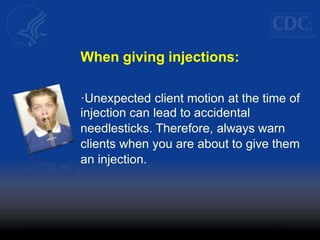
When giving injections:
·Unexpected client motion at the time of
injection can lead to accidental
needlesticks. Therefore, always warn
clients when you are about to give them
an injection.
Managing injuries and exposure
Studies have shown that
squeezing a wound does not reduce the
risk of infection. In addition, do not use
caustic agents, such as bleach, on injuries
from sharp objects.
IF AN EXPOSURE OCCURS
What should I do?
PUNCTURE WOUND:
e.g. Needles tick or sharp injury, bite or
scratch
Encourage bleeding of the wound by
applying gentle pressure.
DO NOT SUCK
IMMEDIATELY – Wash well with soap
under running water.
Dry and apply a waterproof dressing as
necessary.
Report the incident to your manager.
Complete Incident Report Form.
Initiate investigation as to the cause of the
incident and risk assessment.
INJURY FROM CLEAN/UNUSED INSTRUMENT
OR NEEDLE…
Contact Infection Control by telephone if you
are unsure or require advice.
INJURY FROM USED INSTRUMENT OR
NEEDLE, BITE OR SCRATCH…
REPORTASAP but WITHIN 1 HOUR
Attend Employee Health or Emergency
Department
If body fluids splash into:
EYES/NOSE
Irrigate with cold water for at least 15 minutes
If body fluids splash into:
MOUTH - DO NOT SWALLOW
Rinse out several times with cold water
ASAP but WITHIN 1 HOUR Attend Employee
Health or Emergency Department
Post exposure prophylaxis
Detailed protocols for the
administration of post exposure
prophylaxis is written in the
Sharps Injury Prevention Protocol.
For hepatitis C: There is no (PEP)
post exposure prophylaxis available for
hepatitis C. Neither immune globulin
nor antiviral drugs have been shown to
reduce the risk of hepatitis C
transmission.
All staff who are at risk of
exposure to blood or other
body fluids should follow the
hospital vaccination protocol
against hepatitis B virus.
Safe disposal of sharps
To dispose of sharps correctly:
· Do not recap, bend, or break needles
before
the needle from
disposal, and do not remove
the syringe by hand.
needles and syringes
 Dispose of
immediately after use in a puncture-
resistant sharps-disposal container.
Containers
Puncture-resistant sharps-disposal
containers should be conveniently located in
any area where sharp objects are frequently
used (such as injection rooms, treatment
rooms, operating theatres, labour and
delivery rooms, and laboratories).
X
Compliance
Employee's compliance with safe work
practices reduce exposure to blood and other
body fluids, including reductions in sharps-
related injuries .
staff awareness of health and safety is
important to staffs own health and well being.
Reporting
 Proper reporting of needle-stick
injuries is obviously crucial to initiate
early prophylaxis or treatment.
Quality improvement for patient safety
A sentinel event is an unexpected
occurrence involving death or serious
physical or psychological injury, or the risk
thereof.
“that signal the need for immediate
investigation and response”
Quality improvement for patient safety
Root Cause Analysis (RCA) is a process for
identifying the basic or causal factors that
underlie variations in expected
performance. This process is being used
widely in healthcare settings to identify
factors that lead to adverse patient
outcomes or are associated with a "sentinel
event" (e.g., medication errors, laboratory
errors, falls).
The RCA concept also can be applied to
sharps injury prevention.
The purpose of the RCA is to understand
how and why a Sentinel or High Risk Event
occurred and to prevent the same or similar
Event from occurring in the future.
Quality improvement for patient safety
The key to the RCA process is asking the
question "why?" as many times as it takes to
get down to the "root" cause(s) of an event.
· What happened?
· How did it happen?
· Why did it happen?
· What can be done to prevent it from
happening in the future?
· Name and/or identification number of
healthcare worker
· Date, time, and work location of the injury
· Occupation of the worker
·Type of device involved in the injury, and
presence or absence of an engineered
sharps injury prevention feature on the
device involved
· Purpose or procedure for which the sharp
device was being used; and
· When and how the injury occurred.
Data to reported:
FLOWCHARTOF REPORTING
FORMBBF
 If you want a copy of this slides , contact Infection
Control nurse……
khima.rudach@gmail.com
91 94261 43385
THANK YOU

needlestickinjuryf-.pptx

  • 2.
    What is needlestickinjury? A wound caused by accidental penetration of the skin by a needle. Needlestick injuries can cause transmission of bloodborne pathogens.
  • 3.
    Epidemiology of Needlesticks andOther Sharps-related Injuries Data on needlesticks and other sharps- related injuries are used to characterize the who, where, what, when, and how of such events. Surveillance data from the National Surveillance System for Health Care Workers (NaSH) are used to provide a general description of the epidemiology of percutaneous injuries.
  • 4.
    Staff: Sharps pose aserious danger to health care staff. Providers are at risk when handling, passing, or using sharps during service delivery. Maintenance and waste-disposal staff are at risk when sharps are not properly disposed of or when waste containing sharps is mishandled. Sharps can cause injury and transmission of serious infections, including HIV, hepatitis B & Hepatitis C. Who is at risk?
  • 5.
    Clients: Clients canbe placed at risk if improperly discarded sharps are found in unexpected places, like linens. Community: Improper disposal of sharps poses a great threat to members of the community. Sharps that are discarded where they may be found by scavengers, children, and others may cause serious injury and infection. Everyone in the local community is at risk of the spread of infection when scavenged syringes and needles are reused and improperly disposed.
  • 6.
    Where, When andHow Do Injuries Occur? Where? NaSH data show that the majority (40%) of injuries occur on inpatient units, particularly medical floors and intensive care units, and in operating rooms. When? Injuries most often occur after use and before disposal of a sharp device (41%)
  • 7.
    How?  Sharp itemsare found in areas where they are unexpected, such as on surgical drapes or linen handling or disposing of waste used hypodermic needles or that other bed When contains sharps. ·When sudden movement by the client at the time of injection causes a provider to be accidentally stuck
  • 8.
    During use ofa sharp device on a patient (39%), and during or after disposal (16%) ·While recapping hypodermic needles after use. ·Manipulating used sharps (bending, breaking, or cutting hypodermic needles), which can cause the blood inside to splatter or cause staff to accidentally injure themselves · When one staff member accidentally sticks another staff member when carrying unprotected sharps
  • 9.
    Your risk ofinfection following a needlestick injury varies depending on the virus being transmitted. e.g., the risk of infection after exposure to hepatitis B is about 20% to 30%, while the risk is 3% to 10% after exposure to hepatitis C and about 0.4% after exposure to HIV.
  • 10.
    How can youprevent injuries from sharps?  Handle hypodermic needles and other sharps extreme care minimally after use and use whenever sharps are when clinical handled or passed. · Use the "hands-free" technique passing sharps during procedures.
  • 11.
    Do not bend,break, or cut hypodermic needles before disposal. · Do not recap needles. · Dispose of hypodermic needles and other sharps properly.
  • 12.
    Many accidental needlesticksoccur when staff are recapping needles. Recapping is a dangerous practice: If at all possible, dispose of needles immediately without recapping them. If it does become necessary for you to recap a needle (for example, to avoid carrying an unprotected sharp when immediate disposal is not possible), do not bend or break the needle and do not remove a hypodermic needle from the syringe by hand. Recapping: The "one-hand" technique
  • 13.
    To safely recapneedles, use the "one- hand" technique: Step 1 Place the cap on a flat surface, then remove your hand from the cap. Step 2 With one hand, hold the syringe and use the needle to "scoop up" the cap. Step 3 When the cap covers the needle completely, use the other hand to secure the cap on the needle hub. Be careful to handle the cap at the bottom only (near the hub).
  • 14.
    During a clinicalprocedure, health care workers can accidentally stick one another or their clients when passing sharps, especially when there is sudden motion by staff members carrying unprotected sharps, when clients move suddenly during injections, or when sharps are left lying in areas where they are unexpected (such as on surgical drapes). Handling Sharps
  • 15.
    Safe passing ofsharp instruments “safe zone” (“neutral zone”) or "hands-free” “safe zone” (“neutral zone”) or "hands-free” Uncapped or otherwise unprotected sharps should never be passed directly from one person to another. In the operating theatre or procedure room, pass sharp instruments in such a way that the surgeon and assistant are never touching the item at the same time.
  • 16.
    The assistant placesthe instrument in a sterile kidney basin or in a designated "safe zone" in the sterile field. The assistant tells the service (speak out loud) that the in the kidney basin or provider instrument is safe zone. The service provider picks up the instrument, uses it, and returns it to the basin or safe zone.
  • 17.
    When giving injections: ·Unexpectedclient motion at the time of injection can lead to accidental needlesticks. Therefore, always warn clients when you are about to give them an injection.
  • 18.
    Managing injuries andexposure Studies have shown that squeezing a wound does not reduce the risk of infection. In addition, do not use caustic agents, such as bleach, on injuries from sharp objects.
  • 19.
    IF AN EXPOSUREOCCURS What should I do? PUNCTURE WOUND: e.g. Needles tick or sharp injury, bite or scratch Encourage bleeding of the wound by applying gentle pressure. DO NOT SUCK IMMEDIATELY – Wash well with soap under running water. Dry and apply a waterproof dressing as necessary. Report the incident to your manager. Complete Incident Report Form.
  • 20.
    Initiate investigation asto the cause of the incident and risk assessment. INJURY FROM CLEAN/UNUSED INSTRUMENT OR NEEDLE… Contact Infection Control by telephone if you are unsure or require advice. INJURY FROM USED INSTRUMENT OR NEEDLE, BITE OR SCRATCH… REPORTASAP but WITHIN 1 HOUR Attend Employee Health or Emergency Department
  • 21.
    If body fluidssplash into: EYES/NOSE Irrigate with cold water for at least 15 minutes If body fluids splash into: MOUTH - DO NOT SWALLOW Rinse out several times with cold water ASAP but WITHIN 1 HOUR Attend Employee Health or Emergency Department
  • 22.
    Post exposure prophylaxis Detailedprotocols for the administration of post exposure prophylaxis is written in the Sharps Injury Prevention Protocol. For hepatitis C: There is no (PEP) post exposure prophylaxis available for hepatitis C. Neither immune globulin nor antiviral drugs have been shown to reduce the risk of hepatitis C transmission.
  • 23.
    All staff whoare at risk of exposure to blood or other body fluids should follow the hospital vaccination protocol against hepatitis B virus.
  • 24.
    Safe disposal ofsharps To dispose of sharps correctly: · Do not recap, bend, or break needles before the needle from disposal, and do not remove the syringe by hand. needles and syringes  Dispose of immediately after use in a puncture- resistant sharps-disposal container.
  • 25.
    Containers Puncture-resistant sharps-disposal containers shouldbe conveniently located in any area where sharp objects are frequently used (such as injection rooms, treatment rooms, operating theatres, labour and delivery rooms, and laboratories).
  • 26.
  • 27.
    Compliance Employee's compliance withsafe work practices reduce exposure to blood and other body fluids, including reductions in sharps- related injuries . staff awareness of health and safety is important to staffs own health and well being.
  • 28.
    Reporting  Proper reportingof needle-stick injuries is obviously crucial to initiate early prophylaxis or treatment.
  • 29.
    Quality improvement forpatient safety A sentinel event is an unexpected occurrence involving death or serious physical or psychological injury, or the risk thereof. “that signal the need for immediate investigation and response”
  • 30.
    Quality improvement forpatient safety Root Cause Analysis (RCA) is a process for identifying the basic or causal factors that underlie variations in expected performance. This process is being used widely in healthcare settings to identify factors that lead to adverse patient outcomes or are associated with a "sentinel event" (e.g., medication errors, laboratory errors, falls). The RCA concept also can be applied to sharps injury prevention.
  • 31.
    The purpose ofthe RCA is to understand how and why a Sentinel or High Risk Event occurred and to prevent the same or similar Event from occurring in the future. Quality improvement for patient safety
  • 32.
    The key tothe RCA process is asking the question "why?" as many times as it takes to get down to the "root" cause(s) of an event. · What happened? · How did it happen? · Why did it happen? · What can be done to prevent it from happening in the future?
  • 33.
    · Name and/oridentification number of healthcare worker · Date, time, and work location of the injury · Occupation of the worker ·Type of device involved in the injury, and presence or absence of an engineered sharps injury prevention feature on the device involved · Purpose or procedure for which the sharp device was being used; and · When and how the injury occurred. Data to reported:
  • 34.
  • 36.
     If youwant a copy of this slides , contact Infection Control nurse…… khima.rudach@gmail.com 91 94261 43385 THANK YOU