Shade Selection techniques  Presented by Amin Abusallamah Part I
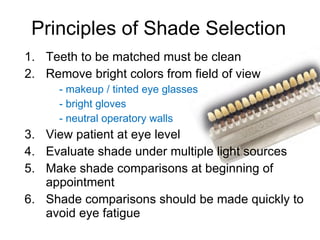
Principles of Shade Selection Teeth to be matched must be clean Remove bright colors from field of view - makeup / tinted eye glasses - bright gloves - neutral operatory walls View patient at eye level Evaluate shade under multiple light sources Make shade comparisons at beginning of appointment Shade comparisons should be made quickly to avoid eye fatigue
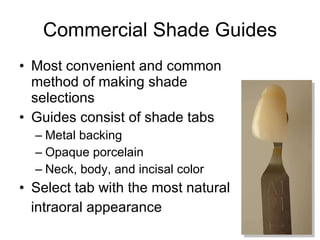
Commercial Shade Guides Most convenient and common method of making shade selections Guides consist of shade tabs Metal backing Opaque porcelain Neck, body, and incisal color Select tab with the most natural  intraoral appearance
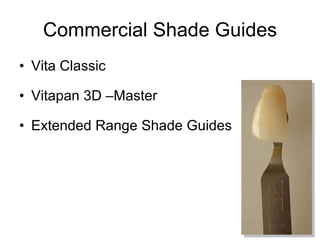
Commercial Shade Guides Vita Classic Vitapan 3D –Master Extended Range Shade Guides
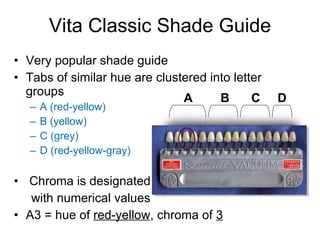
Vita Classic Shade Guide Very popular shade guide Tabs of similar hue are clustered into letter groups A (red-yellow)  B (yellow) C (grey)  D (red-yellow-gray) Chroma is designated with numerical values A3 = hue of  red-yellow , chroma of  3 A  B   C  D
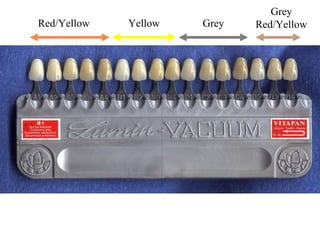
Red/Yellow Yellow Grey Grey Red/Yellow
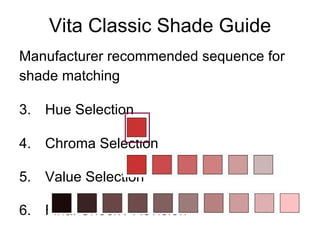
Vita Classic Shade Guide Manufacturer recommended sequence for shade matching Hue Selection Chroma Selection Value Selection Final Check / Revision
Vita Classic – Step 1  (Hue Selection) Four categories representing hue A, yellow-red B, yellow C, gray D, red-yellow-gray Operator should select hue closest to that of natural tooth Use area of tooth highest in chroma for hue selection Difficult to select hue for teeth low in chroma
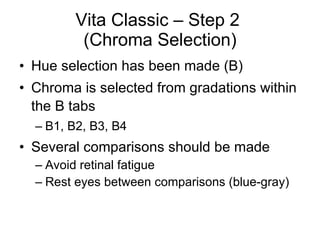
Vita Classic – Step 2  (Chroma Selection) Hue selection has been made (B) Chroma is selected from gradations within the B tabs B1, B2, B3, B4 Several comparisons should be made Avoid retinal fatigue Rest eyes between comparisons (blue-gray)
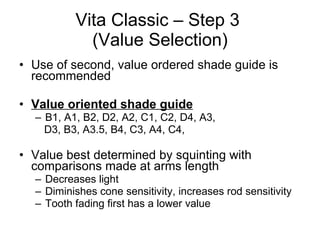
Vita Classic – Step 3  (Value Selection) Use of second, value ordered shade guide is recommended Value oriented shade guide B1, A1, B2, D2, A2, C1, C2, D4, A3,  D3, B3, A3.5, B4, C3, A4, C4,  Value best determined by squinting with comparisons made at arms length  Decreases light Diminishes cone sensitivity, increases rod sensitivity Tooth fading first has a lower value
Vita Classic – Step 4  (Final Check / Revision) Potential Problem Following value selection, tabs selected for hue and chroma may not coincide with shade tab selected for value
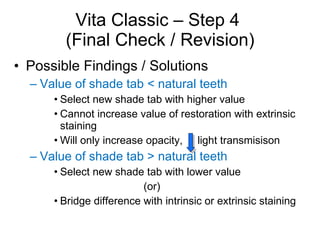
Vita Classic – Step 4  (Final Check / Revision) Possible Findings / Solutions Value of shade tab < natural teeth Select new shade tab with higher value Cannot increase value of restoration with extrinsic staining Will only increase opacity,  light transmisison Value of shade tab > natural teeth Select new shade tab with lower value  (or) Bridge difference with intrinsic or extrinsic staining
Thank You   References  Contemporary Fixed Prosthodontics Rosenstiel (3rd edition)  Esthetics in dentistry Ronald E Goldstein  Esthetics dentistry; a clinical approach to technique and materials Barry G Dale, Kenneth W Aschheim Esthetic dentistry and ceramic restoration Martin Dunitz Tylman’s  Theory and practice of FPD Natural Color Concept: A Systematic Approach to Visual Shade Selection Bernhard Egger Shade selection By Christopher CK Ho, BDS Hons (Syd),

Shade Selection techniques 1

  • 1.
    Shade Selection techniques Presented by Amin Abusallamah Part I
  • 2.
    Principles of ShadeSelection Teeth to be matched must be clean Remove bright colors from field of view - makeup / tinted eye glasses - bright gloves - neutral operatory walls View patient at eye level Evaluate shade under multiple light sources Make shade comparisons at beginning of appointment Shade comparisons should be made quickly to avoid eye fatigue
  • 3.
    Commercial Shade GuidesMost convenient and common method of making shade selections Guides consist of shade tabs Metal backing Opaque porcelain Neck, body, and incisal color Select tab with the most natural intraoral appearance
  • 4.
    Commercial Shade GuidesVita Classic Vitapan 3D –Master Extended Range Shade Guides
  • 5.
    Vita Classic ShadeGuide Very popular shade guide Tabs of similar hue are clustered into letter groups A (red-yellow) B (yellow) C (grey) D (red-yellow-gray) Chroma is designated with numerical values A3 = hue of red-yellow , chroma of 3 A B C D
  • 6.
    Red/Yellow Yellow GreyGrey Red/Yellow
  • 7.
    Vita Classic ShadeGuide Manufacturer recommended sequence for shade matching Hue Selection Chroma Selection Value Selection Final Check / Revision
  • 8.
    Vita Classic –Step 1 (Hue Selection) Four categories representing hue A, yellow-red B, yellow C, gray D, red-yellow-gray Operator should select hue closest to that of natural tooth Use area of tooth highest in chroma for hue selection Difficult to select hue for teeth low in chroma
  • 9.
    Vita Classic –Step 2 (Chroma Selection) Hue selection has been made (B) Chroma is selected from gradations within the B tabs B1, B2, B3, B4 Several comparisons should be made Avoid retinal fatigue Rest eyes between comparisons (blue-gray)
  • 10.
    Vita Classic –Step 3 (Value Selection) Use of second, value ordered shade guide is recommended Value oriented shade guide B1, A1, B2, D2, A2, C1, C2, D4, A3, D3, B3, A3.5, B4, C3, A4, C4, Value best determined by squinting with comparisons made at arms length Decreases light Diminishes cone sensitivity, increases rod sensitivity Tooth fading first has a lower value
  • 11.
    Vita Classic –Step 4 (Final Check / Revision) Potential Problem Following value selection, tabs selected for hue and chroma may not coincide with shade tab selected for value
  • 12.
    Vita Classic –Step 4 (Final Check / Revision) Possible Findings / Solutions Value of shade tab < natural teeth Select new shade tab with higher value Cannot increase value of restoration with extrinsic staining Will only increase opacity, light transmisison Value of shade tab > natural teeth Select new shade tab with lower value (or) Bridge difference with intrinsic or extrinsic staining
  • 13.
    Thank You  References Contemporary Fixed Prosthodontics Rosenstiel (3rd edition) Esthetics in dentistry Ronald E Goldstein Esthetics dentistry; a clinical approach to technique and materials Barry G Dale, Kenneth W Aschheim Esthetic dentistry and ceramic restoration Martin Dunitz Tylman’s Theory and practice of FPD Natural Color Concept: A Systematic Approach to Visual Shade Selection Bernhard Egger Shade selection By Christopher CK Ho, BDS Hons (Syd),