LENDI INSTITUTE OF ENGINEERING AND TECHNOLOGY
Jonnada, Andhra Pradesh- 535005
SWITCHGEAR AND PROTECTION
(IV-I)
SYLLABUS (UNIT WISE)
OBJECTIVES
OUTCOMES
Department of Electrical and Electronics Engineering
COURSE OBJECTIVES
 To provide the basic principles and operation of various types of circuit
breakers.
 To study the classification, operation and application of different types of
electromagnetic protective relays.
 To explain protective schemes, for generator and transformers.
 To impart knowledge of various protective schemes used for feeders and bus
bars.
 To explain the principle and operation of different types of static relays.
 To study different types of over voltages in a power system and principles of
different protective schemes for insulation co–ordination.
Department of Electrical and Electronics Engineering
COURSE OUTCOMES
 Able to understand the principles of arc interruption for application to high
voltage circuit breakers of air, oil, vacuum, SF6 gas type.
 Ability to understand the working principle and operation of different types of
electromagnetic protective relays.
 Students acquire knowledge of faults and protective schemes for high power
generator and transformers.
 Improves the ability to understand various types of protective schemes used for
feeders and bus bar protection.
 Able to understand different types of static relays and their applications.
 Able to understand different types of over voltages and protective schemes
required for insulation co–ordination.
Department of Electrical and Electronics Engineering
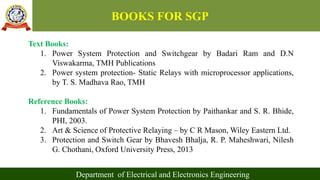
BOOKS FOR SGP
Department of Electrical and Electronics Engineering
Text Books:
1. Power System Protection and Switchgear by Badari Ram and D.N
Viswakarma, TMH Publications
2. Power system protection- Static Relays with microprocessor applications,
by T. S. Madhava Rao, TMH
Reference Books:
1. Fundamentals of Power System Protection by Paithankar and S. R. Bhide,
PHI, 2003.
2. Art & Science of Protective Relaying – by C R Mason, Wiley Eastern Ltd.
3. Protection and Switch Gear by Bhavesh Bhalja, R. P. Maheshwari, Nilesh
G. Chothani, Oxford University Press, 2013
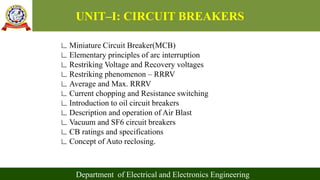
UNIT–I: CIRCUIT BREAKERS
Department of Electrical and Electronics Engineering
∟Miniature Circuit Breaker(MCB)
∟Elementary principles of arc interruption
∟Restriking Voltage and Recovery voltages
∟Restriking phenomenon – RRRV
∟Average and Max. RRRV
∟Current chopping and Resistance switching
∟Introduction to oil circuit breakers
∟Description and operation of Air Blast
∟Vacuum and SF6 circuit breakers
∟CB ratings and specifications
∟Concept of Auto reclosing.
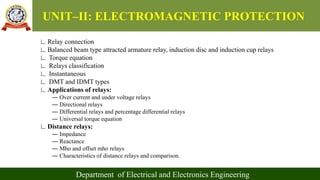
UNIT–II: ELECTROMAGNETIC PROTECTION
Department of Electrical and Electronics Engineering
∟Relay connection
∟Balanced beam type attracted armature relay, induction disc and induction cup relays
∟ Torque equation
∟ Relays classification
∟ Instantaneous
∟ DMT and IDMT types
∟Applications of relays:
― Over current and under voltage relays
― Directional relays
― Differential relays and percentage differential relays
― Universal torque equation
∟Distance relays:
― Impedance
― Reactance
― Mho and offset mho relays
― Characteristics of distance relays and comparison.
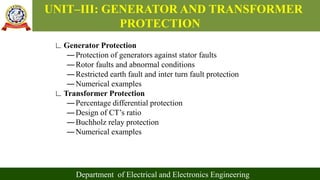
UNIT–III: GENERATOR AND TRANSFORMER
PROTECTION
Department of Electrical and Electronics Engineering
∟Generator Protection
―Protection of generators against stator faults
―Rotor faults and abnormal conditions
―Restricted earth fault and inter turn fault protection
―Numerical examples
∟Transformer Protection
―Percentage differential protection
―Design of CT’s ratio
―Buchholz relay protection
―Numerical examples
UNIT–IV: FEEDER AND BUS BAR PROTECTION
Department of Electrical and Electronics Engineering
∟Protection of lines
―Over current Protection schemes
―PSM, TMS
―Numerical examples
―Carrier current and three zone distance relay using impedance relays
―Protection of bus bars by using Differential protection
UNIT–V: STATIC AND DIGITAL RELAYS
Department of Electrical and Electronics Engineering
∟Static relays
―Static relay components
―Static over current relays
―Static distance relay
―Micro processor based digital relays
UNIT–VI: PROTECTION AGAINST OVER
VOLTAGE AND GROUNDING
Department of Electrical and Electronics Engineering
∟Generation of over voltages in power systems
∟Protection against lightning over voltages
∟Valve type and zinc oxide lighting arresters
∟Insulation coordination
∟BIL
∟Impulse ratio
∟Standard impulse test wave
∟Volt-time characteristics
∟Grounded and ungrounded neutral systems
∟Effects of ungrounded neutral on system performance
∟Methods of neutral grounding
―Solid
―Resistance
―Reactance
―Arcing grounds and grounding Practices
Department of Electrical and Electronics Engineering
Thank you
Department of Electrical and Electronics Engineering

SGP Syllabus as per JNTU-K

  • 1.
    LENDI INSTITUTE OFENGINEERING AND TECHNOLOGY Jonnada, Andhra Pradesh- 535005 SWITCHGEAR AND PROTECTION (IV-I) SYLLABUS (UNIT WISE) OBJECTIVES OUTCOMES Department of Electrical and Electronics Engineering
  • 2.
    COURSE OBJECTIVES  Toprovide the basic principles and operation of various types of circuit breakers.  To study the classification, operation and application of different types of electromagnetic protective relays.  To explain protective schemes, for generator and transformers.  To impart knowledge of various protective schemes used for feeders and bus bars.  To explain the principle and operation of different types of static relays.  To study different types of over voltages in a power system and principles of different protective schemes for insulation co–ordination. Department of Electrical and Electronics Engineering
  • 3.
    COURSE OUTCOMES  Ableto understand the principles of arc interruption for application to high voltage circuit breakers of air, oil, vacuum, SF6 gas type.  Ability to understand the working principle and operation of different types of electromagnetic protective relays.  Students acquire knowledge of faults and protective schemes for high power generator and transformers.  Improves the ability to understand various types of protective schemes used for feeders and bus bar protection.  Able to understand different types of static relays and their applications.  Able to understand different types of over voltages and protective schemes required for insulation co–ordination. Department of Electrical and Electronics Engineering
  • 4.
    BOOKS FOR SGP Departmentof Electrical and Electronics Engineering Text Books: 1. Power System Protection and Switchgear by Badari Ram and D.N Viswakarma, TMH Publications 2. Power system protection- Static Relays with microprocessor applications, by T. S. Madhava Rao, TMH Reference Books: 1. Fundamentals of Power System Protection by Paithankar and S. R. Bhide, PHI, 2003. 2. Art & Science of Protective Relaying – by C R Mason, Wiley Eastern Ltd. 3. Protection and Switch Gear by Bhavesh Bhalja, R. P. Maheshwari, Nilesh G. Chothani, Oxford University Press, 2013
  • 5.
    UNIT–I: CIRCUIT BREAKERS Departmentof Electrical and Electronics Engineering ∟Miniature Circuit Breaker(MCB) ∟Elementary principles of arc interruption ∟Restriking Voltage and Recovery voltages ∟Restriking phenomenon – RRRV ∟Average and Max. RRRV ∟Current chopping and Resistance switching ∟Introduction to oil circuit breakers ∟Description and operation of Air Blast ∟Vacuum and SF6 circuit breakers ∟CB ratings and specifications ∟Concept of Auto reclosing.
  • 6.
    UNIT–II: ELECTROMAGNETIC PROTECTION Departmentof Electrical and Electronics Engineering ∟Relay connection ∟Balanced beam type attracted armature relay, induction disc and induction cup relays ∟ Torque equation ∟ Relays classification ∟ Instantaneous ∟ DMT and IDMT types ∟Applications of relays: ― Over current and under voltage relays ― Directional relays ― Differential relays and percentage differential relays ― Universal torque equation ∟Distance relays: ― Impedance ― Reactance ― Mho and offset mho relays ― Characteristics of distance relays and comparison.
  • 7.
    UNIT–III: GENERATOR ANDTRANSFORMER PROTECTION Department of Electrical and Electronics Engineering ∟Generator Protection ―Protection of generators against stator faults ―Rotor faults and abnormal conditions ―Restricted earth fault and inter turn fault protection ―Numerical examples ∟Transformer Protection ―Percentage differential protection ―Design of CT’s ratio ―Buchholz relay protection ―Numerical examples
  • 8.
    UNIT–IV: FEEDER ANDBUS BAR PROTECTION Department of Electrical and Electronics Engineering ∟Protection of lines ―Over current Protection schemes ―PSM, TMS ―Numerical examples ―Carrier current and three zone distance relay using impedance relays ―Protection of bus bars by using Differential protection
  • 9.
    UNIT–V: STATIC ANDDIGITAL RELAYS Department of Electrical and Electronics Engineering ∟Static relays ―Static relay components ―Static over current relays ―Static distance relay ―Micro processor based digital relays
  • 10.
    UNIT–VI: PROTECTION AGAINSTOVER VOLTAGE AND GROUNDING Department of Electrical and Electronics Engineering ∟Generation of over voltages in power systems ∟Protection against lightning over voltages ∟Valve type and zinc oxide lighting arresters ∟Insulation coordination ∟BIL ∟Impulse ratio ∟Standard impulse test wave ∟Volt-time characteristics ∟Grounded and ungrounded neutral systems ∟Effects of ungrounded neutral on system performance ∟Methods of neutral grounding ―Solid ―Resistance ―Reactance ―Arcing grounds and grounding Practices
  • 11.
    Department of Electricaland Electronics Engineering Thank you Department of Electrical and Electronics Engineering