POWER SYSTEM PROTECTION AND SWITCH GEAR
PRESENTATION ON PROTECTIVE RELAYS
PRESENTED BY:
UTFAL DEBNATH ( ROLL NO-1411030075)
DEBABRATA MAJUMDER(ROLL NO-1411030067)
SUBRATA PAUL(ROLL NO-1411030067)
BE 7th Semester, EE Department
Techno India Agartala
Date of presentation: 07/12/2017
CONTENTS
• WHY A SYSTEM NEEDS PROTECTION?
• WHAT IS RELAY?
• OPERATING PRINCIPLES
• TYPES OF RELAYS
• CONCLUSION
2
WHY A SYSTEM NEEDS PROTECTION?
• There is no fault free system.
• It is neither practical nor economical to make a fault free system.
• Electrical system shall tolerate certain degree of faults.
• Usually faults are caused by breakdown of insulation due to various reasons:
system aging , lightning , etc.
3
WHAT IS A RELAY?
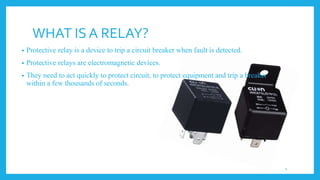
• Protective relay is a device to trip a circuit breaker when fault is detected.
• Protective relays are electromagnetic devices.
• They need to act quickly to protect circuit, to protect equipment and trip a breaker
within a few thousands of seconds.
4
OPERATING PRINCIPLES
• They work on the following two main operating principles:
1. Electromagnetic Attraction
2. Electromagnetic Induction
5
ELECTROMAGNETIC ATTRACTION
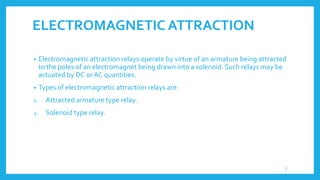
• Electromagnetic attraction relays operate by virtue of an armature being attracted
to the poles of an electromagnet being drawn into a solenoid. Such relays may be
actuated by DC or AC quantities.
• Types of electromagnetic attraction relays are:
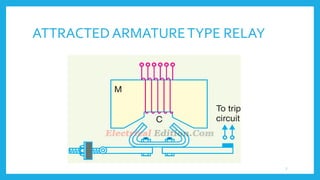
1. Attracted armature type relay.
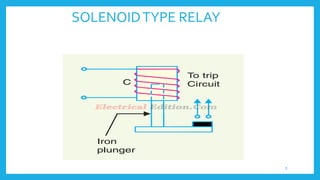
2. Solenoid type relay.
6
ATTRACTEDARMATURETYPE RELAY
7
SOLENOIDTYPE RELAY
8
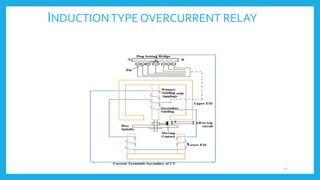
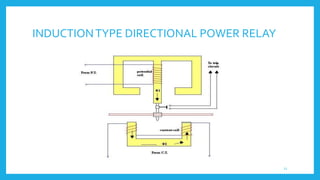
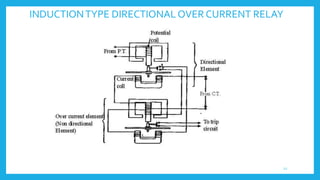
INDUCTIONTYPE RELAY
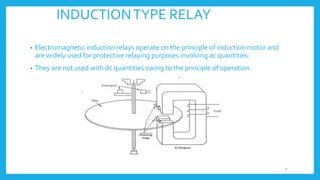
• Electromagnetic induction relays operate on the principle of induction motor and
are widely used for protective relaying purposes involving ac quantities.
• They are not used with dc quantities owing to the principle of operation.
9
INDUCTIONTYPE OVERCURRENT RELAY
10
INDUCTIONTYPE DIRECTIONAL POWER RELAY
11
INDUCTIONTYPE DIRECTIONAL OVER CURRENT RELAY
12
CONCLUSION
• Safety is increased.
• Protective relays are essential for keeping faults in the system isolated and keep
equipment from being damaged.
13
14
THANKYOU

Relay Introduction

  • 1.
    POWER SYSTEM PROTECTIONAND SWITCH GEAR PRESENTATION ON PROTECTIVE RELAYS PRESENTED BY: UTFAL DEBNATH ( ROLL NO-1411030075) DEBABRATA MAJUMDER(ROLL NO-1411030067) SUBRATA PAUL(ROLL NO-1411030067) BE 7th Semester, EE Department Techno India Agartala Date of presentation: 07/12/2017
  • 2.
    CONTENTS • WHY ASYSTEM NEEDS PROTECTION? • WHAT IS RELAY? • OPERATING PRINCIPLES • TYPES OF RELAYS • CONCLUSION 2
  • 3.
    WHY A SYSTEMNEEDS PROTECTION? • There is no fault free system. • It is neither practical nor economical to make a fault free system. • Electrical system shall tolerate certain degree of faults. • Usually faults are caused by breakdown of insulation due to various reasons: system aging , lightning , etc. 3
  • 4.
    WHAT IS ARELAY? • Protective relay is a device to trip a circuit breaker when fault is detected. • Protective relays are electromagnetic devices. • They need to act quickly to protect circuit, to protect equipment and trip a breaker within a few thousands of seconds. 4
  • 5.
    OPERATING PRINCIPLES • Theywork on the following two main operating principles: 1. Electromagnetic Attraction 2. Electromagnetic Induction 5
  • 6.
    ELECTROMAGNETIC ATTRACTION • Electromagneticattraction relays operate by virtue of an armature being attracted to the poles of an electromagnet being drawn into a solenoid. Such relays may be actuated by DC or AC quantities. • Types of electromagnetic attraction relays are: 1. Attracted armature type relay. 2. Solenoid type relay. 6
  • 7.
  • 8.
  • 9.
    INDUCTIONTYPE RELAY • Electromagneticinduction relays operate on the principle of induction motor and are widely used for protective relaying purposes involving ac quantities. • They are not used with dc quantities owing to the principle of operation. 9
  • 10.
  • 11.
  • 12.
  • 13.
    CONCLUSION • Safety isincreased. • Protective relays are essential for keeping faults in the system isolated and keep equipment from being damaged. 13
  • 14.