
SHORT CIRCUIT ANALYSIS
What is short circuit?
6/27/2017 www.vbengg.com 2
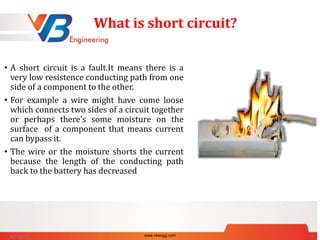
• A short circuit is a fault.It means there is a
very low resistence conducting path from one
side of a component to the other.
• For example a wire might have come loose
which connects two sides of a circuit together
or perhaps there’s some moisture on the
surface of a component that means current
can bypass it.
• The wire or the moisture shorts the current
because the length of the conducting path
back to the battery has decreased
Types of short circuits
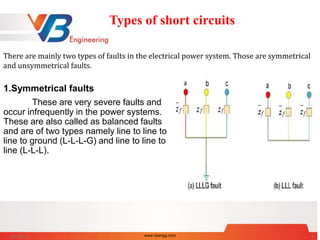
1.Symmetrical faults
These are very severe faults and
occur infrequently in the power systems.
These are also called as balanced faults
and are of two types namely line to line to
line to ground (L-L-L-G) and line to line to
line (L-L-L).
6/27/2017 www.vbengg.com 3
There are mainly two types of faults in the electrical power system. Those are symmetrical
and unsymmetrical faults.
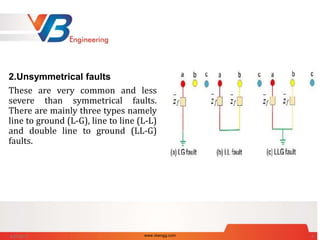
2.Unsymmetrical faults
These are very common and less
severe than symmetrical faults.
There are mainly three types namely
line to ground (L-G), line to line (L-L)
and double line to ground (LL-G)
faults.
6/27/2017 www.vbengg.com 4
Causes of Electrical Faults
• Weather conditions: It includes lighting strikes, heavy rains, heavy
winds, salt deposition on overhead lines and conductors, snow and ice
accumulation on transmission lines, etc.
• Equipment failures: Various electrical equipments like generators,
motors, transformers, reactors, switching devices, etc.
• Human errors: Electrical faults are also caused due to human errors such
as selecting improper rating of equipment or devices, forgetting metallic or
electrical conducting parts after servicing or maintenance, switching the circuit
while it is under servicing, etc.
• Smoke of fires: Ionization of air, due to smoke particles, surrounding the
overhead lines results in spark between the lines or between conductors to
insulator.
6/27/2017 www.vbengg.com 5
Effects of electrical faults
• Over current flow: When fault occurs it creates a very low impedance path for the
current flow
• Danger to operating personnel: Fault occurrence can also cause shocks to
individuals
• Loss of equipment: Heavy current due to short circuit faults result in the
components being burnt completely which leads to improper working of equipment
or device
• Disturbs interconnected active circuits: Faults not only affect the location at
which they occur but also disturbs the active interconnected circuits to the faulted
line.
• Electrical fires: Short circuit causes flashovers and sparks due to the ionization of
air between two conducting paths which further leads to fire as we often observe in
news such as building and shopping complex fires.
6/27/2017 www.vbengg.com 6
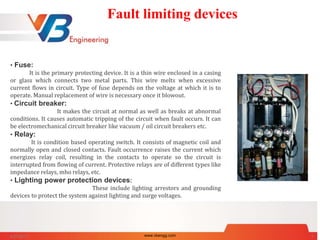
Fault limiting devices
• Fuse:
It is the primary protecting device. It is a thin wire enclosed in a casing
or glass which connects two metal parts. This wire melts when excessive
current flows in circuit. Type of fuse depends on the voltage at which it is to
operate. Manual replacement of wire is necessary once it blowout.
• Circuit breaker:
It makes the circuit at normal as well as breaks at abnormal
conditions. It causes automatic tripping of the circuit when fault occurs. It can
be electromechanical circuit breaker like vacuum / oil circuit breakers etc.
• Relay:
It is condition based operating switch. It consists of magnetic coil and
normally open and closed contacts. Fault occurrence raises the current which
energizes relay coil, resulting in the contacts to operate so the circuit is
interrupted from flowing of current. Protective relays are of different types like
impedance relays, mho relays, etc.
• Lighting power protection devices:
These include lighting arrestors and grounding
devices to protect the system against lighting and surge voltages.
6/27/2017 www.vbengg.com 7
Applications
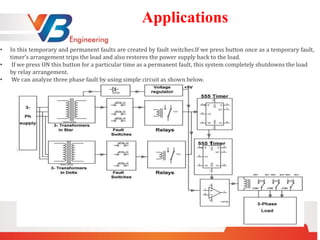
• In this temporary and permanent faults are created by fault switches.If we press button once as a temporary fault,
timer’s arrangement trips the load and also restores the power supply back to the load.
• If we press ON this button for a particular time as a permanent fault, this system completely shutdowns the load
by relay arrangement.
• We can analyze three phase fault by using simple circuit as shown below.
6/27/2017 www.vbengg.com 9

Short circuit analysis

  • 1.
  • 2.
    What is shortcircuit? 6/27/2017 www.vbengg.com 2 • A short circuit is a fault.It means there is a very low resistence conducting path from one side of a component to the other. • For example a wire might have come loose which connects two sides of a circuit together or perhaps there’s some moisture on the surface of a component that means current can bypass it. • The wire or the moisture shorts the current because the length of the conducting path back to the battery has decreased
  • 3.
    Types of shortcircuits 1.Symmetrical faults These are very severe faults and occur infrequently in the power systems. These are also called as balanced faults and are of two types namely line to line to line to ground (L-L-L-G) and line to line to line (L-L-L). 6/27/2017 www.vbengg.com 3 There are mainly two types of faults in the electrical power system. Those are symmetrical and unsymmetrical faults.
  • 4.
    2.Unsymmetrical faults These arevery common and less severe than symmetrical faults. There are mainly three types namely line to ground (L-G), line to line (L-L) and double line to ground (LL-G) faults. 6/27/2017 www.vbengg.com 4
  • 5.
    Causes of ElectricalFaults • Weather conditions: It includes lighting strikes, heavy rains, heavy winds, salt deposition on overhead lines and conductors, snow and ice accumulation on transmission lines, etc. • Equipment failures: Various electrical equipments like generators, motors, transformers, reactors, switching devices, etc. • Human errors: Electrical faults are also caused due to human errors such as selecting improper rating of equipment or devices, forgetting metallic or electrical conducting parts after servicing or maintenance, switching the circuit while it is under servicing, etc. • Smoke of fires: Ionization of air, due to smoke particles, surrounding the overhead lines results in spark between the lines or between conductors to insulator. 6/27/2017 www.vbengg.com 5
  • 6.
    Effects of electricalfaults • Over current flow: When fault occurs it creates a very low impedance path for the current flow • Danger to operating personnel: Fault occurrence can also cause shocks to individuals • Loss of equipment: Heavy current due to short circuit faults result in the components being burnt completely which leads to improper working of equipment or device • Disturbs interconnected active circuits: Faults not only affect the location at which they occur but also disturbs the active interconnected circuits to the faulted line. • Electrical fires: Short circuit causes flashovers and sparks due to the ionization of air between two conducting paths which further leads to fire as we often observe in news such as building and shopping complex fires. 6/27/2017 www.vbengg.com 6
  • 7.
    Fault limiting devices •Fuse: It is the primary protecting device. It is a thin wire enclosed in a casing or glass which connects two metal parts. This wire melts when excessive current flows in circuit. Type of fuse depends on the voltage at which it is to operate. Manual replacement of wire is necessary once it blowout. • Circuit breaker: It makes the circuit at normal as well as breaks at abnormal conditions. It causes automatic tripping of the circuit when fault occurs. It can be electromechanical circuit breaker like vacuum / oil circuit breakers etc. • Relay: It is condition based operating switch. It consists of magnetic coil and normally open and closed contacts. Fault occurrence raises the current which energizes relay coil, resulting in the contacts to operate so the circuit is interrupted from flowing of current. Protective relays are of different types like impedance relays, mho relays, etc. • Lighting power protection devices: These include lighting arrestors and grounding devices to protect the system against lighting and surge voltages. 6/27/2017 www.vbengg.com 7
  • 8.
    Applications • In thistemporary and permanent faults are created by fault switches.If we press button once as a temporary fault, timer’s arrangement trips the load and also restores the power supply back to the load. • If we press ON this button for a particular time as a permanent fault, this system completely shutdowns the load by relay arrangement. • We can analyze three phase fault by using simple circuit as shown below.
  • 9.