CIR Smart Grids and Cleanpower
Role of innovators in changing the
industry
IAN ELLERINGTON
Head of Engineering and Innovation
4 June 2014
www.hvm-uk.com
Agenda
•  Introduction
•  What is innovation?
•  Why is innovation important?
•  Some examples…
2 Presentation title - edit in Header and Footer
DECC Innovation and Engineering
Teams Major programmes
3 Low Carbon Energy Innovation
Innovation Policy
Co-ordinating innovation spend in energy across government, not just
DECC (DECC is about 20% of total)
Monitoring, designing and evaluating innovation schemes
Owning and developing TINAs
Europe engagement
Innovation Delivery
Project management/delivery unit
Approx 160 contracts and grants, inc. around 60 SMEs,
Very wide range from nuclear reactors to innovative biomass recycling to
lightbulbs
Science and Engineering Teams (2)
4 Low Carbon Energy Innovation
Energy Engineers
Central engineering experts
Support CSA and policy teams on very wide range of subjects –
core focus on energy infrastructure
Support to innovation programme
Technical Energy Analysis
Central engineering and science experts
Core focus on issues around the built environment
Own R&D programme supporting a range of DECC policies
5 Presentation title - edit in Header and Footer
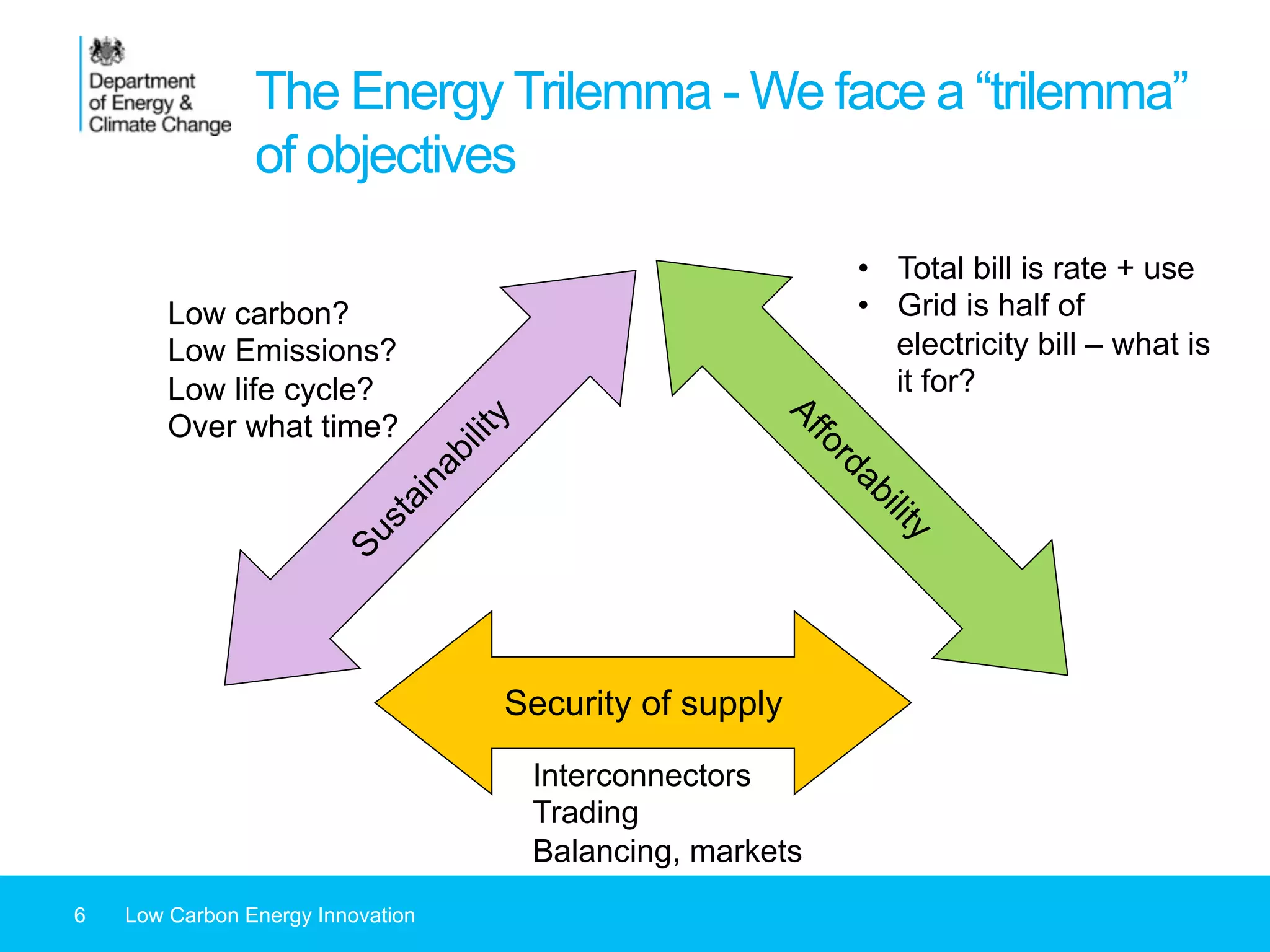
The Energy Trilemma - We face a “trilemma”
of objectives
6 Low Carbon Energy Innovation
Security of supply
Low carbon?
Low Emissions?
Low life cycle?
Over what time?
Interconnectors
Trading
Balancing, markets
•  Total bill is rate + use
•  Grid is half of
electricity bill – what is
it for?
What is innovation?
Government spend is around £1billion on Energy Research, Development and
Demonstration…
In addition, subsidies support pre-commercial deployment…
7 Presentation title - edit in Header and Footer
8 Low Carbon Energy Innovation
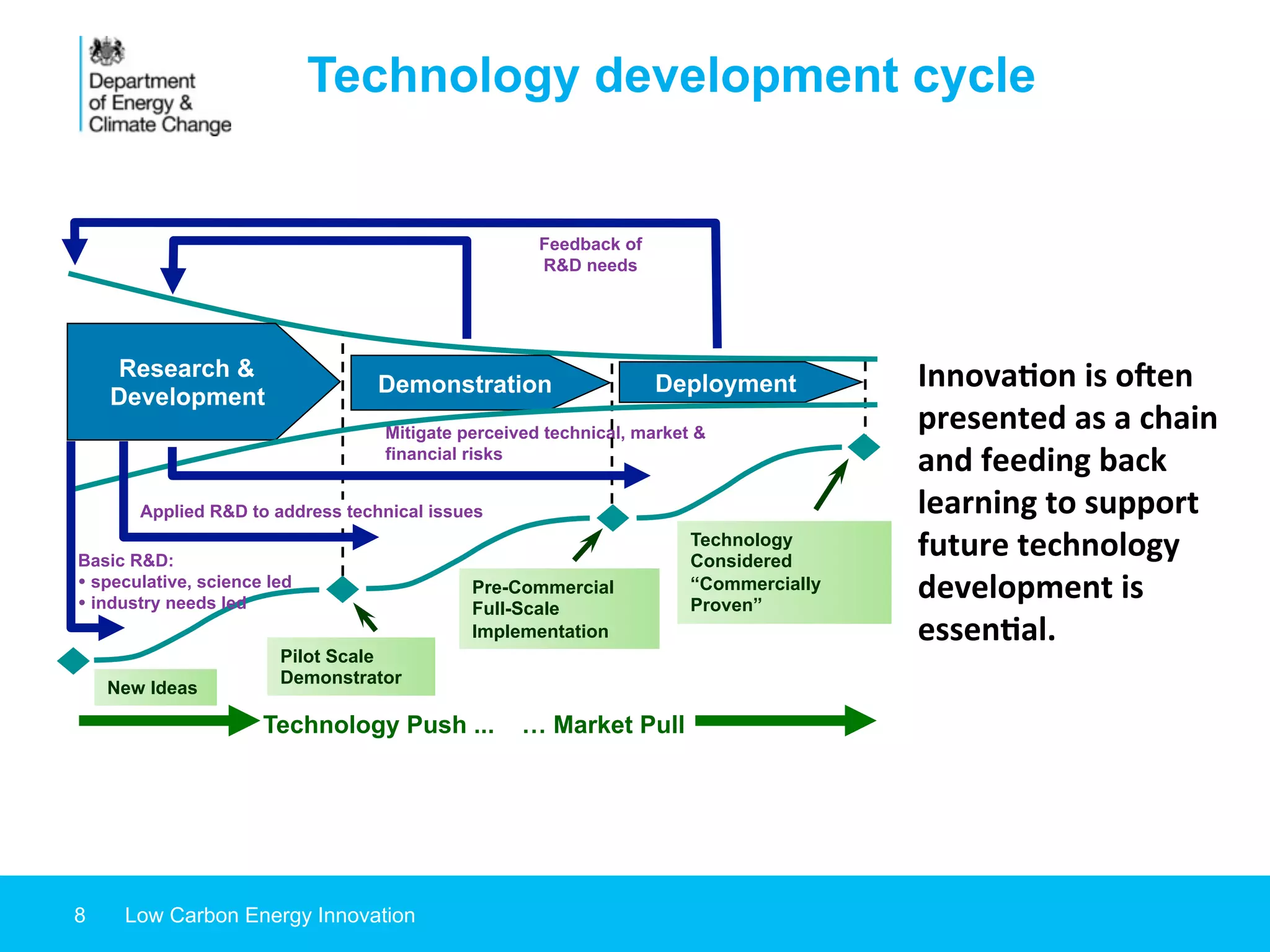
Mitigate perceived technical, market &
financial risks
Pilot Scale
Demonstrator
Technology
Considered
“Commercially
Proven”
Pre-Commercial
Full-Scale
Implementation
New Ideas
Feedback of
R&D needs
Demonstration Deployment
Research &
Development
Applied R&D to address technical issues
Technology Push ... … Market Pull
Basic R&D:
Ÿ speculative, science led
Ÿ industry needs led
Innova&on	
  is	
  o*en	
  
presented	
  as	
  a	
  chain	
  
and	
  feeding	
  back	
  
learning	
  to	
  support	
  
future	
  technology	
  
development	
  is	
  
essen&al.	
  	
  
Technology development cycle
9 Low Carbon Energy Innovation
•  Three objectives for low carbon innovation:
•  Contribute directly and indirectly to
economic growth
•  Secure, Affordable, Sustainable Energy
•  Reducing risks and costs
•  UK’s Climate Change Act - reduce GHG
emissions by at least 80% below 1990 levels by
2050.
•  Massive investment predicted in new energy
infrastructure – c.£120bn by 2020.
•  DECC Carbon Plan 2011 – between 60-80GW
of new capacity required by 2030.
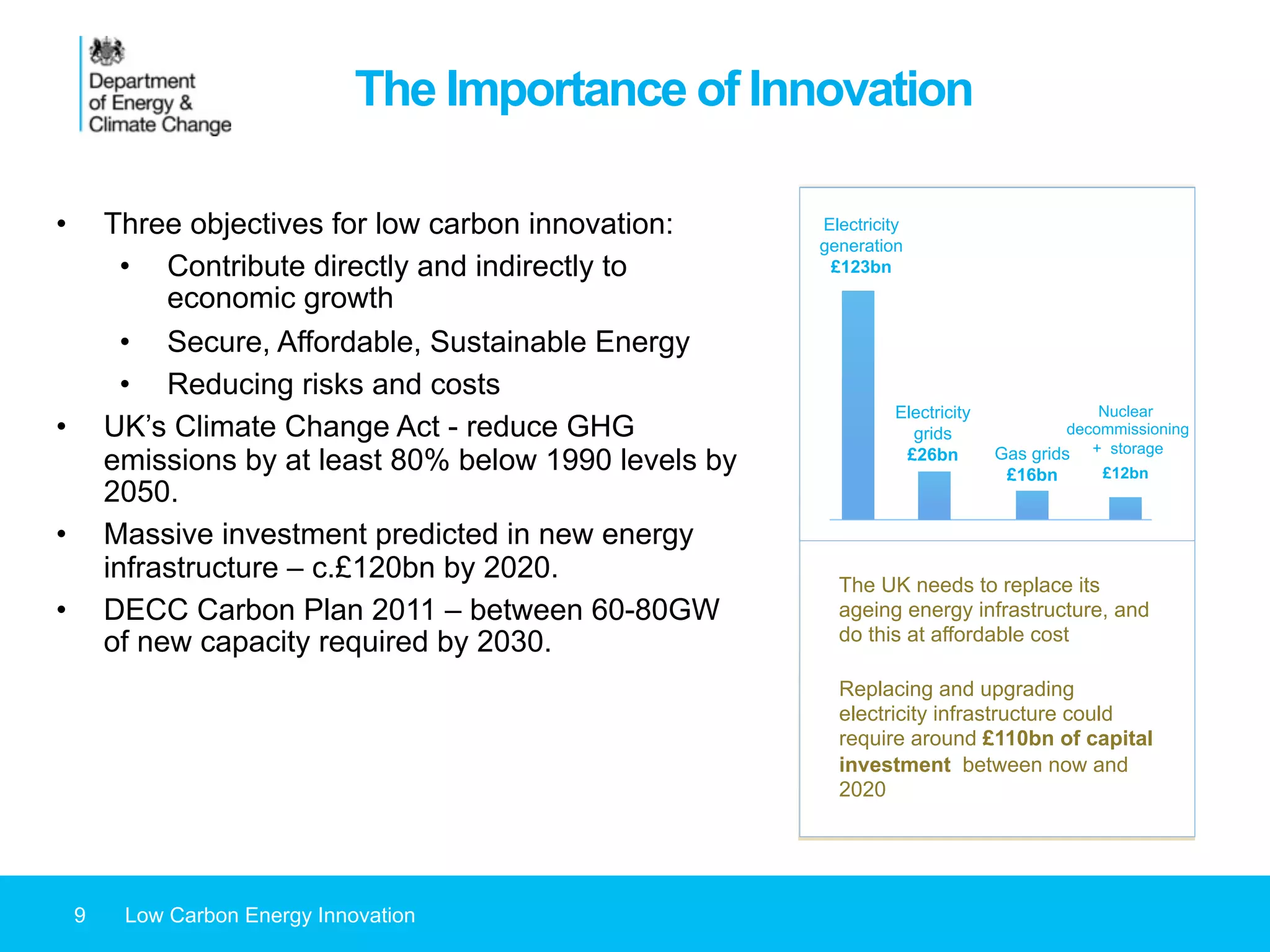
Replacing and upgrading
electricity infrastructure could
require around £110bn of capital
investment between now and
2020
Electricity
generation
£123bn
Electricity
grids
£26bn
Nuclear
decommissioning
+ storage
£12bn
Gas grids
£16bn
The UK needs to replace its
ageing energy infrastructure, and
do this at affordable cost
The Importance of Innovation
10 Low Carbon Energy Innovation
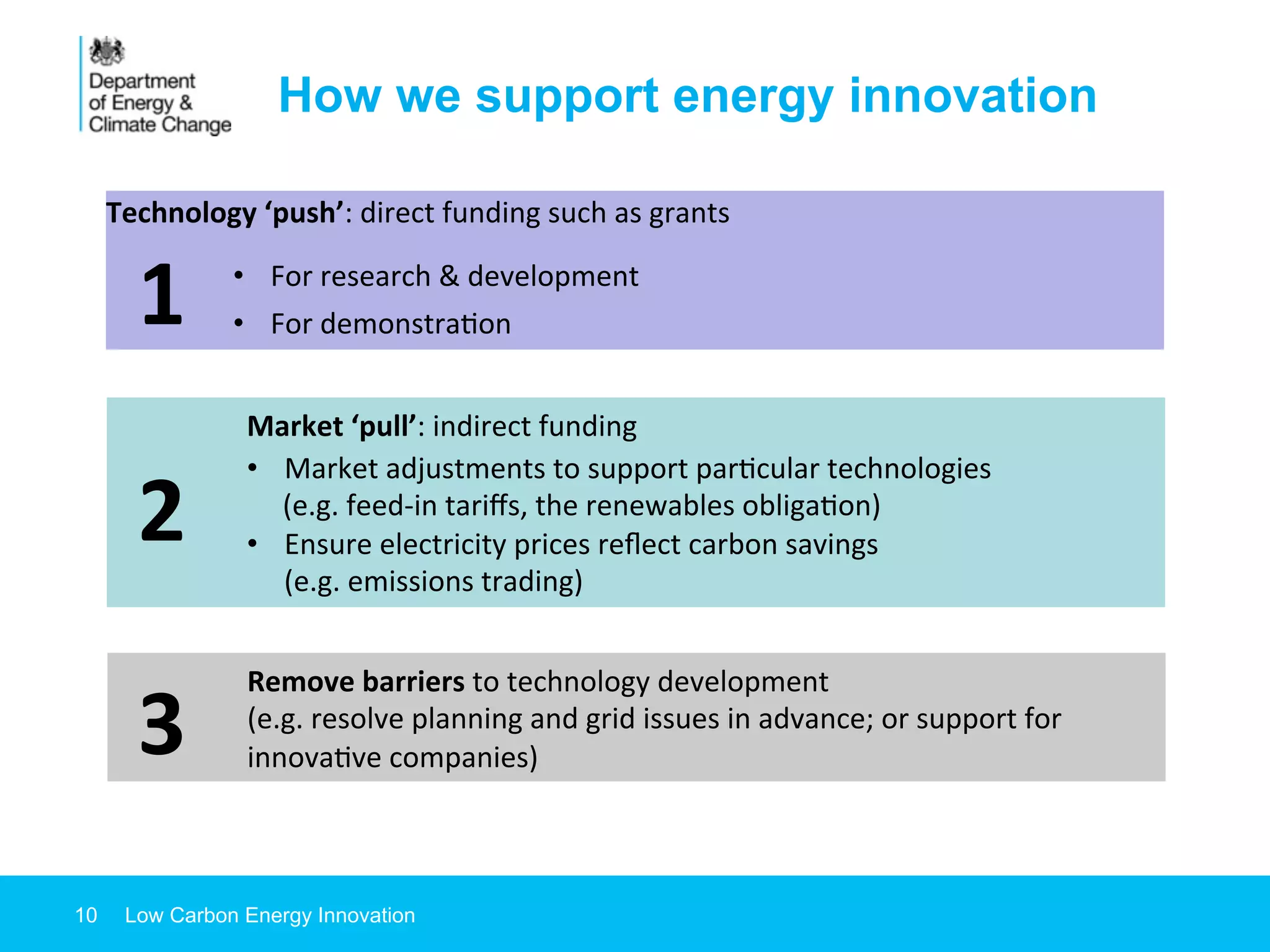
How we support energy innovation
Technology	
  ‘push’:	
  direct	
  funding	
  such	
  as	
  grants	


•  	
  	
  For	
  research	
  &	
  development	
  
•  	
  	
  For	
  demonstra7on	
  
Market	
  ‘pull’:	
  indirect	
  funding	
  	
  
•  	
  	
  Market	
  adjustments	
  to	
  support	
  par7cular	
  technologies	


  (e.g.	
  feed-­‐in	
  tariffs,	
  the	
  renewables	
  obliga7on)	
  
•  	
  	
  Ensure	
  electricity	
  prices	
  reflect	
  carbon	
  savings	


  (e.g.	
  emissions	
  trading)
Remove	
  barriers	
  to	
  technology	
  development	
  
(e.g.	
  resolve	
  planning	
  and	
  grid	
  issues	
  in	
  advance;	
  or	
  support	
  for	
  
innova7ve	
  companies)
1	
  
2	
  
3	
  
11 Low Carbon Energy Innovation
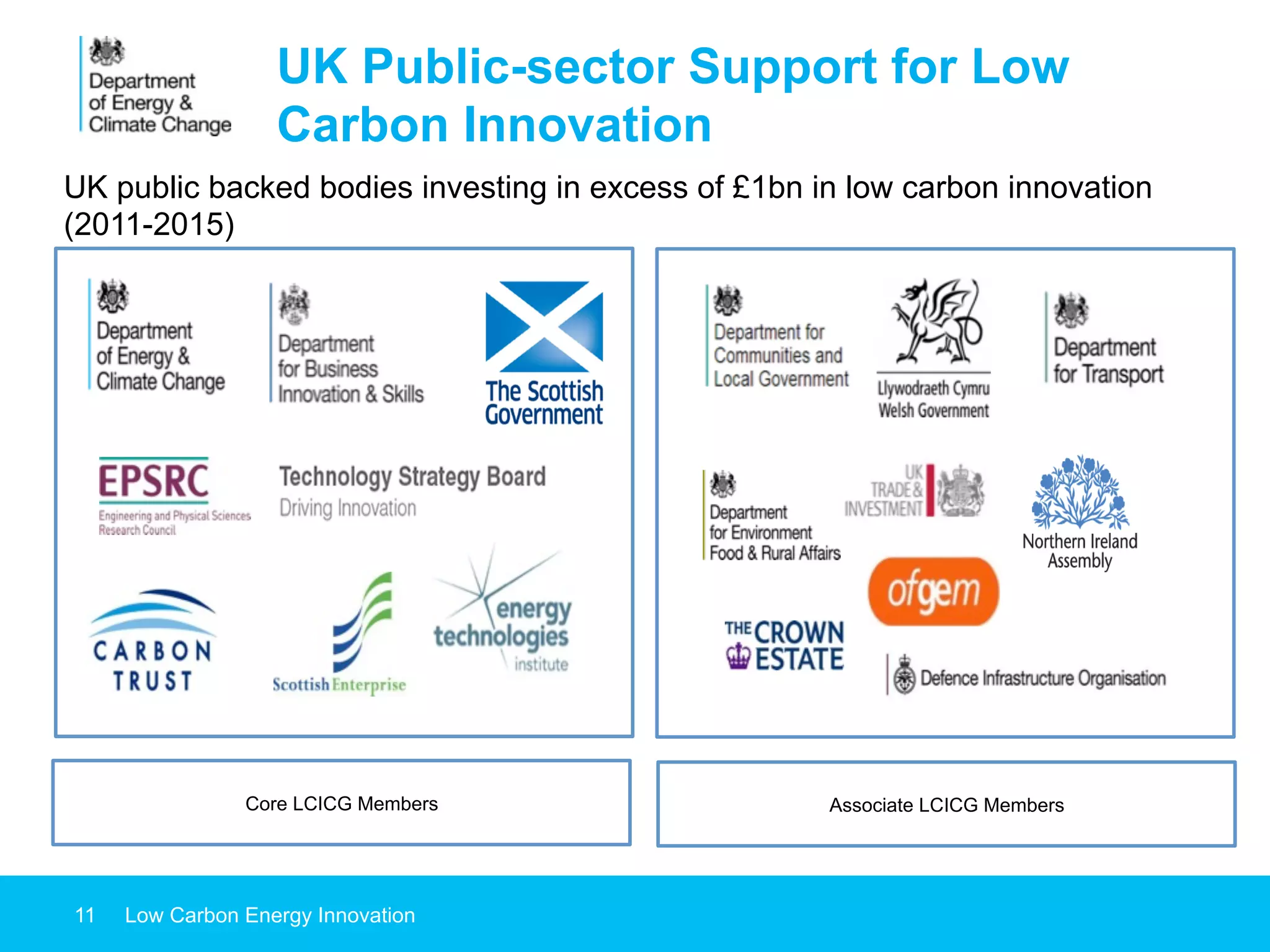
UK Public-sector Support for Low
Carbon Innovation
Core LCICG Members Associate LCICG Members
UK public backed bodies investing in excess of £1bn in low carbon innovation
(2011-2015)
12 Low Carbon Energy Innovation
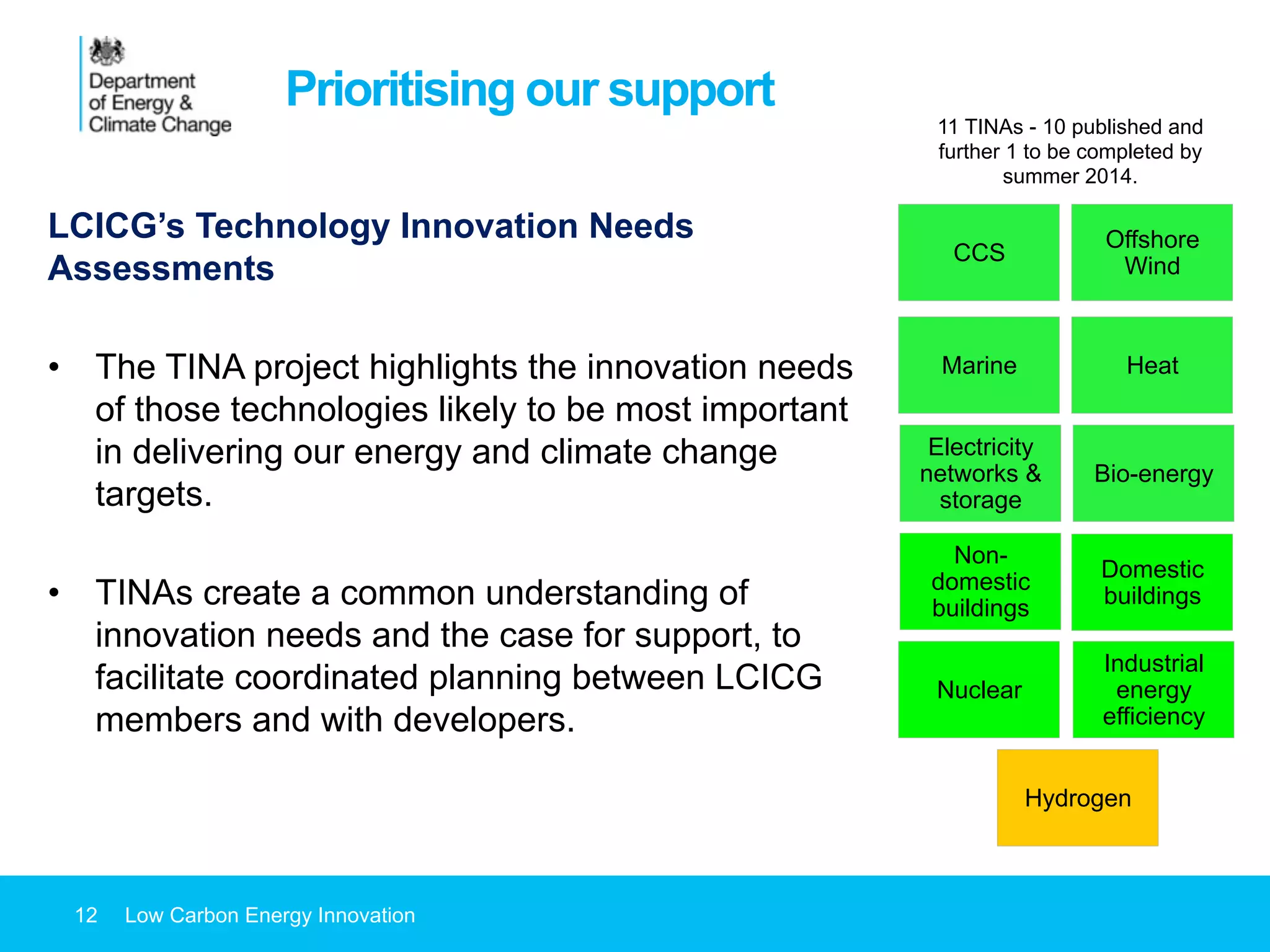
Prioritising our support
LCICG’s Technology Innovation Needs
Assessments
•  The TINA project highlights the innovation needs
of those technologies likely to be most important
in delivering our energy and climate change
targets.
•  TINAs create a common understanding of
innovation needs and the case for support, to
facilitate coordinated planning between LCICG
members and with developers.
CCS
Offshore
Wind
Marine
Domestic
buildings
Non-
domestic
buildings
Nuclear
Electricity
networks &
storage
Heat
Bio-energy
Industrial
energy
efficiency
Hydrogen
11 TINAs - 10 published and
further 1 to be completed by
summer 2014.
LCICG’s Low Carbon Innovation Strategy
•  “Coordinating Low Carbon Technology Innovation Support” ,
published in February 2014.
•  A shared cross government view on innovation priorities out to
2020.
•  A guide to what we will be focusing our support on in the next 6
years.
•  The Strategic Framework sets out the LCICG’s planned approach to
collaboration and the prioritisation of future innovation support
programmes.
•  It builds on the TINA evidence base, it also presents a shared
assessment of the key innovation needs that will likely require
government support between now and 2020.
www.lowcarboninnovation.co.uk/
13 Low Carbon Innovation
14 Low Carbon Energy Innovation
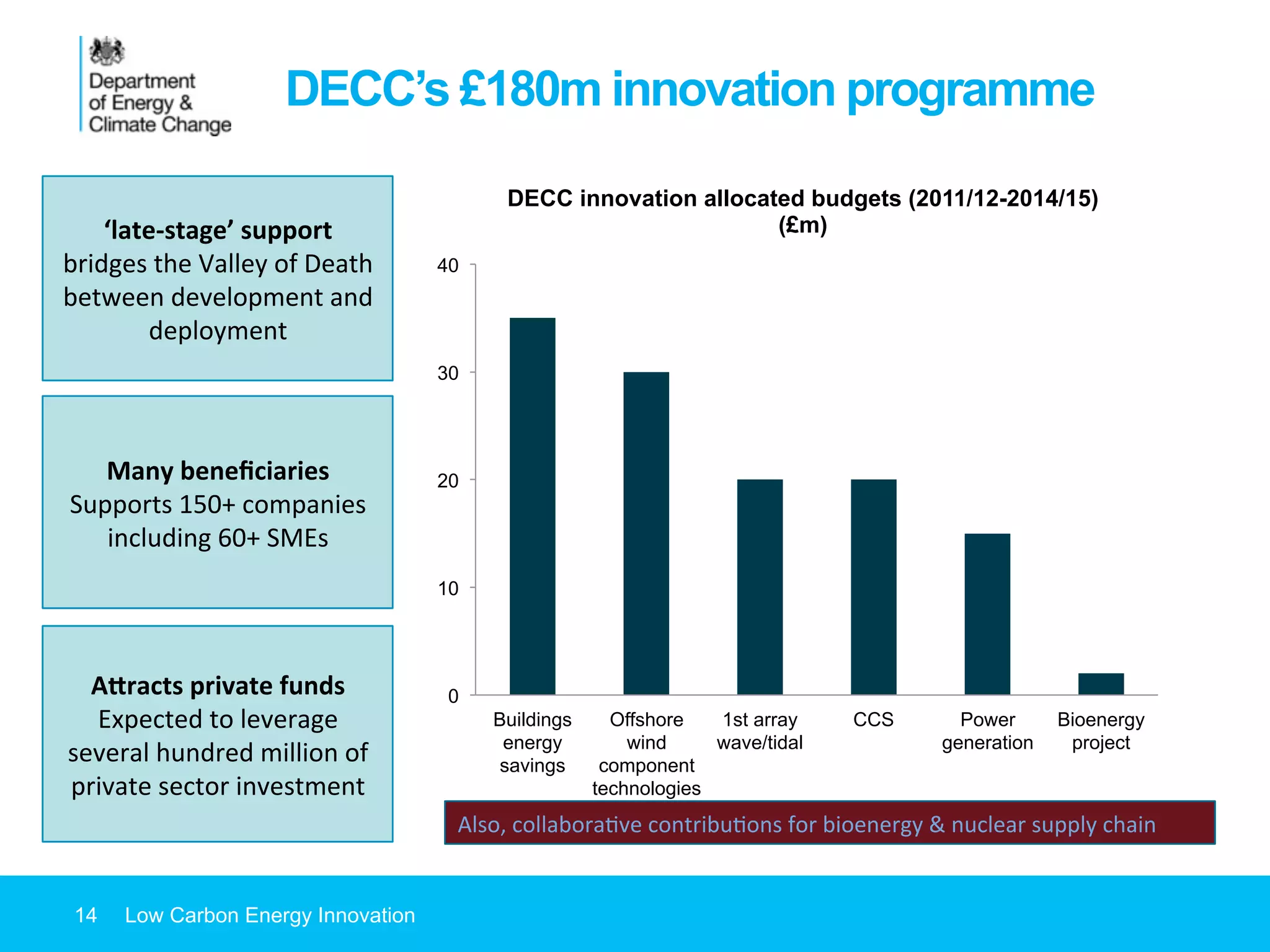
DECC’s £180m innovation programme
‘late-­‐stage’	
  support	
  
bridges	
  the	
  Valley	
  of	
  Death	
  
between	
  development	
  and	
  
deployment	
  	
  
Many	
  beneficiaries	
  
Supports	
  150+	
  companies	
  
including	
  60+	
  SMEs	
  
AFracts	
  private	
  funds	
  
Expected	
  to	
  leverage	
  
several	
  hundred	
  million	
  of	
  
private	
  sector	
  investment	
  
0
10
20
30
40
Buildings
energy
savings
Offshore
wind
component
technologies
1st array
wave/tidal
CCS Power
generation
Bioenergy
project
DECC innovation allocated budgets (2011/12-2014/15)
(£m)
Also,	
  collabora7ve	
  contribu7ons	
  for	
  bioenergy	
  &	
  nuclear	
  supply	
  chain	
  
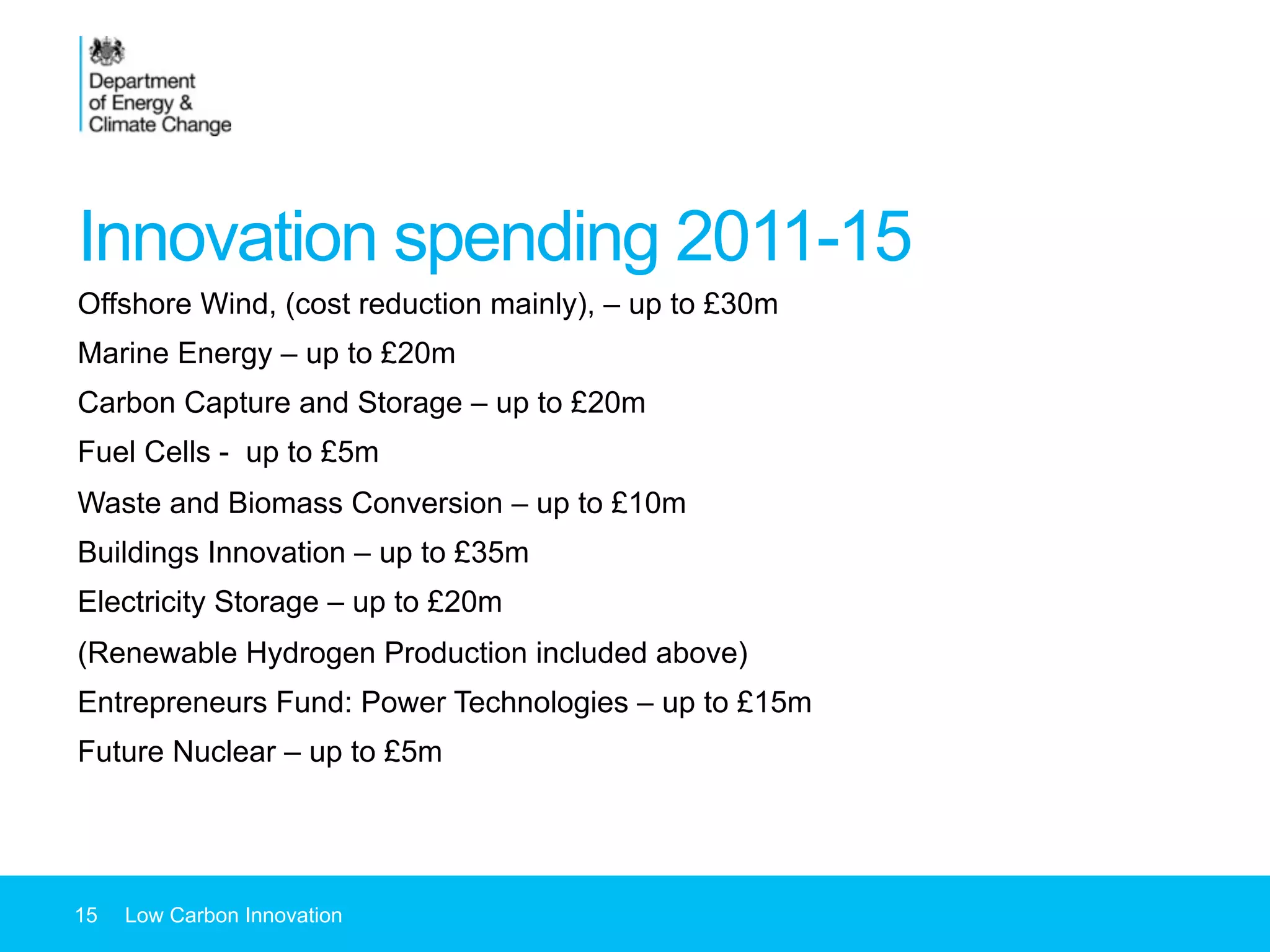
Innovation spending 2011-15
15 Low Carbon Innovation
Offshore Wind, (cost reduction mainly), – up to £30m
Marine Energy – up to £20m
Carbon Capture and Storage – up to £20m
Fuel Cells - up to £5m
Waste and Biomass Conversion – up to £10m
Buildings Innovation – up to £35m
Electricity Storage – up to £20m
(Renewable Hydrogen Production included above)
Entrepreneurs Fund: Power Technologies – up to £15m
Future Nuclear – up to £5m
16 Low Carbon Energy Innovation
International collaborations
•  UK investment alone won’t deliver. Collaboration with other
countries is key.
•  The EU’s Strategic Energy Technology (SET) Plan is
doing just that.
•  The SET Plan is the technology pillar of the EU’s energy
and climate policy. It is the principal decision-making
support tool for European energy policy, with a goal of:
•  Accelerating knowledge development, technology transfer
and up-take; Maintaining EU industrial leadership on low-
carbon energy technologies; […] and contributing to the
worldwide transition to a low carbon economy by 2050.
•  In each technology a Roadmap and Implementation Plan
has been developed and is informing national and EU
investment decisions.
•  An integrated Roadmap and Action Plan are under
development.
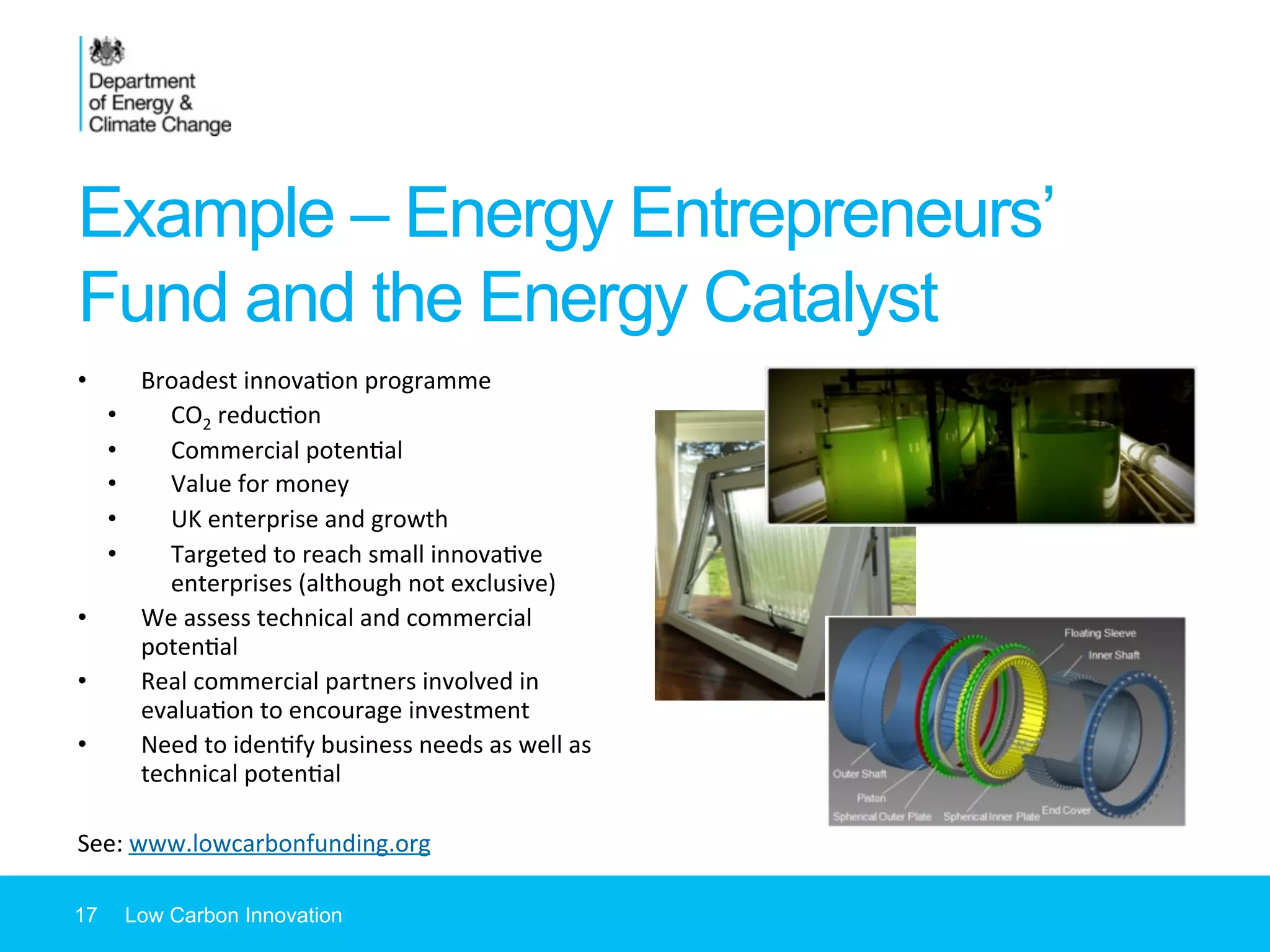
Example – Energy Entrepreneurs’
Fund and the Energy Catalyst
•  Broadest	
  innova7on	
  programme	
  
•  CO2	
  reduc7on	
  
•  Commercial	
  poten7al	
  
•  Value	
  for	
  money	
  
•  UK	
  enterprise	
  and	
  growth	
  
•  Targeted	
  to	
  reach	
  small	
  innova7ve	
  
enterprises	
  (although	
  not	
  exclusive)	
  
•  We	
  assess	
  technical	
  and	
  commercial	
  
poten7al	
  
•  Real	
  commercial	
  partners	
  involved	
  in	
  
evalua7on	
  to	
  encourage	
  investment	
  
•  Need	
  to	
  iden7fy	
  business	
  needs	
  as	
  well	
  as	
  
technical	
  poten7al	


See:	
  www.lowcarbonfunding.org	
  	
  
17 Low Carbon Innovation
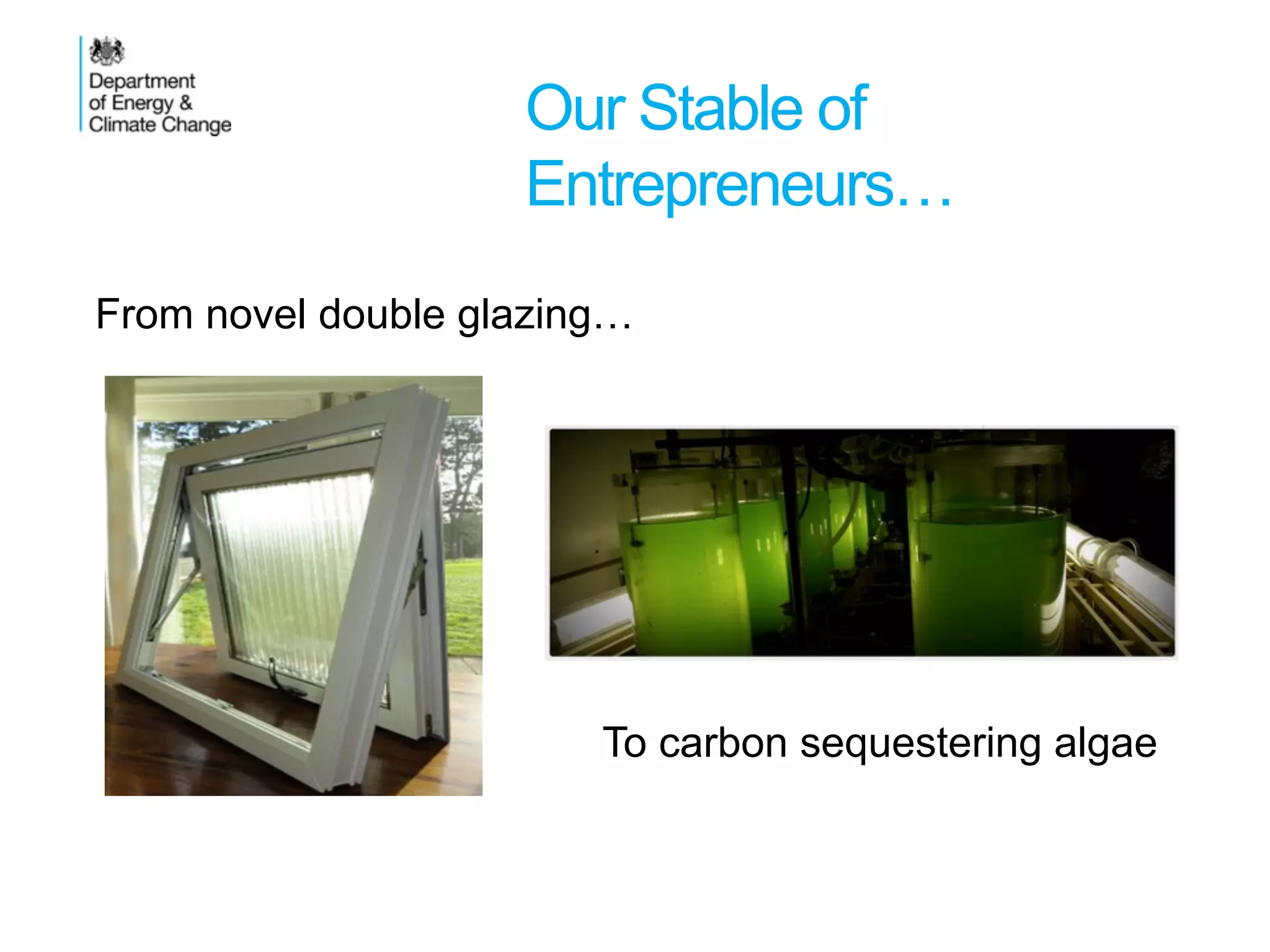
Our Stable of
Entrepreneurs…
From novel double glazing…
To carbon sequestering algae
Carbon Emissions Impacts of Wind Generation on GB electricity System
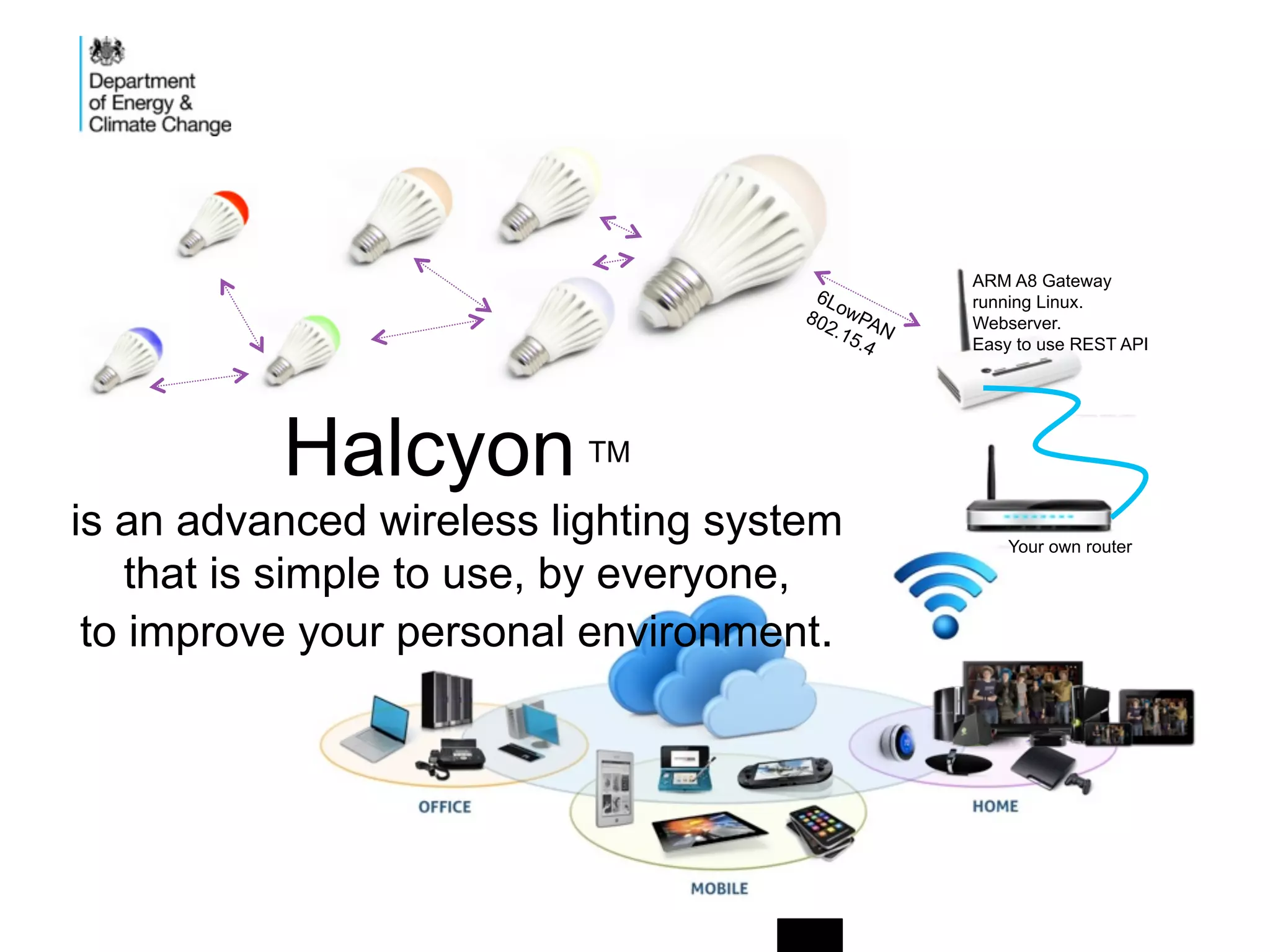
Halcyon TM
is an advanced wireless lighting system
that is simple to use, by everyone,
to improve your personal environment.
Your own router
ARM A8 Gateway
running Linux.
Webserver.
Easy to use REST API
UK Government see’s low carbon innovation as key
to achieving energy and growth objectives.
There are multiple public-sector backed bodies
providing broad programme of support.
We’ve been working to strengthen coordination
through the LCICG.
Collaboration between countries, companies,
universities is key to delivering the innovation we
need.
The key challenge as we prepare for the next
Spending review will be the need for prioritisation.
We have a framework to make those choices and
want to work closely with stakeholders to do so.
Summary
www.lowcarboninnovation.co.uk
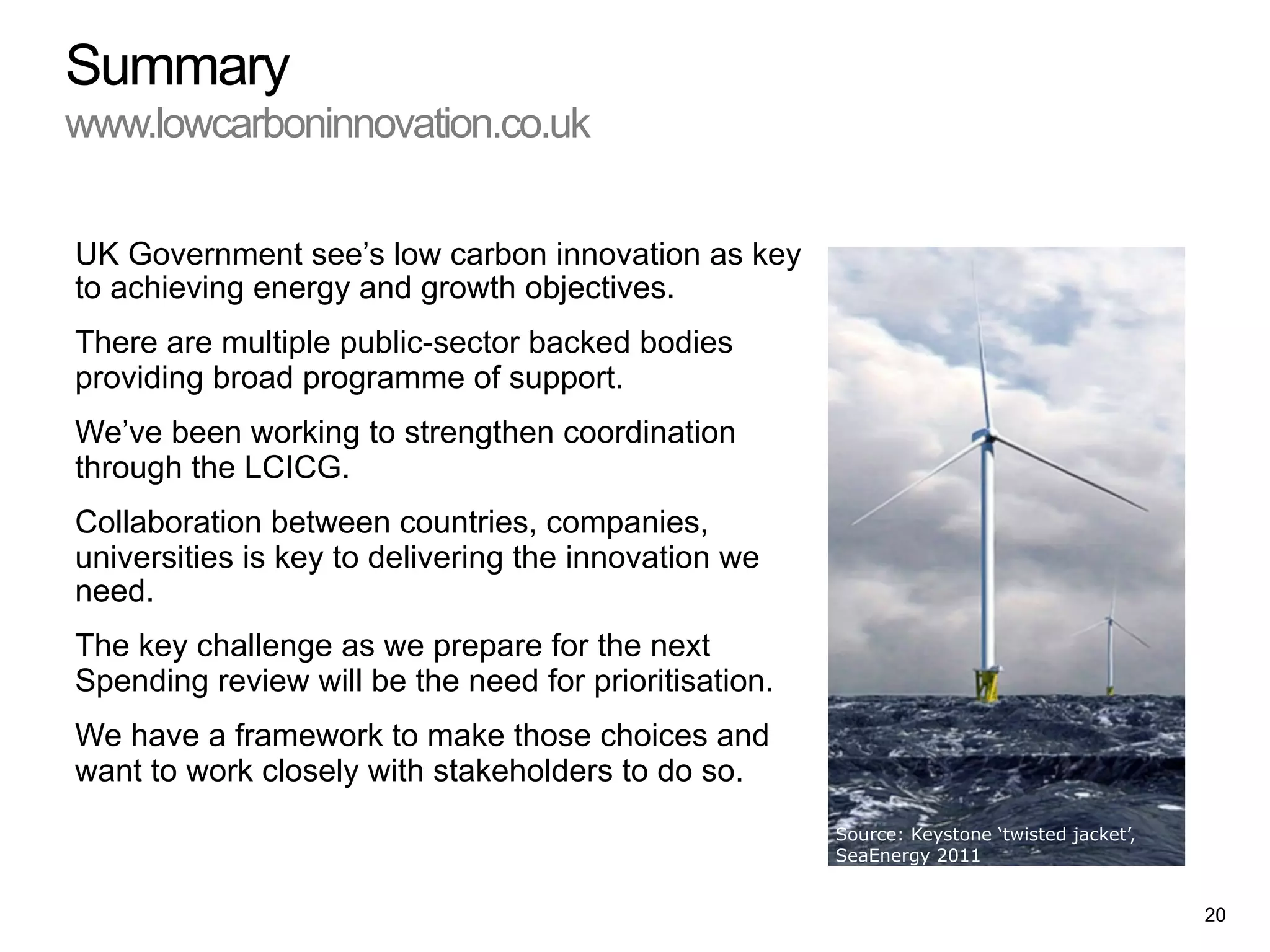
Source: Keystone ‘twisted jacket’,
SeaEnergy 2011
20
Thank you
ian.ellerington@decc.gsi.gov.uk
https://www.gov.uk/innovation-funding-for-low-carbon-
technologies-opportunities-for-bidders
21
Thank - you
Carbon Emissions Impacts of Wind Generation on GB electricity System
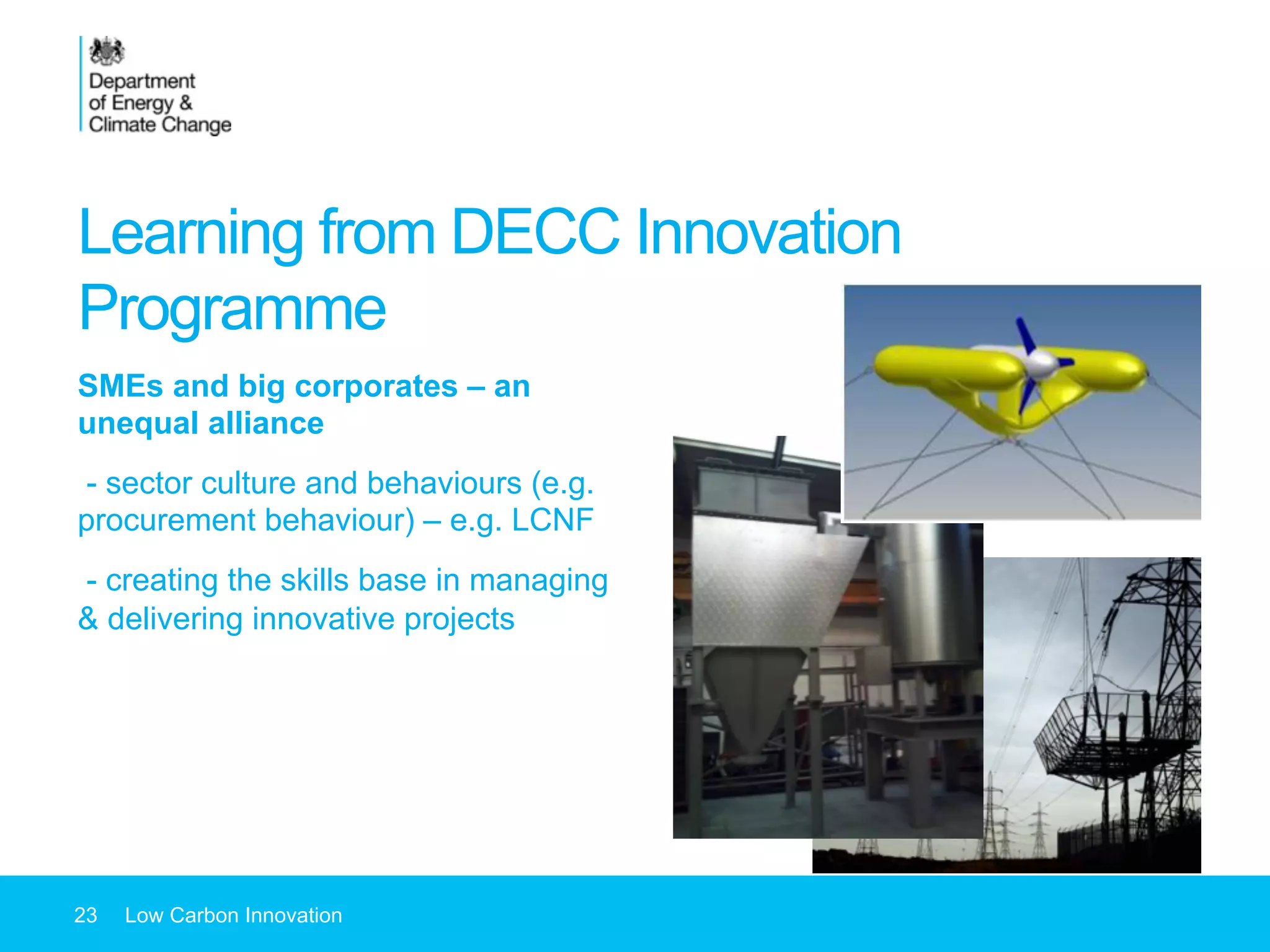
Learning from DECC Innovation
Programme
SMEs and big corporates – an
unequal alliance
- sector culture and behaviours (e.g.
procurement behaviour) – e.g. LCNF
- creating the skills base in managing
& delivering innovative projects
23 Low Carbon Innovation
24 Low Carbon Energy Innovation
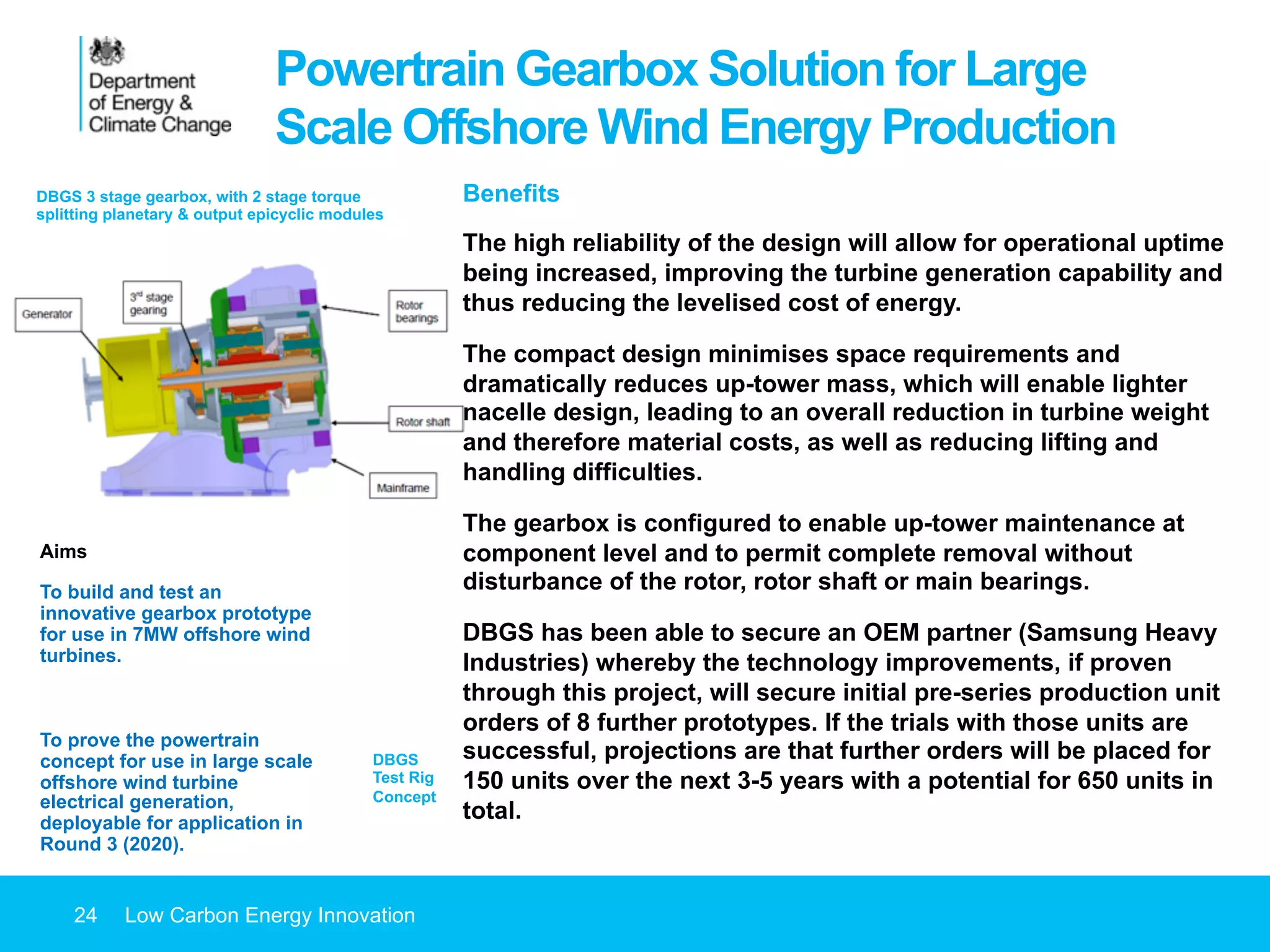
Powertrain Gearbox Solution for Large
Scale Offshore Wind Energy Production
Aims
To build and test an
innovative gearbox prototype
for use in 7MW offshore wind
turbines.
To prove the powertrain
concept for use in large scale
offshore wind turbine
electrical generation,
deployable for application in
Round 3 (2020).
Benefits
The high reliability of the design will allow for operational uptime
being increased, improving the turbine generation capability and
thus reducing the levelised cost of energy.
The compact design minimises space requirements and
dramatically reduces up-tower mass, which will enable lighter
nacelle design, leading to an overall reduction in turbine weight
and therefore material costs, as well as reducing lifting and
handling difficulties.
The gearbox is configured to enable up-tower maintenance at
component level and to permit complete removal without
disturbance of the rotor, rotor shaft or main bearings.
DBGS has been able to secure an OEM partner (Samsung Heavy
Industries) whereby the technology improvements, if proven
through this project, will secure initial pre-series production unit
orders of 8 further prototypes. If the trials with those units are
successful, projections are that further orders will be placed for
150 units over the next 3-5 years with a potential for 650 units in
total.
DBGS
Test Rig
Concept
DBGS 3 stage gearbox, with 2 stage torque
splitting planetary & output epicyclic modules
25 Low Carbon Energy Innovation
Carbon Capture and Storage
Aim:
The overarching aim of the NET Power
programme is to develop and
demonstrate a technology that will reduce
the cost of CCS so that it can be deployed
earlier and for lower cost that currently
projected.
Benefits
Development of a technology that will
enable widespread deployment of low cost,
highly efficient power plants with carbon
capture from fossil fuels
Development of manufacturing expertise in
the UK to supply advanced materials to the
power generation industry and future
commercial NET Power plants
Dramatically reduction of the costs currently
expected for the deployment of CCS
technologies

Sgcp14ellerington

  • 1.
    CIR Smart Gridsand Cleanpower Role of innovators in changing the industry IAN ELLERINGTON Head of Engineering and Innovation 4 June 2014 www.hvm-uk.com
  • 2.
    Agenda •  Introduction •  Whatis innovation? •  Why is innovation important? •  Some examples… 2 Presentation title - edit in Header and Footer
  • 3.
    DECC Innovation andEngineering Teams Major programmes 3 Low Carbon Energy Innovation Innovation Policy Co-ordinating innovation spend in energy across government, not just DECC (DECC is about 20% of total) Monitoring, designing and evaluating innovation schemes Owning and developing TINAs Europe engagement Innovation Delivery Project management/delivery unit Approx 160 contracts and grants, inc. around 60 SMEs, Very wide range from nuclear reactors to innovative biomass recycling to lightbulbs
  • 4.
    Science and EngineeringTeams (2) 4 Low Carbon Energy Innovation Energy Engineers Central engineering experts Support CSA and policy teams on very wide range of subjects – core focus on energy infrastructure Support to innovation programme Technical Energy Analysis Central engineering and science experts Core focus on issues around the built environment Own R&D programme supporting a range of DECC policies
  • 5.
    5 Presentation title- edit in Header and Footer
  • 6.
    The Energy Trilemma- We face a “trilemma” of objectives 6 Low Carbon Energy Innovation Security of supply Low carbon? Low Emissions? Low life cycle? Over what time? Interconnectors Trading Balancing, markets •  Total bill is rate + use •  Grid is half of electricity bill – what is it for?
  • 7.
    What is innovation? Governmentspend is around £1billion on Energy Research, Development and Demonstration… In addition, subsidies support pre-commercial deployment… 7 Presentation title - edit in Header and Footer
  • 8.
    8 Low CarbonEnergy Innovation Mitigate perceived technical, market & financial risks Pilot Scale Demonstrator Technology Considered “Commercially Proven” Pre-Commercial Full-Scale Implementation New Ideas Feedback of R&D needs Demonstration Deployment Research & Development Applied R&D to address technical issues Technology Push ... … Market Pull Basic R&D: Ÿ speculative, science led Ÿ industry needs led Innova&on  is  o*en   presented  as  a  chain   and  feeding  back   learning  to  support   future  technology   development  is   essen&al.     Technology development cycle
  • 9.
    9 Low CarbonEnergy Innovation •  Three objectives for low carbon innovation: •  Contribute directly and indirectly to economic growth •  Secure, Affordable, Sustainable Energy •  Reducing risks and costs •  UK’s Climate Change Act - reduce GHG emissions by at least 80% below 1990 levels by 2050. •  Massive investment predicted in new energy infrastructure – c.£120bn by 2020. •  DECC Carbon Plan 2011 – between 60-80GW of new capacity required by 2030. Replacing and upgrading electricity infrastructure could require around £110bn of capital investment between now and 2020 Electricity generation £123bn Electricity grids £26bn Nuclear decommissioning + storage £12bn Gas grids £16bn The UK needs to replace its ageing energy infrastructure, and do this at affordable cost The Importance of Innovation
  • 10.
    10 Low CarbonEnergy Innovation How we support energy innovation Technology  ‘push’:  direct  funding  such  as  grants       •     For  research  &  development   •     For  demonstra7on   Market  ‘pull’:  indirect  funding     •     Market  adjustments  to  support  par7cular  technologies              (e.g.  feed-­‐in  tariffs,  the  renewables  obliga7on)   •     Ensure  electricity  prices  reflect  carbon  savings        (e.g.  emissions  trading) Remove  barriers  to  technology  development   (e.g.  resolve  planning  and  grid  issues  in  advance;  or  support  for   innova7ve  companies) 1   2   3  
  • 11.
    11 Low CarbonEnergy Innovation UK Public-sector Support for Low Carbon Innovation Core LCICG Members Associate LCICG Members UK public backed bodies investing in excess of £1bn in low carbon innovation (2011-2015)
  • 12.
    12 Low CarbonEnergy Innovation Prioritising our support LCICG’s Technology Innovation Needs Assessments •  The TINA project highlights the innovation needs of those technologies likely to be most important in delivering our energy and climate change targets. •  TINAs create a common understanding of innovation needs and the case for support, to facilitate coordinated planning between LCICG members and with developers. CCS Offshore Wind Marine Domestic buildings Non- domestic buildings Nuclear Electricity networks & storage Heat Bio-energy Industrial energy efficiency Hydrogen 11 TINAs - 10 published and further 1 to be completed by summer 2014.
  • 13.
    LCICG’s Low CarbonInnovation Strategy •  “Coordinating Low Carbon Technology Innovation Support” , published in February 2014. •  A shared cross government view on innovation priorities out to 2020. •  A guide to what we will be focusing our support on in the next 6 years. •  The Strategic Framework sets out the LCICG’s planned approach to collaboration and the prioritisation of future innovation support programmes. •  It builds on the TINA evidence base, it also presents a shared assessment of the key innovation needs that will likely require government support between now and 2020. www.lowcarboninnovation.co.uk/ 13 Low Carbon Innovation
  • 14.
    14 Low CarbonEnergy Innovation DECC’s £180m innovation programme ‘late-­‐stage’  support   bridges  the  Valley  of  Death   between  development  and   deployment     Many  beneficiaries   Supports  150+  companies   including  60+  SMEs   AFracts  private  funds   Expected  to  leverage   several  hundred  million  of   private  sector  investment   0 10 20 30 40 Buildings energy savings Offshore wind component technologies 1st array wave/tidal CCS Power generation Bioenergy project DECC innovation allocated budgets (2011/12-2014/15) (£m) Also,  collabora7ve  contribu7ons  for  bioenergy  &  nuclear  supply  chain  
  • 15.
    Innovation spending 2011-15 15Low Carbon Innovation Offshore Wind, (cost reduction mainly), – up to £30m Marine Energy – up to £20m Carbon Capture and Storage – up to £20m Fuel Cells - up to £5m Waste and Biomass Conversion – up to £10m Buildings Innovation – up to £35m Electricity Storage – up to £20m (Renewable Hydrogen Production included above) Entrepreneurs Fund: Power Technologies – up to £15m Future Nuclear – up to £5m
  • 16.
    16 Low CarbonEnergy Innovation International collaborations •  UK investment alone won’t deliver. Collaboration with other countries is key. •  The EU’s Strategic Energy Technology (SET) Plan is doing just that. •  The SET Plan is the technology pillar of the EU’s energy and climate policy. It is the principal decision-making support tool for European energy policy, with a goal of: •  Accelerating knowledge development, technology transfer and up-take; Maintaining EU industrial leadership on low- carbon energy technologies; […] and contributing to the worldwide transition to a low carbon economy by 2050. •  In each technology a Roadmap and Implementation Plan has been developed and is informing national and EU investment decisions. •  An integrated Roadmap and Action Plan are under development.
  • 17.
    Example – EnergyEntrepreneurs’ Fund and the Energy Catalyst •  Broadest  innova7on  programme   •  CO2  reduc7on   •  Commercial  poten7al   •  Value  for  money   •  UK  enterprise  and  growth   •  Targeted  to  reach  small  innova7ve   enterprises  (although  not  exclusive)   •  We  assess  technical  and  commercial   poten7al   •  Real  commercial  partners  involved  in   evalua7on  to  encourage  investment   •  Need  to  iden7fy  business  needs  as  well  as   technical  poten7al     See:  www.lowcarbonfunding.org     17 Low Carbon Innovation
  • 18.
    Our Stable of Entrepreneurs… Fromnovel double glazing… To carbon sequestering algae Carbon Emissions Impacts of Wind Generation on GB electricity System
  • 19.
    Halcyon TM is anadvanced wireless lighting system that is simple to use, by everyone, to improve your personal environment. Your own router ARM A8 Gateway running Linux. Webserver. Easy to use REST API
  • 20.
    UK Government see’slow carbon innovation as key to achieving energy and growth objectives. There are multiple public-sector backed bodies providing broad programme of support. We’ve been working to strengthen coordination through the LCICG. Collaboration between countries, companies, universities is key to delivering the innovation we need. The key challenge as we prepare for the next Spending review will be the need for prioritisation. We have a framework to make those choices and want to work closely with stakeholders to do so. Summary www.lowcarboninnovation.co.uk Source: Keystone ‘twisted jacket’, SeaEnergy 2011 20
  • 21.
  • 22.
    Thank - you CarbonEmissions Impacts of Wind Generation on GB electricity System
  • 23.
    Learning from DECCInnovation Programme SMEs and big corporates – an unequal alliance - sector culture and behaviours (e.g. procurement behaviour) – e.g. LCNF - creating the skills base in managing & delivering innovative projects 23 Low Carbon Innovation
  • 24.
    24 Low CarbonEnergy Innovation Powertrain Gearbox Solution for Large Scale Offshore Wind Energy Production Aims To build and test an innovative gearbox prototype for use in 7MW offshore wind turbines. To prove the powertrain concept for use in large scale offshore wind turbine electrical generation, deployable for application in Round 3 (2020). Benefits The high reliability of the design will allow for operational uptime being increased, improving the turbine generation capability and thus reducing the levelised cost of energy. The compact design minimises space requirements and dramatically reduces up-tower mass, which will enable lighter nacelle design, leading to an overall reduction in turbine weight and therefore material costs, as well as reducing lifting and handling difficulties. The gearbox is configured to enable up-tower maintenance at component level and to permit complete removal without disturbance of the rotor, rotor shaft or main bearings. DBGS has been able to secure an OEM partner (Samsung Heavy Industries) whereby the technology improvements, if proven through this project, will secure initial pre-series production unit orders of 8 further prototypes. If the trials with those units are successful, projections are that further orders will be placed for 150 units over the next 3-5 years with a potential for 650 units in total. DBGS Test Rig Concept DBGS 3 stage gearbox, with 2 stage torque splitting planetary & output epicyclic modules
  • 25.
    25 Low CarbonEnergy Innovation Carbon Capture and Storage Aim: The overarching aim of the NET Power programme is to develop and demonstrate a technology that will reduce the cost of CCS so that it can be deployed earlier and for lower cost that currently projected. Benefits Development of a technology that will enable widespread deployment of low cost, highly efficient power plants with carbon capture from fossil fuels Development of manufacturing expertise in the UK to supply advanced materials to the power generation industry and future commercial NET Power plants Dramatically reduction of the costs currently expected for the deployment of CCS technologies